Feeds:
Posts
Comments

When Hurricane Katrina made landfall on August 29, 2005, it resulted in the deaths of nearly 1,400 people, destroyed property and upended the lives of tens of thousands of others, none more than one Ashton R. O’Dwyer, Jr.

The radical changes to O’Dwyer’s life didn’t actually begin until three weeks later, at five minutes after midnight on September 20, but the change – and his fall from grace – was fast and furious. Literally.

What he described, and continues to describe, as gross negligence by the U.S. Army Corps of Engineers and the State of Louisiana “through various agencies, instrumentalities and political subdivisions,” caused 80 percent of the homes and businesses in New Orleans to flood.

AROD, as he refers to himself, at the time was a respected partner in the New Orleans law firm of Lemle & Kelleher. He specialized in admiralty and maritime law. He decided to remain on his property “in order to protect what belonged to him,” according to court records, because his property, at 6034 St. Charles Ave. in the uptown section of New Orleans, was “high and dry” and undamaged by the storm. Moreover, he had a generator “and sufficient food and water to provision a small army.”

Because St. Charles Avenue did not flood and since it provided access to both U.S. 90 and I-10, and because his home was located on one of the main thoroughfares in and out of New Orleans, journalists traveled the route extensively during their coverage of the carnage. They would see O’Dwyer clearing debris from his and neighbors’ yards and the neutral ground along St. Charles in front of his house and stop to interview him.

In a tongue-in-cheek gesture, he devised a spoof based on the Peter Sellers movie The Mouse that Roared and “seceded” from the U.S., the State of Louisiana and the City of New Orleans and declared his property as “sovereign territory,” more particularly the “Duchy of Kilnamanagh,” (which, in fact, is the geographic area within County Tipperary in the Province of Munster “on the Emerald Isle whence the O’Dwyer Sept sprung”).

O’Dwyer’s fate was sealed when, on September 19, he drove to Baton Rouge where the Eastern District Federal Cout was temporarily headquartered and filed the very first “Victims of Katrina” lawsuit against the United States of America, the State of Louisiana, the governor, the City of New Orleans, the New Orleans mayor, the Orleans Levee Board, the Sewerage & Water Board and others.

Twelve hours later, at five minutes after midnight, the fecal matter hit the proverbial oscillating air circulation device. As he sat at a table in his driveway watching the news on television, a “goon squad” of Louisiana State Troopers DESCENDED ONTO HIS PROPERTY, “abducted him and transported him to a temporary jail facility that became known as Camp Amtrak,” he wrote in documents filed with the U.S. Fifth Circuit Court of Appeals, a court he has come to refer to as the “Fifth Circus.”

At Camp Amtrak, he was “brutalized and tortured” by Louisiana Department of Public Safety and Corrections prison guards from the Louisiana State Penitentiary at Angola who kept him in custody for the next 16 ½ hours where he was pepper-sprayed more than three dozen times and shot 12 times in both lower extremities at point-blank range (from two feet away) with a 12-gauge shotgun loaded with beanbag rounds.

Was the ABDUCTION of O’Dwyer from his property (without a warrant, no less) and his subsequent incarceration and physical abuse for 16 ½ hours somehow connected to that lawsuit he had filed earlier in Baton Rouge?

For that answer, we’ll let you connect the dots.

Documents filed by O’Dwyer in federal court said his life began to unravel when what he described as a “cabal,” led by Federal Judge Stanwood Duval, conspired against him in order to promote their own $400 billion Katrina lawsuit against the U.S. Corps of Engineers that, it turned out, was rife with major conflicts of interest.

The “cabal” members, O’Dwyer said in filings, were signatories to a document entitled “Levee Breach Litigation Group Co-Counsel Agreement” and to a similar document for the “MRGO (Mississippi River Gulf Outlet) Litigation Group” by terms of which the signatories agreed to share legal fees with each other. Those signatories, he said, included Joseph Bruno (later appointed by Duval as “Plaintiffs Liaison Counsel” for all Katrina tort cases), Denham Springs attorney Calvin Fayard (the lead counsel for the MRGO litigation Group and likewise named by Duval to head the Insurance Committee), Danny Becnel and others.

O’Dwyer would not learn until much later that those attorneys had entered into an agreement with then-Attorney General Charles Foti, Jr., to “secretly represent the interests of the State of Louisiana, its agencies, instrumentalities and political subdivisions for the presentation of a tort claim on behalf of the State, et al, and against the U.S. Corps of Engineers, in the amount of $200 billion (later increased to $400 billion).”

O’Dwyer stressed that, “The existence of the agreement was not disclosed to the other litigants or to their attorneys…until the second anniversary of Katrina, August 29, 2007.”

The cabal’s strategy,” O’Dwyer said, was laid out when Duval traveled as Fayard’s guest to the LSU-Alabama football game in Tuscaloosa, Alabama, in November 2005. Duval, O’Dwyer pointed out, never disclosed the trip to Katrina litigants or their attorneys –some might describe that as an ex parte (one-sided) communication between a judge and a litigant, a legal no-no. Nor did Duval report the all-expenses-paid trip on his federal financial disclosure form as required (he would later claim “inadvertence” for the omission).

Also making that same expenses-paid trip were Duval’s wife who was also his law clerk and his “other” law clerk, who just happened to be Fayard’s daughter, Caroline, who organized the trip.

But back to that second anniversary of Katrina on August 29, 2007. Even as Fayard et al were refining their lawsuit, Duval was unceremoniously and summarily dismissing O’Dwyer’s lawsuit without so much as bothering to hear oral arguments, much less any discovery on the merits of the lawsuit he had filed on behalf of some 2,000 Katrina victims.

“In other words,” asserted O’Dwyer, Duval “engaged in a persistent course of conduct in the litigation to attempt to ‘feather the nest’ of his close personal friend of long-standing, Fayard, and was biased and prejudiced in favor of Fayard…”

Duval even went so far in February 2007 as to sanction O’Dwyer for “harassment” of the State of Louisiana (Fayard’s secret client at the time).

But then the unthinkable occurred when it was ruled that the United States, through the Corps of Engineers, was immune from being sued over the levee’s failure. That left only one obvious defendant – the State of Louisiana, and because Foti, as attorney general is constitutionally required to defend the State, it became an inconvenient – and obvious – conflict of interest for the State to be named as a defendant in their lawsuit.

A flurry of legal back-and-forth then ensued the details of which would only make a reader’s head hurt but the eventual upshot was:

  • Judge Ivan Lemelle’s finding O’Dwyer in contempt and hitting him with a principal default judgment of $90,831.57, prejudgment interest of another $24,304.14, plus $150.56 per day from and including June 12, 2009, plus attorney’s fees in the amount of one-third of the principal and prejudgment interest, and for post-judgment interest on the principal sum and attorney’s fees;
  • Lemelle’s recommendation that O’Dwyer be suspended and disbarred;
  • Katrina victims were left holding the proverbial bag because of the failure of the “cabal” to name the state as a defendant;
  • The eventual settlement of $21 million, of which $3.5 million went to attorneys’ fees, $13.5 million for “reimbursable” costs incurred by attorneys, and settlement checks as small as $2.50 for some Katrina claimants.

O’Dwyer subsequently attempted in vain to learn or obtain:

  • The actual sum of money was made available for distribution to claimants;
  • A spreadsheet that identified the sum of money that each claimant received;
  • The actual sum of money that the lawyers received and the amount of money that each lawyer or firm received;
  • The amount the Special Master received;
  • How much demographer Gregory Rigamer or his companies, GCR, Inc., of Gregory C. Rigamer & Associates received;
  • What the administrative costs were – and who received what amounts;
  • Documentation for the assertion that the plaintiffs’ lawyers in the levee cases actually spent $13.5 million in reimbursable costs, and
  • How much lawyers in the MRGO Litigation Group (as opposed to “levee” lawyers) received.

None of O’Dwyer’s requests for the foregoing information has been responded to and the information remains unavailable to the public.

All of the event described above, he said, began less than two weeks after Katrina struck New Orleans when Louisiana Supreme Court Associate Justice (later Chief Justice) Catherine “Kitty” Kimball, Charles B. Plattsmier, Jr. (chief disciplinary counsel of the Louisiana Attorney Disciplinary Board) and then-Attorney General Charles C. Foti, Jr., “among other co-conspirators,” met in Baton Rouge on Sunday, September 11, 2005. During that meeting, O’Dwyer says, Kimball said to those present, “Somebody’s got to shut that guy (O’Dwyer) up. He’s giving us all a bad name.”

As the direct result of what he describes as a “reign of terror” unleashed against him, O’Dwyer lost his law partnership, his law license, his home and his marriage of more than 40 years, his 380-SL Mercedes and all his financial resources. He was criminally prosecuted for two years (that was the only battle he eventually won) and even spent 34 days in solitary confinement and prolonged home confinement. Through all his travails, however, he has somehow retained his dignity.

UP NEXT: How O’Dwyer’s multitude of problems, though unrelated and decades apart, dovetailed with the legal entanglements that the embattled Archdiocese of New Orleans now finds itself in with its ongoing child sex abuse litigation.

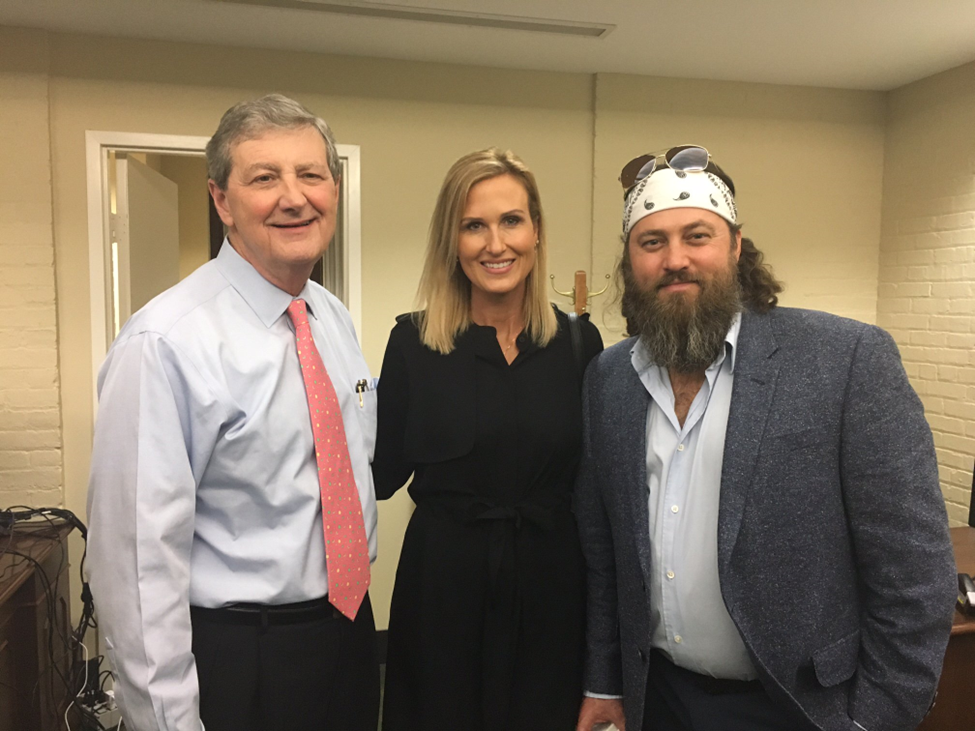
I don’t know about you, but my attention is going to be on Louisiana Sen. John Kennedy during the upcoming confirmation hearings on some of Donald Trump’s cabinet nominees.

Kennedy’s pretty good at getting out in front of the crowd in his attempts to appear wise and all-knowing, but I’m going to be look for some consistency in his questioning of some of these nominees.

I concurred with him in one rare case when he took President Biden’s nominee for a U.S. District judgeship in Colorado to task for his lack of basic knowledge of the Brady motion.

The Brady motion is only the legal concept which holds that the prosecution must hand over potentially favorable (exculpatory) evidence to the defense in a criminal trial. Any fan of the movie My Cousin Vinny knows that.

But Biden’s nominee, KATO CREWS, who had served more than four years as a magistrate judge, did not.

Any first-year law student should know that but Crews thought it involved “something regarding the Second Amendment.”

Kennedy loves playing cat and mouse with witnesses in order to advance his own agenda.

It’s going to be interesting to see how he questions Matt Gaetz (attorney general) or Kristy Noem (Homeland Security) or Robert F. Kennedy, Jr. (Health and Human Services) during their CONFIRMATION HEARINGS.

I’m betting it will be much different. I predict a gentler, kinder John Neely Kennedy – one with kid gloves.

After four-and-one-half years of foot-dragging, $40 million in legal and professional fees and little progress toward a resolution, events in the Catholic Church’s New Orleans Archdiocese appear to be suddenly moving at warp speed, including rumors of a pending high-level (as in the highest local level) retirement

Abuse survivors, some 500 or so of them, have filed a response to the court-appointed expert’s REPORT filed on October 21 that contain a few surprises, including a call that Archbishop Gregory Aymond be deposed along with a “corporate representative” of the archdiocese (other than Aymond), expert Mohsin Meghji and the husband-wife team of Wayne and Susan Zeringue.

Early word is that Aymond will refuse to cooperate on any proposed deposition and if ordered to participate, is expected to plead the Fifth Amendment on the basis of the ongoing criminal investigation into possible sex-trafficking by the church.

But the biggest surprise (though not really a surprise to some) is that Aymond may well announce his retirement in the coming days, perhaps as early as tomorrow (Thursday). That would follow the national trend of retiring bishops and archbishops in the wake of the wave of sexual abuse litigation that has spread from Boston to Los Angeles and points between.

Here is Meghji’s 35-page report, for which he was paid $350,000, or $10,000 per page:

One person who read the report said he was not impressed with Meghji’s work. “I’d like the opportunity to compare this Report with other Reports that Meghji has generated in other cases, and with similar Reports by other ‘experts’ that were generated in other Catholic Church bankruptcy cases across the country,” he said.

“Meghji’s Report is exactly what one should have expected as ‘an opening salvo’ from a ‘numbers cruncher’ or ‘bean counter.’ Note that on page three, Meghji states: ‘…an analysis of the underlying facts, claims, defenses or other factors related to the hundreds of sexual abuse proofs of claim asserted against the Debtor is beyond the scope of this Report.’ Translated into plain English from mediator language this means: ‘FACTS BE DAMNED; let’s start talking numbers,’ because the numbers are all that matter. ‘How much have you got? What are you willing to take?’

“Generally, in mediation-speak, it takes at least 15 minutes or so to reach this point, which will drive the discussions until the end of the process. Meghji cut to the chase in just a few pages. For this case to settle, the archdiocese and the apostolates will have to identify and be prepared to liquidate vast real estate holdings that have not yet been identified and valued accurately. If you represented an insurer of the church, would you pony up hundreds of millions of dollars in cash (that rightfully belongs to your shareholders) before the church and its apostolates have accurately identified and valued their real estate holdings, much of which will have to be liquidated via sales to third parties before any Survivor Trust can be funded and settlement reached?

“As I read Meghji’s Report, I couldn’t help but conclude that the man (who is under INVESTIGATION for having engaged in at least one attempt to curry favor so he could exercise undue influence with at least one official, namely a Texas bankruptcy court judge, who recently resigned from the bankruptcy court bench in Houston, but only after the same Judge had approved a large loan by the debtor in a bankruptcy case that benefitted Meghji directly) has an agenda.”

Here is the full seven-page response filed on Monday:

Funny thing about Meghji’s report is that nowhere in that October 21 report does he mention a mediation, apparently scheduled for November 5. Yet, the archdiocese’s insurer certainly got wind of such a mediation and on November 1 fired off a letter to bankruptcy judge Meredith Grabill requesting a seat at the table. Here is that letter:

So, why do the plaintiffs want both Zeringues deposed? Well, as LouisianaVoice pointed out on OCTOBER 1, Susan Zeringue is the executive counsel for the archdiocese, having replaced Wendy Vitter, wife of former U.S. Sen. David Vitter, upon Wendy Vitter’s confirmation as a federal district judge for Louisiana’s Eastern District.

Susan Zeringue was instrumental, as the top legal advisor for the archdiocese, in the hiring of New Orleans law firm Jones Walker to defend the archdiocese bankruptcy litigation. Her husband, Wayne, is a partner in the Jones Walker firm and among the Jones Walker invoices for services to the archdiocese were 11.8 hours charged by Wayne Zeringue – for communications with his wife – pillow talk, as one observer called it, at a rate of $400 per hour.

The problem with that is that Wayne Zeringue’s field of expertise is in maritime law. He has zero experience as a bankruptcy attorney. But what’s the harm of a little hint of nepotism as long as you keep it in the family?

The lawsuits thus far have generated only delay, delay, delay – and $40 million in legal and other expert fees – money that will go to the hired guns in suits while 500 alleged victims continue to wait.

And the meter’s still running…

Here’s LSU Coach Brian Kelly in his post-game press conference as he discusses the Tigers’ chances of making the 2024 NCAA playoffs:

PLAYOFFS?

…Oops, sorry, that was another coach at another time and place.

But, hey! It could well have been Kelly after LSU’s humiliating loss to ‘Bama in Tiger Stadium last Saturday – especially after top honchos at the Ole War Skule cratered to a two-bit politician’s demands that a live tiger, albeit not Mike VII, but a borrowed (or rented) cat from Rhonda Santis’s state of Florida, be ushered into the stadium before adoring (a better word being sympathetic) LSU fans.

Could it possibly get any worse?

Well….yes, it can.

U.S. District Judge John deGravelles on Tuesday, in a 177-page decision, figuratively knocked over the easel that Landry intended to use to display the TEN COMMANDMENTS in each and every public classroom in Louisiana.

Saying that posting the commandments would make children a “captive audience” (sort of like 100,000 LSU fans jammed into Tiger Stadium last Saturday night), the judge said the law was “facially unconstitutional,” adding that Louisiana’s law was in direct conflict with a 1980 U.S. Supreme Court decision that struck down a similar law in Kentucky.

Landry’s sock puppet Attorney General Liz Murrill said that while the disastrous Alabama decision is final now that the loaner tiger has been returned to Florida, the state would “immediately appeal” deGravelle’s preliminary injunction, saying, “We strongly disagree with the court’s decision.”

Of course, she does and of course there will be an appeal.

How else can all those attorneys who contributed to the campaigns of her and her boss earn their fees? They’re gonna reap financial windfalls litigating this issue for years to come.

Wait. You mean you actually thought those campaign contributions were made to advance good, clean, honest government? That’s so cute. You probably learned that in high school civics (if they even still teach that). But this is the real world.

The tangled web of sex abuse litigation and possible child sex trafficking involving the Archdiocese of New Orleans is a holy mess (no pun intended) that has reverberations all the way to the Vatican.

Oddly enough, some of the claims of ex parte meetings and furtive plots date to the 2009 disbarment of New Orleans attorney Ashton O’Dwyer. Both issues, though completely unrelated on the surface, share an ugly history that goes all the way back to the aftermath of Hurricane Katrina in 2005

Throw in the Louisiana Supreme Court’s assignment of the state’s 5th Circuit Court of Appeal (not to be confused with the U.S. 5th Circuit Court of Appeals) to investigate itself over Pro Publica’s devastating Exposé of the its alleged MISHANDLING OF PRO SE APPEALS of their convictions by prison inmates and you have a story line that seems more appropriate for a John Grisham novel than a real-life court system in total disarray.

The state’s 5th Circuit, to no one’s surprise, unanimously adopted an en banc (full court) resolution on Sept. 9, 2008, in response to Pro Publica’s story. In that resolution, the court completely and calmly – and apparently with a straight face – absolved itself of any wrongdoing in the handling of 454 prisoner appeals over a three-year period.

But as bad as the apparent dereliction of duty on the part of the state 5th Circuit judges appeared to be in that story, it pales in comparison to what has transpired and continues to occur in the sex abuse case against the Catholic Church – not only in New Orleans but world-wide.

The focus of this story, however, is on the New Orleans Archdiocese and the claims of more than 500 men who are claiming they were sexually abused by priests, nuns and staff at Catholic churches, schools and residential homes for children.

And many of the same names that were involved in the beating and tasing of Ashton O’Dwyer in 2005 and his subsequent disbarment are the same ones who surface on the Catholic church litigation and O’Dwyer doesn’t think it’s by coincidence.

So, let’s start with PART ONE and work our way forward.

First, we go back to 2004 when Shell Oil Co.’s Norco refinery allegedly produced contaminated gasoline that ended up damaging the fuel gauges and “inter alia” (among other things) on motorists’ vehicles.

The result was a settlement by Shell the following year for $3.7 million to cover damages.

But the kicker was that presiding Federal District Judge Ivan L.R. Lemelle more or less took it upon himself, in an ex parte hearing, to appoint a five-member fee committee which recommended an allocation of nearly half of the $6.875 million in attorneys’ fees to the five members of the fee committee and their law firms. None of the other 74 attorneys who worked on the case were notified of the hearing on the fee committee’s recommendation nor were they shown the allocation proposal or the proposed order approving the committee’s fee share designation.

The five attorneys were John Barrett of Lexington, Mississippi; Ben Barnow of Chicago, Illinois; Patrick Geraghty of Fort Myers, Florida; Walter Dumas of Baton Rouge and Richard Arsenault of Alexandria

Besides the appearance of lawyer overkill with the involvement of 32 firms and 79 attorneys, there were a couple of problems with that. First, ex parte (Latin for one side only), defined as any communication between a judge and one party to a case either without the knowledge or consent of all parties or without proper notice to all parties, is prohibited.

Second, Judge Lemelle approved the committee’s self-serving recommendations which caused other involved attorneys to complain of being short-changed for their services (for example, one firm claimed fees of more than $114,000 but received just $33,000).

Third, Lemelle ordered that his approved fee structure be paid out immediately, with no opportunity for objections.

Forth, the judge ordered the record sealed so as to “prevent lawyers from fighting over awards that they could not compare,” according to the subsequent ruling by the U.S. Fifth Circuit Court of Appeals which said that Lemelle went beyond his scope of authority practically every step of the way in his decision on the Shell fee allocation.

(Click on the + sign below to enlarge print)

(Click on the + sign at the top to enlarge print

and slide bar at bottom to the right to see entire document)

Lemelle, however, was never sanctioned nor otherwise reprimanded over his holding the ex parte meeting with the five plaintiff attorneys so there was little incentive for him to alter his behavior on the bench.

That same mindset prevailed when it came to his treatment of Ashton O’Dwyer’s case before him three years later, in 2008, and again the following year in which Lemelle called first for the suspension and then the disbarment of O’Dwyer.

But first, one has to go back to August 29, 2005, when an unwelcome visitor named Katrina blew into New Orleans and set into motion attorney O’Dwyer’s battle with the judicial and bar establishments which led in turn to his eventual downfall.

NEXT: How O’Dwyer’s class-action lawsuit on behalf of Katrina victims resulted in an ex parte meeting about how to deal with him and how those meetings set in motion a series of judicial rulings that not only destroyed his career and personal life, but also set the stage for the current legal crisis with the New Orleans Archdiocese sex abuse scandal.