Feeds:
Posts
Comments

Well, he’s an avowed supporter of Yam-Tits Trump and Brain-Worm Kennedy, Jr., so you might expect him to skirt Louisiana’s toothless ethics laws to enrich himself through his position as chairman of the State Senate Health and Welfare Committee.

And he does.

State Sen. Patrick McMath (R-Covington) is owner of Southern Interior Solutions and his store has won bids to provide furnishings for health systems affected-and regulated-by his committee, according to a New Orleans TV station.

Trump has never let ethics—or the courts, for that matter—stand in the way of his making a buck off his presidency, so why should McMath be expected to play by the rules, especially when those rules provide a convenient loophole in the state ethics laws?

No less authority than the LOUISIANA BOARD OF ETHICS itself says in its Summary of the Louisiana Code of Governmental Ethics that “The Ethics Code provides an additional prohibition applicable to legislators, certain executive branch officials, their spouses, or legal entities in which either owns an interest in excess of 5% from entering into a contract with any branch, agency, department, or institution of state government, with a few specific exceptions.

“Example: A Louisiana Senator and his business were prohibited by Section 1113D from bidding on or entering into a contract with the Louisiana Recovery School District, provided the Senator owned an interest greater than 5% in the business. (Advisory Opinion No. 2010-988).”

The Baton Rouge Advocate on Wednesday (sorry, we can’t share it because the publication has a paywall to its online stories, most of which lately have been devoted to LSU football and the transfer portal) pointed out that historically, Louisiana legislators have promoted legislation that benefitted their own personal businesses. “[L]awmakers who own nursing homes have sought to ease their legal liability in cases of understaffing, lawmakers who own gas stations have pushed bills to sideline their competitors, lawmakers who own timber companies have proposed sales tax exemptions for their products,” The Advocate story said.

In addition, legislators who are attorneys representing specific industries, such as insurance or oil and gas, for instance, have shown little hesitancy to pull double duty by jumping into the legislative fray.

But thanks to Govs. Bobby Jindal and Jeff Landry, Louisiana ethics laws have been so watered down as to be virtually meaningless. Oh, elected officials and public employees must still take a so-called “ethics course” yearly but its enforcement powers are a cruel joke to good-government advocates.

That’s precisely why McMath can serve as chairman of a powerful committee and sell furniture to entities regulated by his committee: the law prohibits lawmakers from “contracting” with state government and selling furniture is technically not a “contract.”

The owner of a competing furniture store told WWL-TV that he was told by a person at a local (St. Tammany Parish) health system that they were replacing his company with Southern Interior Solutions because they were “instructed to use SIS.”

So, while the letter of the law does not appear to be violated, there’s no question that the spirit of the law is in open violation despite McMath’s admission that certain boundaries do exist and his assertion that “I take those boundaries serious, and I’ve stayed within them.”

And like Trump, he appears to have been unable resist twisting the knife a bit: “I also understand why competitors who are losing business might be frustrated. But frustration isn’t an ethics standard. We compete on price, service, and performance — and we win on those terms.”

Yep. Republican to the core.
Accreditation.

There is so much about that word that the average person has so little knowledge about.

What does accreditation mean? Who does the accreditation? How is accreditation conducted? Why is accreditation important? Is it important?

To the last question, the answer may vary, depending upon which institution is being evaluated for accreditation. For hospitals, as an example, accreditation is important, even critical. We want to know we’re receiving treatment from an institution that meets the highest standards of care.

For prisons, the value of accreditation is iffy at best. We’ll take a closer look to learn why that is in a follow up story.

For colleges and universities, accreditation is also important in that one should know whether or not he is paying good money to obtain a degree from a reputable institution or just shelling out big bucks to enrich some huckster like Donald Trump and his so-called Trump University (which was forced by the courts to adopt the name “seminar” and to drop “university.”

That, of course, was before the investigation that completely stripped it of any credibility and eventually forced Trump to pay back some $25 million to students Trump had defrauded with his school.

Accreditation or the lack thereof also weeds out other schools and so-called universities which fall short of reaching any degree (no pun intended) of accountability. Those may include business and trade schools that are fly-by-night or schools that call themselves seminaries for the benefit of bestowing Doctor of Divinity degrees to anyone who pays the fees but which aren’t worth the paper the diplomas are printed on.

Southeastern Louisiana University (SLU) might well be a case in point. The university, nestled in Hammond, about an hour east of Baton Rouge, recently was granted accreditation by the Southern Association of Colleges and Schools Commission on College (SACSCC). More specifically, it had its accrerditation “reaffirmed.”

But wait. The announcement of accreditation was made in December at the commission’s annual meeting in Nashville, Tennessee, where SLU President William Wainwright was elected to the commission’s Board of Trustees.

Somehow, that appears as something of a conflict of interests—or at least a too-cozy relationship between accreditor and accreditee. Why would an officer of an institution be a member of the organization evaluating his institution—and pay the organization to be a member in addition to its accrediting services?

According to the SACSCOC’s FEE SCHEDULE, it’s not a cheap process.

  • The application fee for membership (payment to accompany application): $12,500.
  • Candidacy fee for institutions authorized a Candidate Committee:   $5,000.
  • Pre-Applicant Workship (registration fee and lunch per person:  $250.
  • Fee and expenses for a Reaffirmation Review: actual travel expenses plus $750
  • Review by the Off-Site Reaffirmation Committee:  $3500
  • Review by Interim Review Committee (for institution’s Fifth-Year Interim Review: $3500
  • Fee for an institution seeking review of a substantive change prospectus or application for level change:  $500.
  • Per-SACSCC member fee for a substantive change involving multiple institutions: $500
  • Administrative fee for Substantive Change Committee:  $2000
  • Actual cost of the Committee (includes travel, lodging, food and related expense for each evaluator and staff and incidental expenses for each evaluator) and Administrative Fee for Special Committee:  $1,500
  • Chairs and other members of SACSCOC review committees receive an amount for incidental expenses in addition to their actual reimbursable expenses: $300 for Committee Chairs, $150 for Committee members.

Gov. Landry has tossed out the idea of employing another, or perhaps even creating a new accrediting organization as a way of cutting costs of accreditations.

But other organizations have their own fee structures. For example, the HIGHER LEARNING COMMISSION (HLC) has base dues of $5400, plus 65 cents per student. With an enrollment of 14,400 or so, SLU’s total per-student fee under that structure would be almost $10,000 over and above the base fee of $5400. Plus, there are more than a dozen other fees the HLC keeps in its back pocket to whip out at a moment’s notice, fees that run from $3450 to $10,000.

Having said that, it’s somewhat interesting to note that SLU Provost and Vice President of Academic Affairs Eric Skipper sent a two-page letter to all department heads at the university on Dec. 17 informing them that they “should plan for at least 30 percent of instructional activity (based on workload hours) to be provided by part-time instructors, including lecturers, graduate teaching fellows (GTFs) and qualified staff members who teach.

To more easily read, click on the + above letter to enlarge. slide bar at bottom of second page to right to see entire page.

A special report compiled by Program in Higher Education Leadership at the UNIVERSITY OF TEXAS indicates that a high ratio of full-time to part-time instructors generally translates to higher graduation rates, higher retention rates and more instructor advising.

The same study says that part-time instructors:

  • Are less likely to use high-impact teaching practices
  • Have less teaching experience
  • Spend less time preparing for class
  • Have less access to administrative and technical support
  • Are less likely to hold an advanced degree

The American Federation of Teachers says that the model faculty and college excellence legislation calls for 75 percent of undergraduate courses in each department to be taught by full-time, tenured or tenure-track faculty.

Skipper said in his letter that, “All departments that have graduate programs should be utilizing Graduate Teaching Fellows to the fullest extent possible.”

The base salary for graduate teaching fellows is $4500 for the fall and spring semesters and $2250 for the summer. The base salary for professional services assistants is $12.03 per hour for 20 hours per week, or approximately $3850 for the fall and spring semesters and about $1825 for the summer. The base salary for administrative assistants is $10.46 per hour for 20 hours per week, or about $3350 for fall and spring and $1675 for the summer.

Bear in mind, if you will, the root of all this cost-cutting and economic austerity goes back to The Jindal administration when college budgets were repeatedly cut to the bone in order for Jindal to balance his state budget, brought to the brink of bankruptcy by his insistence on cutting corporate taxes to accommodate his supporters at the Louisiana Association of Business and Industry (LABI).

But taxes, budgets and full-time to part-time ratios notwithstanding, it just seems a bit out of kilter to have any public institution purchasing membership in an organization that evaluates that institution. But to have a member of the institution serving on the accreditor’s board and for the institution to be paying the organization of which it is a member for accreditation just seems a bit like buying a sundae from your own ice cream store where you’re always sure to get the flavor you wanted. It’s just too incestuous for a healthy relationship.

Did the president of Southeastern Louisiana University just get punked?

Dr. William Wainwright, who has been SLU’s top man not quite three years, is the subject of a glowing, 1300-word COVER STORY in CEO MAGAZINEcomplete with the image of his smiling face beaming out from the cover of the JANUARY ISSUE of the magazine.

But was it such a big deal really? We’ll get to that question in a bit but first, there’s another little issue that needs addressing: Just who wrote the article?

Look again at the press release found in our first link above. Besides carrying the date Jan. 7, 2026, it informs us that the story was produced by Neal Gregory, the cover photo was by Randy Bergeron (good Louisiana name, that), other photos (described as “images”) by Anthony Lamothe Photography and words by Chrissie McClatchie.

Hold it right there. Now, just who is this Chrissie McClatchie? That appears to be the question of the day here.

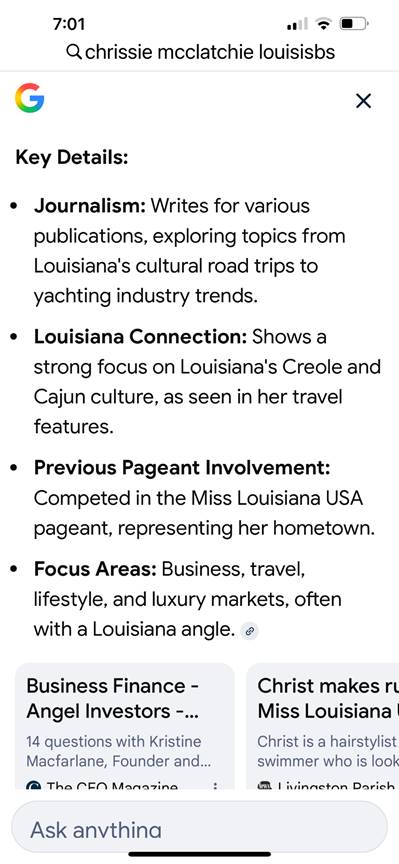
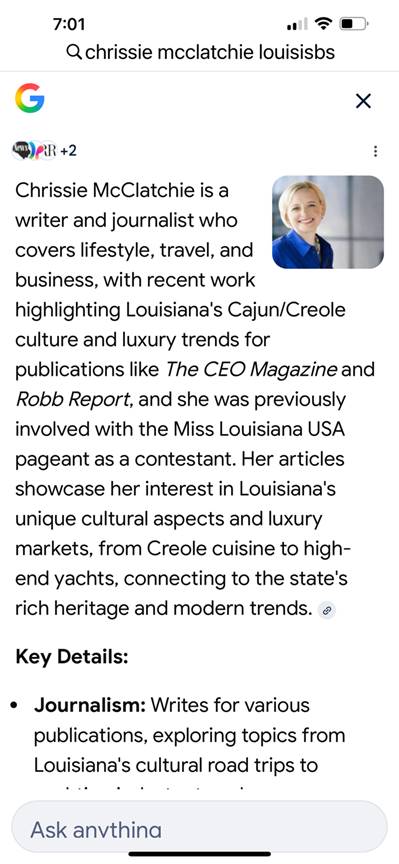
We have a Chrissie McClatchie who describes herself as a “writer and journalist” whose recent work highlighted “Louisiana’s Cajun/Creole culture and luxury trends for publications like The Ceo Magazine and Robb Report…” She includes in her qualifications as a writer the fact that she one was “involved” with the Miss Louisiana USA pageant “as a contestant representing her hometown,” though she neglects to identify that hometown. (Well, I once got a base hit and actually drove in a winning run, so I suppose that qualifies me to play left field for the Red Sox.)

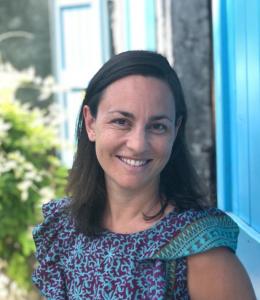
Her bio, posted online, even includes a thumbnail photo of an attractive blonde young lady:

Now I’ve never been a contestant in a beauty contest but I did once get roped into helping judge a high school beauty contest in which the winner of the talent division bounced a beach ball to The Champs song Limbo Rock—and she was really the best talent, though she did bounce the ball off her foot into the audience at one point during the song (did I mention it was a very small high school?)

But wait a cotton-pickin’ minute.

There seems to be another Chrissie McClatchie, a French-Australian.

Funny thing, she also claims to be a journalist. Moreover, she presents herself as a writer for CEO Magazine.

What a coincidence! Same name, same spelling, same occupation and same publication. What are the odds?

Here is the French-Australian Chrissie McClatchie’s Post:

Chrissie McClatchie

You can now download the April and May issues of The CEO Magazine Global for free 🙂

The CEO Magazine Global

Want to know how Australia’s top CEOs aren’t just surviving but thriving during these tough times? Access your FREE digital downloads of the April and May issue of The CEO Magazine ANZ, and discover the secrets of the world’s most successful brands, how to future-proof your company, how fashion guru Giorgio Armani is working harder than ever to burnish his brand and how the remarkable Serena Williams has made sport a winning business.

Travel | Wine | Yachting

Chrissie McClatchie is a French-Australian freelance travel and yachting writer who grew up on Sydney’s northern beaches and has called the Côte d’Azur home for over a decade.

She’s at her happiest reporting on hidden or unusual angles: whether that’s Provence’s chickpea renaissancethe Michelin-starred chef on a quest to curate the world’s largest South African cookbook collection, or the sommeliers bringing wines from the depths of the ocean to the restaurant table.

Deciphering which is the Chrissie McClatchie who wrote the story on the president of the Hammond school is difficult but it’s probably more significant to understand how these type stories work and what they can cost, making it questionable if the perceived exposure is worth the investment.

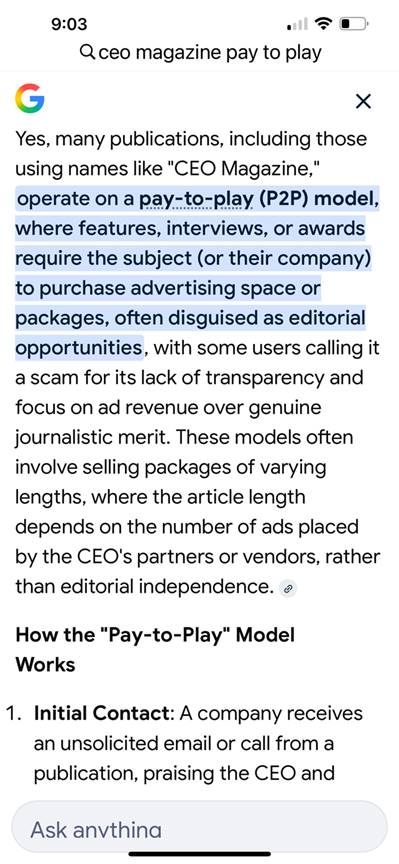
We say “perceived” exposure because the subject of the story—in this case, Dr. Wainwright—is probably told that the story will be exposed to X-thousand (CEOs for business types, educators, alumni and influential politicians for folks like college presidents). What they’re not told is that the magazine will be handed out in bulk at hotel conventions, conferences and such, stacked on registration desks where many of them will die or be tossed by indifferent attendees. But hey, they were “exposed” to the publication, right?

Another tactic is to discreetly inquire of the story’s subject (during the interview process, of course) of the names and contact information for vendors, partners, fellow businessmen or prominent politicians who will subsequently solicitated to place an ad in the magazine congratulating good-ol’-Joe Blow for reaching the pinnacle of his profession by making the cover of the prestigious magazine.

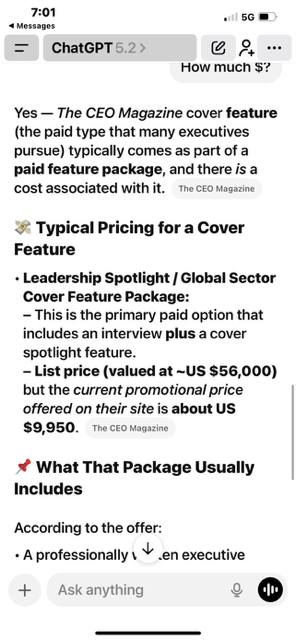
Depending on the length of the story (in this case, the aforementioned 1300 words) and the number of suckers individuals who purchase ads, the cost of gracing the cover and the accompanying feature story can run anywhere from $8000 to $50,000.

Here are a few comments picked up online about the magazine and its tactics:

So now, the two burning questions lingering out there are (1) did SLU or any of its affiliates (like the school foundation) pony up any money for this story, or (2) did the magazine solicitate names of any prominent alumni (like Robin Roberts, for instance) to buy an ad in the issue featuring Dr. Wainwright?

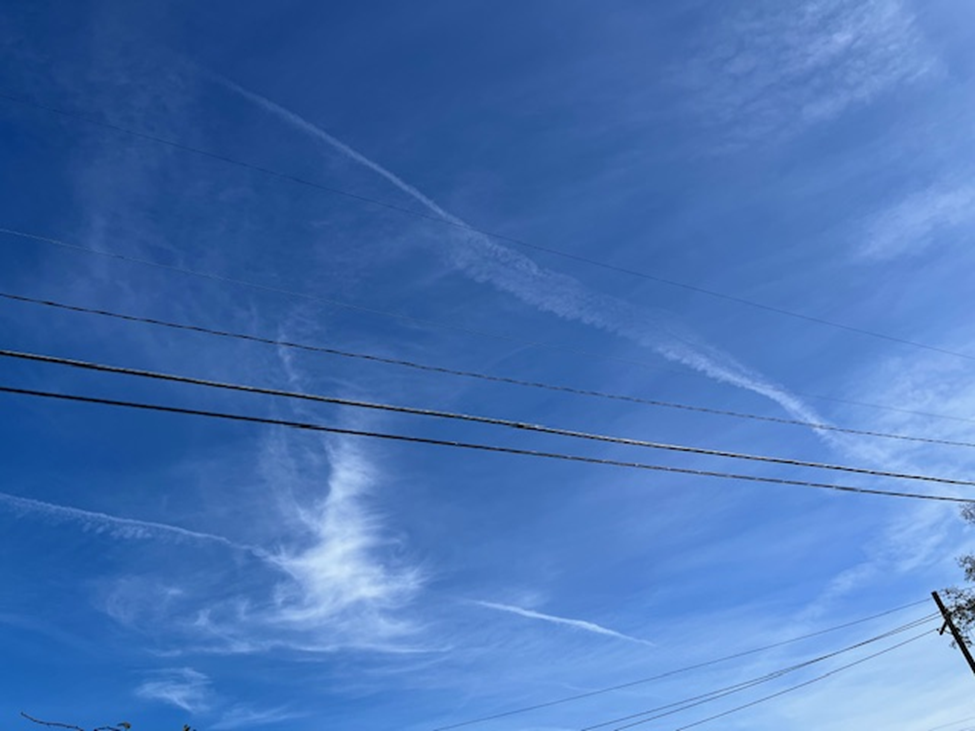
Two of the three contrails spotted over Livingston Parish Sunday morning

Ir’s enough to keep a Louisiana legislator awake nights. The 58 House members and 35 senators should be horrified to learn that their passage of a bill to outlaw contrails from jet airplanes to be released over the state was apparently for naught.

It’s especially disconcerting for Sen. Valerie Hodges and Rep. Kellee Hennessee Dickerson, both of Denham Springs, who had signed on as co-sponsors of SB46, which became Act 95, and for Gov. Jeff Landry who signed the silly bill into law.

The lawmakers mistakenly referred to chemtrails in their bill when the proper term should have been contrails. But contrails are created when airplanes fly in cold and humid atmospheric conditions and ice crystals form around the exhaust particles emitted from the plane’s engines–and that explanation, though legitimate and accurate, shoots down their wonderful but crackpot theory.

Of course, there are a few others who should be, but probably are not, feeling a little silly about the absurdity of their little conspiracy. There were several legislators who joined lead author State Sen. Michael “Big Mike” Fesi (R-Houma) in co-authoring the bill. They include fellow Sens. Heather Cloud (R-Turkey Creek) and Valarie Hodges (R-Denham Springs) and 12 representatives: Beryl Amedee (R-Houma), Michael Bayham, Jr. (R-Chalmette), Marcus Bryant (D-New Iberia), Kimberly Coates (R-Ponchatoula), Raymond Crews (R-Bossier City), Kellee Hennessee Dickerson (R-Denham Springs), Kathy Edmonston (R-Gonzales), Peter Egan (R-Covington), Dodie Horton (R-Haughton), Danny McCormick (R-Oil City).

It’s not been determined if a single one of the co-authors or any of those who voted for its passage ever stopped to think that these contrails appear over every single state or to ask themselves if it might be the least bit logical or sane to think that the U.S. government was deliberately attempting to poison its citizens, its livestock or its fruits and vegetables with chemicals released at 30,000 feet above the earth.

I mean, there’re a lot of issues on which I don’t trust the guvmint, but this ain’t one of ’em.

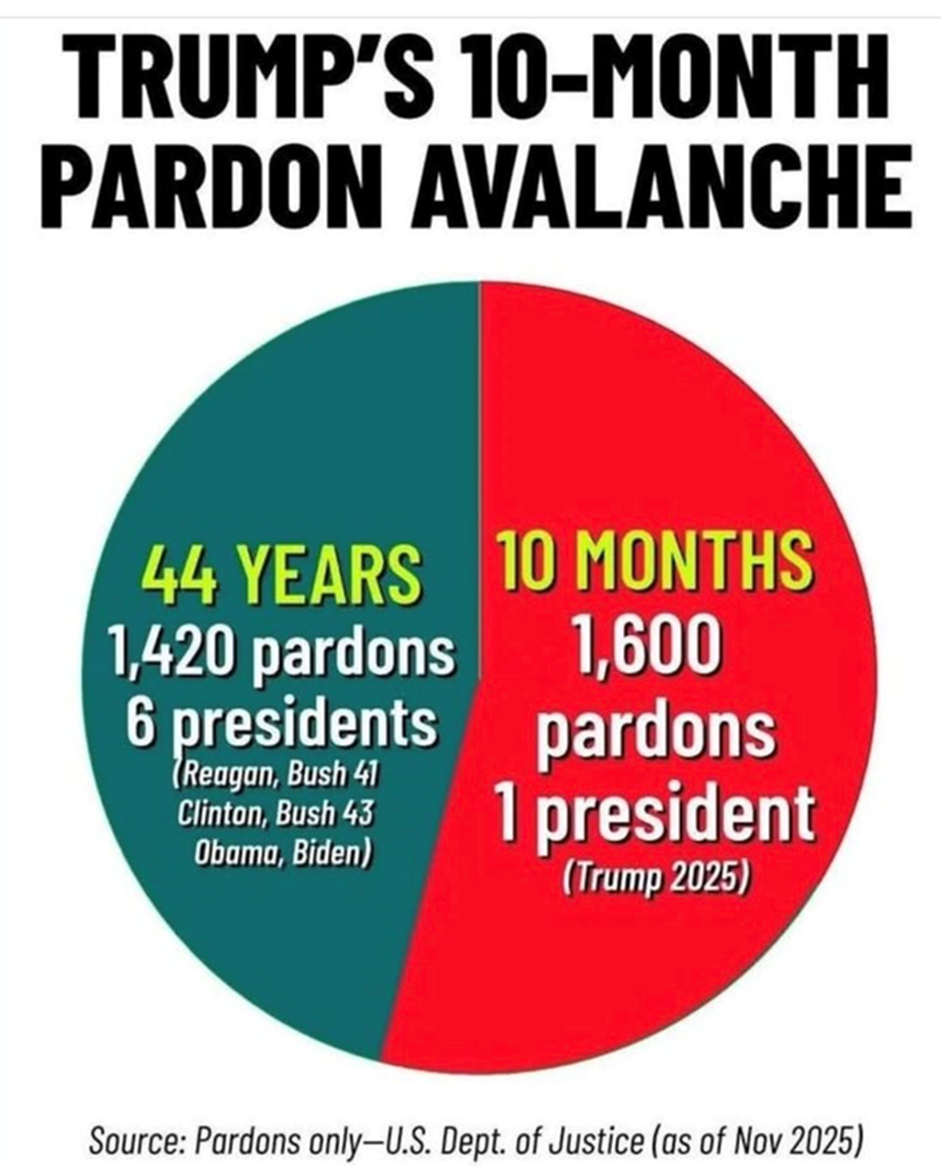
Since Jan. 20, 2025, his first day of his second term, Donald Trump has issued 89 pardons, not counting the Since Jan. 20, 2025, his first day of his second term, Donald Trump has issued 89 pardons, not counting the NEARLY 1600 BLANKET PARDONS he bestowed on all those rioters from the Jan. 6, 2021 storming of the U.S. Capitol.

(And these were for just the first 10 months of 2025)

Of those 89, no fewer than 36 were for felons convicted of fraud or drug offenses.

The 27 fraud pardons and nine pardons for drug charges might seem a little out of kilter for a president who presents himself as be so opposed to fraud in Minnesota and drugs in Venezuela.

So, let’s take a look at those 36 pardons.

Former Illinois Gov. Rod Blagojevich: convicted in 2011 of, among other things, attempting to sell a US Senate seat. (as a side note, Blagojevich was once booted off Trump’s reality TV show, Celebrity Apprentice.)

Brian Kelsey: the former Tennessee state senator had pleaded guilty to campaign finance fraud.

Devon Acher: defrauding the Wakpamni Native American tribe of tens of millions of dollars.

Trevor Milton: Former CEO of Nikola convicted of defrauding investors but pardon kept him from having to repay $660 million to victims.

Jason Galanis: along with Acher, conspiracy to defraud Wakpamni tribe of $60 million. Received commutation of sentence instead of full pardon. Both Acher and Galanis had worked with Republicans in their effort to impeach President Joe Biden.

Ozy Media, Carlos Watson: Conspiracy to commit securities fraud, ordered to make $37 million restitution.

Michele Fiore: former Las Vegas city council member convicted of defrauding a federal charity.

Scott Howard Jenkins: former Pennsylvania county sheriff convicted on four counts of honest services fraud, along with seven counts of bribery.

Todd and Julie Chrisley: Reality TV stars convicted in 2022 of bank and tax fraud.

Lawrence Duran: Convicted of $205 million in Medicare fraud in Florida, ordered to repay $87 million.

Michael Gerard Grimm; Former New York representative pleaded guilty in 2014 to felony tax evasion.

George Santos: former New York representative convicted of fraud, removed from office.

Marian I Morgan: convicted of running multimillion-dollar Ponzi scheme from her Florida home.

John G. Rowland: former Connecticut governor convicted of election fraud, conspiracy.

Charles Overton Scott: convicted of securities fraud.

Changpeng zhao: Perhaps the most egregious of Trump’s pardons, Zhao was founder of Binance, the world’s largest cryptocurrency exchange. He was convicted of failing to stop criminals from using the platform to move money connected to child sex abuse, drug trafficking, terrorism and money laundering.

Glen Casada: former Tennessee House Speaker convicted of conspiracy to commit fraud, theft, bribery and kickbacks.

Cade Cothren: Casada’s former chief of staff convicted along with his boss.

Joseph Lewis: the British national billionaire businessman pleaded guilty two years ago to conspiracy to commit securities fraud. He was pardoned last November.

David Gentile: investment manager was convicted of multiple fraud charges and was sentenced to seven years. He reported to prison last Nov. 14 but served only 12 days before Trump pardoned him.

Enrique Roberto and Imelda Rios Cueller: member of Congress from Texas, Cueller and his wife were indicted on charges that for a decade, they ran a fraudulent bribery scheme. The couple was indicted but were pardoned before they could be tried.

Alexander Sittenfeld: Cincinnati City Council member pleaded guilty campaign fraud, bribery, attempted extortion, sentenced to 16 months in prison

Robert Henry Harshbarger, Jr.: pleaded guilty in 2013 to health care fraud and distributing a misbranded drug through his wife’s company, American Inhalation Medication Specialists. His wife, also a pharmacist, was elected to Congress in 2020 as a Trump supporter.

Tim Leiweke: the ex-CEO of Oak View Group, the developer for a new LSU arena was indicted but never tried for orchestrating a conspiracy to rig the bidding process before Trump issued him a full pardon.

And then there are the nine pardons for drug offenders:

Ross William Ulbricht: the founder of the Silk Road dark web marketplace where he operated “the most sophisticated and extensive criminal marketplace” was sentenced to life imprisonment for fraud in identifying drugs sold over the internet and for money laundering.

Jean Pinkard: convicted of conspiracy to possess with intent to distribute controlled substances, she is the beneficiary of Trump’s “No MAGA Left Behind” pardoning spree.

Michael Ray Harris: All this gang leader did was run a national drug trade (and get himself convicted of conspiracy to commit first-degree murder.

Larry Hoover: another gang leader (from Chicago) who had been serving multiple life sentences for drugs, money laundering, extortion and murder.

Garrett Gilbert Smith; Baltimore drug trafficker who was sentenced to 25 years in prison. Trump commuted to time served with no further fines, restitution, supervised release or other conditions.

Charles Lavar Tanner: convicted of conspiracy to possess with intent to distribute five kilos or more of cocaine.

Anabel Valenxula: sentenced in 2009 to 32 years for meth trafficking.

Edward Ruben Soeiot and Joe Soteio: convicted and sentenced in the 1990s as major players in a drug conspiracy.

Juan Orlando Hernandez: The granddaddy of all presidential pardons, Hernandez is the former president of Honduras who was found guilty of conspiracy to import some 400 tons of cocaine into the U.S., along with assorted firearms charges. Sentenced to 45 years in federal prison. It mattered little that he was the leader of one of the largest criminal enterprises ever subject to a conviction in U.S. courts; he had a friend named Roger Stone and Stone had a friend named Trump. So, a PARDON was a mere formality.

To see the list of all 89 persons pardoned by Trump in 2025, as compiled by the U.S. Department of Justice, go HERE.

And here’s a bit of lagniappe for you. It’s a list of all those pardoned by Trump (mostly Jan. 6 participants) who have subsequently been arrested on other charges:

  • David Daniel 
  • Andrew Kyle Grisby 
  • Theodore Middendorf 
  • Andrew Quentin Taake 
  • John D. Andries 
  • Joshua Lee Atwood 
  • Bryan Betancur 
  • Dominic Box 
  • Kyle Travis Colton 
  • Timothy Desjardins 
  • James Tate Grant 
  • Jarod Lee Hawks 
  • Joshua Dillon Haynes 
  • Emily Hernandez 
  • Colby Dillion Herrington 
  • Daryl Eugene Johnson 
  • Edward Kelley 
  • Kene Brian Lazo 
  • Jia Liu 
  • Martin Joseph Pastucci 
  • Donald Nathan Pelham 
  • Narayana Chandra Rheiner 
  • Alan Michael St. Onge 
  • Hatchet Speed 
  • Taylor Taranto 
  • Shane Jason Woods 
  • Miles Adkins 
  • Zachary Alam 
  • John Banuelos 
  • Brent John Holdridge 
  • Matthew Huttle 
  • Christopher Moynihan 

There you have it—the fraud and drug crime honor roll. A tribute to that paragon of law and order, Donald J. Trump.

So, remember, boys and girls. Crime does not pay (unless you happen to have a connection to Agent Orange). But most of all, don’t be conned into believing that Venezuela is about drugs or Minnesota is about fraud. The math just doesn’t work.