Feeds:
Posts
Comments

Archive for the ‘State Police’ Category

When State Police Capt. Barry Branton, a supervisor with a previously unblemished record, approved a Prescription Monitoring Program (PMP) on fellow Troop D Lt. Harlan Chris Guillory, it did not seem to matter that Guillory was indeed found to be abusing prescription drugs while on duty.

Instead, Guillory was subsequently promoted to captain and made Commander of Troop D while Branton was placed on administrative leave and demoted the rank of lieutenant. He appealed and eventually reached a settlement by agreeing to accept the demotion in exchange for having the suspension expunged from his record and his receiving full back pay.

But the bottom line was Branton was demoted for initiating a PMP out of concern for the professionalism of a fellow officer.

That stands in stark contrast to the decision not to punish a state trooper in Washington Parish after he and his brother, a DEA agent, were reported to have threatened a Metairie lawyer with bodily harm, imprisonment, and closure of his law practice—all over the issue of the attorney’s having parked his vehicle near their deer stand in December of 2012.

Michael Gahagan, a Metairie immigration attorney, on Tuesday provided LouisianaVoice with a three-page affidavit he filed with the Washington Parish Sheriff’s Office following a December 21, 2012, confrontation with State Police Captain Kevin Devall and his brother, Drug Enforcement Agent Page Devall.

Both men are the sons of Hammond Police Chief Roddy Devall who is said to be a strong supporter of State Police Superintendent Mike Edmonson.

Gahagan told LouisianaVoice that he was “assaulted, threatened, and abducted by the brothers after they blocked his truck which he said was parked on the roadside next to a hunting lease controlled by the Parish Line Hunting Club. Gahagan said he was a member of the club and was hunting from his deer stand around 4 p.m. on December 21 when he heard an all-terrain vehicle drive up to his truck and stop and then leave after a few minutes.

He said he climbed down from his deer stand about 5:15 intending to drive home only to find his truck blocked by Kevin Devall’s full-sized white pickup truck and a black trailer. When he asked the brothers, who were standing nearby, to move, they approached him cursing and grabbing the front of his shirt with their faces touching his.

He said he broke free and began walking backwards down the road that led away from his truck and into the woods in an effort to get away from them. He said as he walked backward, he extended his hands in front in an effort to keep them at arms’ length. All the while, he said the brothers were screaming threats at him. Page Devall yelled that he was a DEA agent and that “I kick in doors for a living” as he repeatedly “reached out and put his finger in my face and pushed my face,” Gahagan said.

Kevin Devall, he said, boasted that “I make the laws in Louisiana” and that he “would throw me in jail for the rest of my life and take away my law license if I didn’t do what he said.”

Fearing that he would be severely beaten or even killed, he considered drawing his handgun that he was carrying in his back waistband. He said he is a registered concealed carry permit holder and that if the two had not been police officers, “I would have defended myself and shot and killed them in order to prevent a beating and escape the attack and illegal detention.”

Because the two men were police officers, he said, “I chose not to draw and fire my handgun,” he said. “I did not use deadly force to defend myself because I was afraid what would happen to me after I was arrested by other police officers for shooting a police officer in self-defense.”

He said after about 45 minutes of repeated threats from the two, Kevin Devall ordered him into the Devalls’ ATV “so that he would drive me back into the woods and show me where he would allow me to park my vehicle.”

Before getting into the ATV, Gahagan was ordered by Paige Devall to disarm “or we will never let you leave,” he said. Gahagan said he removed his handgun and placed it into his truck and locked the truck. “Then Paige Devall gave me a full-body pat down (without probable cause or reasonable suspicion that I had committed any crime).”

Gahagan said he was then driven “several miles” into the woods and shown where he would be allowed to park.

He said he was finally allowed to leave the area around 8 p.m., nearly three hours after his ordeal began.

Following the confrontation, State Police Internal Affairs conducted an investigation of the allegations during which Gahagan was administered a polygraph test but neither of the Devalls were required to take a polygraph.

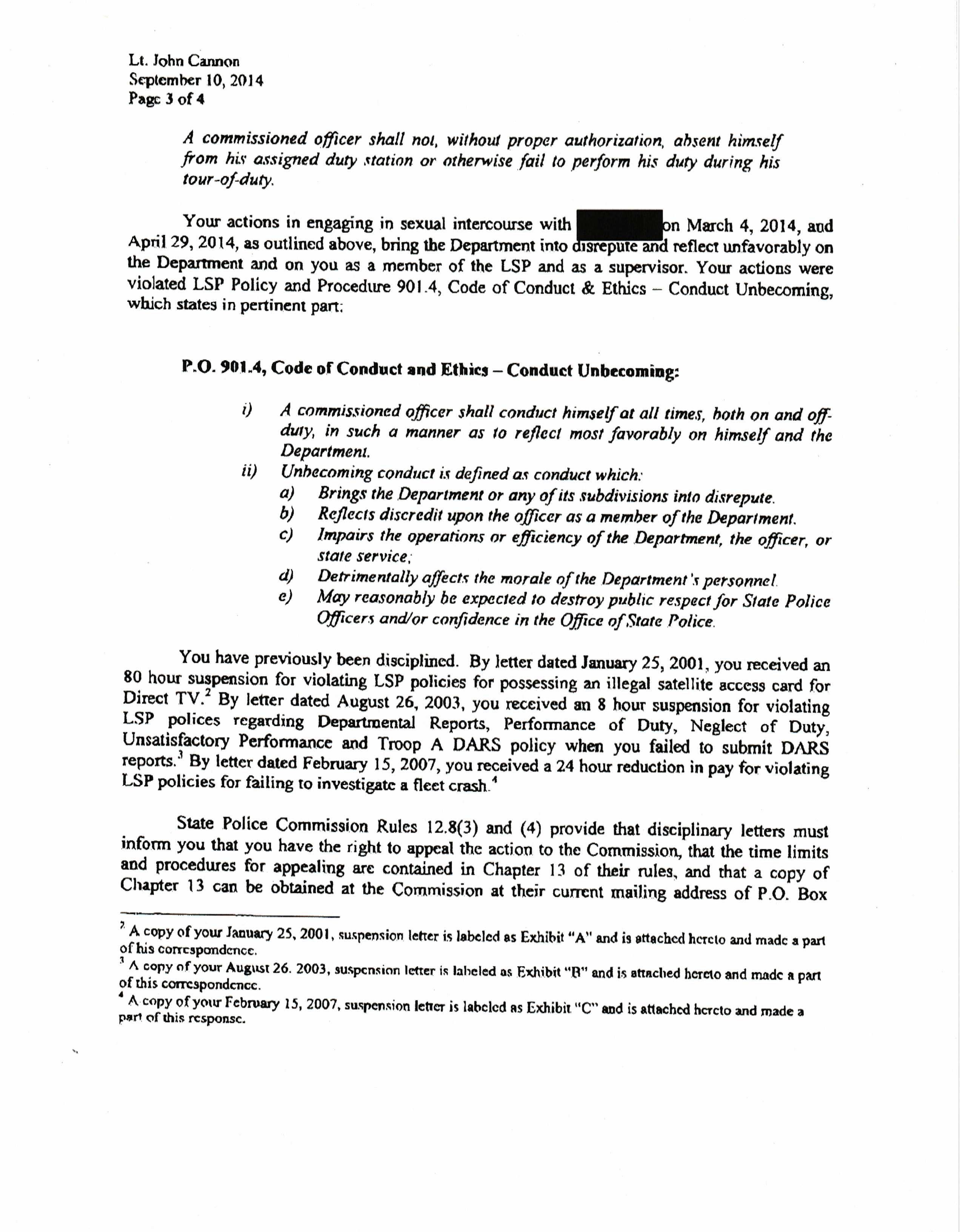
That was similar to the case of State Police Lieutenant John Cannon who was accused by a woman of twice paying her to have sex, once in the rear seat of his patrol car. The woman was given a polygraph but Cannon was not even though he did admit to twice having sex with her while on duty but denied paying for sex.

Two other significant events followed Gahagan’s encounter with the Devalls, he said.

First, Parish Line Hunting Club discontinued the Devalls’ membership at the hunting lease and after Gahagan filed a formal complaint against Paige Devall with his employer, DEA, Gahagan, his wife and his law practice were subjected to IRS audits. “I had never been audited by the IRS before in my life,” he said. “It seems awfully coincidental that I would be hit with three simultaneous audits at that particular time.”

LouisianaVoice has made a formal public records request to State Police for Kevin Devall’s personnel file and all Internal Affairs investigative reports on him.

Here is the sworn affidavit Gahagan filed with the Washington Parish Sheriff’s Office following his encounter with the Devalls (Warning: this document contains graphic language that may be offensive to some): AFFIDAVIT OF MICHAEL GAHAGAN

Nor was the 2012 incident the last time that Kevin Devall has had a complaint filed against him.

About 16 months later, on April 22, 2014, the estranged wife of St. Bernard Parish President Dave Peralta filed a formal complaint against Kevin Devall for the manner in which he investigated her report that her husband, a former police officer, had forced her to perform oral sex on him and then raped her the previous October. Here is her formal complaint: SHARON PERALTA COMPLAINT

Sharon Peralta said Devall, instead of arresting her husband, was laughing and joking with Dave Peralta on the front lawn and that her husband was never handcuffed but instead was allowed to walk around the front lawn freely. “I was told to leave and they would handle things from there,” she was quoted as saying by the New Orleans Times-Picayune. She said Dave Peralta subsequently intimidated her into dropping charges against him. http://www.nola.com/politics/index.ssf/2014/04/state_police_probe_sharon_pera.html#incart_email

It took exactly five days after Mrs. Peralta’s charges were made public for State Police Internal Affairs to clear Devall of any improper conduct in the manner in which he conducted his investigation. http://www.nola.com/crime/index.ssf/2014/04/state_police_clear_captain_of.html

But on April 23, a St. Bernard Parish grand jury indicted Dave Peralta on a charge of sexual battery, which could have carried a 10-year prison sentence.

Prosecutors dismissed that case on a technicality in April but in August of this year, Peralta was re-indicted by a St. Bernard Parish grand jury that accused him of using parish employees to help him stalk his ex-wife as well as other offenses. In September of 2014, he was indicted by a St. Tammany Parish grand jury on charges of felony stalking and in May of this year, he was indicted by an East Baton Rouge Parish grand jury on three counts of filing false reports and for perjury.

Read Full Post »

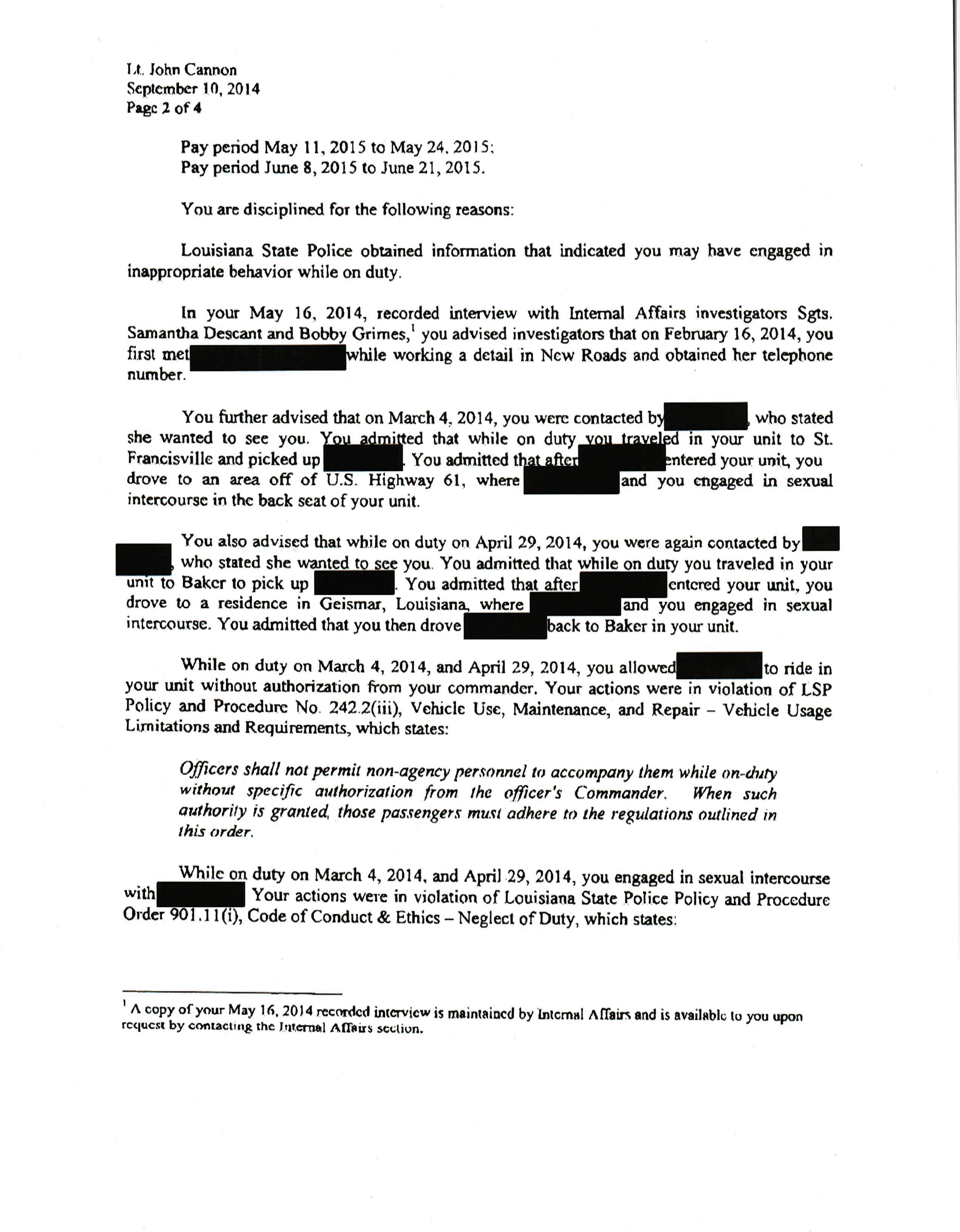
“After they had sex, Lt. Cannon realized his unit was stuck….”

State Police internal investigation report, detailing in what is assumed was an unintentional double entendre how state police lieutenant John Cannon’s patrol car got stuck during a back seat sexual encounter while on duty near St. Francisville on March 4, 2014.

Read Full Post »


Louisiana Troop A State Police Lieutenant John Cannon remains on his $115,690 per year job despite having been reprimanded for numerous offenses including theft of satellite television signals, failure to file required Daily Activity Reports (DARs), unauthorized voiding of traffic tickets, failure to investigate a fleet crash, failure to deliver fatality packets to the families of traffic fatality victims, and twice having sex with a woman while on duty—with one of those times being in the rear seat of his patrol unit.

Legislators approved two double digit state police pay increases six months apart earlier this year even as more than 35,000 state civil service employees were learning that they again would not receive 4 percent pay increases. https://louisianavoice.com/2015/09/29/state-general-fund-has-yet-to-see-any-of-the-11-million-in-delinquent-fine-collections-to-pay-for-state-police-pay-raise/

http://theadvocate.com/news/13605105-128/no-pay-raises-for-most

Troop A includes the eight parishes of East and West Feliciana, Pointe Coupee, East and West Baton Rouge, Iberville, Livingston, Ascension and part of St. James. Cannon, a shift supervisor, has been a state trooper since 1990. He was promoted to sergeant in July of 2000 and to lieutenant in August of 2010.

LouisianaVoice obtained the 38-page state police internal affairs investigative file on Cannon through a public records request. That file indicates Cannon was never demoted for his actions. His most severe punishment included a 36-hour suspension without pay and a $904.96 per pay period reduction in pay for nine two-week pay periods (the equivalent of a 240-hour suspension)—from Oct. 27, 2014 through June 21, 2015, that was handed down by letter of Sept. 10, 2014 from Lt. Col. Charles Dupuy.

The internal affairs investigation of claims that Cannon had sex with a woman on two occasions while on duty was launched on May 15, 2014, after West Feliciana Parish sheriff’s deputies reported they had a woman in custody for possession of Lortab and marijuana. The woman, whose name was redacted throughout the report, told deputies that she twice had exchanged sex for money with Cannon.

She repeated her story to state police detectives but failed a polygraph test on the question of her being paid for sex, the report said. Cannon subsequently admitted to detectives that he had sexual intercourse with the woman but denied he paid her for sex although he did admit that he twice gave her money. He said the money was given immediately before or after each sexual encounter but that on the first occasion the money was to pay her cell phone and the second time was to pay her rent and that he was only trying to help her and to establish a friendship.

While the woman was twice subjected to polygraph tests and failed on the key point of payment for sex, the state police report never indicated that a similar test was administered to Cannon even though that was the only aspect of the entire affair that would have actually been criminal in nature.

The two first met on Feb. 16, 2014 in, New Roads in Pointe Coupee Parish where Cannon was working a seat belt grant. The woman told investigators that the two had multiple conversations by phone before meeting behind the parish library in New Roads on Feb. 21 “sometime between 9 and 11 p.m.,” but that they did not engage in sex on that occasion. She said they subsequently “negotiated sex on the phone.”

Cannon later called her at her father’s home in St. Francisville where she was living and told her he “needed her,” she said. The woman told authorities that she told Cannon she was out of money and that he later picked her up in his marked state police unit near her father’s residence and “immediately gave her $120, which she claimed was for sex,” according to the report. Cannon later said the amount was closer to $60 and was not for sex but for her cell phone bill. The report by internal affairs put the date as March 4, 2014.

She told investigators that their first sexual encounter took place in a wooded area south of St. Francisville just off U.S. 61 and lasted “approximately two minutes.” Afterward, she said, Cannon realized his patrol car was stuck and that she smoked a marijuana joint while he checked to see how badly the car was stuck. Apparently realizing how it might look if he were caught with her in such a secluded area, especially given the fact that he was dating an employee of the West Feliciana Parish Sheriff’s Office at the time, he ordered her to walk to the main highway and catch a ride while he called for someone to pull him out.

She did catch a ride to her father’s house while Cannon called the sheriff’s department for help in removing his vehicle.

Almost two months later, on April 29, Cannon picked her up—in his state police unit while on duty and in full uniform—from an apartment in Baker where she was living with her boyfriend. Cannon drove to a home she told authorities she believed to be in Baton Rouge but which Cannon later admitted was a friend’s home in Prairieville in Ascension Parish. They again had sexual intercourse in a bedroom of the home, that time for a duration of about three minutes, she said. She told investigators she requested $150 afterward but Cannon gave her only $100. He admitted that he stopped at a Regions Bank ATM on Highland Road in Baton Rouge in order to withdraw some cash. He said the amount he gave her was closer to $60 to $80 but when advised that she claimed it was $100, he told investigators it “was possible he could have given her that amount,” the report said.

The report reiterated Cannon’s claim that while he gave her money, it was to pay her phone bill and to pay her rent but was never given in exchange for sex

While en route from Baker to Prairieville, she activated Cannon’s patrol unit’s siren which resulted in other motorists moving out of the way and that she videoed the interior of his unit with her cell phone. She said she also took a photo of the house to show her boyfriend. She said Cannon was aware of her videoing the inside of his patrol car but that he did not know about her taking a picture of the house.

His 36-hour suspension ran from Oct. 10, 2014 through Oct. 13, 2014, and he was allowed to return to work from Oct. 15 through Oct. 26.

That 224-hour time frame actually covers 18 pay periods because, according to the specified dates of his suspension, he was suspended only on every other pay period, thus allowing him to work during alternate pay periods.

The suspension also contained no prohibition to Cannon’s being able to work overtime in order to make up for the $904.96 reduction in pay for each pay period for which he was suspended. LouisianaVoice has submitted a follow-up public records request for documents related to all overtime worked by him from Oct. 27, 2014, and June 21, 2015.

Cannon has had a checkered record in his 25 years as a state trooper.

  • On April 12, 1995, he received a letter of reprimand for his involvement in a traffic accident in his state police car, a not uncommon occurrence for state police.
  • On Jan. 25, 2001, he was suspended for 80 hours after being found in possession of an illegal satellite access card for Direct TV.
  • On June 6, 2003, he received an eight-hour suspension for failure to submit his Daily Activity Reports (DARs).
  • On April 27, 2006, he received a reduction in pay equivalent to a 24-hour suspension for failure to investigate a fleet crash.

And even after Dupuy’s letter of Sept. 10, 2014, which imposed the 240-hour suspension for his sexual misconduct while on duty, he received a reprimand but no suspension on March 18 of this year for his failure to act upon six traffic citation void slips and for failure to follow state police procedure with nine other citations.

Additionally, a review revealed that Cannon had seven fatality reports that are provided by state police as a courtesy to families of the deceased which he had not delivered. The fatalities had occurred between the dates of March 24, 2014, and Oct. 1, 2014, but still had not been delivered to families of the deceased as of Dec. 4, 2014.

And while technically, Cannon claims he was not paying for sex, a case could be made that because he was on duty at the time of his trysts, he was being paid for sex.

All of which raises the obvious questions: Was he being protected from above and if so, who was protecting him?

Here is Lt. Col. Dupuy’s letter of Sept. 10, 2014, to Cannon (Click on image to enlarge):

IMAG1320IMAG1321IMAG1322IMAG1323

Read Full Post »

None of the $11 million earmarked to pay for state police pay raises through enhanced debt collection efforts by the Office of Motor Vehicles has been submitted to the state general fund, according to a spokesperson for the House Appropriations Committee.

Meanwhile, a confidential report prepared for legislators has been obtained by LouisianaVoice which indicates that despite State Police Superintendent Mike Edmonson’s claim last January that the pay raise would not affect “upper echelon” personnel, 145 lieutenants, captains, and majors got pay raises totaling $5.3 million per year. Additionally, four deputy superintendents received raises averaging $26,170 (23 percent) each.

Seven pilots ($29,769, or 39 percent), 24 emergency services personnel ($31,247, or 45 percent), two polygraphists ($33,995, or 49 percent), and six support personnel ($25,309, or 31 percent) also received pay hikes.

The breakdown shows that 13 majors and 106 lieutenants received 46 percent pay hikes and 26 captains got bumps of 53 percent. The average salaries ranged from $108,571 for lieutenants to $136,333 for captains, the report indicates.

The largest individual salary increase was $57,252 and the largest single percentage increase was 74 percent, the report says.

State classified employees, when they receive merit increases, generally receive only 4 percent increases but those salaries have been frozen for nearly six years because of budgetary constraints.

Moreover, a separate national study released on Tuesday (Sept. 29) listed police departments from three Louisiana cities as among the worst paying in the nation, including one rated as the lowest.

Altogether, 945 state troopers, ranging from cadets to majors, accounted for more than $20 million in pay increases, thanks to two measures passed by legislators six months apart in 2015.

Unsaid in the report was the effect the pay raises will inevitably have on the unfunded accrued liability (UAL) of the Louisiana State Police Retirement system.

State senators, with minimal discussion, approved the $11 million pay increase during the waning days of the 2015 legislative session only six months after troopers received their first sizable increase. Together, the two raises boosted state trooper pay by 30 percent, according to calculations by the Legislative Fiscal Office.

The first state police pay adjustment was approved in June of 2014 but the money did not become available until the Jan. 19 increase took effect.

In the case of the second pay raise, however, the funds were committed before they were received and none of the anticipated $11 million from old tickets has been received by the state general fund, a situation that could leave the state another $11 million short if the money is not forthcoming by the end of the current fiscal year which closes next June 30.

Lines 42-47 on page 65 of House Bill 1, the Appropriations Bill, appropriates the $11 million “Payable out of state general fund by Statutory Dedications out of the Debt Recovery Fund to the Office of State Police for additional salary support for state troopers, in the event that House Bill No. 638 of the 2015 Regular Session of the Legislature is enacted into law.”

HB 638, by State Rep. Barry Ivey (R-Baton Rouge), which was enacted into law and signed by Bobby Jindal as Act 414, provides that the Department of Public Safety (DPS) collect certain fees “associated with the suspension of an operator’s license” which are related to auto liability insurance requirements. The fees become delinquent after 60 days and are referred to the Office of Debt Recovery.

The bill earmarks $25 million from the Debt Recovery Fund for use by the Office of State Police. Here is the legislative digest of HB 638 (ACT 414)

But with none of that money having been yet gone to the general fund, legislators are beginning to worry.

Additionally, the state police pay increases have not yet produced additional sergeants’ positions. The report said, “State Police leadership claimed in two meetings that the agency was experiencing difficulty attracting Master Troopers who were interested in applying for Sergeant Positions.” The number of Sergeants, however, has only increased by four, from 193 to 197, it said.

Moreover, there have been only 123 promotions within state police ranks and 44, or more than a third, were from cadet to trooper.

There has been one promotion from captain to major, five from lieutenant to captain and 11 from sergeant to lieutenant, the report indicates.

Here is the BREAKDOWN OF STATE POLICE PAY RAISES

Coincidentally, even as the two pay increases combined to make state police the highest-paid law enforcement agency in the state, a national survey Tuesday (Sept. 29) listed three Louisiana cities as among the 30 with the lowest pay for police officers.

Alexandria had the lowest pay in the nation among major cities with an average salary of $31,370 per year for officers. Monroe, with an average salary of $34,000 was eighth lowest, while Lake Charles was 21st lowest in the state with an average salary of $35,320.

The State Police Retirement System (STPOL) had the smallest UAL of four state retirement systems which combined for an UAL balance of $18.588 million in 2013. The breakdown for the individual systems shows that the Teachers Retirement System (TRSL) had the largest UAL of $11.13 million, followed by the Louisiana State Employees Retirement System (LASERS) at $6.25 million, the Louisiana School Employees Retirement System (LSERS) at $863.7 million and STPOL at $305.4 million (up from the $166.5 UAL of 2006).

STPOL receives revenues from the state and from taxes on insurance premiums but the funding levels from the state have decreased steadily since the high of 73.1 percent of 2007 to 59.1 percent of 2013.


Read Full Post »

When LouisianaVoice attempted through a public records request to obtain an unredacted version of the disciplinary records of a trooper in State Police Troop D, our request was denied. Louisiana State Police Attorney Supervisor Michele Giroir explained that the individual’s rights to privacy outweighed the public’s right to know.

Specifically, her letter of Aug. 18 said:

  • The Department has reviewed your request. It remains the Department’s position that you are not entitled to review the redacted information. The individuals’ rights to privacy established by Article 1, Section 5 of the Louisiana Constitution of 1974, as amended, outweigh the public’s right to know the personal information in this matter….The substance of the matter is personal in nature and not related to (the trooper’s) duties as a state trooper. The information that you reviewed in the letter (in the redacted document we were provided) contains the substance of the conduct for which (the trooper) was disciplined as it related to his duties as state trooper. Providing further information would violate the involved parties’ rights to privacy.

Her decision left us disappointed but at the same time, we understand there are certain rights to privacy that must be upheld.

Apparently Troy Hebert did not get the memo. And now he is being sued for making just such private information public.

Moreover, it appears he may have violated an order from a Civil Service hearing referee not to discuss the matter with anyone, “including the media.”

Actually, his actions only provided cause for the filing of an amendment to a lawsuit already filed in Federal District Court in Baton Rouge over Hebert’s retaliation against former ATC agent Brette Tingle.

One day after Giroir’s letter, on Aug. 19, Hebert, Director of the Louisiana Office of Alcohol and Tobacco Control (ATC), issued a news release that was disseminated widely over television and print media in which Hebert leaked the contents of private cell phone text messages and emails.

Though Tingle’s communications on his state-issued cell phone contained sexually and racially-charged messages, the messages were to friends and family members, some of them African-American. Such messages are considered private under the Louisiana Constitution, as Giroir said in her letter. Moreover, LouisianaVoice learned in interviewing two African-American agents that some of the racial remarks were made to them but were said in jest. “I say some of the same things he said,” said one African-American agent, a female. “We joke back and forth with each other that way.”

Another African-American who worked with Tingle, Larry Hingle, said he understood the context in which Tingle’s messages were made and that he had no problem with him.

Tingle, in fact, contends that Hebert’s vendetta against him stems from his (Tingle’s) testimony on behalf of Charles Gilmore, one of three African-American ATC agents who filed Equal Employment Opportunity Commission (EEOC) complaints against Hebert. The three, Gilmore, Hingle, and Daimian T. McDowell subsequently filed suit against Hebert in Baton Rouge Federal District Court. https://louisianavoice.com/2014/07/14/forcing-grown-men-to-write-lines-overnight-transfers-other-bizarre-actions-by-troy-hebert-culminate-in-federal-lawsuit/

In his amended lawsuit, Tingle cites the same Article 1, Section 5 of the Louisiana Constitution which says, “Every person shall be secure in his person, property, communications, houses, papers, and effects against unreasonable searches, seizures, or invasions of privacy.” That pretty much tracks the Fourth Amendment which prohibits unreasonable search and seizure.

The search and seizure of the text messages in this case was (sic) unreasonable because, at the search’s inception, there was (sic) no reasonable grounds to believe that the search would reveal any employee misconduct and because Troy Hebert provoked this search in bad faith, in an arbitrary and maximally intrusive manner, and in retaliation for Brette Tingle’s exercise of protected activity,” Tingle says in his amended petition.

“The plaintiff (Tingle) never consented to Troy Hebert or anybody else searching his private text messages with his friends and family in an intrusive fishing expedition to search for any evidence that Troy Hebert could try to use to avoid the consequences of his overt race discrimination against African-American employees by discrediting Brette Tingle as a witness,” it said.

Moreover, the petition says, Hebert laid out false allegations of payroll fraud against Tingle in his news releases “even though an extensive investigation by the Louisiana Office of Inspector General (OIG) had found no probable cause for the payroll fraud accusation…”

(Both Hebert and the OIG’s Inspector General are appointed by the governor.)

Even more egregious, Tingle says, Hebert read Tingle’s communications aloud to 12 female ATC employees on Aug. 21.

“The extracts of these conversation, which were widely publicized by Troy Hebert, constitute defamation by innuendo and the embarrassing disclosure of personal and private facts,” the petition says. “This is particularly so since these alleged conversations have nothing whatsoever to do with Brette Tingle’s job performance and thus, Troy Hebert had no legitimate interest in publicly broadcasting these alleged private conversations.”

Hebert even hinted that Tingle may have been guilty of setting fire to Hebert’s state vehicle, Tingle said. “In an interview with a New Orleans news outlet, WVUE-TV, on Aug. 19, Troy Hebert…stated that if a person was (sic) to ‘connect the dots,’ it would be clear who vandalized the vehicle.

“While it is apparently true that Troy’s vehicle had been set on fire, Troy Hebert had no evidence that the plaintiff had committed this crime,” Tingle said. “Troy Hebert did know, or certainly should have known, that the temporal proximity of his statements and the termination of the plaintiff carried false and defamatory implications.”

The petition said the communications from his cellphone were “taken out of context and do not accurately reflect Brette Tingle’s attitudes toward persons of color.” He said he is “well-respected” by persons of color for his “fair-minded attitudes and conduct. Indeed, it is only because Brette Tingle took a firm and courageous stand against Troy Hebert’s race discrimination and retaliation against former fellow employees that Troy Hebert has gone to great lengths to destroy his (Tingle’s) career and reputation,” it said.

We at LouisianaVoice have followed Troy Hebert’s ham-handed manner of running his agency since he was named to replace Murphy Painter who was fired on bogus charges by the Jindal administration.

If there is anything that can be said of Hebert, it’s that he appears to be as inept and clueless as his boss. He has managed to run a once-fine investigative agency into the ground with his petty insistence on requiring agents rise and greet him with an enthusiastic “Good morning, Commissioner” upon his entering a room. We were dismayed to learn that he has forced agents, fully grown adults, to literally write lines. We were incredulous when he ordered Gilmore transferred from Baton Rouge to Shreveport literally overnight with no opportunity for him to make plans for such a move. And we were shocked to the point of disbelief upon learning that he had ordered a female agent to return to a New Orleans bar in full uniform—after she had purchased drugs while working as a plainclothes undercover agent in that same bar only days before.

We were puzzled when Jindal snatched him from the Legislature to serve as the top enforcement agent for ATC with no qualifications other than the fact that his wife is the Jindals’ children’s pediatrician.

But now, somehow we are unable to be shocked at anything this man does. Apparently no underhanded tactic is beneath him—even when it comes to violating the same State Constitution that the chief legal counsel for the Louisiana State Police was sufficiently cognizant to uphold in denying our access to personal records.

Hebert apparently has no problem violating a direct order from a Civil Service hearing referee who presided over an appeal of Tingle’s firing in July. The referee was quite specific in admonishing witnesses not to discuss the Tingle matter “with each other or anyone else, including the media.” That order was issued when Tingle’s hearing was continued by the referee who said a violation of her dictum “could result in disciplinary action, including dismissal” from their jobs. https://louisianavoice.com/2015/07/10/civil-service-hearing-for-fired-atc-agent-continued-to-sept-after-settlement-talks-break-down-troy-didnt-want-us-there/

In an otherwise competent, transparent and ethical administration, we would have expected Hebert to have been fired months ago. Under the Jindal administration, we harbor no such hope. In fact, Jindal did quite the opposite in naming Hebert his office’s legislative liaison.

Read Full Post »

« Newer Posts - Older Posts »