Feeds:
Posts
Comments

Archive for the ‘Public Records’ Category

“Blessed is he who expects nothing, for he shall never be disappointed.”

–Alexander Pope

The so-called “investigation” by the Louisiana State Police Commission (LSPC) into the laundering of campaign money by the Louisiana State Troopers Association (LSTA) through the association’s executive director turned into a major sham that only served to reinforce the old adage that crap flows downhill.

But the good news is state civil service employees may now pursue a method whereby they can make their own heretofore verboten political campaign contributions.

Hyped for two weeks as an investigation that would “name respondents” for the association’s deliberate circumvention of state regulations prohibiting political activity on the part of individual state troopers, the “report” of Natchitoches attorney Taylor Townsend, hired to conduct the investigation and to make recommendations back to the commission, was a major dud in every respect.

His recommendation at Thursday’s (July 14) meeting: Do nothing. Punt. Abdicate the commission’s responsibility.

The term “deliberate” is not used lightly here. It was, after all, LSTA Executive Director David Young, in whose name more than $45,000 was contributed to various political candidates, including Gov. John Bel Edwards, who told the commission that the campaign contributions were made through him in order that “there could never be a question later that a state employee made a contribution.” Young said he wrote the checks, dating back to 2003 and the association would reimburse him. https://louisianavoice.com/2016/01/15/louisianavoice-exclusive-at-long-last-it-can-be-disclosed-that-the-reason-for-all-the-problems-at-state-police-is-us/

For two weeks, word has circulated that Townsend’s report would name names and would be sharply critical of the association’s practice.

There is even word of an audio tape at a contentious meeting of association members from Troop I in Lafayette at which it was disclosed by association representatives that LSTA officers made the decision as to whom would receive campaign contributions.

That tape was never mentioned in Townsend’s brief “report” on Thursday (July 14). Nor were any names given as those directly responsible for the decision to contribute campaign money to candidates.

Instead, Townsend said the commission has no jurisdiction over the association or over Young. While that was an accurate assessment openly acknowledged before Townsend was ever brought on board, it was also acknowledged prior to his being hired that the association did have investigative and disciplinary powers over individual state troopers found in violation of state law. And while Townsend was quick to absolve the commission of any responsibility for Young and the association, he conveniently neglected to bring up the commission’s responsibility for enforcement of laws and regulations when individual state trooper actions are involved.

Because the LSTA is a 501(c) non-profit charitable organization, it is free, under certain restrictions, to make political contributions. So, by having Young make personal contributions in his name and then filing an expense report, the LSTA conveniently bypasses state law by funneling money to political candidates through Young.

Carrying his verbal report to its obvious conclusion, state civil service employees may need no longer worry about a similar prohibition against their making campaign contributions. All they have to do is form an association and get IRS approval of their status as a 501(c).

Of course, while state police have received two recent pay increases totaling 50 percent in some cases (and, by the way, they still want more), state civil service workers have been routinely denied even their paltry 4 percent annual merit increases for more than five years now, so they, unlike their fortunate state trooper counterparts, could hardly be expected to afford to make token campaign contributions.

So, the question is how is it that an investigation which only a couple of weeks ago seemed almost certain to result at least in suspensions for identical infractions that forced three of the LPSC members to resign since April was suddenly rendered impotent? https://louisianavoice.com/2016/04/14/two-more-members-of-lspc-quit-over-political-contributions-while-pondering-probe-of-lsta-for-same-offense/

To find the answer to that, one must go right to the top—the man who ran on the strength of his West Point Code of Honor.

It was John Bel Edwards who reappointed State Police Superintendent Mike Edmonson, most likely solely on the strength of the Louisiana Sheriffs’ Association insistence.

Asked by LouisianaVoice on Oct. 27, 2015, at 10:57 a.m. (before he took the oath of office) what his intentions were regarding the reappointment of Edmonson Edwards professed he had no intentions either way:

Please tell me your intentions as to the re-appointment of Mike Edmonson.


Tom Aswell

LouisianaVoice


From: John Bel Edwards

Sent: Tuesday, October 27, 2015 12:50 PM

To: Tom Aswell  

Subject: Re: QUESTION


I don’t intend one way or the other

Being as charitable as possible, we now are forced to speculate that Edwards was being less than truthful at the time.

Edmonson was Bobby Jindal’s boy so why would Edwards feel obligated to keep him on? The LSTA even drew the line and said no to Edmonson’s request to have the association write a letter to Edwards recommending his reappointment.

Well, before he was Bobby Jindal’s boy, he was the Louisiana Sheriffs’ Association’s boy. The Sheriffs’ Association wanted him to stay around because he is easily controlled and manipulated by the sheriffs.

The Sheriffs’ Association endorsed Edwards when the outcome of his runoff election against U.S. Sen. David Vitter was still in doubt. He needed that endorsement and the condition that went with the endorsement was that Edwards would keep their boy on. https://louisianavoice.com/2015/12/16/lsp-unable-to-locate-sergeants-critical-letter-warning-of-danger-edmonson-is-reappointed-by-gov-elect-edwards/

And don’t forget that Daniel Edwards is Sheriff of Tangipahoa Parish—and an influential member of the Sheriff’s Association—and probably has more than a little influence with his brother, the governor.

Consequently, anything that might implicate—or even embarrass—Edmonson would, by extension, embarrass Gov. Edwards and the Sheriffs’ Association. Accordingly, the report by former State Sen. Taylor Townsend had to be watered down or even killed.

In short, everyone simply circled the wagons.

And that’s now what we were led to expect from one who espouses the West Point Code of Honor.

(Note to self: Stop expecting.)

Read Full Post »

There are times when we have to dig pretty deep to uncover wrongdoing, conflicts of interest, favoritism, and outright corruption. There are other times when the information just seems to drop into our lap.

Such is the ongoing reports of kangaroo court proceedings conducted by the Louisiana State Board of Dentistry. And how was a witness in a case against a fellow dentist rewarded with a seat on the board? And how is that dentist/board member allowed to serve as an insurance claims analyst in determining payments to other dentists in the same geographic area of his own practice?

It’s probably a good idea to provide something of a refresher to bring new readers up to speed. The State Dentistry Board previously had a contract with a private investigator who had a nasty habit of deciding that a dentist was in violation of some obscure regulation and then going about his investigation with the intent of proving his pre-set theory.

Investigator Camp Morrison, who racked up hundreds of thousands of dollars in billings while contracted to the board for more than two decades (he even was provided rent-free office space in the Dentistry Board’s office suite on Canal Street in New Orleans), appeared to have an unlimited expense account.

And why not? He roamed the state under color of law, harassing dentists to self-generate his own fees which were more than paid for by the six-figure fines levied against dentists not in the board’s favor.

Of course, he couldn’t have done all that without the aid of the board’s general counsel, who often served in dual capacity as board counsel and board prosecutor, a violation of legal ethics rules and common sense. Because he only had a duty to his client the board of dentistry to act in its best interest, anyone that he prosecuted was denied due process. The same would be true if a police force handled its own prosecutions without an independent prosecutor; there would be no fundamental perception of fairness.

Attorney Brian Begue was also known to hide behind the cloak of administrative law in denying defendants’ rights afforded under the US Constitution. Because he self-generated his own fees, he had apparently selfish financial motives for seeing dentists prosecuted. In 2012, he was found by the Louisiana 4th Circuit Court of Appeals to have violated the due process of a Louisiana dentist. https://louisianavoice.com/2015/11/16/dentistry-board-facing-difficult-future-because-of-policies-contracts-with-attorney-private-investigator-are-cancelled/

This investigator and attorney were perhaps given cover by a few complicit board members and staff to carry out their harassment and extortion schemes.

Take Dr. Isaac “Ike” House of Haughton in Bossier Parish. http://www.lsbd.org/boardinfo.htm

In a highly questionable move by the Jindal administration after he testified as a witness in a hearing in which a Louisiana dentist alleged the board participated in criminal conspiracy and unfair trade practices against him by revoking his license to practice in Louisiana.

Was that appointment his reward for his testimony against the dentist?

Dr. Ike, it seems, wears many hats: he’s a dentist, a witness, a board member, and more recently, it has been learned, an analyst for dental insurance claims for a Baton Rouge dental insurance company.

IMAG2140

DENTAL INSURANCE CLAIM ANALYSIS PERFORMED BY DENTAL BOARD MEMBER DR. ISAAC “IKE” HOUSE (CLICK ON IMAGE TO ENLARGE)

            That last position might appear to some as something of a conflict. As one who performs evaluations of claims for an insurance company serving dentists in his geographic area, he has direct input on their financial reimbursement from the company.

But conflicts of interest have never been a deterrent to the board in the past. The questionable practices of Begue and Morrison is ample evidence of that.

One former Shreveport dentist, Dr. Ryan Haygood, fought the board for several years and finally settled with the board early last month.

Dr. Haygood settled for a fine of $16,500, a fraction of what the board unjustly cost him in its ongoing persecution. Haygood’s attorney told him the facts of life about a board hearing that was cancelled at the last moment after the settlement agreement was reached: the deck was stacked against him and he would lose at the hearing—and it would cost him much more than the $16,500. The board was raising the same issues as before and daring him to appeal. He said he did not have the $300,000 necessary to go through with the appeal, only to lose since the board itself decides all appeals of its decisions.

He said there was no confidentiality clause in the agreement but two of the stipulations of the agreement were that he would take his Internet blog down and that he would sign a “non-disparaging clause.”

LouisianaVoice, however, is not bound by any such restrictions and our blog is still up and we will continue to disparage when deemed appropriate.

Haygood, however, is moving forward with his civil lawsuit against the board which will ultimately be determined in a court of law and not in the Dentistry Board’s hearing room by an attorney who acts as accuser and judge.

Meanwhile, rumors of state and federal investigations persist. http://theadso.org/federal-racketeering-laws-may-finally-bring-the-dental-board-to-its-knees/

It would be most refreshing if investigators could offer a valid explanation of how certain boards’ powers to run roughshod over licensees has been allowed to go unchecked for so long

If there’s corruption, this must be Louisiana (with apologies to the 1969 movie If It’s Tuesday, This Must Be Belgium).

Read Full Post »

LouisianaVoice has obtained documents which reveal that a doctor at the Veterans Administration Medical Center in Alexandria, LA. was denied a license in Florida because she had previously falsified medical records while employed at a hospital in Maryland.

The records from Maryland were provided subsequent to our story on Wednesday that examined numerous complaints about Dr. Shivani Negi over her confrontations with hospital staff members and families of patients. https://louisianavoice.com/2016/06/29/cenla-media-ignore-elephant-in-the-room-alexandria-va-hospital-rife-with-controversy-swirling-around-one-doctor/

LouisianaVoice has also learned that the U.S. Attorney’s office, which normally would investigate and possibly prosecute cases of criminal wrongdoing, instead provided a legal defense for Dr. Negi in a civil lawsuit brought against her in federal court by the family of one patient who died in her care. That would make it all but impossible for that same U.S. Attorney to take part in any prosecution of the doctor should it be determined later that there might have been criminal neglect involved in the deaths of several patients at the hospital.

Dr. Negi has been the subject of repeated criticism for rude behavior and for the manner in which she is said to insist on the signing of “Do Not Resuscitate” orders by family members of other elderly patients.

She was denied a medical license by the Florida Board of Medicine in September 2003. LouisianaVoice reported on Wednesday that the board’s minutes reflected that the committee “discussed in length the seriousness of the issue” and that Dr. Negi “gave a brief history of events” but that the minutes failed to provide any details of the “event” or “issue.” REFUSED HER APPLICATION

(LEFT CLICK ON IMAGES TWICE TO ENLARGE)

Since then, additional documents have surfaced that show that Dr. Negi falsified medical records while working at Maryland General Hospital in Baltimore in December 2000 and then lied about her actions when confronted by an ad hoc committee formed to investigate the incident.

Saying that she exercised both bad judgment and unethical behavior when she “inappropriately altered the medical record,” she was ordered by the chairman of the hospital’s Department of Medicine to attend an education program for appropriate medical record keeping, medical ethics, and proper professional behavior. “Your participation in this program is mandatory,” said Dr. William C. Anthony in a May 1, 2001, letter to her. LETTER OF REPRIMAND

The issue arose when a nurse filed an incident report regarding the events of Dec. 6, 2000. The nurse said she photocopied the chart Administration Order Sheet “sometime after 2:30 a.m.” on that date in order to attach it to the patient’s Risk Occurrence Report that she was completing. MARYLAND HOSPITAL LETTERMARYLAND HOSPITAL LETTER PAGE 2

Several days later, the nurse, Rhonda Calhoun, reviewed the order form and noticed a discrepancy in that orders for hourly blood cultures “had been added to the physician’s order form sometime after Dec. 6, 2000, 2:50 a.m.”

She said she was certain that the orders were entered after the original order “because the order does not appear on the photocopy she made for attachment to the Risk Occurrence Report.” Moreover, she told the ad hoc committee that she was present when Dr. Negi wrote orders at 10 p.m. and that she watched Dr. Negi write orders concerning the patient’s temperature “and observed her write ‘do not call me’ and then cross it out and change it to ‘let HO know.’”

It was not immediately clear what “HO” referred to, but Calhoun told the committee she was positive that Dr. Negi did not write the order for blood cultures at that time. She insisted that the order for blood cultures was not on the order sheet when she entered the orders into the computer at 2:50 a.m. on Dec. 6.

Dr. Negi was then called before the committee and proceeded to claim “emphatically” that she wrote it at 10 p.m. on Dec. 5, the ad hoc committee report says.

She was shown a copy of the final charter order that included her order for the blood cultures and then she was shown the photo copy of the chart order form that included “all orders through December 6, 2000, 2:30 a.m., but (which) does not include any orders for blood cultures. She continued to insist that she wrote the orders for blood cultures at the same time she wrote the orders to be called by the nurse in case of elevated patient temperatures. She said he had no explanation for why the photocopy did not contain her order for blood cultures.

She was then asked if she wished to make any other commits to the committee, but she declined and was excused.

In its report, the ad hoc commit said Dr. Negi’s explanation “is not plausible. The committee believes Dr. Negi inappropriately altered the medical records after the fact by adding her order for blood cultures to the charter order sheet sometime after” 2:30 a.m. Dec. 6, 2000, and by “trying to make it appear” as though it was written at 10 p.m. on Dec. 5.

“Furthermore, the committee is dismayed by Dr. Negi’s inability or unwillingness to admit to this inappropriate alteration of the medical records. The committee unanimously agreed that this inappropriate alteration of the medical record, and the physician’s implausible response to our questioning, reflect not only bad judgment, but also unethical behavior.”

Among the grounds for denial of a medical license in Florida is “Making deceptive, untrue, or fraudulent representations in or related to the practice of medicine or employing a trick or scheme in the practice of medicine.” This apparently was the hook on which the State of Florida hung its denial of a medical license to Dr. Negi on September 13, 2003.

GROUNDS FOR DISCIPLINE

REASONS FOR DISCIPLINE

She then applied to and was granted a medical license by the Commonwealth of Virginia, one of only a handful of states which licenses graduates of foreign medical schools. That license was granted effective Nov. 13, 2003.

Dr. Negi is a graduate of Ross University School of Medicine in the Caribbean island nation of Dominica. Though Illinois-based DeVry University has since taken over the school, it still is not accredited by the Association of American Medical Colleges. http://www.bloomberg.com/news/articles/2013-09-10/devry-lures-medical-school-rejects-as-taxpayers-fund-debt

On her Florida application, Dr. Negi was asked “Have you had any application for professional license or any application to practice medicine denied by any state board or other governmental agency of any state, territory, or country.” She checked “No” to that question.

On her Virginia application, however, she failed to even respond yes or no to a similar question: “Have you ever been denied a license or privilege of taking a license/competency examination by any licensing authority?” Instead, she wrote, “I had applied for a Florida license but changed my mind and did withdraw my application.”

VIRGINIA QUESTIONNAIRE

APPLIED FOR A FLORIDA LICENSE

Her Florida application, however, was not withdrawn until June 8, 2006, more than two and one-half years after Virginia issued her a license in November 2003 and 33 months after her Florida application was denied.

So, Dr. Negi is on record as having lied about altering medical records while employed at Maryland General in December 2000 and again when applying for her medical licenses in Virginia after having been denied a license in Florida.

All of which raises a few obvious questions that come immediately to mind:

  • Who vets doctors for vets at the VA?
  • What can be done about Dr. Negi at this point in time?
  • Given this latest information, along with what we’ve been hearing about the VA, would you allow your loved one to be treated at a VA hospital?

Read Full Post »

MAGNIFYING GLASS

By Ken Booth

Guest Columnist 

Under the provisions of Louisiana 44:1 et seq. (The Public Records Law), should any local or state government official raise questions as to whether requested records are public, the agency’s custodian of public documents is required to notify in writing the person making the request of the custodian’s determination and the reasons, including the legal basis. Said notice shall be made within three days of the request exclusive of Saturdays, Sundays, and legal holidays (emphasis added).

The law is pretty plain. It doesn’t say “may be made,” “might be made” or “should be made” within three days. The word used was shall.

MIKE EDMONSON PHOTO

But with the introduction of the new administration, elected and appointed officials in Louisiana seem to have decided they are exempt from provisions of the state law…one of them, the head of the State Police, of all people, even having “manufactured…own loophole for denying public records requests,” as reported by Louisiana Voice. https://louisianavoice.com/2016/06/01/lsp-stakes-out-claim-that-investigations-records-are-exempt-from-public-records-law-if-no-disciplinary-action-is-taken/

Are they perhaps taking their cues from federal officials?  Within the past week, for instance, the State Department told a federal court that processing a demand for documents relating to Hillary Clinton and her aides would take as long as 75 years and would stretch “generations.”

Besides Obama, of course, Nixon, both Bushes and Bill Clinton have regularly invoked executive privilege as a means of protecting documents from public scrutiny.

What brings this to mind are a series of demands for public records recently involving three areas of significant public interest but which have either gone unacknowledged or denied or even fought with lawsuits against the public seeking the records.  That’s a mean stretch even by Louisiana’s political and corruption standards.

When the weekly Ouachita Citizen sought to follow-up on a state audit that pointed to possible payroll fraud involving a law clerk for the 4th Judicial District Court, the court’s judges balked and denied the paper’s request for disciplinary action taken against court clerk Allyson Campbell over her alleged falsification of time sheets and other public documents.

When the newspaper filed a complaint with the District Attorney, the court filed a lawsuit against the newspaper which from a financial standpoint would effectively throttle further attempts to litigate the issue.

The paper has multiple public requests in at the office of state Attorney-General Jeff Landry which have for weeks gone unanswered.

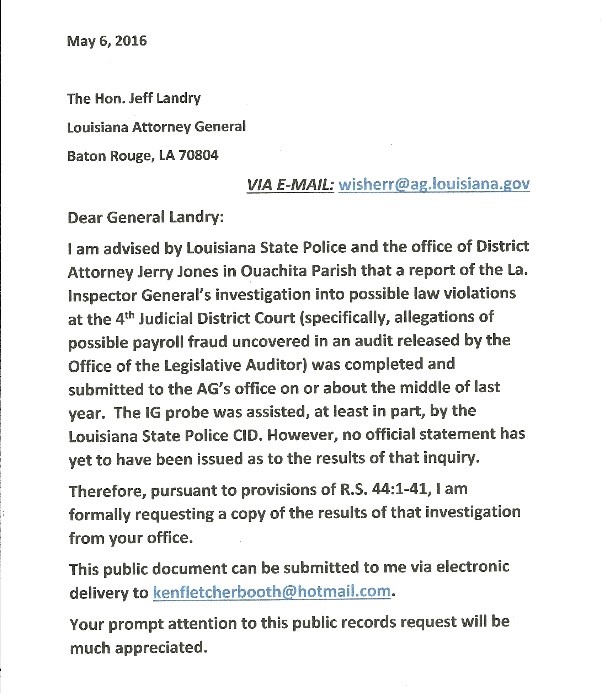
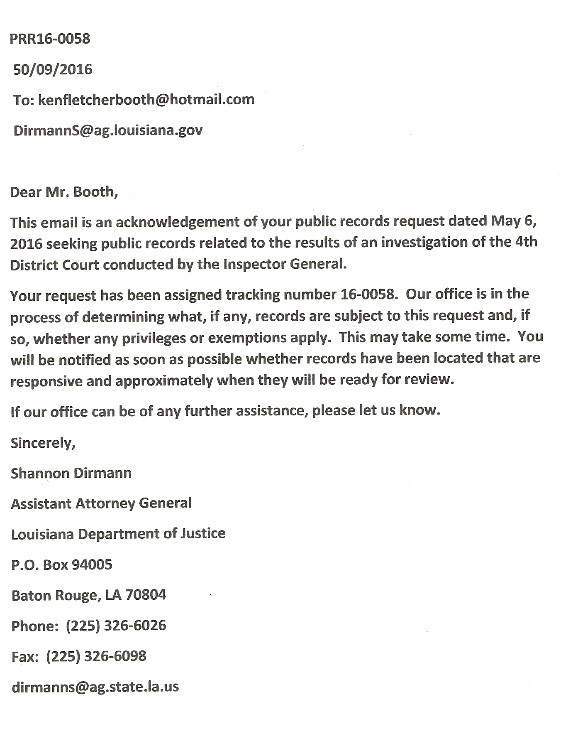
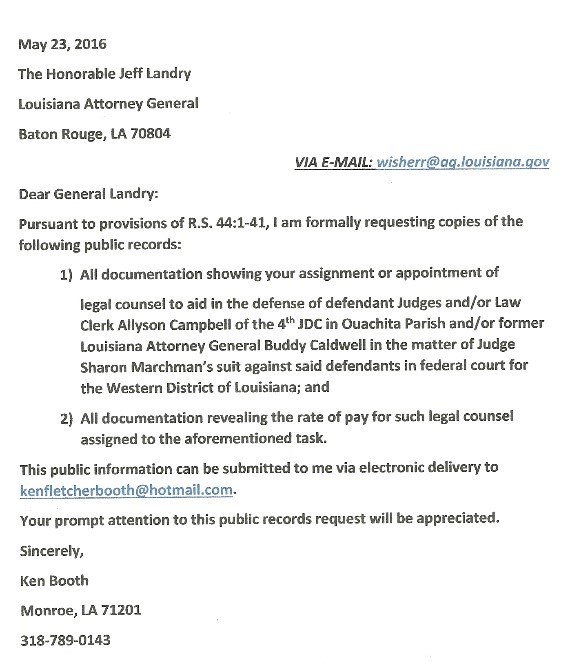
Similarly, a couple of my own requests (shown here) to the new “transparency-minded” and “aggressive” Republican Attorney-General remain without result except for one letter which said it “may take some time.”

In a June 7th E-mail to Landry’s office, I wrote: “I would very much appreciate either the documents requested sixteen days ago or an opinion from that office on why they cannot be produced. Please know this is a public records request that will not go away silently.”

Landry’s press secretary Ruth Wisher has made sure that reporters know that her boss doesn’t always return her texts. Well, that certainly makes everything hunky-dory.

BOOTH REQUEST

AG RESPONSE TO BOOTH

BOOTH FOLLOW UP REQUEST
           Known records requests to the AG’s office also demand access to a state police report on its investigation into the allegations of possible payroll fraud and destruction or concealment of court documents. A report on the findings from a companion investigation by the Inspector General’s office was released back on April 15th. The state police report is known to be in the hands of the Attorney General.

All of this is at odds with the very public Landry who has been throwing his weight around the capitol lately pushing for control of his agency’s own finances, making national headlines while trying unsuccessfully to crack down on illegal aliens, and squaring off (at least publicly) with the Gov. John Bel Edwards as if he hopes to succeed him some day.

But Landry and the 4th Judicial District Court in Ouachita Parish are not the only ones playing keep-away with public records.

LouisianaVoice has been repeatedly stymied by the Louisiana State Police with respect to sought after records.

In fact, as a recent LouisianaVoice post notes, Edmonson has manufactured his own loophole for denying public records requests after tiring, he suggests, of the public learning of “far too many instances of misconduct at LSP followed by a mindset of circling the wagons.”

Several high-profile cases of alleged improper State Trooper conduct have been determined to have been free of wrong doing and are therefore exempt  from public records laws if no diciplinary action is taken. That’s staking out a rather questionable claim by the Supertindent.

Curiously, however, his agency did release records showing payroll fraud had occurred at Troop D headquartered in Lake Charles when the lieutenant there was accused of having instructed the men under his command to pad their time sheets to reflect work that had not been performed.

Ironically, that’s the same charge investigated by the same LSP against the law clerk in Ouachita Parish, the report of which has been hidden from public scrutiny even amid growing speculation nothing will come of the charges against her or the Judges who approved her bogus time sheets. It should be noted that the Troop D lieutenant was found to have engaged in “no wrong doing” and access to any investigation findings with respect to him has been denied. However, a trooper he supervised and who figured in the padded time sheets was fired.

The Superintendent of the Louisiana State Police is appointed by the Governor with consent of the State Senate. Edmonson had—and continues to have—the support of Gov. Edwards.

Edwards is also credited with preserving through his influence, at least indirectly, the job of another Jindal administration hold-over department head, Education Superintendent John White. While White actually is appointed by the Board of Elementary and Secondary Education over which the governor has little control since most board members are elected, his stated support of White certainly didn’t hurt.

JOHN WHITE PHOTO

White, a 2012 BESE appointee, has been under considerable public fire over his steadfast defense of the Common Core program.

White has filed a lawsuit against two individuals seeking public records in five different requests from the Department of Education, presumably to block their access to dirty laundry in that agency as might be said of the lawsuit by the Judges in Monroe against The Ouachita Citizen.

Even considering Louisiana’s notorius reputation for politial scandals, suing private citizens or even the news media by government agencies has plunged the state’s standards to a new low.

As has been pointed out elsewhere the use of unlimited financial and legal resources—all paid for by the taxpayers—to block citizens with limited financial means is a dangerous threat to the very notion of checks and balances that are supposed to protect the public from abuse.

For those elected Louisiana officials to sit back and do nothing to put a stop to this unprecedented assault on the public’s right-to-know is pretty much tantamount to an endorsement of such actions.

And if the civilian public looks the other way when this kind of mess is exposed and doesn’t demand that it stop then expect the level of distrust to grow.


Read Full Post »

By James C. Finney, Ph.D.

Guest Columnist

(Editor’s Note: James Finney is one of two Louisiana citizens (Mike Deshotels is the other) who was named as a defendant in a lawsuit by State Education Superintendent John White in an effort to thwart efforts by the pair to obtain public records from the Department of Education. White has defended his action by pointing out he is not seeking monetary damages from Finney or Deshotel. He failed to mention, however, that it will cost them money from their personal funds to defend the lawsuit while White has the financial resources of the State of Louisiana at his disposal.)


Much has been written about the Student Scholarships for Educational Excellence Program, otherwise known as the Louisiana Scholarship Program, or the voucher program. To summarize: The Department of Education allows vouchers for almost any private school that wants them (or so it seems) and then performs minimal oversight.

The students are tested, but the Department works hard to make sure taxpayers don’t get to see any useful data. The program is based on a premise that it helps poor kids access private schools. But “poor” is 2.5 times the poverty level which, for a family of four, means an annual income of $59,625 is low enough to put a kid in a private school at taxpayer expense. And, of course, the state refuses to release any data about how many children are at which ends of that range of income. And the point is, allegedly, to allow kids to escape failing public schools.

Never mind that the students may have never attended a public school. Ever.

But this post isn’t about that voucher program. It’s about the sneaky alternative that funds private schools by way of tax rebates. The Tuition Donation Rebate Program allows donors to fund private school tuition and recoup most of that donation as a tax rebate.

As might be expected, there are middlemen taking their cut of the money. At the beginning of the program, there was only one such organization—Arete Scholars Louisiana. The registered agent, Gene Mills, he of the Family Forum, has apparently neglected the paperwork required to keep charter 41200779N active with the Louisiana Secretary of State.

Mills, founder of Louisiana Family Forum, was the centerpiece of an extraordinary post by Jason France on his Crazy Crawfish blog in October 2012. https://thecrazycrawfish.com/tag/louisiana-family-fourm/

Founded in 1998, Louisiana Family Forum included as its “Independent Political Consultant” and “Grassroots Coordinator,” former State Sen. Dan Richey. http://www.lafamilyforum.org/about/

As an example of the family values for which Family Forum supposedly stands, Richey, while serving as a state senator from Ferriday in the 1980s, gave his allotted Tulane scholarship to a Caddo Parish legislator’s daughter in exchange for that legislator’s awarding of his scholarship to Richey’s brother as a means of circumventing the informal prohibition against giving the scholarships to immediate family members.

Superintendent John White’s Department of Education, with the approval of the Board of Elementary and Secondary Education (BESE), thought it was critical that there be multiple organizations available to help people support private education rather than pay taxes. So they gave grants of up to $499,750 to ACE Scholarships Louisiana (charter 41590796K) and up to$500,000 for New Schools for Baton Rouge Excellence Scholarship Fund (charter41726088K) so that these limited-liability corporations could each set up their business of accepting donations, funneling them to private schools, and providing the documentation required for the donors to get tax rebates from the Louisiana Department of Revenue.

According to the Louisiana Nonpublic School Choice 2015 Annual Report, which was submitted to BESE but not accepted, the tuition donation rebate program started in 2013-14 with Arete.

Arete’s 2013-14 Arete’s 2014 Annual Report indicates that the organization disbursed 14 scholarships, worth a total of $60,975.02, and all funded by the Atlanta Falcons.

No, that’s not a typo: Those Atlanta Falcons. That amount was confirmed by the Louisiana Department of Revenue: One unnamed taxpayer was issued a rebate in the amount of $60,975.02 in tax year 2014.

According to the state’s 2015 annual report cited above, there were two Student Tuition Organizations active in 2014-15: Arete and ACE. Arete’s 2015 Annual Report confirms the number of scholarships reported by the state, 50, at 24 schools, with a total value of $180,381, while ACE Scholarships Louisiana LLC’s 2015 Annual Report reports 13 scholarships, three schools, and a total of $40,780.67.

The donors of note on Arete’s annual report include the Atlanta Falcons, Chik-fil-A, James Garvey and several other individuals. ACE’s donors were David George and Edward Rispone. According to the Louisiana Department of Revenue, the total of rebates awarded in 2015 was $101,659.85, and they ranged in size from $950 to $47,105.

The numbers exploded in 2015-16, though, especially for ACE.  The state’s voucher report indicates that Arete awarded (as of March 2016) 205 scholarships at 50 schools, ACE awarded 558 scholarships at 77 schools, and New Schools awarded 13 scholarships at four schools. The names of the schools, donors and dollar amounts likely won’t be available for several months, however.

The targets for total scholarship awards (remember those half-million dollar contracts a few paragraphs above) were 1,000 for this year and 1,250 for 2016-17 (ACE) and 75 and 125, respectively for New Schools. So apparently New Schools aimed low and shot lower. Perhaps that’s a good thing, in that taxpayers will see less revenue diverted away from the state’s coffers. On the other hand, this spreadsheet indicates that, as of the end of 2015, New Schools had already collected $300,000 on its contract, and ACE had already collected $249,874.98.

It’s interesting what a person can learn from availing themselves of their rights under Louisiana’s public records law (Title 44).

Read Full Post »

« Newer Posts - Older Posts »