Feeds:
Posts
Comments

Archive for the ‘PACs’ Category

By Morgan Statt, Guest Columnist

It’s 2005, and the National All Schedules Prescription Reporting Act (HR 1132) is on President George W. Bush’s desk ready to sign. With one fell swoop he signs the bill into law, and it grants all states $100 million in funding to aid prescription drug monitoring services. Shortly after, former Louisiana representative Billy Tauzin abandons his post in the House of Representatives and accepts a job as President and CEO of PhRMA, a major lobbying group for pharmaceutical companies. Instead of celebrating the bill being signed into law, Tauzin finds a way to dismantle the allocation of funding.

Now, let’s bring it back to present day. Today, there is an almost daily snippet of news on America’s opioid epidemic, one that has ravaged nearly every area of the country. In 2016, more than 63,600 opioid overdose deaths were reported, the highest number ever, and new reports show that the crisis is lowering the average American life expectancy.

What’s being done to combat the crisis that either directly or indirectly affects millions of Americans?

For one, states are strengthening their prescription monitoring programs, the very thing Rep. Tauzin dismantled funding for in 2005. Although these programs have been in place for a number of years, only a limited number of providers have taken advantage of their ability to detect and deter abuse. Additionally, cities and states across the country have filed lawsuits against pharmaceutical companies for their role in the crisis.

And Louisiana is one of them.

In September 2017, the Louisiana Department of Health filed a lawsuit against 16 drug manufacturers, among them OxyContin maker Purdue Pharma, at the 19th Judicial Court in Baton Rouge. The suit claims that the named companies used aggressive marketing tactics and encouraged physicians to prescribe opioids under the guise that they were not addictive.

Louisiana Attorney General Jeff Landry has said that “Louisiana is one of eight states that has more opioid prescriptions than residents.” Despite the fact that Big Pharma played a role in the opioid epidemic, will these lawsuits actually make a difference? Even if there was an astronomical payout, will these lawsuits help to end the crisis and prevent future epidemics?

The short answer is: no.

Big Pharma is like that rich, popular kid in high school we all knew. They used their money and status to manipulate peers and played off students’ desires to be a part of their inner circle.

Similarly, Big Pharma uses status and influence to get what it wants. Its targets for manipulation span multiple areas of the industry, which include the current regulations in place and clinical trials.

Before we can even have a sliver of hope that a hefty payout will change its ways, we have to tackle the pharmaceutical industry’s influence head-on to see any real impact on its actions. We can start by addressing these two areas of influence.

Drug companies have the ability to fund clinical trials.

Imagine you come out of surgery and are placed on a blood thinner to prevent any clotting from happening once you’re off the operating table. You’ve been told of the internal bleeding side effects, but there just so happens to be no known antidote on the market yet to serve as treatment if such complications arise.

This was the case for the anticoagulant Pradaxa. In 2010, the medication was met with FDA approval and put on the market without an antidote. But then severe internal bleeding incidents took place, and over 1,000 people died as a result of being prescribed the medication. Since then, manufacturer Boehringer Ingelheim has had a slew of Pradaxa lawsuits filed against it for its role in patient harm.

I bring up Pradaxa as an example because it points to issues with the clinical trial process that exist today. In a recent study conducted by Johns Hopkins University, clinical trial funding that has been traditionally provided by the National Institute of Health has fallen dramatically over the years. To supplement the lack of funding, pharmaceutical companies sponsor the trials. But, this presents the opportunity for companies with financial interest in the trial outcomes to favor positive results over any negative side effects that could occur.

In the case of Pradaxa, its industry-funded clinical trial RE-LY was met with criticism from drug safety groups for generalizing the medication’s potential population and failing to be carried out as a double-blind study. Skewed trial results led to hasty FDA approval and ultimately the creation of a $650 million settlement fund in 2014 that Boehringer Ingelheim used to settle over 4,000 claims.

Laws & regulations favor Big Pharma.

Despite legislators’ best attempts to protect consumers, certain laws & regulations currently in place often aid pharmaceutical companies’ business ventures, rather than prioritizing patient safety. One such law that has faced criticism in recent years is the 21st Century Cures Act, which loosened regulations on the drug and medical device approval process.

Although put in place to encourage innovation and quicken the ability for life-saving drugs to get to market, critics argue that the real winners of the bill were the drug companies. As part of the “loosening” of regulations, Big Pharma can now get away with using only “data summaries” instead of conducting full clinical trials to get drug approval. They’re also now able to promote off-label uses for their medications, enabling them to expand their markets – and their profits.

Ironically enough, drug companies aggressively promoted the off-label use of opioids and contributed to the rise in addictions across the country. Look no further than Insys Therapeutics’ push for non-cancer patients to take Subsys, a “powerful, fentanyl-based liquid” originally marketed for cancer patients with pain that couldn’t be treated with any other option.

As much as we’d like to pretend that lawsuits against Big Pharma can play a role in solving the opioid crisis, this isn’t the case. Drug companies’ influence stretches far and wide, and it may be time to strip that influence away little by little.

Let’s scrutinize the laws and regulations in place that give Big Pharma the upper hand. Let’s consider alternative funding sources for clinical trials that would allow little room for bias. But most importantly, let’s find a way to ensure that lawmakers, lobbyists, and other government officials are committed to doing what’s best for the American public rather than chasing that dollar sign.

(Morgan Statt is a Health & Safety Investigator for Consumersafety.org, a consumer information organization which strives to provide information about recalls and safety-related news about drugs, medical devices, food, and consumer products.)

Read Full Post »

New Orleans native Donna Brazile has created quite a stir over her new book Hacks: The Inside Story of the Break-ins and Breakdowns that Put Donald Trump in the White House. But her description of the infighting in the national Democratic Party is mirrored at least in part on a local scale by what has been transpiring in the Louisiana Democratic Party since State Sen. Karen Carter Peterson ousted Buddy Leach as State Chairman in 2012.

Brazile, in her book, described how candidate Hillary Clinton took over the Democratic National Committee’s funding during the primary season while still competing with Sen. Bernie Sanders for the Democratic nomination for President. By gaining control of the party’s finances, Brazile said, Clinton effectively rigged the process to kill whatever chance Sanders may have had to win the nomination.

But paralleling the infighting that developed between followers of Hillary and Sanders, the Louisiana Democratic Party appears to have fallen into its own state of considerable disarray on Peterson’s watch. And its problems, like that of the DNC, can be traced back to money and power.

Back room deals, endorsements, and questionable expenditures in the recent campaign for state treasurer have raised a number of questions. For example:

  • Is State Sen. Neil Riser truly a Republican?
  • If so, why did he lavish money on traditionally Democratic organizations like the Black Organization for Leadership Development (BOLD), THE New Orleans East Leadership PAC, New Orleans East Leadership PAC, Louisiana Independent Federation of Electors, Algiers PAC, Jefferson United, and Treme Improvement Political Society in his campaign for state treasurer?
  • Are the aforementioned actually Democratic organizations or are they simply a means to raising money in exchange for the endorsement of the highest bidder?
  • If they are Democratic organizations, why didn’t they endorse Democrat Derrick Edwards in the first primary instead of waiting until Riser lost—he finished dead last among the four major candidates—to direct their support to Edwards?

BOLD’s open bidding policy pre-dates Peterson. In 2003, the organization endorsed Bobby Jindal over Kathleen Blanco for governor. Of course, that was after Jindal paid BOLD $10,000 for “consulting and printing.”

During his campaign, Riser’s expenditures included $15,000 to BOLD for printing (BOLD, which Peterson’s dad, Ken Carter, co-founded, subsequently listed Riser at the top of its sample ballots), $14.500 in two contributions to New Orleans East Leadership PAC, a $10,000 contribution to the Louisiana Independent Federation of Electors, $6,000 to Algiers PAC for printing, $5,000 to Jefferson United for undetermined expenses, $5,000 to Treme Improvement Political Society.

But the treasurer’s race is merely symptomatic of a far greater problem within the State Democratic Party.

One of Peterson’s first acts as the new State Chairperson in 2012 was to nullify all parish executive committee appointments made during Leach’s tenure. And it’s been downhill ever since.

In an organization that is perpetually financially strapped, the Executive Committee, once stacked with her appointees, awarded her an annual stipend of $36,000 plus expenses. This was done without the approval of the Democratic State Central Committee, most of whom were unaware of the stipend. She has continued taking the money in her second term, again without approval.

Stephen Handwerk, Executive Director of the State Democratic Party, pulls down nearly $100,000 in salary but he has been reluctant to make use of an available database to identify and engage Democratic voters, claiming he has insufficient staff to do so. Yet, he found the time to take a second salaried job with the Democratic National Committee, according to DNC expense reports.

Peterson also has made it a point to take care of family in her role as chairperson. Her sister, Eileen Carter, of Houma, was paid $13,000 during October and November 2015 for “organizational/grassroots consultation,” according to figures provided by the Louisiana Ethics Commission.

Other payments made by the Louisiana Democratic Party under Peterson include:

  • Twelve payments of $600 each to the Chicken Shack of Baton Rouge for party card distribution and catering. Chicken Shack is a business owned by former State Sen. Joe Delpit of Baton Rouge.
  • Four separate payments of $900 each to J&M Transportation of Slidell for state party card distribution. J&M is a limousine service.

Peterson denies being among the three prominent Democrats (including then-Sen. Mary Landrieu) who met with then-State. Rep. John Bel Edwards at New Orleans International Airport in 2015 and tried to convince him to withdraw from the governor’s race so that a moderate Republican might be elected. Landrieu has since apologized for her part in that effort but Peterson has not.

Peterson also threw up roadblocks to the State Democratic Party’s official endorsement of Derrick Edwards (no relation to Gov. John Bel Edwards) for treasurer until after the first primary, in which Edwards led all candidates as the only Democrat in the race.

According to the State Democratic Party’s by-laws, “The Democratic State Central Committee (DSCC) shall conduct such activities, as it deems appropriate to elect Democratic candidates in national, state and local elections.”

Yet, there was Republican Riser’s name at the top of BOLD’s sample ballots which most likely accounts for Peterson’s reluctance to endorse Edwards at the outset.

Gov. John Bel Edwards, despite Peterson’s attempt to get him to drop out of the gubernatorial race, has been loath to support a replacement for her for fear of alienating the Legislative Black Caucus.

But the biggest concern to several Democratic Parish Executive Committee (DPEC) members is the lack of membership on no fewer than 29 parish executive committees, a condition critics attribute to Peterson’s lack of timely appointments.

“There are 29 parishes which have five or fewer members on their committee,” one DPEC member said. “There should be at least 15 members of each parish executive committee. That’s nearly half the state that has non-existent or non-functioning DPECs. Livingston Parish has only seven of 15 seats filled. One member of the Livingston DPEC has been working since February to get the seats filled but that still hasn’t been done even though names have been submitted.”

And nearly two years into Peterson’s second term as state chairperson, there are 33 DSCC vacancies. “If she fills positions at all, it’s usually with her minions,” one DSCC member said.

Parishes with one or more vacancies in DSCC representation include Caddo, Bossier, DeSoto, Sabine, Lincoln, Union, Ouachita, Iberville, Pointe Coupee, West Baton Rouge, West Feliciana, Caldwell, Catahoula, Franklin, LaSalle, Tensas, Concordia, East Carroll, Madison, Tensas, Rapides, Lafayette, Vermilion, Calcasieu, Acadia, Iberia, St. Martin, East Baton Rouge, Livingston, Tangipahoa, Washington, St. Tammany, and Jefferson.

Meanwhile, Peterson in March of this year managed to get herself elected to the DNC as Vice Chair of Civic Engagement and Voter Participation. “How ironic is that?” the DSCC member asked.

“Karen Carter Peterson is an ambitious politician of questionable loyalties who has used her chairmanship of DSCC to build a fiefdom and to launch a national career, all at the expense of the organization she was elected to build and serve,” the DSCC member said.

Read Full Post »

It’s been nearly a year since we’ve written anything about the Louisiana State Board of Dentistry and while there appears to be little going on with the board, there is quite a bit of activity going on beneath that veneer of tranquility, including, apparently, an ongoing FBI audit of the board.

Despite the efforts of State Sen. Daniel Martiny (R-Metairie) who, in 2014 passed legislation to move the board’s headquarters from New Orleans to Baton Rouge, the board has continued to resist the move from its posh high-rent offices on Canal Street.

Our last story about the LSBD was last July. https://louisianavoice.com/2016/07/18/case-of-slidell-dentist-illustrates-unbridled-power-of-dentistry-board-to-destroy-careers-for-sake-of-money/

Apparently the FBI has taken an interest in the LSBD.

The AGENDA for a special March 10 meeting (a Friday, no less) of the board caught the eye of one of our regular readers, a dentist who was put through the board’s mill and ground into so much fodder a few years ago.

Buried on page three of the agenda, under the heading “New Business and any other business which may properly come before the board,” was item IX which said, “Discussion of FBI audit results (p. 50).”

We had no prior knowledge of any FBI audit, although we have been aware that the board’s former attorney is awaiting a disciplinary hearing before the Louisiana Attorney Disciplinary Board. https://louisianavoice.com/2015/11/16/dentistry-board-facing-difficult-future-because-of-policies-contracts-with-attorney-private-investigator-are-cancelled/

At the very bottom of page 3 was a call for an executive session “for the purpose of discussing investigations, adjudications, litigation and professional competency of individuals and staff; because discussion of these topics would have a detrimental effect on the bargaining and litigation position of the Louisiana State of Dentistry.”

It was unclear if the proposed closed-door session was related to the FBI audit or not.

LouisianaVoice will be making a public records request for that FBI audit report and we will publish our findings.

Meanwhile in his farewell address in the winter 2014 LSBD BULLETIN, outgoing President Dr. Wilton Guillory said, “Legislation was recently passed to move the Board’s domicile to Baton Rouge. If that legislation is not changed in the upcoming legislature as I hope, then the Board, who self generates its funds, will have to raise the license fees to fund the move. We have been able to prevent this in years past but will have no choice. We are working with the LDA (Louisiana Dentists Association) and legislators to try to prevent this unnecessary move.”

That self-generation of funds has been a bone of contention between the board and the dentists its disciplines. Because the board sets itself up as accuser, prosecutor and judge, dentists who appear on the board’s radar have little chance of prevailing in disputes.

That is, if they choose to dispute the board—and that’s a big “if” that carries high risks, as in high dollar risks. Often a token fine, if disputed, quickly becomes a five- or even a six-figure fine and more than one dentist has been run out of business by the sheer cost of defending himself from the board’s kangaroo court.

That’s why Martiny, when his own dentist fell into disfavor for a minor offense, took it upon himself to rein in the board by moving it from its Taj Mahal to more modest headquarters in Baton Rouge.

Thanks to State Reps. Robert Johnson (D-Marksville) and Frank Hoffman (R-West Monroe), Martiny’s efforts may be overturned before the move can even be implemented.

House Bill 521 by Johnson and Hoffman has been reported out of committee and is scheduled to be taken up for debate before the full House tomorrow (Wednesday, May 17). Simply put, the bill would amend Act 866 by Martiny, effectively negating that action, and allow the board to remain in either New Orleans or Jefferson Parish.

Hoffman has received $3000 from the Louisiana Dental Political Action Committee since 2011, $500 from Appel Dental, LLC in 2007, and an additional $500 from two individual dentists in 2007 and 2011.

Johnson, meanwhile, has received $6,250 from the Louisiana Dental PAC since 2011, and $500 from the Kid’s Dental Zone of Alexandria, LLC in 2015. He also received $500 each from the same two individual dentists as Hoffman.

We have documented several cases of the board’s heavy-handedness in dealing with dentists, its unscrupulous investigative methods, its dictatorial dealings with dentists and its exorbitant system of fines imposed in order to pay the rent on its office space and to pay its contract private investigator and attorney. We have also written about the legal troubles of that investigator.

Perhaps legislators might like to refresh their memories about the board before they vote on Wednesday. Here are links to just a few of our stories:

https://louisianavoice.com/2016/03/18/like-dental-board-louisiana-board-of-medical-examiners-survives-on-fines-and-incentive-to-punish/

https://louisianavoice.com/2015/04/16/13976/

https://louisianavoice.com/2016/07/07/dentistry-board-member-was-witness-in-earlier-case-now-he-also-decides-insurance-claims-benefits-paid-to-other-dentists/

https://louisianavoice.com/2015/04/15/remarks-by-former-head-of-state-dentistry-board-on-suit-dismissal-reopens-louisianavoice-investigation-of-tactics/

https://louisianavoice.com/2014/03/23/appeal-court-slams-lsdb-tactics-in-reversing-kangaroo-court-license-revocation-board-attorney-rules-on-his-own-objection/

Read Full Post »

A question for Public Service Commissioner Mike Francis:

How much is enough?

And that’s not a rhetorical question. We really want to know what your limits are.

According to Francis, a wealthy man in his own right, he should be entitled to a free lunch.

Literally.

You see, the political campaigns of Public Service Commission (PSC) members, the Louisiana Insurance Commissioner and judges at every level are financed in large part by the very ones they regulate or do business with on a daily basis.

But apparently that association is not cozy enough for Francis, who wants to remove all restrictions on accepting free meals from representatives of utilities, motor carriers, and others regulated by the PSC.

Granted, the PSC purports to hold itself to a higher standard than actual ethics rules allow. Legally, elected officials are allowed to accept up to $60 per day in food and beverage under the guise of “business” lunches or dinners. But, as Baton Rouge Advocate columnist and resident curmudgeon JAMES GILL writes, the PSC, at the urging of members Foster Campbell and Lambert Boissiere, rammed through a rule barring all freeloading.

That didn’t sit well with Francis, who is financially solvent enough to daily feed the entire commission out of his petty cash account.

Saying he wanted the commission to be run like a business, he sniffed that a working lunch is “pretty standard procedure in the real work world.”

Our question to Francis then is this: since when is government run like a business? Businesses are run to make a profit; government is run to provide services for its citizens. The two concepts are like the rails on a railroad track: they never cross though they often do appear to converge.

And then there is our follow up question to Mr. Francis: isn’t it enough that you manage to extract huge sums of money from the industries you regulate in the form of campaign contributions? Why would you need a free lunch on top of that?

After all, your campaign finance reports indicate you received $5,000 from AT&T, $5,000 from ENPAC (Entergy’s political action committee), $5,000 from Atmos Energy Corp. PAC, $2,500 from the Louisiana Rural Electric Cooperative, $2,500 from Dynamic Environmental Services, $2,500 from ADR Electric, $2,500 from carbon producing company Rain CII, $2,500 from Davis Oil principal William Mills, III, $2,500 each from Jones Walker and the Long law firms, each of whom represents oil and energy interests. There are plenty others but those are the primary purchasers of the Francis Free Lunch.

LouisianaVoice would like to offer a substitute motion to the Francis Free Lunch proposal. It will never be approved, but here goes:

Let’s enact a law, strictly enforced, that will prohibit campaign contributions from any entity that is governed, regulated, or otherwise overseen by those elected to the Public Service Commission, the Louisiana Insurance Commission, judgeships at all levels, Attorney General, and Agriculture Commissioner.

  • No electric or gas companies, oil and gas transmission companies, or trucking and bus companies or rail companies could give a dime to Public Service Commission candidates.
  • Lawyers would be prohibited from contributing to candidates for judge or Attorney General.
  • Insurance companies would not be allowed to make contributions to candidates for Insurance Commissioner.
  • Likewise, companies like Monsanto, DuPont, Dow, Syngenta, Bayer and BASF, who control 75% of the world pesticides market, and Factory farms like Tyson and Cargill, which account for 72 percent of poultry production, 43 percent of egg production, and 55 percent of pork production worldwide, could no longer attempt to influence legislation through contributions to candidates for Agriculture Commissioner.
  • Members of the Board of Elementary and Secondary Education (BESE) could no longer accept contributions from individuals or companies affiliated in any way, shape or form with education.

While we’re at it, the Lieutenant Governor’s office oversees tourism in the state. In fact, that’s about all that office does. So why should we allow candidates for Lieutenant Governor to accept campaign contributions from hotels, convention centers, and the like?

This concept could be taken even further to bar contributions from special interests to legislators who sit on committee that consider bills that affect those interests. Education Committee members, like BESE members, could not accept funds from Bill Gates or from any charter, voucher or online school operators, for example.

Like we said, it’ll never happen. That would be meaningful campaign reform. This is Louisiana. And never the twain shall meet. The American Legislative Exchange Council (ALEC) would see to that.

But wouldn’t it be fun to watch candidates scramble for campaign funds if such restrictions were to be implemented?

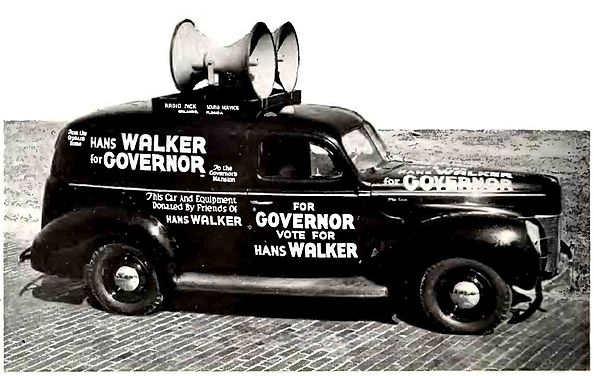
We might even see a return of the campaign sound trucks of the Earl Long era rolling up and down the main streets of our cities and towns after all the TV advertising money dries up.

Ah, nostalgia.

Read Full Post »

Republican U.S. Rep. Charles Boustany apparently moved back to Louisiana for crawfish and now does his best to ignore a new book with a spectacular claim that he was somehow tied to prostitutes murdered in Jefferson Davis Parish (he is suing the author and publisher over that story).

Republican U.S. Rep. John Fleming is running TV ads proudly tying his agenda to that of Donald Trump (though Fleming may now wish to put distance between him and the GOP presidential nominee in light of the release of a recording of Trump’s recent conversation about women).

Democrat Public Service Commissioner Foster Campbell is opting for his “straight talk” TV ads, lashing out at fellow Democrat Caroline Fayard as never having held office and that she “wants to start at the top.”

Republican State Treasurer John Kennedy would “rather drink weed killer.”

Independent former state Alcohol and Tobacco Control Director Troy Hebert just wants to sue somebody.

Absent in all the white noise are any real solutions to problems the nation faces—such as rotting infrastructure, jobs, education, climate change, and closing the racial and economic gaps that continue to divide the country.

And then there is that mysterious ESAFund.com TV ad that attacks both Boustany and Fleming.

The ad blasts Fleming for living in a “million-dollar mansion” in the Washington area and Boustany for getting rich while in Congress and for voting for a pay raise for himself.

Well, as it happens, both Boustany and Fleming are physicians so they probably are rich and likely can afford to live where they choose.

As for Boustany’s “vote” to raise his pay, that claim is downright misleading—and inaccurate.

The fact is, in 1989 Congress passed an obscure bill designed to allow them to avoid the stigma of voting for pay raises. The way it works is if there is no vote specifically not to raise congressional salaries, the pay raise kicks in automatically. Cute.

Accordingly, members of Congress do not vote for pay raises—because they don’t have to—and any claim to the contrary is simply untrue. http://www.politifact.com/florida/article/2011/nov/23/truth-about-congressional-pay-raises/

So, just who is this ESAFund that is behind this attack ad?

Well, it is, of course, a super Pac and it has already spent $5.5 million on the 2016 federal elections, including the ad currently being run in Louisiana. https://www.opensecrets.org/outsidespending/detail.php?cmte=C00489856

Officially known as Ending Spending Action Fund, it claims to be “an independent organization that proudly supports candidates regardless of party affiliation who favor enhancing free enterprise, reducing the size of government, and balancing our nation’s budget.” http://esafund.com/

All of which sounds awfully close to the Tea Party’s platform except ESAFund and the Tea Party often find themselves supporting opposing candidates as in Kansas’ First Congressional District. http://thehill.com/blogs/ballot-box/house-races/289027-conservative-allies-on-opposite-sides-in-gop-primary-fight

Perhaps the biggest irony of ESAFund is that it is a super PAC that is campaigning to end Citizens United, the 2010 U.S. Supreme Court decision that opened the floodgates for super PAC spending in political campaigns. http://endcitizensunited.org/ending-spending-action-fund/

And while the current ad blitz goes out of its way to slam Boustany and Fleming, who, coincidentally, are near the top in most polls, it is careful not to attach its own candidate’s name to the ad. That’s because super PACs are limited as to their direct involvement in the campaigns of individual candidates.

A quick glance at recent history, however, reveals an undeniable link to Kennedy’s campaign. In fact, when former Kennedy top aide Jason Redmond shut down his own Super Pac, Make Louisiana Proud, in July of this year, about $120,000 of its cash and in-kind funds were transferred to ESAFund and ESAFund reciprocated by officially endorsing Kennedy.

https://lapolitics.com/2016/07/super-pac-bows-out-of-senate-race/

All of which makes sense. Kennedy, who once seemed to have an insurmountable lead, has seen his support slipping. That should come as no surprise, given the political heavyweights who are also seeking the Senate seat being vacated by David Vitter.

With other candidates hitting the airwaves with their ads, it was inevitable that Kennedy would see some of his support being drained away, especially given his original decision not to advertise until after the general election. That obviously has changed and Kennedy has begun his own TV ad campaign.

A super PAC is freed from restrictions imposed upon traditional campaign committees so long as it:

Neither gives money directly to a candidate or other political committees that give directly to candidates, and

It does not coordinate how it spends its money with a federal candidate.

https://sunlightfoundation.com/blog/2012/01/31/nine-things-you-need-know-about-super-pacs/

Here is a list of  http://esafund.com/candidates/ endorsed by ESA.

So, while the ESAFund ad attempts to sound principled, and with no attempt here to defend Boustany or Fleming, it still is an attack ad and nothing more.

Before accepting any ad, especially those employing actors posing as concerned Louisiana citizens who almost certainly are not residents of this state (who knows where they actually reside and vote?), remember the number one rule:

Follow the money.

Read Full Post »

« Newer Posts - Older Posts »

