Feeds:
Posts
Comments

Archive for the ‘Legislators’ Category

75b6e117b785e594d770c9bcc52fd34e_2phq_lt4o[1]

(CLICK ON IMAGE TO ENLARGE)

“That clanking sound you heard,” says blogger C. B. Forgotston, “was Louisiana’s proverbial fiscal can hitting the end of the road.” And he has been around state government long enough to know the signs.

“Like a kid behaving badly, we’ve been placed on probation,” added State Treasurer John Kennedy.

Both men’s assessments were in response to the double whammy of two investor rating services’—Moody’s and Standard & Poor’s—action to move Louisiana’s credit outlook from stable to negative on Friday and to threaten the more severe action of a downgrade.

“This should be a wake-up call that we need to stop spending more than we take in,” Kennedy said.  “We’ve drained our trust funds, we’ve relied on nonrecurring money and we’ve had to cut the budget in the middle of the fiscal year for too many years now.  Many have been warning that this day would arrive, and it has.”

The dual action by the two ratings services impacts $2.7 billion in outstanding general obligation debt and $1.25 billion in related debt.

Moody’s warned that continued structural imbalances, steep growth in pension costs, deterioration in financial liquidity and failure to contain costs in the state’s Medicaid system will result in a credit rating downgrade, making it more costly for the state to borrow money.

S & P added a warning that “Should budget adjustments fail to focus on recurring solutions or if the structural gap grows with continued declines in revenue or material reductions in federal program funding to the state, we could lower the rating” even further.

Gov. Bobby immediately attempted to put a positive spin on the bad news (or as Forgotston described it, tried to pour perfume on the manure pile to change the smell but not the content) by saying that the agencies didn’t lower the ratings on the existing outstanding General Obligation bonds.

But what Gov. Bobby did not say, according to Forgotston, was that the rating on those bonds was not lowered because the Louisiana State Constitution gives those bonds first call, even before employee retirement benefits, on all the money in the state treasury. “In other words, if the state goes bankrupt, those bonds will be paid,” he said, adding that future state borrowing will also cost more.

It could also mean that in the event of default, retirees won’t be getting their pension checks, something that should get the gray panthers up in arms.

At this point, we feel it important to point out—just in case anyone still needs reminding—that Gov. Bobby has been traveling all over the country (well, mainly to Iowa and Washington, D.C.) spewing his rhetoric about how he has cut the number of state employees, how Louisiana’s economy is out-performing other states, how new industry is locating to Louisiana, and how little it costs to attend LSU.

Except it’s all part of his big lie—except, of course, the part about hauling state workers out to the curb.

But if he is so hell-bent on claiming and then taking credit for all these wonderful events and trends (of course he never mentions the state’s high poverty rate, poor health care availability, our second lowest median household income, the eighth lowest percentage of citizens with a bachelor’s degree or higher, or our fifth highest violent crime rate), then he must shoulder the blame for the bad news as well.

Any coach will tell you that’s the way the game is played; if you take credit for the wins, you have to take the blame for the losses.

And of course, he never, never does that. Everything out of his mouth is about all the great accomplishments of his administration, and always spouted off in such rapid-fire fashion as to give little chance for argument from dissenters. It’s his style to overwhelm with statistics quoted by rote in his boring staccato delivery.

Well, Bobby, your rhetoric—and for that matter, you as well—are wearing a little thin.

The doubt began creeping in here in Louisiana midway of your first term and has continued to build until now the national media have caught on. Only last week, three or four national stories revealed the pitiful shape you are leaving our state in for your unfortunate successor to attempt to clean up.

Unfortunately, whoever follows you will most likely be a one-term governor because no one can clean up your mess in a single term and the voters are likely to grow weary of whoever is unfortunate enough to follow you and turn him or her out of office after four years in a desperate attempt to find a quick solution that in reality may take decades. You have set this state back that far (Thank you, Gov. Mike Foster for inflicting this plague upon us).

And, Gov. Bobby, you can just mothball your national political ambitions. Being President is a far distant fantasy by now and any prospects of a cabinet position are just as surely disappearing like so much sand through your fingers. You can now only accept that you will go down as one of, if not the most vilified governor in the history of this state. You have succeeded, by comparison, in making Earl Long appear to have been in full control of his mental faculties back in 1959.

And lest anyone think we are giving the legislature a free pass on this situation, think again. With only a handful of exceptions, those of you in the House and Senate have been complicit in this charade of governance. You have aided and abetted this pitiful excuse of a chief executive who, while pandering repeatedly that he had the job he wanted, nevertheless plunged full speed ahead toward his fool’s errand of seeking the Republican presidential nomination. Why, his own family was talking openly of his becoming President—at his first inauguration way back in 2008!

Moody’s and S &P were each quite thorough in laying out the reasoning for their simultaneous actions on Friday.

Moody’s said its action reflects a $1.6 billion structural deficit, continued budget gaps, the state’s large Medicaid caseload, job growth below the national average and significant unfunded pension liabilities.  “The negative outlook reflects the state’s growing structural budget imbalance, projected at $1.6 billion for fiscal 2016, or about 18% of the $8.7 billion general fund even after significant budget cuts of recent years,” Moody’s said. “The state has options for reducing the imbalance, including scaling back various tax credit programs, but the overall scale of balancing measures needed may further deplete resources and reduce the state’s liquidity, which has been one of its strengths.”

S & P was no kinder, citing Gov. Bobby’s reliance on non-recurring revenue which it said only served to increase future budgetary pressures. “In our view, the state’s focus on structural solutions to its general fund budget challenges will be a key determinant of its future credit stability.

“We could consider revising the outlook back to stable if revenue trends stabilize and if Louisiana makes material progress in aligning its recurring revenues and expenditures on a timely basis with a focus on recurring solutions. Should budget adjustments fail to focus on recurring solutions or if the structural gap grows with continued declines in revenue or material reductions in federal program funding to the state, we could lower the rating,” S & P said.

Forgotston, in his own unique way, tells us what Moody’s and S & P were really telling us: “Bobby, you and the legislators have made a big ‘number-two’ mess in your fiscal pants and we have no faith in your ability to clean it up. Folks, don’t let the legislators try to fool you; this is very bad news for us taxpayers and the legislators are the reason for it.”

Yes, it’s easy to blame Gov. Bobby because he has in his seven years initiated every Ponzi scheme one could imagine from giving away something like $11 billion in tax incentives (according to one recent story), to giving away the state’s charity hospitals, to robbing the Office of Group Benefits reserve fund, to attempting to rob the state’s retirement system, to refusing federal grants for needed projects, to rejecting Medicaid expansion and thus depriving the state’s indigent population access to decent health care which in turn led directly to the announced closure of the emergency room of a major Baton Rouge hospital. The list goes on.

But, as Gov. Bobby is so fond of saying, at the end of the day, it was the legislature, through the “leadership” of Senate President John Alario, House Speaker Chuck Kleckley and Appropriations Committee Chairman Jim Fannin that allowed him to do it by refusing to grow a collective set and stand up to this vindictive little amateur dictator.

This is an election year and Louisiana voters—particularly state employees, former state employees who have lost their jobs because of Gov. Bobby, teachers, retirees and the state’s working poor would do well to remember what this governor has done to them and which legislators voted to support the administration’s carnage inflicted upon this state.

There are those few in the House and Senate who have spoken up and tried to be the voices of reason but those voices have been drowned out by Gov. Bobby’s spinmeisters.

So when you vote for governor next fall, you would do well to ignore the TV commercials bought by those who want only to continue down this same path of economic destruction and growing income disparity and consider who you believe really has the best interest of the state, and not the special interests, at heart. In other words, think for yourselves instead of letting some ad agency do your thinking for you.

If you don’t get your collective heads out of the sand and in the most emphatic manner you can muster, tell your neighbors, your friends, your family, the clerk at the store where you shop for food and clothing, the cashier at the restaurant where you eat what this governor and this legislature have done to you and to them, then come next fall, you have no one to blame but yourselves.

The time for joking about Gov. Bobby is over. We’re at the end game now.
Read Full Post »


Louisiana’s colleges and universities are facing some difficult choices.

With the latest round of budget cuts to higher education announced by Gov. in Absentia Bobby Jindal, college presidents have been thrown into deep crisis mode in trying to figure out how to keep their schools afloat in the wake of another $350 million slashed from their cumulative budgets.

The LSU campuses are facing cuts of 35 percent to 40 percent, or about $141.5 million which translates to the elimination of 27 percent of faculty positions, 1,572 courses, 28 academic programs and 1,433 faculty and staff positions, according to Associated Press reporter Melinda Deslatte. http://theadvocate.com/home/11535937-125/lsu-outlines-dire-budget-scenarios

Because of Jindal’s disastrous fiscal policies over the past seven years, repeated budget cuts have been imposed on both health care and higher education.

Conspiracy theorists might attribute that to the goal of the American Legislative Exchange Council (ALEC) and its objective of “taking the state out of state colleges,” or including public colleges and universities in its stated drive toward near total privatization of government.

And those conspiracy theorists, in this case at least, might not be too far off.

As has already been reflected in tuition increases of 90 percent for state colleges and universities in Louisiana since Jindal took office (with more undoubtedly on the way), it’s rather easy to see what such privatization would mean: soaring tuition costs putting college out of reach for all but the wealthiest Americans absent the securing of ever-rising student loans from private banks with debts guaranteed by the federal government (ALEC wants privatization to go just so far, it seems).

The Center on Budget and Policy Priorities has conducted an exhaustive state by state study of cuts to higher education which show Louisiana has undergone some of the deepest cuts (fourth highest in the nation) at 43.6 percent from Fiscal Year 2008 (the year that began six months before Jindal assumed office in January of 2008) through FY-13 (2012-2013). There have been two additional cuts since then in Louisiana. The $4,714 per student cut through FY-13, for example, has increased to more than $5,000 since then in Louisiana. http://www.cbpp.org/cms/?fa=view&id=3927

The center’s report said state could have reduced the size of the spending cuts by enacting “significant new revenues, but many (including Louisiana) chose not to.”

It is an understatement to say that Louisiana colleges and universities are going to have to make some hard decisions, but the one issue that has flown under the radar thus far is intercollegiate athletics.

This is going to get some push back from the more rabid sports fans, especially at LSU which plays in the big leagues of the Southeastern Conference. Not to slight the other schools, but the reality is (as Jindal is fond of saying) the LSU athletic program is the only one in the state that is self-sustaining—but athletics could be adversely impacted in another key area: keeping players academically eligible.

You see, there is something out there called Section 504 of the Rehabilitation Act of 1973 which was written to protect the rights of individuals with disabilities.

Section 504 is employed by elementary and secondary schools to help students with learning and other disabilities but is especially popular in college athletic programs, according to one former high school coach who is familiar with the program.

Because any school receiving federal funding (which is all Louisiana colleges and universities) is mandated to provide extra assistance to those with learning disabilities. Section 504, therefore, is protected and exempt from any state cutbacks—much to the appreciation of college athletic programs.

Athletes with learning disabilities, and let’s be honest: there are a lot of college jocks who can’t read or write above fifth or sixth-grade levels and some have comprehension skills that fall lower than that, are provided special tutors. These tutors, our source tells us, not only do much of the students’ academic assignments for them, but even sit with them during testing, coaxing them on when they provide an incorrect answer and often even pointing to the correct answer.

(Had I had that kind of help at Louisiana Tech, I could have made the dean’s list other than the one I found myself on most of the time.)

There has been much written about Mary Willingham, the former academic advisor at the University of North Carolina who finally had enough and blew the whistle on so-called “paper courses,” or “counterfeit classes” for 18 years involving more than 160 student-athletes.

Willingham said athletes were literally funneled into the program as a means of keeping them eligible at the sacrifice of any semblance of a real education. The “paper classes” produced boiler plate papers that were shamelessly plagiarized. Professors in those classes rarely, if ever, bothered to read the papers but instead relied on counselors who simply advised the professors as to the grade an athlete needed to remain eligible, a practice they called “GPA boosters.”

Willingham said the “paper classes,” many of which were African and African-American studies, were openly discussed as a way to keep athletes eligible to participate in sports. One email from a counselor to a professor advised, “Yes, a D will be fine; that’s all she needs. I didn’t look at the paper but figured it was a recycled one as well, but I couldn’t figure out from where.”

Willingham called the system “corrupt because many of these young men are passed through the system without really being given what they’re promised, which is a real education.”

She said universities have lowered their admissions standards for athletes and the NCAA allows it to keep the revenue-producing sports going.

That’s because NCAA-level college football alone is a $16 billion (with a B) business for tax-exempt, “non-profit” universities which ostensibly are focused on research and education.

No wonder that subsequent to releasing her research on the poor literacy levels, UNC officials went to extreme of hiring outside academics in an attempt to discredit her findings.

We attempted to learn how many LSU athletes are currently participating in the Section 504 program. We submitted the following public records request:

Please provide any and all documents and/or public records that provide the following information;

The number of learning-disabled student athletes currently enrolled at the LSU Baton Rouge campus;

The percentage of learning-disabled student-athletes to the overall student population currently enrolled at the LSU Baton Rouge campus.

Please understand I am not asking for names—just the raw numbers and percentages of overall student population.

LSU responded that it had no record of such data, a claim we find extremely difficult to believe. Nevertheless, we tried once more, making the same request of Louisiana Tech. This time we received not so much as even a response to our request.

Never wishing to leave part of the story untold, LouisianaVoice did a little research of its own into some of the degree programs into which athletes may be “funneled,” to borrow a phrase from Willingham. We should preface what follows by stressing the samples of classes come directly from the LSU 2014-2015 catalog: http://catalog.lsu.edu/index.php?catoid=6

General Studies:

Semester 1: Gen. Ed. Analytical Reasoning MATH Course; “C” or better in ENGL 1001 . Semester 2: Gen. Ed. Natural Sciences; Gen. Ed. Social Sciences or Gen. Ed. Arts; Declare a Degree Program. Semester 3: Gen. Ed. Analytical Reasoning or Gen. Ed. Arts; 2.0 LSU and cumulative GPA.
African & African American Studies: Black Popular Culture (3); African Diaspora Intellectual Thought (3); Topics in History of Africa and the African Diaspora (3) (non-U.S.); Topics in Pre-Colonial Africa (3) (non-US); Special Topics in African & African American Studies (1-3); Black Music in America (3); Folklore of the African Diaspora (3); African American History (3); The New South (3)
Child & Family Studies: General Education course – Humanities (3); General Education course – Natural Sciences (3); Electives (6) or Fundamentals of Communication (3) or Introduction to Performing Literature (3); Public Speaking (3) or Introduction to Agricultural Economics (3)
Kinesiology: KIN 3513 Introduction to Motor Learning (3); KIN 3515 The Physiological Basis of Activity (3); PHYS 2001 General Physics I (3); KIN 3525 Laboratory Techniques in Exercise Physiology (1); KIN 1801 Movement Fundamentals for Physical Activity (2) or KIN 1802 Individual/Lifetime Activities (2) or KIN 1803 Team Activities (2)Sports Administration: History and Philosophy of Kinesiology (3); Sport in Society (3); Introduction to Management Information Systems (3); General Education course – Natural Sciences (3)

Sports Studies Minor: To graduate with a minor in sports studies, students must complete 18 semester hours from the following: KIN 2530 , three activity courses and 12 semester hours from the following courses: KIN 2502 , KIN 2511 , KIN 2525 , KIN 2526 , KIN 3507 , KIN 3800 , KIN 4513 , KIN 4515 , KIN 4517 , KIN 4800 , MKT 3410 .

Okay, you get the picture. Obviously, these are important courses. The beast must be fed so we can continue to kneel at the altar of intercollegiate athletics. Some things, after all, are sacrosanct. The option of cutting these programs is not even on the table.

So the cuts must be made elsewhere. But where?

Oh, such non-revenue producing programs as English, Arts, Physics, Engineering, Medical School (after all, who needs doctors after Jindal’s cuts to health care?), Business, Economics, History, etc. After all, who ever heard of TAF selling tickets to a science lecture?

Loss of accreditation of the business and engineering colleges? Hmpf, we don’t need no stinking accreditation when there’s a national championship to be won.

The alternative could be to sacrifice some of the courses we listed above in an effort at maintaining some semblance of academic integrity.

Of course, that would mean all athletes would have to take real courses—and pass. The lack of academic funding of the university and the resulting cancellation of the courses required for athletic eligibility will deal the death blow to athletic programs as we know them.

And that could have LSU playing Baton Rouge Community College in flag football next season.

Efforts to contact Les Miles and Johnny Jones for confirmation of the mothballing of the 2015 football and basketball seasons were unsuccessful.

We can only conclude that although Jindal, who has exhibited nothing but disdain and contempt for Louisiana’s education systems, knew of the consequences of his administration’s budget cuts on college and university athletic program, this was an “unintended consequence” by the legislature. To that, we can only say to legislators: “You should have done your homework and not sold your soul to Jindal for personal and political gain.”

(Thanks to Ruston High classmate John Sachs for the idea for this post.)

Read Full Post »

Friday traditionally is a slow news day around the State Capitol and observers know that most controversial announcements or bad news releases by the administration of Gov. Bobby Jindal will be issued late on Fridays in the hope that most reporters have gone home for the day.

The timing of the mundane and not-so-good news releases also is such that people just don’t follow events as closely over the weekend.

Accordingly, LouisianaVoice has pulled together some of the stories that are not likely to make the local six o’clock news or cause much stir in the state’s daily newspapers. But they are, nevertheless, stories that we feel deserve at least some attention, so here we go:

Mike Edmonson Retirement Redux

Regular readers will remember our story of last July 11 which launched the major controversy coming out of last year’s legislative session. That was the story about Senate Bill 294 (SB 294) by State Sen. Neil Riser that was signed into law by Gov. Bobby Jindal as Act 859 which gave State Police Superintendent Mike Edmondson that otherwise illegal hefty retirement boost of about $55,000.

The LouisianaVoice story created quite an uproar and culminated with a judicial ruling on a lawsuit by State Sen. Dan Claitor (R-Baton Rouge) that the requirement increase was unconstitutional, which seemed at the time to end the matter.

But not so fast. Claitor, not altogether trusting the system to prevail, has pre-filed a bill which he hopes will tie up any remaining loose ends.

Senate Bill 2 (SB 2) by Sens. Claitor and Barrow Peacock (R-Bossier City) have pre-filed the bill which “repeals provisions for payment to certain DROP (Deferred Retirement Option Plan) participants of a retirement benefit calculated as if the person had not participated in DROP.”

The very title of the bill puts Edmonson—along with one other state trooper who by sheer coincidence qualified for the increase under the Riser bill amendment that was snuck through an unsuspecting legislature on the last day of the 2014 session—squarely in the crosshairs of the Claitor-Peacock bill.

The Riser amendment created one of the uglier moments of the entire legislative session as slowly details leaked out of how Riser, acting on the directions of Gov. Bobby Jindal, attached the amendment to the bill that ostensibly dealt with police disciplinary procedures and once passed, was quickly signed into law by Jindal.

Had the amendment gone undetected, it would have bumped Edmonson’s retirement from $79,000 per year to $134,000 yearly.

Here is the link to the Claitor-Peacock bill by title, followed by a link to the actual bill:

https://www.legis.la.gov/legis/BillInfo.aspx?i=226443

STATE POLICE BILL

Exceptional Jindal profile by Tyler Bridges

And speaking of Jindal, it appears that the national media are beginning to catch on to the Jindal Traveling Road Show, prompted it seems, by his hysterical claim of Islamic enclaves of “no-go” zones in Europe, followed in quick fashion by a silly response to the mention by blogger Lamar White that the governor’s official portrait in his fourth floor office gives the appearance of something like 50 shades of white. It turns out that portrait is a loaner and not the “official” portrait. The “official” portrait gives of a decidedly pinkish hue, making it appear that the white one got a bit too much sun.

Be that as it may, Tyler Bridges, a New Orleans writer, has penned an excellent piece on Jindal’s failed fiscal policies (much more important in the long run than his skin tones) for Politico, a Washington, D.C. news service widely read by political junkies—especially in Iowa, New Hampshire and South Carolina, where Jindal hopes (almost to the point of desperation, it seems) to make early headway in his clumsy efforts to grab the GOP presidential nomination. Here is the link to that superb piece by Bridges:

http://www.politico.com/magazine/story/2015/02/bobby-jindal-campaigning-114948.html?ml=m_t1_2h#.VNTyL005Ccy

LR3 Contract with Economic Development

Last February we dissected the events surrounding the awarding of a $717,000 no-bid contract awarded to LR3 Consulting LLC of Baton Rouge by the Louisiana Office of Economic Development (LED).

That contract, which runs through Sept. 30 of this year, calls for the “development, establishment and/or delivery of a database of potential trainees for continued pre-hire training using a customized assessment instrument to determine skills proficiencies based on individual company requirements.”

We are not altogether sure why a $717,000 contract needed to be awarded to a firm to perform the same duties already being done by the Louisiana Workforce Commission but hey, who are we to question good government?

The contract was broken down into three yearly amounts—$169,999 for the first year (Oct. 12, 2012 through Sept. 30, 2013) and $249,999 for each of the ensuing two years. This was done, according to an LED spokesman, so as to avoid the necessity of issuing a request for proposals (RFP) and thus avoid “competitive bidding or competitive negotiation.”

The issuing of service contracts is permissible so long as the “total contract amount is less than $250,000 per twelve-month period,” according to Title 39, Section 1494.1 of the Louisiana Revised Statutes which then goes on to say, “Service requirements shall not be artificially divided so as to exempt contracts from the request for proposal process.” Hmmm. Seems to us a real proponent of good government would want competitive bidding.

Nevertheless, it has come to our attention that LR3 may well not be a viable entity and thus, ineligible to contract with the state.

A check of the Secretary of State’s corporate web page reveals that LR3 Consulting LLC is “not in good standing for failure to file (an) annual report.”

With nearly eight months left on the LR3 contract, the loss of standing with the Secretary of State should be a concern to Lionel Rainey, III, the agent and sole officer of LR3:

The term “not in good standing” means that a limited liability company is delinquent in filing the annual report required by R.S. 12:1308.1.

The statute goes on to say that each limited liability company which is not in good standing “shall be prohibited from engaging in commercial business operations with the state or its boards, agencies, departments, or commissions.  Any contract between the state or its boards, agencies, departments, or commissions and a limited liability company which is not in good standing may be declared null and void by the board, agency, department, commission, or the division of administration.”

Here is the link to the Secretary of State’s corporate records page which shows that LR3 is not in good standing:

https://coraweb.sos.la.gov/CommercialSearch/CommercialSearchDetails.aspx?CharterID=1001456_F5D52

Our favorite news blog, too?

And speaking of corporate records, one of our favorite political web blogs also turns up as “inactive,” according to the Secretary of State.

We particularly enjoy The Hayride, a Jindal support group blog run by Scott McKay for the off the wall advertisements that are featured daily on his blog. Recently, we’ve seen ads for products that feature a cure baldness almost immediately, a cure for cancer through a Biblical verse, a cure for Alzheimer’s, and even tips on how to invest in gold “form the former director of the U.S. mint,” for a military grade “steroid alternative,” and of course, secret weight loss measures.

But alas, the Secretary of State now tells us that Hayride Media, LLC is no longer active as a corporate entity.

That won’t change the flow of wonderful material coming from the blog, but it does remove any legal protection from litigation that might be lurking in the bushes, ready to pounce on any actual error by The Hayride. We’re just sayin’…

Here is The Hayride’s corporate record entry on the Secretary of State’s web page:

https://coraweb.sos.la.gov/CommercialSearch/CommercialSearchDetails.aspx?CharterID=878951_J6D52

Read Full Post »

What should Louisiana citizens know about a $12 million real estate deal in Iberville Parish between the Louisiana Department of Economic Development (LED) and a Russian Oligarch involving a proposed fertilizer plant on property surrounding a Louisiana National Guard facility?

Apparently nothing, if one judges from the status updates coming from the Jindal administration since the deal was made back in June of 2013.

Throw in a curious buy-back clause contained in the agreement between the state and EuroChem Louisiana LLC, an option for EuroChem to purchase a second tract in St. John the Baptist Parish, and talk about environmental emission credits that were supposedly promised to Eurochem but then appear to have evaporated into…well, thin air, and you have the makings of political intrigue with an international flavor.

Readers may remember our post last October 20 in which we revealed what appeared to be a sweetheart deal between the state and Vantage Health Plan whereby Vantage was allowed to purchase the former Virginia Hotel in Monroe for $881,000 without having to bother with a pesky public auction and sealed bids.

That transaction was made possible (even though there was another party interested in purchasing the building that had been serving as the State Office Building in Monroe) by Senate Bill 216 (SB 216) by Sens. Mike Walsworth (R-West Monroe), Rick Gallot (D-Ruston), Neil Riser (R-Columbia), and Francis Thompson (D-Delhi).

Well, it turns out there was considerably more to SB 216 (which became Act 127 upon the signature of Gov. Bobby Jindal). We saw the bill in its entirety at the time we wrote our story last October but did not understand the significance of a part of the bill entitled Section 3.

Until now.

Section 3 called for the sale of 2,150 acres of land within the town of St. Gabriel in Iberville Parish to a then unidentified “business entity that enters into a cooperative agreement” with the Department of Economic Development.

Not only was the prospective buyer not named in the bill (contrary to the other part of the bill that clearly identified Vantage Health and the purchase price of the Virginia Hotel), but the bill also contained no mention of a purchase price for the Iberville property. Neither the name EuroChem nor a purchase price is contained anywhere in the bill.

It is understandable that the buyer’s name might be left out of the bill, especially if the sale is still pending and nothing has been finalized. But when considering a proposal to dispose of a 2,150-acre tract of property for industrial purposes, one might be reasonably expected to ask how much money is involved before casting a vote on such a measure.

The bill passed the House by a 96-1 vote and by a 31-1 vote in the Senate. Voting against the bill in the House was Rep. Marcus Hunter (D-Monroe) while the lone dissenting vote in the Senate was cast by Sen. Dan Claitor (R-Baton Rouge). Seven senators and eight House members were absent or did not vote.

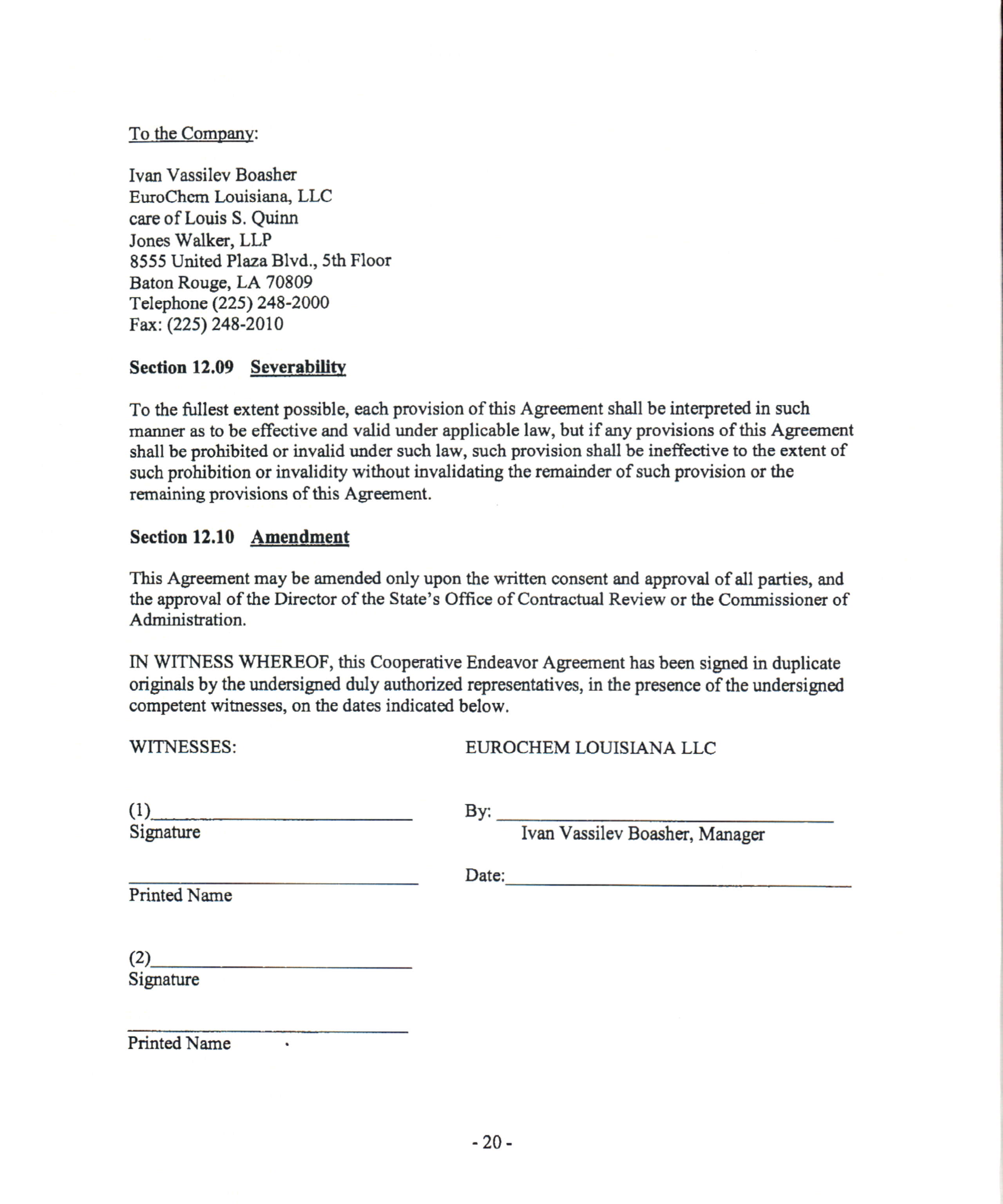
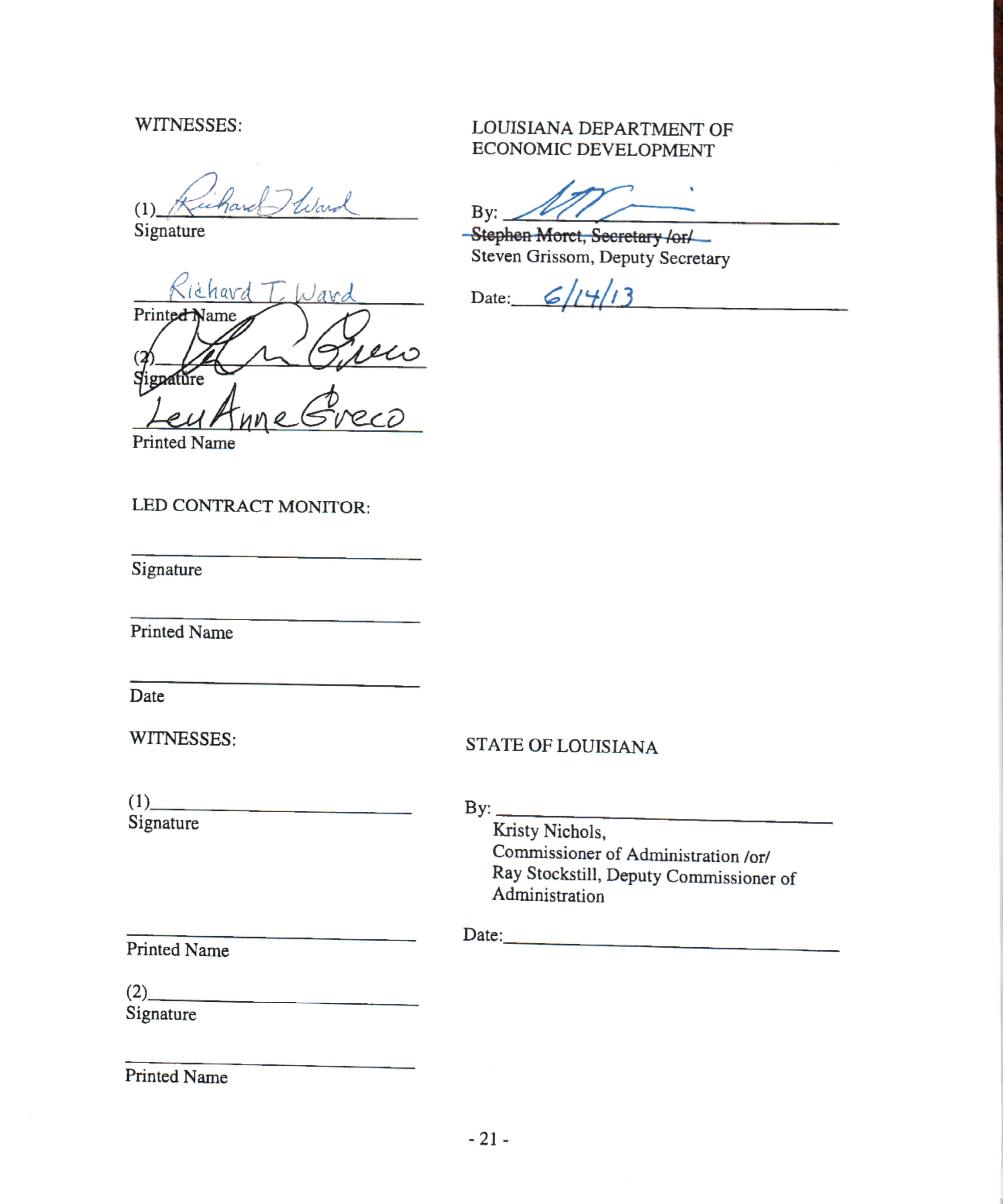
The Senate vote was on April 24, 2013, and the House approval followed on May 22. Gov. Bobby Jindal signed the bill on June 5 and the cooperative endeavor agreement was signed on June 14 by LED Deputy Secretary Steven Grissom—even though the bill did not become law until Aug. 1, 2013. PTDC3577

(CLICK ON IMAGE TO ENLARGE)

The name of the Eurochem representative on the state documents obtained from LED was Ivan Vassilev Boasher, identified only as “Manager.”PTDC3576

(CLICK ON IMAGE TO ENLARGE)

EuroChem, founded in 2001, is a Russian company owned jointly by Melnichenko (92.2 percent of shares) and CEO Dmitry Strezhnev, who owns the remaining 7.8 percent. It was Strezhnev, and not Melnichenko, who joined with Jindal in announcing plans for the $1.5 billion facility.

To secure the project, the state offered the company a competitive incentives package that includes a $6 million performance-based grant to offset the costs of site infrastructure improvements, the announcement said. In addition, EuroChem will receive the services of LED FastStart—the state’s workforce training program. “The company also is expected to utilize Louisiana’s Quality Jobs and Industrial Tax Exemption programs,” Jindal said in making the announcement on July 10, 2013.

“EuroChem is evaluating two final sites for its Louisiana plant,” he said. The Iberville Parish property had been on the market for more than two years through the Office of State Lands, and EuroChem deposited $12 million in an escrow account to buy the property. At the same time, EuroChem also secured an option to purchase a 900-acre, privately-owned tract in St. John the Baptist Parish. “Both Mississippi River sites are being evaluated for construction and logistics suitability, and the company will make a final site decision within the next year,” Jindal said. http://gov.louisiana.gov/index.cfm?md=newsroom&tmp=detail&articleID=4141&printer=1

Well, a year has come and gone and the option on the St. John property, identified by sources as the Goldmine Plantation in the Mississippi River’s east bank near the town of Edgard, which was for 330 days, has expired and was not renewed. No documents requesting permits have been filed with the parishes of St. John or Iberville, the town of St. Gabriel or the U.S. Army Corps of Engineers.

Meanwhile, during the 2014 legislative session—a year after approval of the sale of the Iberville Parish land to an unknown buyer for an undisclosed price—State Rep. John Bel Edwards apparently decided the deal was not a good one in light of the Ukraine crisis which erupted after approval of the cooperative endeavor agreement.

Edwards pushed through House Concurrent Resolution 209 (HCR 209) which requested that LED Secretary Stephen Moret “reevaluate and explore rescinding the cooperative endeavor agreement with the Russian-based company EuroChem.”

Of course the administration promptly ignored the resolution.

The 2,150 acre parcel in Iberville Parish is surrounded on three sides by the Mississippi River and the tract in turn surrounds the Carville Historic District that houses the National Hansen’s Disease Museum, the Gillis W. Long Military Center (Louisiana National Guard facility), and the U.S. Department of Labor’s Carville Job Corps Center. There are no exiting shipping terminals on the tract and the property is prone to flooding during times of high water.

One Iberville Parish official told our sources that he did not believe the project was going to move forward because of relations between the U.S. and Russia over the Ukraine crisis and because of current restrictions in Iberville on air emissions from existing plants which limits the amount of air emission credits available.

And it is those air emission, or carbon, credits that appear to be the key in the entire deal.

One person close to the St. John transaction, told our source that while the prospect of Eurochem’s building a plant in Louisiana is “still alive,” the purchase of the Iberville property “had to do with environmental credits.”

The credits, he said, were available from another company at the time they purchased the Iberville tract but are now gone. He refused to identify the company from whom credits were supposed to be available nor did he say what happened to those credits. “One was the deal (for construction) and one was about emission credits,” he said. “They purchased the Iberville land and continued to do business with us like it never happened.”

A spokesman for the Department of Environmental Quality explained that there are basically two geographic categories when considering air quality standards for permitting: attainment or nonattainment. When an area is considered to be in the nonattainment area, DEQ works with businesses to lower emissions to meet standards through “emissions credits.”

These “credits,” which are provided by the state, are gained by companies that make improvements to their current physical plants in order to reduce oxide and volatile organic compound (VOC) emissions. The credits can be bought and sold much like a commodity on the open market, he explained.

The credits also have to be acquired from companies within that particular designated geographic area that is considered in the nonattainment area.

Because Iberville Parish is within a nonattainment area, Eurochem would have to acquire the credits if planning to make an application for construction and would be required to demonstrate it had sufficient oxide and VOC credits to meet the application approval.

While no one is making any accusations, there is a flourishing international black market for emissions credits that has come under scrutiny by several investigative agencies, including Interpol, which calls carbon trading the “world’s fasting growing commodities market.” Guide to Carbon Trading Crime

http://www.interpol.int/en/News-and-media/News/2013/PR090/

Larry Lohmann, writing for New Scientist, says that the larger carbon markets are “poised on the edge of breakdown.” https://www.academia.edu/3152549/Regulation_as_Corruption_in_the_Carbon_Offset_Markets

Deloitte Forensic, Australia, calls carbon credit fraud “the white collar crime of the future.”

carbon_credit_fraud

Carbon credits also have become a favorite vehicle for money laundering schemes, according to investigative agencies. http://www.redd-monitor.org/2013/08/06/itv-series-fraud-squad-investigates-carbon-credit-criminals/

http://www.marymonson.co.uk/fraud-solicitors/carbon-credit-fraud/

There are too many unknowns about the Iberville Parish land sale, according to retired Gen. Russel Honoré, leader of the Louisiana Green Army coalition. “The state is broke and we’re making deals with foreign entities who are polluters in their own countries,” he said of the Iberville Parish land sale as well as a recent deal with a Chinese company that has had a poor environmental record.

“As much pollution problems and erosion problems as we have in this state, we don’t need to be bringing in these companies from other countries unless they have clean safety and environmental records,” Honoré said.

Still another unanswered question concerns that buy-back clause in the cooperative endeavor agreement between Eurochem and LED. The side of the ledger favoring EuroChem is the $6 million grant the state gave EuroChem, along with all the other tax incentives it is receiving—should the plant be built. But on the plus side for Louisiana is the clause that says if the fertilizer plant is not built, the state has the option of buying the land back at a reduced price or approving the buyer for re-sale.


Read Full Post »

Having laid off about all the personnel he can, after cutting higher education and health care to the bone, and after selling all the state property he can and privatizing state agencies and hospitals to benefit political allies, Gov. Bobby Jindal has finally turned to his only recourse in making even deeper cuts in the state budget to cover an ever-widening deficit: state contracts.

Meanwhile, LouisianaVoice has learned that a Jindal “policy advisor” recently appointed as an Assistant Secretary at the Department of Environmental Quality will remain in that post only about nine months before enrolling in law school.

Chance McNeely, who has served as a $65,000-a-year policy analyst for the governor’s office since last March, began in his new position of Assistant Secretary for Environmental Compliance this month but is already making plans to leave.

Jindal, you may recall, has issued two hiring freezes and two expenditure reductions and even issued a directive last April that “no agency use employee transfers, promotions, reallocations or the creation of new positions in such a manner as to exceed a ceiling” imposed by the administration.

State Treasurer John Kennedy and others have been calling on the governor to cut contract expenses across the board as a means of saving money for the state but those calls have largely been ignored by Jindal who no doubt will now claim this decision as his own.

The state issued 3,576 contracts or contract amendments in Fiscal Year 2014 (July 1, 2013 through June 30, 2014) totaling a little more than $3.6 billion, according to figures provided by the Office of Contractual Review.

The Office of Group Benefits accounted for 17 contracts totaling nearly $1.5 billion, the most of any state agency. Blue Cross Blue Shield of Louisiana has a $1.1 billion contract to administer the health benefits program for state employees, retirees and dependents, which accounts for most of that $1.5 billion figure.

The governor’s office, through the Division of Administration, was second highest with 807 contracts or amendments costing more than $744.2 million.

The Department of Health and Hospitals (DHH) normally has the highest amount of active contracts in terms of value at any given time, but the 730 contracts/amendments approved by DHH during Fy-14 accounted for $454.9 million, third highest among state agencies.

In fiscal 2007 (July 1, 2006 through June 30, 2007), the year before Jindal took office, there were 6,621 active contracts totaling $3.3 billion, up from the $2 billion in contracts during the 2005-06 (FY-07) fiscal year because of hurricanes Katrina and Rita that year. The next year’s total increased to $4.72 billion. Jindal took office in January of 2008, halfway through that fiscal year. In and to $5 billion in FY-2008-09. The number of contracts decreased from 7,286 to 6,781 that year but the cumulative amount of those contracts increased to $5 billion.

The number of state contracts continued to decline through the 2013-14 fiscal year but they increased to a high of $6.55 billion in 2011-12 even though the actual number of contracts continued to decrease to fewer than 4,800.

Across the board cuts will most likely not work as some state contracts necessarily must remain intact. Those would include contracts funded in whole or part by federal dollars in such areas as highway construction, Medicaid benefits and community development projects.

But in many other contracts it will be interesting to see if the cuts will be carried out since many of the contractors are major contributors to the campaigns of Jindal and other state politicians.

Jeez, how will the administration decide which contracts to cut?

Those contractors who don’t pony up with campaign cash are the obvious candidates.

Then there are those who give only token contributions to the governor’s political campaigns. Cuts, yes, but perhaps not so much.

But those who open up their wallets and bank accounts? No way. Gotta dance with who brung you (apologies to the late University of Texas coach Darrell Royal).

A random check by LouisianaVoice turned up 26 companies with state contracts totaling nearly $1.4 billion which, either through the companies themselves or through corporate representatives, have combined to pour more than $283,000 into one or more of Jindal’s state campaigns. That means that for every dollar contributed, the donor receives a contract of nearly $4,947. A 10 percent net profit on those contracts would mean a bottom line return of $495 for every dollar contributed—a nice investment by anyone’s standards.

Having said that, let’s take a look at some major contractors, the amount of their contracts and their campaign contributions (in parenthesis) to Jindal:

  • CSRS, Inc.: $5 million ($10,000);
  • DB Sysgraph, Inc.: $1.2 million ($5,000);
  • United Healthcare: $14.86 million ($20,000);
  • Coastal Estuary Services: $18.87 million ($18,000);
  • Vantage Health Plan: $45 million ($11,000);
  • Louisiana Health Service (Blue Cross Blue Shield of Louisiana): $1.1 billion ($7,500);
  • Alvarez & Marsal: $7.4 million ($5,000);
  • Acadian Ambulance: $4.3 million (13 contracts) ($15,000);
  • Van Meter & Associates: $8.7 million ($17,500);
  • Fitzgerald Contractors: $655,400 ($2,500);
  • Global Data Systems: $1.74 million ($5,000);
  • Sides & Associates: $4.4 million ($6,000);
  • GCR, Inc.: $10 million ($2,000);
  • GCI Technologies & Solutions: $32.5 million ($5,000);
  • SAS Institute, Inc.: $630,000 ($6,000);
  • Hammerman & Gainer, LLC: $67 million ($20,000);
  • Rodel, Parson, Koch, Blanche, Balhoff & McCollister: $3.7 million ($26,500);
  • CH2M Hill: $3 million ($13,500);
  • Burk-Kleinpeter, Inc.: $7 million ($17,500);
  • CDM Smith, Inc.: $6 million (two contracts) ($2,500);
  • Eustis Engineering Services: $3 million ($1,000);
  • Sigma Consulting: $3 million ($21,250);
  • MWH Americas, Inc.: $3 million ($5,000);
  • McGlinchey, Stafford, PLLC: $2.8 million ($17,000);
  • Faircloth, Melton & Keiser, LLC: $4.1 million ($19,000);
  • Adams & Reese, LLP: $1.33 million ($3,350);

In addition to the contributions to Jindal, four contractors also contributed to the Louisiana Republican Party: DB Sysgraph ($5,000), GCR, Inc. ($6,000), CGI Technologies and Solutions ($5,000), and Blue Cross/Blue Shield ($2,000). Blue Cross also contributed $15,500 to Insurance Commissioner Jim Donelon and $2,500 to Speaker of the House Chuck Kleckley (R-Lake Charles).

Vantage Health also contributed $10,000 to Donelon and $3,500 to Kleckley and United Health Care contributed $3,000 to Kleckley.

Another firm, Hunt-Guillot of Ruston, held a three-year, $20 million contract to perform grant management activities in connection to hurricanes Katrina, Rita, Gustav and Ike. That contract expired last June 30. Hunt-Guillot also held a five-month, $3 million contract in 2011 for additional grant management of recovery projects related to Katrina and Rita.

Hunt-Guillot made two contributions totaling $4,750 to Jindal’s campaign in 2007. Additionally, Hunt-Guillot principal Trot Hunt made two contributions of $2,500 each to Jindal during his 2007 campaign for governor.

And Jindal made a $5,000 campaign contribution to Hunt-Guillot principal Jay Guillot during his successful run for the Board of Elementary and Secondary Education in 2011, campaign finance records show.

As the vise tightens around Jindal, who is striving desperately to hold things together until he leaves town a year from now in his quest for the presidency, hard decisions will have to be made. He can’t keep firing employees and he’s run out of state property to sell.

After seven years, it may be in Jindal’s final year that the legislature finally stands up to his amateurish manner of handling the state’s finances. Speaker Kleckley, heretofore one of Jindal’s staunchest allies in the House, has come out publicly in opposition to any additional cuts to higher education. The Public Service Commission earlier refused to surrender its automobile fleet to Jindal who wanted to sell them at auction. It’ll be interesting to see who will be the next to grow a pair.

Jindal is rarely in the state these days and when he is, he is too busy taking potshots at President Obama and planning prayer meetings when he should be minding the store and doing the job to which he was twice elected. There is more than ample evidence by now that Jindal is having trouble holding things together by remote control.

To continue on his course of self-promotion at the expense of four million Louisiana citizens is the worst kind of duplicity and deceit and he most certainly deserves his near certain future of political obscurity.

Read Full Post »

« Newer Posts - Older Posts »