Feeds:
Posts
Comments

Archive for the ‘Judges’ Category

Facing discipline that included recommendations of demotion, reassignment, removal from the SWAT team and a 160-hour suspension without pay, he RESIGNED from the Opelousas Police Department.

When he next popped up, he was working as a public information officer for the St. Landry Sheriff’s Office where he tried to transform his image into that of some sort of John Wayne-George Patton clone.

But that went south as well when it was learned that his salary was being garnished by the FBI because he had paid NO FEDERAL INCOME TAXES for several years and that he was about $100,000 behind in his CHILD SUPPORT payments.

So, it was only natural that Clay Higgins would benefit from the 2016 Trump wave that would sweep him INTO OFFICE as U.S. Representative from Louisiana’s Third Congressional District.

During the 2016 campaign, he was taped by his ex-wife in a TELEPHONE CONVERSATION in which he said, “I’m just learning really about campaign laws…but there’s going to be a lot of money floating around.”

Higgins has established himself in the same mold as state and federal offices-holders Leander Perez, John Rarick, and David Duke in the two short years he has served in Congress.

Mildred “Mimi” Methvin wants to alter the image of the 3rd Congressional District to reflect a more rational approach to addressing the district’s problems at what she calls a “pivotal moment” for the district, state and the country.

Former U.S. Magistrate Judge Mimi Methvin, right, discusses her candidacy for U.S. Representative from the 3rd Congressional District with Ellen Torgrimson, New Orleans, of the League of Women Voters.

She is one of six challengers to Higgins—three other Democrats (one of whom just switched from Republican a few weeks ago), a Libertarian, and a Republican. If qualifications and past performance are any kind of barometer, she would be the hands-down selection as the candidate with the best chance of unseating the enigmatic Higgins.

Mildred “Mimi” Methvin, left, formally qualifies to run for U.S. Representative from Louisiana’s 3rd Congressional District last Wednesday. Looking on is Meg Casper of the Louisiana Secretary of State’s office.

Methvin has worked as a prosecutor in the U.S. Attorney’s office and served 26 years as a U.S. magistrate judge. Magistrate judges are selected on the basis of merit and she was vetted for each of her three terms. In that position, she mediated several complex litigation cases and in 2009, she returned to private practice, having just won a $1.2 million award for a Rapides Parish teacher.

“Our Constitution is a moral covenant,” she says. “The question that must be addressed is this: Does the voice of the average American still count or is the voice of corporate America the only voice heard?

“The people of the 3rd District need to be independent, not bought by the special interests,” she said.

To that end, unlike Higgins, she has eschewed PAC contributions while Higgins has accepted nearly a quarter-of-a-million dollars in PAC money thus far, including contributions from political action committees representing big oil, utilities, defense contractors, health care companies, insurance companies, chemical companies, the NRA (through Russian operatives perhaps?), and even an outfit called the “Support to Ensure Victory Everywhere PAC.”

Methvin listed health care, coastal restoration, and income equality as issues that are important to the district. She was harshly critical of what she described as the transfer of wealth to corporations and of recent attacks by the Trump administration on NATO—and of Higgins’ voting record in Congress.

“Congressman Higgins has turned his back on promises he made as a candidate. Ninety thousand of his constituents have lost their health care while he has put dollars in the pockets of the rich. He is in lock step with the corporations.”

She accused Higgins of “incontrovertible fealty to party loyalty” over the interests of his constituents.

Having once presided over a major case in which a sheriff’s department was held liable for beating an innocent suspect with a metal baseball bat, Methvin definitely has the chops to be tough while standing up for the interests of the citizens of the district.

Higgins’ unwavering devotion to Donald Trump notwithstanding, this could be the most interesting race of all six congressional districts.
 

Read Full Post »

Remember Robert “Robbo” Davidson, the DeSoto Parish sheriff’s chief investigator whose private company ran more than 41,500 background checks through the sheriff’s office in an 11-month period?

Davidson (now retired) was a principal in LAGNIAPPE and CASTILLO RESEARCH and INVESTIGATIONS, which charged customers $12 for each background report and paid the sheriff’s office $3 per report for a profit of more than $372,000 for him and his partner, Allan Neal Castillo.

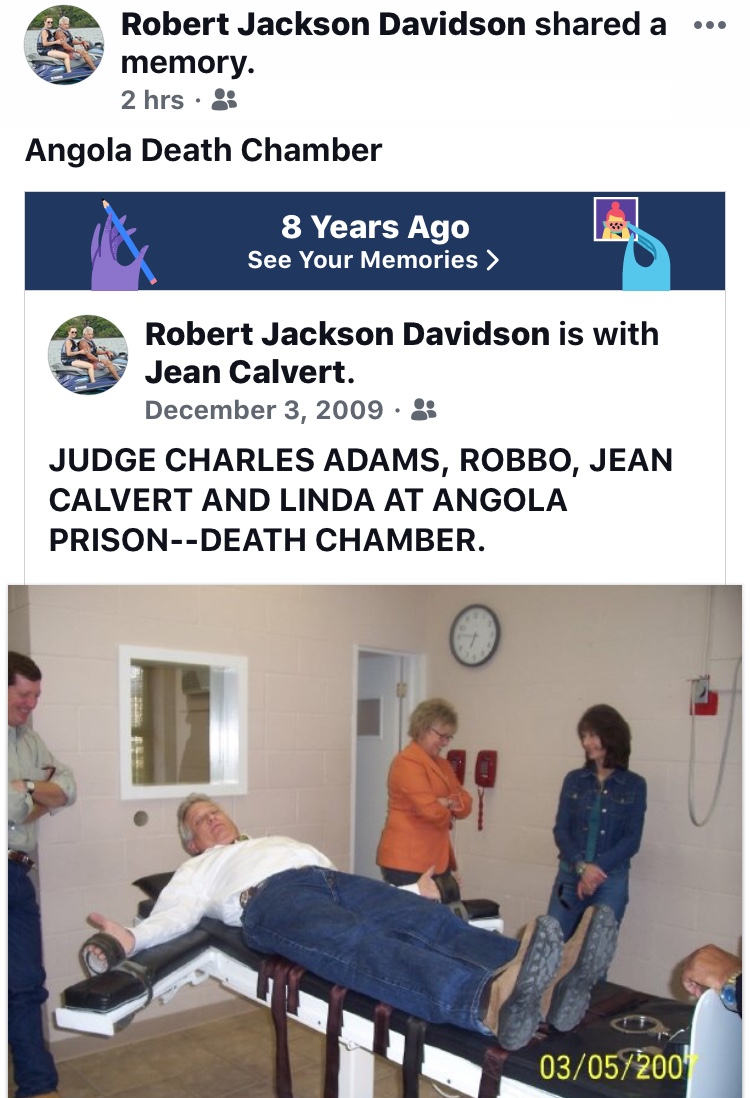
Now, LouisianaVoice has obtained an old Facebook photograph of Davidson, along with 42nd Judicial District Court Judge Charles Adams having a little fun in the Angola State Penitentiary death chamber.

The photo shows Davidson lying on the gurney where lethal injections are administered to death row inmates. Enjoying the moment are, standing, left to right, Judge Adams, Jean Calvert, Adams’s secretary, and Davidson’s wife Linda Davidson, a DeSoto Parish constable.

The most inappropriate aspect of this photo, besides the obvious poor taste of posing for it in the first place, is that there are presently four death row inmates from DeSoto Parish at Angola and should either of the cases be remanded to 42nd JDC by an appellate court, it would put Adams, as the presiding judge, in something of an awkward position.

One of those death row inmates, by the way, is JAMES BALDWIN, father of current DeSoto Parish Sheriff Jayson Richardson.

Richardson recently refused to provide personnel files of the sheriff’s office to Legislative Auditor Daryl Purpera’s office and Richardson fought back with a PETITION for declaratory and injunctive relief. Purpera countered by seeking to move the matter to the 19th Judicial District in Baton Rouge.

The issue of proper jurisdiction was heard by Judge Adams, who ruled that the case would be heard in his court which, in light of his coziness with the sheriff’s office, as depicted in this photo, only serves to raise more questions than answers about the propriety of hearing Richardson’s petition in Adams’s court.

Read Full Post »

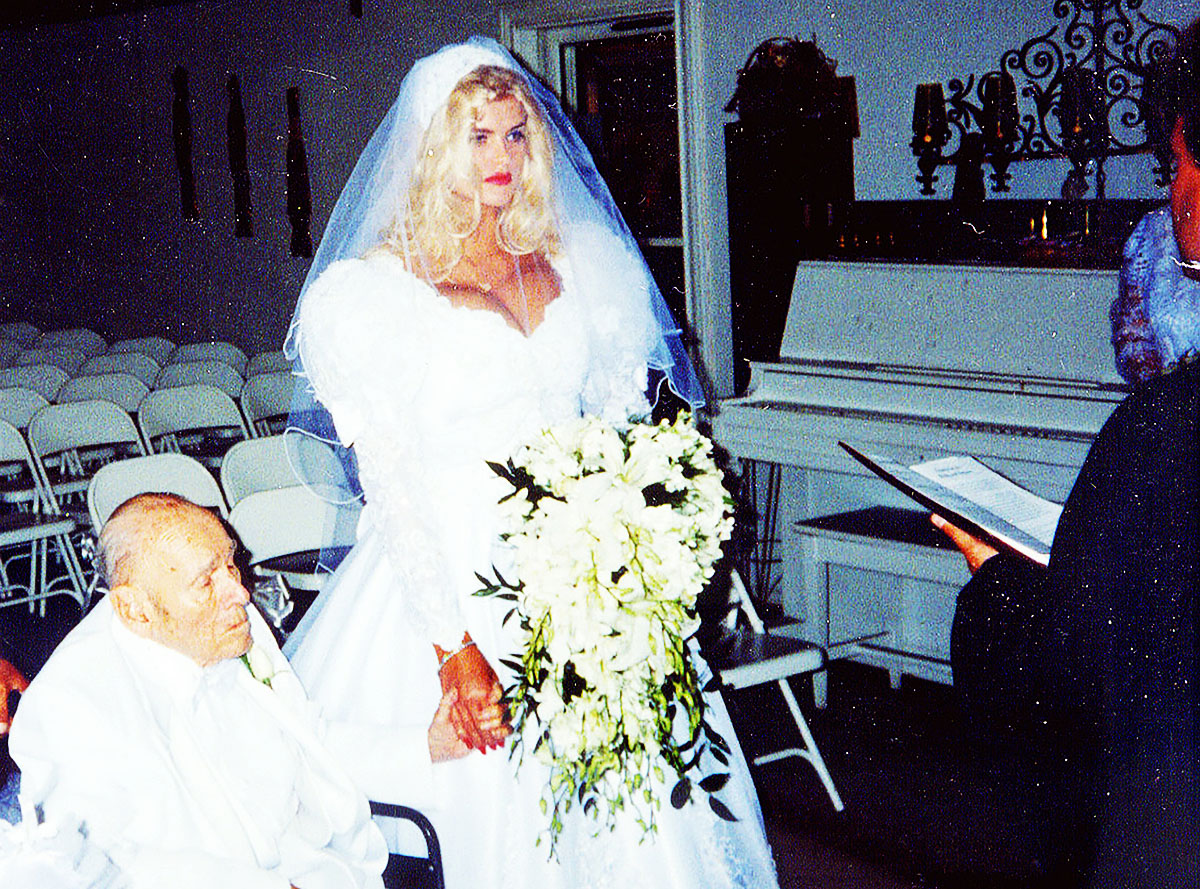
Remember the tacky story of Anna Nicole Smith, the 26-year-old stripper who married the 89-year-old wheelchair-bound gazillionaire J. Howard Marshall back in 1994?

To no one’s surprise, he died a year later. But he did so without ever having bothered to include her in his will.

That’s the kind of stuff that’s tailor-made for the lawyers and sure enough, the battle lines were quickly drawn between the broken-hearted widow and the disinherited younger son Howard III on one side and the remaining children of J. Howard on the other.

The ensuing legal battle out-lived Anna Nicole, who died in 2007 at the ripe old age of 40 of an accidental prescription drug overdose.

And even though he’s been dead nearly a quarter of a century and she’s been gone for a decade, the legal jousting that began in Houston rages on—but now has moved to 14th Judicial District Court in Lake Charles.

The latest legal skirmishes involve the administration of the Marshall family trust, the appointment of one judge as a trustee for the trust, a request for the Louisiana Supreme Court to recuse the presiding judge and all manner of apparent conflicts of interest and questionable judicial conduct on the part of a third Judge, Clayton Davis.

Got it? Didn’t think so.

The common denominator that makes the entire affair one complicated messy knot is that all three judges are from the 14th Judicial District (Calcasieu Parish).

Before going any further with this, it might be helpful to provide a scorecard of the main players:

  • Pierce Marshall Sr.: Prevailed in the extended legal action against Anna Nicole Smith to gain control of the trust which is governed under the Louisiana Trust Code.
  • Elaine Marshall: Widow of Pierce Marshall and named by him as the sole trustee with specific power to name co-trustees.
  • Lilynn Cutrer: 14th JDC judge named as one of the co-trustees of the Trust, which includes significant shares of Koch Industries, the nation’s second-largest privately-owned company. Her fee alone could be as much as $18 million, based on her projected earnings of .3 percent (that’s three-tenths of a percent) of the amount of the trust.
  • Preston Marshall: Son of Pierce and Elaine Marshall who was terminated from the family business for alleged misconduct in 2015 and who is fighting for a share of the enormous trust. “At issue are billions (with a “B”) of dollars,” says his attorney, a claim denied by Elaine Marshall’s legal counsel.
  • Sharon Darville Wilson: 14th JDC judge who has presided over the case for the past two years.
  • Hunter Lundy: Lake Charles attorney who represents Preston Marshall and who filed a motion to recuse Judge Wilson.
  • Clayton Davis: 14th JDC judge who first recused himself from ruling on the recusal motion but then signed an order requesting the Louisiana Supreme Court to assign an ad hoc judge to replace Judge Wilson.

Now here’s where it gets really sticky (as if the entire mess wasn’t slimy enough already).

Hunter Lundy has been in partnership with Clayton Davis for at least 18 years, including the 10 years since Davis’s 2008 election to the bench. Those partnerships included:

  • TEXLA PROPERTIES, formed in 2000 and still active, according to records on file with the Louisiana Secretary of State.
  • LLAAD, LLC, formed in 2005 but now inactive.

Both men are listed as officers of the two entities, domiciled at 501 Broad Street in Lake Charles. That is also the address of the law firm Lundy, Lundy, Soileau & Smith.

  • Matt Lundy, Hunter Lundy’s brother, is listed as manager and Clayton Davis is listed as agent for TIGER SEATS, LLC, also domiciled at 501 Broad Street in Lake Charles and still an active entity. The latest report filed with the Secretary of State was on May 9 of this year.
  • Moreover, Davis was also law partners with the Lundys and from his election in 2008 until last year, Judge Davis was co-owner of the office building housing the Lundy law firm.

Davis, citing his business relationship with the Lundys, properly recused himself on Friday, June 22. But five days later, on June 27, he signed a three-page order asking the Supreme Court to assign an ad hoc judge to replace Judge Wilson.

But if he had already recused himself, it would seem that he had no authority to sign the order—or anything else having anything to do with the trust—which is precisely the argument made by Baton Rouge attorney Richard Sherburne, legal counsel for Elaine Marshall.

“It has long been recognized in our civil procedure that once a judge is recused, or a motion for his recusal has been filed, he has no power to act (except to appoint the proper person to sit ad hoc when the law provides for such an appointment),” Sherburne said. “Any action taken by a recused judge is an absolute nullity,” he added. “The theory of recusation is based upon public policy, for it is applied not only for the protection of the litigants but generally to see that justice is done by an impartial court.” (emphasis Sherburne’s).

RESPONSE TO DAVIS ORDER

In retrospect, this entire sordid mess started when a young stripper spotted a lonely but filthy rich old man in the audience of a strip club and married him only to be left out of his will.

She went to court against the old man’s son, who prevailed but in so doing, apparently had a falling out with one of his sons who now is suing over the appointing of his widowed mother to govern the family trust, rich beyond the average person’s imagination.

And now the lawyers are raking in more money on this one case than most of us will see in a lifetime.

Sometimes it just doesn’t seem to be worth the heartache that goes with having more money than one needs. It reminds me of a couple of relevant lines in the late Harry Chapin’s song Sequel:

“It’s better sometimes, when we don’t get to touch our dreams.”

Simple enough. And then there are these lines further down in the song:

“…From my journey between heaven and hell,

With half the time thinking of what might have been

And half thinkin’ just as well.”

Read Full Post »

In the 10 years that Louis Ackal has served as sheriff of Iberia Parish, his office has paid out more than $2.8 million in lawsuit settlements or judgments, a staggering average of more than $23,000 per month, according to an ASSOCIATED PRESS story.

Abuses and negligence attributed to Ackal, a retired Louisiana state trooper, and his office range from turning VICIOUS DOGS loose on prisoners for the apparent entertainment of deputies to forcing clubs down prisoners’ throats in a simulation of oral sex to the shooting death of a HANDCUFFED PRISONER in a sheriff’s department vehicle which was ruled a suicide despite the his being shot in the chest while his hands were cuffed behind him.

In the latest case, a woman and her two children were awarded in excess of $41,000. That decision stemmed from an incident in which a pregnant Lakitha Wright was thrown to the ground and pepper-sprayed in April 2012.

During the confrontation that ensued after deputies were summoned by neighbors who reported that two of Wright’s relatives were fighting, deputies allegedly shouted racial slurs and erased a cellphone video of the confrontation.

It is unclear whether or not the erasure of the cellphone would constitute evidence tampering but the Wright case was just the latest in a long string of legal setbacks that have plagued the sheriff’s office since Ackal took office in 2008 following his election in November 2007.

And the $2.8 million is only for cases in which the judgment or settlement amounts were revealed. In the case of Victor White, the 22-year-old who was said to have (a) gotten hold of a gun (b) and shot himself in the chest (c) while his hands were cuffed behind him, details of the settlement conference were sealed by the court.

The SETTLEMENT CONFERENCE ORDER, held March 15 in Lafayette federal court, gave both parties 60 days in which to come up with a settlement, which is believed to have been several hundred thousand dollars, although no official announcement has been made to that effect and the local news media have done little to ascertain the final settlement amount. There is, however, a DISMISSAL WITHOUT PREJUDICE, which meant if a reasonable settlement was not reached, the lawsuit could be re-instituted.

Also unknown is whether the sheriff’s office even continues to have liability insurance coverage either because of the cost of premiums associated with a high risk or because companies may simply refuse to underwrite such a loose cannon as the IPSO.

The Victor White death has had other ramifications for the department. U.S. Rep. Cedric Richmond wrote a lengthy LETTER to then-U.S. Attorney General Loretta Lynch in which he requested an investigation into mistreatments and the deaths of eight people while in custody of the IPSO.

When DONALD BROUSSARD initiated a recall of Ackal, he found out just how serious opposition to a powerful man like the local sheriff can be. Broussard found himself on the short end of a NEGLIGENT HOMICIDE indictment in connection with a fatal auto accident in which he was not even involved.

The charges were in obvious reprisal against Broussard for his opposition to Ackal and even though the charges were subsequently dropped, it served as an object lesson as to just how all-powerful a sheriff can be and how willingly some are to abuse that power.

Yes, Ackal was tried and acquitted of all charges. That could be because he was successful in throwing a few deputies under the bus who weren’t so fortunate. Guilty pleas and convictions resulted in the cases of several deputies. It could be because the original judge scheduled to hear his case in Lafayette showed up in court impaired and the case was moved to a different judge—in Shreveport. It could be because he hired a high-dollar defense counsel. Or it could have been a combination of all those things.

And despite Ackal’s acquittal, more than 100 criminal cases involving IPSO deputies dating back to 2008, the year Ackal took office, had to be tossed.

Not all the stories about sheriffs are horror stories. There’s the legendary story of a DC-9 loaded with bales of marijuana being smuggled into the country from Colombia which, in 1977, crashed onto a rural chicken farm just south of Farmerville in Union Parish, Louisiana.

The pilot of the aircraft was killed in the crash but two other Colombian smugglers wedged themselves between the bales of weed and were cushioned as the aircraft sawed off the tops of pine trees and crashed into the farm. (The owner of the farm is said to have sued over the crash because, he claimed, his chickens were traumatized by the crash and stopped laying—although it is unclear whom he would have sued if, indeed, he did.)

As federal, state and local law enforcement officers swarmed the area to investigate the crash and to search for the two survivors, a Union Parish sheriff’s deputy, who apparently had not retained much from his high school geography class, spotted one of the smugglers. He stopped his patrol car and called the man over. “Where you from?” he asked.

“Señor,” answered the still dazed man, “I am from Colombia.”

“You know John McKeithen?” the deputy asked, confusing the South American country for the northeast Louisiana Delta town of Columbia, home of the former governor about 50 miles south-southeast of Farmerville.

“No…”

“Get in th’ car, boy, you’re under arrest. Everbody in Columbia knows John McKeithen.”

Whether that story is true or not, it should be.

But one fact remains: Ackal is still in office and he is still the political power in Iberia Parish—just like any other sheriff is—or was—the political power in his parish: Frank Clancy and Harry Lee in Jefferson, Jerry Larpenter in Terrebonne, Noah Cross in Concordia Parish, “Cat” Doucet in St. Landry Parish, John Grosch and Martin Gusman of Orleans Parish, Gilbert Ozenne of Iberia Parish, and “Dutch” Rowley of St. Bernard Parish, to name just a few past and present.

Or, if you care to venture outside Louisiana, Joe Arpaio of Maricopa County, Arizona; Lee Baca of Los Angeles County; Pat Kelly of Athens County, Ohio; Lawrence Hodge of Whitley County, Kentucky; Chuck Arnold of Gibson County, Tennessee; Tyrone Clark of Sumpter County, Alabama, or Mike Byrd of Jackson County, Mississippi.

It’s enough to leave our ears ringing with that ole cliché: “You’re in a heap-a trouble, boy.”

Read Full Post »

Editor’s note: The following (with added comment) is a guest column provided to LouisianaVoice by the Healthcare Alliance for Regulatory Board Reform (HARBR):

By Christian Wolff

Louisiana Senate Bill 286, dubbed the Physician’s Bill of Rights, fell into a “coma” before the Louisiana Legislature on last Wednesday but not before an outburst over the testimony of the bill’s author.

Sen John Milkovich (D-Shreveport) was in the middle of explaining the obvious conflict of interest on the Louisiana State Board of Medical Examiners when he was interrupted by New Orleans attorney Jack Stolier who twice shouted that Milkovich’s testimony was a “bald faced lie.” (Milkovich’s testimony and Stolier’s off-camera interruption can be heard beginning at the 7:15 MARK of this video of the House Health and Welfare Committee.)

Milkovich had just referenced an “affair” between Dr. Cecilia Mouton, then an investigator for the board of medical examiners, and Stolier, who represented physicians before the board in disciplinary matters.

But hey, the brief flareup was by far the most interesting—and probably the most intelligent—moment of this session sadly marked by legislative ineptitude, indecision, and concerted efforts to bow to the will of special interests st the expense of constituents and Louisiana (See the disgraceful Senate passage of the Payday Loan bill. How anyone can hold out one scintilla of hope for this bunch is beyond comprehension).

After Stolier was escorted from the committee room by Capitol security personnel, Milkovich read from a March 18, 2016, LouisianaVoice post which alluded to the relationship between the two. He also cited a letter from a board director which acknowledged a “personal relationship” between the two. Mouton, now Director of Operations for the board, and Stolier have since married but Milkovich called the romantic link between Mouton, who was prosecuting doctors, and Stolier, who was defending them, a blatant conflict of interest.

This, folks, is typical of the manner in which both the Board of Medical Examiners and the Louisiana State Board of Dentistry disregard due process and run roughshod over members of the medical profession who are charged and deemed guilty without even a nod at procedure. Guilty until proven innocent turns legal procedure on its head and is the very reason why some sort of checks and balances are desperately need to bring these rogue board under control.

But instead, the board, without objection, agreed that the bill be involuntarily deferred, meaning that for all practical purposes, it is dead for this session. (This, by the way, is the same Board of Medical Examiners that has defied a court order and continues to refuse to allow the legislative auditor to see its records so the auditor can do his job.)

Typically, the House does not entertain motions to override/hear bills that were involuntarily deferred in a committee.

This is the same legislature that is on the verge of approving (the Senate already has, by a 20-17 vote) an increase to 167 percent in interest rates payday loan predators can charge, along with doubling loan origination fees. Looks like the American Legislative Exchange Council (ALEC) has been busy this session—as it has in past years.

Advocates of SB 286 praised it on May 2 as an excellent piece of legislation. It was referred to it as “landmark” bill with implications for the due process reforms of healthcare licensing boards in every state in the nation.

Legislators’ indifference—not unlike their indifference to solving the state’s fiscal ills—could open the state up to litigation, leaving it to Attorney General Jeff Landry to try and defend the state, an interesting proposition in itself. Such potential litigation already has a precedent: a recent U.S. Supreme Court decision, North Carolina Board of Dental Examiners v Federal Trade Commission. In that decision, SCOTUS laid out conditions by which licensing and regulatory boards could and could not act as agents of their respective states.

In order to be considered a “state agency,” boards now need to show that they have a voting minority of “market place participants” in the profession being regulated. The other means by which a state regulatory or licensing board may come into compliance with the SCOTUS decision, and now, the Federal Trade Commission (FTC) mandate, is to have demonstrable and meaningful state oversight by an entity or entities which are not marketplace participants in the profession regulated by the board over which they are providing oversight.

The concern of SCOTUS and the FTC is that without meeting at least one of these two conditions, licensing and regulatory boards might act in their own interests rather than in the interest of the public. Moreover, SCOTUS and FTC, are concerned that beyond acting in the interest of their own professions over the interest of the public, boards may act in the interest of boards themselves over the fair and equal interest of given licensees or classes of licensees. This might be called “market capture via regulatory capture” and would be to the detriment of patients, the public, and licensees alike.

States whose regulatory boards do not comply with the conditions set forth in North Carolina Dental Board leave every member of every board including administrative staff and legal counsel legally exposed in their professional capacities and as individuals. Suits might be based in the violation of anti-trust laws, or on injury against persons (such as licensees) who were harmed without the benefit of due process of law.

Healthcare licensees in every state across the nation are being awakened to the injustices which have befallen physicians, and increasingly, other healthcare providers, since the passing of the short-sighted Healthcare Quality Improvement Act in 1986.

Louisiana is not alone by any stretch. It was foolish and immature for the Louisiana House Health and Welfare Committee to put SB 286 to rest in the way it did. When the Physicians’ Bill of Rights awakens from its “Involuntary Deferment” it may well be in a different state already positioned to make the proper move. The first state will set the landmark precedent and if the precedent does not affect national policy, it will be followed by every state in the nation.

Read Full Post »

« Newer Posts - Older Posts »


