Feeds:
Posts
Comments

Archive for the ‘House’ Category

All you folks up in north Louisiana who have been burning up Facebook over that proposed open burn of the 15 million pounds of M6 propellant at Camp Minden need to relax.

All of you who have been in contact with Erin Brockovich in an effort to solicit advice on stopping the burn should just cool your jets.

All of you alarmist who have been saying serious health issues could result from the burn ought to go back to whatever your day job is.

And as for north Louisiana’s congressional delegation, you have your 2016 re-election to think about so perhaps you would be wise to start calling campaign contributors and stop worrying about such things as environmental toxins.

After all, as of today (Jan. 12), Chance McNeely is on the job—until next September anyway—as Assistant Secretary of the Department of Environmental Quality (DEQ) Office of Environmental Compliance at a cool $102,000—a 36 percent bump from his $65,000-a-year salary in the governor’s office.

Not bad for a 26-year-old with virtually zero experience—especially considering how rank and file state employees have gone without pay raises for five years now.

The title alone should scare the bejeezus out of anyone who might endanger the health of residents by the open burning of 15 million pounds of ammunition propellant. I mean, it’s not like they’re spraying Agent Orange on the peach trees in Ruston.

Chance is a 2010 graduate of LSU (B.S. in agricultural business), which gives him four full years of experience in the real world. What more could we ask of someone in charge of compliance with environmental regulations?

Why, just look at his impressive curriculum vitae:

  • He worked for the U.S. House of Representatives from August 2010 to September 2010 (that’s an entire month, folks!);
  • He worked from September 2010 to May 2011 (nine months—almost enough time to give him tenure) as a program assistant (whatever that title entails) for the NRA (speaking of propellants);
  • He then returned to the U.S. House of Representatives as a legislative assistant in May of 2011 and remained there almost three years (that’s two years longer than Vance McAllister served the residents of Louisiana’s 5th District in Congress);
  • Since last March, he has served as a “policy advisor” for Gov. Bobby Jindal’s office. We’re somewhat in the dark as to what type advice an agricultural business major with four years’ experience may have provided Jindal, who has about as much knowledge of agriculture as he does of constructing $250 million wash ‘n’ wear berms in the Gulf of Mexico.

The Office of Environmental Compliance is charged with conducting inspections to ensure facilities are complying with terms of their permits, responding to complaints, evaluating of air and water conditions statewide, underground storage tank regulations and enforcement.

As DEQ liaison for the governor’s office, McNeely, 26, is said to have helped with air quality issues, landfill matters and the Explo Systems explosive issues near Minden. explo-la-4-14-site-removal-action

Well, that’s certainly a comfort. After all, Jindal was only a year older than that when Gov. Mike Foster appointed him to head the Department of Health and Hospitals.

And like Jindal, McNeely doesn’t seem destined to remain in one place long. Sources tell LouisianaVoice he plans to enroll in law school in September.

“He was completely my choice,” said DEQ Secretary Peggy Hatch of McNeely’s hiring. “He has been our policy adviser at DEQ on a number of matters. He was the first who came to my head.”

Hatch may have been more accurate to say she was told by Jindal that McNeely was her choice.

It will certainly be interesting to watch McNeely’s performance in the brewing controversy in Minden. However it plays out, it won’t be pretty.

The M6 was abandoned on site after the bankruptcy of Explo Systems in 2013. A year earlier, in October 2012, one of Explo’s bunkers exploded, rattling homes and shattering windows four miles away and creating a 7,000-foot mushroom cloud.

An ensuing investigation by state police revealed the millions of pounds of M6, used as an explosive propellant for launching artillery shells, stored in 98 bunkers scattered throughout Camp Minden. http://www.thenewsstar.com/story/news/local/2015/01/08/controversy-heats-open-burn-camp-minden/21468283/

The EPA has issued assurances that a controlled open burn is inexpensive and safe, with little environmental impact.

Others disagree.

“Our Louisiana politicians have allowed our beautiful state to become a dumping ground for toxic waste,” said retired Gen. Russel Honoré, leader of the Louisiana Green Army. “Our elected officials have allowed Bayou Corne, Grand Bayou, Mossville, and other communities to be polluted by their out-of-state political donors.

“The EPA-sanctioned open burn at Camp Minden without a doubt puts the health and safety of communities at risk and would not be allowed in California or Massachusetts. The good people of Louisiana deserve no less. The GreenARMY supports the citizens’ demand for accountability and their demand for no open burn at Camp Minden.”

Despite pending EPA approval of the burn, LSU-S organic chemistry professor Brian Salvatore said the EPA’s test burn was only to determine how the material burns and not the by-products in the smoke.

Salvatore said he posed the question of how much uncombusted dinitrotoluene (DNT, one of four chemicals contained in M6) escaped with the burn but was told the heat was too intense for monitoring. DNT causes cancer, he said. “It’s known as a definite carcinogen.

Other chemicals, he said, can cause birth defects and can trigger issues for those suffering from asthma. “All of these things are associated with these chemicals,” he said. “And they will happen.”

He said munitions similar to M6 were burned in Merrimac, Wisconsin in the 1970s and the chemicals leached into the area’s groundwater. He said it took years for symptoms to manifest themselves but officials are now seeing declining health among residents.

He said if the open burn takes place, residents in a 50 mile radius, from the Red River to the Ouachita River, could be affected. http://www.ktbs.com/story/27811846/lsu-s-professor-warns-camp-minden-open-tray-burn-could-cause-cancer-birth-defects

Citizens for Safe Water around Badger, an organization based in Merrimac, has been in contact with local opponents of the Minden burn.

Environmental activist Erin Brockovich has even gotten on board via Facebook. In a message to one Minden area resident, she said, “Change, no matter what it is, starts with you, but sometimes finding the resources for you to enable change can be difficult. It’s about creating awareness of the issues that we all should be concerned about.”

But not to worry. In Washington, the House has passed a bill that effectively prevents scientists who are peer-reviewed experts in their field from providing advice to the EPA.

Rep. Chris Stewart (R-Utah) sponsored H.R. 1422, the Science Advisory Board Reform Act, which changes the rules for appointing members to the Science Advisory Board (SAB).

SAB provides scientific advice to the EPA administrator but the Stewart resolution stipulates that board members “may not participate in advisory activities that directly or indirectly involve review or evaluation of their own work.”

Said another way, a scientist who has published a peer-reviewed paper on a particular topic, say open burning of M6, will not be able to advise the EPA on the findings contained in his or her paper. This means the very scientists who are most knowledgeable about a subject will not be allowed to discuss it.

Rep. Jim McGovern (D-Massachusetts) told House Republicans: “I get it, you don’t like science. And you don’t like science that interferes with the interests of your corporate clients. But we need science to protect public health and the environment.” House Passes Bill that Prohibits Expert Scientific Advice to the EPA | Inhabitat – Sustainable Design Innovation, Eco Architecture, Green Building

So all things considered, it’s good to know Chance McNeely is on the job.

Read Full Post »

Pulitzer Prize winning author Hedrick Smith’s best-selling book Who Stole the American Dream? is a real eye-opener for anyone who still believes our elected officials in Washington are the watchdogs of democracy and are ever-vigilant in protecting the interests of their constituents (that would be you and me).

Smith is not the only one who has tried to warn us of the unholy alliance between Wall Street, large corporations, lobbyists and members of Congress. Charles Derber’s Corporation Nation, says one critic, “is the single best explanation of how big corporations have usurped the power of ordinary citizens…”

David Cay Johnston, another Pulitzer winner, has three books (Free Lunch, Perfectly Legal and The Fine Print) that illustrate how complicated tax laws and federal regulations favor the very rich by transferring the tax burden and other costs to the fast disappearing middle class.

For our purposes here, however, we shall limit the discussion to Smith and his book by highlighting some of the book’s timeline:

  • 1950—Top CEO salary in America: GM chairman Charlie Wilson is paid $663,000, roughly  $5  million  in  today’s  dollars,  and  about  40  times the annual wage of his average assembly line worker. Corporate ethic frowned on CEOs taking stock grants as unfair “competitive avarice.” Economists call this period “The Great Compression because the income gap between the rich and the middle class is at its narrowest in the twentieth century.
  • November 1967—Pat  O’Neill, at nineteen, starts a thirty-five-year career with United Airlines  as  a  jet  airline  mechanic,  working  the  overnight  “graveyard  shift”  at Chicago’s   O’Hare  field. He works his way up to chief mechanic, making $60,000 a year, leading a crew that does repairs and safety checks so that planes are ready to be airborne by dawn.
  • August 1971—Corporate attorney Lewis Powell sparks a political rebellion with his call to arms for Corporate America. Circulated by the U.S. Chamber of Commerce, Powell’s   memo warns that anti-business attitudes and government regulation are threatening to “fatally weaken or destroy” the American free enterprise system. Powell declares that business must arm itself politically, battle organized labor and consumer activists, and mount a long-term campaign to change the balance of power and policy trends in Washington. Later that same year, President Nixon appointed Powell to the U.S. Supreme Court.
  • 1971–1972—The CEOs  of  America’s  biggest  corporations, responding to Powell’s  memo, organize the Business Roundtable, which becomes the most potent political lobbying arm of Corporate America. The National Association of Manufacturers moves its headquarters to Washington. In one decade the U.S. Chamber of Commerce doubles its membership and the National Federation of Independent Businesses (small business) grows from 300 to 600,000 members.
  • 1973—The productivity of U.S. workers rises 96 percent since 1945, and average hourly compensation rises in tandem—94 percent from 1945 to 1973. Average Americans share in the nation’s prosperity.  In the next three decades, from 1973 to 2011, worker productivity rises another 80 percent but hourly compensation rises only 10 percent. Ordinary Americans are cut out of their share of the nation’s economic gains.
  • October 1976—Inspired by their mentor, free market economist Milton Friedman, business school professors Michael Jensen and William Meckling propose in an academic study that CEOs be given stock options to align their interests with those of stockholders. Corporate boards, seeing an advantage because options are not charged as a company expense, adopt this “pay for performance” idea, and by 1980, 30 percent of CEOs are receiving stock option grants.
  • Late 1970s—Business mobilizes politically. The number of companies with Washington lobbying offices grows from 175 in 1971 to 2,445 a decade later. Along with 2,000 different trade associations, businesses have a combined Washington staff of 50,000, plus 9,000 lobbyists and 8,000 public relations specialists. Business lobbyists and advocates now outnumber members of Congress by 130 to 1.
  • 1980—Congress passes a deregulatory bill that overrules state usury laws and effectively abolishes limits on interest rates for first mortgages, paving the way for the future subprime mortgage boom.
  • 1994—The CEO stock option boom takes off. 70 percent of CEOs now receive stock option grants and by 2000, grants of millions of stock options become the norm, hugely increasing CEO pay. Corporate executives overtake the inherited rich as the biggest portion of the nation’s richest 1 percent.
  • 2001–2003—The Federal Reserve, led by Chairman Alan Greenspan, cuts interest rates 11 times from 6.5 percent to 1 percent, providing cheap money to fuel a housing boom and revive the U.S. economy. Home prices rise so fast that Americans borrow $700 billion a year from their home equity. Despite warnings about the dangers of rising personal  debt,  Greenspan  hails  home  owners’  “equity  extraction”  as  the  engine  for consumer demand and economic growth.
  • 2003—Airline  mechanic  Pat  O’Neill  retires from United Airlines after 35 years on the job, but when United Airlines declares bankruptcy, his lifetime pension is drastically cut, and his employee stock option plan collapses. His 401(k) suffers from a sharp stock market decline and he is forced to take another job. To rebuild financially, O’Neill is still working today, and he expects never to retire.
  • 2005–2006—More than half of the people to whom banks sell subprime mortgage loans, at high interest rates with heavy fees, are actually solid mainstream middle-class borrowers who qualified for—and should have been sold—prime loans.
  • 2006—Oracle CEO Larry Ellision, with $706.1 million in pay and stock in 2001, tops a Wall Street Journal compilation of the biggest CEO pay packages from 1995 to 2005. Close behind are Michael Eisner of Disney, with payouts of $575.6 million in 1999 and $203 million in 1993; and Sandy Weill of Citigroup, with pay of $621.8 million in three big years between 1997 and 2000.
  • July 4, 2007—Hundreds  of  workers  at  Sunbeam Razor’s  profitable plant in McMinnville, Tennessee, are laid off and ordered to train their replacements in a factory in Mexico, in a firing ordered by Sunbeam CEO Al Dunlap. Dunlap has makes a personal fortune as a serial downsizer of businesses. Jack Wahl, owner of Sunbeam competitor Wahl Clipper Corporation, criticizes the Sunbeam layoffs as shortsighted and “extremely wasteful,” and says his company runs profitably with U.S. workers.
  • 2007—The richest 1 percent take a near-record 23 percent of the personal incomes paid to all Americans, earning a combined $1.35 trillion a year, which is more than the entire economies of Canada, Italy, or France.
  • 2007—Among economic sectors, corporate profits see their share of national income rise during the Bush years to the highest level since 1943, while the share of national income going to employee salaries and wages sinks to its lowest level since 1929.
  • 2008—In a Cornell University survey, 57 percent of people say they have never benefited from any government program or policy. But questioned in more detail, it turns out that 94 percent have actually benefited from at least one program. The average person has used four government programs.
  • 2009—After a taxpayer bailout, big Wall Street banks rebuff President Obama’s appeal to “hire American.” They continue offshore hiring and domestic layoffs. In the 2000s, the Hackett Group reports, 3.9 million jobs in finance, IT, human resources, and back-office functions have been lost in North America and Europe. In 2011, JPMorgan Chase, Bank of America and Citigroup sign new contracts to offshore $5 billion worth of ITJ and back-office work to Indian firms.
  • 2010—Wall Street financial firms hire 1,447 former government officials as lobbyists to fight new banking regulation legislation, attempting to eliminate or water down provisions for strict regulations. After the bill passes, Wall Street bankers and lobbyists continue the battle to delay or weaken new regulations.
  • 2010—In the Congressional elections of 2010, business interests outspend labor $1.3 billion to $79 million, a 16-to-1 advantage for business. In soft-money contributions to political parties, rather than donations made directly to candidates through political action committees, the business advantage is 97-to-1 ($972 million for business to $10 million for labor).
  • 2010—Thirty-three of 60 new Tea Party members elected to the House are millionaires. Tea Party members have an average net worth of $1.8 million. Overall, 261 of the 535 senators and House representatives are millionaires—49 percent compared to 1 percent among the public at large. http://hedricksmith.com/timeline-who-stole-the-american-dream/

The CEOs of the top corporations in the U.S. made, on average, 331 times the wages of the average rank-and-file U.S. worker in 2013, compared to that 4:1 ratio reported in 1950. The CEO-to-minimum-wage-worker pay ratio was 774:1. http://www.aflcio.org/Corporate-Watch/Paywatch-2014

Between 1978 and 2013, CEO compensation increased 937 percent.

The pay increase of non-supervisory workers during this same time period? 10.2 percent.  http://www.epi.org/publication/ceo-pay-continues-to-rise/

The breaks enjoyed by super rich at the expense of Joe the Plumber are such that even Warren Buffett, Chairman and CEO of Berkshire Hathaway and one of the richest men in America, publicly acknowledged the disparity. Noting that his 2010 tax rate was lower than that paid by 20 of his employees.

“While the poor and middle class fight for us in Afghanistan, and while most Americans struggle to make ends meet, we mega-rich continue to get our extraordinary tax breaks,” he said. “My friends and I have been coddled long enough by a billionaire-friendly Congress. It’s time for our government to get serious about shared sacrifice.”

So, what has all this to do with the price of eggs?

Plenty.

The House this week defeated by a vote of 168-243 House Resolution 5 which would have barred tax deductions for executive pay packages in excess of $1 million unless the company raised worker pay by a percentage tied to its productivity.

We suppose the executives of Wal-Mart need all the help they can get. WAL-MART TAX BREAKS

So how did the Louisiana delegation vote?

Democratic Rep. Cedric Richmond (2nd District) was the only one of the six to vote in favor of the interests of workers over those of in the executive offices.

Voting “no” on the measure were newly elected Reps. Garrett Graves (6th District) and Ralph Abraham (5th District), as well as Steve Scalise (1st District), Charles Boustany (3rd District) and John Fleming (4th District).

We don’t feel that extending even more generous tax breaks for corporate executives to the detriment of those on whose backs they made their fortunes was in the best interest of Louisiana citizens who elected them to be their voices in Washington.

Read Full Post »

Having laid off about all the personnel he can, after cutting higher education and health care to the bone, and after selling all the state property he can and privatizing state agencies and hospitals to benefit political allies, Gov. Bobby Jindal has finally turned to his only recourse in making even deeper cuts in the state budget to cover an ever-widening deficit: state contracts.

Meanwhile, LouisianaVoice has learned that a Jindal “policy advisor” recently appointed as an Assistant Secretary at the Department of Environmental Quality will remain in that post only about nine months before enrolling in law school.

Chance McNeely, who has served as a $65,000-a-year policy analyst for the governor’s office since last March, began in his new position of Assistant Secretary for Environmental Compliance this month but is already making plans to leave.

Jindal, you may recall, has issued two hiring freezes and two expenditure reductions and even issued a directive last April that “no agency use employee transfers, promotions, reallocations or the creation of new positions in such a manner as to exceed a ceiling” imposed by the administration.

State Treasurer John Kennedy and others have been calling on the governor to cut contract expenses across the board as a means of saving money for the state but those calls have largely been ignored by Jindal who no doubt will now claim this decision as his own.

The state issued 3,576 contracts or contract amendments in Fiscal Year 2014 (July 1, 2013 through June 30, 2014) totaling a little more than $3.6 billion, according to figures provided by the Office of Contractual Review.

The Office of Group Benefits accounted for 17 contracts totaling nearly $1.5 billion, the most of any state agency. Blue Cross Blue Shield of Louisiana has a $1.1 billion contract to administer the health benefits program for state employees, retirees and dependents, which accounts for most of that $1.5 billion figure.

The governor’s office, through the Division of Administration, was second highest with 807 contracts or amendments costing more than $744.2 million.

The Department of Health and Hospitals (DHH) normally has the highest amount of active contracts in terms of value at any given time, but the 730 contracts/amendments approved by DHH during Fy-14 accounted for $454.9 million, third highest among state agencies.

In fiscal 2007 (July 1, 2006 through June 30, 2007), the year before Jindal took office, there were 6,621 active contracts totaling $3.3 billion, up from the $2 billion in contracts during the 2005-06 (FY-07) fiscal year because of hurricanes Katrina and Rita that year. The next year’s total increased to $4.72 billion. Jindal took office in January of 2008, halfway through that fiscal year. In and to $5 billion in FY-2008-09. The number of contracts decreased from 7,286 to 6,781 that year but the cumulative amount of those contracts increased to $5 billion.

The number of state contracts continued to decline through the 2013-14 fiscal year but they increased to a high of $6.55 billion in 2011-12 even though the actual number of contracts continued to decrease to fewer than 4,800.

Across the board cuts will most likely not work as some state contracts necessarily must remain intact. Those would include contracts funded in whole or part by federal dollars in such areas as highway construction, Medicaid benefits and community development projects.

But in many other contracts it will be interesting to see if the cuts will be carried out since many of the contractors are major contributors to the campaigns of Jindal and other state politicians.

Jeez, how will the administration decide which contracts to cut?

Those contractors who don’t pony up with campaign cash are the obvious candidates.

Then there are those who give only token contributions to the governor’s political campaigns. Cuts, yes, but perhaps not so much.

But those who open up their wallets and bank accounts? No way. Gotta dance with who brung you (apologies to the late University of Texas coach Darrell Royal).

A random check by LouisianaVoice turned up 26 companies with state contracts totaling nearly $1.4 billion which, either through the companies themselves or through corporate representatives, have combined to pour more than $283,000 into one or more of Jindal’s state campaigns. That means that for every dollar contributed, the donor receives a contract of nearly $4,947. A 10 percent net profit on those contracts would mean a bottom line return of $495 for every dollar contributed—a nice investment by anyone’s standards.

Having said that, let’s take a look at some major contractors, the amount of their contracts and their campaign contributions (in parenthesis) to Jindal:

  • CSRS, Inc.: $5 million ($10,000);
  • DB Sysgraph, Inc.: $1.2 million ($5,000);
  • United Healthcare: $14.86 million ($20,000);
  • Coastal Estuary Services: $18.87 million ($18,000);
  • Vantage Health Plan: $45 million ($11,000);
  • Louisiana Health Service (Blue Cross Blue Shield of Louisiana): $1.1 billion ($7,500);
  • Alvarez & Marsal: $7.4 million ($5,000);
  • Acadian Ambulance: $4.3 million (13 contracts) ($15,000);
  • Van Meter & Associates: $8.7 million ($17,500);
  • Fitzgerald Contractors: $655,400 ($2,500);
  • Global Data Systems: $1.74 million ($5,000);
  • Sides & Associates: $4.4 million ($6,000);
  • GCR, Inc.: $10 million ($2,000);
  • GCI Technologies & Solutions: $32.5 million ($5,000);
  • SAS Institute, Inc.: $630,000 ($6,000);
  • Hammerman & Gainer, LLC: $67 million ($20,000);
  • Rodel, Parson, Koch, Blanche, Balhoff & McCollister: $3.7 million ($26,500);
  • CH2M Hill: $3 million ($13,500);
  • Burk-Kleinpeter, Inc.: $7 million ($17,500);
  • CDM Smith, Inc.: $6 million (two contracts) ($2,500);
  • Eustis Engineering Services: $3 million ($1,000);
  • Sigma Consulting: $3 million ($21,250);
  • MWH Americas, Inc.: $3 million ($5,000);
  • McGlinchey, Stafford, PLLC: $2.8 million ($17,000);
  • Faircloth, Melton & Keiser, LLC: $4.1 million ($19,000);
  • Adams & Reese, LLP: $1.33 million ($3,350);

In addition to the contributions to Jindal, four contractors also contributed to the Louisiana Republican Party: DB Sysgraph ($5,000), GCR, Inc. ($6,000), CGI Technologies and Solutions ($5,000), and Blue Cross/Blue Shield ($2,000). Blue Cross also contributed $15,500 to Insurance Commissioner Jim Donelon and $2,500 to Speaker of the House Chuck Kleckley (R-Lake Charles).

Vantage Health also contributed $10,000 to Donelon and $3,500 to Kleckley and United Health Care contributed $3,000 to Kleckley.

Another firm, Hunt-Guillot of Ruston, held a three-year, $20 million contract to perform grant management activities in connection to hurricanes Katrina, Rita, Gustav and Ike. That contract expired last June 30. Hunt-Guillot also held a five-month, $3 million contract in 2011 for additional grant management of recovery projects related to Katrina and Rita.

Hunt-Guillot made two contributions totaling $4,750 to Jindal’s campaign in 2007. Additionally, Hunt-Guillot principal Trot Hunt made two contributions of $2,500 each to Jindal during his 2007 campaign for governor.

And Jindal made a $5,000 campaign contribution to Hunt-Guillot principal Jay Guillot during his successful run for the Board of Elementary and Secondary Education in 2011, campaign finance records show.

As the vise tightens around Jindal, who is striving desperately to hold things together until he leaves town a year from now in his quest for the presidency, hard decisions will have to be made. He can’t keep firing employees and he’s run out of state property to sell.

After seven years, it may be in Jindal’s final year that the legislature finally stands up to his amateurish manner of handling the state’s finances. Speaker Kleckley, heretofore one of Jindal’s staunchest allies in the House, has come out publicly in opposition to any additional cuts to higher education. The Public Service Commission earlier refused to surrender its automobile fleet to Jindal who wanted to sell them at auction. It’ll be interesting to see who will be the next to grow a pair.

Jindal is rarely in the state these days and when he is, he is too busy taking potshots at President Obama and planning prayer meetings when he should be minding the store and doing the job to which he was twice elected. There is more than ample evidence by now that Jindal is having trouble holding things together by remote control.

To continue on his course of self-promotion at the expense of four million Louisiana citizens is the worst kind of duplicity and deceit and he most certainly deserves his near certain future of political obscurity.

Read Full Post »

U.S. Rep. Steve Scalise’s claim that he did not know who he was talking to when he spoke to that meeting of the Workshop on Civil Rights hosted by the European-American Unity and Rights Conference (EURO) back in May of 2002 is coming unraveled like a cheap suit.

And so too, are the cover stories concocted by participants of that meeting who are trying to pull Scalise’s fat out of the fire.

And those accounts, with their unsavory associations and bizarre twists, constitute some of the most sordid stories imaginable, complete with bombing plots, pornography, escort services, mailing lists and dozens of politicians who subsequently went into scramble mode.

Mark Twain once said, “If you tell the truth, you don’t have to remember anything” and because of conflicting memories of those involved, the coverups appear to be spinning out of control.

Thanks to stellar investigative reporting by blogger Lamar White, Scalise’s position as House Majority Whip could go the same way as that of former Sen. Trent Lott (R-MS) who resigned his post as Senate Majority Leader following his association with a similar white supremacy group, the Council of Conservative Citizens (CCC). Lott resigned from the Senate five years later and now works, along with former U.S. Sen. John Breaux (D-LA) in the powerful Washington lobbying firm Squire Patton Boggs.

CCC and EURO have cross-pollinated over the years to the point where it’s difficult to distinguish one from the other with certain individuals having been—and remaining—members of both organizations.

One of those with just such dual membership is Kenny Knight of Prairieville.

Knight has publicly taken credit for issuing the invitation to Scalise to speak to the Jefferson Heights Civic Association at the Landmark Hotel in Metairie 12 years ago, but not, he said, to EURO, which was scheduled to meet in the same room later that day.

There are several problems with that story.

One, Scalise himself has made no such claim, choosing instead to plead ignorance that he was addressing a white supremacy group in 2002 while he was a member of the Louisiana House of Representatives. He makes no mention of any such civic association. http://www.businessreport.com/article/scalise-defending-amid-rising-scandal-regarding-2002-speech-white-supremacist-event

But claiming ignorance is a pretty weak defense given his comment years ago to New Orleans Times-Picayune reporter Stephanie Grace that he was “like David Duke without the baggage.” http://www.theneworleansadvocate.com/news/state/11213737-123/stephanie-grace-scalises-pitch-to

Duke, of course, was—and is—President of EURO and also addressed the Landmark gathering via teleconference hookup from Europe.

The second inconvenient snag in the failure to communicate (with apologies to the late Strother Martin of Cool Hand Luke) occurred when Knight told the Times-Picayune that he was not a member of EURO http://www.nola.com/politics/index.ssf/2014/12/david_duke_adviser_kenny_knigh.html

Barbara Noble, whom the Times-Picayune  said “was dating Knight” at the time of Scalise’s address (the implication being they might no longer be dating), backed up his claim. “Neither of us were members of EURO,” she said.

But while technically, Knight may not have a member of EURO, a quick check of the Louisiana Secretary of State’s corporate records reveals that he was not only a member of the organization’s predecessor, the National Organization for European American Rights (NO FEAR), he was the organization’s treasurer. (Duke changed the name to EURO after being sued for trademark infringement by No Fear, Inc.)

And what would be Noble’s motivation in having his back if she is a former girlfriend?

A further check of the Secretary of State’s web page also reveals that she and Knight both were officers of or affiliated with five separate corporate entities, three of which are still in good standing with the Secretary of State’s office.

All-American Health & Life Insurance of Metairie is not in good standing for failure to file its annual report with the Secretary of State, records show but both were listed as officers. Knight was the firm’s president she was vice president.

Southeast Solar Distributors likewise is listed as inactive by the Secretary of State. She was the company’s president and Knight its vice president when it was active, records show.

While she is not listed as an officer of T-Mart, Inc. of Prairieville, a telephone call to the business by LouisianaVoice reached her voice mail. Other active businesses in which the two are involved include Axcess Medical Clinic, Inc., of Prairieville (Knight is Director and she is Secretary) and Louisiana Men’s Clinic, Inc. of Mandeville (both are directors).

Louisiana Men’s Clinic is a facility that specializes in the treatment of erectile dysfunction http://louisianamensclinic.com/ while Axcess Medical Clinic appears to be an office complex for physicians owned by the pair.

Two months following Scalise’s address to EURO, Knight was on the Mississippi Gulf Coast representing CCC in its celebration after the Gulfport City Council voted to keep flying the confederate flag.

KENNY KNIGHT

(That’s Kenny Knight in the middle with the white shirt, brown shorts and white beard.)

Accompanying Knight at that rally was Vincent Breeding, one-time resident of Duke’s home and keeper of the EURO flame as its president while Duke served a federal prison term for fraud and tax evasion.

VINCE BREEDING

(Vincent Breeding is on the right wearing the slacks and tie. Kenny Knight is at the far left. And as one reader pointed out, these aren’t Ole Miss frat boys waving the Rebel flag.)

But Breeding, it turns out, had a much darker side. In addition to espousing the virtues of white supremacy, Christian beliefs and conservative values, he hosted an internet website which, in addition to offering graphic pornography, also provided an escort service that catered to all tastes, including black women. That would seem rather difficult to square with the EURO philosophy.

But then Duke himself once published a sexual self-help book for women entitled Finders Keepers under the pseudonym Dorothy Vanderbilt.

In 2003, Breeding was ousted from his leadership role in EURO and was succeeded by Knight but four years later, on Aug. 2, 2007, both Knight and Breeding, along with Barbara Noble, would participate in ribbon-cutting ceremonies for the Ascension Parish Chamber of Commerce.

Breeding, in addition to his porn web page and escort service and his previous employment at a Tampa strip club, once shared an apartment with one Todd Vanbiber who authorities thwarted in his plot to place 14 bombs along two major highways, I-4, the major access route to Walt Disney World, and U.S. 441. The bombings were planned for April 19, 1997, the second anniversary of the Oklahoma City bombing.

Another Duke associate, Don Black, was once shot while attempting to steal the mailing list of the National States’ Rights Party. The man who shot him was Jerry Ray, brother of James Earl Ray. Ironically, Black not only survived the gunshot, but later worked closely with Duke through his web page Stormfront and along the way, married Duke’s ex-wife.

Mailing lists, it turns out, constitute the life blood of organizations such as EURO, CCC, and the KKK. It is those mailing lists that allow the leaders of the organizations to solicit funds from those of like minds and it was just such a list that supported Duke’s lavish lifestyle that finally caught up with him.

And it was that same list that was sold to then-gubernatorial candidate Mike Foster in 1995 for $150,000. Foster failed to report the purchase as a campaign expenditure and would become the first Louisiana governor to be fined for violating the state’s code of ethics for elected officials.

But Foster was not the first by any stretch—nor the last—to be linked to such white supremacy groups. Louisiana Congressman John Rarick and Georgia Gov. Lester Maddox both were members of the old White Citizens Council, forerunner to the CCC.

Former Mississippi Supreme Court Chief Justice Kay Cobb addressed CCC on two occasions and Trent Lott five times, once telling its members that they stood “for the right principles and the right philosophy,” only to later claim he had “no idea” what the organization stood for (we’re beginning to detect a trend here). As nice saves go, Senator, not so much.

Lott also spoke at the 100th birthday celebration of Sen. Strom Thurmond of South Carolina, proclaiming that if the rest of the country had followed Mississippi’s lead in voting for the segregationist “Dixiecrat” when he ran for president in 1943, “we wouldn’t have had all these problems over all these years…” When Lott later apologized for his remarks, the CCC labeled him as “little more than a political prostitute.”

Former Mississippi Gov. Haley Barbour was elected largely on the strength of support from CCC and his photo even appeared with CCC officers on the organization’s website and former Georgia Congressman Bob Barr delivered the keynote speech at the CCC national convention in June of 1998.

Byron De La Beckwith, the man who in 1963 murdered civil rights activist Medgar Evers, was a CCC member as was Charles Sharpe. While serving as South Carolina’s Commissioner of Agriculture, Sharpe was arrested for accepting $20,000 in bribes to protect an illegal cockfighting ring.

And then there is Tony Perkins who, like Lott and Judge Cobb, addressed the Louisiana CCC. His appearance was on May 19, 2001 (almost exactly a year before Scalise’s appearance), when he was serving as a Republican state representative from Baton Rouge. Perkins currently serves as President of the Family Research Council in Washington, D.C.

These are only the more prominent public officials who have affiliated themselves with these groups. There are others. http://www.splcenter.org/get-informed/intelligence-report/browse-all-issues/2004/fall/communing-with-the-council

So we have the CCC, EURO, and the KKK, which are pretty much synonymous with their interchangeable memberships, rubbing shoulders with right-wing, family-values politicians who run for cover the moment the glare of public scrutiny is shone upon them. The only thing missing from the picture are the 30 pieces of silver.

All of which must, by necessity, raise this burning question: Is the price of political fraudulence worth the wear and tear on an elected official’s integrity?

Read Full Post »

In our lowlights review for the first six months of 2014, we were reminded by State Rep. Jerome “Dee” Richard (I-Thibodaux) that we had omitted a major low point in Louisiana politics.

Accordingly, we will preface our second half with the June veto by Gov. Bobby Jindal of HB 142 by Richard and Sens. Francis Thompson (D-Delhi) and Mack “Bodi” White (R-Central) which was pass unanimously by both the House (84-0) and Senate (37-0).

Called by Richard as the only “piece of legislation that would’ve done anything in the form of reform,” HB142 called for a reduction in consulting contracts. Richard said the bill also “would’ve provided transparency in the way the state hands out contracts” and would have provided savings that would have been dedicated to higher education.

“It just made too much sense to Bobby,” Richard said.

Jindal, on the other hand, said the bill would “hinder the state’s efforts to continue to provide its citizens with timely, high-quality services.”

Such high-quality services as paying $94,000 to a firm to assistant students to learn to play during recess; paying consulting fees to Hop 2 It Music Co. or to the Smile and Happiness Foundation.

Jindal also said the bill would “cause significant delays and introduce uncertainty to executing a contract” and would “discourage businesses from seeking opportunities to provide services to the people of Louisiana.”

Which now brings us to the second half of political news that could only occur in Louisiana.

JULY

Troy Hebert back in the news:

Three former ATC supervisors, all black, have filed a federal lawsuit in the Baton Rouge’s Middle District claiming a multitude of actions they say Hebert took in a deliberate attempt to force the three to resign or take early retirement and in fact, conducted a purge of virtually all black employees of ATC.

Baton Rouge attorney J. Arthur Smith, III filed the lawsuit on behalf of Charles Gilmore of Baton Rouge, Daimian T. McDowell of Bossier Parish, and Larry J. Hingle of Jefferson Parish.

The lawsuit said that all three plaintiffs have received the requisite “right to sue” notice from the U.S. Department of Justice pursuant to Equal Employment Opportunity Commission (EEOC) complaints.

So, where are all those savings we were promised?

To probably no one’s surprise except a clueless Gov. Bobby Jindal, the takeover of the Louisiana Office of Group Benefits (OGB) by Blue Cross Blue Shield of Louisiana a scant 18 months ago has failed to produce the $20 million per year in savings to the state.

Quite the contrary, in fact. The OGB fund balance, which was a robust $500 million when BCBS took over as administrators of the Preferred Provider Organization (PPO) in January of 2013, now stands at slightly less than half that amount and could plummet as low as an anemic $5 million a year from now, according to figures provided by the Legislative Fiscal Office.

There is no tactful way to say it. This Jindal’s baby; he’s married to it. He was hell bent on privatizing OGB and putting 144 employees on the street for the sake of some hair-brained scheme that managed to go south before he could leave town for whatever future he has planned for himself that almost surely does not, thank goodness, include Louisiana.

So ill-advised and so uninformed was Jindal that he rushed into his privatization plan and now has found it necessary to have the consulting firm Alvarez and Marcel, as part of their $5 million contract to find state savings, to poke around OGB to try and pull the governor’s hand out of the fiscal fire. We can only speculate as to why that was necessary; Jindal, after all, had assured us up front that the privatization would save $20 million a year but now cannot make good on that promise.

We can save, but we have to let you go…

The Jindal administration announced plans to jettison 24 more positions at the Office of Group Benefits (OGB) as a cost cutting measure for the cash-strapped agency but is retaining the top two positions and an administrator hired only a month ago.

Affected by layoffs are eight Benefits Analyst positions, three Group Benefits Supervisory spots, one Group Benefits Administrator, seven Administrative Coordinators, an Administrative Assist, two Administrative Supervisors, one IT Application Programmer/Analyst and one Training Development Specialist.

All this takes place at a time whe OGB’s reserve fund has dwindled from $500 million at the time of the agency’s privatization in January 2013 to about half that amount today. Even more significant, the reserve fund is expected to dip as low as $5 million by 2016, just about the time Jindal leaves town for good.

Completing the trifecta of good news, we also have learned that health benefits for some 200,000 state employees, retirees and dependents will be slashed this year even as premiums increase.

Neil Riser helps Edmonson revoke the irrevocable:

One of the single biggest state political stories of the year was the surreptitious attempt of State Sen. Neil Riser to slip an amendment into an otherwise nondescript bill ostensibly addressing procedures in handling claims against police officers that would have given State Police Superintendent Mike Edmonson an illegal $55,000 per year retirement boost.

Events quickly began to spin out of control after Riser first denied, then admitted his part in the ruse and as retired state police opposed the move and public opinion mounted against the move, Edmonson, after first claiming he was entitled to the raise, finally relented and said he would not accept the increase.

Meanwhile, Jindal, who signed the bill, was eerily quiet on the issue despite speculation he was behind the attempt to slip the increase into the bill.

State Sen. Dan Claitor, just to make sure Edmonson didn’t go back on his word, filed suit to block the raise and a Baton Rouge judge agreed that the bill was unconstitutional.

The bill, which quickly became known as the Edmonson Amendment, along with the Office of Group Benefits fiasco, constituted the most embarrassing moments for a governor who wants desperately to run for president.

AUGUST

Selective—and hypocritical—moral judgments

Gov. Bobby Jindal weighed in early on the kissing congressman scandal up in Monroe. When rookie U.S. Rep. Vance McAllister was revealed on video exchanging amorous smooches with a female aide, Jindal was all over him like white on rice, calling for his immediate resignation.

Jindal’s judgmental tone was dictated more by the philosophical differences between the two (McAllister wanted the state to expand Medicaid, Jindal most assuredly did not) than any real issues based on morals as Jindal’s silence on the philandering of U.S. Sen. David Vitter who did a tad more than exchange affectionate kisses.

Edmonson Amendment spawns other state police stories:

LouisianaVoice, in its continuing investigation of the Department of Public Safety (DPS), learned that a number of DPS employees enjoy convenient political connections.

  • Dionne Alario, Senate President John Alario’s daughter-in-law, is a DPS Administrative Program Manager;
  • Alario’s son, John W. Alario, serves as a $95,000 per year director of the DPS Liquefied Petroleum Gas Commission.
  • DPS Undersecretary Jill Boudreaux retired on April 28 from her $92,000 per year salary but the day before, she double encumbered herself into the position and reported to work on April 30 in the higher position of Undersecretary. Commissioner of Administration Angéle Davis ordered her to repay the 300 hours of annual leave (about $46,000) for which she had been paid on her “retirement,” but Davis resigned shortly afterward and the matter was never pursued.
  • DPS issued a pair of contracts, hired the contractor as a state employee, paid her $437,000 to improve the Division of Motor Vehicles and ponied up $13,000 in airfare for trips to and from her home in South Carolina. The contractor, Kathleen Sill, heads up a company called CTQ but the company’s web page lists Sill as its only employee.
  • Boudreaux’s son-in-law Matthew Guthrie was simultaneously employed in an offshore job and was on the payroll for seven months of the State Police Oil Spill Commission.
  • Danielle Rainwater, daughter of former Commissioner of Administration Paul Rainwater was employed as a “specialist” for State Police.
  • Tammy Starnes was hired from another agency at a salary of $92,900 as an Audit Manager. Not only was her salary $11,700 more than state trooper Jason Starnes, but she is in charge of monitoring the agency’s financial transactions, including those of her husband.

Thanks, retirees; here’s your bill for medical coverage:

LouisianaVoice was first to break the news that the Jindal administration was planning to force retirees out of the Office of Group Benefits by raising premiums astronomically and slashing benefits.

The news sparked waves of protests from employees and retirees alike, prompted legislative hearings at which Commissioner of Administration Kristy Nichols looked more than foolish in their attempts to defend the ill-conceived plan.

The entire fiasco was the result of the Jindal administrations foolish decision to cut premiums, which allowed the state to be on the hook for lower contributions as well. The money the state saved on matching premiums went to help patch those recurring holes in the state budget. Meanwhile, because of the lower premiums, the $500 million OGB reserve fund shrank to about half that amount as OGB spent $15 million per month more than it received in premiums.

All this occurred just three years after then-Commissioner of Administration Paul Rainwater, in a letter on the eve of the privatization of OGB, promised the continuation of quality service, rates that would be “unaffected” with any increases to be “reflective of medical market rates.” More importantly, he emphatically promised that benefits “will NOT change.”

HHS_2013_SNPS_35_Day

OCTOBER

What premium decrease?

Contrary to the testimony of Commissioner of Administration Kristy Nichols that Buck Consultants recommended that the Office of Group Benefits reduce premiums for members, emails from Buck Consults said exactly the opposite. State Rep. John Bel Edwards (D-Amite) had asked Nichols during legislative committee hearings who recommended the decrease and she replied that the recommendation came from Buck. All witnesses before legislative committees are under oath when they testify.

Surplus, deficit, tomato, to-mah-to:

Nichols “discovered” a previously unknown “surplus” of $320 million in mystery money that set off a running dispute between her office and State Treasurer John Kennedy—an argument that eventually made its way before the Joint Legislative Committee on the Budget.

With a tip of our hat to cartoonist Bud Grace, we are able to show you how that surplus was discovered:
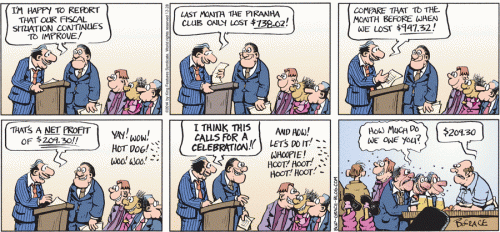
JINDAL SURPLUS SECRET

(CLICK ON IMAGE TO ENLARGE)

Murphy Painter vindicated, Jindal humiliated:

Jindal’s attempted prosecution persecution of fired Director of the Office of Alcohol and Tobacco Control Murphy Painter blew up in the governor’s face when Painter was first acquitted of criminal charges, costing the state nearly half a million dollars in reimbursement of Painter’s legal fees, but Painter subsequently won a defamation suit against his accuser.

Secret survey no longer a secret but “no one” more popular than Jindal:

A survey to measure state employee satisfaction in the Division of Administration (DOA) should be an eye opener for Commissioner of Administration Kristy Kreme Nichols and agency heads within DOA.

Meanwhile, LouisianaVoice has learned that Gov. Bobby Jindal (R-Iowa, R-New Hampshire, R-Anywhere but Louisiana) received some exciting news this week when a new poll revealed that no one was more popular among Republican contenders for the GOP presidential nomination.

The excitement was short-lived, however, when the actual meaning of the numbers was revealed.

It turns out that in a CNN poll of New Hampshire voters, Jindal tied with Rick Santorum with 3 percent, while “No one” polled 4 percent, prompting Comedy Central’s Stephen Colbert to joke that Jindal should adopt the slogan “Jindal 2016: No one is more popular.”

To shred or not to shred:

The controversy surrounding the sweeping changes being proposed for the Office of Group Benefits just got a little dicier with new information obtained by LouisianaVoice about the departure of Division of Administration executive counsel Liz Murrill and the possibly illegal destruction of public records from the Office of Group Benefits (OGB) and the involvement of at least two other state agencies.

While it was not immediately clear which OGB records were involved, information obtained by LouisianaVoice indicate that Murrill refused to sign off on written authorization to destroy documents from OGB.

We first reported her departure on Oct. 14 and then on Oct. 22, we followed up with a report that Murrill had confided to associates that she could no longer legally carry out some of the duties assigned to her as the DOA attorney.

But now we learn that the issue has spilled over into two other agencies besides OGB and DOA because of a state statute dealing with the retention of public documents for eventual delivery to State Archives, a division of Secretary of State Tom Schedler’s office.

Reports indicate that Schedler became furious when he learned of the destruction or planned destruction of the records because records should, according to R.S. 44:36, be retained for three years and then delivered to the state archivist and director of the division of Archives, records management and history.

NOVEMBER

Secret grand jury testimony of Greenstein made public:

The Louisiana Attorney General’s office, in an unprecedented move, released the 100-plus pages of testimony of Bruce Greenstein, former Secretary of the Department of Health and Hospitals but the testimony did little in revealing any smoking gun related to the state’s $180 million contract with CNSI. About the only thing to come out of his testimony was the indication of an incredible bad memory in matters related to his dealings with his former bosses at CNSI and a razor-sharp recall of other, more insignificant events.

Approval? We don’t need no stinkin’ approval:

The very first state agency privatized by Gov. Bobby Jindal was the Office of Risk Management (ORM) and after the state paid F.A. Richard and Associates (FARA) $68 million to take over ORM operations and then amended the contract to $75 million after only a few months, the agency was subsequently transferred three times to other firms. The only hitch was a specific clause in the original contract with FARA that no such transference was allowable without “prior written approval” from the Division of Administration. The problem? When LouisianaVoice made an FOIA request for that written approval, we were told no such document existed.

Edwards’ Last Hurrah:

Former Gov. Edwin Edwards, one of the most successful, colorful and charismatic politicians in Louisiana history, lost—decisively. Republican Graves Garrett rode the Republican tide to easily hand Edwards his first political defeat, dating back to his days on the Crowley City Council. Some may remember when Buddy Roemer led the field in 1987, forcing Edwards into a runoff. Technically, though, Edwards did not lose that election because he chose not to participate in the runoff, thus allowing Roemer to become governor. But he would return in 1991 to win his unprecedented fourth term.

DECEMBER

Friends of Bobby Jindal seeking donations:

A new web page popped up seeking donations for the Friends of Bobby Jindal, raising speculations of an attempt at a higher office (president?) since Jindal can’t run for governor again.

The new web page cited a speech by Jindal at a foreign policy forum at which he called for increased military spending.

Gimme the keys to the cars:

The Public Service Commission (PSC) became the second state agency (the State Treasurer’s office was the first) to openly defy Jindal when the administration demanded that the PSC relinquish possession of 13 vehicles as part of the administration’s cost-cutting measures.

We have already examined State Rep. Jerome “Dee” Richard’s attempt to cut consulting contracts which was passed unanimously by both the House and Senate but vetoed by Jindal.

But there was another veto that should be mentioned in context with Jindal’s penny wise but pound (dollar) foolish fire sale approach to state finances.

Earlier this year, State Sen. Jack Donahue (R-Mandeville) managed to get overwhelming passage of a bill that called for more oversight of the tax break programs by the state’s income-forecasting panel.

But Jindal, who never met a tax break he didn’t like, promptly vetoed the bill, saying it could effectively force a tax increase on businesses by limiting spending for the incentive programs.

Only he could twist the definition of removal of a tax break for business into a tax increase even while ignoring the fact that removal of those tax breaks could—and would—mean long-term relief for Louisiana citizens who are the ones shouldering the load. And for him to willingly ignore that fact borders on malfeasance.

Another (yawn) poor survey showing:

24/7 Wall Street, a financial news and opinion company, released a report which ranked Louisiana as the 11th worst-run state in America.

Louisiana, in ranking 40th in the nation, managed to fare better than New Jersey, which ranked 43rd, or eighth worst, something Jindal might use against Gov. Christ Christie if it comes down to a race between those two for the GOP nomination.

Louisiana had “one of the lowest median household incomes in the nation,” at just $44,164, the report said “and 10.7 percent of all households reported an income of less than $10,000, a higher rate than in any state except for Mississippi. Largely due to these low incomes, the poverty rate in Louisiana was nearly 20 percent (19.8 percent) and 17.2 percent of households used food stamps last year, both among the highest rates in the nation. The state’s GDP grew by 1.3 percent last year, less than the U.S. overall.

May we pray?

Meanwhile, Jindal prompted more controversy by having his favorite publisher and LSU Board of Supervisors member Rolfe McCollister run interference in securing the LSU Maravich Center for a political prayer event in January of 2015. The event will be sponsored by the controversial American Family Association and will not (wink, wink) be a political event, Jindal said.

And that, readers, is where we will leave you in 2014.

For 2015, we have an election campaign for governor to look forward to.

Just when you thought it couldn’t get any worse.

Read Full Post »

« Newer Posts - Older Posts »