Feeds:
Posts
Comments

Archive for the ‘House’ Category

C.B. Forgotston calls it “the lowest of a lot of low points” in Louisiana legislative history.

He says legislators have “already abdicated their constitutional responsibility to Bobby Jindal,” and now they are pleading with a non-resident of Louisiana “for help doing their jobs.”

Sadly, we agree.

In the waning days of the 2015 legislative session 11 Republican members of the Louisiana House are groveling to Grover.

Eleven state representatives who made all kinds of promises when they ran for office, chief among the promises they most likely made was one in which they swore their independence and ability to represent you, their constituents, and to not be beholden to the special interests.

But now the Elastic Eleven, as we shall call them from this point forward, have revealed their collective feet of clay as the legislative session winds to a close by begging Sir Grover, the sole possessor of that is wise, to please, sir, won’t you reconsider your “no tax” pledge so that we won’t incur the wrath of Grovernor Jindal?

The 11 spineless legislators, all members of the House Ways and Means Committee, otherwise known as Norquist’s House “No-way and by No Means Committee,” following the lead of Committee Chairman Joel Robideaux of Lafayette, have each signed off on a letter to Grover Norquist dated today (Monday, June 8) but apparently written and faxed Sunday night whining that Jindal “intends to veto the 2015-16 Louisiana State Budget and/or revenue measures if the legislature doesn’t approve Senate Bill 284 (SB284),” otherwise known as the Student Assessment for Valuable Education, or SAVE credit program.

The SAVE bill is an illusion from the get-go, creating money out of thin air, apparently from bit coins, as Stephen Winham has already explained in LouisianaVoice.  The bill would establish a new higher education tax credit to cover a nonexistent student fee, which makes no sense whatever. It would save families and students zilch on their college bills while creating the illusion of a tax break worth of David Copperfield. Which, according to the gospel of Grover, would allow Jindal to claim in his equally illusionist—and delusional—quest for the Republic president nomination that the credit would “offset” other tax increases being proposed.

https://louisianavoice.com/2015/06/05/save-guest-columnist-wonders-if-grover-norquist-holding-compromising-videos-of-louisiana-legislators-bobby-jindal/

“We are told that SB284 would allow him to remain in compliance with ATR’s (Norquist’s personal organization Americans for Tax Reform) ‘no tax pledge.’ However, we do not have any direct confirmation from your organization that this is actually the case.”

Wait. What?

No direct confirmation from Norquist’s organization? Do these so-called leaders need permission or confirmation from Norquist before they can go form an opinion? Good God, what have we become in this state that our legislators have to go kiss the ring of some guy in Washington, D.C. before they can make a decision? Are we living in a bad version of The Godfather where Don Vito Corleone must be consulted on every move that is made?

Here’s a news flash, folks: Grover Norquist is not a resident of Louisiana, he does not pay taxes in Louisiana and, most of all, he does not vote in Louisiana. So why do you give a rat’s behind what he thinks?

“We are deeply concerned about the clear and present danger posed by this bill,” their letter said. “As conservative Republican legislators, we firmly believe SB 284 is the biggest threat to fiscal responsibility our state has ever faced.”

So, what, exactly is the problem? If it’s a bad bill, kill it in committee. Problem solved.

But they can’t do that. They’re so upset by all of this and so intimidated by Norquist that a tear probably ran down each member’s leg as they signed the letter.

“Mr. Norquist, we are proud to have enacted numerous genuine tax cuts in our time here, primarily to attract business and grow our economy,” the letter continues. “Over the last 5 years, these reductions have save Louisiana taxpayers over $2.1 billion. Over the past 7 years, the duration of Governor Jindal’s term, the reductions have topped $2.7 billion.”

My God in heaven. How pathetic is that?

And just how well have those tax cuts, by their own admission granted “primarily to attract business,” worked out for Louisiana? Well, according to various surveys we have:

  • The highest poverty rate in the nation;
  • The third highest income disparity between its richest and poorest citizens;
  • The second highest disparity of income between men and women (yet the legislature continues to defeat bills to close that gap);
  • The sixth worst ranking in terms of employee economic mobility (opportunity for advancement);
  • The fifth lowest percentage of adults with bachelor’s degrees;
  • The fourth worst infrastructure in the U.S.
  • The 23rd lowest average salary and the seventy-lowest median household income;
  • The 17th lowest domestic product growth;
  • The nation’s second highest cancer mortality rate;

Couple that with our ranking as third from the bottom in quality of life, ninth worst state in which to be unemployed and dead last in business climate, and the picture just isn’t very encouraging.

And it seems the Elastic Eleven, while boasting of that $2.7 billion in tax cuts, mostly to corporations and certainly not the middle class or lower income segments of the population, have conveniently overlooked the current $1.6 billion budget hole those cuts have dug the state into.

“It is our profound hope that you will be able to take a few minutes from your busy schedule to review this matter and contact us at your earliest possible convenience,” the letter concludes. “The taxpayers of Louisiana anxiously await your timely reply.”

What?!!! Busy schedule? Review this matter? Your earliest convenience? The taxpayers?

To paraphrase former New Orleans Saints Coach Jim Mora: “The TAXPAYERS? The TAXPAYERS? Don’t talk to me about the taxpayers!” You no longer speak for the taxpayers. You are crouched in your collective fear of a lame duck governor and a non-resident who apparently is calling all the shots.

Are you truly concerned about the taxpayers? Well, surely there are a goodly number of Louisiana taxpayers in your respective districts who have very strong feelings, one way or another, about taxes.

So why do you feel the need to get the opinion of an absentee governor who long ago quit caring about this state or some yahoo in Washington before you are brave enough to venture off to the restroom to make tee-tee or butt pudding?

Do us all a favor. Grow a set. Right or wrong, be your own person. That’s what you were elected to do.

Those members besides Robideaux who signed this humiliating letter were Brett Geymann of Lake Charles, Lance Harris of Alexandria, Joe Harrison of Gray, Cameron Henry of Metairie, Eddie Lambert of Gonzales, Nancy Landry of Lafayette, Jay Morris of Monroe, Jim Morris of Oil City, John Schroder of Covington and Kirk Talbot of River Ridge.

Perhaps C.B. said it best: “I am calling on all of the legislators who signed onto this letter to resign immediately. You are an embarrassment to our state.”

To that we would add: if they won’t resign then perhaps the voters in their respective districts can help them with that difficult decision in October.

Oh, one more thing. Whoever is in charge of the legislative web pages should do a little updating. Of the 11 who signed the letter, only Robideaux and Lambert are listed on the web page as members of the Ways and Means Committee which must mean the web page is hopelessly out of date for anyone who wanted to do a little research.

Or was web maintenance among Jindal’s budget cuts?
Read Full Post »

State Treasurer John Kennedy on Tuesday told the House Appropriations Committee that the Division of Administration exerts extortion-like tactics against legislators and takes the approach that it should not be questioned about the manner in which it hands out state contracts and that the legislature should, in effect, keep its nose out of the administration’s business.

Kennedy was testifying on behalf of House Bill 30 by State Rep. Jerome Richard (I-Thibodaux) which provides for reporting, review and approval by the Joint Legislative Committee on the Budget (JLCB) of all contracts for professional, personal and consulting services totaling $40,000 or more per year which are funded exclusively with state general fund (SGF) or the Overcollections Fund. HB 30

HB 30 FISCAL NOTES

Kennedy, in a matter of only a few minutes’ testimony, attacked figures provided by three representatives of the Division of Administration (DOA) who objected to the bill because of what they termed additional delays that would be incurred in contract approval and because of claimed infringement upon the separation of powers between the legislative and administrative branches of government.

Here is the link to the committee hearing. While Kennedy spoke at length on the bill, the gist of his remarks about DOA begin at about one hour and 13 minutes into his testimony. You can move your cursor to that point and pick up his attacks on DOA. http://house.louisiana.gov/H_Video/VideoArchivePlayer.aspx?v=house/2015/may/0526_15_AP

That argument appeared to be a reach at best considering it is the legislature that appropriates funding for the contracts. It also appeared more of a smokescreen for the real objections: DOA’s, and by extension, Bobby Jindal’s wish that the administration be allowed to continue to operate behind closed doors and without any oversight, unanswerable to anyone.

DOA representatives tried to minimize the effect of the bill by downplaying the number and dollar amount of the contracts affected (which raises the obvious question of why the opposition to the bill if its impact would be so minimal). The administration said only 164 contracts totaling some $29 million would be affected by the bill.

Kennedy, however, was quick to jump on those figures. “The numbers the division provided you are inaccurate,” he said flatly. “The Legislative Auditor, who works for you,” he told committee members, “just released a report that says there are 14,000 consulting contracts, plus another 4600 ‘off the books.’

“The fiscal notes of 2014 by the Legislative Fiscal Office—not the Division (DOA)—said the number of contracts approved in 2013 by the Office of Contractual Review was 2,001—not 160—professional, personal and consulting service contracts with a total value of $3.1 billion,” he said. “I don’t know where DOA is getting its numbers.

“To sum up their objections,” he said, “it appears to me that DOA and more to the point, the bureaucracy, is smarter than you and knows how to spend taxpayer dollars better than you. That’s the bottom line. They don’t want you to know. This bill will not be overly burdensome to you. Thirty days before the JLCB hearing, you will get a list of contracts. If there are no questions, they fly through. If there are questions, you can ask.”

Kennedy tossed a grenade at DOA on the issue of separation of powers when he accused the administration of blackmailing legislators who might be reluctant to go along with its programs.

“Let’s talk about how the division’s advice on contracts has worked out,” he said. “The Division advised you to spend all the $800 million in the Medicaid Trust Fund for the Elderly. Now they have zero in that account. In fact, they pushed you to do that. Some of you were told if you didn’t do that, you’d lose your Capital Outlay projects. How’s that for separation of powers? How’d that work out for you?

“My colleagues from Division who just testified against the bill are the same ones who told you to take $400 million out of the (Office of Group Benefits) savings account set aside to pay retirees’ and state employees’ health claims. How’d that work out?”

Kennedy didn’t stop there. He came prepared with an entire laundry list of accusations against the administration.

“My colleagues from Division are the ones who told you, ‘Look, we need to privatize our health care delivery system,’ which I support in concept. They sat at this table and I heard them say we would only have to spend $600 million per year on our public-private partnership and (that it would be) a great deal ‘because right now we’re spending $900 million.’ I thought we’d be saving $300 million a year. Except we’re not spending $600 million; we’re spending $1.3 billion and we don’t have the slightest idea whether it’s (the partnerships) working. How’d that work out for you?

“I sat right here at this table and I heard my friends from Division say we need to do Bayou Health managed care. You now appropriate $2.8 billion a year for four health insurance companies to treat 900,000 of our people—not their people, our people,” he said. “There’s just one problem: when the Legislative Auditor goes to DHH (the Department of Health and Hospitals) to audit it (the program), they tell him no.”

Kennedy said that pursuant to orders from DOA, “the only way they can audit is if they take the numbers given him (Legislative Auditor Daryl Purpera) by the insurance companies.

“This is a good bill,” he said. “It’s not my bill. My preference is to tell Division to cut 10 percent on all contracts and if you can’t do it, you will be unemployed. But this bill allows you to see where the taxpayer money is being spent.

“I have more confidence in you than I do in the people who’re doing things right now,” he said.

Kennedy said he was somewhat reluctant to testify about the bill “but I’m not going to let this go—especially the part about separation of powers.

“You want to see a blatant example of separation of powers?” he asked rhetorically, returning to the issue of the administration’s heavy handedness. “How about if I have a bill but you don’t read it. You either vote for it or you lose your Capital Outlay projects. How’s that for separation of powers?”

That evoked memories from November of 2012 when Jindal removed two representatives from their committee assignments one day after they voted against the administration’s proposed contract between the Office of Group Benefits and Blue Cross/Blue Shield of Louisiana.

“Everything they (legislative committees) do is scripted,” said Rep. Joe Harrison (R-Gray), speaking to LouisianaVoice about his removal from the House Appropriations Committee. “I’ve seen the scripts. They hand out a list of questions we are allowed to ask and they tell us not to deviate from the list and not to ask questions that are not in the best interest of the administration.” https://louisianavoice.com/2012/11/02/notable-quotables-in-their-own-words-142/

Rep. John Schroder (R-Covington) asked Kennedy what his budget was to which Kennedy responded, “Less than last year and less that year than the year before and probably will be even less after this hearing. But you know what? I don’t care.

“There’s nothing you can say to get Division to support this bill,” he said. “They’re just not going to do it.

“You can’t find these contracts with a search party. But if you require them to come before you, you can get a feel for how money is being spent that people work hard for and you can provide a mechanism to shift some of that spending to higher priorities.

“Next year, you will spend $47 million on consulting contracts for coastal restoration. I’m not against coastal restoration; I’m all for it. But these consultants will not plant a blade of swamp grass. Don’t tell me they can’t do the job for 10 percent less. That $47 million is more than the entire state general fund appropriation for LSU-Shreveport, Southern University-Shreveport, McNeese and Nicholls State combined.

“Under the law, agencies are supposed to go before the Civil Service Board and show that the work being contracted cannot be done by state employees but that is perfunctory at best,” Kennedy said.

To the administration’s arguments of delays in contract approvals and infringements on the separation of powers, Rep. Brett Geymann (R-Lake Charles) dug in his heels. “This is not a bad thing,” he insisted. “We’re not going to go through every page of every contract unless someone calls it to our attention. It doesn’t matter if it’s 14,000 or 14 million contracts. The number is immaterial. If there’s an issue with a contract, we need to look at it.”

For once, the administration did not have its way with the legislature. The committee approved the bill unanimously and it will now move to the House floor for debate where Jindal’s forces are certain to lobby hard against its passage.

Should the bill ultimately pass both the House and Senate, Jindal will in all likelihood, veto the measure and at that point, we will learn how strong the legislature’s resolve really is.

But for Kennedy, the line has been drawn in the dust.

Read Full Post »

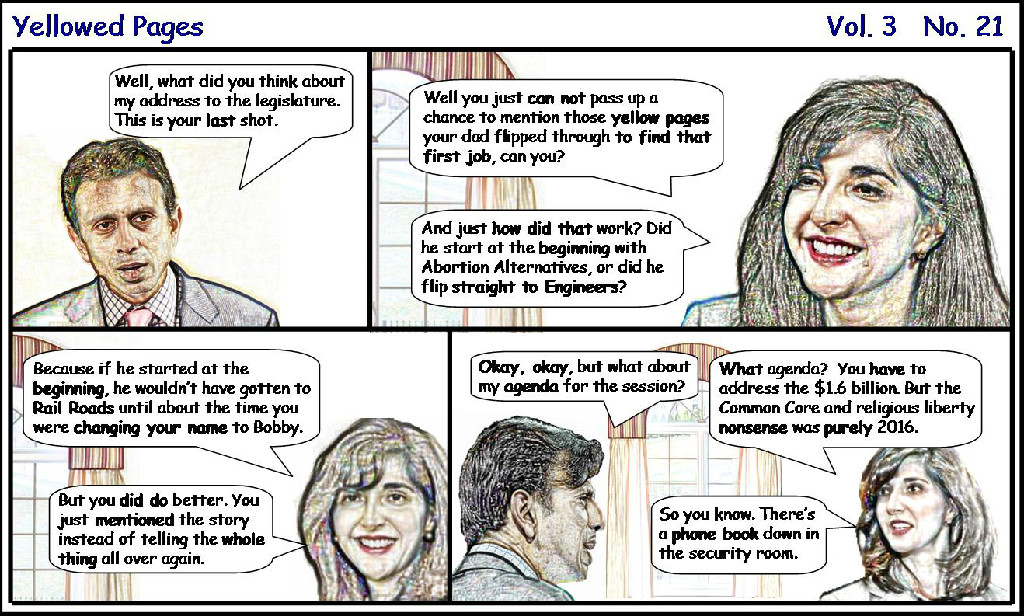
JINDAL STATE OF THE STATE ADDRESS(FROM OUR ANONYMOUS CARTOONIST: CLICK ON IMAGE TO ENLARGE)

If there was any lingering doubt that Bobby Jindal has been committing payroll fraud, that doubt was erased in last Monday’s State of the State address to legislators at the opening of the 2015 legislative which, thankfully, will be his last such address.

Fraud is defined as:

  • The wrongful or criminal deception intended to result in financial or personal gain;
  • Deceit, trickery, or breach of confidence perpetrated for profit or to gain some unfair or dishonest advantage;
  • A person or thing intended to deceive others, typically by unjustifiably claiming or being credited with accomplishments or qualities.

Payroll fraud is further defined as the unauthorized altering of payroll or benefits systems in order for an employee to gain funds which are not due. The person making financial gain could be the employee or could be an associate who is using the employee to commit the fraud while taking the funds for himself.

There are generally three types of payroll fraud but for our purposes we are interested in only one:

  • Ghost employees—A person, fictional or real, who is being paid for work he does not perform. In order for the fraud to work the ghost employee must be added to the payroll register. If the individual is paid a monthly salary this is easier for the fraudster, as once this has been set up there is little or no paperwork required. In order for the fraud to work, the ghost employee must be added elected to the payroll register. Once this has been set up, there is little or no paperwork required.

Under that definition, Jindal could certainly be considered a ghost employee. One person even suggested that it was not really Jindal speaking to legislators, that Jindal was actually in Iowa and they were being addressed by a hologram.

We maintain that Jindal is committing payroll fraud by vacating the state so often and leaving the details of running the state to appointed subordinates as inexperienced and naïve as he. The point here is this: No one on his staff was elected; he was. And he has not been at the helm of the ship of state and by absenting himself so frequently and so consistently as he gins up his presidential candidacy, he is committing payroll fraud, theft, and malfeasance. Others, like former Desoto Parish School Superintendent and Board of Elementary and Secondary Education member Walter Lee have been indicted and been prosecuted for payroll fraud.

Before we really get into his speech to legislators, JINDAL ADDRESS TO LEGISLATURE we simply must call attention to the feeble effort at humor he (or someone) injected into the third line of his speech:

“Well, here we are…at the moment that some of you have been waiting for a long time—my last state of the state speech.”

After an apparently appropriate pause, he continued: “No, that was not supposed to be an applause line…and I do appreciate your restraint.”

Seriously? You actually wrote that line in your speech? If you have to write that in, if you are incapable of ad-libbing that simple line, then we now understand that idiotic response to President Obama’s State of the Union Address in 2009.

Before getting to the real meat of his legislative agenda for this year (if you can call it that), he touched ever-so-lightly on a few other points he generously referred to as his administration’s accomplishments. Our responses to each point are drawn directly from statistics provided by 24/7 Wall Street, a service that provides a steady stream of statistical data on business and government:

  • “We cleaned up our ethics laws so that now what you know is more important than who you know.” (A quick look at the appointment of Troy Hebert as director of the Office of Alcohol and Tobacco Control after the baseless firing of Murphy Painter could quickly debunk that bogus claim. So could several appointments to the LSU Board of Supervisors and the equally egregious firing of key personnel like Tommy Teague who did their jobs well but made the fatal mistake of crossing Mr. Egomaniac.)
  • “We reformed our education system…” (Louisiana is the fifth-worst educated state and we are the third-worst state for children who struggle to read);
  • “We reformed our health care system…” (Really? Is that why the privatization of our state hospitals remain in turmoil? That same reform ultimately forced the closure of Baton Rouge General Mid-City’s emergency room because of the overload brought on by the closure of Earl K. Long Hospital? Can we thank your “reform” for the fact that Louisiana still has the nation’s third-lowest life expectancy rate or that we enjoy the nation’s third-most unhealthy rating, that we are fifth-highest in cardiovascular deaths or that we have the highest obesity rate in the nation?);
  • “…Our economy is booming.” (Seriously? Louisiana is rated as the worst state for business in the U.S.; we rank sixth-highest among states where the middle class is dying; we remain the eighth-poorest state in the nation with a poverty rate that is third-highest, and we’re saddled with the fourth-worst income disparity in the nation and we’re rated the 10th-worst state in which to be unemployed.);
  • “We have balanced our budget every year…and have received eight credit upgrades.” (This one of those claims so preposterous one doesn’t know how to respond, but we’ll give it our best. Jindal has repeatedly patched budget holes by skimming funds from other agencies, like more than $400 million from the Office of Group Benefits reserve fund, from the sale of the tobacco settlement, from ripping funds for the developmentally disadvantaged (to fund a race track tied a political donor—what was that line again about “what you know, not who you know”?), by cutting health care and higher education, by selling state property, and now he’s trying to cover the current $1.6 billion budget hole by selling the State Lottery. As for those credit upgrades, we can only point to the February action by Moody’s and Standard & Poor’s bond rating agencies to move the state’s credit outlook from stable to negative—and to threaten the more severe action of a downgrade.);
  • “The end result is a stronger, more prosperous Louisiana for our children. I measure Louisiana’s prosperity not by the prosperity of our government, but by the prosperity of our people.” (So, why are the fifth-most dangerous state in the nation? The 10th-most miserable state? Why do we have the eighth-worst quality of life? And the 11th-worst run state in the nation? And why have you never once addressed in your seven-plus years in office our ranking as the number-one state in the nation for gun violence or our ranking as first in the world for our prison incarceration rate?)
  • “We don’t live by Washington’s rules of kicking our debts down the road.” (For the love of God…);
  • “We have laid out a budget proposal that seeks to protect higher education, health care and other important government functions.” (And that’s why higher education and health care have been cut each of your years in office and why more cuts are anticipated that could conceivably shut down some of our universities. You really call cuts of up to 80 percent “protecting” higher education?);
  • “We have a system of corporate welfare in this state.” (Wow. After more than seven years of giving away the store to the tune of billions of dollars in corporate tax breaks, you finally come the realization that perhaps your generosity to the Wal-Marts, chicken processing plants and movie production companies may have been a bit much—that those policies may have actually hurt the state? What brought about this sudden epiphany? Bob Mann, in his Something Like the Truth blog, was all over that when he called attention to Jindal’s latest comment in the face of his claim a couple of years ago that we were “crushing businesses” with oppressive taxes. We’ll let him take this one.) http://bobmannblog.com/2015/04/17/bobby-jindal-is-now-against-corporate-welfare/
  • “We have identified over $500 million of corporate welfare spending that we think should be cut…” (Why the hell did it take you seven years?)

After all was said and done, after his hit-and-run sideswipes at all his purported “accomplishments,” Jindal devoted the bulk of his address to only two issues: Common Core and religious liberty. Of the latter issue, he said, “I absolutely intend to fight for passage of this legislation.”

Jindal was referring to Bossier City Republican State Rep. Mike Johnson’s HB 707 which would waste an enormous amount of time and energy—time that could be better spent on far more pressing matters, like a $1.6 billion deficit—on preventing the state from taking “any adverse action” against a person or business on the basis of a “moral conviction about marriage.”

Despite claims by Jindal and Johnson to the contrary, the bill is nothing more than a clone of the Indiana law that constitutes a not-so-subtle attack on gays or anyone else with whom any businessman deems a threat to his or her definition of marriage.

So, after eight addresses to the legislature, Jindal has yet to address any of the issues like inadequate health care, violence, poverty, pay disparity or equal pay for women, increasing the minimum wage, poor business climate (his rosy claims notwithstanding), our highway system (we didn’t mention that, but we are the seventh-worst state in which to drive, with the 15th-highest auto fatality rate), or our having the highest incarceration rate in the world.

Instead, the thrust of his address is aimed at Common Core—he called it federal control even though Common Core was devised by the nation’s governors and not the federal government—and something called the “Marriage and Conscience Act.”

And he expects those two issues, along with something he calls “American Exceptionalism,” to thrust him into the White House as leader of the free world.

And, of course, attacking national Democrats like Obama and just today, Hillary Clinton, on her claim of having immigrant grandparents. Jindal, of course, wants exclusive rights to that claim and says so with his oft-repeated platitude: My parents came to this country over 40 years ago with nothing but the belief that America is the land of freedom and opportunity. They were right. The sad truth is that the Left no longer believes in American Exceptionalism.”

Well, to tell the truth, if Bobby Jindal is the example—the standard-bearer, if you will—for what is considered “American Exceptionalism,” then frankly, we don’t believe in it either.

Read Full Post »

Dr. Randall M. Wilk operates a medical practice in Gretna dedicated to the surgical treatment of diseases in the head and neck. http://www.drrandallwilk.com/#

Approximately 25 percent of his patients are cancer sufferers. Licensed to practice medicine in the state of Louisiana (License No. MD022962), Wilk earned his medical degree from the LSU School of Medicine in New Orleans. He did his general surgery training at the Ochsner Medical Institutions and did his head and neck surgery training in Portland, Oregon.

He also has a Ph.D. in anatomy from LSU and a DDS from the Baylor College of Dentistry and has a certificate in oral surgery.

But even though he does not operate a dental facility, that DDS degree has cost him more than $100,000 in legal fees because of the heavy-handed tactics of the Louisiana State Board of Dentistry which carried its badgering of Wilk all the way to the floors of the Louisiana House and Senate.

“Since graduating from dental school 25 years ago I have never filled a tooth, made a denture, made a crown, cleaned teeth, restored a tooth, or anything that one would consider a dental practice,” Wilk says, adding that he went “from graduating dental school in 1987 to starting graduate school” that same year.

Wilk noted that the dental board, in its 2009 financial statement, reported a loss to the Department of Health and Hospitals (DHH) of more than $60,000 and that the only plan put forth for managing that loss was “higher revenue from the collection of fines.”

Within weeks of that report, Wilk said, “I received a letter from the board sating that they had received a complaint on me from a Camp Morrison.”

Morrison, a private investigator, has worked for the board for numerous years under a series of contracts totaling more than $1 million. Moreover, even though he is an independent contractor, he is given free office space in the board’s suite at the high-rent One Canal Place office building in New Orleans.

Dating back to 1997, Morrison was issued nine consecutive contracts totaling more than $1.8 million. Most of his contracts were for two-year durations. His first, from March 1, 1997 to Feb. 28, 2000, was for $45,000. But from Sept. 1, 2000, through Aug. 31, 2002, his contract more than trebled, to $150,000 and increased again to $200,000 with his next contract which ran from Sept. 1, 2002 through Aug. 31, 2004.

Beginning on Sept. 1, 2004, he was awarded four consecutive two-year contracts of $240,000 each. Those four contracts combined to run through Aug. 31, 2012.

For whatever reason, on Sept. 1, 2012, the board cut his contract back to nine months and $110,000 but when that pact expired on June 30, 2013, he was issued a new contract, this one for three years, from July 1, 2013 through June 30, 2016, for $340,000.

Wilk said he was told that Morrison had reported to the board “that they had no record of me having an anesthesia permit from the dental board in 2007, that they had no record of me having a certificate in oral surgery, and that I was suspended from the Medicaid and Medicare programs.

“All of those are false statements,” he said, but the board refused to produce a copy of Morrison’s report. “I believe that filing a false report is a crime.”

Wilk said a meeting was scheduled and at that meeting two board members said they wanted him to sign a consent decree and to pay the board $5,000.

When Wilk said he had no intention of signing anything without first having his attorney examine the document, they left the room for a short time and returned with an adding machine “and told me that if I did not sign the document right then and there, that they could levy fines of over $100,000.”

He said the two handed him the adding machine tape “and placed the consent decree in front of me. For those familiar with the Godfather movies, the only thing missing was Luca Brassi with a pistol to my head.” He said a board member said it appeared that he (Wilk) felt his medical degree was more important than his dental degree.

“This was a pure and simple shakedown,” Wilk said.

He said it’s not unusual for medical specialists to obtain a dental degree prior to going to medical school and residency. “In the state of Louisiana, dozens of doctors are in this position. At least half-a-dozen are otolaryngologists, several are plastic surgeons, general surgeons, head and neck surgeons, orthopedic surgeons, gastroenterologists, anesthesiologists, even psychiatrists.

“Having a dental degree does not make your medical practice a dental practice,” he said.

Apparently the dental board and its investigator, Camp Morrison, disagree. Here are minutes of a 2011 dental board meeting at which Wilk’s case is discussed. DENTAL BOARD MINUTES MAY 20, 2011 (bottom of page 14)

Moreover, the DENTAL BOARD BULLETIN also mentions disciplinary action against Wilk (Item no. 14 in the left column near the bottom of page 3).

Wilk obtained legal counsel but the barrage from the dental board continued “for almost two years,” he said. “They subpoenaed me five times, requested copies of my patient records for several years and required my staff to go over 12,000 records. The final documents sent to them weighed several hundred pounds.

“Despite my being represented by counsel, Mr. Morrison continued to serve me subpoenas, to appear in my office waiting room, the operating room at Ochsner Hospital and at my home,” all the while passing out his cards to people and saying he was the investigator for the board of dentistry.”

Eventually, the board relented somewhat by notifying Wilk’s attorneys that if he paid the board $10,000 the matter would “go away.” Wilk said he feels that such tactics are tantamount to corruption or shakedowns. Again, he refused to pay.

Louisiana Revised Statute 37:793 (H) (2) says:

  • A personal permit is not required when the dentist uses the services of (1) a trained medical doctor, (2) doctor of osteopathy trained in conscious sedation with parenteral drugs, (3) certified registered nurse anesthetist, (4) a dentist who has successfully completed a program consistent with Part II of the American Dental Association Guidelines on Teaching the Comprehensive Control of Pain and Anxiety in Dentistry, or (5) a qualified oral and maxillofacial surgeon provided that the doctor or certified registered nurse anesthetist remains on the premises of the dental facility until any patient given parenteral drugs is sufficiently recovered.

When Wilk’s pointed out that the statute “specifically exempts me from what they are fining me for, their lawyer stated that he will have to ‘get that law changed.’” Wilk said. He said the board, which in 2010 reported an operating loss of $104,000, “held its own trial and fined me and held me for the board’s legal costs, totaling about $100,000.” They are their own judge, jury, and executioners,” he said. DENTISTRY BOARD 2009 FINANCIAL STATEMENT

The board subsequently prevailed on then-State Rep. Herbert Dixon to introduce legislation giving the dental board the necessary leverage to pursue claims against medical practitioners like Wilk who were not practicing dentists.

Wilk was scheduled to testify in committee against Dixon’s bill, HB 172, at 10 a.m. on May 15, 2012 but upon arriving, learned that the bill had been moved up to first on the calendar and had already been discussed and passed by the committee. It subsequently passed unanimously in both the House and Senate, yet more evidence that legislators often pass bills without really knowing what they contain or the implications of the language.

Wilk said that State Sen. David Heitmeier (D-New Orleans) had a discussion with Peyton Burkhalter, who had by then succeeded Barry Ogden as executive director of the board, and that Burkhalter had assured Heitmeier that the board had decided to drop the charges against Wilk. “He said that Mr. Morrison’s Gestapo tactics would end,” Wilk said.

State Sen. Fred Mills (R-Breaux Bridge) told LouisianaVoice on Thursday that he and former House Speaker Jim Tucker (R-Terrytown) had experienced clashes with the board in the past. “They’ve got some problems with that board,” he said, “and I believe the answer in the end will be the establishment of oversight over them,” he said. “We’ve had to threaten them with legislative action, including replacing the entire board, in order to back them down in the past.”

Wilk said he feels there is outright corruption on the board and that its shakedowns of dentists and non-dentists alike constitutes extortion. “Knowing that no violation of any statute occurred but demanding payment under threat of costly litigation is unethical conduct,” he said.

“I believe that their changing the law was intended to persecute me but also puts many other practitioners at risk. The implications…are far-reaching and as such constitute a restraint of trade. The precedent set by this bill (HB 172) (allows) other boards to reach beyond their jurisdiction. This law does nothing to protect the public,” he said.

Read Full Post »

My wife received an invitation in the mail Monday (March 23).

It was an invitation to a David Vitter Town Hall Meeting next Monday (March 30) in the East Baton Rouge Parish Council chambers in Baton Rouge at 9:30 a.m.

Needless to say, we are more than a little curious as to why she would get such an invitation from him inasmuch as both she and I are former Republicans now enrolled in RR (Recovering Republicans) and participating in the 12-Step Program.

To be fair, under her name in the address were the words “or current resident,” the implication being that whoever dwells in our house is invited.

Regardless, I’m not entirely certain I want my wife or any of my three daughters in the same room with this man—and not just because of the obvious—the 2007 revelations of Vitter’s association with the former (now deceased) D.C. Madam, Deborah Jeane Palfrey prior to his 2004 election to the U.S. Senate (while he was serving in the U.S. House of Representatives).

Neither is it a claim by former New Orleans Madam Jeanette Maier that Vitter had been a client of hers in the late 1990s.

Nope. It’s the 1993 case of Mary Mercedes Hernandez that sounds alarms and raises red flags for me.

Who is Mary Mercedes Hernandez, you ask?

Fair question. She is a conservative Republican whom Vitter defeated in the race for the District 81seat in the Louisiana House of Representatives in 1991.

In April of 1993, Vitter was one of 16 New Orleans-area House members who voted not to table House Bill 1013 which would have made it illegal for employers or insurers to discriminate based on sexual orientation. There was some feeling that he voted not to kill the bill so that it could be debated on the House floor—and defeated on its merits.

Later that same year, on Sept. 21, Hernandez attended a “town hall meeting” held by Vitter at the American Legion Hall in Metairie. She, along with other constituents, had been invited to attend the meeting by Vitter (we’re seeing a trend here) to “discuss state issues,” she said in a lawsuit she filed against Vitter for physically attacking her at the meeting.

Documents obtained Monday by LouisianaVoice show that Vitter counter-sued Hernandez for harassment, naming prominent state Republican officials as her co-conspirators but that in the end, a judgement was signed in favor of Hernandez and Vitter paid Hernandez a small amount of money to settle her lawsuit in March of 1998, the year before he won a 1999 special election to succeed U.S. Rep. Bob Livingston who resigned following disclosures of his own extra-marital affair. VITTER 1993 ASSAULT CASE

The amount of the final settlement—a mere $50—isn’t nearly as important as what the few pages reveal about Vitter and how he can go on the attack when challenged.

For example, among the documents obtained by LouisianaVoice was a letter written by Vitter two years after the suit was filed, and while it was still moving through the legal system, to Livingston.

The letter, dated April 12, 1995, read:

  • “Thank you very much for your recent letter inviting me to help support the East Jefferson Parish Republic PAC with a significant contribution. I have been an active participant in and supporter of the PAC in the past, and would love to continue that support. However, one matter prevents me from doing so at this time.
  • “Several months ago, a Ms. Mercedes Hernandez slapped me with an utterly frivolous lawsuit which continues to languish in the courts. This is a continuation of a personal vendetta against me on the part of not only Ms. Hernandez, but other persons active in the PAC, specifically including John Treen and Vincent Bruno. Both Messrs. Treen and Bruno were instrumental in encouraging this harassing action. In light of this and in light of these persons’ continued active involvement in the PAC, I will have nothing to do with the PAC’s fundraising efforts.
  • “I can easily tolerate sincere disagreements with people. I can even tolerate serious disagreements which lead to litigation. But I will have nothing to do with people who pervert the judicial system to harass me, carry out a personal vendetta, and directly harm not only me but my wife and child as well.”

John Treen, the older brother of the late Gov. Dave Treen, lost a 1989 special election to the Louisiana House of Representatives to Ku Klux Klansman David Duke and Dave Treen lost to Vitter in that 1999 election to succeed Livingston by a scant 1,812 votes. Bruno was a member of the Republican Party’s State Central Committee and worked in the 1999 Dave Treen congressional campaign.

So, it’s easy to see that bitter feelings were running deep when Hernandez asked Vitter during a question and answer session to explain the intent of House Bill 1013, the so-called “Gay Rights Bill,” had failed by a 71-24 vote in April of that year—with Vitter voting against passage. It might even reasonably be called ambush journalism—but sometimes that’s the only way to get an answer from some of our elected officials (see Bobby Jindal).

In her petition, she said Vitter “became agitated and enraged,” left the podium and advanced toward her in a “threatening manner, pushing aside chairs where were in his path,” and wrenched a portable tape recorder from her grasp, causing injuries to her right hand.

In the classic defense of “My dog doesn’t bite,” “I keep my dog in my yard,” “I don’t own a dog,” Vitter denied that (a) the incident occurred, (b) he had no intent to cause “physical contact or the apprehension of physical contact,” (c) “any contact was incidental,” (d) that Hernandez “sustained no injuries as a result of the alleged events in question,” and (e) Hernandez should be held in comparative negligence and assumption of risk…in mitigation or in reduction of any damages recoverable by the plaintiff…”

And then he filed a reconventional demand, or countersuit, claiming that Hernandez had gained the floor at the “town hall meeting” to “spread false, malicious and damaging information about Mr. Vitter, particularly concerning his voting record with regard to gay rights.”

Hernandez, in her answer to Vitter’s reconventional demand, described herself as a conservative Republican and active as a member of the Jefferson Parish Republican Party. She said she wanted him to explain the “Gay Rights Bill” and his position on the bill because she “had heard that he was a co-author of the bill” by former Rep. Troy Carter (D-Algiers).

(An attempt by LouisianaVoice to determine the names of any co-sponsors of the bill was unsuccessful because the Legislature’s web page which tracks bills in current and past sessions goes back only to 1997.)

She said “after being assaulted and battered” by Vitter “in front of scores of people,” she left the meeting and went to a nearby restaurant where she met a friend, Peggy Childers, who had been seated next to her at the meeting and who had witnessed the encounter.

It was Childers, she said, who suggested that she contact John Treen, “a friend and very prominent and respected member of the Republican Party, for advice. The following day, Sept. 22, she met with John Treen, Ms. Childers, Bruno (then Vice-Chairman of the Jefferson Parish Republican Party), and several others.

The judgment against Vitter was for a pittance ($50, plus judicial interest and costs is certainly that in any legal proceeding), but it did vindicate Hernandez and the entire matter illustrates the mental makeup of the man who wants to be our next governor.

(An earlier post of this story incorrectly said Vitter voted to kill the bill.)

Read Full Post »

« Newer Posts - Older Posts »


