Feeds:
Posts
Comments

Archive for the ‘Health Care’ Category

There are times when we have to dig pretty deep to uncover wrongdoing, conflicts of interest, favoritism, and outright corruption. There are other times when the information just seems to drop into our lap.

Such is the ongoing reports of kangaroo court proceedings conducted by the Louisiana State Board of Dentistry. And how was a witness in a case against a fellow dentist rewarded with a seat on the board? And how is that dentist/board member allowed to serve as an insurance claims analyst in determining payments to other dentists in the same geographic area of his own practice?

It’s probably a good idea to provide something of a refresher to bring new readers up to speed. The State Dentistry Board previously had a contract with a private investigator who had a nasty habit of deciding that a dentist was in violation of some obscure regulation and then going about his investigation with the intent of proving his pre-set theory.

Investigator Camp Morrison, who racked up hundreds of thousands of dollars in billings while contracted to the board for more than two decades (he even was provided rent-free office space in the Dentistry Board’s office suite on Canal Street in New Orleans), appeared to have an unlimited expense account.

And why not? He roamed the state under color of law, harassing dentists to self-generate his own fees which were more than paid for by the six-figure fines levied against dentists not in the board’s favor.

Of course, he couldn’t have done all that without the aid of the board’s general counsel, who often served in dual capacity as board counsel and board prosecutor, a violation of legal ethics rules and common sense. Because he only had a duty to his client the board of dentistry to act in its best interest, anyone that he prosecuted was denied due process. The same would be true if a police force handled its own prosecutions without an independent prosecutor; there would be no fundamental perception of fairness.

Attorney Brian Begue was also known to hide behind the cloak of administrative law in denying defendants’ rights afforded under the US Constitution. Because he self-generated his own fees, he had apparently selfish financial motives for seeing dentists prosecuted. In 2012, he was found by the Louisiana 4th Circuit Court of Appeals to have violated the due process of a Louisiana dentist. https://louisianavoice.com/2015/11/16/dentistry-board-facing-difficult-future-because-of-policies-contracts-with-attorney-private-investigator-are-cancelled/

This investigator and attorney were perhaps given cover by a few complicit board members and staff to carry out their harassment and extortion schemes.

Take Dr. Isaac “Ike” House of Haughton in Bossier Parish. http://www.lsbd.org/boardinfo.htm

In a highly questionable move by the Jindal administration after he testified as a witness in a hearing in which a Louisiana dentist alleged the board participated in criminal conspiracy and unfair trade practices against him by revoking his license to practice in Louisiana.

Was that appointment his reward for his testimony against the dentist?

Dr. Ike, it seems, wears many hats: he’s a dentist, a witness, a board member, and more recently, it has been learned, an analyst for dental insurance claims for a Baton Rouge dental insurance company.

IMAG2140

DENTAL INSURANCE CLAIM ANALYSIS PERFORMED BY DENTAL BOARD MEMBER DR. ISAAC “IKE” HOUSE (CLICK ON IMAGE TO ENLARGE)

            That last position might appear to some as something of a conflict. As one who performs evaluations of claims for an insurance company serving dentists in his geographic area, he has direct input on their financial reimbursement from the company.

But conflicts of interest have never been a deterrent to the board in the past. The questionable practices of Begue and Morrison is ample evidence of that.

One former Shreveport dentist, Dr. Ryan Haygood, fought the board for several years and finally settled with the board early last month.

Dr. Haygood settled for a fine of $16,500, a fraction of what the board unjustly cost him in its ongoing persecution. Haygood’s attorney told him the facts of life about a board hearing that was cancelled at the last moment after the settlement agreement was reached: the deck was stacked against him and he would lose at the hearing—and it would cost him much more than the $16,500. The board was raising the same issues as before and daring him to appeal. He said he did not have the $300,000 necessary to go through with the appeal, only to lose since the board itself decides all appeals of its decisions.

He said there was no confidentiality clause in the agreement but two of the stipulations of the agreement were that he would take his Internet blog down and that he would sign a “non-disparaging clause.”

LouisianaVoice, however, is not bound by any such restrictions and our blog is still up and we will continue to disparage when deemed appropriate.

Haygood, however, is moving forward with his civil lawsuit against the board which will ultimately be determined in a court of law and not in the Dentistry Board’s hearing room by an attorney who acts as accuser and judge.

Meanwhile, rumors of state and federal investigations persist. http://theadso.org/federal-racketeering-laws-may-finally-bring-the-dental-board-to-its-knees/

It would be most refreshing if investigators could offer a valid explanation of how certain boards’ powers to run roughshod over licensees has been allowed to go unchecked for so long

If there’s corruption, this must be Louisiana (with apologies to the 1969 movie If It’s Tuesday, This Must Be Belgium).

Read Full Post »

LouisianaVoice has obtained documents which reveal that a doctor at the Veterans Administration Medical Center in Alexandria, LA. was denied a license in Florida because she had previously falsified medical records while employed at a hospital in Maryland.

The records from Maryland were provided subsequent to our story on Wednesday that examined numerous complaints about Dr. Shivani Negi over her confrontations with hospital staff members and families of patients. https://louisianavoice.com/2016/06/29/cenla-media-ignore-elephant-in-the-room-alexandria-va-hospital-rife-with-controversy-swirling-around-one-doctor/

LouisianaVoice has also learned that the U.S. Attorney’s office, which normally would investigate and possibly prosecute cases of criminal wrongdoing, instead provided a legal defense for Dr. Negi in a civil lawsuit brought against her in federal court by the family of one patient who died in her care. That would make it all but impossible for that same U.S. Attorney to take part in any prosecution of the doctor should it be determined later that there might have been criminal neglect involved in the deaths of several patients at the hospital.

Dr. Negi has been the subject of repeated criticism for rude behavior and for the manner in which she is said to insist on the signing of “Do Not Resuscitate” orders by family members of other elderly patients.

She was denied a medical license by the Florida Board of Medicine in September 2003. LouisianaVoice reported on Wednesday that the board’s minutes reflected that the committee “discussed in length the seriousness of the issue” and that Dr. Negi “gave a brief history of events” but that the minutes failed to provide any details of the “event” or “issue.” REFUSED HER APPLICATION

(LEFT CLICK ON IMAGES TWICE TO ENLARGE)

Since then, additional documents have surfaced that show that Dr. Negi falsified medical records while working at Maryland General Hospital in Baltimore in December 2000 and then lied about her actions when confronted by an ad hoc committee formed to investigate the incident.

Saying that she exercised both bad judgment and unethical behavior when she “inappropriately altered the medical record,” she was ordered by the chairman of the hospital’s Department of Medicine to attend an education program for appropriate medical record keeping, medical ethics, and proper professional behavior. “Your participation in this program is mandatory,” said Dr. William C. Anthony in a May 1, 2001, letter to her. LETTER OF REPRIMAND

The issue arose when a nurse filed an incident report regarding the events of Dec. 6, 2000. The nurse said she photocopied the chart Administration Order Sheet “sometime after 2:30 a.m.” on that date in order to attach it to the patient’s Risk Occurrence Report that she was completing. MARYLAND HOSPITAL LETTERMARYLAND HOSPITAL LETTER PAGE 2

Several days later, the nurse, Rhonda Calhoun, reviewed the order form and noticed a discrepancy in that orders for hourly blood cultures “had been added to the physician’s order form sometime after Dec. 6, 2000, 2:50 a.m.”

She said she was certain that the orders were entered after the original order “because the order does not appear on the photocopy she made for attachment to the Risk Occurrence Report.” Moreover, she told the ad hoc committee that she was present when Dr. Negi wrote orders at 10 p.m. and that she watched Dr. Negi write orders concerning the patient’s temperature “and observed her write ‘do not call me’ and then cross it out and change it to ‘let HO know.’”

It was not immediately clear what “HO” referred to, but Calhoun told the committee she was positive that Dr. Negi did not write the order for blood cultures at that time. She insisted that the order for blood cultures was not on the order sheet when she entered the orders into the computer at 2:50 a.m. on Dec. 6.

Dr. Negi was then called before the committee and proceeded to claim “emphatically” that she wrote it at 10 p.m. on Dec. 5, the ad hoc committee report says.

She was shown a copy of the final charter order that included her order for the blood cultures and then she was shown the photo copy of the chart order form that included “all orders through December 6, 2000, 2:30 a.m., but (which) does not include any orders for blood cultures. She continued to insist that she wrote the orders for blood cultures at the same time she wrote the orders to be called by the nurse in case of elevated patient temperatures. She said he had no explanation for why the photocopy did not contain her order for blood cultures.

She was then asked if she wished to make any other commits to the committee, but she declined and was excused.

In its report, the ad hoc commit said Dr. Negi’s explanation “is not plausible. The committee believes Dr. Negi inappropriately altered the medical records after the fact by adding her order for blood cultures to the charter order sheet sometime after” 2:30 a.m. Dec. 6, 2000, and by “trying to make it appear” as though it was written at 10 p.m. on Dec. 5.

“Furthermore, the committee is dismayed by Dr. Negi’s inability or unwillingness to admit to this inappropriate alteration of the medical records. The committee unanimously agreed that this inappropriate alteration of the medical record, and the physician’s implausible response to our questioning, reflect not only bad judgment, but also unethical behavior.”

Among the grounds for denial of a medical license in Florida is “Making deceptive, untrue, or fraudulent representations in or related to the practice of medicine or employing a trick or scheme in the practice of medicine.” This apparently was the hook on which the State of Florida hung its denial of a medical license to Dr. Negi on September 13, 2003.

GROUNDS FOR DISCIPLINE

REASONS FOR DISCIPLINE

She then applied to and was granted a medical license by the Commonwealth of Virginia, one of only a handful of states which licenses graduates of foreign medical schools. That license was granted effective Nov. 13, 2003.

Dr. Negi is a graduate of Ross University School of Medicine in the Caribbean island nation of Dominica. Though Illinois-based DeVry University has since taken over the school, it still is not accredited by the Association of American Medical Colleges. http://www.bloomberg.com/news/articles/2013-09-10/devry-lures-medical-school-rejects-as-taxpayers-fund-debt

On her Florida application, Dr. Negi was asked “Have you had any application for professional license or any application to practice medicine denied by any state board or other governmental agency of any state, territory, or country.” She checked “No” to that question.

On her Virginia application, however, she failed to even respond yes or no to a similar question: “Have you ever been denied a license or privilege of taking a license/competency examination by any licensing authority?” Instead, she wrote, “I had applied for a Florida license but changed my mind and did withdraw my application.”

VIRGINIA QUESTIONNAIRE

APPLIED FOR A FLORIDA LICENSE

Her Florida application, however, was not withdrawn until June 8, 2006, more than two and one-half years after Virginia issued her a license in November 2003 and 33 months after her Florida application was denied.

So, Dr. Negi is on record as having lied about altering medical records while employed at Maryland General in December 2000 and again when applying for her medical licenses in Virginia after having been denied a license in Florida.

All of which raises a few obvious questions that come immediately to mind:

  • Who vets doctors for vets at the VA?
  • What can be done about Dr. Negi at this point in time?
  • Given this latest information, along with what we’ve been hearing about the VA, would you allow your loved one to be treated at a VA hospital?

Read Full Post »

For the embodiment of what has happened to the newspaper industry and to erstwhile good, hard-hitting investigative reporting, one need look no further than the Alexandria Town Talk.

It’s not that The Town Talk, one of five Gannett-owned newspapers in Louisiana and one of 123 Gannett publications in the U.S., Guam, and the United Kingdom, is necessarily the poster child for the fast-food media genre. But when a newspaper ignores a major news story all but gift-wrapped and dropped in its lap, it unavoidably becomes a microcosm for all that’s ailing the once robust medium.

So, what’s this big story that The Town Talk and other area media were repeatedly called about but chose not to pursue?

That would be the Veterans Administration Medical Center in Alexandria.

It’s not that the problems of veterans obtaining medical treatment from the VA has been hiding under a rock. It’s a national disgrace and it’s well documented that while the rest of the country is politely offering an empty, robotic “Thank you for your service” to our military, it begins to take on a hollow ring as our nation’s leaders continue to send our young men and women into harm’s way only to discard them when they return with missing limbs, closed head injuries, psychological disorders and PTSD. They’re quietly shunted aside and forgotten. The Pentagon, it seems, has little use for damaged merchandise—unless it’s a billion-dollar aircraft that won’t fly built by a defense contractor (read: campaign contributor) favored by some powerful member of Congress.

When a friend, a career soldier, was diagnosed with pancreatic cancer a few years ago, he was promptly discharged before he could qualify for his pension. Thank you for your service.

The horror stories of long waits for treatment and refusals of benefits and medication are by now well-known and it is no different at the Alexandria VA Medical Center.

But it is at that medical center that the stories become almost macabre in nature. And they all seem to revolve around a single doctor, Dr. Shivani Negi.

Here’s what we know about Dr. Negi:

  • The families of several patients have signed affidavits attesting to her callous treatment of patients and her insistence that family members allow patients to die without attempts at resuscitation;
  • Those same grief-laden affidavits describe in detail how abusive and non-communicative Dr. Negi becomes when families refused to sign “Do Not Resuscitate” (DNR) forms;
  • Some family members said in their affidavits that they believed Dr. Negi allowed their loved ones to die deliberately and that she purposely removed them from the intensive care unit (ICU) to a remote room on another floor without benefit of one-on-one care normally given critical patients;
  • Other doctors and nurses have provided written statements or testified in depositions as to her inappropriate remarks in the presence of family members and patients;
  • The same doctors and nurses describe her violent temper and her threats to “kick butts” of subordinates;

The Commonwealth of Virginia granted her license to practice medicine after she testified she had never been refused a license elsewhere and that she had withdrawn her application in Florida. The only problem was Florida had actually refused her application a full two months prior to Virginia’s awarding her a license. Her Florida application, however, was not withdrawn until 2006.

The minutes of the Florida Board of Medicine’s Credential Committee of Sept. 13, 2003, provide little insight as to the reasons for the  denial of her license application but do hint at some problem in Dr. Negi’s professional past.

“The applicant (Negi) was present and sworn in by the court reporters,” the minutes begin. “The applicant gave a brief history of events. The Committee discussed in length the seriousness of the issue. Dr. Tucker made a motion to deny the (application). The motion was seconded by Dr. Avila. The motion failed with Dr. Miguel, Dr. Davies and Mr. Dyches opposing. Dr. Davies made a new motion to deny the application…and allow 14 days to withdraw. The motion was seconded by Dr. Miguel. The motion passed unanimously.” REFUSED HER APPLICATION

The Florida statutes on which the application rejection was based were identical in both motions with only the provision to allow 14 days for Dr. Negi to withdraw added to the second motion.

There was no explanation of the “history of events” given by Negi, nor the circumstances of those “events.” Nor was there any explanation of the “issue” described deemed by the committee to be a serious sticking point in the consideration of her application.

The problem, however, could have been with the medical school she attended, Ross University School of Medicine (RUSM) in the Caribbean island nation of Dominica which was not accredited by the Association of American Medical Colleges, the body that approves medical programs in the U.S. as of September 2013, according to a story by Bloomberg Markets. http://www.bloomberg.com/news/articles/2013-09-10/devry-lures-medical-school-rejects-as-taxpayers-fund-debt

RUSM has since been taken over by Illinois-based DeVry University which Bloomberg says accepts students rejected by U.S. medical colleges. And even though it is a for-profit school, U.S. taxpayers pick up the tab for about 34 to 48 percent of students who default on their student loans which average about $250,000 compared to $170,000 for graduates of U.S. medical schools.

On her Florida application, a copy of which was obtained by LouisianaVoice, there were a series of questions and blocks to check for the appropriate “yes” or “no” answers.

For the question “Have you ever been dropped, suspended, placed on probation, expelled or requested to resign from any school, college or university,” she first checked “Yes” but scratched that answer out and checked “No.”

On another page further into her Florida application, she also checked “No” to the question: “Have you had any application for professional license or any application to practice medicine denied by any state board or other governmental agency of any state, territory, or country?”

Virginia apparently asks a similar question on its application forms because Dr. Negi submitted an “Addendum to questions 14 and 15” which said, “I had applied for a Florida license but changed my mind and did withdraw my application.” APPLIED FOR A FLORIDA LICENSE

There is a problem with the timeline on that answer, however. LouisianaVoice has copies of a document from Florida Regulatory Specialist Cherise Davis which indicates Dr. Negi did not withdraw her application until June 8, 2006, nearly three years after her license was issued by Virginia.

In the case of Floyd Hamilton, Jr., a Bronze Star recipient who died in 2009, there are many questions but few answers.

Hamilton, 85 died at the hospital in 2009, nearly three years after Dr. Negi removed him from ICU to a room on another floor and far from the nurses’ station and without the ventilator support necessary, in the view of one physician who was involved in a verbal exchange with Dr. Negi when he attempted to treat Hamilton. Hamilton’s son claims his father suffered irreparable brain damage from the removal of the ventilator.

At least two other doctors at the VA hospital, as well as other staff members, have taken issue with both Dr. Negi’s medical decisions and her attitude toward patients and co-workers.

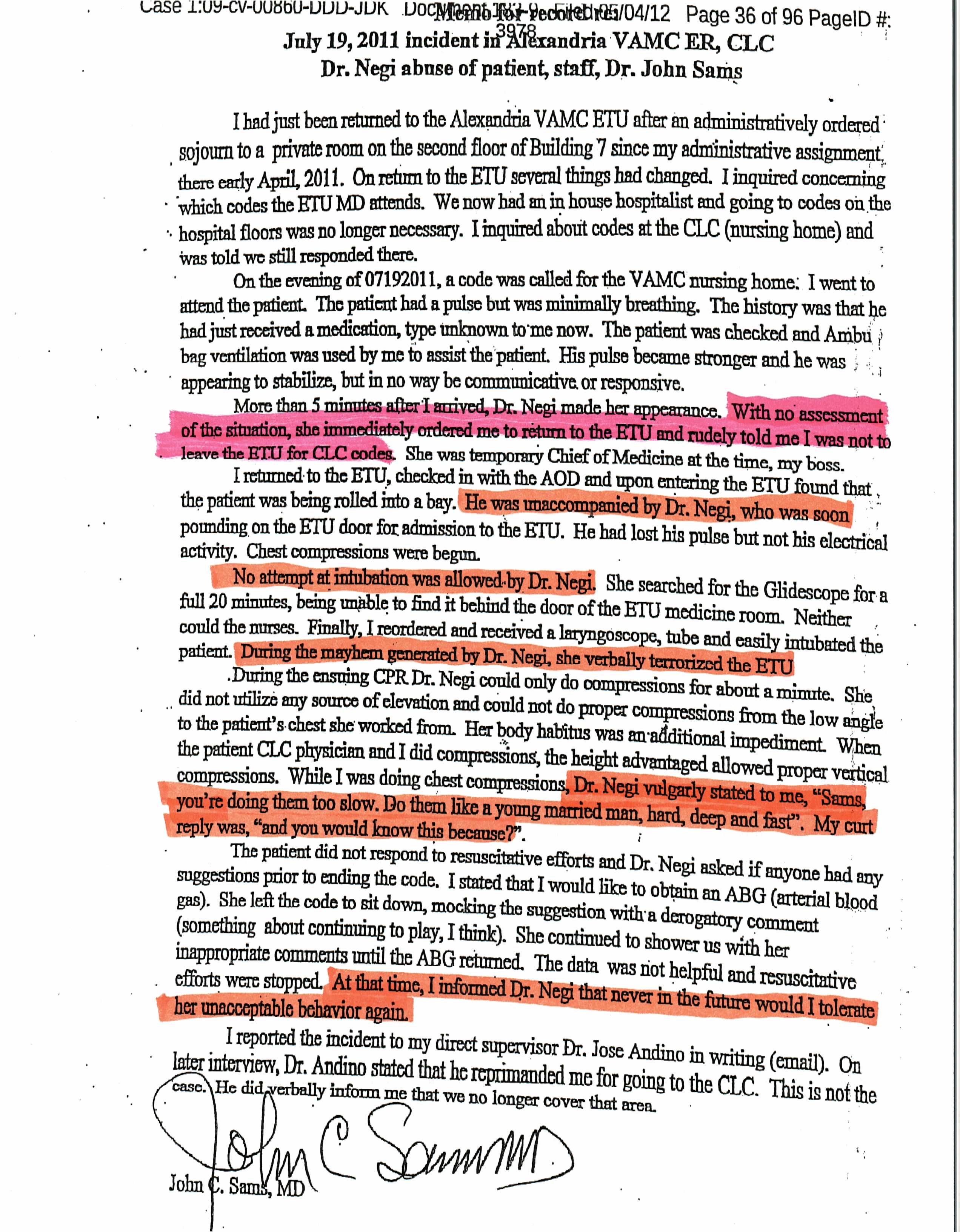
Dr. John Sams said he responded to a code for another patient on July 19, 2011, and found him “minimally breathing.” He initiated treatment and the patient’s pulse became stronger and he began to stabilize. SIGNED REPORT
“More than five minutes after I arrived, Dr. Negi made her appearance,” he wrote in his signed report. “With no assessment of the situation, she immediately ordered me to return to the (Express Treatment Unit) and rudely told me I was not to leave the ETU for CLC (Community Living Center, or VA nursing homes) codes. She was temporary Chief of Medicine at the time, my boss,” he wrote.

“I returned to ETU…and upon entering found that the patient was being rolled into a bay. He was unaccompanied by Dr. Negi, who was soon pounding on the ETU door for admission. He (Hamilton) had lost his pulse. Chest compressions were begun.

“No attempt at intubation was allowed by Dr. Negi. Finally, I reordered and received a laryngoscope tube and easily intubated the patient. During the mayhem by Dr. Negi, she verbally terrorized the ETU. While I was doing the chest compressions, Dr. Negi vulgarly stated to me, ‘Sams, you’re doing them too slow. Do them like a young married man—hard, deep and fast.’”

Dr. Sams wrote that Hamilton did not respond to resuscitative efforts and Dr. Negi “asked if anyone had any suggestions prior to ending the code.” Sams said he said he would like to obtain an arterial blood gas (ABG)—a procedure to determine how well the lungs are moving oxygen into the bloodstream. “She left the code to sit down, mocking the suggestion with a derogatory comment. She continued to shower us with her inappropriate comments until the ABG returned. The date was (sic) not helpful and resuscitative efforts were stopped. At that time, I informed Dr. Negi that never in the future would I tolerate her unacceptable behavior.”

Dr. Sams said he reported the incident in writing to his director supervisor who, instead of taking action against Dr. Negi, reprimanded Sams for responding to the CLC code.

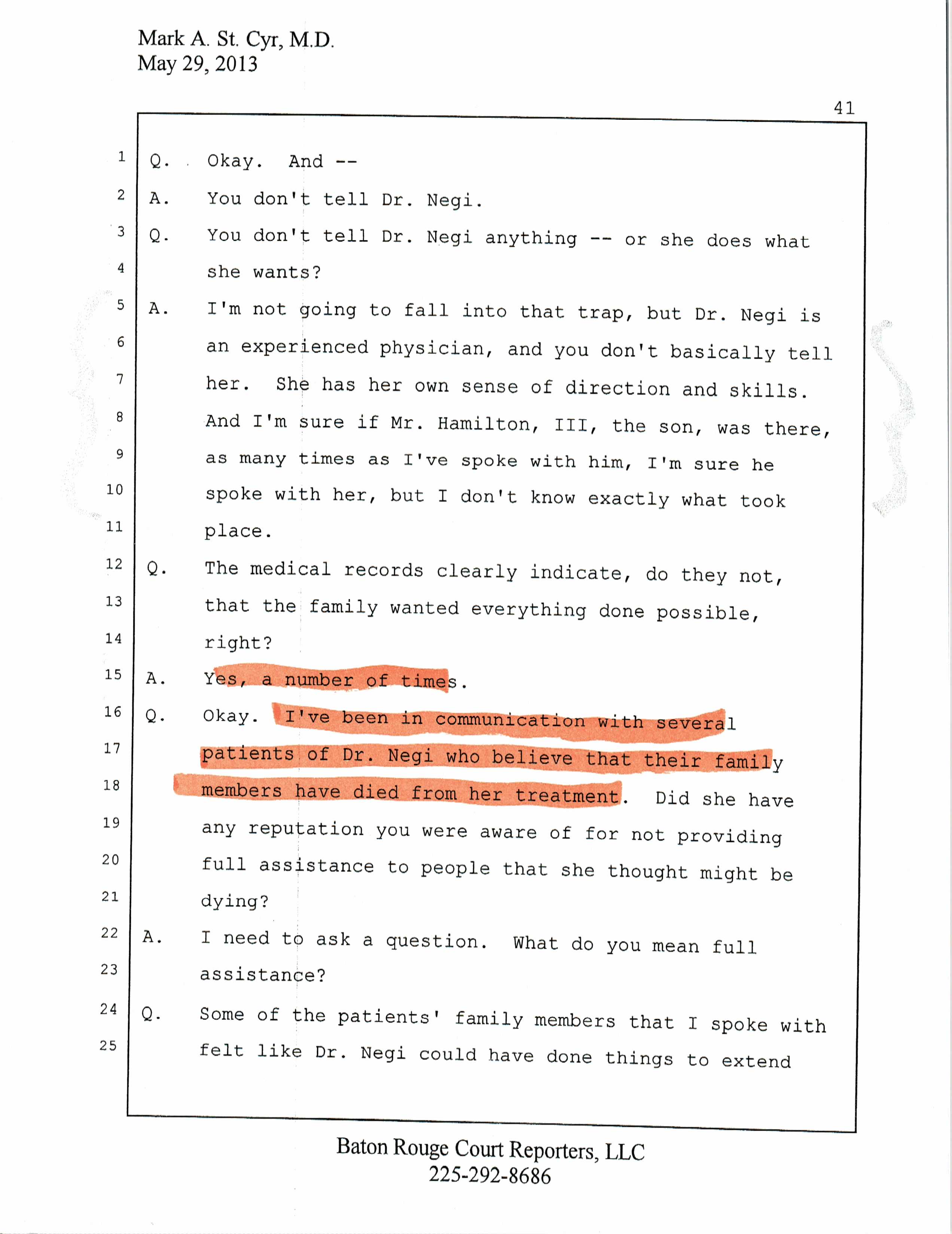
Dr. Mark St. Cyr, an emergency room contract physician, testified in a deposition that he had a conflict with Dr. Negi from the first moment they met. He said Dr. Negi threatened to “kick my butt” after he sought permission to admit an ER patient into the hospital. His deposition was given in a lawsuit by Floyd Hamilton, III, the deceased patient’s son.

He said the younger Hamilton gave specific instructions that he wanted his father kept in ICU and that the family “wanted everything possible done” to keep his father alive—and that he did not wish to sign a Do Not Resuscitate (DNR) order.

Attorney Robert Evans, III, indicated in the deposition of Dr. St. Cyr that he had been in communication with the families of several patients of Dr. Negi “who believe that their family members have died from her treatment.” COMMUNICATION WITH FAMILIES

Floyd Hamilton, III, as did family members of other patients, said Dr. Negi became incensed and abusive when her requests for DNR orders were not signed by family members. Hamilton said she even stopped communicating with him and would not return his calls.

Documents showed that Dr. Negi even sent a $50 money order to one woman in Leesville so that she could travel to Alexandria to sign a DNR order.

Dr. St. Cyr said Dr. Negi’s decision to remove a tube protecting his airway was not consistent with the family’s wishes. Asked in his deposition of removing the tube was not consistent with the family’s request to do everything possible, Dr. St. Cyr responded, “That’s a fair statement.” THAT'S A FAIR STATEMENT

St. Cyr described Dr. Negi as “aggressive” in terms of “getting patients in and getting them out” of the hospital. “(If) she doesn’t feel like something is worth it, she may not be quite as aggressive medically in terms of performing certain actions,” he said.

When asked by attorney Evans if “she might put him somewhere and take out the tube to expedite his demise,” Dr. St. Cyr again replied, “It’s a fair statement.” EXPEDITE HIS DEMISE
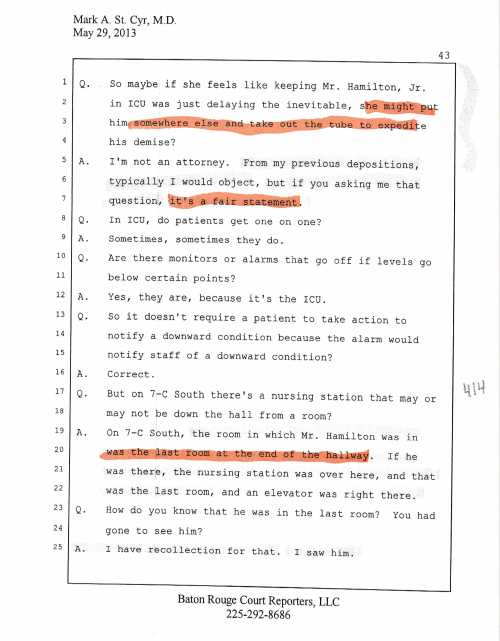
That line of questioning developed over St. Cyr’s description of how Dr. Negi removed the elder Hamilton from ICU to another floor at the end of a hall furthest from the nurses’ station. “Why would he (Hamilton) go to the floor, the last room at the end of the hallway (when he) can’t press a button, can’t call a nurse, or anything, and he’s not even responsive?” he asked. “You’re literally putting the person out there to die.”

Asked if any other hospital personnel were involved in the removal of the intubation of Hamilton, Dr. St. Cyr said, “No, sir. That’s solely Dr. Negi. When a person’s in the intensive care unit, Dr. Negi was in charge and you don’t go against Dr. Negi.”

Two nurses also filed written reports of the confrontation involving Dr. Negi and Dr. Sams, both claiming that Dr. Negi was yelling, belligerent, unprofessional, and throwing her gloves. “…She stated, ‘You never stop CPR,’” one of the nurses quoted her as saying. “CPR was never stopped on the vet other than when Dr. Negi was doing CPR.” The same nurse said Dr. Negi “continued to berate Dr. Sams” because Dr. Sams wanted a blood gas. Dr. Negi made the comment to respiratory, ‘Well I guess you will get to practice your collection of blood gases.’”

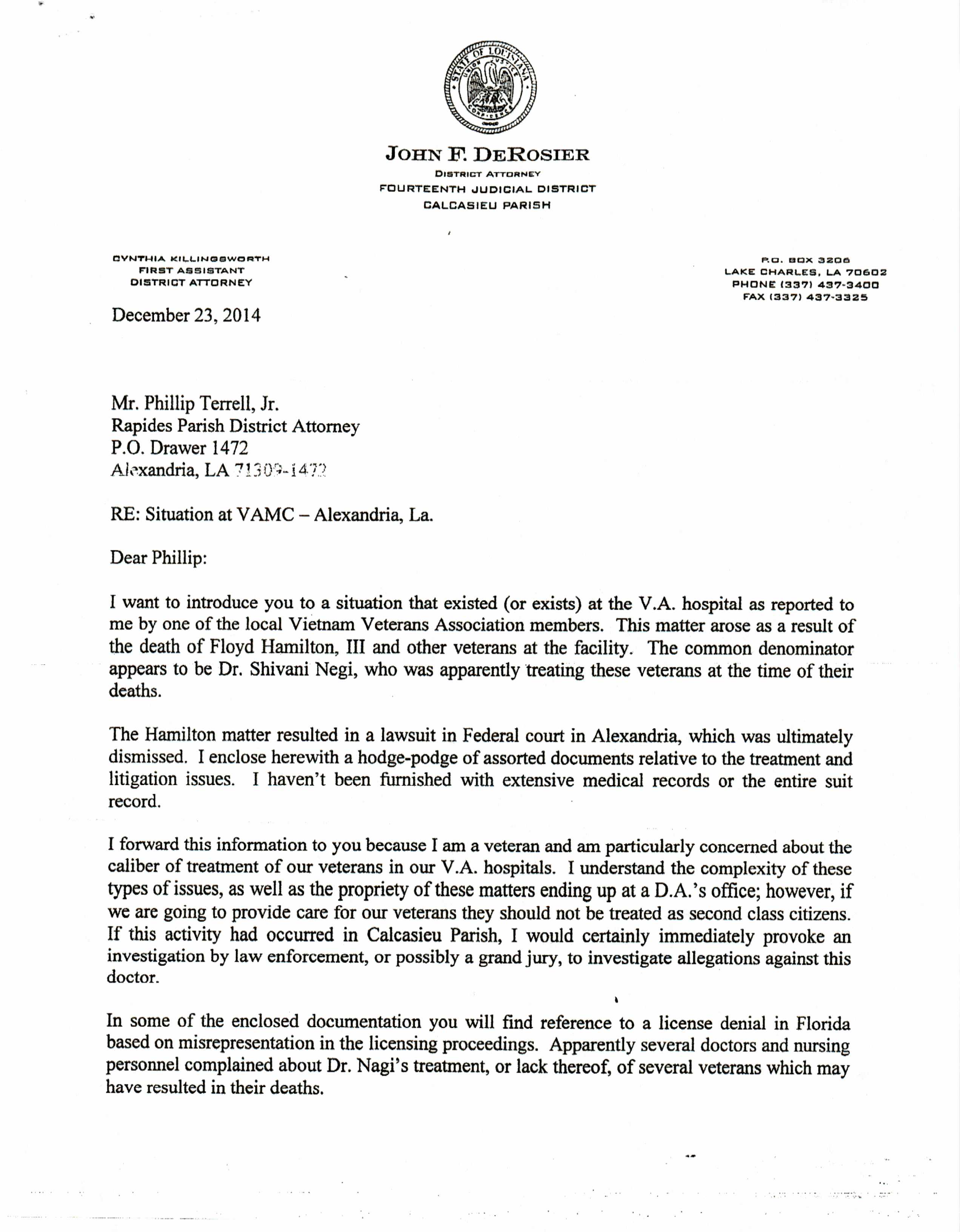
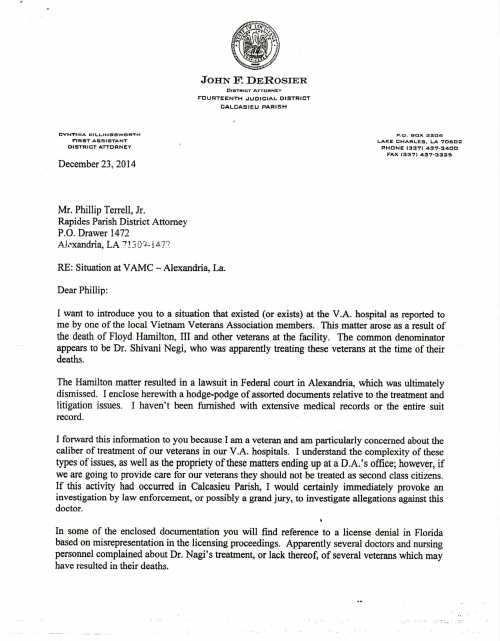
The Calcasieu Parish District Attorney, in a letter to his counterpart in Rapides, intimated that had the events involving Hamilton occurred in Calcasieu, “I would certainly immediately provoke an investigation by law enforcement, or possibly a grand jury, to investigate allegations against this doctor.”

D.A. John Derosier, in his Dec. 23, 2014, letter to Rapides D.A. Phillip Terrell, Jr., wrote, “Please have someone…determine whether or not there is sufficient basis to move forward with a formal investigation.”
 

LETTER TO HIS COUNTERPART

D.A. LETTER PAGE 2

Terrell, claiming his office was not equipped for such an extensive investigation, asked for assistant from then-Attorney General Buddy Caldwell’s office and Assistant Attorney General Arthur Ogea of Lake Charles was given the assignment.

Jeff Landry, upon taking office as Caldwell’s successor, however, fired Ogea and seized all his records on the Hamilton case. Contacted by LouisianaVoice, Ogea agreed to talk in more detail about his thoughts in the coming days but did say he felt there was sufficient evidence for a grand jury investigation and possible charges of negligent homicide against Negi.

It will be interesting to see how Louisiana’s new attorney general proceeds with this investigation.

Floyd Hamilton, III, meanwhile, kept applying pressure by picketing the hospital and by notifying members of Louisiana’s congressional delegation and VA officials.

Because he took photographs of his father that showed the stark contrast between the elder Hamilton’s condition before and after being removed from ICU, there is now a sign posted at the VA Hospital in Alexandria proclaiming an absurd—and unenforceable—rule that photographs are no longer allowed at the facility.

The Department of Veterans Affairs, Office of Inspector General, conducted an investigation of “suspicious deaths” at the Alexandria VA hospital. In its executive summary dated Feb. 14, 2008, the OIG repeatedly—and predictably—said that investigators “did not substantiate” any of the allegations involving Hamilton or any of several other patients who died while in the care of Dr. Negi.

Five days later, Christina Lavine, director of the VA’s Hotline Division, wrote Hamilton’s son, Floyd Hamilton, III to say that the VA OIG had closed his father’s case. “As we advised you when we opened this case, our decision to close a Hotline case is final, and there are no appeal rights,” she wrote.

Instead of definitive, meaningful action, all we’re received so far are insincere apologies and empty promises that conditions will improve. But they never do.

A congressional subcommittee held hearings on the Alexandria VA Hospital only last week. Even though subcommittee members were well aware of irregularities pointed out by Floyd Hamilton, III, and even though he was in attendance at the hearing, he was never allowed to testify. Perhaps, to borrow a phrase from Al Gore, Hamilton’s claims constituted “an inconvenient truth” to officials who should be infuriated at the manner in which our veterans are treated upon their return from duty.


Read Full Post »

By Robert Burns

After Louisiana’s FYE books were closed on June 30, 2013, the Jindal administration touted the fact that 2,340 hospital employees had been laid off during that fiscal year. Nevertheless, one hospital, the Huey P. Long Hospital in Pineville, was proving particularly vexing for Jindal’s administration.

With much fanfare, Jindal’s folks called a news conference to announce that the hospital’s operations would be transferred to England Airpark with an estimated $30 million required to renovate the facility which was closed in the early 1990s. The money was said to come from $5 million pledged by the England facility and the remainder from state-issued capital outlay bonds issued during FYE ’13.

Despite all of the hoopla associated with the announcement of the transfer, the proposal ended up fizzling out, and Jindal’s administration had to conjure up a “Plan B.”

That turned out to be another iteration of the public/private partnerships for which the Jindal administration essentially could have qualified for a patent on crafting such arrangements. In this instance, the public/private partnership would entail Rapides Regional Medical Center and Christus St. Frances Cabrini Hospital taking over much of the workload of Huey P. Long.

Of course, the whole proposal had the

gnawing obstacle that it needed approval from those darn folks at the Legislature, and that’s where things got interesting.

To accomplish the goal, Senator Gerald Long obediently introduced

Senate Concurrent Resolution (SCR) 48 in the regular session of the 2014 Legislative Session. On March 31, 2014, the Senate Committee posted an agenda for its meeting of April 2, 2014; however, that agenda was devoid of any reference to SCR-48.

On April 1, 2014 at 4:07 p.m., a revised agenda was posted in which SCR

-48 was posted and itemized to include a notation entailing its subject matter: “creating a new model of health care delivery in the Alexandria and Pineville area.” Amendments were added to SCR-48, and it ultimately passed both the House (66-28) and Senate (26-11).

Baton Rouge attorney Arthur Smith, III,

filed litigation on behalf of affected employees of the hospital and others alleging violations of Senate Rules of Order 13.73 and 13.75.

Also alleged was a violation of Louisiana’s Open Meetings Laws

, and relief was sought to have SCR-48 declared null and void (a relief available under Louisiana’s Open Meetings laws) based on that violation and also an assertion that SCR-48 was unconstitutional. A preliminary injunction was also sought to block the closure of the hospital with the ultimate goal of obtaining a permanent injunction.

The trial court granted the preliminary injunction, but it simultaneously suspended enforcement of the

preliminary injunction upon the defendants (the Louisiana Senate, LSU, and the State of Louisiana) perfecting an appeal.

It was initially believed that the Louisiana Supreme Court (LSC) would decide the matter because of the issue raised of the constitutionality of SCR

-48. However, the Supreme Court quickly refused to hear the matter in stating that it was “not properly before this Court.” The Supremes (no, not the singing Supremes) elaborated by ruling that it could consider only matters which had been declared unconstitutional in a court of law.

Since the trial court’s reasons for judgment only made reference to the

potential unconstitutionality of SCR-48 without making a definitive declaration that it was unconstitutional, the Supreme Court denied writs.

Meanwhile, the hospital was closed, and Smith took his case to the First Circuit Court of Appeal. That appeal was dismissed based

upon the fact there was no active injunction to prevent the hospital from being closed. That was the case because, expecting (wrongly) the Supreme Court to rule on the matter, Judge Robert Downing suspended the preliminary injunction. With no injunction in place to prevent the closure, the hospital was padlocked.

The First Circuit issued its decision on September 15, 2015. That ruling notwithstanding, the

declaratory judgment aspect of the lawsuit could proceed forward, and that led to a hearing in 19th JDC Judge Don Johnson’s courtroom on Monday, June 13, 2016.

During that hearing, much of what has been elaborated above was rehashed, but then co-counsel for the day’s proceedings, Chris Roy, Sr., of Alexandria, took center stage and converted what had been basically a snooze fest into a fireworks display.

Prior to Roy beginning testimony, Judge Johnson interjected a few points of his own into the arguments. First, Johnson indicated that, while he was a student at Southern University, he experienced a significant health issue and went to Baton Rouge’s local charity hospital

, Earl K. Long, and he said, “I sure was glad it was there to treat me.”

Earl K. Long was also shut down by the Jindal administration and subsequently demolished. Emergency room treatment of indigent patients was initially taken over by Baton Rouge General Midtown. But Baton Rouge General closed its emergency room more than a year ago. That forced low-income charity patients in the northern part of East Baton Rouge Parish to travel a much further distance to Our Lady of the Lake Medical Center in South Baton Rouge for treatment. That point was not lost on attorneys for the defendants who claimed that care would continue to be provided for the underprivileged, but such care would simply now take place under the new public/private venture.

Roy said that the closure of the

Huey Long Charity Hospital caused an enormous level of anxiety among the community’s population and also with the employees of the hospital. Johnson acknowledged that fact and said, “I’m aware of that fact. They didn’t like it at all.” Roy stressed that “125 employees lost their jobs and $11 million in wages were lost as a result of this episode.”

Roy focused most of his arguments on the fact that, contrary to defense attorney claims, the whole issue

of SCR-48 is not now “moot.” He emphasized that ordinary citizens are provided with only one mechanism for making their sentiments known about proposed legislation and that is through “showing up and testifying at committees and subcommittees of the Legislature.”

Roy then rhetorically asked how they were supposed to do that w

hen the Senate would engage in such a “flat-out violation” of posting an addition to the agenda at 4:07 p.m. the day before a hearing when the clearly-established deadline was 1 p.m. for such an addition. Roy then stressed his age, and even poked fun at the relative youth of one of his opposing counselors (who appeared to be in his late 20s at most), in indicating that he, Roy, was one of the participants in the formation of the present Louisiana Constitution.

Roy said, “One of our main objectives was to try and make everything as transparent as possible because there had been a prior governor, whom I won’t reference by name (a thinly veiled reference to Huey Long), who sought to keep the public from knowing

anything that was transpiring.” The irony of the subject matter of the suit being the closing of a hospital named for him seemed not to be lost on anybody in the room.

“Your Honor,” Roy continued, “the Senate basically said ‘to hell with the Constitution. We are the Senate of the State of Louisiana, and we decide what we will do and won’t do.’” Roy then emphasized that opposing counsel could not simply argue that the whole matter was “moot,” and assert a defense along the lines of “we won’t do it again.” Roy then emphasized that Louisiana Senate President John Alario is a good man with integrity and a close personal friend of his, but he then asserted that what Alario allowed to transpire in this instance was just “wrong.”

The State sought the granting of a Motion for Summary Judgment (MSJ) to dismiss the case, and the plaintiffs sought the granting of an MSJ declaring SCR-48 to be null and void. In the battle of the MSJs, Johnson ruled in favor of the plaintiffs: “SCR-48 of the 2014 Regular Session is declared to be Null and Void. The Plaintiff’s may seek attorney fees, costs, and expenses through post-hearing motion. The Joint Motion for Summary Judgment filed by defendants is denied.”

Now all that remains to be seen is whether the state will have to pay salaries and benefits retroactive to the hospital’s closing date to those 125 employees (the amount given was $11 million saved by closing the facility) or if there will be yet another appeal of a 19th JDC judge’s ruling to the First Circuit.

The smart money is on an appeal.

Read Full Post »

Three book signings have be set for my latest book, Bobby Jindal: His Destiny and Obsession.

Our first book signing will be this Saturday at 2 p.m. at Cavalier House Books in Denham Springs’ Antique Village. It’s the same store where I held my first book signing for my first book, Louisiana Rocks: The True Genesis of Rock & Roll.

Also on hand for this Saturday’s signing will be Del Hahn, author of Smuggler’s End: The Life and Death of Barry Seal. Hahn is the retired FBI agent who successfully pursued Seal. I had a small hand in the book as editor.

Before we go any further, it might be worthwhile to point out that my book about Jindal is not a powderpuff book in the mold of the two books by Jindal which probably resulted in his dislocating his shoulder from repeatedly patting himself on the back.

Please know that this book was undertaken and written in its entirety with zero collaboration or cooperation from anyone in the Jindal camp.

It’s the kind of book that result in my being removed from Jindal’s Christmas card list—had we ever been on that list, which we certainly were not.

This 294-page book is an examination that addresses several issues:

  • How did Jindal become a multi-millionaire after only three years in Congress?
  • Jindal’s claims of a new high standard of ethics are debunked by his own actions as governor.
  • Jindal’s claim of transparency is also belied by his penchant for secrecy.
  • His vindictive nature in firing or demoting anyone and everyone who dared disagree with him.
  • His awarding of prestigious board and commission memberships to big contributors.
  • His sorry record in protecting the state’s environment and the state’s coastline.
  • His mysterious deal to sell state hospitals via a contract containing 50 blank pages.
  • His single-handed destruction of higher education and health care.
  • His near-comical, yet pathetic candidacy for the Republican presidential nomination.

There is much, much more, of course, but you will have to get the book to read it.

Here is the current schedule for upcoming book signings:

  • Cavalier House Books in Denham Springs: Saturday, May 14, at 2 p.m.
  • The Winn Parish Library in Winnfield: Thursday, May 19, at 2 p.m.
  • Barnes and Noble Bookstore in Mandeville, Saturday, June 18, from 2 to 4 p.m.

This schedule will be updated as additional signings are scheduled.

Read Full Post »

« Newer Posts - Older Posts »