Feeds:
Posts
Comments

Archive for the ‘Governor’s Office’ Category

Additional checks by LouisianaVoice into the expenditure of campaign funds after leaving office has revealed that Troy Hebert, director of the Office of Alcohol and Tobacco Control was something of a piker in what appear to be his inappropriate expenditures of $39,000 in campaign contributions long after he left the Louisiana Senate in November of 2010.

Campaign reports examined by LouisianaVoice show that two former governors combined to spend more than $600,000 on what would appear to be such non-allowable expenditures as clerical salaries, club memberships, consulting fees, federal taxes, internet fees, office equipment, and something called “constituent relations” long after there were no longer any constituents. shall not be used for any perso

Three other former legislators who, like Hebert, now serve in other appointive capacities in state government were also checked at random and found to have combined for a little more than $22,000 in post-office-holding expenditures that appear to be for purposes specifically disallowed by the Louisiana Board of Ethics.

But former governors Kathleen Blanco and Mike Foster have made generous use of their leftover campaign bank accounts by paying hundreds of thousands of dollars for similarly disallowable purchases and expenditures.

Campaign expenditures for former governors Buddy Roemer and Edwin Edwards were not available on the State Ethics Board’s web page.

At the same time, we found one former legislator who has not spent a penny of his leftover campaign funds—for anything. Democrat Dudley “Butch” Gautreaux of Morgan City has spent none of his campaign funds—for any purpose—since leaving office in January of 2012. We sincerely hope there are others.

Foster, a Republican, accounted for more than $201,000 in apparent non-allowable expenditures from his campaign fund. He had the following expense items listed in his campaign expenditure report:

  • $3,000 for internet service;
  • $66,675 for clerical payroll;
  • $70,000 for copiers and other office equipment and maintenance contracts;
  • $9,400 in dues to the Camelot Club and City Club, both in Baton Rouge;
  • $4,300 in workers’ compensation insurance premiums for office staff;
  • $25,000 for bookkeeping services;
  • $9,800 in federal income tax payments on office staff;
  • $13,500 for “constituent services”;
  • $403 in payments to M.J. Foster Farms—an apparent reimbursement to himself for unknown expenditures.

In addition, Foster contributed to numerous causes, including $1,000 to a lamppost restoration drive in his hometown of Franklin and other charitable civic and church organizations and several political candidates. Only his contributions to political candidates and to the Louisiana Republican Party appeared to have been allowable under Ethics Board regulations.

Democrat Blanco easily eclipsed Foster with more than $400,000 in expenditures described in various Ethics Board opinions as not allowable for purposes “related to a political campaign or the holding of a public office.”

Some of her questionable expenditures included:

  • $188,000 for communication consulting;
  • $88,000 in clerical salaries;
  • $67,000 in donations to various causes;
  • $64,500 in tech support;

To be fair, however, there was brief speculation that Blanco would oppose Jindal in his re-election campaign of 2011 until health considerations took her out of that race. Any funds spent in exploration of a possible run would probably be looked upon favorably as campaign-related. Charitable contributions are allowed under certain conditions, such as in the cases of pro-rata refunds of unused contributions but otherwise such use of campaign funds for charitable donations is not allowed. We found an Ethics opinion that addresses that very issue: James David Cain

Like Foster, she also contributed generously to several political candidates as well as to the Louisiana Democratic Party, all allowable under Ethics Board regulations.

Former Sen. Anne Duplessis (D-New Orleans), now a member of the LSU Board of Supervisors ($13,440), former Rep. Kay Katz (R-Monroe), now a member of the Louisiana Tax Commission ($7,700), and former Rep. and former Sen. Noble Ellington (R-Winnsboro), now Chief Deputy Commissioner of Insurance ($1,300), each also had combined expenditures from their respective campaign funds totaling about $22,400 for purposes not allowed, according to Ethics Board regulations.

Small as those expenditures were when contrasted to Blanco, Foster or even Hebert, however, the samplings of more than $662,000 in questionable expenditures found by LouisianaVoice for only six former office holders—and the many examples of misuse of campaign funds by current officer holders—illustrates the critical lack of oversight of the manner in which office holders and former office holders alike live the good life off, what for many of them, is tax-free income most times in the tens of thousands of dollars but in some cases, six figures.

Campaign funds are contributed by donors, such as lobbyists, corporations, or other special interests who want something in return, like a favorable vote on a key issue. And because the politicians generally oblige, the donors couldn’t care less how campaign funds are spent. The funds are donated for the wrong reasons, so why should they care if they are spent for the wrong reasons?

That in a nutshell is what is wrong with our political system today. Far too much quid pro quo, a few winks, a couple of drinks over steak or lobster and donors look the other way as the recipient enjoys nice restaurants, club memberships, luxury car leases and tickets to college and pro athletic events and perhaps the occasional hooker.

Two things can occur to rein in this abuse:

The Louisiana Legislature, in a rare (and we do mean rare) moment of integrity and soul-searching, could enact binding laws governing who can contribute to campaigns (such as tracking the federal elections laws prohibiting corporate contributions), limiting PAC funds and spelling out in detail how campaign funds may and may not be spent.

But don’t look for that to happen in this or any other lifetime. Like corporations and banks, politicians just aren’t going to self-regulate without including a gaggle of hidden loopholes in any legislation that might happen to address the issue. You can bet any legitimate attempt will either be killed outright or amended to death in committee.

The other—and this, sadly, is just as unlikely—the voters of Louisiana will, in unity, say “ENOUGH!” They will, like Peter Finch as Howard Beale in Network, scream out their windows, “I’m mad as hell and I’m not going to take it any more” and they will turn out of office any legislator who so much as buys the first ticket to a football game or dines at a fine restaurant or leases a luxury auto with campaign funds. And in equal unanimity, they will demand reimbursement of all funds wrongly spent by current and former office holders alike.

But a final word of caution: That would be in a perfect world so don’t hold your breath.
 

Read Full Post »


Because of our limited staff (one, plus a few occasional contributors), we often fall behind in our efforts to keep up with the news of our misbehaving public officials. We try to keep up, but these guys are pretty slick and very resourceful in finding new ways to siphon off funds, whether they be state funds or contributions from campaign supporters.

So, today, we will highlight a couple of politicos who are very tight: Bobby Jindal and his director of the Office of Alcohol and Tobacco Control (ATC), Troy Hebert (whose wife just happens to be the Jindal children’s pediatrician, we’re told).

We have an update on the status of Frederick Tombar III, who, like Hebert was appointed to a high-level position in the Jindal administration only to harass himself out of a job.

Tombar, it seems, has landed on his feet after leaving his $260,000 a year job as director of the Louisiana Housing Corporation because of some sexually explicit emails he sent to two female employees—one, a contract employee and the other an actual employee of the agency.

Both women attempted to put off Tombar’s advances because of fear of losing their jobs but eventually each filed complaints and Tombar left before he could be interviewed during an investigation by Ron Jackson, Human Resources Director for the Division of Administration.

Not to worry. We’re told by sources that Tombar, of New Orleans, had a soft landing at Cornerstone Government Affairs consulting company where he will work alongside two former state Commissioners of Administration, Mark Drennan and Paul Rainwater. http://www.cgagroup.com/index.html

http://www.cgagroup.com/team/RainwaterPaul.html

http://www.cgagroup.com/team/mark_drennen.html

Efforts to reach both Drennan and Rainwater for comment were unsuccessful.

It’s not known what Tombar’s salary at Cornerstone will be, but we are willing to bet it doesn’t approach the quarter-million a year he was making as a Jindal appointee.

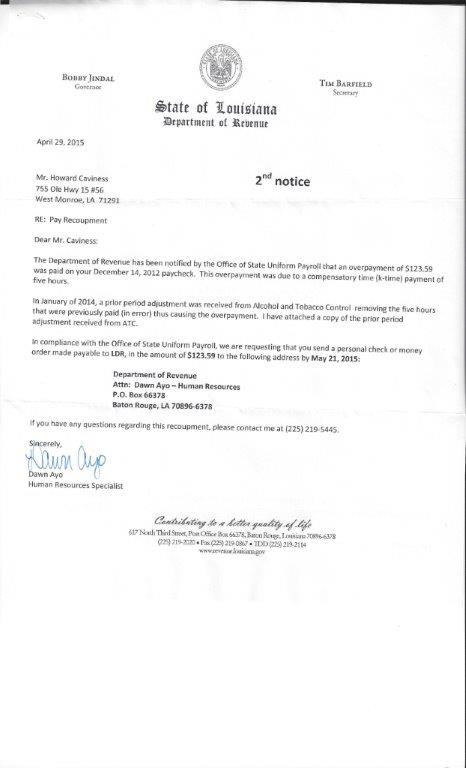
That other appointee mentioned earlier, Troy Hebert, of whom much has been written here, little of it good, recently sent a bill to former ATC agent Howard Caviness of West Monroe who now serves as Grambling State University chief of police. Well, actually, the bill was not from Hebert, but from the agency under which he serves, the Department of Revenue (LDR).

The invoice, for all of $123.59 is for an alleged overpayment to Caviness in Dec. of 2012, according to the letter dated April 29 which is stamped “2nd notice.” Supposedly, the $123.59, when collected, will go to help patch over Jindal’s $1.6 billion budget deficit. LDR letter

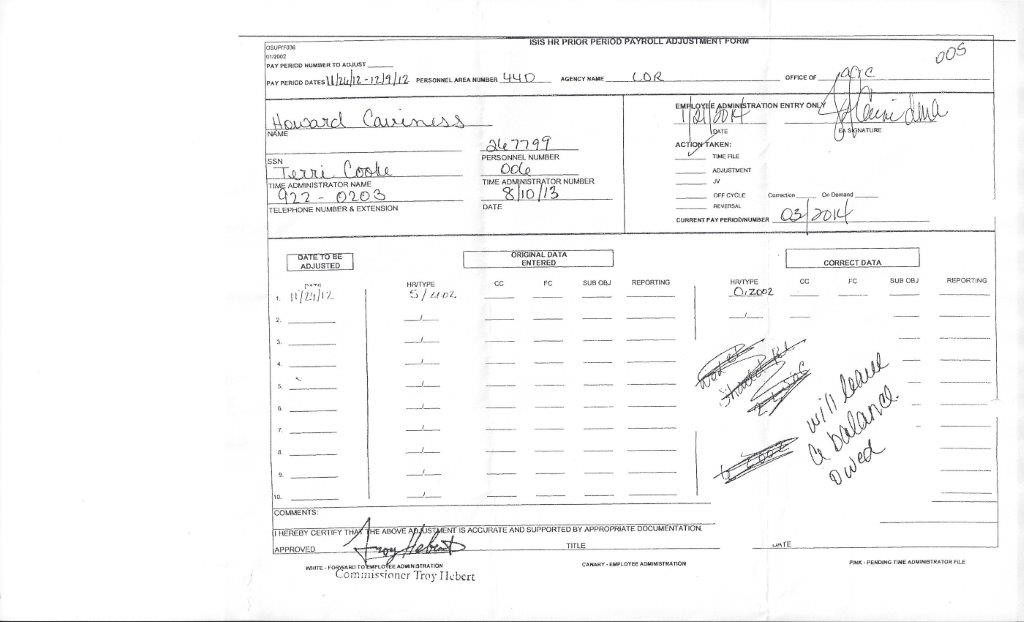
Attached to the letter is a time sheet for the two-week time period of Nov. 26—Dec. 9, 2012, with no explanation other than a hand-scrawled, “will leave a balance owed.” ATC timesheet

(CLICK ON IMAGES TO ENLARGE)

Caviness, contacted by LouisianaVoice, feels the action is in retaliation for his having testified on behalf of another former agent, Brett Tingle, who Hebert fired while Tingle was recovering from a heart attack.

Reprisals against a state employee by officials in the Jindal administration? Surely not!

But that would fit the modus operandi of Hebert and would give credence to a third former agent who revealed she was ordered to conduct an investigation of LouisianaVoice publisher Tom Aswell (that would be me). That former agent admitted that she did indeed follow through on the investigation but found me “rather boring.” We’ll take boring any day.

But we did our own nosing around and found that Hebert played pretty fast and loose with campaign donors’ money while he was still a state senator—and even after he left office to take over operations at ATC after Jindal did a number on former ATC Director Murphy Painter.

At the top of the list, as with the case of so many office holders, was his $12,165 expenditure for the purchase of what seems to be the most sought-after perk of all state politicians: LSU football tickets—$4,930 of that well after he left the House of Representatives in 2010 to become head of ATC. It’s somewhat difficult to see how whose expenditures, especially the $4,930 spent after he left office, could be justified as being “related to the holding of public office,” as state campaign expense laws clearly dictate. related to a campaign  personal use  cannot use campaign funds for personal use

But, as they say in those cheesy TV commercials, “Wait! There’s more!”

Our boy Troy also shelled out the following amounts for other seeming unrelated purposes:

  • Nov. 11, 2014: All State Sugar Bowl tickets, $590 (again, quite a stretch in tying this to holding public office); SUGAR BOWL
  • April 22, 2009: Sullivan’s Restaurant, Baton Rouge, $2,323.10 for a fundraiser; RESTAURANTS
  • April 1, 2010: Delta Airlines, $691.80 (no explanation of any destination, but his House district was pretty small and probably didn’t require air travel to get around Iberia Parish; TRAVEL
  • April 1, 2010: Hilton Hotel, Washington, D.C., $1,505.70. Ah! There’s his destination for that Delta flight. But what was he running for in Washington? HOTELS
  • May 10, 2011: Monteleone Hotel, New Orleans, $500. About those two hotel bills: state regulations limit hotel rooms to a mere $120 per night. Perhaps someone should sent Hebert a bill for the difference. Oh, wait. The rooms were paid out of campaign funds, not the state treasury. So that makes it okay, we guess.  travelguide

Still, $15,452 in campaign expenditures which somehow just don’t pass the smell test for legitimate campaign expenditures, especially $5,520 of which was spent after he left office.

And then there’s Jindal.

Since 2009, a year after he first took office, he has racked up an eye-popping expenditure of $169,597 in hotel room costs alone. TRAVEL

Even more revealing, all but $30,000 of that ($139,660) has been since his re-election in October of 2011, evidence that he has spent precious little time in Louisiana performing the “job he always wanted,” and the job to which he was elected.

Jindal also spent more than $185,000 in campaign money since 2003 on air travel, his campaign expense records show. Because his travel expenses were about equally divided between pre- and post-re-election in 2011, it would indicate that much of his lodging was provided by organizations to whom he was speaking.

By running as an “undeclared” candidate for the Republican presidential nomination, he was able to make free use of campaign funds he reaped while running for and serving as governor. That would explain why he is so cagey about his non-candidacy candidacy: the rules change and federal regulations kick in once he is a declared candidate. His self-serving claim to be “praying for guidance” over his decision has little or nothing to do with it; it’s all about the way he can spend the money.

Read Full Post »

By Robert Burns (Special to LouisianaVoice)

On Monday, November 5, 2012, the Louisiana Auctioneer Licensing Board (LALB) conducted a meeting at which two members, Vice President James Sims and Greg Bordelon, engaged in racist roll call responses. Because the meeting was quietly moved up by nearly three weeks, neither I nor Rev. Freddie Lee Phillips, Louisiana’s only African American auctioneer in its history, were aware of it and thus didn’t attend (our only absence in seven years).

Upon learning of the meeting, I made a public records request for an audio recording of it.  My request was ignored for almost a month, so I threatened litigation. Reluctantly, the LALB provided the recording.  Phillips, who thought I was joking about the racist responses, was justifiably outraged when he heard the tape. He wanted the Jindal Administration to hear the recording, so I supplied it to them. Meanwhile, an Advocate reporter, Ted Griggs, took an interest in the matter, and published this article on December 22, 2012. Jindal called upon the inspector general (IG) to “investigate” the matter. That “investigation” concluded with the release of this this report on February 20, 2013 in which the behavior is excused as mere “diabetes and dentures” flaring up for Sims and Bordelon merely “mocking Sims as a North Louisiana redneck.” Griggs published a follow-up story on the IG’s report soon after its release.

I was intrigued by the recording’s revelation of LALB members, especially Vice Chairman James Sims, lambasting Jindal over his freezing their per diem payments. Despite Jindal’s signing this Executive Order effective August 5, 2012, LALB members defied the order and accepted payments for the September 2012 meeting. I raised this issue privately with LALB Attorney Larry S. Bankston via email, and he responded with an email assuring me I could address my concerns at the next meeting (January 8, 2013). Meanwhile, Phillips wanted to address the roll call responses as part of the approval of the November 5, 2012 minutes. Phillips wanted verbatim roll call responses entered into the record of those minutes.

When January 8, 2013 rolled around, Bankston was emphatic that neither Phillips nor I would be permitted to speak on our respective issues as evidenced in this video.

Louisiana Revised Statute 42:14(D) mandates an opportunity for public comment on any meeting agenda item for which a vote is taken. Since the minutes of the prior meeting requires a vote for adoption, as does approval of financials (within which the illegal per diem payments constituted a line item), Phillips and I filed this open meetings law violation lawsuit pro se on March 6, 2013. In an effort to maximize his billings to his LALB client, Bankston filed back-to-back Dilatory Exception motions (a fruitless legal technique to drag out a case’s duration). The first motion, for which oral arguments were heard on July 22, 2013, resulted in Judge Hernandez granting a 30-day period to amend the lawsuit to more succinctly state a cause of action. The second motion, for which oral arguments were heard on February 3, 2014, was denied, thus forcing Bankston to file an answer to the suit over a year after it had been filed.             Because the case was a clear violation of the law, Phillips and I filed a Motion for Summary Judgment on May 12, 2014.  Oral arguments on our motion were heard by Hernandez on August 4, 2014. We argued that the case was a violation of the open meetings laws and we were therefore entitled to $100 each from the board members for denying us the right to speak on items clearly on the agenda. In a motion for summary judgment, one side (us in this instance) argues that no issues of material fact exist which can permit the case to continue to trial; therefore, judgment should be granted to the moving party as a matter of law. Upon the conclusion of oral arguments on August 4, 2014, Judge Hernandez took the matter under advisement, saying, “It will all boil down to whether the court finds there is a matter of material fact to permit the case to continue.”

Bankston filed his own Motion for Summary Judgment for the LALB for which oral arguments were set for September 15, 2014. Meanwhile, in a continued effort to maximize his legal billings, Bankston took depositions for both Phillips and myself. For Phillips, Bankston argued he suffered “no harm” from not being able to address the roll call response, to which Phillips told Hernandez, “I was unable to defend my culture, my heritage, or to confront the two board members directly on their actions.”

Bankston also argued that, because per diem payments were not a line-item on the agenda, the LALB violated nothing in terms of denying me the opportunity to speak. Never mind that per diem payments were a line item on the financials and that those very financials containing the illegal payments were being approved at that January 8, 2013 meeting. Never mind that Bankston had provided me with an email on December 23, 2012 which said that I would be permitted to address my concerns. If one isn’t permitted to discuss such an integral component of the financial statements being approved, what can the public state regarding the financials at the meeting? Bankston also posed the argument that, because I had informed Jindal’s office that the LALB was defying his executive order and Jindal’s office had demanded that the board members refund the per diem overpayments as a result, my goal had been accomplished notwithstanding the fact I was not permitted to discuss the matter at a public meeting.

Judge Hernandez again took the matter under advisement. When no ruling was issued prior to the November 4, 2014 election, I told Phillips, who resides in Hernandez’s district, that was a very bad sign. I said if Hernandez were to issue a ruling against us before the election, the contents of his ruling may cause Phillips to implore his congregation, relatives, and friends to vote for Hernandez’s opposition. Because of that, Hernandez was delaying making his ruling until after the election. If so, he was smart because he barely survived a strong challenge by Democrat Collette Greggs (53-47).

Judge Hernandez issued his ruling granting Bankston’s Motion for Summary Judgment more than 60 days after the election. In doing so, Hernandez went from openly questioning if any issue of material fact existed on Aug. 4, 2014, to permitting defendants to continue toward a trial, in effect saying plaintiffs had no basis for proceeding with trial!

Hernandez said in his ruling, “The agenda did not include the subject of per diem payments,” and he therefore ruled that the board would be required to add the line item of per diem payments to the agenda to permit discussion! So, using Hernandez’s “logic,” a board guilty of making illegal payments must vote to add a line item entailing the illegal payments in order for the public to address them! Don’t hold your breath waiting for that to occur. Hernandez’s ruling not only makes a mockery of LA R. S. 42:14(D), but his ruling makes the court culpable in attempts to keep illegal payments by board members. Moreover, the court is made to appear even more culpable than those seeking to keep the illegal payments. His ruling sends a horrible message to members of the public seeking to hold public bodies accountable.

Hernandez went on to say that, even if a violation of the open meetings law transpired on January 8, 2013, it was remedied at the March LALB meeting. The fact that a judge has to say, “even if a violation occurred,” is a point-blank statement that an issue of material fact exists in the case and therefore he was bound by law to deny Bankston’s motion and permit the matter to continue to trial.

We wanted to appeal Hernandez’s ruling as it’s doubtful any three-judge panel of the First Circuit would have upheld his ruling. State agencies, with infinite resources of taxpayer dollars, routinely appeal rulings knowing they stand no chance of being overturned.  LouisianaVoice readers may recall an article on the CNSI trial in which Judge Kelley told the state’s attorneys “there is nothing to appeal because this matter is that clear,” regarding Bruce Greenstein having waived attorney-client privilege. Nevertheless, at a cost approximating $30,000, the state appealed Kelley’s ruling, only for it to be upheld.

My attorney informed me it would cost about $9,000 to appeal Hernandez’s ruling and even if we prevailed, there was no way to recover that $9,000. Hence, we had little choice but to walk away. That’s why Judge Caldwell’s “split the baby” ruling in the Tom Aswell’s public records request lawsuit last week felt like such a victory from my vantage point. A judge finally provided some relief to the “small guy.”


Read Full Post »

While others may become bored reading about my grandfather, I never tire of writing about him. He drove from Ruston to Galveston, Texas, back in 1945 to retrieve an abandoned and malnourished infant from a hospital there, brought him home and he and his wife set about giving the baby a home filled with love and not much else.

My grandparents were unlearned in terms of formal education but my grandfather tried to teach me dignity, honesty and respect—respect, most of all. Some of those lessons stuck. Once he bought me a candy bar and as we were riding in his pickup moments later, I tossed the wrapper out the window. Suddenly a resounding POW! exploded in my ears as the palm of his hand found the back of my head and I saw Jesus at the end of a long tunnel waving me to the light. My grandfather never said a word. He didn’t have to and to this day, I refuse to throw anything out my truck window and defy any of my passengers to do so.

But there was another lesson he taught me, one that a man named Winston Churchill also espoused. He drilled into my psyche the importance of defending myself and defending the rights others with equal determination. “If you don’t stand up for yourself, it’s for damned sure nobody else will,” he told me at least a thousand times during my childhood and adolescence. Churchill more eloquently said much the same thing on Oct. 29, 1941, in a speech at Harrow School: “Never, never, in nothing great or small, large or petty, never give in except to convictions of honour and good sense. Never yield to force; never yield to the apparently overwhelming might of the enemy.” https://www.youtube.com/watch?v=wVEiskNv1hs

That’s why I call Bobby Jindal out on every occasion that I catch him lying through his teeth. Like, for instance his claim that he has reduced the state work force by 30,000 employees during his administration when the Office of Civil Service, in its latest report, puts that actual number far lower—like 13,604 positions abolished but only 8,420 people laid off since Fiscal Year 2008 which actually started six months before he took office. But don’t take my word for it; see for yourself: MAY 2015 LAYOFF REPORT

The words of both my grandfather and Churchill are lessons we can apply in our efforts to confront the efforts of Jindal and the Louisiana Legislature in their efforts to weaken state employees and teachers.

Remember a few years ago when bills were introduced to abolish civil service? Those bills actually provided the impetus to start LouisianaVoice. Already making preparations to retire from my own civil service job with the Office of Risk Management, I could not stand idly by and watch my fellow employees stripped of their job protection, such as it was. (Of course, when LouisianaVoice was born, it hastened my retirement as Jindal did not—and does not—take kindly to criticism of any form or from anyone.)

I could understand and accept the prohibition against civil service employees’ participation in political campaigns. That ban extended to campaigning, contributing to campaigns and even to signs and bumper stickers. But it was okay. Civil Service was established by Gov. Jimmie Davis for the specific purpose of protecting employees from political patronage and their firing for no cause other than supporting the wrong candidate.

But to place that restriction while at the same time abolishing their job protection? Not for one nano-second, not as long as I owned a computer and a keyboard. Even though it ultimately precipitated my retirement a year or so sooner than I had anticipated, my grandfather’s admonitions to stand up for myself and others was stronger than my concerns for job security.

The efforts to do away with civil service failed but now Jindal and his lackeys in the House and Senate are doing their dead level best to follow the example of Wisconsin Gov. Scott Walker http://thinkprogress.org/election/2015/05/04/3654397/scott-walker-says-crush-whats-left-american-unions-elected-president/ and to meekly obey the demands of Grover Norquist of Americans for Tax Reform (ATR) in his letter to legislators: https://www.atr.org/louisiana-labor-committee-passes-paycheck-protection-bill

That letter calls on legislators to support House Bill 418 by Rep. Stuart Bishop (R-Lafayette) and Senate Bill 204 by Sen. Dan Martiny (R-Metairie), both of which call for the cessation of the withholding of union dues for teachers by the state.

Both bills are blatant attempts to weaken teachers unions, namely the Louisiana Federation of Teachers and the Louisiana Association of Educators. The smokescreen thrown up by proponents of the bills is that it is burdensome for the state to process the dues withholding.

That’s simply a lie and a disingenuous one at that. The transactions are done by computer and once set up, never need human input. It’s certainly no more difficult than withholding state employee premiums paid to the Office of Group Benefits or to any one of dozens of premiums withheld for life, dental and disability insurance companies. You’d think these guys would at least give the appearance of trying to be a little more believable.

A story by Education Week explains the predicament faced by teachers in a single headline: “Education is political; can teachers afford not to be?” http://www.edweek.org/tm/articles/2015/05/01/education-is-political-can-teachers-afford-not.html

The story points out that teachers often refrain from viewing themselves as political even though curriculum, standards, testing and funding are all political.

“If teachers and parents don’t get more political, our public schools will continue to be assaulted by the privatizers, profiteers, pseudo-reformers, voucherizers and other enemies of public education,” one reader wrote in a comment about the story.

Don’t believe that? Let’s review. It was in March of 2012 when teachers demonstrated at the State Capitol over Bobby Jindal’s so-called “education reforms” and when one teacher attempted to testify before the House Education Committee, then-Rep. Nancy Landry (R-Lafayette) attempted to push through a requirement that in addition to the customary practice of witnesses providing their names, where they were from and whom they represent, they also be required to say if they were appearing before the committee in a “professional capacity or if they were on annual or sick leave.”

A furious John Bel Edwards (D-Amite) said he had never in his House tenure seen such a rule imposed on witnesses. “This house (the Capitol) belongs to the people,” added Rep. Pat Smith (D-Baton Rouge), “and now we’re going to put them in a compromising position? This is an atrocity!” https://louisianavoice.com/2012/03/page/5/

If teachers still are not convinced that they should unite as one and flex a little muscle, perhaps they should remember Jindal’s infamous speech before the Louisiana Association of Business and Industry in January of 2012 at which he introduced his education reform package. During that speech, he alluded to paying teachers simply by virtue of their ability to breathe. http://gov.louisiana.gov/index.cfm?tmp=detail&md=newsroom&articleID=3197

Subsequent to that endearing line, several teachers stopped breathing when they sacrificed their lives defending school children from berserk gunmen but Jindal never once acknowledged those acts of heroism. Not once, though he did pose with his family for his Christmas card last year—with everyone, including children, dressed in camouflage. Touching.

If additional proof is needed of the severity of the situation for educators, in North Carolina, teachers have begun demonstrating their commitment to public schools by wearing red clothing as a symbol of support for their vocation.

So, what’s wrong with that, you ask? Didn’t we in recent years start a tradition of wearing red on Fridays as a salute to our armed forces?

Yes, but with teachers apparently it’s different and offensive enough that Senate Bill 480 was introduced in the Tar Heel State legislature that would make such a brazen act a Class 1 misdemeanor because supporting public education is considered a political view, subjecting teachers participating in such anarchy to dismissal.

http://crooksandliars.com/2015/05/north-carolina-teachers-no-free-speech-you?utm_source=Crooks+and+Liars+Daily+Newsletter&utm_campaign=82e35765a1-RSS_EMAIL_CAMPAIGN&utm_medium=email&utm_term=0_d4904be7bc-82e35765a1-330138269

Never mind that the late Supreme Court Justice Thurgood Marshall said that the “threat of dismissal is nonetheless a potent means of inhibiting speech” and a violation of First Amendment rights.

So, bottom line, corporations, with their billions in political dark money, are classified as individuals and free to purchase elections and politicians at will but teachers, with an average salary of $40,065, are political activists to be feared and controlled—muzzled, as it were.

But to all teachers who read this: you vote, your family votes, your friends vote and you would be wise to watch to see how your legislators vote on issues that affect you. The election is this October. We will be choosing a governor and 144 legislators.

I harken back to my grandfather’s sage advice: “If you don’t stand up for yourself, it’s for damned sure nobody else will.”


Read Full Post »

LouisianaVoice is continuing its fundraising drive to help offset the costs of litigation against the Division of Administration and Bobby Jindal in our never-ending fight for access to public records.

These are records of what the administration is doing, how it is spending your taxpayer dollars, and how it is implementing policies that affect your daily lives.

These are also records that belong to you, the citizens of this state, and Jindal does not want your prying eyes looking over his shoulder—even if that shoulder is in Iowa or New Hampshire. Nor do the various boards and commissions which exercise tremendous power over small businesses want us looking into their operations.

But we do and we will continue to do so. But it is costing us legal fees—fees that we don’t recover if we fail in court. And the courts are not inclined to side with the public’s right to know; they would rather take the easy way out and rule for the state.

But we nevertheless must keep the pressure on and to do so costs money and time.

Please help by contributing what you can either by clicking on the Donate Button with Credit Cards button to the right of the page or by mailing your check to:

Capitol News Service/LouisianaVoice

P.O. Box 922

Denham Springs, LA. 70727-0922

Thanks for your support!

Read Full Post »

« Newer Posts - Older Posts »