Feeds:
Posts
Comments

Archive for the ‘Courts’ Category

Before the recent spate of sexual harassment claims in Hollywood, New York and Washington, D.C., there was a lawsuit filed by a female attorney for the Louisiana Department of Health against the agency’s general counsel.

That lawsuit, filed in June 2014 by Bethany Gauthreaux, a $42,500 per year attorney for LDH, against LDH and its $100,000-per-year Attorney Supervisor Weldon Hill, was quietly settled in May 2017.

The matter was settled for only $40,000—far less than it probably should have been, given the circumstances of the treatment undergone by Gauthreaux, according to a former associate who said Gauthreaux told her at the time that she just wanted the entire matter to be over and done.

SETTLEMENT

Even then, that might have been end of it all had not Hill and Executive Counsel Stephen Russo continued the intimidation and humiliation of Gauthreaux after she complained about Hill—to his supervisor and to LDH Human Resources—treatment that continued until her eventual resignation in May 2015.

Moved to Storage Room

The former associate who asked that she not be identified because she still works for the state—but in a different agency now—said Gauthreaux was moved from her eighth-floor office to a converted storage room on the fifth floor. She was not provided a telephone in her new location nor was she allowed to take her computer with her. Two other female employees were also moved from eighth to fifth floor but both took their computers with them to their new offices.

Meanwhile, Hill and the two attorneys over him who protected him, continued to receive pay increases.

“I would go into the restroom and find Bethany crying,” the former associate said. “I asked her what was wrong and she said, ‘Weldon Hill won’t stop.’”

Hill, Gauthreaux’s lawsuit said, would ask her highly personal questions following the birth of her child, questions about how it felt to pump breast milk. He also would position himself behind her chair and press his body against hers as he monitored her computer screen, sometimes, placing his hand on hers on the computer mouse, the petition said.

DEPOSITION OF GAUTHREAUX

DEPOSITION OF HILL

DEPOSITION OF RUSSO

The former associate said that in addition to Gauthreaux, there were at least four other women who were intimidated, harassed, and mistreated by Hill and Russo, who, as Hill’s direct supervisor and the department’s hiring authority, appeared to be protecting Hill. “They totally ostracized Bethany after she complained to Russo,” she said. “She finally said she couldn’t take it anymore and quit.”

‘Women have nothing to say’

“Weldon does not listen to women,” she said. “He said women ‘have nothing to say.’ He listens to every third word women say. Those who stood up to him paid a price,” she said. “I stood up to him once and he filed a complaint against me to Russo.”

She said another female employee who complained about Hill was given a “Needs Improvement” letter for something that had occurred two years before.

She said that Hill also performed outside legal work on state time. “That’s payroll fraud,” she said. Asked by LouisianaVoice if that could be proven, she said, “Only by checking his state computer.”

And while Gauthreaux preceded the “Me Too” movement, the work environment at LDH apparently remains hostile for female employees.

Gauthreaux, for example, never received a promotion to Attorney 2 in her two years at LDH and received one pay increase of $1,638 per year, Hill saw his pay increase by $5,720 per year, one of those raises coming only a couple of months after Gauthreaux’s lawsuit was filed and another beginning on Jan. 1 this year, which brought his annual salary to $99,800.

During that same period, Russo saw his salary increase by $7,930, to $138,500 per year.

Triumvirate Cronies

Kathleen Callaghan, a former supervisory attorney for LDH who is now retired, is also familiar with the triumvirate of Hill, Russo and $140,300-per-year LDH General Counsel 3 Kimberly Humbles.

“They’re all cronies who pal around together,” Callaghan said. “They retaliated against Bethany, they retaliated against me and they retaliated against other female employees. Weldon Hill is a typical predator who ingratiates himself with Russo and Humbles and they in turn protect him.”

She said she was told by higher ups that Gauthreaux wasn’t strong enough. “I said, ‘Are you kidding me? She took on the whole bunch and she prevailed.’ Nobody else in a supervisory position would stand up for her. She had to stand up for herself. Hill should have been put on administrative leave immediately when that suit was filed,” she said. “He should be gone.”

Callaghan said she once was accused of being AWOL by the same supervisor who had approved her two-week vacation. “My vacation started just a couple of days before Bethany’s lawsuit was filed, so they thought I’d ducked out. In reality, my vacation had been approved in advance but for whatever reason, they never checked that until I pointed it out to them,” she said. “And they’re supposed to be lawyers.”

Timing Bathroom Breaks

She said Hill keeps tabs on when subordinates leave their desks and how long they’re gone. “If he has time to do that, he isn’t busy enough,” Callaghan said. “He needs something to keep him busy besides keeping track of how long people spend in the bathroom. He is a Third-Party Administrator, which is just filing liens. He generates letters, something a clerical could do. He needs to be transferred to federal court where he can keep busy doing what he should be doing.”

Asked by LouisianaVoice why LDH Secretary Dr. Rebekah Gee hasn’t taken action to keep LDH from further liability exposure, Callaghan said, “I don’t think Dr. Gee is even aware of the lawsuit. I think they kept a lid on it and she doesn’t even know about it.”

She said former LDH Secretary Kathy Kliebert once was informed of similar problems. “Her response was we should all go on retreat together. I’m sorry, but that’s not a solution,” she said, indicating that someone with authority needs to step in and clean up LDH’s legal department.

At some time, the message must sink in that just because you’re in a supervisory capacity, you cannot, must not, attack, subvert, or destroy a person’s dignity and self-respect.
 

Read Full Post »

By now, thanks to the Internet and network TV news, virtually everyone in the U.S.—and apparently some foreign countries—knows about the ham-handed manner in which the Vermilion Parish School Board shut down one of its teacher’s comments during a recent board meeting.

The manner in which Kaplan middle school English teacher Deyshia Hargrave’s was cut off from speaking and subsequently manhandled by a city marshal was carried out with all the tact, consideration, delicacy, and diplomacy of Donald Trump discussing immigrants from $*%#hole countries.

And the fact that the school board employed the CITY MARSHAL who was previously accused of using excessive force against a 62-year-old man in poor health to carry out the handcuffing and arrest of Hargrave certainly didn’t help matters in what overnight brought national and international negative attention to Louisiana.

And the announcement by the city prosecutor that Hargrave would not be prosecuted only enhances her chances of reaping a financial settlement subsequent to the lawsuit she is almost certain to file for her rude treatment and public humiliation.

To provide a little background for anyone who may not have heard, Hargrave was at the board meeting to protest a $30,000-per-year proposed salary increase for School Superintendent Jerome Puyal (from $110,190 to $140,188) while teachers, cafeteria workers and, support staff received no salary increases. School Board President Anthony Fontana, an Abbeville attorney who has been on the board about a quarter-of-a-century, promptly gaveled her into silence, proclaiming her comments were not germane to the board’s agenda.

One report had Fontana referring to Hargrave, parish’s 2015-2016 teacher of the year, as “the poor little lady” in an INTERVIEW subsequent to the meeting. That charitable reference is almost certain to absolve him of any culpability in what has become a public relations nightmare sufficiently grievous to attract the attention of the ACLU and teachers’ unions, not to mention network television news.

But that all could have been avoided had Fontana simply consulted in advance with the good folks at Gravity Drainage District 8 of Calcasieu Parish Ward 1. Not those folks know how to shut a dissident up quietly and efficiently.

The secret is to get an attorney who isn’t afraid to threaten the dissident and a judge who can ignore the First Amendment to the U.S. Constitution and issue an order that the dissident may not make public records requests nor have any contact with any members or employees of the gravity drainage district.

Or, better yet, have a gaggle of judges file suit against a newspaper to prevent it from seeking public records from the court.

Problem solved.

Never mind that the gravity drainage district hired with Billy Broussard to remove debris from drainage canals following Hurricane Rita under a FEMA contract and then instructed Broussard to remove older pre-storm debris and that he would be paid to do so.

But when FEMA said the older debris was not part of the project, the drainage district flat-out refused to pay Broussard about a million dollars that was due him for the work. Moreover, some of that older debris consisted of large cypress logs—still very much useful in construction—which mysteriously disappeared.

So, when Broussard attempted unsuccessfully to get reimbursed for his work, RUSSELL STUTES, Lake Charles attorney for the drainage district, wrote a testy letter to Broussard in which Stutes, elevating himself to judge status, threatened Broussard with jail time “the next time any Calcasieu Parish employee is contacted by you or any of your representatives with respect to the project…”

Stutes even filed a petition for injunctive relief to bar Broussard from contacting members or employees of the drainage district and from seeking public records. Incredibly, 14th Judicial District Judge David Ritchie signed the order for the INJUNCTION that bars Broussard from his constitutionally-guaranteed right to seek answers from a public body. That right is also guaranteed under Louisiana R.S. 42:4.1 et seq.

Likewise, the judges of the 4th JDC up in Monroe filed SUIT against the Ouachita Citizen newspaper in West Monroe in order to stymie the newspaper’s efforts to obtain public records from the court.

So, you see, Mr. Fontana, it really wasn’t necessary to shoot yourself in the foot by having the city marshal strongarm Ms. Hargrave, your defense that he was authorized to do so notwithstanding. That just brought unwanted attention to a board what was already contentious in its membership makeup—some of that disharmony stemming from the performance of the very superintendent to whom you trying to give an extra $30,000 per year.

All you had to do was have the board attorney (and you are an attorney yourself) to find a judge who would sign an order for injunctive relief which, while questionable in its legality, would nevertheless have shut Ms. Hargrave up.

For a minute, anyway, to borrow a phrase from Ron “Tater Salad” White, one of my favorite stand-up comics, which he tags at the end of this joke but which is deleted from this VIDEO.


Read Full Post »

The ongoing soap opera of the Louisiana State Police Commission (LSPC), which in no way resembles its membership makeup of a little more than a year ago, continues unabated.

In a relatively short time, the commission has undergone a complete membership turnover, has seen two commission chairmen resign under pressure, a member resigning in protest over what he called a lack of integrity on the part of fellow commissioners, the resignations or removals of other members, and the forced resignation of its executive director.

Now that former executive director, Cathy Derbonne, is back with a vengeance—and with an attorney known in Baton Rouge for taking on the establishment in a take-no-prisoners frontal assault.

Derbonne and her attorney, Jill Craft, have filed suit against the Louisiana State Police Commission, claiming that then-Commission Chairman T.J. Doss, commission member Jared Caruso-Riecke, Louisiana State Police upper command (including then-Superintendent Mike Edmonson) conspired to force her from the job she had held for eight years.

DERBONNE PETITION

She claims in her lawsuit that the reprisals started after she initiated an investigation into reports that members of the commission and the Louisiana State Troopers Association (LSTA) had violated regulations against political activity by making monetary contributions to several political campaigns, including that of Bobby Jindal and John Bel Edwards.

She alleges in her petition that Doss was sharply critical of her at the LSTA convention held in Lafayette in June 2016. She claims that Doss said the furor over the political contributions were her fault and that she “had lost her mind.”

She says a year later, on July 14, 2016, Doss was detailed from his job in Troop G in Shreveport to Baton Rouge headquarters “with the purpose of closely monitoring and observing (Derbonne’s) daily routine,” and the following day he appeared unannounced in her office to ask when was the last time she had been evaluated “which petitioner (Derbonne) understood was a threat.”

When she brought an unlawful pay increases of as much as 32 percent for Edmonson and four of his top deputies to the attention of the Legislative Fiscal Office in September 2016, many of her administrative duties were taken from her by the commission through the efforts of Doss.

She said on Jan. 7 of this year she received an anonymous letter warning her that Doss, by then elevated to commission Chairman, was leading a “secret charge” for her removal. Five days later, at the Jan. 12 commission meeting, she was told that the commission had the necessary votes to remove her. They pressured her to resign, saying they would humiliate her in public.

She did resign but says in her lawsuit that she was harassed and “constructively discharged” in reprisal for her engaging in activities protected under state statute.

She is requesting a trial by jury.

Only two members, Jared-Riecke and Eulis Simien, Jr., remains from the commission membership that convened on Jan. 12. The commission’s primary function is to consider appeals of disciplinary action against state troopers. But like the administration of former Superintendent Edmonson, it has been rocked with one controversy after another which has made it nearly impossible for it to formulate any cohesive action other than damage control and finding new creative ways to embarrass the Edwards administration.

Read Full Post »

By Morgan Statt, Guest Columnist

It’s 2005, and the National All Schedules Prescription Reporting Act (HR 1132) is on President George W. Bush’s desk ready to sign. With one fell swoop he signs the bill into law, and it grants all states $100 million in funding to aid prescription drug monitoring services. Shortly after, former Louisiana representative Billy Tauzin abandons his post in the House of Representatives and accepts a job as President and CEO of PhRMA, a major lobbying group for pharmaceutical companies. Instead of celebrating the bill being signed into law, Tauzin finds a way to dismantle the allocation of funding.

Now, let’s bring it back to present day. Today, there is an almost daily snippet of news on America’s opioid epidemic, one that has ravaged nearly every area of the country. In 2016, more than 63,600 opioid overdose deaths were reported, the highest number ever, and new reports show that the crisis is lowering the average American life expectancy.

What’s being done to combat the crisis that either directly or indirectly affects millions of Americans?

For one, states are strengthening their prescription monitoring programs, the very thing Rep. Tauzin dismantled funding for in 2005. Although these programs have been in place for a number of years, only a limited number of providers have taken advantage of their ability to detect and deter abuse. Additionally, cities and states across the country have filed lawsuits against pharmaceutical companies for their role in the crisis.

And Louisiana is one of them.

In September 2017, the Louisiana Department of Health filed a lawsuit against 16 drug manufacturers, among them OxyContin maker Purdue Pharma, at the 19th Judicial Court in Baton Rouge. The suit claims that the named companies used aggressive marketing tactics and encouraged physicians to prescribe opioids under the guise that they were not addictive.

Louisiana Attorney General Jeff Landry has said that “Louisiana is one of eight states that has more opioid prescriptions than residents.” Despite the fact that Big Pharma played a role in the opioid epidemic, will these lawsuits actually make a difference? Even if there was an astronomical payout, will these lawsuits help to end the crisis and prevent future epidemics?

The short answer is: no.

Big Pharma is like that rich, popular kid in high school we all knew. They used their money and status to manipulate peers and played off students’ desires to be a part of their inner circle.

Similarly, Big Pharma uses status and influence to get what it wants. Its targets for manipulation span multiple areas of the industry, which include the current regulations in place and clinical trials.

Before we can even have a sliver of hope that a hefty payout will change its ways, we have to tackle the pharmaceutical industry’s influence head-on to see any real impact on its actions. We can start by addressing these two areas of influence.

Drug companies have the ability to fund clinical trials.

Imagine you come out of surgery and are placed on a blood thinner to prevent any clotting from happening once you’re off the operating table. You’ve been told of the internal bleeding side effects, but there just so happens to be no known antidote on the market yet to serve as treatment if such complications arise.

This was the case for the anticoagulant Pradaxa. In 2010, the medication was met with FDA approval and put on the market without an antidote. But then severe internal bleeding incidents took place, and over 1,000 people died as a result of being prescribed the medication. Since then, manufacturer Boehringer Ingelheim has had a slew of Pradaxa lawsuits filed against it for its role in patient harm.

I bring up Pradaxa as an example because it points to issues with the clinical trial process that exist today. In a recent study conducted by Johns Hopkins University, clinical trial funding that has been traditionally provided by the National Institute of Health has fallen dramatically over the years. To supplement the lack of funding, pharmaceutical companies sponsor the trials. But, this presents the opportunity for companies with financial interest in the trial outcomes to favor positive results over any negative side effects that could occur.

In the case of Pradaxa, its industry-funded clinical trial RE-LY was met with criticism from drug safety groups for generalizing the medication’s potential population and failing to be carried out as a double-blind study. Skewed trial results led to hasty FDA approval and ultimately the creation of a $650 million settlement fund in 2014 that Boehringer Ingelheim used to settle over 4,000 claims.

Laws & regulations favor Big Pharma.

Despite legislators’ best attempts to protect consumers, certain laws & regulations currently in place often aid pharmaceutical companies’ business ventures, rather than prioritizing patient safety. One such law that has faced criticism in recent years is the 21st Century Cures Act, which loosened regulations on the drug and medical device approval process.

Although put in place to encourage innovation and quicken the ability for life-saving drugs to get to market, critics argue that the real winners of the bill were the drug companies. As part of the “loosening” of regulations, Big Pharma can now get away with using only “data summaries” instead of conducting full clinical trials to get drug approval. They’re also now able to promote off-label uses for their medications, enabling them to expand their markets – and their profits.

Ironically enough, drug companies aggressively promoted the off-label use of opioids and contributed to the rise in addictions across the country. Look no further than Insys Therapeutics’ push for non-cancer patients to take Subsys, a “powerful, fentanyl-based liquid” originally marketed for cancer patients with pain that couldn’t be treated with any other option.

As much as we’d like to pretend that lawsuits against Big Pharma can play a role in solving the opioid crisis, this isn’t the case. Drug companies’ influence stretches far and wide, and it may be time to strip that influence away little by little.

Let’s scrutinize the laws and regulations in place that give Big Pharma the upper hand. Let’s consider alternative funding sources for clinical trials that would allow little room for bias. But most importantly, let’s find a way to ensure that lawmakers, lobbyists, and other government officials are committed to doing what’s best for the American public rather than chasing that dollar sign.

(Morgan Statt is a Health & Safety Investigator for Consumersafety.org, a consumer information organization which strives to provide information about recalls and safety-related news about drugs, medical devices, food, and consumer products.)

Read Full Post »

It was suspicious enough when Stewart Cathey was arrested and handcuffed for a six-year-old seat belt violation exactly a month before the 2015 primary election for State Senate. But taken with events that have transpired with Louisiana State Police (LSP) and the agency’s former superintendent since that time, it seems less and less likely to have been mere coincidence.

Incumbent State Sen. Bob Kostelka (R-Monroe) was term-limited in 2015. Three-term Rep. Jim Fannin, a Jonesboro Democrat-turned-Republican, then serving as Chairman of the House Appropriations Committee, was also term-limited and looking to move to the upper chamber.

Cathey, a Monroe native, a graduate of the University of Louisiana Monroe, and managing partner of the Cathey Group, an information technology management consulting firm in Monroe, also had his eye on the District 35 Senate seat. The district includes all or parts of the parishes of Rapides, Grant, Winn, Ouachita, Lincoln, and Jackson.

A captain in the U.S. Army Reserve, the Republican Cathey had received a ticket for a seat belt violation in 2009 but soon after was deployed to Afghanistan where he managed more than $250 million in infrastructure development projects and, he says, he forgot about the ticket.

Fast forward to the 2015 campaign. Fannin, endorsed by Kostelka and a heavy favorite for the Senate, is pressed by the upstart Cathey. They are only a few percentage points apart when Cathey was arrested and HANDCUFFED on a bench warrant issued by Monroe City Judge Tammy D. Lee.

His arrest was on Sept. 24, exactly one month before the primary election. Cathey said he attempted to pay the ticket, if belatedly, but was denied the opportunity. He said he was told he would have to turn himself in, be arrested and bonded out. Quite naturally, considering the timing and all, Cathey quite naturally suspected that mischief was afoot.

“This is the ugly side of politics,” he said. “Career politicians will stop at nothing to get back to the good old boys’ club in Baton Rouge. This is nothing new to Jim Fannin and Bob Kostelka and their team. I’ve seen them do it in the past.”

But Kostelka, who retired as a state district judge before his own election to the District 35 seat back in 2007, was quick with a sincere “Who, me?” denial, saying he had “no control over Monroe City Court or Judge Lee.”

Fannin subsequently defeated Cathey by 6 percentage points to take the election.

Granted, all that has been written here to this point is old news that got plenty of ink at the time. The story might well have ended there had not Cathey gone one step further with something called a Freedom of Information Act (FOIA) request, better known in Louisiana simply as the garden variety public records request.

And that’s where the questions regarding actions by LSP, certain other unknown municipal and/or parish law enforcement agencies, and former LSP Superintendent Mike Edmonson come in.

On October 12, 2015, just 12 days before the primary election, Cathey submitted a public records request to State Police Lt. J.B. Slaton in which he requested:

  • Any and all emails with regards to the account: stacey.barrett@la.gov from September 28, 2015 through October 10, 2015.
  • Any and all emails, memos, or other writings discussing the findings from a Background Audit performed between September 28, 2015 and October 10, 2015 into the searches of Stewart Cathey, Jr.’s driving record as well as searches into the NCIC system for Stewart Cathey, Jr.’s record.

(LouisianaVoice has copies of Cathey’s request and the LSP response but because some of Cathey’s personal information is included on both documents, it was decided not to display copies of either.)

On Oct. 21, three days before the primary, LSP attorney Adrienne E. Aucoin responded—somewhat.

After recapping his request, Aucoin said any such searches on the Louisiana Law Enforcement Telecommunications System (LLETS) are privileged, “which exempts from the public view” records collected and maintained by the Louisiana Bureau of Criminal Identification and Information (LBCII).

A spokesperson for the LSP Legal Department explained to LouisianaVoice that it was LSP policy not to release information on searches. She implied there was usually a good reason for someone checking to see if they were being investigated. She said releasing such information could alert a suspect to an otherwise confidential ongoing investigation of criminal activity. “We would thank them for the tip, though,” she said.

Aucoin’s letter went on to say, “Attached hereto, please find emails that are responsive to your request. Please note that a section of these emails has been redacted. The redacted information pertains to records maintained by the Bureau of Criminal Identification and Information.”

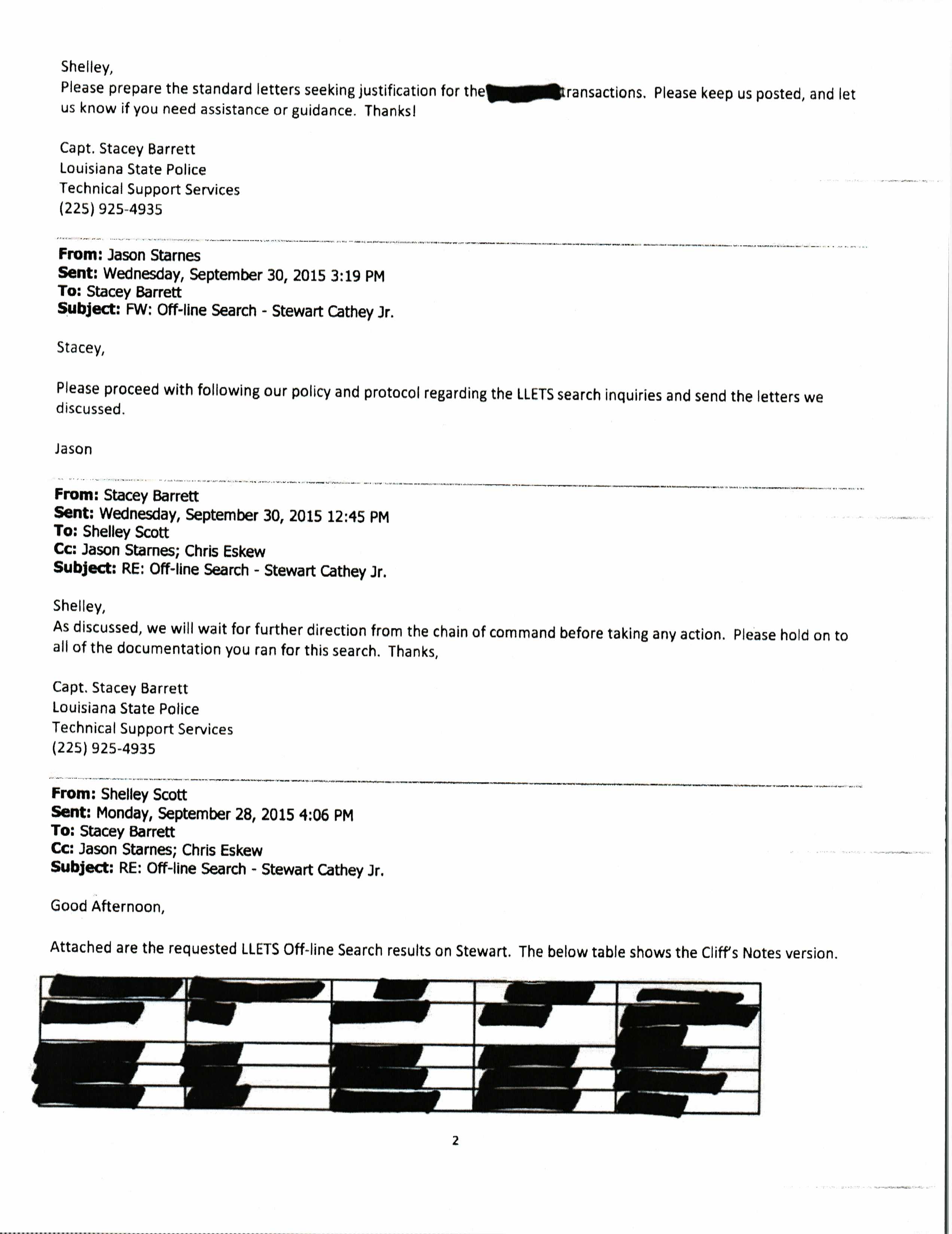
(NOTE: The email chain below begins with the most recent communication and reads backward to the earliest. The text of the messages also makes it obvious that Cathey initiated his inquiries about the background checks almost a month before his formal FOIA request.)


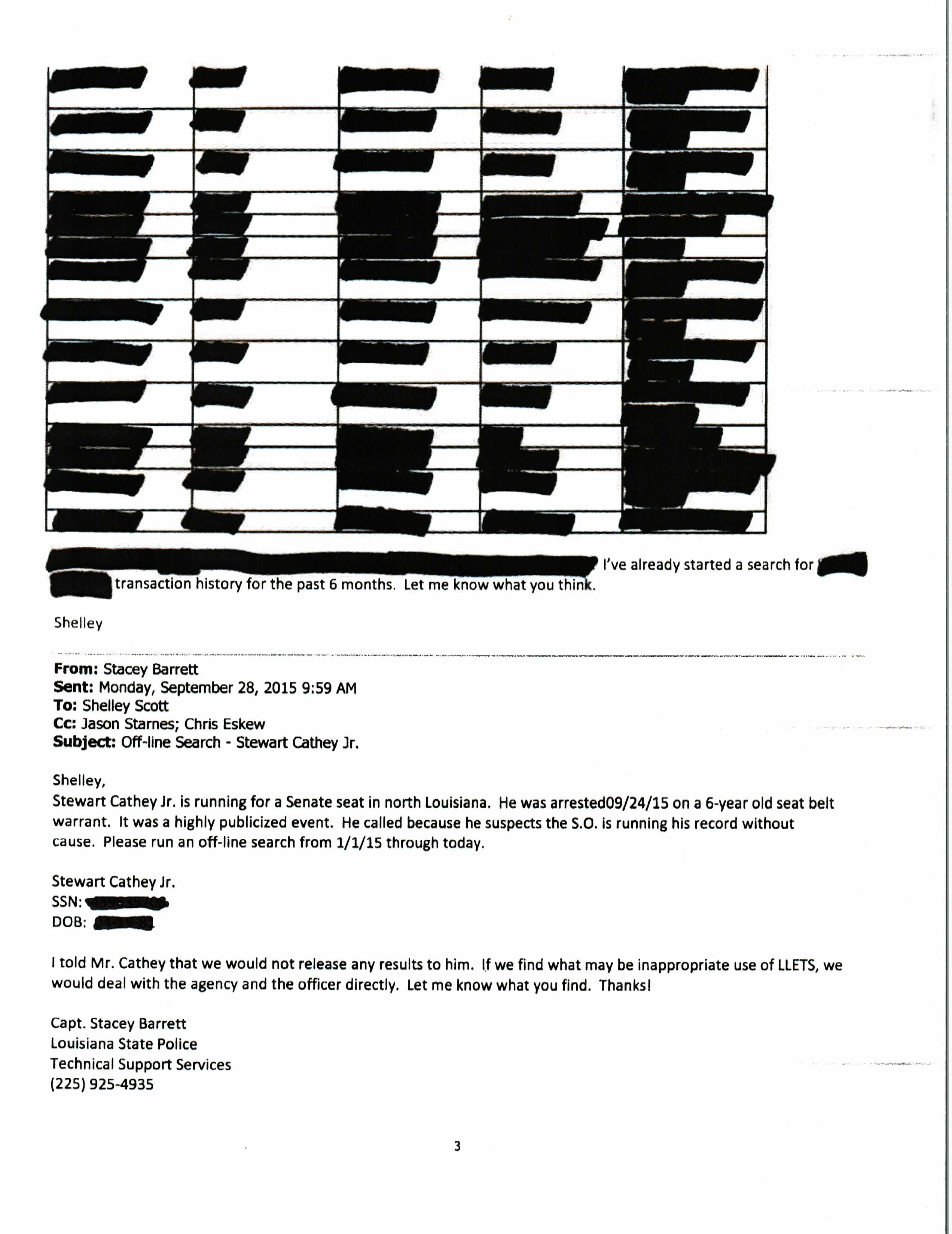
The email chain started with a message at 9:59 a.m. on Sept. 28 to criminal records analyst Shelley Scott from Capt. Stacey Barrett of LSP Technical Support Services:

“Stewart Cathey, Jr. is running for a Senate seat in north Louisiana. He was arrested on 09/24/15 on a 6-year-old seat belt warrant. It was a highly publicized event. He called because he suspects the S.O. (sheriff’s office) is running his record without cause. Please run an off-line search from 1.1.15 through today.

“I told Mr. Cathey that we would not release any results to him. If we find what may be inappropriate use of LLETS, we would deal with the agency and the officer directly. Let me know what you find.”

Maj. Jason Starnes and LSP Lt. Chris Eskew were also copied on that email.

At 4:06 p.m. that same day, Scott emailed Barrett, Starnes, and Eskew:

“Attached are the requested LLETS off-line results on Stewart. The below table shows the Cliff’s (sic) Notes version.”

What followed was the “section” alluded to by Aucoin as redacted. The redacted portion was a transaction history for a six-month period comprising about three-quarters of a page and containing 20 redacted lines which appeared to represent background searches or requests for same.

At 12:45 p.m. on Sept. 30, Barrett wrote to Scott, Starnes, and Eskew:

“As discussed, we will wait for further direction from the chain of command before taking any action. Please hold on to (sic) all of the documentation you ran for this search.”

At 3:19 p.m., Starnes responded to Barrett:

“Please proceed with following our policy and protocol regarding the LLETS search inquiries and send the letters we discussed.”

Finally, at 3:45 p.m., also on Sept. 30, Barrett emailed Scott and Eskew:

“Please prepare the standard letters seeking justification for the (redacted) transactions. Please keep us posted and let us know if you need assistance or guidance.”

The cryptic nature of the email communications is curious since routine public records requests do not normally attract such attention up and down the chain of command.

The timing of Cathey’s arrest, the reported discipline of an Alexandria municipal police officer for running a background check on Cathey, and the LSP emails and redacted reports, taken together, would seem to indicate there was some legitimacy to Cathey’s suspicions that someone deliberately sought to undermine his election campaign by initiating widespread background checks and even his arrest—complete with handcuffs—for an otherwise minor offense.

To add icing on the proverbial cake, Cathey said on Monday, Oct. 26, just two days after the Oct. 24 election, he was contacted by Monroe City Court and informed the charges against him for the seat belt violation were being dropped. He also said an investigation begun by the Office of Inspector General (OIG) was abruptly shut down with no explanation given.

No disrespect to the late Gertrude Stein, but there certainly appears to be a there there.

Edmonson had a reputation during his nine years at the helm of LSP as one who would dole out favors to legislators in efforts to ingratiate himself to lawmakers. A relay by state troopers to deliver football tickets to a legislator in New Orleans for an LSU national championship football game when she accidentally left her tickets in Shreveport is one example of that mindset.

Ordering background checks by LSP and/or requesting checks by other law enforcement agencies could be another example.

When contacted by LouisianaVoice about the possibility of an investigation into whether or not Edmonson had taken such action, Public Information Officer Doug Cain said unless a formal complaint was lodged by Cathey, LSP would not initiate an investigation.

After the OIG investigation was suddenly terminated, Cathey did not follow up with a formal complaint to LSP.

He is currently deployed to Puerto Rico where his unit is working on hurricane relief.

Read Full Post »

« Newer Posts - Older Posts »


