Feeds:
Posts
Comments

Archive for the ‘Campaign Contributions’ Category

The good people of Alabama need not fear the corruptive influence of former Gov. Donald Siegelman. Women and children may emerge from hiding, confident they are now safe and no longer must be protected from his treachery.

Siegelman is securely incarcerated at Oakdale’s federal lockup, the same facility that once housed another former governor—Louisiana’s very own Edwin W. Edwards—and from all accounts Sweet Home Alabama is the better for his prolonged absence.

The man, after all, took a $500,000 contribution from a member of the state board for hospital oversight, one Richard Scrushy, CEO of HealthSouth.

But wait. The half-million bucks didn’t go to Siegelman, after all. The money was contributed by Scrushy instead to help underwrite a campaign to convince the voters of Alabama to vote in favor of a state lottery, the proceeds of which would provide funds for Alabama youth to attend state colleges for free.

The referendum was controversial in that owners of the Indian casinos next door in Mississippi were somewhat skittish about Alabamans spending their gambling money at home to fund, of all things, education—not to mention that free college sounds a bit socialistic.

Suddenly, major players entered the picture—players like Karl Rove and notorious lobbyist Jack Abramoff, who would soon face his own legal problems. No matter. Abramoff led the fight, pouring money into the campaign to oppose the referendum which ultimately lost.

And what did Scrushy get in return? Siegelman reappointed him to the Certificates of Need Review Board where he had been serving without pay for the previous 12 years.

The prosecution of Siegelman has been heavily criticized by legal experts and columnists across the nation. https://madmimi.com/p/940b05?fe=1&pact=23974859063

Even the award-winning CBS news magazine 60 Minutes weighed in on the issue. http://www.cbsnews.com/news/did-ex-alabama-governor-get-a-raw-deal/

Siegelman, a Democrat with Jewish and Catholic roots, had won every state office in Alabama by 1998, including attorney general and lieutenant governor. In 2002, having already served one term as governor, he was heavily favored to win election over incumbent Gov. Bob Riley, the man who had defeated him four years earlier. But then the state’s top Republican operative, Bill Canary, contacted the nation’s top Republican operative, Rove, and the Justice Department’s investigation of Siegelman—led by Canary’s wife, U.S. Attorney Leura Canary—was launched.

With rumors swirling about alleged wrongdoing, Siegelman suddenly found himself in a tight race with Riley. On election night, Siegelman went to bed after having been declared the winner only to awake the next morning with Riley claiming victory.

Overnight, an unexpected redistribution of gubernatorial votes in Baldwin County, which includes the city of Daphne and part of Mobile Bay, reduced Siegelman’s total votes by 3,000, giving Republican Riley the governorship. Republican Attorney General Bill Pryor denied a recount of the paper ballots. No votes for any of the other offices being contested were changed. (Can you say hanging chads?)

And who was running Riley’s re-election campaign? That would be Bill Canary, husband of federal prosecutor Leura Canary. Well, no conflict of interest there.

Canary’s first efforts, carried out by assistant U.S. Attorney Alice Martin, were unsuccessful. Federal District Judge U.W. Clemon threw out the indictment for lack of evidence, saying the prosecution “was completely without legal merit” and “the most unfounded criminal case over which I presided in my entire judicial career.”

Canary was successful on her second try, however, obtaining a conviction on one of the 23 counts on which Siegelman was indicted. Presiding over that trial was Federal Judge Mark Fuller, who omitted a key legal requirement when giving the jury its instructions before it retired to deliberate: the need for an explicit promise of understanding in accepting the $500,000 from Scrushy.

Fuller, an appointee of President George W. Bush, would later have his own legal problems as well. In August of this year, he was arrested for beating his wife in an Atlanta hotel room http://www.al.com/news/index.ssf/2014/09/federal_judge_mark_fuller_a_ti.html but unlike Siegelman, was able to get the record expunged. http://crooksandliars.com/2014/09/don-siegelman-trial-judge-weasels-out

So what has all this to with the price of eggs in Louisiana?

Well, we just thought it would be interesting to compare the single transgression that got Siegelman a ticket to Oakdale with certain activities in Louisiana—and to ask somewhat rhetorically why no investigative agency is taking a closer look at some of the tactics of Gov. Bobby Jindal.

Take, for example, the case of Richard Blossman, Jr., of Lacombe and his Central Progressive Bank.

Blossman, while CEO of Central Progressive, “gave” each of his 11 board members a $5,000 bonus. The reality is (to borrow a favorite Jindal phrase), however, none of the $5,000 bonus payments ever went to the board members, according to Raphael Goyeneche, president of the New Orleans Metropolitan Crime Commission. Instead, immediately after the bonuses were “announced” by Blossman, 11 individual checks of $5,000 each were sent to Jindal’s 2007 campaign in the names of the individual—and oblivious—board members.

“The defendant (Blossman) well knew the ‘bonus’ was to funnel illegal political contributions and was not a bonus, as he caused to be inscribed in the board minutes,” prosecutors said in June of 2012.

“That is a felony,” Goyeneche added.

This revelation came on the heels of word from the Louisiana Board of Ethics in May of 2012 that Jindal received $40,000 in campaign contributions from landfill company River Birch, Inc. of Metairie when the company formed six “straw man entities” to launder illegal donations to Jindal.

So, did Jindal’s campaign return the $95,000 in ill-gotten gains?

Well….no. “We accept every contribution in good faith and in accordance with the law,” said Timmy Teepell, who ran Jindal’s 2007 campaign. Asked if Blossman received anything in exchange for his contributions, Teepell sniffed, “Absolutely not. Everyone who donates to our campaign gets the same thing and that is good government.”

Wow. Perhaps Earl Long was correct when he once said, One of these days, the folks in Louisiana will get good government “and they ain’t gonna like it.”

Jindal’s campaign and his Believe in Louisiana organization also accepted $158,500 in contributions from Iowa, LA., businessman Lee Mallet, his family members and several of his companies. Jindal then appointed Mallett, a college dropout, to the LSU Board of Supervisors and also had the Department of Corrections issue a directive to state parole and probation officers to funnel offenders into Mallett’s halfway house in Lacassine.

ATS LETTER

No quid pro quo there, right?

Mallett and his son were major contributors to other Republican candidates and the National Republican Party as well.

Carl Shetler of Lake Charles also received an appointment from Jindal—to the University of Louisiana System Board of Supervisors—after contributing $42,000 to Jindal’s campaign. Shetler, a Lake Charles car dealer, some years before had singlehandedly gotten McNeese State University placed on athletic probation by the NCAA when it was learned that he’d paid money to McNeese basketball players.

In fact, Jindal’s campaign received $1.8 million in contributions from people he has appointed to state boards and commissions, some of whom delivered their checks only days or weeks after their appointments, according to Nola.com. Virtually the entire memberships of the Louisiana Stadium and Exposition District (Superdome Commission) and the LSU Board of Supervisors are comprised of major contributors to Jindal political campaigns.

In 2008, Jindal accepted $30,000 from Florida attorney Scott Rothstein, his law firm and his wife. Rothstein was later disbarred after his conviction for running the largest ($1.4 billion) Ponzi scheme in Florida history.

Jindal also accepted $10,000 from Affiliated Computer Services (ACS) and later gave ACS employee Jan Cassidy, sister-in-law of Congressman Bill Cassidy, a state job with the Division of Administration.

Jindal took $11,000 from the medical trust fund of the Louisiana Horsemen’s Benevolent and Protective Association (LHBPA). The LHBPA board president, Sean Alfortish, was subsequently sentenced to 46 months in prison for conspiring to rig the elections of the association and then helping himself to money controlled by the association.

The association also was accused of paying $347,000 from its medical and pension trust funds to three law firms without a contract or evidence of work performed. A state audit said LHBPA improperly raided more than $1 million from its medical trust account while funneling money into political lobbying and travel to the Cayman Islands, Aruba, Costa Rica and Los Cabos, Mexico.

The association, created by the Louisiana Legislature in 1993, is considered a non-profit public body and as such is prohibited from contributing to political campaigns.

And then there is Tony Rudy.

Rudy once headed up an influence-peddling organization called the Alexander Strategy Group and through that firm, he pulled in tens of thousands of dollars in the 2004 and 2005 election cycles on behalf of Jindal from such donors as UPS, Eli Lilly, Bellsouth, R.J. Reynolds, Microsoft, Fannie Mae, Koch Industries, DuPont, AstraZeneca (a biopharmaceutical company), the National Auto Dealers Association, the Property Casualty Insurers Association, the American Bankers Association, and Amgen (biotechnology and pharmaceutical company).

Alexander Strategy Group was one of Washington’s premier lobbying operations before it was shut down in January of 2006 after its ties to DeLay and Abramoff, became known.

Rudy, a former aide to DeLay, worked for Abramoff before joining Alexander Strategy Group. Rudy’s wife also ran a political consulting firm that received $50,000 in exchange for services Rudy performed while working for DeLay. Delay was indicted in 2005 on money-laundering charges. Abramoff pleaded guilty in early January of 2006 to fraud and conspiracy charges.

One of Abramoff’s clients was the Chitimacha Indian Tribe of Louisiana that contributed at least $1,000 to Jindal who since has claimed to have given that money to charity.

Abramoff also received $32 million from the Coushatta Tribe of Louisiana to help promote and protect their gambling interests. The legal counsel for the Coushattas was one Jimmy Faircloth who once served as Jindal’s executive counsel and who has pulled in well over $1 million in representing Jindal in lost causes in various courts in Louisiana. Faircloth advised the tribe to sink $30 million in a formerly bankrupt Israeli technology firm for whom his brother Brandon was subsequently employed as vice president for sales.

And most recently, courtesy of Manuel Torres of the New Orleans Times-Picayune and Lee Zurik of WVUE-TV in New Orleans, we have learned that Jindal has spent more than $152,000 of state campaign funds on trips that bear a suspicious resemblance to federal campaign activity. http://www.nola.com/politics/index.ssf/2014/11/louisiana_gov_bobby_jindals_tr.html

State Ethics Administrator Kathleen Allen said the state’s campaign finance law grants considerable latitude as to how money may be spent but that the law prohibits the expenditure of funds on the office of president or vice president of the U.S. and Congress, presidential electors and party offices.

“When I read these provisions together, the conclusion is that you are a candidate for a state race and the money you raise can be used only for (a state) campaign or for exercise of that office,” Allen told Torres and Zurik.

There are other activities of the Jindal administration which have little to do with campaign contributions or appointments but which are nonetheless are questionable as to their motives:

  • Efforts to enhance State Police Superintendent Mike Edmonson’s retirement by as much as $55,000 per year. Because of our story, that unconstitutional attempt by our governor and his allies in the State Senate and the Department of Public Safety was thwarted.
  • Major pay increases given unclassified employees in the Jindal administration at the same time rank and file state employees have been denied raises for five years.
  • Generous tax incentives, exemptions and other favorable treatment given corporations that are costing the state some $3 billion per year even as repeal of the Stelly plan has cost the state $300 million per year.
  • Widespread abuses by the State Board of Dentistry and the Louisiana Auctioneer Licensing Board.
  • Bruce Greenstein’s initial refusal in testimony before a Senate committee to name the winner of a $200 million contract with the Department of Health and Hospitals and his eventual admission that the contract went to his former employer—testimony that eventually led to his indictment on nine counts of perjury.
  • Attempts by the Department of Education to enter into a data sharing agreement whereby sensitive personal information on students in the state’s public schools would be made available to a company controlled by Rupert Murdoch, head of Fox News.
  • Funding sources for Jindal’s political organization Believe in Louisiana—sources who have received major concessions and political appointments from the Jindal administration.
  • The real reason for the firing and indictment of former head of the Office of Alcohol and Tobacco Control (ATC) Murphy Painter: Painter’s refusal to crater to demands from the governor’s office that favored New Orleans Saints owner Tom Benson, a major contributor to Jindal’s political campaigns (Painter was subsequently acquitted of all charges and the state was forced to pay his legal expenses of some $300,000).
  • Efforts by Jindal to force retirees out of the Group Benefits health program with irresponsibly unaffordable increases in co-pays and deductibles, a story that eventually prompted hearings by the House Appropriations Committee.
  • The subsequent revelation that a document cited by DOA and the Office of Group Benefits (OGB) representative as the basis for the health benefits changes in reality said just the opposite of what was testified to.

And while all this goes on unabated in Louisiana, the former governor of Alabama, who did nothing more than accept a contribution to fund a referendum to benefit education, remains in Oakdale, victim of a prosecution with far more questions about the participants and their surreptitious activities than answers.

http://www.huffingtonpost.com/bennett-l-gershman/bribery-cases-_b_1590284.html

Read Full Post »

In reading Destiny’s Anvil, a novel about Louisiana politics by New Orleans writer Steven Wells Hicks, one sentence near the end of the story was so profound that it jumped off the page at us:

  • The responsibility for building and maintaining our way of open and honest government belongs in the hands of those who elect our leaders and not the leaders themselves.

The very simplicity of that one sentence, so succinct and straightforward a summation of what our government should aspire to, should be the credo which dictates the acceptance of every campaign contribution, every promise made and every action carried out by every elected official in America.

Sadly, it does not. And most certainly, it does not in Louisiana, especially where generous donors to the campaigns of Gov. Bobby Jindal (R-Iowa, R-New Hampshire, R-Florida, R-Anywhere by Louisiana) are concerned.

LouisianaVoice has learned that one major donor and its principals not only benefitted from several contracts worth more than $240 million, but also appear to have been given preferable treatment in the purchase of a state building at a bargain price at the expense of taxpayers.

The electorate of this state has capitulated in that responsibility, choosing instead to acquiesce to backroom deals fueled by campaign contributions and to actions concealed in secrecy and carried out for political expedience or personal gain instead of for the common good of the citizenry.

Remember last month when we wrote that Timmy Teepell in 2010 issued a directive to Tommy Teague, then the CEO of the Office of Group Benefits that a request for proposals (RFP) be crafted in such a way as to favor a specific vendor and that then-Commissioner of Administration Angéle Davis resigned shortly thereafter?

At the time, Teepell was Jindal’s Chief of Staff. The RFP was for vendors to provide health care coverage to state workers primarily in northeast Louisiana. Vantage Health Plan of Monroe subsequently landed the 26 month, $70 million contract, effective July 1, 2010. Six months later, on Jan. 1, 2011, a second one-year contract of $14 million awarded to Vantage to provide a Medicare Advantage plan for eligible OGB retirees and on Sept. 1, 2012, Vantage received yet another four-month $10 million contract under an emergency rule to provide an HMO plan to OGB members.

Since Jindal took office in January of 2008, Vantage has been awarded six contracts totaling nearly $242 million.

In addition to the claim of the 2010 directive to Teague to “write a tightly-written” RFP, LouisianaVoice has learned the Jindal administration may have deliberately circumvented the usual procedure for selling state property in order that Vantage could purchase a six-story state office building in Monroe last year.

By legislative fiat, the administration was within its legal rights to sell the State Office Building in Monroe to a chosen buyer without going through the bid process but it may have done so at a cost to state taxpayers.

Senate Bill 216 of 2013 by Sens. Mike Walsworth (R-West Monroe), Rick Gallot (D-Ruston), Neil Riser (R-Columbia) and Francis Thompson (D-Delhi) passed overwhelming in both the House and Senate and was signed into law by Jindal as Act 127, clearing the way for the sale of the former Virginia Hotel at 122 St. John Street.

By law, if a legislative act is passed, the state can legally bypass the public bid process but there are several indications that the administration may well have gone out of its way to accommodate Vantage and its President, Dr. Patrick Gary Jones through the Louisiana Department of Economic Development (LED).

The cooperative endeavor agreement between Vantage and the state was executed by Vantage Executive Vice President Mike Breard and LED Undersecretary Anne Villa on Aug. 28, 2013.

Vantage paid the state $881,000 for the six-story, 100,750-square-foot building and an adjoining 39,260-square-foot lot and one-story office building. The cost breakdown was $655,000 for the hotel and $226,000 for the adjoining property.

The Virginia Hotel was constructed in 1925 at a cost of $1.6 million and underwent extensive renovations in 1969 and again in 1984, according to documents provided LouisianaVoice by DED.

But LouisianaVoice has learned that there was at least one other potential buyer interested in the Virginia Hotel/State Office Building and indeed, documents obtained from LED contained no fewer than three references to fears by Vantage officers that if the building were put up for public auction, the bids might make the costs prohibitive to Vantage.

Melody Olson and husband Kim purchased the nearby Penn Hotel for $341,000 and poured $2 million into converting it into condominiums.

The late Shady Wall, a colorful state representative from Ouachita Parish, lived in the Penn’s penthouse. (Wall once wedged a pencil between a stack of books and the “yes” button at his House desk and went home for the day, officially casting “yes” votes on every matter that came up in the chamber after his departure.) The Olsons now reside in that same penthouse.

Melody Olson told LouisianaVoice that she and her husband wanted to purchase the Virginia and convert it into a boutique hotel but were never given the opportunity.

“It was sold through the Department of Economic Development and never was offered for public bid,” she said. “We never got the chance to make an offer.”

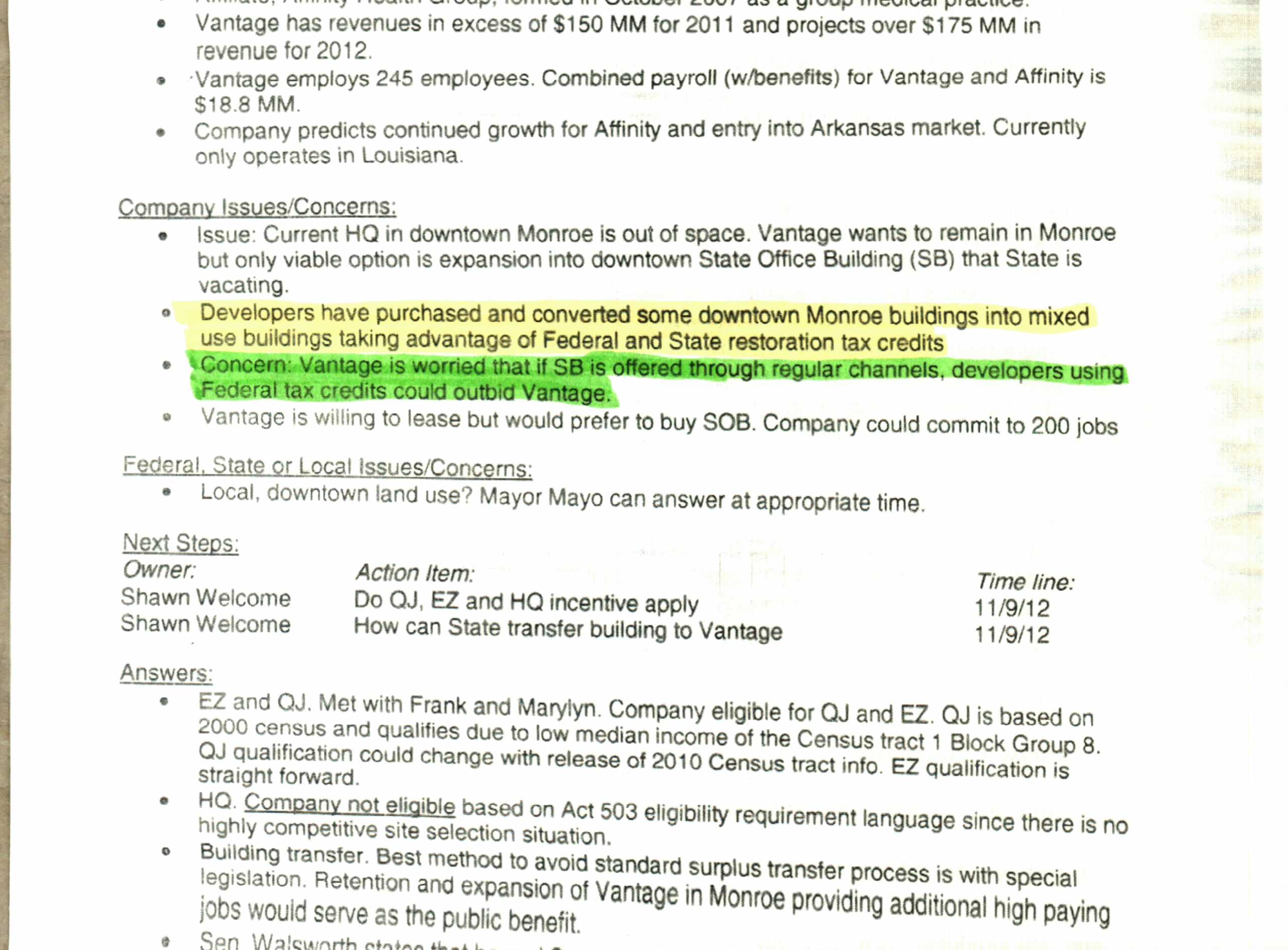
One internal LED memorandum said that Vantage Health Plan (VHP) “approached LED to help arrange the sale in order to avoid typical State surplus real property requirements of public bidding. VHP fears that public bidding would allow a developer utilizing various incentive programs to pay an above market price that VHP would find hard to match.” (Emphasis added.) IMAG0379

(CLICK ON IMAGE TO ENLARGE)

Another document appears to be an internal memorandum that provides an overview of a 2012 meeting about the sale. It indicates that LED Secretary Stephen Moret, Sen. Walsworth, LED Legislative and Congressional Liaison Mandi Mitchell and LED Director of Contract Performance Shawn Welcome were in attendance on behalf of the state and Dr. Jones and his son-in-law Michael Echols, Director of Business Development, representing Vantage.

Under a heading entitled Company Issues/Concerns there were these two notations:

  • “Developers have purchased and converted some downtown Monroe buildings into mixed use buildings (by) taking advantage of federal and state restoration tax credits.”
  • “Concern: Vantage is worried that if SB (state building) is offered through regular channels, developers using federal tax credits could outbid Vantage.” IMAG0377

(CLICK ON IMAGE TO ENLARGE)

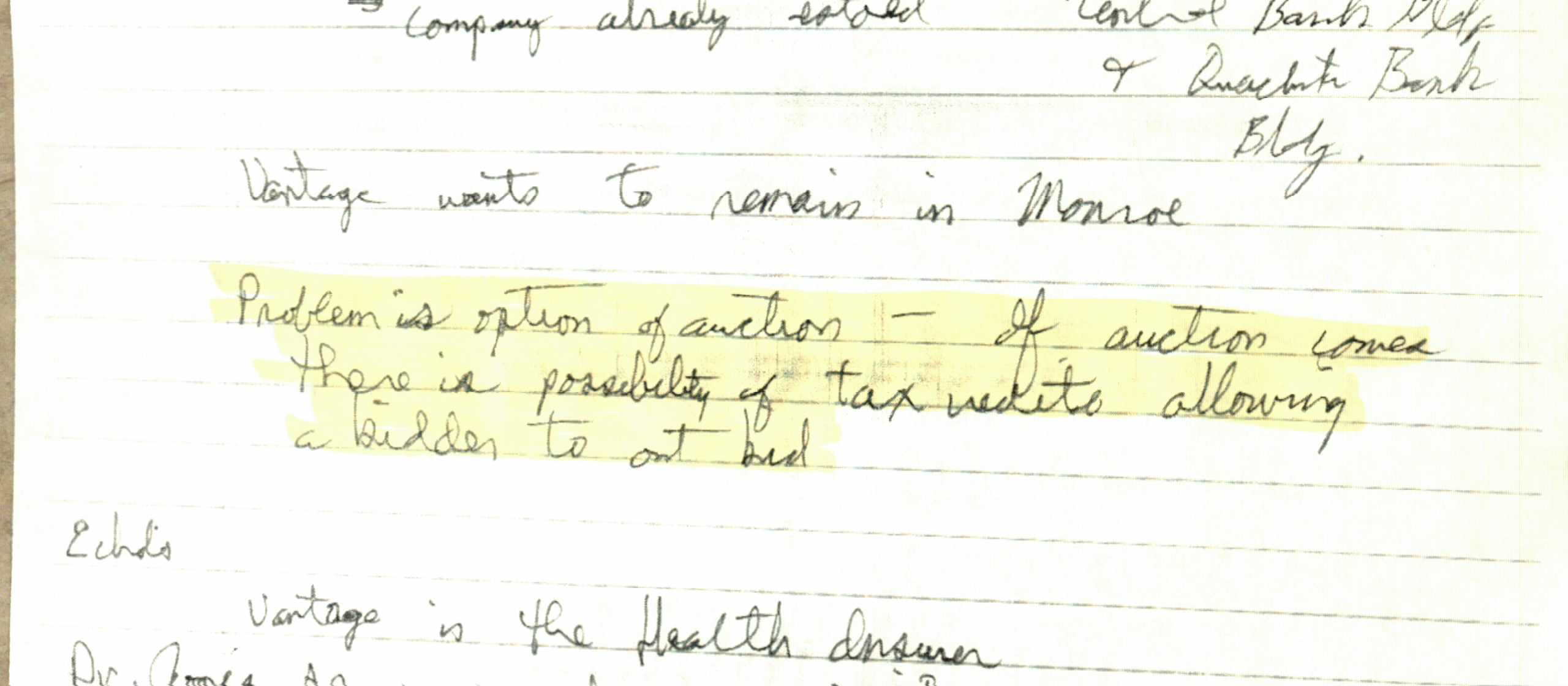
Finally, there was a handwritten note which described another meeting on Nov. 1, 2012. Besides the notation that “Sen. Riser supports,” there was this:

  • “Problem is option of auction—if auction comes there is possibility of tax credits allowing a bidder to out-bid.”

IMAG0378

(CLICK ON IMAGE TO ENLARGE)

Finally, there was a hand-scrawled notation at the bottom of a typewritten page containing employment estimates by Vantage through 2024 which directed that an “approach” be written “specific to Vantage.”

And while Vantage repeatedly cited concerns about other potential buyers obtaining state and federal incentives which they might use to thwart their purchase plans for the building, Vantage was not shy about seeking incentives from the state for its own benefit.

Documents obtained from LED show no fewer than 20 applications or notices of applications for various state incentive programs, including Enterprise Zone, Quality Jobs Program and property tax exemptions for renovations to existing offices in Monroe or expansion into new offices in Shreveport, Mangham, West Monroe, New Orleans and even into Arkansas.

Nor were Vantage and its corporate principals shy about flashing cash for political campaign contributions.

Campaign finance records show that Vantage its affiliate, Affinity Health Group, their corporate officers and family members combined to contribute more than $100,000 to various political campaigns, including $22,000 to Jindal and $11,000 to three of the four Senators who authored the bill authorizing the sale of the Virginia Hotel to Vantage: Thompson ($5,400), Walsworth ($4,500), and Riser ($1,000.

Read Full Post »

Of all the incumbents running in Louisiana’s Senate and five House elections, no less than $6.5 million in political action committee (PAC) money has been poured into the various campaigns.

Incumbent Sen. Mary Landrieu led the pack with $2.6 million in PAC money with Rep. Steve Scalise, 1st District, a distant second at $1.7 million), followed by Charles Boustany, 3rd District ($984,000), Landrieu challenger Congressman Bill Cassidy, 6th District ($724,550), Cedric Richmond, 2nd District ($723,000), John Fleming, 4th District ($258,000) and Vance McAllister, 5th District ($123,000).

Others with PAC contributions include

  • S. Senate candidate Rob Maness ($35,000);
  • 5th District congressional candidates Monroe Mayor Jamie Mayor ($6,000), Zach Dasher ($5,000) and Ralph Abraham and Harris Brown ($1,000 each);
  • 6th District congressional candidates Dan Claitor ($15,601), Paul Dietzel II ($15,325), Edwin Edwards ($8,700), Trey Thomas ($3,500), Cassie Felder ($2,500) and Lenar Whitney ($500).

In Congressional Districts 1, 2, 3, and 4, no candidates other than the incumbents already covered in previous stories reported any PAC contributions.

Among all incumbents, 5th District Congressman Vance McAllister, facing re-election only a year after winning a special election to succeed retired Rodney Alexander, had the fewest PAC contributions.

Still, the $123,000 he received is ample evidence of how quickly an incumbent can attract PAC money—even an incumbent with a single year under his belt.

Here are some of McAllister’s PAC contributions:

ALTRIA GROUP PAC: $1,000

  • Altria Group, Inc. (previously named Philip Morris Companies Inc.) The name change alternative offers the possibility of masking the negatives associated with the tobacco business,” thus enabling the company to improve its image and raise its profile without sacrificing tobacco profits,
  • According to the Center for Public Integrity, Altria spent around $101 million on lobbying the U.S. government between 1998 and 2004, making it the second most active organization in the nation.
  • Altria also funded The Advancement of Sound Science Coalition which lobbied against the scientific consensus on climate change.
  • Daniel Smith, representing Altria, sits on the Private Enterprise Board of the American Legislative Exchange Council (ALEC).

AT&T PAC: $2,500

  • AT&T is the second-largest donor to United States political campaigns, and the top American corporate donor, having contributed more than US$47.7 million since 1990, 56% and 44% of which went to Republican and Democratic recipients, respectively. Also, during the period of 1998 to 2010, the company expended US$130 million on lobbying in the United States. A key political issue for AT&T has been the question of which businesses win the right to profit by providing broadband internet access in the United States.
  • Bobby Jindal rejected an $80 million federal grant for the expansion of broadband internet service in rural Louisiana even as AT&T was contributing $250,000 to the Foundation run by Jindal’s wife Supriya after Gov. Jindal signed SB- 807 into law (Act 433) in 2008 over the objections of the Louisiana Municipal and the State Police Jury associations. The bill, the Consumer Choice for Television Act removed from local and parish governments their authority and responsibility to negotiate cable franchise agreements with companies that relied largely on locally-owned public infrastructure such as utility poles. The bill also allows AT&T to sell cable television service without the necessity of obtaining local franchises.
  • Bill Leahy, representing AT&T, sits on the Private Enterprise Board of the American Legislative Exchange Council (ALEC).

EVERY REPUBLICAN IS CRUCIAL PAC: $10,000

  • Every Republican is Crucial (ERIC) has contributed nearly $9.2 million to Republican candidates, including $50,000 to fellow Louisiana Rep. Steve Scalise.
  • ERIC is the PAC of defeated Virginia House member Eric Cantor whose campaign was underwritten in turn by a gaggle of Wall Street bankers, including Goldman Sachs, Blackstone Group, and Citigroup.

CMR POLITICAL ACTION COMMITTEE: $3,500

  • CMR is the political action committee launched by Congresswoman Cathy McMorris Rodgers (R-Washington) who is apparently as AWOL from her eastern Washington district as Gov. Bobby Jindal is from Louisiana. In challenging Jindal for racking up frequent flyer miles, she has visited North Carolina, Indiana, Las Vegas, Florida, Colorado, New Hampshire, Ohio, and California on behalf of Republican candidates.

EXXON MOBIL CORP. PAC: $5,000

  • ExxonMobil has drawn criticism from scientists, science organizations and the environmental lobby for funding organizations critical of the Kyoto Protocol and seeking to undermine public opinion about the scientific conclusion that global warming is caused by the burning of fossil fuels. Mother Jones Magazine said the company channeled more than $8 million to 40 different organizations that have employed disinformation campaigns including “skeptical propaganda masquerading as journalism” to influence opinion of the public and of political leaders about global warming and that the company was a member of one of the first such groups, the Global Climate Coalition, founded in 1989. ExxonMobil’s support for these organizations has drawn criticism from the Royal Society, the academy of sciences of the United Kingdom. The Union of Concerned Scientists released a report in 2007 accusing ExxonMobil of spending $16 million, between 1998 and 2005, towards 43 advocacy organizations which dispute the impact of global warming. The report argued that ExxonMobil used disinformation tactics similar to those used by the tobacco industry in its denials of the link between lung cancer and smoking, saying that the company used “many of the same organizations and personnel to cloud the scientific understanding of climate change and delay action on the issue.” These charges are consistent with a purported 1998 internal ExxonMobil strategy memo, posted by the environmental group Environmental Defense, which said:

“Victory will be achieved when

  • Average citizens [and the media] ‘understand’ (recognize) uncertainties in climate science; recognition of uncertainties becomes part of the conventional wisdom;
  • Industry senior leadership understands uncertainties in climate science, making them stronger ambassadors to those who shape climate policy;
  • In 2003, the United States Attorney for the Southern District of New York announced that J. Bryan Williams, a former senior executive of Mobil Oil Corp., had been sentenced to three years and ten months in prison on charges of evading income taxes on more than $7 million in unreported income, including a $2 million kickback he received in connection with Mobil’s oil business in Kazakhstan. Documents filed with the court said Williams’ unreported income included millions of dollars in kickbacks from governments, persons, and other entities with whom Williams conducted business while employed by Mobil. In addition to his sentence, Williams must pay a fine of $25,000 and more than $3.5 million in restitution to the IRS, in addition to penalties and interest.
  • Those promoting the Kyoto treaty on the basis of extant science appear out of touch with reality.”

HONEYWELL INTERNATIONAL PAC: $1,000

  • In December 2011, the non-partisan liberal organization Public Campaign criticized Honeywell International for spending $18.3 million on lobbying while paying no taxes during 2008–2010, instead getting $34 million in tax rebates, despite making a profit of $4.9 billion, laying off 968 workers since 2008, and increasing executive pay by 15% to $54.2 million in 2010 for its top 5 executives.
  • Honeywell has been criticized in the past for its manufacture of deadly and maiming weapons. The Honeywell Project, for example, targeted Honeywell executives in an attempt to halt the production of cluster bombs.
  • The EPA said that no corporation has been linked to a greater number of Superfund toxic waste sites than has Honeywell. Honeywell ranks 44th in a list of US corporations most responsible for air pollution, releasing more than 9.4 million pounds of toxins per year into the air. In 2001, Honeywell agreed to pay $150,000 in civil penalties and to perform $772,000 worth of reparations for environmental violations involving:
  • failure to prevent or repair leaks of hazardous organic pollutants into the air
  • failure to repair or report refrigeration equipment containing chlorofluorocarbons.
  • inadequate reporting of benzene, ammonia, nitrogen oxide, dichlorodifluoromethane, sulfuric acid, sulfur dioxide and caprolactam emissions.
  • In 2003, a federal judge in New Jersey ordered the company to perform an estimated $400 million environmental remediation of chromium waste, citing “a substantial risk of imminent damage to public health and safety and imminent and severe damage to the environment.” In the same year, Honeywell paid $3.6 million to avoid a federal trial regarding its responsibility for trichloroethylene contamination in Illinois. In 2004, the State of New York announced that it would require Honeywell to complete an estimated $448 million cleanup of more than 165,000 pounds of mercury and other toxic waste dumped into Onondaga Lake in Syracuse. In 2005, the state of New Jersey sued Honeywell, Occidental Petroleum and PPG to compel cleanup of more than 100 sites contaminated with chromium, a metal linked to lung cancer, ulcers and dermatitis. In 2008, the state of Arizona made a settlement with Honeywell to pay a $5 million fine and contribute $1 million to a local air-quality cleanup project, after allegations of breaking water-quality and hazardous-waste laws on hundreds of occasions between the years of 1974 and 2004.

PROSPERITY ACTION, INC. PAC: $5,000

  • Founded by Rep. Paul Ryan (R-Wisconsin), Prosperity Action leadership PAC has contributed $182,500 to incumbent congressional candidates and challengers seeking election in 2014. Ryan was Mitt Romney’s running mate in the 2012 presidential election.
  • Among Ryan’s most consistent—and generous—supporters were David and Charles Koch of Koch Industries, the major benefactor of the American Legislative Exchange Council (ALEC).

REYNOLDS AMERICAN PAC: $1,000

(It seems curious that a physician would accept campaign money from a tobacco company.)

  • In 1994, then CEO James Johnston testified under oath before Congress, saying that he didn’t believe that nicotine is addictive.
  • In 2002, the company was fined $15m for handing out free cigarettes at events attended by children, and was fined $20m for breaking the 1998 Master Agreement, which restricted targeting youth in its tobacco advertisements.
  • In May 2006 former R.J. Reynolds vice-president of sales Stan Smith pleaded guilty to charges of defrauding the Canadian government of $1.2 billion through a cigarette smuggling operation. Smith confessed to overseeing the 1990s operation while employed by RJR. Canadian-brand cigarettes were smuggled out of and back into Canada, or smuggled from Puerto Rico, and sold on the black market to avoid taxes. The judge referred to it as biggest fraud case in Canadian history.

COMMITTEE FOR THE PRESERVATION OF CAPITALISM: $5,000

  • Committee membership includes Bill Gates, four members of the Walton (Walmart) family, former Mississippi governor Haley Barbour, a member of his lobbying firm, George W. Bush’s former White House Chief of Staff Andrew Card and Jeffrey Immelt, CEO of General Electric which has managed to avoid paying any corporate income tax for the past half-dozen years despite record-breaking profits and extensive operations that have been outsourced to other countries which provide cheap labor.

Read Full Post »

While we have had no trouble unearthing double standards, misrepresentations, distortions and outright lies in our coverage of the Jindal administration, political campaigns often take the practice to a new level.

The mind-numbing campaign for the U.S. Senate comes to mind. At this point in the campaign, voters just wish Mary Landrieu and Bill Cassidy would both shut up and leave us alone. But those TV ads from both camps keep pounding away at us, each accusing the other of distortions, lies, misrepresentations, pro-this, and anti-that.

The comic strip Non Sequitur would well have been referencing either candidate with this submission:

nq141010[1]

Or it could have been alluding to the recently ramped-up campaign of 6th Congressional District candidate Garrett Graves, former chairman of the Louisiana Coastal Protection and Restoration Authority (CPRA) and director of the Governor’s Office of Coastal Activities, who only recently kicked off his media blitz.

Of course most observers are accustomed to grandiose promises.

For at least the past 20 years or so, the challenger in the Baton Rouge mayor-president’s election without fail has promised to improve public education in East Baton Rouge Parish—never mind the fact that the mayor’s office has absolutely nothing to do with the East Baton Rouge Parish School Board. Zero. Zilch. They are two entirely separate political entities.

And we’re all used to congressional candidates saying they are going to fight waste, work to improve infrastructure, and vote to defend the Constitution blah, blah, blah.

But Graves has taken the rhetoric to a new extreme. He has one TV spot running on the Baton Rouge in which he says not that he will “work to” or “vote to,” but that he “will” repeal Obamacare, he “will” cut spending, he “will” stop illegal immigration, and he “will” eliminate terrorism.

Those are pretty big promises, folks, and unless he’s Clark Kent in disguise, we just can’t see how one freshman tea party congressman can impose his will on 434 other members of the House and 100 senators, not all of whom are tea partiers.

And while we are on the subject of political rhetoric, there has been much said about U.S. Sen. Mary Landrieu’s ownership of an $800,000 home in Washington, D.C. while not owning a home outright in Louisiana (though she is part owner, along with her siblings, of her parents’ home in New Orleans).

But not a peep has been said about Graves’ 2005 purchase of a home at 210 11th Street SE in Washington, also appraised at more than $800,000. Nothing on his federal financial disclosure statement for Jan. 1, 2013 through July 15, 2014, indicates ownership of a home in Louisiana—not even part ownership of his father’s home—although he does list ownership of property in Gulf Shores, Alabama. And Graves has never been elected to any office, let alone one that demands his presence in Washington.

He apparently purchased the home during his tenure in Washington. He worked as a policy adviser to former U.S. Sen. John Breaux and U.S. Congressman Billy Tauzin and worked for the Senate Commerce, Science and Transportation Committee and the House Energy and Commerce Committee. He also served as staff director of the U.S. Senate Subcommittee on Climate Change and Impacts. http://www.epa.gov/gcertf/bios/graves.html

Apparently he liked Washington well enough to plan on returning because he did not sell the home when he grabbed onto Gov. Bobby Jindal’s coattails in 2008 to head up CPRA at $135,000 per year through 2012. His salary was bumped up to $147,300 in 2013, according to his financial disclosure records.

Even though he left the state’s employ on February 28, his financial statement indicates he still received $52,961 in salary from the state this year and another $31,346 from Evans-Graves Engineers, the firm owned by his father, John Graves.

Graves flew pretty much under the radar until he became a high-profile opponent of the lawsuit filed by the Southeast Louisiana Flood Protection Authority-East against 97 oil and gas companies for damage to the state’s wetlands while at the same time carping at the U.S. Coast Guard for its failure to force BP to be more responsive to the Deepwater Horizon oil disaster. http://theadvocate.com/home/8290180-125/graves-to-step-down-from

His opposition to the lawsuit seeking to hold big oil responsible for the damage it has done to the state’s coastline for the past century notwithstanding, the real story of Garrett Graves is the awarding of more than $130 million in government contracts to his father’s engineering firm while he was head of CPRA, which oversees such contracts.

That figure represented an 1800 percent increase over contracts awarded to Evans-Graves for all years prior to Garrett Graves’ tenure at CPRA.

Some might call this old news, given the fact that Jeremy Alford first reported on this as far back as 2008. http://www.houmatoday.com/article/20080203/news/659908125

But the practice went unabated for years after his story and even more curious, when an ethics opinion was sought as to the propriety of the contracts, it was not the Louisiana Board of Ethics that was consulted, but attorney Jimmy Faircloth.

Faircloth, who was Jindal’s first executive counsel before running unsuccessfully for the Louisiana Supreme Court, has done extensive legal work for the administration, collecting fees in excess of $1 million defending losing positions that Jindal has championed.

But his issuing an ethics opinion in the case of Evans-Graves Engineering appears to have been a conflict in itself: Faircloth at the time was the legal counsel for Evans-Graves.

“As we discussed, Governor Jindal has asked that we disclose and commit to avoiding even the appearance of conflict,” Faircloth said in his opinion. “Thus, as we agreed, out of an abundance of caution, the appropriate solution is that your father’s company not pursue an interest in or receive any state contract that involves coastal restoration, levees or hurricane protection while you serve in the administration. This would explicitly include such contracts overseen by DOTD (Department of Transportation and Development) and DNR (Department of Natural Resources).”

Even though Garrett Graves in February of 2008 agreed to cease pursuing projects that could cause a conflict of interest, Evans-Graves kept receiving lucrative contracts from the U.S. Army Corps of Engineers, CPRA’s primary partner. And while Garrett Graves did not actually sign the contracts, his agency did set priorities for the state on corps-related work.

“I said from the beginning there was a potential conflict of interest, and apparently that fell on deaf ears,” said John Graves when the issue first arose more than six years ago. Jindal’s office professed to know nothing of the potential conflict.

And even though Garrett Graves was working for the state and his father’s company was receiving millions of dollars in contracts with the Corps of Engineers through Garrett Graves’ agency, Garrett Graves was given a Toyota Tundra truck by the elder graves in 2009, a clear violation of state ethics rules against state employees accepting gifts from vendors.

And while Evans-Graves was receiving millions of dollars in CPRA-approved contracts with the Corps of Engineers, Evans-Graves was subcontracting nearly $66.5 million in work to 18 construction and contract companies, compared to only $3.5 million prior to Garrett Graves’ appointment. Those 18 subcontractors have combined to contribute more than $250,000 to Graves’ congressional campaign.

Additionally, 11 of those 18 companies, along with corporate officers and family members, have combined to contribute nearly $316,000 to various political campaigns of Jindal.

Here is the list of subcontractors and the amounts they and/or their corporate officers and families contributed to Jindal:

  • Daybrook Fisheries—$1,000;
  • Industrial Specialty Contractors—$29,500;
  • Bollinger Shipyards—$65,850;
  • Major Equipment and Remediation—$50,000;
  • Arkel Constructors—$4,500;
  • Delta Launch Services—$11,000;
  • Cajun Constructors—$52,000;
  • Coastal Environments—$30,500;
  • Performance Contractors—$41,500;
  • H. Fenstermaker & Associates—$20,500;

JNB Operating—$5,000.

And now Garrett Graves just wants to move back into his $800,000 home in D.C.

Read Full Post »

Between U.S. Mary Landrieu and U.S. Rep. Bill Cassidy, the man who wants to replace her, incumbents in five of the state’s six November congressional races have received more than $21.5 million in campaign contributions, of which more than $6.5 million has come from political action committees, or PACs, according to figures provided by the Federal Elections Commission.

The number of corporate dollars that have flowed into the races is somewhat deceptive, however, because money given by corporate officers and board members are listed as individual contributions and is not counted with the PAC money.

LouisianaVoice has always maintained that political clout no longer belongs to the citizenry, but to special interest groups like corporations and corporate officers who pour money into political campaigns, in the process drowning out the voice of individual voters.

In two of the congressional races, PAC contributions to incumbents actually outpace those of individuals—Reps. Charles Boustany of the 3rd District ($984,000 to $769,000) and Cedric Richmond of the 2nd District ($723,000 to $278,000).

Even more alarming, each candidate we’ve reported on thus far has accepted money from PACs connected to corporations that have serious legal and ethical issues. Those issues include, among others, insider trading, influence peddling, environmental pollution, and fraud.

It might be of no real consequence if these were isolated occurrences, but they’re not. The same companies keep turning up in report after report is what has become a dangerous trend of corporate control of the entire Congress as the welfare of the American people has been all but crowded out of the picture and excluded from the national dialog.

Following is a partial list of some of Richmond’s PAC contributions:

ALTRIA GROUP PAC: $1,500

  • Altria Group, Inc. (previously named Philip Morris Companies Inc.) The name change alternative offers the possibility of masking the negatives associated with the tobacco business,” thus enabling the company to improve its image and raise its profile without sacrificing tobacco profits,
  • According to the Center for Public Integrity, Altria spent around $101 million on lobbying the U.S. government between 1998 and 2004, making it the second most active organization in the nation.
  • Altria also funded The Advancement of Sound Science Coalition which lobbied against the scientific consensus on climate change.
  • Daniel Smith, representing Altria, sits on the Private Enterprise Board of the American Legislative Exchange Council (ALEC).

ARCHER DANIELS MIDLAND CO.: $1,000

  • On December 20, 2013 the SEC announced that it had charged ADM for failing to prevent illicit payments (bribes) made by its foreign subsidiaries to Ukrainian government officials in violation of federal statutes. ADM agreed to pay more than $36 million to settle the SEC’s charges.
  • In 1993, the company was the subject of a lysine price-fixing investigation. Senior ADM executives were indicted on criminal charges. Three of ADM’s top officials, including vice chairman Michael Andreas were eventually sentenced to federal prison in 1999. Moreover, in 1997, the company was fined $100 million, the largest antitrust fine in U.S. history at the time.
  • One hundred percent or more of overcharges resulting from price fixing are passed through to consumers.
  • The company has been the subject of several major federal lawsuits related to air pollution. In 2001, it agreed to pay a $1.46 million fine for violating federal and Illinois clean-air regulations at its Decatur feed plant and to spend $1.6 million to reduce air pollution there.
  • The company paid $4.5 million in penalties and more than $6 million to support environmental projects. In addition, ADM agreed to eliminate more than 60,000 tons of emissions of carbon monoxide, particulate matter, organic volatile chemicals and other pollutants from 42 plants in 17 states at a cost of hundreds of millions of dollars.

AT&T PAC: $6,000

  • AT&T is the second-largest donor to United States political campaigns, and the top American corporate donor, having contributed more than US$47.7 million since 1990, 56% and 44% of which went to Republican and Democratic recipients, respectively. Also, during the period of 1998 to 2010, the company expended US$130 million on lobbying in the United States. A key political issue for AT&T has been the question of which businesses win the right to profit by providing broadband internet access in the United States.
  • Bobby Jindal rejected an $80 million federal grant for the expansion of broadband internet service in rural Louisiana even as AT&T was contributing $250,000 to the Foundation run by Jindal’s wife Supriya after Gov. Jindal signed SB- 807 into law (Act 433) in 2008 over the objections of the Louisiana Municipal and the State Police Jury associations. The bill, the Consumer Choice for Television Act removed from local and parish governments their authority and responsibility to negotiate cable franchise agreements with companies that relied largely on locally-owned public infrastructure such as utility poles. The bill also allows AT&T to sell cable television service without the necessity of obtaining local franchises.
  • Bill Leahy, representing AT&T, sits on the Private Enterprise Board of the American Legislative Exchange Council (ALEC).

CHESAPEAKE ENERGY CORP. PAC: $2,000

  • Former Chief Executive Aubrey McClendon borrowed $1.1 billion against his stake in thousands of company wells. The loans, undisclosed to shareholders, were used to fund McClendon’s operating costs for the Founders Well Participation Program, which offered him a chance to invest in a 2.5 percent interest in every well the company drills. McClendon in turn used the 2.5 percent stakes as collateral on those same loans. Analysts, academics and attorneys who reviewed the loan documents said the structure raised the potential for conflicts of interest and raised questions on the corporate governance and business ethics of Chesapeake Energy’s senior management. The company disagreed that this is a conflict of interest or a violation of business ethics.
  • Current CEO Doug Lawler was responsible for laying off over 800 employees—roughly 16 percent of the workforce—within a few months of taking the position. Lawler released waves of employees over the course of a few months. All of the layoffs culminated in October of 2013 when Lawler released a staggering 800 employees nationwide, 640 of whom were from the corporate office in Oklahoma City.
  • In June of 2014, the state of Michigan filed felony fraud and racketeering charges against Chesapeake Energy, alleging that the company canceled hundreds of land leases on false pretenses after it sought to obtain oil and gas rights. Chesapeake Energy disputed all charges.

CHEVRON EMPLOYEES PAC: $4,500

  • In 2003 a class action lawsuit against Chevron was sued in Ecuadorian court for $28 billion for making residents ill and damaging forests and rivers by discharging 18 billion US gallons of formation water into the Amazon. Chevron claimed that agreements with the Ecuadorian Government exempted the company from any liabilities.
  • In 2011, Ecuadorian residents were awarded $8.6 billion, based on claims of loss of crops and farm animals as well as increased local cancer rates. The award was later revised to $19 billion on appeals, which was then appealed to the Ecuadorean National Court of Justice. Chevron described the lawsuit as an “extortion scheme” and refused to pay the fine.
  • Chevron’s activities at its century-old Richmond refinery have been the subject of ongoing controversy. The project generated over 11 million pounds of toxic materials and caused more than 304 accidents. The Richmond refinery paid $540,000 in 1998 for illegally bypassing waste water treatments and failing to notify the public about toxic releases. Overall, Chevron is listed as potentially liable for 95 Superfund sites, with funds set aside by the EPA for clean-up.
  • Chevron’s operations in Africa have also been criticized as environmentally unsound. In 2002, Angola became the first country in Africa to levy a fine on a major multinational corporation operating within its borders when it demanded $2 million in compensation for oil spills allegedly caused by Chevron.
  • On October 16, 2003, Chevron U.S.A. settled a charge under the Clean Air Act, which reduced harmful air emissions by about 10,000 tons a year. In San Francisco, Chevron was ordered to spend almost $275 million to install and utilize innovative technology to reduce nitrogen and sulfur dioxide emissions at its refineries. In 2000, after violating the Clean Air Act at an offline loading terminal in El Segundo, California, Chevron paid a $6 million penalty as well as $1 million for environmental improvement projects.

CH2M HILL COMPANIES: $1,000

  • CH2M HILL used nearly $10 million in stimulus funding to design the elaborate Solyndra solar panel facility in Fremont, California. While CH2M HILL is in no danger of suffering the same bankruptcy plight, they also languish in a pool of mismanaged taxpayer funds. The firm has a history of fraud, kickbacks, violations, and cover-ups, not to mention one particular parallel with the Solyndra scandal—layoffs. This, despite receiving almost $2 billion in stimulus funding.
  • CH2M Hill has agreed to pay a total of $18.5 million in 2013 after admitting to defrauding the public by engaging in years of widespread time card fraud in its contract with the Department of Energy.

COMCAST: $5,000

  • Comcast’s customer satisfaction often ranks among the lowest in the cable industry.
  • With $18.8 million spent in 2013, Comcast has the seventh largest lobbying budget of any individual company or organization in the United States. Comcast employs multiple former U.S. congressmen as lobbyists.
  • Comcast also supports lobbying and PACs on a regional level, backing organizations such as the Tennessee Cable Telecommunications Association and the Broadband Communications Association of Washington PAC. Comcast and other cable companies have lobbied state governments to pass legislation restricting or banning individual cities from offering public broadband service. Municipal broadband restrictions of varying scope have been passed in a total of 20 US States, including Louisiana.

DELOITTE & TOUCHE PAC: $5,000

  • Deloitte has delayed payments to hundreds of thousands of unemployed in the State of California.
  • The firm has been working on a statewide case management system for California courts which originally had a budget of around $260 million. Almost $500 million has already been spent and costs are expected to run as high as $2 billion. No single court is yet fully operational. California’s Judicial Council terminated the project in 2012 citing actual deployment costs associated with the project and California’s budget concerns

DUKE ENERGY: $5,000

  • In 1999 the EPA initiated an enforcement action against Duke Energy for making modifications to old and deteriorating coal-burning power plants without getting permits under the Clean Air Act.
  • In 2002, researchers identified Duke Energy as the 46th-largest corporate producer of air pollution in the United States, with roughly 36 million pounds of toxic chemicals released into the air annually. Major pollutants included sulfuric and hydrochloric acid, chromium compounds, and hydrogen fluoride. The Political Economy Research Institute ranks Duke Energy 13th among corporations emitting airborne pollutants in the United States.

EMPLOYEES OF NORTHROP GRUMMAN PAC: $5,000

  • From 1990-2002, Northrop Grumman contributed $8.5 million to federal campaigns. The company gave more than $1 million to federal candidates in 2005-2006 election cycle, compared to $10.6 million given by all defense contractors in the same cycle. This was behind only General Dynamics and Lockheed Martin in the defense industry. Former Northrop Grumman Electronics Systems chief James Roche served as Secretary of the Air Force for two years under George W. Bush. Roche was eventually nominated to head the Army, but was forced to withdraw his nomination among accusations of mismanaging a contract with Boeing and of failing to properly handle the Air Force sexual assault scandals of 2003. At least seven former officials, consultants, or shareholders of Northrop Grumman held posts in the Bush administration.
  • Northrop Grumman has dealt with multiple scandals during its history. In 1995, Robert Ferro, an employee for TRW, a company acquired by Northrop Grumman, discovered that satellite components manufactured for the U.S. Air Force were faulty and likely to fail in operation. TRW allegedly suppressed Ferro’s report and hid the information from the Air Force, even after a satellite in space equipped with the faulty components experienced serious anomalies. Ferro later sued Northrop Grumman in federal court under the federal whistle-blower law. In April 2009 Northrop Grumman agreed to pay $325 million to settle the suit. Ferro was awarded $48.8 million of the settlement.
  • The company was sued in 1999 for allegedly knowingly giving the Navy defective aircraft. This suit sought $210 million in damages. Then in 2003, the company was sued for allegedly overcharging the U.S. government for space projects in the 1990s. Northrop Grumman paid $111.2 million to settle out of court.
  • In 2010, Virginia’s computer operations experienced a week-long computer outage. Northrop Grumman operated these systems under a $2.4 billion contract. As a result, as many as 45,000 citizens could not renew their driver’s licenses prior to their expiration. Computer systems for 26 of the state’s 89 agencies were affected and some data may have been permanently lost.

EXXON MOBIL CORP. PAC: $2,500

  • ExxonMobil has drawn criticism from scientists, science organizations and the environmental lobby for funding organizations critical of the Kyoto Protocol and seeking to undermine public opinion about the scientific conclusion that global warming is caused by the burning of fossil fuels. Mother Jones Magazine said the company channeled more than $8 million to 40 different organizations that have employed disinformation campaigns including “skeptical propaganda masquerading as journalism” to influence opinion of the public and of political leaders about global warming and that the company was a member of one of the first such groups, the Global Climate Coalition, founded in 1989. ExxonMobil’s support for these organizations has drawn criticism from the Royal Society, the academy of sciences of the United Kingdom. The Union of Concerned Scientists released a report in 2007 accusing ExxonMobil of spending $16 million, between 1998 and 2005, towards 43 advocacy organizations which dispute the impact of global warming. The report argued that ExxonMobil used disinformation tactics similar to those used by the tobacco industry in its denials of the link between lung cancer and smoking, saying that the company used “many of the same organizations and personnel to cloud the scientific understanding of climate change and delay action on the issue.” These charges are consistent with a purported 1998 internal ExxonMobil strategy memo, posted by the environmental group Environmental Defense, which said:

“Victory will be achieved when

  • Average citizens [and the media] ‘understand’ (recognize) uncertainties in climate science; recognition of uncertainties becomes part of the conventional wisdom;
  • Industry senior leadership understands uncertainties in climate science, making them stronger ambassadors to those who shape climate policy;
  • Those promoting the Kyoto treaty on the basis of extant science appear out of touch with reality.”


  • In 2003, the United States Attorney for the Southern District of New York announced that J. Bryan Williams, a former senior executive of Mobil Oil Corp., had been sentenced to three years and ten months in prison on charges of evading income taxes on more than $7 million in unreported income, including a $2 million kickback he received in connection with Mobil’s oil business in Kazakhstan. Documents filed with the court said Williams’ unreported income included millions of dollars in kickbacks from governments, persons, and other entities with whom Williams conducted business while employed by Mobil. In addition to his sentence, Williams must pay a fine of $25,000 and more than $3.5 million in restitution to the IRS, in addition to penalties and interest.

GLAXOSMITHKLINE PAC:  $1,000

  • In July 2012 GSK pleaded guilty to criminal charges and agreed to a pay $3 billion to settle the criminal charges as well as civil lawsuits in the largest settlement paid by a drug company at the time. The criminal charges were for promoting Paxil and Wellbutrin and for unapproved uses and failing to report safety data about Avandia:; GSK paid $1 billion to settle the criminal charges. The remaining $2 billion were part of the civil settlement over unapproved promotion and paying kickbacks, making false statements concerning the safety of Avandia; and reporting false prices to Medicaid. GSK also signed an agreement which obligated it to make major changes to the way it did business.

HONEYWELL PAC: $5,000

  • The EPA says that no corporation has been linked to a greater number of Superfund toxic waste sites than has Honeywell. Honeywell ranks 44th among U.S. corporations causing air pollution. The firm released more than 9.4 million pounds of toxins per year into the air. In 2001, Honeywell agreed to pay $150,000 in civil penalties and to perform $772,000 worth of reparations for environmental violations.
  • In 2003, a federal judge in New Jersey ordered the company to perform an estimated $400 million environmental remediation of chromium waste, citing “a substantial risk of imminent damage to public health and safety and imminent and severe damage to the environment.” In the same year, Honeywell paid $3.6 million to avoid a federal trial regarding its responsibility for trichloroethylene contamination in Illinois. In 2004, the State of New York announced that it would require Honeywell to complete an estimated $448 million cleanup of more than 165,000 pounds of mercury and other toxic waste dumped into Onondaga Lake in Syracuse, N.Y.

LOCKHEED MARTIN EMPLOYEES’ PAC: $5,000

  • Lockheed Martin received $36 billion in government contracts in 2008, more than any company in history. It does work for more than two dozen government agencies from the Department of Defense and the Department of Energy to the Department of Agriculture and the Environmental Protection Agency. It’s involved in surveillance and information processing for the CIA, the FBI, the Internal Revenue Service (IRS), the National Security Agency (NSA), The Pentagon, the Census Bureau and the Postal Service.
  • Lockheed is listed as the largest U.S. government contractor and ranks third for number of incidents, and 21st for size of settlements. Since 1995 the company has agreed to pay $606 million to settle 59 instances of misconduct.
  • Through its political action committee (PAC), the company provides low levels of financial support to candidates who advocate national defense and relevant business issues. It was the top contributor to House Armed Services Committee chairman Howard P. “Buck” McKeon (R-California), giving more than $50,000 in the most recent election cycle. It also topped the list of donors to Sen. Daniel Inouye (D-HI), chairman of the Senate Appropriations Committee before his death in 2012.
  • Lockheed Martin Employees Political Action Committee is one of the 50 largest in the country. With contributions from 3,000 employees, it donates $500,000 a year to about 260 House and Senate candidates.
  • In March 2013, Maryland State Senate Majority Leader Rob Garagiola, while he was said to be dating a Lockheed Martin lobbyist, cosponsored a resolution which would give Lockheed Martin tax rebate worth millions of dollars related to hotel taxes paid at its CLE facility in Bethesda, MD. This was after Montgomery County Council refused to pass a similar resolution.

MARATHON OIL EMPLOYEES PAC: $10,000

  • Marathon gave $250,000 to the Supriya Jindal Foundation and Gov. Bobby Jindal’s administration promptly awarded Marathon subsidiaries $5.2 million in state funds.

MICROSOFT CORP. PAC: $4,500

  • One of Microsoft’s business tactics, described by an executive as “embrace, extend and extinguish,” initially embraces a competing standard or product, then extends it to produce their own version which is then incompatible with the standard, which in time extinguishes competition that does not or cannot use Microsoft’s new version. Various companies and governments have sued Microsoft over this set of tactics, resulting in billions of dollars in rulings against the company.
  • Microsoft has been criticized for its involvement in censorship in the People’s Republic of China. Microsoft has also come under criticism for outsourcing jobs to China and India. There were reports of poor working conditions at a factory in southern China that makes some of Microsoft’s products.
  • To avoid providing stock options and medical and retirement benefits to employees, Microsoft hires thousands of temporary workers (temps) for the designing, editing and testing of its software. When a federal judge (upheld by the U.S. Supreme Court) outlawed the hiring of temps for longer than six months, Microsoft got around the ruling by laying off its temps for 100 days and then rehiring them.

MONSANTO CO.: $4,000


  • In 2003, Monsanto reached a $300 million settlement for manufacturing and dumping of the toxic chemical polychlorinated biphenyls (PCBs) in Alabama.
  • In 2004, Monsanto, along with Dow and other chemical companies, were sued by a group of Vietnamese for the effects of its Agent Orange defoliant, used by the U.S. military in the Vietnam War. The case was dismissed.
  • In 2005, the US DOJ filed a Deferred Prosecution Agreement in which Monsanto admitted to violations of the Foreign Corrupt Practices Act and making false entries into its books and records. Monsanto also agreed to pay a $1.5 million fine. The case involved bribes paid to an Indonesian official.
  • The Monsanto Company Citizenship Fund has donated more than $10 million to various candidates since 2003. In 2011, Monsanto spent about $6.3 million lobbying Congress and the U.S. Department of Agriculture about regulations that would affect the production and distribution of genetically engineered produce.
  • US diplomats in Europe have worked directly for Monsanto.
  • Monsanto gave $186,250 to federal candidates in the 2008 election.
  • Monsanto spent $8.1 million opposing the passage of Proposition 37 in California, making it the largest donor against the initiative. Proposition 37, which was rejected in November 2012, would have mandated the disclosure of genetically modified crops used in the production of California food products.
  • More recently, as of October 2013, Monsanto and DuPont Co. are backing an anti- labeling campaign with roughly $18 million so far dedicated to the campaign.


PFIZER, INC. PAC: $2,500


  • In September 2009, Pfizer pleaded guilty to the illegal marketing of the arthritis drug Bextra for uses unapproved by the U.S. Food and Drug Administration (FDA), and agreed to a $2.3 billion settlement, the largest health care fraud settlement at that time. Pfizer also paid the U.S. government $1.3 billion in criminal fines related to the “off-label” marketing of Bextra, the largest monetary penalty ever rendered for any crime. Called a repeat offender by prosecutors, this was Pfizer’s fourth such settlement with the U.S. Department of Justice in the previous ten years.


RAYTHEON CO. PAC: $7,500

  • In March 1990, Raytheon pleaded guilty to one felony count of illegally obtaining classified Air Force budget and planning documents. U.S. District Judge Albert V. Bryan, Jr. imposed a $10,000 criminal fine for one felony count of “conveyance without authority” and $900,000 in civil penalties and damages. The documents allegedly gave Raytheon an unfair advantage against its competitors in bidding for weapons contracts. Although the plea only involved 1983 Air Force documents, U.S. Attorney Henry Hudson said Raytheon also illegally obtained a wide range of secret Pentagon documents.
  • In October 1994, Raytheon paid $4 million to settle a U.S. government claim that it inflated a defense contract for antimissile radar. The PAVE PAWS (Precision Acquisition Vehicle Entry Phased Array Warning System) system was designed to detect incoming submarine-launched ballistic missiles. The government claimed in a federal lawsuit that Raytheon inflated a contract to upgrade two of four PAVE PAWS sites by proposing to hire higher-skilled employees than were necessary for the job.
  • Just one year earlier, on October 14, 1993, Raytheon paid $3.7 million to settle allegations that it misled the U.S. Department of Defense by overstating the labor costs involved in manufacturing Patriot missiles. “The recovery of this money is yet another warning to contractors that the Truth in Negotiations Act’s information disclosure requirements will be strictly and sternly enforced,” Assistant Attorney General Frank Hunger said.
  • The Patriot missile system was not the spectacular success in the Persian Gulf War that the American public was led to believe. There is little evidence to prove that the Patriot hit more than a few Scud missiles launched by Iraq during the Gulf War, and there are some doubts about even these engagements. The public and the U.S. Congress were misled by definitive statements of success issued by administration and Raytheon representatives during and after the war.

BOEING CO. PAC.: $2,000

  • In 2003, Lockheed Martin sued Boeing for industrial espionage to win the Evolved Expendable Launch Vehicle (EELV) competition. Lockheed Martin claimed that the former employee Kenneth Branch, who went to work for McDonnell Douglas and Boeing, passed nearly 30,000 pages of proprietary documents to his new employers. Lockheed Martin argued that these documents allowed Boeing to win 19 of the 28 tendered military satellite launches.
  • In July 2003, Boeing was penalized, with the Pentagon stripping seven launches away from the company and awarding them to Lockheed Martin. Furthermore, the company was forbidden to bid for rocket contracts for a twenty-month period, which expired in March 2005. Boeing settled with the U.S. Department of Justice for $615 million.
  • On September 15, 2010, the World Trade Organization ruled that Boeing had received billions of dollars in illegal government subsidies.

DOW CHEMICAL EMPLOYEES PAC: $10,000

  • Dow was one of several manufacturers who began producing the napalm B compound under government contract from 1965. After experiencing protests and negative publicity, the other suppliers discontinued manufacturing the product, leaving Dow as the sole provider. The company said that it carefully considered its position, and decided, as a matter of principle, “its first obligation was to the government.” Despite a boycott of its products by anti-war groups and harassment of recruiters on some college campuses, Dow continued to manufacture napalm B until 1969. The USA continued to drop napalm bombs on North Vietnam until 1973.
  • Until the late 1970s, Dow produced DBCP (1,2-dibromo-3-chloropropane), a soil fumigant, and nematicide, sold under the names the Nemagon and Fumazone. Workers at Dow’s DBCP production plants were made sterile by exposure to the compound. These effects were consistent with animal experiments showing that DBCP sterilized rabbits. The workers successfully sued the company, and most domestic uses of DBCP were banned in 1977.
  • Areas along Michigan’s Tittabawassee River, which runs within yards of Dow’s main plant in Midland, were found to contain elevated levels of the cancer-causing chemical dioxin in November 2006. In July 2007, Dow reached an agreement with the EPA to remove 50,000 cubic yards of sediment from three areas of the riverbed and levees of the river that had been found to be contaminated. In November 2008, Dow Chemical along with the EPA and Michigan Department of Environmental Quality agreed to establish a Superfund to address dioxin cleanup of the Tittabawassee River, Saginaw River and Saginaw Bay.[48]
  • According to the EPA, Dow has some responsibility for 96 of the United States’ Superfund toxic waste sites, placing it in 10th place by number of sites.

GOLDMAN SACHS PAC: $5,000

  • A federal appeals court upheld the conviction of former Goldman Sachs Group Inc director Rajat Gupta, one of the biggest successes in federal prosecutors’ long-running probe to stop insider trading on Wall Street.
  • Federal prosecutors and Securities and Exchange Commission officials also investigated whether a senior Goldman investment banker, Matthew Korenberg, fed inside information to a Galleon Group portfolio manager named Paul Yook, according to separate reports in the New York Times and the Wall Street Journal.


HOME DEPOT PAC: $2,500

  • In July 2005, former employee Michael Davis filed a whistleblower lawsuit against the Home Depot, alleging that his discharge was in retaliation for refusing to make unwarranted backcharges against vendors. Davis alleges that the Home Depot forced its employees to meet a set quota of backcharges to cover damaged or defective merchandise, forcing employees to make chargebacks to vendors for merchandise that was undamaged and not defective.
  • In the settlement of the litigation, Home Depot changed some of its corporate governance provisions. Home Depot also agreed to pay the plaintiff’s counsel $6 million in cash and $8.5 million in common stock.

WALMART STORES PAC: $6,000

  • Wal-Mart is the beneficiary of $96.5 million in economic development subsidies in Louisiana and $1.2 billion in tax breaks nationwide. Yet, in 2011, Walmart, four of whose owners are among the 11 richest Americans, decided to roll back health care coverage and to increase premiums for its employees. Wal-Mart still boasted that 90 percent of its employees had health coverage, neglecting to mention that more than half of those got their coverage through their spouses’ group coverage. The company provides no health coverage at all for new part time employees despite the company’s 24.7 percent gross profit martin that same year.
  • An April 2012 New York Times investigative report revealed that a former Walmart executive alleged that, in September 2005, Walmart de Mexico paid bribes throughout Mexico in order to obtain construction permits, information, and other favors. Concerns were raised that Walmart executives in the United States concealed the allegations. Reportedly, bribes were given to speed up construction permits, which gave Walmart a substantial advantage over its business competitors. A follow-up investigation by The New York Times published December 17, 2012, revealed evidence that regulatory permission for siting, construction, and operation of 19 stores were obtained through bribery.
  • A paper published in Farm Foundation in 1997 found that some small towns can lose almost half of their retail trade within ten years of a Walmart store opening.
  • A 2004 paper by two professors at Penn State University found that counties with Walmart stores suffered increased poverty compared with counties without Walmarts due to displacement of workers from higher-paid jobs in retail stores which customers no longer choose to patronize. A study in Nebraska looked at two different Walmarts, the first of which had just arrived and was in the process of driving everyone else out of business by cutting their prices to the bone. In the other Walmart, “they had successfully destroyed the local economy, there was a sort of economic crater with Wal-Mart in the middle; and, in that community, the prices were 17 percent higher.”
  • The Economic Policy Institute estimates that between 2001 and 2006, Walmart’s trade deficit with China alone eliminated nearly 200,000 U.S. jobs. Another study found that a new store increases net retail employment in the county by 100 jobs in the short term, half of which disappear over five years as other retail establishments close.
  • Walmart has been criticized by labor unions, community groups, grassroots organizations, religious organizations, environmental groups, and even Walmart’s own customers and employees. They have protested against the company’s policies and business practices, including charges of racial and gender discrimination. Other areas of criticism include the corporation’s foreign product sourcing, treatment of product suppliers, employee compensation and working conditions, environmental practices, the use of public subsidies, the company’s security policies and slavery. Wal-Mart denies doing anything wrong and maintains that low prices are the result of efficiency.

Read Full Post »

« Newer Posts - Older Posts »