A friend from up in Ruston from our slo-pitch softball-playing days in those wonderful, endless summer weekend tournaments credits me with predicting great things for an obscure singer way back in the 1970s.
And while Bill Baldwin is correct that I did tell him once long ago that we would be hearing good things from this artist, it’s not exactly accurate to give me the credit for being able to spot a great talent before most people.
You see, I was living on a quiet street in the St. George area of Baton Rouge back then and plying my trade as a reporter for the old Baton Rouge State-Times. Living on the same South Potwin Street at that same time was an older gentleman whose full name, unfortunately, I’m unable to recall but I do know his last name was Prine.
Mr. Prine was one of the first people I knew who transferred vinyl records to cassette tapes (we were all into those wonderful eight-track tapes back then) and one day at his home I noticed several of his tapes that he had labeled with the name of Jimmy Buffett.
“Who’s Jimmy Buffett?” I asked, more out of polite conversation than any real curiosity to learn about a new singer. I was, after all, just getting into the likes of Kris Kristofferson, Willie Nelson and Waylon Jennings.
“Give a listen,” he said, slipping one of the cassettes into his player. I did, and from that moment on, I was hooked. My smug prediction to Baldwin came sometime after that encounter.
About this same time, WYNK, a country music radio station in Baton Rouge that was ahead of the curve in spotting music trends, featured a Sunday night program called “The Other Side,” which was dedicated exclusively to what was then called progressive country as performed by the singers mentioned above, along with a few others like Jerry Jeff Walker, Guy Clark, Steve Goodman, et al.
The station even promoted a contest to name the best progressive country album of the year in 25 words or less, with the prize being 50 country music albums. For me, the winner was obvious, so I submitted my nomination for Willie’s album Red Headed Stranger. I justified my pick by saying it had “done more to bring the rednecks and the freaks [aka hippies] together than any other album.” I was half asleep when I heard them announce the winner on the air but I was jolted awake when they said my entry had won.
The next day I dropped by the station and received 50 of the most obscure, flat-out nothing record albums I’d ever seen – or heard. Everyone knows who Tom T. Hall is. Well, one of the records I won was by his brother Harlan. Ever heard of him? Of course not.
But I’m getting away from the point of this little missive. Because of my friendship with the boys at WYNK (yeah, they didn’t have female disc jockeys back then) that grew from winning that contest, I was able to score two backstage passes to a gala outdoor country music festival to be held at the Baton Rouge Fairgrounds in September 1976. Did I mention they were backstage passes? Yeah, Frank Jerome, another Ruston friend, and I got to hang out that day with the biggest names in country music.
If you don’t’ remember those wonderful festivals, they also had ones in Magnolia, Mississippi, and Downsville, Louisiana, to name just a couple, and probably sprang from the Woodstock concept. But back then, there was only one stage and the entire festival was more or less a day-long pot festival that the police didn’t even try to regulate. Even Willie smoked weed on stage during his set. (He came on at midnight and when we left at 5 the next morning, he was still performing. Lord, he gave a show!)
But I had the enviable and unforgettable pleasure of spending the entire festival wandering around backstage interviewing the likes of Waylon, his wife Jessi Colter, Willie, David Allen Coe (that was a trip in its own right) and Guy Clark. One of the nicest was Steve Goodman, who wrote Coe’s hit You Never Even Called Me by My Name and who wrote Arlo Guthrie’s City of New Orleans. Early on, I mentioned to Goodman that I was conducting interviews and wanted to get back to him but first, I had to talk to Waylon. After that, every time I looked up, there was Goodman following me around. “You ready yet?” he kept asking. Incredibly personable guy.
Another was Guy Clark, who wrote and sang L.A. Freeway. Clark, one of the most underrated writer/singers ever, also sang That Old Time Feeling, Texas 1947, Desperados Waiting for a Train, Instant Coffee Blues and Let Him Roll. L.A. Freeway was a bigger hit for Jerry Jeff Walker than for Clark, but Clark’s version is certainly worth listening to. And if you’ve never heard Desperados, Instant Coffee Blues or Let Him Roll, you’ve really missed out on some great music.
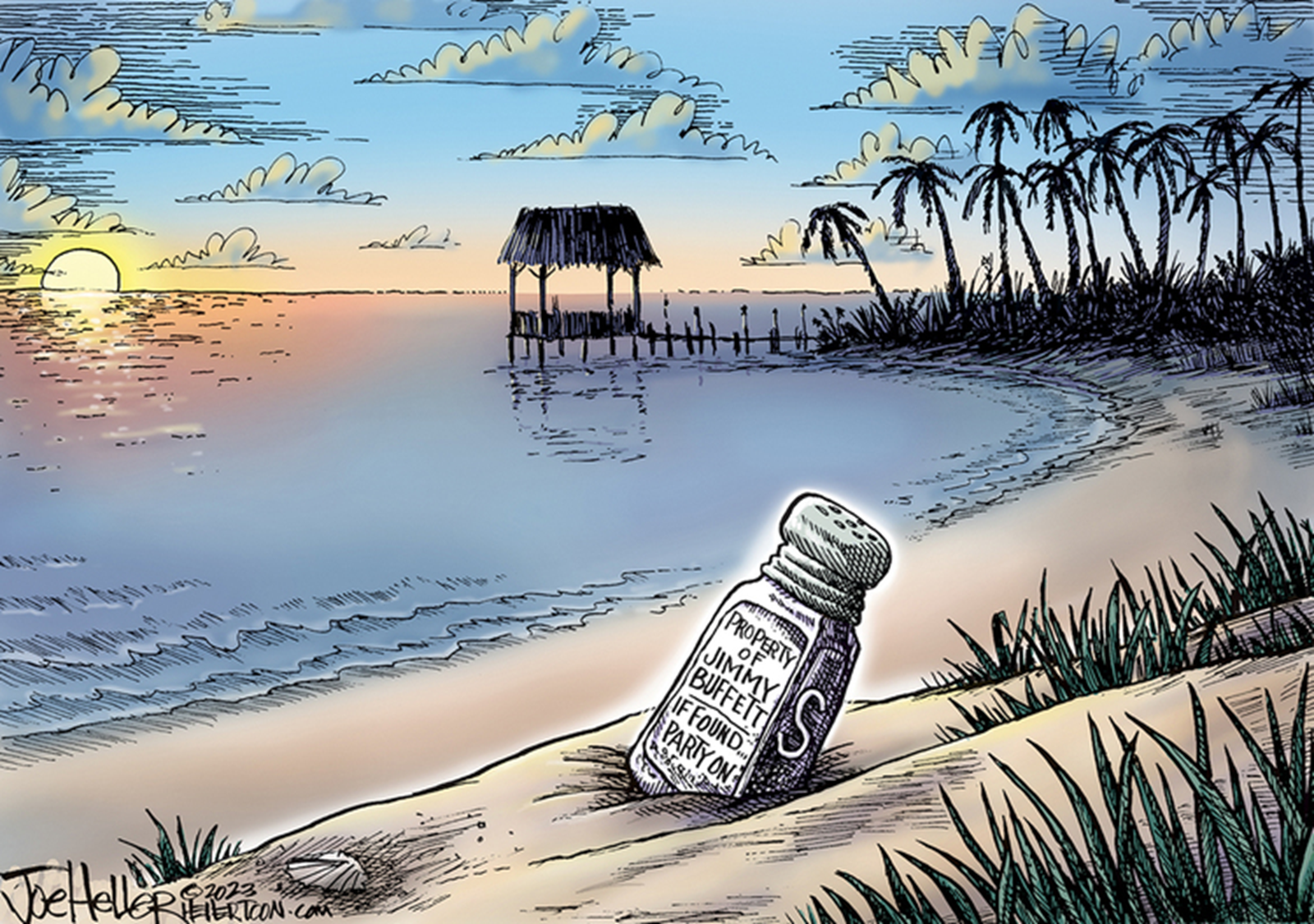
Sadly, Waylon, Clark and Goodman have moved on to that big stage in the sky and they were joined this past weekend by Jimmy Buffett, the epitome of misspent youth as lived by one who we somehow thought would never die.
Buffett, the freest of the all the free spirits performing that day nearly 47 years ago and likely the only one not based in Austin, Texas, was about as far removed from the image of the Texas outlaw country singer as you could get, what with his sandy beaches, Caribbean-style of laid-back music about sailing boats, Paris and sunsets.
Buffett, as most everyone probably knows by now (as first described in my book Louisiana Rocks: The True Genesis of Rock and Roll), Buffett, born in Pascagoula, Mississippi, and raised in Mobile, began his music odyssey as a busker (or street musician) in the New Orleans French Quarter before lightning struck.
And it was in the middle of his electric set at that 1976 festival that he was joined onstage by Louisiana Gov. Edwin Washington Edwards. And the image of Edwards standing beneath a straw cowboy hat as a drink of some unknown beverage was poured into the hat and filtered onto the face and into the mouth of the governor of the gret stet of Loozianer as half-stoned fans (some doubtless from “second-hand” smoke) went out of their collective minds is an image etched permanently in my brain. Through it all, Buffett never missed a beat.
And now, with one hand on the starboard rail and the other around the shoulder of his beloved grandfather, aka The Captain, he has retired to that ONE PARTICULAR HARBOR, a most mysterious calling harbor so far and yet so near, sheltered from the wind and where all are safe within and COME MONDAY, he can finally get that CHEESEBURGER IN PARADISE.
So yes, Bill Baldwin, I did once predict that Buffett would be big, but I was by no means the first.






 Louisiana Voice
Aswell, That’s a great article you wrote about Jimmy Buffett. Roxanne and I attended that Baton Rouge festival. I can’t imagine being backstage with all those great performers. There’s one error in the article, though. It says that Steve Goodman “sang Arlo Guthrie’s City of New Orleans.” Goodman also wrote the song; Arlo had the hit record of it. (On one of his live albums, Arlo tells a great story about meeting Goodman and first hearing the song.) Loved your article. JB was Roxanne’s favorite.
You are correct, Fred. I got the writer and singer of the hit version of the song reversed. Goodman wrote it and Guthrie recorded the hit version of the song. Thanks for keeping me honest.
I saw Willie at the state fairgrounds, and did Jimmy Buffet play the organ at one of the old theaters downtown???those were the days my friend, I thought they would never end…thanks great article ron thompson
With apologies to Robert Frost, I submit that Buffett was the greatest American poet of the 20th Century.
Well, he was a great one, all right, but you have to throw Kris Kristofferson into the mix somewhere. Sunday Morning Coming Down is a classic as is Loving Her was Easier Than Anything I’ll Ever Do Again.
Cannot disagree!