Feeds:
Posts
Comments

Archive for July, 2021

Before beginning our second installment, it might be appropriate to point out a couple of clarifications to our first story as provided by Ashton O’Dwyer, the victim of some especially roughshod justice meted out in the days and weeks following Hurricane Katrina in 2005.

O’Dwyer was kind enough to inform LouisianaVoice that Chales Talley, one of his former law partners at Lemie and Kelleher, “unequivocally reported to me over the telephone during the week of the 11th, in a conversation which he initiated in order to attempt to intimidate me into silence, that I had, indeed already been suspended from the practice of law by Plattsmier.

“However, Talley said that the firm (Lemle & Kelleher) had ‘influence’ with [Charles] Plattsmier, and could get the suspension ‘lifted,’ but only if I quit giving interviews, surrender my weapons to ‘lawful authority’ (armed looters were still roaming parts of the City at this time, almost at will, without intervention by law enforcement), and vacate my property on St. Charles Avenue and join my law partners … wherever the heck they happened to be (other than in New Orleans). This same ‘message’ was delivered to me by Foti’s ‘hatchet man’ and Chief of the LDOJ Criminal Division, Burton Guidry, during his unannounced visit to my home on Saturday the 17th. However, during that visit, [Frank] Neuner, when asked, denied that I had in fact been suspended, proving that Talley was a liar. Plattsmier later (months later) confirmed to me that ‘Nobody has authority to use by name and the stature of my office without express permission,’ which he has never given to anyone (but Plattsmier’s a liar, too, about many other topics).

O’Dwyer also said that attorney Joseph Bruno “didn’t actually represent the State, like some of the others who Duval anointed to ‘control and manage’ the litigation. Bruno was ‘Plaintiffs’ Liaison Counsel,’ who was willfully doing the bidding of the real puppet masters, i.e., Calvin Clifford Fayard, Jr., Jim Roy of Domengeaux & Wright, Danny Becnel, and a host of others that I specifically named as defendants in what I have called ‘the biggest legal malpractice Class Action lawsuit in the annals of American jurisprudence,’ namely Civil Action No. 08-4728, which was filed in the U.S. District Court for the Eastern District of Louisiana on Oct. 23, 2008.

“Exactly two weeks to the day later, on Nov. 7, I was summarily suspended from the practice of law in Federal court by Judge [Ivan L.R.] Lemelle, and haven’t been able to practice law since.”

But we’re getting ahead of ourselves.

At five minutes after midnight on Tuesday, Sept. 20, only 12 hours after O’Dwyer had filed his class-action lawsuit against the US, Gov. Kathleen Blanco, New Orleans Mayor Ray Nagin, former New Orleans Police Superintendent Edwin Compass and Orleans Parish Criminal Sheriff Marlin Gusman, and others, he was watching television and preparing to retire for the evening.

Suddenly, a dark SUV emblazoned with the Louisiana State Police (LSP) logo on its front doors blocked O’Dwyer’s driveway. Three individuals, believed by O’Dwyer to have been state troopers (they were clad in dark “swat-like” uniforms, he said, and armed with both pistols and automatic weapons, emerged and approached O’Dwyer.

O’Dwyer told the officers they were not authorized to be on his property and that they should retreat to the sidewalk. Instead, one of the officers replied, “Sir, you are coming with us. You can either come with us voluntarily or we will remove you from here by force. Now, what’s it going to be?”

O’Dwyer responded, “I will not resist, but you will have to remove me from my property by force.” He says he repeatedly asked officers what was going on, who sent them and was he under arrest and if so, what were the charges against him? The only response he received was, “Shut the f*** up.”

He was thrown face-down onto the ground and while he was in a prone position with his hands bound behind his back, one of the officers attempted to enter his residence but was blocked by houseguest Gerald Guice, who was visiting O’Dwyer at the time and had opted to spend the night rather than violate the 6 p.m. curfew. “The reasons for the officer’s attempt to gain entry into plaintiff’s residence were unknown,” O’Dwyer would claim in a subsequent lawsuit, “but the officer clearly had no legal right to enter plaintiff’s residence because he had no search warrant to plaintiff’s knowledge and no arrest had been made or announced.”

O’Dwyer sustained non-permanent but painful bodily injuries when thrown to the ground at his home and was under the impression that he was the victim of a cruel joke. But then he was taken to a remote area of the Union Passenger Terminal in downtown New Orleans, which had been converted into a holding area where, clad only in a pair of shorts and deck shoes, he was pepper sprayed “in the face and over his entire body” by who he believes was a member of the Donaldsonville Police Department. His protests were met with more pepper spray.

As he began to taunts officers, calling them “gutless dogs,” and not men enough to break his nose or jaw, one officer broke out a 12-guage, 18-inch barrel shotgun and fired several bean-bag rounds at his thighs.

Finally, at the end of his 16 ½-hour ordeal, Odwyer was given a slip of paper upon his release. The paper suggested that he had been arrested for “public intoxication,” which he said in his lawsuit “is a lie. Plaintiff does not allow himself to become intoxicated,” a condition he says “demonstrates a lack of character.”

When asked by LouisianaVoice to provide names of the state troopers who detained and/or tormented him, he identified Trooper John Nelson and Sgt. Christopher Ivy, both of the beleaugured Troop F, headquartered in Monroe.

He said the claims he filed against all defendants except State Supreme Court Chief Justice Catherine “Kitty” Kimball, Plattsmier and troopers Nelson and Ivy were dismissed by Federal District Judge Helen “Ginger” Berrigan.

“It was left to the Fifth Circuit Court of Appeals to dismiss the claims against the remaining named defendants on the basis that [the claim] failed to establish ‘the requisite causal connection’ between the acts committed by them and the events of his arrest,” O’Dwyer said. “An appeal to the U.S. Supreme Court also proved futile.

“In dismissing [my] claims, the federal courts established that no one involved in the administration of justice or law enforcement would be held responsible for the illegal abduction and torture of citizen Ashton O’Dwyer, and by extension, other critics of the government who might follow in his footsteps,” he said. “This is a characteristic of a police state.”

So, in recapping, we have an attorney who decided to remain in his home that suffered only minimal damage from Hurricane Katrina. He did so to protect his possessions from looters and he did so legally.

But then he was vocally critical of the federal, state and local governments’ responses to the storm and to make matters worse, filed a class-action lawsuit on behalf of Katrina victims, a move that upset the legal community, some of whom were already conspiring to file a $400 billion claim against the federal government. But because those lawyers were working with then-Attorney General Charles Foti, they were, in effect, representing the state in recovery efforts. So, when the federal government was determined to be immune under a 1928 law, they were precluded from suing the state.

To shut O’Dwyer up, they sent state troopers to bring him in. At least two of those troopers were identified as members of the infamous Troop F which is currently under a microscope for the beating of one African-American after a traffic stop and the death of another following a similar traffic stop a year before that.

And of course, the legal community, including state and federal judges, closed ranks to protect themselves from O’Dwyer’s wrath and the only way to do that was to suspend his license and to permanently disbar him, thereby not only “shutting him up,” but destroying his ability to earn a living at something he’d been doing for 35 years, destroy his marriage, cost him his marriage, his home, and robbed him of the only thing he had left: his dignity.

As a bitter footnote to all this, the paltry $20 MILLION SETTLEMENT eventually reached over the inadequate protections from Katrina, netted some claimants payments ranging from as little as $1 to $463, while attorneys representing the claimants got up to $3.5 million and an additional $2.4 million to $3.5 million was set aside for administering between 200,000 and 800,000 claims.

That’s the Louisiana political and justice systems in a nutshell, folks. If you’re politically-connected, you’ll do quite well. But cross the wrong people and you’ll pay the price.

Read Full Post »

I suppose every reporter who ever covered the State Capitol or a political campaign has his or her favorite Edwin Edwards story. In that regard, I know I’m not unique, but I happen to have had two interactions with the man that impressed me deeply. And there’re two other stories that, while I was in no way involved, remain among my favorites.

Gov. Edwards died this morning at 93 and like him or not, there will not be another quite like him in Louisiana politics. He was not, as some might like to paint him, a throwback to the Huey Long era. He was his own man who built his own legacy – good, bad, or indifferent – without any help from the Kingfish.

My experience with the man goes all the way back to the mid-1970s when I was a snot-nosed reporter for the Baton Rouge State-Times. (Some say little has change in my personality over the ensuing half-century, but that’s another story.)

Jim Hughes, then-managing editor of the State-Times, approached my desk one morning to say he’d received a call that things were amiss at Southeastern Louisiana University in Hammond, where school president Clea Parker was said to be stealing the university blind through a combination of chicanery and mismanagement. He asked me to drive over and snoop around.

I did, spending the better part of a week on the campus talking to various officials and examining financial records. I even interviewed Parker, who broke down and wept during our interview at the idea that he would be accused of wrongdoing. If Parker was guilty of anything, I concluded, it of being too trusting of those in his inner circle.

I reported back to Hughes that I could find nothing that warranted a story and he said not to worry about it anymore.

A couple of weeks later, I visited family in Ruston for Christmas and dropped by the offices of the local newspaper, The Daily Leader, where I had begun my journalistic odyssey back in 1966 (I would work for the paper on four separate occasions during my career). I mentioned to publisher Tom Kelly, who had first hired me off the street as an advertising account rep, the dead-end I’d encountered at SLU.

He suddenly snapped his fingers and said, “My brother-in-law teaches there and he recently told me that a fellow professor (who Kelly named, but I won’t after so many years because, frankly, it would serve no purpose) had stopped at his table in the student center and announced that he was going to be the next president of Southeastern. He said Gov. Edwards had promised him the job.”

Now I had a hook on which to hang my story – provided I could get confirmation from Edwards, whom I’d never met.

When I returned to work on Monday, I naively walked over to the Capitol, rode the elevator up to the fourth floor and announced I wanted to see the governor (keep in mind, I was not a Capitol beat reporter, nor had I called for an appointment).

The receptionist replied, “Certainly. Have a seat and I’ll let the governor know you’re here.” (Years later, it would literally prove impossible to get Bobby Jindal to even return a call, much less acknowledge your presence). I waited all of five or six minutes before being ushered into the governor’s office. I sat down in front of his desk which was unoccupied. I sat alone in the room for just a minute or two before I became aware of someone walking behind me, coming up on my right side. I looked up to see Edwards stride past holding a Styrofoam cup of coffee. He stepped up into the seat of his chair and sat on top of the backrest, a most unconventional position for the chief executive for the State of Louisiana, or any other state, to say the least. “May I help you?” he asked.

“Governor, did you promise the presidency of Southeastern to _________?” I blurted. So much for subtlety.

The man never blinked nor did he hesitate. “What I promised _______ was that if the presidency became vacant, I would recommend him for the position and since I appoint all the members of the Board of Trustees (of State Colleges and Universities), my recommendation would carry a certain amount of weight. Does that answer your question?”

Boom! I had my story straight from the horse’s mouth.

That afternoon, after the paper came out with my story splashed across the front page, I got a call from the furious professor. He was screaming at me, denying the content of the story. I waited until he finished and then said as calmly as I could, “Sir, if you have a problem with the facts of the story, please take it up with the governor. He was my source.”

I never heard another word about it.

Another time, when I was editor of the Daily Leader (on my fourth tour there) I had occasion to call Edwards about a story I was working on. He was not in and I left a message for him to return my call. An hour or so later, the phone rang and a voice on the other end said, “This is Edwin Edwards. You wanted to talk to me?” No secretary calling to tell me to hold for the governor. Just EWE his own bad self returning his own calls. Years later, he told me that was his policy with the press. “I figure they’re busy and want to talk directly to me and I found I got much better treatment if I didn’t make them talk to an intermediary first,” he explained.

Now for those other two stories.

In 1971, when Edwards ran for governor the first time, his chief opponent was State Sen. (later US Sen.) J. Bennett Johnston of Shreveport. As usual in Louisiana’s gubernatorial campaigns, there are about a dozen or so minor candidates. One of those was a guy named Warren J. “Puggy” Moity of New Iberia. Moity was a colorful character who added a dash of spice to any campaign he was involved in and ’71 was no different (he would receive 0.76% of the vote in that election).

Among the charges he threw out with reckless abandon during the campaign was his claim that Edwards was gay.

A few days after Moity made his outlandish claim, the candidates were scheduled to debate at the old Capitol House Hotel (formerly known as the Heidelberg Hotel where Huey Long liked to hang out in the day). When Edwards walked into the lobby, one of the first people he saw was Moity. He never broke stride as he walked up to Moity and planted a wet one on his cheek.

The other story involved former Gov. Jimmie Davis, who lived in retirement behind the governor’s mansion, across the lake from the State Capitol. Davis regaled in telling the story of how he was outside working one day, “knocking down dirt-dobber nests and spider webs when I saw Gov. Edwards walking straight toward the lake. I realized that he was going to try and walk across the water on his way to the Capitol. I stopped and watched in horror and sure enough, about halfway across, he sank like a rock. There wasn’t anything I could do but walk out there, pull him up out of the water and carry him the rest of the way.”

Rest in peace, Governor.

Read Full Post »

It’s no secret that I despise Donald John Trump, aka “the former guy.” He campaigned as a buffoon and his four years in office were even worse.

But much as I detested him and his political agenda (read: redneck rhetoric), I have to admit he got one thing right: he knew enough about politics not to run as some obscure third-party candidate.

One need only look at the roster of those who tried to know at a glance no third-party candidate stands a chance in hell against the two monied, established parties. It just ain’t gonna happen.

The most successful of the third-party candidates in the 20th century was Teddy Roosevelt who, in 1912, received 27.4 percent of the popular vote, enough to dislodge his former – and future – friend William Howard Taft, who came in with just 23.2 percent. The winner? Woodrow Wilson, with 41.8 percent, second lowest only to John Quincy Adams who pulled down just 32.1 percent to win in 1824.

But bear in mind, Roosevelt had already served nearly two full terms as a Republican president, assuming office when William McKinley was assassinated.

Next highest among independent or third-party candidates in the 20th century was Ross (“I’ll jes’ git under the hood and fix it”) Perot, who received 18.9 percent of the popular vote in 1996.

Continuing the exercise in futility as a third-party candidate, we have, in order of percentages:

  • Robert La Follette (Progressive Party): 16.6 percent in 1924;
  • George Wallace (American Independent): 14.5 percent in 1968;
  • John Anderson (Independent): 6.6 percent in 1980;
  • Gary Johnson (Libertarian); 3.3 percent in 2016;
  • Ralph Nader (Reform and Independent in 3 tries): 2.7 percent in 1996;
  • Strom Thurman (Dixiecrat): 2.4 percent in 1948;
  • Henry Wallace (Progressive Party): 2.4 percent in 1948;
  • Ralph Nader (Green Party): 2.7 percent in 2000;
  • Jo Jorgensen (Libertarian Party): 1.2 percent in 2020;
  • Jill Stein (Green Party): 1.1 percent in 2016;
  • Eugene McCarthy (Independent): 0.9 percent in 1976;
  • David Duke (Populist Party): 0.05 percent in 1988;
  • Pat Buchanan (Reform): 0.04 percent in 2000.

How sad is it that Buchanan couldn’t even poll higher numbers than our very own racist-in-residence? That’s gotta be embarrassing.

Trump actually toyed with the idea of running as an Reform Party candidate in 2000 but in the end, rejected the idea and of course, ran in 2016 as a Republican, getting elected with 46.1 percent of the vote.

The lesson to be learned here is that one should never seek the presidency as a third-party candidate. Too much money and too much power are aligned against you – from both major parties. It’s just not in the cards.

If you’re serious about getting elected as some sort of maverick or novice, the path to follow is the one Trump chose.

You simply hijack an existing party and then follow this formula:

  • Mold it to shape whatever warped ideology you may embrace at the time;
  • Insult the other candidates;
  • Dodge legitimate questions about policy, your personal life and business dealings;
  • Make false promises you have no intention of keeping;
  • Claim to be a genius;
  • Beg for money while claiming to be financing our own campaign;
  • Call anyone who disagrees with you a loser (or worse);
  • Appoint aides but give them no authority and fire them on a whim;
  • Cozy up to adversaries and betray allies.

Of course, with such tactic only works if the party you ultimately choose capitulates and allows itself to be seized in a hostile takeover.

Read Full Post »

One-time prominent New Orleans attorney Ashton O’Dwyer’s story certainly isn’t new. In fact, it’s 16 years old now and has been chronicled by several writers, including popular New Orleans Times-Picayune/Morning Advocate columnist James Gill.

But his story takes on renewed significance – and timeliness – with the media spotlight turned on Louisiana State Police Troop F following the May 2019 death of RONALD GREENE and the beating of a second African-American by state troopers and the ensuing federal investigation of Louisiana State Police (LSP).

For those who have been in a coma for the past two years, Greene, 49, was killed by state troopers after he fled when officers attempted to pull his car over for an unspecified traffic violation. An AUTOPSY (copies of which, by the way, authorities have refused to release) reportedly revealed he had no drugs or alcohol in his system, nor were there any such substances in his vehicle, Moreover, there were no outstanding warrants for his arrest, so the reason he fled police, other than the possibility that he felt he had reason to fear police, remains a mystery.

A year after the Greene incident (and nearly a year before details of Greene’s death would become public) troopers from Troop F beat another black man, 29-year-old ANTONIO HARRIS under similar circumstances. That incident included at least one officer who was involved in the Greene death. Unlike Greene, however, Harris survived and currently has a lawsuit pending against LSP, as does Greene’s family.

At least two troopers from Troop F were among those who participated in the brutalization of O’Dwyer in the days following Hurricane Katrina which devastated much of New Orleans but which spared O’Dwyer and his St. Charles Street home – until he made the wrong people uncomfortable and he suddenly became a problem.

Unlike Greene and Harris, O’Dwyer is white and was a full partner in the New Orleans law firm of Lemie and Kelleher where he had worked for 35 years, specializing in admiralty and maritime law. He resided in one of the most upscale sections of New Orleans.

In the end, his crossing the politically-connected legal establishment would cost him his job, his marriage, his law license and his home and leave him destitute and a broken man.

It’s not how the system is supposed to work and O’Dwyer is living testament to man’s inhumanity to man.

To learn the full impact of how the system came down on O’Dwyer, we have to go back to Aug. 29, 2005, the day that Hurricane Katrina slammed into New Orleans. When the levees gave way, about 80 percent of New Orleans homes and businesses flooded. By stroke of good fortune (and because he was on higher ground), O’Dwyer’s home and others on St. Charles Avenue did not. Accordingly, O’Dwyer chose (legally) not to evacuate but to remain in his home to protect his possessions from looters. He had plenty provisions and a generator, giving him the independence he need to subsist until order and power could be restored to a crippled city.

He even took in a few guests and entertained visiting media, giving interviews on a regular basis and offering his opinion on the federal and state governments’ abysmal failure to respond in a timely manner to the plight of thousands trapped in the Louisiana Superdome, the Convention Center, on elevated expressways and on rooftops with no water, food, electricity or toilets. He spared no one in his criticisms – most especially the US Army “Corpse” of Engineers (his term), the Orleans Water and Sewer Board, the various levee boards, through Louisiana Department of Transportation and Development, and any others he could call to mind who incurred his wrath and indignation.

Twenty days after Katrina’s landfall, on Sept. 19, O’Dwyer drove to Baton Rouge to do what lawyers do – file a class-action lawsuit in US District Court for the Eastern District of Louisiana (which had been temporarily relocated from New Orleans to the Capital City) on behalf of Katrina’s victims. Named as defendants were the United States of America, Gov. Kathleen Blanco, New Orleans Mayor Ray Nagin, former New Orleans Police Superintendent Edwin Compass and Orleans Parish Criminal Sheriff Malin Gusman.

“My approach to the Katrina litigation was quite simple,” O’Dwyer told LouisianaVoice. “I believed that the case would hinge on a single issue, namely: did the USA have immunity or not? If the USA was not immune, then the Federal Tort Claims Act, coupled with the depth, breadth and scope of the federal purse, was fully able to compensate everyone, including the lawyers, handsomely.

“But what if the USA was determined to be immune because of the provisions of the Flood Control Act of 1928? What then? Who was the ‘next deepest pocket’? Answer: the State of Louisiana, of course (and its various agencies and instrumentalities and political subdivisions).”

But what O’Dwyer did not know at the time and would not learn until the second anniversary of Katrina (and this is where it gets dicey) was that a cabal of plaintiffs’ attorneys, headed up by Joseph Bruno of New Orleans, had been appointed by Federal Judge Stanwood R. Duval, Jr. to manage and control litigation against the federal government on behalf of the state and 500,000 storm victims.

That created a problem when it was determined that the US did, in fact, enjoy immunity from the Flood Control Act. But, O’Dwyer said, because the attorneys had entered into a secret pact with then-Attorney General Charles Foti to represent the state by filing a $400 billion claim against the federal government, any chance of then suing the state was negated because the state was now their client and attorneys are precluded by something called legal ethics from suing their own clients.

Meanwhile, the wheels were set in motion to silence O’Dwyer’s constant stream of interviews about the poor response to the hurricane. Twelve days after the storm, on Sept. 11, there was a MEETING in Foti’s Baton Rouge office. Among the attendees were State Supreme Court Justice Catherine “Kitty” Kimball, Louisiana State Bar Association President Frank X. Neuner, Jr., and Chief Disciplinary Counsel of the State Supreme Court’s Attorney Disciplinary Board, Charles B. Plattsmier, Jr.

During that meeting, the discussion turned to O’Dwyer who, in the aftermath of the storm, had been confronted by uniformed members of a militia who threatened to evacuate him by force despite his home having received only minimal damage. O’Dwyer’s protestations had been taped by the media and the notoriety generated by his interviews was deemed unacceptable by those in that meeting.

“Somebody has got to shut that guy up,” Justice Kimball was quoted as saying. “He’s giving us all a bad name.”

Plattsmier, appointed by the Supreme Court, was said to have quickly agreed to take care of the O’Dwyer “problem” by contacting some of his partners at Lemle and Kelleher.

Three days later, on Sept. 14, Charles R. Talley, one of O’Dwyer’s law partners inadvertently revealed to O’Dwyer that he and at least one other partner, Joseph L. “Larry” Shea, Jr., had understood a threat from Plattsmier that O’Dwyer’s law license would be suspended if he continued to talk to the media and vacate his property.

The following day, another partner, William R. Forrester, Jr., hand-delivered a letter from the firm’s chairman Ernest L. Edwards, Jr. (there are a lot of “Juniors” In this story) warning that his partnership was in jeopardy unless he stopped giving interviews to the media or failed to cooperate with government authorities and surrender his weapons. A courtesy copy of the letter was also provided to Plattsmier, which suggested that Plattsmier may well have been the source of the directive.

On September 17, 2005, O’Dwyer was visited by a delegation composed of Neuner and two members of the Louisiana Department of Justice, one of whom was Assistant Attorney General Burton Guidry. They were there to warn him that complaints about him had been made “at the highest levels of government.” That same evening, O’Dwyer was host to several members of the New York City Police Department, who were on special assignment in New Orleans. They were the only police officers who responded to his invitation, posted at the Uptown 2nd District Police Station, to be dinner guests at his home.

Tomorrow: The Axe Falls

Read Full Post »

This a story of your tax dollars at work.

Back in March 2019, the Southern University system-wide grievance committee was hearing an appeal by four professors who had been terminated by the school. Their names are Elaine Lawnau, Christy Moland, Terrilyn Gillis and Marilyn Seibert.

They requested that the hearing be conducted in open session. That is their right. It’s written in Louisiana’s Open Meeting Statutes.

But committee chairperson Maria Dickerson announced that she had met privately with all committee members beforehand and it was agreed that the hearing would be closed to the public.

There were at least four laws broken with that decision:

Meeting “privately” with committee members beforehand was itself a violation of the Open Meetings statutes;

The professors who were filing grievances, not the committee, has the final say under those same statutes as to whether or not the meeting should proceed in open or closed session – and they chose open;

There was never a formal motion to enter into executive session – also a requirement of the law;

There was never an official vote taken by the committee to enter into closed session – again, a require…well, you get the picture.

Because of the flagrant violations, the four professors and I, as a journalist covering the hearing, filed suit against Southern.

The school’s defense attorney, Winston Decuir, Jr. was questioning me during the subsequent trial and he asked, “Mr. Aswell, how many events have you covered at Southern?”

I suppose he was trying to imply that I was there only to serve as some sort of rabble-rouser, neglecting a fine point of law which says that it is irrelevant how many times I have graced Southern or anywhere else with my appearance to cover a meeting.

State District Court Judge Richard “Chip” Moore found Decuir’s lame argument that the university’s grievance committee did not constitute a public body so embarrassingly weak that he LEVIED A FINE of $1,000 per plaintiff ($5,000 total), plus $8,400 in attorney fees to Baton Rouge attorney J. Arthur Smith, III, who was representing the professors and by extension, me. More also ordered Southern to pay $638 in court costs.

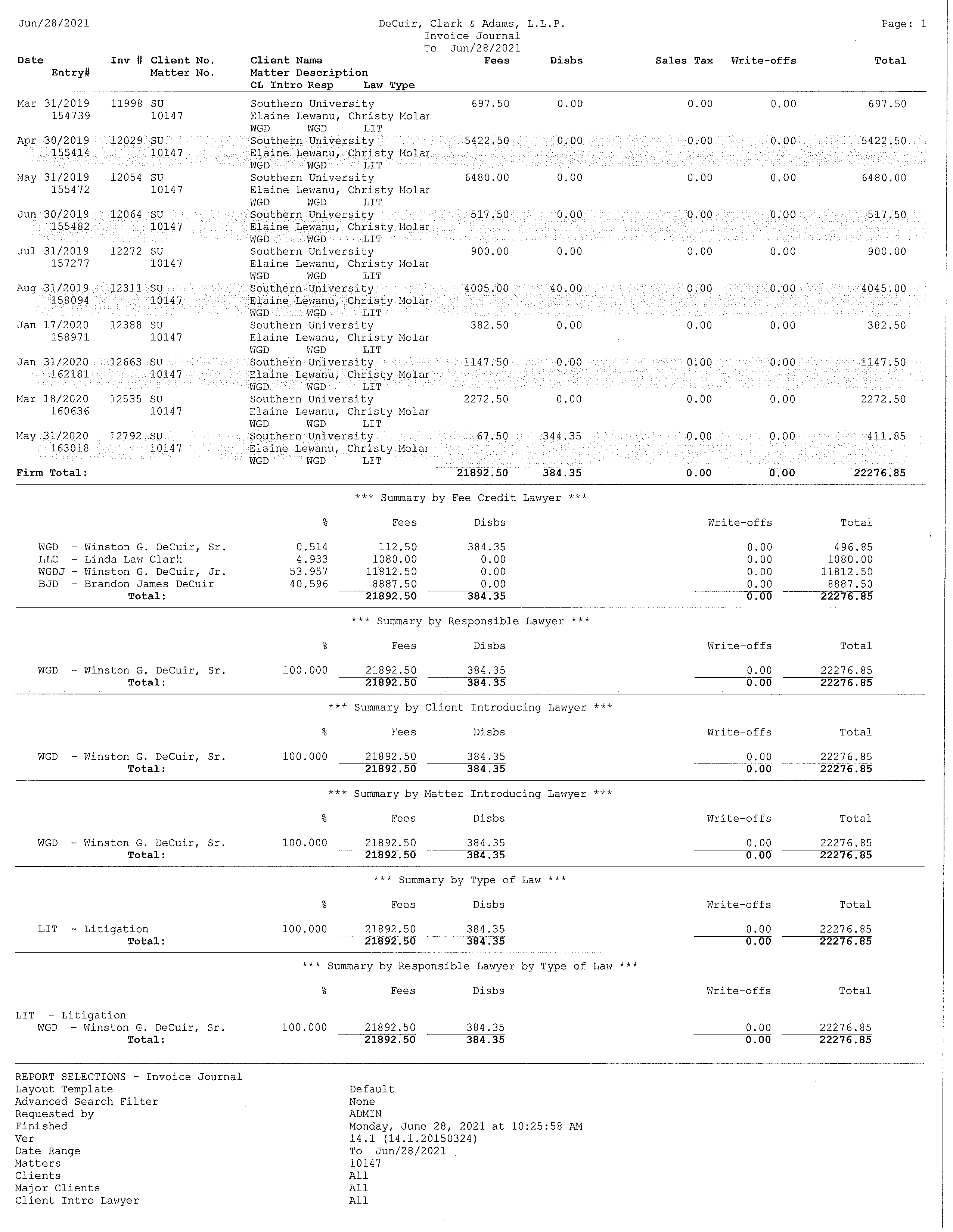
I recently (recently being a relative term) made a public records requests for an accounting of how much the school paid Decuir’s firm to represent the school in this dog of a case.

The records I received earlier this week reflect that up and including the trial in 19th Judicial District Court on the open meetings violations, Southern paid Decuir $12,600.

When Judge Moore handed down his decision in May 2019, Decuir appealed to the First Circuit Court of Appeal where he lost again. For his work on the appeal, Southern paid Decuir an additional $5,462.50.

With two strikes against him, Decuir then took the matter up on writs to the Louisiana State Supreme Court, which simply refused to hear the case – but not before Decuir was paid another $3,782.50.

The final accounting provided by Southern shows that from start to finish, Decuir was paid $22,276.85 for the hearing and the ensuing legal work.

Now, any math whizzes reading this will be quick to realize there’s a $20 discrepancy in the accounting. Just so you know, I am attaching a link to the tabulations provided by Southern. Perhaps you can find the extra twenty bucks. I can’t.

But the point of all this to show that Southern was hit for $22,276.85 (or $22,256.85, depending on whether or not you can find the elusive $20) to keep from paying a $14,038 judgment – $9,145 of which was spent on fruitless appeals that any first-year law student could have said was an exercise in throwing good money after bad.

And while I can’t speak to whether or not the plaintiffs’ attorney fees and court costs have been paid, I can state with certainty that the $5,000 judgment in favor of the five plaintiffs has not been paid.

I wonder if there’s a provision to require attorneys to pony up funds for continuing to bleed a client after losing a case more obvious than Donald Trump’s bogus election claims?

Read Full Post »

« Newer Posts - Older Posts »

