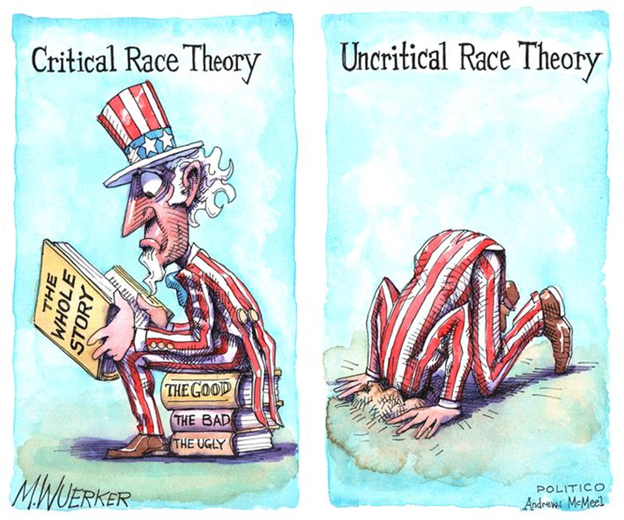
The AMERICAN LEGISLATIVE EXCHANGE COUNCIL (ALEC) is pushing hard to ban it and obedient state legislators across the American landscape are obligingly introducing ALEC-written bills to outlaw the teaching of so-called CRITICAL RACE THEORY, aka the plain, unvarnished American history.
Louisiana is no exception, thanks to the efforts of State Reps. Raymond “Slavery Wasn’t All Bad” Garofalo (R-Chalmette) and Mark “Let’s Study It to Death” Wright (R-Covington). I will return to them in due course.
But first, for those who still believe that “in 1492, Columbus sailed the ocean blue” and “Remember the Alamo” are all we need to impart upon our students as representative of all they need to know in learning what this country is all about, there are a few inconvenient facts that seem to have been lost along the way.
In the 100-year period dating from the Revolutionary War to the years following the Civil War, there were approximately 370 TREATIES signed between the United States government and the various Native American tribes.
The United States government broke every single one of those treaties. Let me say it another way: Without exception, the U.S. government broke its promises to Native Americans 368 times as westward expansion demanded more and more concessions from the indigenous Americans who were relegated to barren lands with little promise. The Black Hills of Dakota, considered useless to the whites, was ceded to the American Indians in the Treaty of Fort Laramie in 1868. But when gold was discovered, it was decided the land was pretty good after all, and the natives were again pushed aside.
Before that, in 1830, there was President Andrew Jackson’s Indian Removal Act that resulted in the infamous Trail of Tears which an estimated 10 to 25 percent of Cherokee Tribe members would die during the 1,200-mile journal from 50 million acres in the American Southeast (Alabama, Florida, Georgia, Tennessee, Mississippi, Kentucky and North Carolina) to Oklahoma.
But ALEC, Garofalo and presumably Wright would prefer that part of American history not be taught in our classrooms because it might be considered racially “divisive.”
It’s not clear how ALEC and its like-minded legislators would have schools teach about the Civil War. I suppose they could revert to the old War of Northern Aggression and omit any reference to slavery – even those so-called good aspects alluded to by Garofalo.
But it’s pretty much a given that other significant events will never see the light of day in a history class if they have their way. Even without their proposed restrictions, little has ever been taught about two such events right here in Louisiana or the real origins of private prisons which can be traced directly to the Bayou State.
Thousands of African-Americans were killed by outlaw outfits like the Ku Klux Klan during Reconstruction immediately following the Civil War. One of the worst such incidents occurred in central Louisiana in the little town of Colfax.
In 1872, Louisiana had a disputed election for governor. When President Grant intervened by dispatching troops to Louisiana to support the Republican candidate, an armed contingent calling itself the ”WHITE LEAGUE” was formed and began attacking blacks and white Republicans across the state.
Grant Parish was carved out of sections of Rapides and Winn parishes and named for President Ulysses Grant. The parish seat of Colfax was named for his Vice President, Schuyler Colfax.
When an all-black militia took control of the local courthouse in April 1873, a similar group of more than 150 White League and KKK members and former Confederate soldiers surrounded the courthouse. Following a brief battle, the blacks surrendered but were cut down as they exited the courthouse. Those who weren’t shot were hanged. Estimates of from 60 to 150 African-Americans died at the hands of the local vigilantes. Three whites also died in the fighting.
Historian ERIC FONERcalled it “the bloodiest single instance of racial carnage in the Reconstruction era.”
But that would never be taught in history classes in Louisiana – or anywhere else – if ALEC and Repugnantcan legislators across the country have their way.
But the Louisiana Department of Commerce and Industry made sure that its take on events would be remembered when it erected a historic marker that says, “On this site occurred the Colfax Riot in which three white men and 150 negroes (lower cased) were slain. This event on April 13, 1873 marked the end of carpetbag misrule in the South.”
Richard Robin, writing in THE ATLANTIC, said he had studied the Civil War and Reconstruction “quite extensively,” but had never heard of the Colfax Riot. “Neither had the half-dozen history professors and the dozen Louisianans from New Orleans, Baton Rouge and Alexandria I’d asked about it since I’d first read that marker.”
And there are those who would like to keep it that way. And, ironically, they are the ones raising all manner of hell over Democrats’ so-called “cancel culture.”
But I digress.
Just a few years later, on Nov. 23, 1887, and 212 miles southeast of Colfax, a mass shooting of African-American farm workers would become known as the THIBODAUX MASSACREand would prompt local planter Mary Pugh to write, “I think this will settle the question of who is to rule – the nigger or the white man for the next fifty years.”
Their sin? They were attempted to form a union in order to gain higher wages for harvesting sugar cane. With no land or own or even rent, workers were forced to live in former slave cabins and to harvest cane for as little as 42 cents per day for 12-hour shifts.
When workers banded together to demand wages of $1.25 per day or $1 per day if meals were included, growers refused. Republican Gov. William Pitt Kellogg, under pressure from the Louisiana White League, backed the growers.
In October, the union again sent demands of $1.25 per day to growers who retaliated by firing the union members. One of the planters was Edward Douglass White who ordered workers off his land and directed that any who stayed be arrested. White would go on to serve as the Chief Justice of the U.S. Supreme Court.
As the cane ripened, growers asked Samuel D. McEnery, Democratic governor and former planter, to compel the Blacks to harvest the cane. McEnery, who had succeeded Kellogg, called on several all-white Louisiana militias under the command of ex-Confederate General P. G. T. Beauregard. A hand-cranked .45 caliber Gatling gun machine gun was parked it in front of the Thibodaux courthouse and an army cannon was set up in front of the jail.
Martial law was declared by Lafourche Parish Judge Taylor Beattie who, despite being a Republican, was a White Leage member and a former Confederate soldier. When two white guards were wounded by gunshots that came from a cornfield, the response was a massacre.
Mobs of whites roamed the streets “night and day shooting colored men who took part in the strike,” said Thibodaux minister Rev. T. Jefferson Rhodes. At least 35 Blacks who offered no resistance were killed outright, including young and old, men and women. Survivors hid in the woods and swamps as the killings continued on plantations. Bodies were dumped into a site that became a landfill.
Whites cheered the Jim Crow victory as workers returned to the fields. The New Orleans Daily Picayune blamed the violence on the black unionizers as their killers went unpunished. Union efforts throughout the South died with the strikers just as the industrial age was emerging.
But don’t look for this ugly chapter in our history of ALEC, Garofalo, et al have their way.
Garofalo introduced House Bill 564 which would have banned the teaching of anything that might be considered racially divisive. Fortunately, the bill was voluntarily deferred by Garofalo when it became evident that it would never get out of the House Education Committee.
Wright, with his House Study Request 3 just wants the Education Committee to “study” critical race theory.
Had Garofalo’s bill passed and been signed into law (Gov. John Bel Edwards likely would have vetoed it), it would have crippled the curriculum for elementary and high school history classes by simply deleting important events in the history of this country and state – things like the racial killings in Colfax and Thibodaux.
Nor will your kids ever learn about the real origins of the private prison industry that warehouses people for profit.
The first prison was privatized in LOUISIANA in 1844. The prison used inmates to manufacture cheap clothing for slaves.
Following the Civil War stricter laws were enacted that were weighted against Blacks. Nathan Bedford Forrest, the first Grand Wizard of the KKK, for a while controlled all convicts in Mississippi, leasing them out to private companies for cheap labor. In Tennessee, Thomas O’Conner forced convicts to work in mines and when they died from exhaustion or disease, he would sell their bodies to a medical school in Nashville for students to practice on.
Companies preferred using convicts because, unlike free workers, they could be “inspired” by torture technique that included “watering” in which a prisoner was strapped down, a funnel forced into his mouth, and water poured in. The action would distend the stomach and put pressure on the heart, making the prisoner feel that he was going to die. Another punishment was “stringing up” which involved wrapping a cord around the men’s thumbs. The cord would then be flung over a tree limb, and tightened until the men hung suspended, sometimes for hours. Whipping was common. An Alabama government inspection showed that in a two-week period in 1889, 165 prisoners were flogged. Arkansas didn’t abolish the lash until 1967.
To ensure the continuance of private prisons, lessees gave a cut of the profits to the states. Between 1880 and 1904, profits from leasing convicts comprised up to 10 percent of Alabama’s state budget. A federal report revealed that revenues from leasing out inmate labor were nearly four times the cost of running prisons.
It took 100 years for the Tulsa massacre to penetrate the American conscience and by next week it will be forgotten just as we have either forgotten or ignored altogether the East St. Louis race riots of 1917, the Chicago race riot of 1919, the Birmingham church bombing in 1963, Bloody Sunday in 1965 Selma, the shooting by a white supremacist at Charleston’s Emanual African Methodist Episcopal Church or even the assassination of Rev. Martin Luther King.
And if ALEC and the Raymond Garofalos of the world have their way, that’s the way it will remain.
LouisianaVoice does not accept advertising because we insist on an independent voice. Likewise, we do not charge a subscription fee for our blog.
That is not to say we do not have expenses—lots of them. Moreover, we would love to add a reporter to provide even better coverage of the underbelly of Louisiana politics.
Your contribution would help us immensely in meeting our growing expenses. Simply click on the “Donate” button here and contribute whatever you feel appropriate.
Thank you.
Tom Aswell, Publisher
Got a tip?
Got a news lead for LouisianaVoice to investigate? Have a suggestion for a story? Your identity will never be revealed. Just send an email to louisianavoice@outlook.com
Read my books!
Read more Books!
Order your Piyush Bumper Sticker Now!
Click image to order
$2.50 each or three for $6.00






 Louisiana Voice