Feeds:
Posts
Comments

Archive for February, 2018

MESSAGE FROM THE PUBLISHER:

Effective immediately, a new policy is being instituted regarding comments to posts on LouisianaVoice:

  • No person will be allowed more than two comments on any single post.
  • No comment may be more than a couple of paragraphs (I will decide if a paragraph runs too long and edit accordingly).
  • No videos may be posted with your comment. You may attach a link to a video, but no actual videos.

I feel I am being generous at that because one comment should be sufficient to get your point across but sometimes when a reader comments on your original comment, you may feel the need to rebut. If so, please be brief.

I am taking this action reluctantly because I do not condone censorship—and that sentiment applies whether your agree with my post or not. Whether or not you agree is irrelevant.

This has become necessary because I have received several complaints lately from readers who feel the comments section is being monopolized by a few readers, well-intentioned though they may be.

I apologize for having to take this action. I hope you will understand.

Tom Aswell

Read Full Post »

Gov. John Bel Edwards and the Louisiana Legislature could probably learn a thing or two about building budgetary surpluses from the St. Landry Parish Fire Protection District No. 2—except at least one St. Landry Parish citizens thinks the surplus may be the result of smoke and mirrors and a little voodoo tax millage assessment.

On the other hand, the State Ethics Board appears to be taking its cue from the Attorney General’s office in stonewalling tactics.

The district had a bank balance of more than three times its annual budget at the end of 2016, according to a state AUDIT of the its books. The audit showed nearly $8.4 million in the bank as of Dec. 31, 2016, after expenses of $2.6 million.

And a formal complaint made to the Louisiana State Board of Ethics last May against the district and its secretary-treasurer has produced only a letter of acknowledgement but no results after nine months.

Despite annual revenues of nearly $3.7 million for both 2015 and 2016, the district’s board seemingly felt it could not afford to hire a qualified employee to apply generally accepted accounting principles in recording the districts financial transactions or preparing its financial statements, the audit indicated.

“A material weakness is a deficiency, or combination of deficiencies, in internal control such that there is a reasonable possibility that a material misstatement of the entity’s financial statements will not be prevented, or detected and corrected on a timely basis,” the audit said. “we identified certain deficiencies in internal control that we consider to be material weaknesses.”

Nor did the board seem to feel it was in a position to hire additional firefighters in order to cut back on more expensive overtime pay. Board members paid themselves nearly $16,600 in 2016 and paid out $1.2 million in salaries. An additional $329,677 was paid in overtime (listed as “extra shifts and call out time”).

Auditors recommended that the board examine the following options and implement policies and procedures in order to reduce excessive payroll expenditures:

  • Establish set annual/monthly salaries for management-level positions in order to eliminate overtime paid;
  • Hire additional firefighters in order to decrease overtime pay;
  • Better utilize volunteer firefighters in an effort to minimize costs.

While Edwards and the legislature might be scratching their heads if they knew of the district’s fiscal wizardry, a closer look at a curious tax millage might clear things up.

It seems that district voters may have once approved a 17.5 mill property tax but the district somehow managed to collect two identical millages of 17.5 mills each until January 2018, when one of the assessments expired.

St. Landry Parish resident and local taxpayer Charles Jagneaux, who filed the complaint with the state ethics board, which has been basically toothless since it was gutted by Bobby Jindal in one of his first acts as governor in 2008, has a theory about that dual tax millage.

“My understanding is that the second millage was passed by calling it a renewal when in fact, it was a second identical millage,” he said. “The board attempted to put the expiring millage on the ballot (for a renewal) this year but the parish council would not let them since there was a multi-million-dollar surplus.”

The ethics complaint was filed against Johnny Ardoin, secretary-treasurer of the district’s board. Ardoin, it turns out, is also a member of the Port Barre TOWN COUNCIL, which would appear to be a case of dual office-holding, illegal under Louisiana law.

As a point of clarification from a reader who is in a position to know, dual office holding falls under (drum roll, please…) the attorney general’s office, not the ethics board so the ethics board would not address that matter,

A second, more serious ethics violation, however, seems to arise from Ardoin’s membership on the fire district board.

The Port Barre Town Council appoints two members of the fire district’s board of commissioners.

That would seem to constitute a built-in conflict of interest for Ardoin. Given his position as a member of the town council, he is in the unique position to appoint himself to the fire district’s board of commissioners.

That ethics complaint, like most complaints to the state ethics board these days, is in all likelihood, a dead-end street, particularly as it regards dual office-holding. But even in cases when ethics fines are assessed, which is seldom, they often are ignored and never collected, thanks again to Bobby Jindal and his ethics reform agenda.

Read Full Post »

When it comes to sucking up to Donald Trump, Louisiana Attorney General Jeff Landry has no peer.

In Jeff Landry’s very limited world view, the Trumpster can do no wrong—just as (in Landry’s opinion) Gov. John Bel Edwards can do nothing right.

Never mind that at least 18 women have come forward to say that Frump molested or attempted to molest them in some fashion over the years.

He’s Jeff’s boy.

Never mind that candidate Grump was heard plainly boasting to Billy Bush about how he loves to grab women.

He’s Jeff’s boy.

Never mind that Thumper openly bragged about bursting into the dressing room of Miss USA candidates, grabbing and pawing the terrified contestants.

He’s Jeff’s boy.

Never mind that Trump approved, before actually reading it, the release of that Nunes memo that was supposed to be a bombshell that would completely discredit the Mueller investigation—but who now refuses to approve the release of the Democrats’ memo rebutting the Nunes memo.

He’s Jeff’s boy.

Never mind that Trump pointed out that Rob Porter, ousted from his White House job after two ex-wives claimed he physically abused them, had never received “due process,” said lament coming just over a year after he chanted on the campaign trail of Hillary Clinton: “Lock her up!”

Not that there’s any lost sympathy for Hillary here, but didn’t she deserve “due process” just as much as Porter?

But never mind, Trump’s Jeff’s boy.

And that’s from the supposed top legal authority in state government.

Now, that’s truly sad for a guy who can’t seem to close out investigations of felony theft in the Desoto Parish Sheriff’s Office, the Alton Sterling shooting, or, after nearly two years, the rape of a 17-year-old girl by an already-convicted rapist in a Union Parish jail cell.

Here are a few examples of Jeff Landry press releases, issued courtesy of Louisiana taxpayer dollars:


Thursday, September 28, 2017

Majority Whip Congressman Steve Scalise Returns to Congress; Attorney General Jeff Landry Elated

BATON ROUGE, LA – Attorney General Jeff Landry today enthusiastically recognized the return of Majority Whip Steve Scalise to the U.S. House Floor:

“It is truly a miracle to see Majority Whip, and my good friend, Steve Scalise return to the House Floor today. Witnessing his triumphant return took us all back to that emotional and terrifying morning in June when he was shot while practicing for the annual Congressional baseball game, an event Steve cherished. As he said this morning in his address, the Capitol Police officers who rushed to his aid that day were heroes – saving his life and undoubtedly the lives of many others. The Capitol Police work tirelessly to keep all members of Congress safe and as a former Congressman, I am grateful for their service. Steve’s message of faith presented on the House Floor today is important for all Americans regardless of religion, political party, or background. Steve’s will to live, his strong faith in God, the selflessness of the Capitol Police, and the prayers of people across the world carried him through. I look forward to following Steve as he continues to be a ferocious leader for Louisiana and our country.”


Thursday, September 28, 2017

BATON ROUGE, LA – Louisiana Attorney General Jeff Landry applauded the White House’s announcement of Louisiana natives Kyle Duncan and Eastern District Chief Judge Kurt Engelhardt to the Court of Appeals for the Fifth Circuit.

The AG’s full statement may be found below:

“Kyle is an exceptional constitutional lawyer and will make an excellent appellate judge. Kyle has vast experience in complex constitutional cases, both civil and criminal. In every case, he demonstrates that is a consummate professional. He and his wife Martha have deep roots in Louisiana, and we are glad he will be bringing his family and intellect back home.

Chief Judge Kurt Engelhardt is also a great choice. Judge Engelhardt has been serving on the federal bench in Louisiana since 2001 and has time and again demonstrated his commitment to the highest principles of judicial ethics and service. We have been lucky to have him on the district court bench here for the last 16 years and are happy to share his intellect and sound judicial instincts with the rest of the Fifth Circuit.


Tuesday, October 10, 2017

Clean Power Plan Repealed, AG Jeff Landry Praises Decision by Trump Administration

BATON ROUGE, LA – Attorney General Jeff Landry is praising EPA Administrator Scott Pruitt’s decision today to repeal the Clean Power Plan, an Obama overreach that would have devastated Louisiana’s power plants and energy consumers.

“On behalf of Louisiana workers, job creators, and consumers – I commend Administrator Pruitt and the Trump Administration for repealing this unconstitutional, job-killing regulation,” said General Landry. “The so-called Clean Power Plan was always a political attempt to force states into green energy submission.”

“Since taking office – I have challenged the legality of the Clean Power Plan, worked with fellow attorneys general to get a stay in federal court on the mandate, and pushed for today’s repeal,” continued General Landry. “The Trump Administration has acknowledged the Clean Power Plan was an unprecedented Washington power grab not only from the states but also from other federal regulatory agencies. It would have cost tens of billions to implement, jeopardized Louisiana’s six coal-powered plants, and devastated the pocketbooks of our State’s seniors and working families who rely upon low-cost energy.”

 
Wednesday, November 1, 2017

BATON ROUGE, LA – Attorney General Jeff Landry applauded President Trump’s nomination of Louisiana Department of Justice (LADOJ) Criminal Director Brandon Fremin as U.S. Attorney for the Middle District.

“President Trump’s nomination of Brandon Fremin is a grand slam homerun. Brandon has truly lived a life of public service, both as a Marine and a prosecutor,” said General Landry. “Brandon has been a tremendous asset to our office; and I am confident that he will lead the U.S. Attorney’s Office in a fair, ethical, and honest way.”

In January 2016, Fremin was hired to serve the Criminal Director for General Landry’s office where he oversees several sections including: general prosecutions, insurance fraud, and the award-winning Medicaid Fraud Control Unit. Under his watch, over 15 public officials have been arrested for public corruption charges – many of whom are currently being prosecuted by the LADOJ.

 
Thursday, January 4, 2018

Federal Marijuana Enforcement Policy Praised by AG Jeff Landry

BATON ROUGE, LA – Louisiana Attorney General Jeff Landry issued the following statement in support of today’s decision by United States Attorney General Jeff Sessions to rescind the Cole Memo:

“I applaud Attorney General Jeff Sessions for his decision to promote the rule of law and rescind the Cole Memo. This issue affects banking, interstate commerce, public safety, and many other areas that are best addressed by Congress not by Executive fiat. Fortunately, the Trump Administration has worked tirelessly to reverse the ill practices of the previous administration. This issue should be settled by our lawmakers, not our law enforcers. Choosing to not enforce duly enacted laws is a dangerous precedent. Whether the law concerns the legality of marijuana or immigration, non-enforcement by the Department mandated to execute the laws is bad policy.”


Wonderful. We now have the Louisiana attorney general and the U.S. attorney general working to keep our prisons overcrowded with non-violent offenders.


Tuesday, January 30, 2018

Louisiana AG Jeff Landry Praises President Donald Trump’s State of the Union

BATON ROUGE, LA – Louisiana Attorney General Jeff Landry praised President Donald Trump’s State of the Union address, especially the parts about two issues of great concern to General Landry: the opioid crisis and illegal immigration.

The opioid crisis is a critical public safety issue that General Landry has spent much time fighting, as it has affected his ability to keep communities safe.

“As the Attorney General of a state most impacted by the opioid crisis, I applaud President Trump for his efforts to end this epidemic,” said General Landry. “President Trump’s support not only helps families struggling with addiction; but also those of us working to reduce opioid misuse, abuse, and overdose.”

Another American public safety issue that General Landry has railed against is illegal immigration. General Landry has repeatedly called for an end to sanctuary cities, most recently when he led an 11-state coalition in a legal brief supporting President Trump’s executive order that prohibits sanctuary cities from receiving grant dollars from specific federal programs.

“As a state chief legal officer tasked with enforcing the law and protecting citizens, I salute President Trump for his commitment to border security,” added General Landry. “President Trump’s efforts to end sanctuary cities will help law enforcement throughout our Nation make our communities safer.”

General Landry, the President-Elect of the National Association of Attorneys General, looks forward to continue working with the Trump Administration on these issues and others of importance to the people of Louisiana.


You probably noticed that Landry manages to make himself the story in virtually every press release coming out of his office. Even when he is voicing support or praise for some program or individual, he somehow manages to begin nearly every release with “Attorney General Jeff Landry…” and oftentimes even manages to sneak his name into a headline for the release.

Well, Jeff, old boy, what we’d really like to see instead of you spending your time trying to score brownie points with Trump and Sessions who, in all likelihood, don’t even know who you are, we’d love to see this headline on one of your press releases:

“Attorney General’s Office releases results of Union Parish jail rape investigation.”

After all, it’s been nearly two years and dozens upon dozens of self-aggrandizing press releases extolling the virtues of one Jeff Landry.

But we won’t hold our breath.


Read Full Post »
When an organization like the Louisiana State Troopers Association (LSTA) trots out sick children to promote its political agenda, one has to wonder about whether that organization is genuinely interested in helping the unfortunate or more focused on shamelessly exploiting them for the purposes of building and maintaining a political power base.

And when an attorney for that organization, its membership made up entirely of active and (some) retired state troopers, says it is a labor union, you have to wonder what, exactly, constitutes a labor union. State civil service employees are allowed to enter into collective bargaining agreements such as the one recently negotiated between the American Federation of State, County, and Municipal Employees (AFSCME) and the Louisiana Department of Health. But state employees are not allowed to strike as would your garden variety labor union. And therein lies an important distinction that attorney Floyd Falcon conveniently neglected to mention.

And when a state commission shirks from its responsibility to enact a RULE CHANGE (See agenda item no. 4) to ensure that state troopers, do not fall into the same trap that KENNER POLICE OFFICERS did a few years back with regard to political contributions, you have to wonder about the qualifications of those commission members to serve—and where their allegiance lies.

And when those same commission members emerge from an executive session with a RULING already neatly typed up (obviously agreed to in executive session) to summarily dismiss its investigation of those contributions—meaning there necessarily had to be a polling of members during the closed session to confirm a predetermined decision, an action blatantly illegal under the state’s open meeting laws—you have to assume a deal had been cut in advance despite the staged and choreographed dog and pony show passed off as a public hearing.

In short, there is little to distinguish this assemblage from the commission makeup of two years ago, when a completely different cast of characters occupied commission seats. The current makeup is comprised of members equally lacking in backbone, scared to death, apparently, to make any decision of consequence. The preferred game plan is to show up for the monthly meetings, occasionally issue a ruling on some trooper’s appeal of disciplinary action, exchange pleasantries and go home.

Some might even call it pontification.

But when it comes down to making hard decisions, the rule of the day is to punt or, in a term attributed to the Louisiana Legislature’s refusal to address real fiscal problems, kick the can down the road.

But on Thursday, things came to a head and it didn’t take long for things to get ugly.

In the end, it was SSDD, with the commission pulling the artful dodge despite months of repeated assurances to retired state trooper Leon “Bucky” Millet that his complaints were “not falling on deaf ears.” By the end of Thursday’s meeting, it was not only deaf ears, but also see no evil, speak no evil.

Millet has been a worrisome pain in the backside for the commission, appearing every month with procedural questions and challenges, only to be repeatedly told his concerns would be addressed at the proper time. Well, on Thursday, he threw the commission a curve. In light of the commission’s consistent stand that it had no jurisdiction over the LSTA’s political contributions, he noted that one LSTA member, a retired state trooper who has been rehired by the Department of Public Safety and who is, therefore, a member of Civil Service, only this week entered into a settlement over political activity whereby he has agreed to two weeks unpaid time off. Millet’s revelation, initially described as a conviction, prompted Falcon into his best lawyerly OUTBURST (pontification) in which he called Millet a flat out liar in much the same manner as he called me a “chronic complainer” a couple of years ago.

One might even be prone to believe that the old guard is still pulling the strings of the puppet commission members. Someone surely was.

Cowed by Falcon, who insisted the commission had no jurisdiction over the LSTA, no action was taken against individual state troopers involved in the decisions to contribute thousands of dollars to political candidates, including Bobby Jindal and John Bel Edwards among others.

Falcon and the commission were right in the assertion that the commission has no jurisdiction over the LSTA since it is a private organization (and let’s be honest; it’s not a union, it’s a fraternity that operates its own bar—at one time even on State Police property). No one argues that point. But the commission certainly has jurisdiction over the actions of individuals in the LSTA who made the decision to launder money through its executive director’s private checking account—and to reimburse him for “expenses”—in order to facilitate the contributions.

That way of doing it, by the way, begs the obvious question of just why did the LSTA do it in that manner if the contributions were legal and above-board? Huh? Answer that question, Mr. Falcon (Hint: the answer is they were not legal and above-board). Any layman can see right through that little scam of washing the money through Executive Director David Young’s personal bank account.

And then to pay $75,000 to John Bel Edwards’s political crony, Natchitoches attorney Taylor Townsend, to “investigate” the contributions only to see him come back to the commission and recommend that “no action be taken.” $75,000. No written report. $75,000. Just a verbal recommendation. $75,000. His contract (did I mention it was for $75,000?) called for a written report but it’s been two years now and the commission still hasn’t found sufficient cojones among its entire collective membership to demand that written report. $75,000.

But the most disgusting, most shameless, most exploitive part of the entire affair Thursday was the LSTA’s parading St. Jude’s patients and Dreams Come True children before the commission to demonstrate the fine, charitable work it does. No one denies that it gives to those organizations. It’s a fine thing to do and there’s not a person anywhere who would not commend the LSTA for that. But to use that as leverage for political gain is worse than reprehensible.

And too, the question remains: what in the name of benevolence does that have to do with the political contributions?

Better yet, why didn’t the LTSA take that money and give it to St. Jude’s or Dreams Come True instead of to politicians if you are so driven by goodwill? That would’ve been a helluva lot better use of the money than secretly funneling it to some politician as if the LSTA was trying to hide something—which it was. And as if LSTA might be trying to buy a little political influence—which it was.

A lot of folks give to St. Jude’s and Dreams Come True who do not make political contributions and if they do, they probably make them openly and legally, not through an employee’s personal bank account like a Russian oligarch laundering money through some shady real estate deal.

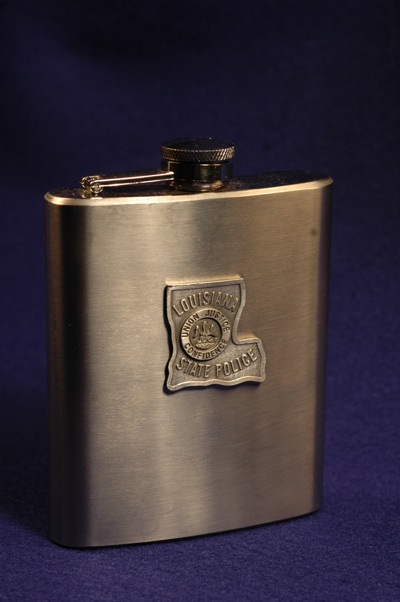
Here’s a good idea: do a video presentation of LSTA parties and post a photo of the liquor flask (I’m sorry, “pocket canteen”) sold by LSTA (complete with Louisiana State Police logo) on your Web page.

And be sure to emphasize how you support MADD in its efforts to curtail drunk driving.

And post those letters to the four retirees (including Millet) who you kicked out of the LSTA because they had the unmitigated gall to question those political contributions.

And tell us again how you want to keep civil service protection while at the same time be allowed to continue to make political campaign contributions.

And Mr. Falcon, Mr. Young, and Mr. Jay O’Quinn (LSTA President) please tell us again, the way you testified on Thursday, how, if the new rule prohibiting campaign contributions goes through, the LSTA will “cease to exist,” because truthfully, we’re in agreement with retired state trooper Jerry Patrick who asked: why, when for decades, LSTA made no political campaign contributions, it didn’t collapse then?

And Mr. Falcon, please enlighten us as to why, as you claimed Thursday, the LSTA “is no different than the Louisiana Sheriffs’ Association.” Because to us, the difference is quite plain. Sheriffs and their deputies are not classified (civil service) employees. State troopers, by contrast, most certainly are.

(Video of Millet-Falcon confrontation and link to dismissal of investigation courtesy of Robert Burns, who covered the commission meeting while I was taking physical therapy for a torn rotator cuff.)


Read Full Post »

By Stephen Winham, guest columnist

Caveat:  I worked closely with Buddy Roemer as state budget director.  I have only the barest of acquaintances with John Bel Edwards. For this reason, I must question how fair my comparison of the two can be.  I admit I am disappointed in John Bel Edwards’ performance as governor to date and have admired Roemer’s efforts even more with the passage of time.

As he assumed office as governor of Louisiana thirty years ago, Buddy Roemer faced a huge budget gap left by his predecessor. The solution was difficult and was complicated by a recalcitrant legislature.  The gap was closed, and a surplus generated within the first year of Roemer’s administration.  In addition, comprehensive budget reforms were enacted to limit the probability of a recurrence of such a gap.

A similar scenario confronted John Bel Edwards 28 years later, yet two years into his administration he has made no real progress on the budget front in terms of balance or reforms.  Roemer and Edwards are very different people and the opposition to their administrations have different roots.

Roemer was, and continues to be a true reformer.  He had little regard, until it was too late, for his gubernatorial re-election chances.  Edwards seems to have been running for re-election from the first day of his administration.  Roemer attempted to buck the system.  Edwards tries to work within it.  They were both elected as Democrats.

Roemer and JBE were improbable victors in their races for governor.  Roemer came from last in the polls to the top (albeit by only 3 points) going into the 1987 primary election.  He won the general election with only 33% of the vote.  His closest competitor was fellow Democrat and three-term governor, Edwin Washington Edwards.  EWE conceded the race rather than face Roemer in a run-off – and denied him an electoral mandate.

JBE was considered a dark horse candidate from the beginning. The only major Democrat in his gubernatorial race, John Bel Edwards finished first in the primary election with 39.9% of the vote. He was expected to lose to his Republican opponent, U. S. Senator David Vitter, in the general election. Despite Vitter’s 23% showing in the primary election, and his personal problems, he was considered a sure winner in the run-off.  To the surprise of most political analysts, JBE won with 56.1% of the vote.

Roemer and JBE were each elected because people were looking for something dramatically different.   Roemer promised to “slay the dragon” and end corruption and special interest control over government.  JBE vowed to bring common sense, fiscal responsibility, and compassion for ordinary people to the office.  Roemer was strident, JBE is calm.

Governors are not dictators.  There is little they can do without action by the legislature and consent, when needed, of the judiciary.  Despite his lack of an electoral mandate, Roemer was able to quickly get a lot of good legislation enacted, mainly because the need was abundantly and undeniably clear – and he was a convenient scapegoat if things went wrong later.   A strong contingent of legislators were loyal to Edwin Edwards and bitter that he was not still governor.  While they went along with the emergency measures Roemer proposed to address the fiscal emergency and reforms including the creation of an official revenue forecast by a new Revenue Estimating Conference, opposition intensified over time.

Historically, Louisiana’s governors were powerful enough to anoint legislative leaders – an obvious plus for enacting an agenda.  The most powerful of those leaders are the house speaker and senate president. The senate is, by its size and nature, a more powerful and cohesive body than the house.  In the middle of Roemer’s term, the senate dealt him a severe blow by replacing his chosen president and returning EWE’s powerful senate president, Sammy Nunez, to that office – an office he continued to hold until he left the legislature in 1996.

Roemer proposed several progressive tax increases that failed in the legislature and the electorate, including a decrease in the sacrosanct homestead exemption.  It is no small irony that he eventually agreed with EWE’s earlier push to legalize gambling and supported an even broader entry into that sector –  the lottery, riverboat casinos, and video poker.

Roemer steadily lost political power as his term went on.  Despite pushing for and achieving hundreds of millions in teacher pay raises, he was vilified because he also pushed a teacher accountability program roundly criticized as unfair by teachers. His environmental reforms angered oil and gas, chemical, and other industries.  He was increasingly perceived as arrogant and hard to work with.

Anxious for EWE’s return, his supporters became even harsher in their opposition to Roemer’s administration.  In 1990, on the grounds it violated federal law, he vetoed a bill passed by the legislature that banned abortion even in cases of rape and incest.  The legislature overrode his veto (a very rare event in Louisiana).  The law was struck down by a U. S. District Court in 1991 for the very reason Roemer had vetoed it, but it didn’t matter politically.

In 1991, Roemer switched parties.  While the national Republican Party sent in big guns to help him get re-elected, emphasizing his scandal-free administration and his budgetary, campaign finance and environmental reforms, he never had the support of the state Republican Party, very many legislators, or the special interests he had disdained.  Quite the contrary. The state party endorsed another candidate and legislators and special interests actively attacked Roemer. It didn’t help that Roemer did not really focus on the campaign but rather continued his zeal for reform to the end. He finished 3rd in the primary and endorsed EWE in the runoff with David Duke – an embarrassing race.  He ran again in 1995 as a conservative Republican but ran 4th in the primary.

His high school’s class valedictorian, like Roemer, and a West Point graduate, versus Roemer’s Harvard education, John Bel Edwards was a conventional, but conservative Democrat.  He is the son of a southeast Louisiana sheriff, Roemer the son of a northwest Louisiana plantation owner. Like Roemer, his biggest obstacle has been the legislature, but for somewhat different reasons.

Louisiana now has a strong Republican Party that believes we should have a Republican governor.  Partisanship was not a big issue when Roemer was governor, but it certainly is now and has gotten more so since JBE became governor in 2016.  Although he had a solid record as a Democratic state representative, what seems to matter most is that he is a Democrat.  Not only do Republicans now control both houses of the legislature, but all statewide elected officials except the governor are now Republicans.  Regaining the governor’s office is a number one priority of the party and since John Bel Edwards has been running for re-election from day one he presents an easy target.

The state house of representatives openly rejected JBE’s choice for speaker.  Rather than elect one of his harshest critics (Cameron Henry who withdrew from consideration), they chose a compromise candidate, the low-key Taylor Barras – who had not even been mentioned as a contender before he was elected.  Not since Huey Long’s administration had the state house elected a speaker not endorsed by the governor, though as noted above, the state senate did unseat Roemer’s chosen president.

Nobody doubted we had a severe fiscal problem when Roemer was elected, but many would argue that we simply spend too much money today – end of story.  JBE’s Republican opposition relishes reports of waste and abuse in the media and remains unconvinced he has done enough to address them.  The governor has not specifically answered the charge he does not do enough to hold his appointees accountable for fiscal irresponsibility unless the media is relentless in reporting it.  This has not helped his case for more revenue.

JBE has proposed both revenue measures and cuts.  However, his proposals are often open to widespread criticism.  When he recommends cuts, they are dramatic and are not presented in such a way that the legislature or public believes they are the only, or the best, ways to cut the budget.  They do not seem to explicitly address the waste and abuse people read about on LouisianaVoice, in the newspapers, and see reported on television.

On the revenue side, JBE did not initially focus on proposals by the task force specifically created to present options for dealing with the “fiscal Cliff.”  That cliff has been forestalled by two years of temporary taxes. The centerpiece of JBE’s revenue proposal last year was the previously unheard of and dead on arrival Commercial Activity Tax.  The CAT constituted over 60 percent of his original package and was so watered down by the time it was actually introduced, it lost what little value it had and was quickly withdrawn.

Another year has passed, and the governor has proposed revenues more in line with what the task force recommended.  The cuts he has recommended are devastating.  His critics in the legislature don’t really like anything he puts forth and as the next election gets closer the criticism is sure to get harsher.

The governor has asked the legislature to present and enact its own proposals if it doesn’t like his.  The legislature has responded by recommending an accountability system and little else.  The proposed system seems to have been presented as a distraction from the need for immediate, concrete, and sustainable solutions.

Let’s face it.  There is nothing new under the sun.  Our fiscal status and options have been studied dozens of times over dozens of years.   The governor can recommend things all day every day, but only the legislature has the power to enact measures to authorize them.  Whether the governor has made truly responsible proposals or not, it is ultimately the legislature’s responsibility to act.  They can blame the governor ad infinitum, but the final responsibility is theirs and the excuse they don’t know enough to come up with solutions is a patently empty claim.

Roemer was able to get a lot done through the legislature in his first year when he had his best chance to do so.  JBE’s chances of significant accomplishments will apparently continue to diminish with time.  Even with the help of the most powerful and long-serving member of the legislature, Senate President John Alario, he has been unable to succeed.  A bloc of opposition in the house stymies him repeatedly.

I am of the considered opinion that we could all save a lot of time, grief, and money by simply agreeing, right now, to make permanent the temporary sales taxes currently in effect, cut as necessary for the difference, and hope for a better, more responsible future under new leadership.  A fool’s hope, perhaps, but at least everybody would be able to make plans for more than a year or two into the future – individuals and businesses.

LABI and other business interests are hypercritical of JBE and, of course, any business taxation.  In the absence of sustainable solutions how can they possibly expect vigorous business expansion and prosperity?  Future taxes are unpredictable, regardless of temporary incentives. How can they, or we, have hope our mediocre infrastructure, educational system, and other public services will not continue to decline?

Trying to ruffle as few feathers as possible in hope of re-election has not worked for JBE.  Ruffling as many feathers as possible may not have worked over time for Roemer, but we are still profiting from major accomplishments in his first few years.  He wasn’t a good politician and maybe that’s why he never got the credit he deserved.

Whether JBE is a good politician remains to be seen.


Read Full Post »

« Newer Posts


