Feeds:
Posts
Comments

Archive for November, 2017

Louisiana State Police (LSP) has suspended three State Troopers and shut down a cooperative program with 44 parishes from Webster to Jefferson, from Calcasieu to East Carroll following a months-long investigation by New Orleans television reporter Lee Zurik that revealed the troopers were paid hundreds of thousands of dollars in overtime they may not have actually worked.

The action to shut down Local Agency Compensated Enforcement (LACE), a program in which state police are paid to conduct traffic patrol for local district attorneys, came after Zurik and New Orleans FOX 8 TV station surveillance found that troopers were in their homes much of the time for which they were being paid for doing patrol.

State Police Superintendent Col. Kevin Reeves, immediately upon learning of the Zurik findings, ordered the SUSPENSION OF THE LACE PROGRAM and also ordered a criminal investigation into what could ultimately be determined as payroll fraud.

Under the program, local district attorneys contract with LSP for the patrols. The parish keeps all fines written by the troopers and reimburses LSP for troopers’ overtime salaries.

The three troopers who were suspended, all from Southeast Louisiana and New Orleans, combined to receive some $340,000 in LACE payments. The three troopers who were suspended, their salaries, their years of service, and their LACE payments over the past year, in parenthesis, include:

  • Master Trooper Daryl J. Thomas, a veteran of 22 years earning $89,300 ($150,000 in LACE payments);
  • Hazmat Specialist Eric Curlee, 19 years with LSP earning $99,800 ($100,000 LACE);
  • Byron G. Sims, polygraphist, 22 years with LSP, earning $109,000 ($90,000 LACE).

A fourth trooper under investigation is already out on sick leave and has not been suspended as yet. Because he has not yet been suspended, his name was not immediately available.

LouisianaVoice revealed in August that former Louisiana State Police Commission (LSPC) member Monica Manzella, as part of her duties as an assistant city attorney for the City of New Orleans, signed off on LACE contracts between the city and LSP but she signed the contracts before being appointed to LSPC and she had no additional oversight responsibilities.

A retired State Trooper said that abuse of the LACE program is not restricted to the New Orleans area and that “there are dozens of troopers out there who have been less than honest on their LACE timesheets. And it’s been going on for years,” he said.

A 29-page report by the State Office of Inspector General in 2010 would seem to back up that claim. The REPORT, dated April 27, 2010, examined overtime for employees of both LSP and the Department of Health and Hospitals. It said that as much as 30 percent of all LSP overtime in 2008 could be attributed to LACE. Even then, it was noted that one trooper earned more than $80,000 in overtime pay.

A story by LouisianaVoice on Dec. 15, 2015, revealed that Trooper JIMMY ROGERS (now retired) was disciplined by former State Police Superintendent Mike Edmonson in 2010 to a 240-hour reduction in pay for 30 pay periods (60 weeks), representing a penalty of more than $4,800. But on Nov. 13, 2015, it was revealed by then-Lt. Col. Charles Dupuy that Rogers was allowed to make up for the suspension by working LACE patrol.

Dupuy said in his letter to then-Troop D Commander Capt. Chris Guillory that from Jan. 6, 2011, to Aug. 9, 2011, “Trooper Rogers worked 16 LACE overtime details in violation of (policy) in effect at that time.”

Guillory told Internal Affairs investigators he was unaware of the policy and that he failed to inform Rogers’s immediate supervisor that Rogers was serving a disciplinary action.

LSP Public Information Officer Doug Cain told LouisianaVoice that subsequent to Zurik’s revelation of his findings, State Police Superintendent Col. Kevin Reeves immediately ordered the criminal investigation and the statewide shutdown of LACE.

Cain said there are three steps to the investigation. First, there will be the criminal investigation, followed by an Internal Affairs investigation. Following the IA investigation’s report, an administrative investigation would be conducted and a decision made on disciplinary action against those involved. A decision will be made on reinstatement of the LACE program pending the outcome of the department’s evaluation of the program.

“We hope to re-start the program at some point,” he said.

Unfortunately, the latest revelations by Zurik are nothing new and that this type of payroll chicanery has been going on for years.

The story of payroll fraud by some LSP Troopers is old news. It has been reported time and time again but no action is taken until the press gets wind of it. Zurik is to be commended for his dedication by conducting a surveillance operation. LSP has yet to learn that Lee did exactly what LSP should have been doing all along.

Any Trooper that spends his time at home while he is supposed to be working can only accomplish that feat with the tacit or purposeful approval of supervision. LSP has yet to hold a single supervisor accountable for failure to supervise troopers who write their set number of tickets (quota) and go home.

Let’s look back at Troop D. There were two troopers who were allowed to resign amid similar accusations. Their supervisors faced zero punishment for the actions they allowed. The common denominator of the two troopers was shift Lieutenant Paul Brady of Beauregard Parish. He supervised both Jimmy Rogers and RONNIE PICOU.

Picou was initially terminated, later allowed to resign, after an investigation revealed massive absences from his shift to include 50 shifts with no work product. LSP failed to even address the partial absences from duty. Troopers anonymously reported Picou for his actions. The response was to give the investigation over to his friends, Capt. Chris Guillory and now retired Lt. Jim Jacobsen.

Guillory cleared Picou and doubled down by allowing him to continue with his practice of writing an assigned number of citations and taking the remainder of the shift off. Brady replaced Jacobsen as the supervisor for Picou upon Jacobsen’s retirement. Picou was finally terminated after public records requests by LouisianaVoice. LSP could have surveilled Picou just as Zurik did but chose to not to. The internal investigation files showed Picou was committing payroll fraud but he was never held accountable for his actions. Nor was Brady.

Jimmy Rogers resigned suddenly after allegations of payroll fraud involving LACE. A trooper who worked with Rogers informed LouisianaVoice that Rogers did exactly what the troopers who are now under investigation did. He wrote his assigned number of citations and took the rest of the shift off. Rogers allegedly took it a step further by writing LACE citations on regular state funded shift and claimed them as overtime. This is more egregious than what Zurik has discovered. Rogers was allowed to resign.

There were efforts to obtain the investigation files on Roger’s departure from LSP. LSP has enthusiastically kept them from public view. An audit of radio logs, LACE citations, and dash cam videos will confirm that Roger’s conduct was more egregious than what Lee Zurik has discovered. We think it is time that LSP held former Trooper Rogers accountable for his actions. The statute of limitations has yet to expire on felony crimes. Picou’s supervisor, Paul Brady was not punished, according to our public records requests.

When it comes to investigating payroll fraud, LSP appears to be incapable or unwilling—or at least so it seemed under Edmonson’s and Secretary of Public Safety and Corrections Jimmy LeBlanc’s leadership. The media seemed to figure it out. When a crime is committed, do an investigation. That investigation might include surveilling the target of the investigation. It seems that investigatory prowess is lost when investigating their own.

One thing seems certain: Reeves did not deserve the mess he inherited from Edmonson.
Read Full Post »

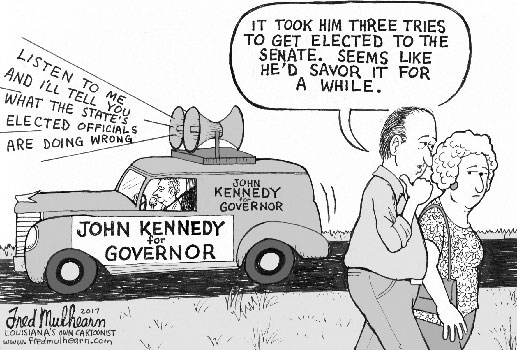
(Thanks to Fred Mulhearn)

Read Full Post »

New Orleans native Donna Brazile has created quite a stir over her new book Hacks: The Inside Story of the Break-ins and Breakdowns that Put Donald Trump in the White House. But her description of the infighting in the national Democratic Party is mirrored at least in part on a local scale by what has been transpiring in the Louisiana Democratic Party since State Sen. Karen Carter Peterson ousted Buddy Leach as State Chairman in 2012.

Brazile, in her book, described how candidate Hillary Clinton took over the Democratic National Committee’s funding during the primary season while still competing with Sen. Bernie Sanders for the Democratic nomination for President. By gaining control of the party’s finances, Brazile said, Clinton effectively rigged the process to kill whatever chance Sanders may have had to win the nomination.

But paralleling the infighting that developed between followers of Hillary and Sanders, the Louisiana Democratic Party appears to have fallen into its own state of considerable disarray on Peterson’s watch. And its problems, like that of the DNC, can be traced back to money and power.

Back room deals, endorsements, and questionable expenditures in the recent campaign for state treasurer have raised a number of questions. For example:

  • Is State Sen. Neil Riser truly a Republican?
  • If so, why did he lavish money on traditionally Democratic organizations like the Black Organization for Leadership Development (BOLD), THE New Orleans East Leadership PAC, New Orleans East Leadership PAC, Louisiana Independent Federation of Electors, Algiers PAC, Jefferson United, and Treme Improvement Political Society in his campaign for state treasurer?
  • Are the aforementioned actually Democratic organizations or are they simply a means to raising money in exchange for the endorsement of the highest bidder?
  • If they are Democratic organizations, why didn’t they endorse Democrat Derrick Edwards in the first primary instead of waiting until Riser lost—he finished dead last among the four major candidates—to direct their support to Edwards?

BOLD’s open bidding policy pre-dates Peterson. In 2003, the organization endorsed Bobby Jindal over Kathleen Blanco for governor. Of course, that was after Jindal paid BOLD $10,000 for “consulting and printing.”

During his campaign, Riser’s expenditures included $15,000 to BOLD for printing (BOLD, which Peterson’s dad, Ken Carter, co-founded, subsequently listed Riser at the top of its sample ballots), $14.500 in two contributions to New Orleans East Leadership PAC, a $10,000 contribution to the Louisiana Independent Federation of Electors, $6,000 to Algiers PAC for printing, $5,000 to Jefferson United for undetermined expenses, $5,000 to Treme Improvement Political Society.

But the treasurer’s race is merely symptomatic of a far greater problem within the State Democratic Party.

One of Peterson’s first acts as the new State Chairperson in 2012 was to nullify all parish executive committee appointments made during Leach’s tenure. And it’s been downhill ever since.

In an organization that is perpetually financially strapped, the Executive Committee, once stacked with her appointees, awarded her an annual stipend of $36,000 plus expenses. This was done without the approval of the Democratic State Central Committee, most of whom were unaware of the stipend. She has continued taking the money in her second term, again without approval.

Stephen Handwerk, Executive Director of the State Democratic Party, pulls down nearly $100,000 in salary but he has been reluctant to make use of an available database to identify and engage Democratic voters, claiming he has insufficient staff to do so. Yet, he found the time to take a second salaried job with the Democratic National Committee, according to DNC expense reports.

Peterson also has made it a point to take care of family in her role as chairperson. Her sister, Eileen Carter, of Houma, was paid $13,000 during October and November 2015 for “organizational/grassroots consultation,” according to figures provided by the Louisiana Ethics Commission.

Other payments made by the Louisiana Democratic Party under Peterson include:

  • Twelve payments of $600 each to the Chicken Shack of Baton Rouge for party card distribution and catering. Chicken Shack is a business owned by former State Sen. Joe Delpit of Baton Rouge.
  • Four separate payments of $900 each to J&M Transportation of Slidell for state party card distribution. J&M is a limousine service.

Peterson denies being among the three prominent Democrats (including then-Sen. Mary Landrieu) who met with then-State. Rep. John Bel Edwards at New Orleans International Airport in 2015 and tried to convince him to withdraw from the governor’s race so that a moderate Republican might be elected. Landrieu has since apologized for her part in that effort but Peterson has not.

Peterson also threw up roadblocks to the State Democratic Party’s official endorsement of Derrick Edwards (no relation to Gov. John Bel Edwards) for treasurer until after the first primary, in which Edwards led all candidates as the only Democrat in the race.

According to the State Democratic Party’s by-laws, “The Democratic State Central Committee (DSCC) shall conduct such activities, as it deems appropriate to elect Democratic candidates in national, state and local elections.”

Yet, there was Republican Riser’s name at the top of BOLD’s sample ballots which most likely accounts for Peterson’s reluctance to endorse Edwards at the outset.

Gov. John Bel Edwards, despite Peterson’s attempt to get him to drop out of the gubernatorial race, has been loath to support a replacement for her for fear of alienating the Legislative Black Caucus.

But the biggest concern to several Democratic Parish Executive Committee (DPEC) members is the lack of membership on no fewer than 29 parish executive committees, a condition critics attribute to Peterson’s lack of timely appointments.

“There are 29 parishes which have five or fewer members on their committee,” one DPEC member said. “There should be at least 15 members of each parish executive committee. That’s nearly half the state that has non-existent or non-functioning DPECs. Livingston Parish has only seven of 15 seats filled. One member of the Livingston DPEC has been working since February to get the seats filled but that still hasn’t been done even though names have been submitted.”

And nearly two years into Peterson’s second term as state chairperson, there are 33 DSCC vacancies. “If she fills positions at all, it’s usually with her minions,” one DSCC member said.

Parishes with one or more vacancies in DSCC representation include Caddo, Bossier, DeSoto, Sabine, Lincoln, Union, Ouachita, Iberville, Pointe Coupee, West Baton Rouge, West Feliciana, Caldwell, Catahoula, Franklin, LaSalle, Tensas, Concordia, East Carroll, Madison, Tensas, Rapides, Lafayette, Vermilion, Calcasieu, Acadia, Iberia, St. Martin, East Baton Rouge, Livingston, Tangipahoa, Washington, St. Tammany, and Jefferson.

Meanwhile, Peterson in March of this year managed to get herself elected to the DNC as Vice Chair of Civic Engagement and Voter Participation. “How ironic is that?” the DSCC member asked.

“Karen Carter Peterson is an ambitious politician of questionable loyalties who has used her chairmanship of DSCC to build a fiefdom and to launch a national career, all at the expense of the organization she was elected to build and serve,” the DSCC member said.

Read Full Post »

A three-judge panel of the First Circuit Court of Appeal in Baton Rouge has scheduled arguments for Tuesday in the state’s appeal of a DECISION by a 19th Judicial District Court judge last March that knocked down much of the Jindal administration’s arbitrary rule changes in the approval of medical treatment for state employees injured on the job.

The decision was another in a long line of “reform” movements by Jindal—and pushed by the American Legislative Exchange Council (ALEC)—that were subsequently found to be unconstitutional or simply fell apart. Some of those included public education funding, group medical coverage for state employees, public-private partnerships in the operation of state hospitals, prison privatizations and tax proposals.

In his March 30 seven-page REASONS for JUDGMENT that followed a Feb. 7 bench trial, District Judge Don Johnson noted that:

Because the legislature did not authorize OWC to create a new rule creating a “tacit denial” when the provider simply ignores a request for treatment, “the Office of Workers Compensation exceeded its legislative authority as (it) lacks the authority to create and implement procedural regulations that authorize the ‘tacit denial of requested medical treatment which is statutorily obligated to the injured worker by the employer pursuant to (state statute).”

Johnson also found that OWC promulgated rules requiring injured workers to meet a higher burden than the state statute for any variance in an injured worker’s treatment schedule are “vague and the regulations are arbitrary, denying injured workers’ medical treatment that Louisiana employers are statutorily obligated to provide…”

Johnson also found that the “scheme” for determining whether an injured worker can receive medical treatment outside the Louisiana medical treatment guidelines (MTG) “is unduly burdensome.”

Special Assistant to the Director Carey Holliday testified that he was hired to help “bring the judges into conformity,” according to the answer to the state’s appeal filed by attorney J. Arthur Smith III on behalf of several plaintiffs. Holiday did that by implementing judicial performance evaluations. While he acknowledged he could not tell judges how to rule, he could “put them together and let them talk” and that “there will be some conformity…to come out of that,” Smith said in his answer.

The most damning revelation to come out of last February’s trial was testimony of improper Ex Parte communication between insurance carriers and defense attorneys about the merits of injury claims pending before OWC judges. Those communications were usually in the form of emails.

For example, one such email from a workers’ compensation defense attorney to former OWC Director Wes Hataway, Holliday, and the OWC chief judge contained complaints that one judge had ruled against an employer. The email went on to say of the judge, “He should be fired immediately,” and implied that the judge’s skills were less than those of a first-year law student. “He will do as he pleases no matter what,” the email said. “If this isn’t grounds to fire a judge, I don’t know what is.” The defense attorney ended his email by saying, “I think it’s time for the W.C. judges to become accountable for their actions.”

Judge Johnson took a dim view of this disregard for judicial independence by the 2011 decision to remove of the decision-making authority of the OWC judges and place it in the hands of the OWC Medical Director, Dr. Christopher Rich.

Johnson ruled that OWC “has violated the separation of powers doctrine by compromising judicial independence” by giving unpreceded powers to Dr. Rich, who was awarded a $500,000 contract to serve as medical director.

Rich, if nothing else, is consistent. Previously involved in ethical problems with another state contract, LouisianaVoice wrote about an apparent conflict of interest. In March 2011, the State Ethics Board ruled that he was prohibited, in his capacity as Medical director of OWC from participating in any matter involving Central Louisiana Surgical Hospital, a facility in which he owned an interest and which provided medical treatment to injured workers.

As OWC Medical Director, he could deny coverage to a state employee and then refer the employee to Central Louisiana Surgical Hospital for private treatment.

And did he ever deny coverage to state employees once ensconced as medical director. He even testified in February that he ignored the clinical judgment of treating physicians, even specialists, giving no weight to the recommendations of treating physicians. Moreover, according to his own testimony, he never examined an injured worker even though he made the final decision on what, if any, medical treatment the employee would receive. He even overruled a neurosurgeon’s recommendation that an employee undergo a cervical fusion because he, Rich, did not deem it necessary.

Attorney Janice Valois Barber testified in February that Rich had denied 100 percent of her clients’ requests for medical treatment variances. Dr. John Logan also testified by deposition that 100 percent of his variances likewise had been denied by Dr. Rich. Dr. Logan said that many of his patients simply gave up, knowing they would never get approval for the medical treatment they needed.

Dr. Pierce Nunley testified that he performs spinal surgery on almost a daily basis. He said he has attempted to contact Dr. Rich regarding Rich’s repeated refusals of request for treatments that vary from the MTG but was never able to get through to Rich nor did Rich return his calls.

So now, the state is continuing to pour good money after bad by appealing the decision of the lower court in an effort to uphold what was—and is—a very bad policy in dealing with people’s lives.

To us, it doesn’t seem quite right that one man, who never even once examined a patient would deny 100 percent of all requests for variances in the normal medical treatment guidelines. Surely there were a couple of valid claims in all of that.

But by consistently rejecting each and every claim, Dr. Rich was enforcing the Bobby Jindal code of justice and fair play.

It might be fine for Jindal to sell his books to his foundation in order to divert money from his non-profit into his pockets but no injured worker had a right to receive treatment for his injuries.

It might be fine for a legislator to lease luxury automobiles, pay ethics fines or even income taxes from campaign funds or for legislators to place relatives in state employment, but we just can’t have judges giving these deadbeat state employees a decent break.

And why not? The money-sucking appeals aren’t costing elected officials and bureaucrats anything. The tab is being picked by those clueless taxpayers. And besides, the state has plenty money.

The three-judge panel hearing the case includes appeal court judges John Michael Guidry, John T. Pettigrew and William J. Crain.


Read Full Post »

To little surprise to anyone paying attention, Louisiana is one of the most violent states in the nation, according to 24/7 Wall Street, a digital business news service that releases articles on studies of economic, industry, marketing political, and crime statistics.

Of even more concern than Louisiana’s ranking as the 5th most violent state, was the city of Monroe’s ranking as the most violent metropolitan area in the nation with 1,187 violent crimes for every 100,000 people. That was more than double the state rate of 566 violent crimes per 100,000 population.

While the precise cause of the increase in violent crime was not clear, poverty was given as a possible explanation. While 14 percent of Americans live below the poverty line, seven of the 10 states with the highest violent crime rate have higher poverty rates than the nation as a whole.

Alaska, with 804 violent crimes per 100,000, was the most violent state, according to the news release but that ranking can be misleading because of Alaska’s relatively small population. For example, the 52 murders statewide in 2016 was 12th fewest in the nation but because of the sparse population, the impact on the murder rate was greater than for a heavily populated area. The state’s imprisonment rate of 409 adults per 100,000 was 16th lowest and the state’s poverty rate of 9.9 percent was 6th lowest.

By contrast, Louisiana had 554 murders during 2016, which was 11th highest in the nation and more than 10 times as many as Alaska. Likewise, the state’s imprisonment rate of 1,019 adults per 100,000 was the highest in the nation (the only state whose imprisonment rate exceeds 1,000—a rating the state has held for a number of years. Oklahoma is close behind with 948 per 100,000. Louisiana’s poverty rate of 20.2 percent is 2nd highest in the nation.

Other states that had higher violent crime rates than Louisiana, in order, were:

  • New Mexico: 703 violent crimes per 100,000; 139 murders (22nd fewest), imprisonment rate of 440 adults per 100,000 (20th lowest), and a poverty rate of 19.8 percent (3rd highest).
  • Nevada: 678 violent crimes per 100,000; 224 murders (25th most); imprisonment rate of 577 adults per 100,000 (15th highest), and a poverty rate of 13.8 percent (23rd highest).
  • Tennessee: 633 violent crimes per 100,000; 486 murders (13th highest), imprisonment rate of 549 adults per 100,000 (18th highest), and a poverty rate of 15.8 percent (11th highest).

Right behind Louisiana were:

  • Arkansas, with 551 violent crimes per 100,000 (6th most violent), 216 murders (25th fewest), an imprisonment rate of 774 per 100,000 (6th highest), and a poverty rate of 17.2 percent (also 6th highest).
  • Alabama, with 532 violent crimes per 100,000 (7th most violent), 407 murders (17th most), imprisonment rate of 790 per 100,000 (4th highest), and a poverty rate of 17.1 percent (7th highest).

Mississippi, which is almost always clustered with Louisiana, Alabama, and Arkansas in such polls, defied the odds on this one, coming in with only 281 violent crimes per 100,000, which was 24th lowest. Its 238 murders, however, were 23rd most. Mississippi’s imprisonment rate of 803 per 100,000 was 3rd highest, and its poverty rate of 20.8 percent was highest in the nation.

Typically, such poll results are met with the “oh, well, this is Louisiana” reaction.

While such comments are, unfortunately, accurate, it is far past the time when we should simply yawn, laugh, and move on to LSU football, crawfish boils or some other distraction.

The only ones who are impacted by these types of results are all of us.

And the only ones who can change these studies are us.

Until we call a screeching halt to allowing LABI, the Louisiana Oil & Gas Association, nursing homes, pharmaceutical companies and banks to dictate the agenda for compliant legislators, things are never going to change. We are going to have to hold our elected officials accountable.

As things are now—and as it has been for decades—legislators are outnumbered by lobbyists by more than 10-1. It’s pretty overwhelming when you have more than 1500 lobbyists swarming around the House and Senate and the various committee rooms.

What’s more disheartening is the lobbyists are paid well to do thorough research and can regurgitate impressive sounding statistical data to legislators while members of the public who will be affected by a particular bill—and who do not have the advantage of a paid research staff—generally fall back on emotional arguments that legislators are unable to hear because of campaign cash stuffed in their ears. This creates an uneven playing field.

It is incumbent, therefore, that the citizenry educate itself on the legislative process. In today’s age of the Internet, it’s so very easy to track bills through committee and to even monitor committee meetings in real time through the legislature’s web page.

So, bottom line, we have no one to blame but ourselves for our state’s pathetic standings in areas that affect our quality of life—from income to crime to education to employment to our overall health.

To sit back and trust elected officials is to make a tragic mistake, as history has clearly shown. Many of these officials are power brokers who serve as important committee chairs and as Senate President and House Speaker. We simply cannot trust them as they long ago established a tradition of ignoring the wishes of the people and acting  not in our best interests but in the interests of campaign contributors—and far too often, to their own financial gain.

To continue to ignore the problem is to continue to settle for the status quo. LouisianaVoice has shown through the years that many of these elected officials are there only to build their own political base, to enrich themselves, to award family members with state jobs with little responsibility, and, or course, to collect campaign contributions to perpetuate their own tenure in office. Those were not among the reasons we sent them to Baton Rouge.

Until that mental approach on the part of our citizens is changed, nothing else will. We will always be at the bottom of those lists and we will continue voice our frustration only when LSU loses to Alabama.


Read Full Post »

« Newer Posts - Older Posts »


