Feeds:
Posts
Comments

Archive for November, 2016

The Republican governor of Nevada has done what Bobby Jindal for eight interminable years refused to do and what Gov. John Bel Edwards should have already done.

Gov. Brian Sandoval, saying, “There’s something not right here and it needs to be fixed,” ordered Nevada’s state dental board on Nov.8 to address—and fix—problems of corruption, bullying and extortion rampant in the board’s patient-complaint/resolution process.

A STORY in the Las Vegas Review-Journal sounded eerily familiar to a number of LouisianaVoice stories dating back to March 2014 about abuses perpetrated by the Louisiana State Board of Dentistry through harassment, intimidation, and exorbitant penalties—including ruined careers—for minor infractions and sometimes none at all.

https://louisianavoice.com/2014/03/07/state-board-employs-intimidation-harassment-to-generate-funds-to-pay-for-lucrative-contracts-worth-millions-of-dollars/

https://louisianavoice.com/2016/03/18/like-dental-board-louisiana-board-of-medical-examiners-survives-on-fines-and-incentive-to-punish/

https://louisianavoice.com/2014/03/23/appeal-court-slams-lsdb-tactics-in-reversing-kangaroo-court-license-revocation-board-attorney-rules-on-his-own-objection/

And should Edwards take it upon himself to rein in the rogue dental board, he may well also wish to take a long hard look at a few other boards that have gone off the reservation over the years.

  • Here are just a few that warrant a closer look:
  • The State Board of Cosmetology;
  • The Auctioneers Licensing Board;
  • The State Board of Medical Examiners;
  • The State Board of Examiners of Psychologists

Each of these boards has been the subject of considerable controversy over the manner in which they investigate complaints and assess penalties without giving their targets the benefit of the same due process to which accused criminals are entitled under 14th Amendment to the U.S. Constitution.

Several dentists and dental hygienists protested a $500,000 increase in the contract for the Nevada dental board’s outside legal counsel, John Hunt and their testimony quickly escalated to shouting a crying by those who said Hunt coerced them to acknowledge wrongdoing and to pay money to the dental board.

Several of them accused Hunt of benefitting from money collected by the board.

As we said earlier, eerily familiar.

https://louisianavoice.com/2015/11/16/dentistry-board-facing-difficult-future-because-of-policies-contracts-with-attorney-private-investigator-are-cancelled/

At least in Nevada, complaints by victims of the dental board led to action.

A legislative audit of the board concluded that the board imposed excessive penalties on those it was investigating and also took issue with the board’s handling of Hunt’s contract. The board’s handling of patient complaints, it said, left targets of investigations with the belief that they either had to accept a settlement agreement or risk steeper punishment if found guilty in a final board hearing.

“That’s where the allegation of extortion comes in,” State Assemblyman Glenn Trowbridge, a member of the subcommittee that conducted the audit, said in June. “Either pay me now or we’ll look into it deeper and you’ll pay me more.”

Again…eerily familiar.

https://louisianavoice.com/2016/07/18/case-of-slidell-dentist-illustrates-unbridled-power-of-dentistry-board-to-destroy-careers-for-sake-of-money/

Sandoval appoints the members of the dental board. He said the time has come for the 11-member board to address the problem. Citing his experience with other state boards during his political career, he said, “I’ve never seen …people as upset as they are.”

The board, following Sandoval’s scolding, postponed action on Hunt’s contract amendment.

1980 U.S. Supreme Court specifically addressed the issue of excessive penalties in the case of U.S. Secretary of Labor v. Jerrico, Inc.

In that case, the Supreme Court reduced a $103,000 penalty to $18,000 in that the higher penalty constituted an unconstitutional risk of bringing “impermissible factors into the prosecutorial decision.”

In an earlier, even more pointed decision, the Supreme Court ruled in 1973 that “board members’ pecuniary interest disqualified them from passing on issues.”

In citing an Alabama case in which the Board of Optometry revoked the licenses of all optometrists employed by corporations such as Lee Optical, the court said, “Because the Board of Optometry was composed solely of optometrists in private practice for their own account, the District Court concluded that success in the board’s efforts would possibly (contribute) to the personal benefit of members of the board, sufficiently so that in the opinion of the District Court, the Board was disqualified from hearing the charges filed against the appellees.

“It is sufficiently clear from our cases,” the court continued, “that those with substantial pecuniary interest in legal proceedings should not adjudicate these disputes.”

As simple to understand as that ruling is, one must wonder why, 43 years later, the Louisiana Board of Dentistry and other licensing boards in the State of Louisiana are still allowed to operate their own respective fiefdoms with carte blanche.

Are their legal counsels not able to read and understand the law?

Is there not a single board member among them with the decency to say, “This isn’t right”?
Read Full Post »

This is a story with no readily apparent good guys.

It’s a story about charges of theft of heavy equipment.

It’s a story about thousands of dollars floating around unaccounted for by public officials.

It’s the story of the attorney general’s office abruptly halting a confrontational deposition.

It’s a story about a Baton Rouge judge having the decency and courage to impose (finally) a stiff financial penalty against a state agency over the agency’s failure to complete the deposition or to produce legally required public records.

It’s a story of how the superintendent of State Police was unable to account for the receipt of two checks totaling nearly $150,000 and how the state attorney general’s office and its former rogue investigator wound up with egg all over their already questionable reputations.

And, of course, it’s a story of how the taxpayer and not the public official responsible ultimately will bear the cost of those penalties.

It all began in May 2014 with the indictment of Joseph Palermo of Sulphur on five counts of possession of stolen things, destruction of serial numbers and forgery.

http://www.kplctv.com/story/25298149/five-count-indictment-unsealed-against-sulphur-businessman

Palermo previously got crossways with state police over operation of casinos in Calcasieu Parish and he settled that civil matter back in 1998 but prosecutors, apparently still nursing a grudge over the casino gambit, brought up the 1998 trouble in connection with his more recent problems. Things have a way of playing out that way for some people.

In February 2015, he pleaded guilty to misdemeanor charges of receiving “ill-gotten gains” in a plea bargain in which he agreed to paying civil penalties of $1.2 million over three years with expenses to the Calcasieu Parish District Attorney’s office coming off the top. After expenses, the $400,000 per year was to be divided equally between the Calcasieu DA, the attorney general and State Police ($133,333.34 each). An additional $14,792.55 was what remained after the district attorney’s expenses were paid.

Identical checks of $14,792.55 and $133,333.34 were then issued to Louisiana State Police and the attorney general’s office. State Police, however, initially had no record of receipt of the funds.

Moreover, neither of the checks to the attorney general’s office was ever negotiated and it took more than a little effort to get State Police Superintendent Mike Edmonson to acknowledge his office had received the money. State Police’s financial section has no record of the checks, nor is there any record of the checks having been deposited in state police accounts.

In February of this year, Palermo began efforts to obtain certain records from the attorney general’s office, specifically those pertaining to the criminal investigation of his case by Scott Bailey, then employed as an investigator for the attorney general’s office.

Bailey, in addition to being a central figure in the botched CNSI investigation of a couple of years back, holds the dubious distinction of being the investigator who photographed Jimmy Swaggart exiting his infamous rendezvous with the hooker in that seedy Metairie motel three decades ago. (Some claims to fame you just want to hang onto for whatever reasons).

Bailey resigned from the attorney general’s office the very day he was directed to provide all his time management records for all his investigations.

The records by Palermo from the attorney general were insufficient to meet the parameters of his request, so he tried again and this time he was met with a response that the records, after all, were exempt from public disclosure despite the investigation of Palermo having been completed for more than a year.

The legal back and forth jockeying continued with two separate legal actions by Palermo—one for public records and the other to force deposit of the checks into the court’s registry pending a determination of to whom the money actually belonged—being consolidated into a single lawsuit. Finally, it culminated in a deposition scheduled for October 27 in Lake Charles.

Alas, it was not to be.

State attorney Chester Cedars abruptly called an end to the deposition only a few minutes into the proceedings, acknowledging he was doing so at his own peril.

On Monday, 19th Judicial District Judge Don Johnson of Baton Rouge came down hard on the attorney general’s office and we would be less than honest if we didn’t admit we are delighted (so much for any pretense of objectivity).

It was such a beautiful order, we’re reproducing some of the wording here:

“Judgment is hereby entered herein in favor of Joseph R. Palermo, Jr. and against Jeff Landry, in his official capacity as the Attorney General of Louisiana, in the amount of twenty-five thousand and no/100 dollars ($25,000.00) payable within 30 days from November 14, 2016.”

Here is the judgment in its entirety.

One courtroom observer speculated that Cedars would likely take writs to the Louisiana Supreme Court on the matter of the amount of the fine.

That’s unlikely, however, because of Cedars’s own admission at the time he suspended Bailey’s deposition.

It is part of the transcript of the deposition and Cedars tells opposing counsel Christopher Whittington, “…I do so at the defendant’s peril. I fully understand that if I’m incorrect in the assertions and the law as I understand it, or in the facts as I understand it, then we are going to have to pay the appropriate sanctions.”

WHITTINGTON: “Okay. And we will move for those sanctions pursuant to Article 1469.”

http://www.laboards-commissions.com/MCBD.pdf

You have to wonder how that little on-the-record exchange and Judge Johnson’s ensuing fine are going to sit with Cedars’s boss, Attorney General Jeff Landry (Of course Landry has his own problems, having recently dodged service on a subpoena in the ongoing litigation with Gov. John Bel Edwards over the governor’s non-discriminatory executive order).

Now, if we can just find out what happened to those two checks after they arrived at State Police headquarters…

(Special thanks to Robert Burns for scurrying around and digging up valuable court documents for this story.)

Read Full Post »

There are those who will label this post as sour grapes.

That’s okay. You can call it Tinker Bell, Rambo or anything you choose. I don’t care because it won’t change the fact that the Louisiana Supreme Court is dominated by gutless hypocrites.

There’s a guy in New Orleans who will agree with me even if no one else does.

His name is Ashton R. O’Dwyer, Jr. and he is an attorney. Or at least he was.

You see, like me, he sounded off to and about the wrong people—judges, to be precise—but unlike me, he was in a vulnerable position in that he was a partner at the prestigious New Orleans law firm Lemle & Kelleher. As such, anything he said about the judiciary could be—and was—met with instant retaliation.

O’Dwyer’s sin was that he had the idea to file a class action lawsuit against the U.S. Army Corps of Engineers over its lack of adequate preparedness for Hurricane Katrina. For good measure, in case it should be determined that the Corps was immune from litigation, he also named the State of Louisiana as a defendant for its pitiful oversight of the various politically inept and corrupt levee boards.

But other attorneys who were politically connected to the presiding judge wanted to be the plaintiff attorney. The judge eventually disqualified O’Dwyer and the rival attorney filed his suit. The only problem is the other attorney also represented the state so he could not, because of the obvious conflict of interests, file against the state.

It was little consolation to O’Dwyer that the Corps of Engineers was, as feared, determined to be immune from being sued which left the other attorney with no case. O’Dwyer was furious and went slightly ballistic.

He was eventually terminated by Lemle & Kelleher and things escalated quickly. Jailed on a questionable charge of making threats, he was held for mental evaluation. It was his second stint in jail. The first came because he refused to leave his St. Charles Avenue home during Katrina—even though a network news crew was allowed to remain in a house next door during the storm.

The courts were far from finished teaching him a lesson. Subjected to monitoring of his emails for years, suspended from the practice of law after being fired, he was later disbarred altogether. http://www.tulanelink.com/stories/o’dwyer_11a.htm

Today, O’Dwyer is not only fired, suspended and disbarred, but also bankrupt—all because he refused to hold his tongue. And today, he still won’t shut up.

http://www.nola.com/opinions/index.ssf/2010/12/disbarred_attorney_not_as_craz.html

After all, what else can they do to him?

Fast forward to November 7, 2016.

Among the writ applications denied by the Louisiana Supreme Court was Case No. 2016-C -1263 (TOM ASWELL v. THE DIVISION OF ADMINISTRATION, OF THE STATE OF LOUISIANA AND KRISTY NICHOLS, INDIVIDUALLY AND AS THE COMMISSIONER OF ADMINISTRATION). http://www.lasc.org/news_releases/2016/2016-065.asp

I filed my writ after the First Circuit Court of Appeal in an equally cowardly act, struck down the penalties against Nichols while acknowledging that the state was negligent in complying to our public records request in a timely manner.

As a refresher, here’s what happened. With the Division of Administration under Nichols already dragging its feet with several pending requests we had submitted, we decided to conduct a test to see if we were being targeted via slow compliance.

In October 2014, we submitted a detailed request for information pertaining to a complicated third party administrator contract between the Office of Group Benefits and a California bill processing firm. On the same day, we had a friendly legislator (who asked not to be named) submit an identical request through the House Legislative Services Office.

The House member received the requested information the very next day. Again, that was in October 2014. In January 2015, I still had not received the documents so I filed suit. Kristy Nichols then had a CD containing the information delivered to my attorney, J. Arthur Smith, III, the day after the suit was filed.

By our calculations, with state law providing penalties of $100 per day for failure to comply to the state’s public records law (remember: Bobby Jindal was touting the state for its “gold standard of transparency), the Division of Administration owed us about $40,000, including that request as well as others that were still outstanding.

District Court Judge Mike Caldwell, in his infinite wisdom, awarded us something on the order of $1200 and Kristy appealed. The First Circuit gutted even that award and we applied for writs to the Supreme Court.

Among those on the Louisiana Supreme Court who would have granted my writ were Jeannette Knoll of the Third District, Jeff Hughes of the Fifth District and John Weimer of the Sixth District. For that, I thank them.

The brain-dead justices who declined to do the right thing, who distorted the state’s public records law to their own satisfaction and who showed they possess no moral compass insofar as the public’s right to know is concerned were Chief Justice Bernette Johnson of the Seventh District, Greg Guidry of the First District, Scott Crichton of the Second District, and Marcus Clark of the Fourth District. For that, I thumb my nose at them.

Let’s recap: I’m not an attorney, I’m retired, and for the moment, the First Amendment, which guarantees my freedom of speech, is still firmly intact. Moreover, since Supreme Court justices are elected, that makes them politicians first, and judges second, which means their title of justices takes on about as much significance as a justice of the peace as far as I’m concerned. They are no more or any less human than anyone else who toils at an occupation. They are mortals endowed with no greater wisdom than my grandfather who had a sixth-grade education. (In fact, truth be known, he was probably light years ahead of most lawyers in terms of moral wisdom.)

In short, the Supreme Court jusrtices can’t do a damned thing to me for calling them imbecilic morons.

Now, lest you think this diatribe is about me, be assured it most definitely is not. It also is not about LouisianaVoice. Nor is it about $1200 in penalties—or even $40,000. The $1200 awarded by Judge Caldwell will neither make me nor break me.

This boneheaded decision, from district court all the way up to the Supreme Court’s decision to deny writs, is about something much larger than me, LouisianaVoice or $1200.

This is about the public’s right to request—and obtain—information about what its government is doing, how it is spending the taxpayers’ dollars, and how its government is meeting—or failing to meet—its responsibility to the public it is supposed to be serving. This rant also raises the obvious question: what purpose do laws serve if they are not enforced? Indeed, what use are judges (other than to look wise when photographed in their robes for their official portraits—at taxpayer expense, of course) when they selectively ignore the law?

With the manner in which our litigation was mangled by the judiciary, governmental agencies and those who run them—from the governor down to the mayors of Shongaloo and Paincourtville—may now take their cue from Case No. 2016-C -1263 (TOM ASWELL v. THE DIVISION OF ADMINISTRATION, OF THE STATE OF LOUISIANA AND KRISTY NICHOLS, INDIVIDUALLY AND AS THE COMMISSIONER OF ADMINISTRATION) and provide as much—or as little—as they choose in the way of public records without fear of financial penalties.

The only recourse we have at this point is to find another friendly legislator to write—and a friendly governor to support—new legislation tightening and re-defining the public records laws and the public’s right to know what its elected and appointed officials are doing in the name of representation of constituents.

We have the friendly governor, we believe, as evidenced by John Bel Edwards’s office prompt response to the public records requests we have submitted to him and to the Division of Administration.

So now, like Diogenes, we are seeking an honest man in the form of a legislator who will take on a difficult, if not impossible task.

Read Full Post »

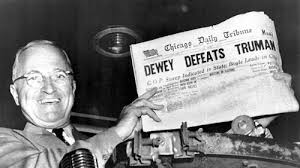
No sooner had The Donald pulled off the biggest political upset since dewey-defeats-trumanthan the speculation on who would hold which cabinet position had begun. And it got downright scary.

There was former New York City Mayor Rudy Giuliani being touted as Attorney General.

Yep. That’s all we need: A doddering old has-been who has all he can handle to remember his own name standing in as the premier legal authority in the land. He’s probably the only one who could make John Mitchell look good.

And Newt-for-God’s-sake-Gingrich as Secretary of State?

And the Republicans thought Hillary was bad in that role?

Next thing you know, Trump will be tossing out Charles Koch’s name as Secretary of the Interior.

And how about Chris Christie as Secretary of Defense?

Or Kansas Gov. Sam Brownback as Secretary of the Treasury? I mean, look what he’s done for that state’s finances.

But according to The Wall Street Journal, in a story quickly picked up by state media, a familiar name (to Louisianans, that is) is being pitched as a potential choice for Secretary of Health and Human Services.

Bobby Jindal.

Are you kidding me?

Apparently not. http://www.wdsu.com/article/report-former-gov-bobby-jindal-being-considered-for-cabinet-role-in-trump-administration/8263712

For some reason the locals believe that because he worked for former Gov. Mike Foster as Secretary of Health and Hospitals and for former President George W. Bush as a special adviser to the Secretary of Health and Human Services, he somehow has a shot at a similar role in the Trump administration.

I would refer those reporters to chapters 30 through 37 of my book Bobby Jindal: His Destiny and Obsession. Those chapters include the sordid details of how Jindal single-handedly dismantled the state’s model public teaching hospital system to benefit a few greedy political hangers-on—even to the point of signing off on a contract containing 50 blank pages. A rhetorical question: would anyone reading this ever sign his or her name to any document containing even one blank page?

As an added bonus, I would refer you to Chapter 17 of the book which details how Jindal’s Commissioner of Administration Kristy Nichols landed a cushy lobbying position with Ochsner Health System after helping negotiate a deal whereby Ochsner would partner with Terrebonne General Medical Center to take over operation of the state’s Leonard Chabert Medical Center in Houma.

At least the WSJ thought to mention failed GOP presidential hopeful Dr. Ben Carson as also being under consideration for the Health and Human Services post.

That would, after all, make a little more sense. After all, Carson did pipe up from time to time on behalf of Trump’s candidacy. We heard nary a peep from the Louisiana wannabe wunderkind Piyush Jindal after he removed himself from the Republican presidential sweepstakes last November…and no one noticed (of course they didn’t notice while he was running, either). All he did was join the board of some Texas corporation and quickly fade from memory—helping the Republican Party but crushing my book sales in the process.

Hey, Donald, here’s a heads-up. After Tuesday’s race for the U.S. Senate seat being vacated by David Vitter, there are two former U.S. Representatives who ran unsuccessfully for the upper chamber who are now unemployed.

And they both just happen to be doctors.

But how can you trump (pun intended) a Rhodes Scholar?

If James Comey wasn’t doing such a splendid job, you might even consider Louisiana State Police Superintendent Mike Edmonson to head up the FBI. Think how regal he’d look sitting behind old J. Edgar’s desk.

But while you’re at it, you may be needing a new Secretary of Immigration and Border Protection. We understand David Duke just pulled an astonishing 3 percent of the vote in that same U.S. Senate race and may be looking for something to do. And we already know the rapport he has with minorities. Why, he’d fit right in.

And while you’re at it, you may be on the lookout for someone to replace Jeh Johnson as Secretary of Homeland Security.

There’s this fellow who previously did such a stellar job running the Louisiana Office of Alcohol and Tobacco Control—into the ground. Troy Hebert did even worse than Duke, racking up a whopping .5 percent of the vote in the 24-person Senate race. That’s one-half of one damn percentage point. Imagine what he could do for Homeland Security.

He may even still have his badge from his ATC days.

Yep, Donald, if you’re looking for washed up political has-beens to lead your administration—and it appears that you are—we have a boatload of ‘em down here in Louisiana.

Take your pick.

Please.

(Apologies to Henny Youngman.)

Read Full Post »

On Tuesday, millions of Americans marched to the polls to cast ballots for President in what is a clear demonstration to the rest of the world that we live in a free society where citizens can say what they want about their leaders without fear of reprisals.

Someone should remind the Louisiana State Troopers’ Association (LSTA) of that.

If additional evidence that the LSTA does little else than attend parties and conventions while brooking no dissention from its membership, there is the ongoing purge of retiree members who dared question activities of its board which LouisianaVoice just learned about.

At the same time LouisianaVoice learned of the reprisals against dissent, we also examined LSTA TAX RETURNS which show that the organization devotes only a small portion of its revenue to charitable causes despite its claims to the contrary. Instead, LSTA has placed about $1 million in trusts, equities and options, mutual funds and money market funds while doing little for the welfare of its members.

LSTA operates Louisiana State Troopers Charities as a 501(c) (3) charitable organization

It also invested more than $200,000 in fundraising activities during 2013, the latest year for which records are available. At the same time, it spent about $28,000 in “grants and other assistance to governments and organizations.”

Among its other expenses were $184,000 for salaries and benefits; $112,400 for conventions, conferences and meetings and nearly $82,000 for travel.

The LSTA is a fraternal organization representing the men and women of the Louisiana State Police. The LSTA represents approximately 97 percent of the commissioned officers as well as a “substantial portion of the state police retirees.”

But those who dare think for themselves need not apply.

The number of retired members has just been reduced by at least four.

LouisianaVoice has learned that four retirees who questioned the authority of LSTA to make political contributions through its executive director in 2015 have been sent letters informing them they are no longer welcome as members of the fraternal organizations they devoted their working lives for.

State civil service rules, which extend to state troopers, prohibit political activity (including campaign contributions) on the part of classified employees.

This precision surgical procedure being carried out on its membership—to remove an inconvenient wart—is evidence of the influence that State Police Superintendent Mike Edmonson has over LSTA despite Edmonson’s repeated contention that he has no direct involvement in the association’s activities.

As further illustration of the influence of Edmonson—and LSTA’s propensity to ignore the wishes of its membership—affiliated troops throughout the state voted against expulsion, LouisianaVoice has learned. The only vote to expel the retired members came from headquarters in Baton Rouge.

So much for the democratic process.

One of those retirees, Bucky Millet of Lake Arthur, has been a particular source of irritation to the association, attending monthly meetings of the Louisiana State Police Commission since last December to challenge actions by both the commission and association.

“I was a member of LSTA for 40 years,” Millet says. “Now they tell me I’m not welcome.”

Millet was instrumental in prodding the commission to at least go through the motions of a pseudo-investigation of the association’s funneling campaign contributions to political candidates through its executive director David Young.

That investigation was turned over to Natchitoches attorney Taylor Townsend, a confidant of Gov. John Bel Edwards, who essentially punted. Townsend declined to even issue a written report, which would have become a public record. He also neglected to include a digital recording—a recording that he possessed then and possesses now—of an admission by LSTA officers that they had violated state ethics regulations in contributing to several political candidates through Young.

So, when Millet and other retirees who were members of LSTA questioned the propriety—and the legality—of the contributions, the lines were effectively drawn. Those trouble-making retirees had targets on their backs from that moment on.

And now, even as 100 million Americans cast their votes in the greatest democracy the world has ever known, we learn there is no room for dissention in what should be a beacon of democracy and freedom of expression—the Louisiana State Troopers Association, the fraternal organization that represents those who are supposed to be the very guardians of our freedoms, our protectors.

Perhaps the leadership of LSTA should take a high school civics refresher course.

Read Full Post »

« Newer Posts - Older Posts »


