Feeds:
Posts
Comments

I’ve always felt that one’s political views are one’s own and while I may disagree with someone, I try to respect another’s viewpoint. For that reason, while I may vehemently disagree with another writer, I am loath to openly criticize another pundit’s opinions. So far, that policy has been reciprocated by fellow writers.

But when someone publishes claims that are so outlandishly misleading, even downright false as has the Hayride writers, I have to call them out.

Last Thursday, Scott McKay, who, for whatever reason, chooses to use the name MacAoidh for his byline (I suppose he thinks he’s a member of a once-powerful Scottish clan), went a little rabid over criticism of the Louisiana Department of Education’s decision to offer those silly PragerU five-minute video clips for public school civics and American history classes.

McKay, or MacAoidh, insisted on calling it Prager U (separating the letter “U” from the rest of the outfit’s name) in some king of subliminal attempt to legitimize it as a full-blown university. It’s not. It’s not even a school. It’s a content carrier. In other words, a not-so-subtle propaganda generator much the same as Fox News or the late, not-so-great Rush Limburger. Watch any PragerU video clip and you’re going to be treated to some oatmeal-for-brains-generated mishmash of “everything’s rosy in America except Democrats” claptrap.

Watching these clips, I could almost hear David Duke proclaiming that he has lots of black friends, or Florida’s Rhonda Santis extolling the virtues of Key West’s gay community in an effort to sound .

I’ll let you decide if it’s a real civics or history lesson when PragerU’s own CEO Marissa Strett said that the U.S. education system is “a left-wing propaganda machine” and that PragerU is “medicine for the mind so that we can cure and help people think clearly.”

But wait. There’s more. In one video clip that National Public Radio cited as being offered by PragerU, an animated CHRISTOPHER COLUMBUS says, “Being taken as a slave is better than being killed, no? I don’t see the problem.”

Really? PragerU’s clip must have overlooked a third alternative: freedom, as opposed to slavery or death.

Apparently, PragerU and by extension, McKay/MacAoidh, are just fine with one human being owning another human.

I’d have to say the PragerU teachings pretty much dovetail Florida’s new standards that require that students be taught that the experience of slavery was beneficial to African Americans because it helped them acquire skills.

But that must be okay with McKay/MacAoidh.

Here’s what McKay/MacAoidh said in praising the works of PragerU: “Prager U (sic) is a great educational asset. Prager U’s video content items are among the most digestible Cliff’s Notes versions of explainers for historical events, civics concepts and other things that would fall under the ambit of ‘social studies.’”

Then there’s Hayride writer CHUCK OWEN who felt the need to be the official apologist for Superintendent of Education Cade Brumley. Without commenting on Brumley’s qualifications, we do challenge the veracity of Owen’s claim that complaints over the PragerU controversy is “repressive tolerance,” a “tool of Cultural Marxists that seeks to silence anything that they don’t approve or understand.”

Owen wouldn’t know “cultural Marxism” if it hit him in the face. And as far as accusing anyone of seeking to silence anything they don’t approve or understand, has he taken a look at the Republicans’ “don’t say gay” nonsense or their efforts to squelch any teachings about the Civil War and slavery or women’s suffrage? Or maybe the right’s hysterical apoplexy over the content of public and school libraries? I think the proper term for that is grooming.

And finally, Hayride columnist Jeffrey Sadow, an associate professor of political science at LSU-Shreveport, offered up his own defense of PragerU with his rambling DIATRIBE.

As we did last week, we invite you to make your own decisions by clicking HERE to view some of the clips being offered by PragerU. Don’t watch just the featured video that pops up, though it’s sufficient inane to induce eye rolls. Go to the menu at the right of the page and check out a few of the others.

The late Sen. Daniel Parick Moynihan has often been cited for one of his more famous utterances: “Everyone is entitled to his own opinions, but not his own facts.”

The folks at the Hayride would do well to remember that.
Only one day left in our May fundraiser. LouisianaVoice strives to give you the freshest perspective on developments coming out of Baton Rouge that affect all of our lives. Whether its education, taxes, employment, health care, crime or just plain old malfeasance, we try to give you the back story and its ramifications. This is what we do and it takes tremendous resources in time, effort and money. Your support is essential to keep us going. Please click on the yellow DONATE button (below right of this post) and contribute by credit card what you feel you can afford. No matter the size, it helps and it is appreciated more than you could ever know. Thank you for your past support.

(Editor’s note: Rip Picard is not the writer’s real name, for obvious reasons. His column below gives a rare peek into the way Louisiana’s prison system operates.)

Allen’s Finest…

By Rip Picard

January 2003 I was transported to Allen Correctional Center in Kinder, Louisiana. I’d been sentenced not two years before on a robbery charge which stemmed primarily from youthful rebelliousness and a naivete which soon was made clear after being arrested. At that age, I was under the impression that the badder I was, the cooler I was. I was ultimately sentenced – as a first offender – to fifteen years with the Louisiana Department of Public Safety and Corrections. Of those fifteen years, I would end up serving just over 12 years in accordance with Louisiana sentencing and good time laws.

Anytime – as most often is the case – you start a lengthy sentence in any of the various “satellite” camps (local facilities which house DOC offenders) in Louisiana, you find yourself satiating your boredom by digesting the grapevine of what’s available at State operated facilities. Educational opportunities range from Literacy classes to vocational school and even college. Various State facilities even boast other trades such as sign language certification and seminary. Beyond education, there are offender nonprofit organizations such as the Junior Chamber of Commerce, Toastmasters of America, VETS, and several facility-bred nonprofits which offenders can pursue the opportunity to learn how to plan and carry out community service activities to further sharpen their citizenship skills for their return to society. Should you find yourself with a little extra time here and there, State facilities have recreation yards, weight piles, gymnasium, sports leagues, arts and crafts, and countless self-help classes – many of which can afford you more good time off your release date for completion of same. All in all, there is a glaring opportunity for any offender to truly refine and redefine themselves into a productive individual with a true sense of self-worth. Couple that with the handful of organizations and government initiatives aimed at achieving employment for recently released offenders, and there is the real opportunity for the criminal justice initiatives of rehabilitation, education, and reentry to become a reality.

All in all, I was housed at Allen Correctional Center from January 2003 until January 2010, at which time I transferred to Rayburn Correctional Center in Angie, Louisiana. While at Allen, I completed a vocational trade, was a peer trainer/tutor in several classes/self-help programs, as well as an elected board member of a nonprofit organization. Such endeavors, however, come with the added cost of having to figuratively fight for the ability to participate. Starting with the mandate – at least at the time – that you serve a minimum of 90 days in the field line prior to obtaining a job change. This could be seen as a reasonable election to see what type of workers individuals are, but what’s left in the grey area is that many offenders are given disciplinary reports by security guards who simply make up a reason to issue an infraction – and sometimes this is done with the specific intent to keep the offender from obtaining a job change. My field job when arriving at Allen consisted of digging to the tap root of pine trees and chopping them down and cutting them into sections with an axe which was welded to a quarter inch thick hollow steel pipe which weighed anywhere from 20-25 pounds each. Likewise, for those working the shovels, pitchforks, hoes, etc., all were welded to the same type of piping for the appropriate length for the tool. They didn’t want to pay for replacement wooden handles.

For those who received infractions for no reason at all, they were brought before a kangaroo court disciplinary board where the offender disciplinary counsel already knew what the disciplinary board planned to do and told the offender either plead guilty and receive sentence “A” or fight it and maybe they’ll send you to the cell block. Considering the disciplinary procedures are a manifestation of the Louisiana legislature to provide a semblance of Due Process within the prison system, the actual procedures adhered to would make any actually just barrister roll eternally in their grave. There were only two members of the disciplinary board, a chairman and member. During my time there, Assistant Warden Mark Estes, Major Lasonya Thomas, and Captain Selton Manuel were the dominant presence on the disciplinary board. In short, Estes was gifted an Assistant Warden position at about the age of 25 from the “Good Old Boy Club” in Allen Parish, Thomas was a time bomb who would break security radios on the side of offenders’ heads because she felt like it (and was even kicked out of a GEO prison in Texas because of these antics) without any legal repercussions whatsoever, and Manuel was always seeking an angle to send someone to the cell block whether they deserved it. None of the three ever had anything to do with anything which could be perceived as rehabilitation. In fact, I was once told that they expected offenders to remember their place by acting up and being offenders, they didn’t care about all “that other stuff”.

Allen Correction Center, for the entire time I was there, was a compost pile of staff which was poorly – if at all – trained and an administration that was the poster child for the way Louisiana government really works. Once, there was an offender who was brutally beaten by a captain and several members of the field line staff. While he was handcuffed. Little did they know the individual’s family member worked for the FBI. Next thing you know the captain and those field line staff were escorted off the compound by the FBI. Needless to say, many (if not all) of those staff members went on to work in other prisons. Another time an offender was stabbed to death and kicked by another offender who acquired the steak knife from the lunch box of a female staff member with whom he was in a relationship. The offender only received an eight-year sentence for murdering that man. So, was his life less valuable than someone who isn’t in prison? If “Karen” or “Kevin” were stabbed to death and kicked while dying, that would come with at least a life sentence. Manslaughter at the low end.

These are just a few examples of what really goes on in prisons in Louisiana. There are a great many staff members, particularly those involved in programs, counseling, and reentry services who truly care and do their best to make a difference. It’s a bittersweet victory for them, however, because they often find themselves targeted by administration and staff as well because they can’t fathom the idea of offenders becoming better. As assistant warden was quoted as saying during a staff training session, “If an inmate is talking, he’s lying.” Although I can’t speak to the circumstances which pushed the bad apples to the deranged mentality they acquired, I can say that the Stanford Prison Experiment by Philip Zimbardo hit the nail on the head. I can remember – while at Allen – reading “The Lucifer Effect”, written by Zimbardo, and feeling like they must be talking about Allen Correctional.

At some point, Louisiana’s constituents need to be able to bridge the gap between what they believe about Louisiana’s government and what reality is. There are times I feel there are a great many people who know better and just don’t care because they don’t want to concern themselves with the mess which is government. And I get it, life is hard enough by itself without trying to champion a cause which may or may not be affecting an individual. But then I think about the old Greek offender I was housed with for a time, who was in Greece when it was occupied by the Nazis. He was actually going to be shipped to a concentration camp and, but to his good fortune, the UN took back Greece. I asked him one day if there were any particular prison in Louisiana wherein the guards reminded him of the Nazis, to which he replied, “Yeah, St. Tammany Parish Jail.” I’ll close with one of my favorite poems I look to when seeking a little inspiration:

First they came for the Communists
And I did not speak out
Because I was not a Communist
Then they came for the Socialists
And I did not speak out
Because I was not a Socialist
Then they came for the trade unionists
And I did not speak out
Because I was not a trade unionist
Then they came for the Jews
And I did not speak out
Because I was not a Jew
Then they came for me
And there was no one left
To speak out for me

– Pastor Martin Niemöller

Why the urgency to can Dr. Brian Salvatore at LSUS?

I mean after all, he’s not the only faculty member at the school who is outspoken on political matters. Associate political science professor Jeffrey Sadow has been far more vocal in defending all things Republican and attacking all things Democrat on the Hayride blog for years now, which apparently gives him free rein to pontificate – in contrast to Salvatore, who has made the school’s administration a tad uncomfortable with his criticism of toxic chemical disposal and open meetings violations.

Now, why would LSU find it intolerable for Salvatore to discuss toxic pollution of the air, land and water? I mean, aren’t we all concerned about that?

Well, when you’re a major university that receives mega-funding grants from corporate interests that are directly involved in the business of the toxic poisoning of the air, land and waterways of this state, or of malfeasance, then you become a bit sensitive to such criticism, any criticism actually.

This heavy-handed method of dealing with free speech goes all the way back to the firings of Drs. Fred Cerise and Roxanne Townsend for the sin of SPEAKING OUT against proposed policy.

Jeff Landry, when he was still attorney general, attempted to get Bob Mann FIRED from his professorship at LSU after Mann was critical of the way Landry had dispatched a “flunkie” from his office to the LSU Faculty Senate meeting to read a letter attacking covid vaccines.

Then, we have the story about the LSU School of Dentistry’s sacking of Dr. John Kent, the firing of STEPHEN HATFIELD who was erroneously implicated in the mailings of anthrax envelopes in 2001 – and Hatfield’s boss, Stephen Guillot, director of the National Center for Biomedical Research and Training and the Academy for Counter-Terrorist Education.

And most of us remember the firing of Ivor van Heerden for his CRITICISM of the U.S. Army Corps of Engineers over the levees that failed during Hurricane Katrina, causing extensive flooding of New Orleans. Well, van Heerden sued LSU and prevailed in a multi-million-dollar settlement.

Actually, the Hatfield and van Heerden episodes pre-date the Cerise and Townsend kerfuffles.

So, why was LSU so uber-sensitive to criticism on the part of its professors – or in Hatfield’s case, so eager to rid itself of a possible suspect in a terror attack before the first shred of evidence was present, and indeed, never was?

Because LSU receives millions upon millions of dollars in grants from the Corps of Engineers, federal law enforcement and the medical community. The last thing it wanted – far more than say, protecting the rights of its employees – was to jeopardize the continued money flow from cash cows. So much for justice and fairness being top priorities.

Having said that, let’s now take a deep dive into the LSUS administration that so desperately wants to destroy Salvatore, who has fought the proposed outdoor burning of toxic CHEMICAL WASTE at facilities in MINDEN and Colfax and in the process, accused of LSUS of possibly contributing to the problem with its own chemical wastes.

So, what about the guy who is behind the effort to show Salvatore the door?

That would be Chancellor Robert Smith who hand-picked the ad-hoc committee which heard Salvatore’s case and who has now taken the committee’s termination recommendation up the chain to LSU system President William Tate who will almost certainly uphold the committee and Smith for fear of antagonizing dictator Gov. Landry.

Having said that, let’s take a look at Smith’s curriculum vitae.

Smith recently joined LSUS after leaving his position as Provost at Valdosta State University last July. While at Valdosta State, his claims to fame were hiring a dean of science and mathematics without receiving the consent of the faculty.

That dean, Keith Walters, was arrested as a SEXUAL PREDATOR who was accused of soliciting sex online from 13-year-old children. After Walters was arrested, Smith appointed a new dean who subsequently “violated the academic freedom of VSU biology professor LESLIE JONES who was teaching her students peer reviewed science about the biological basis of gender, ‘woke s**t’ in the words of the PARENT of a student who called the university to complain,” according to an article in The Spectator.

Professor Jones subsequently sought legal assistance from the Foundation for Individual Rights and Expression (FIRE).

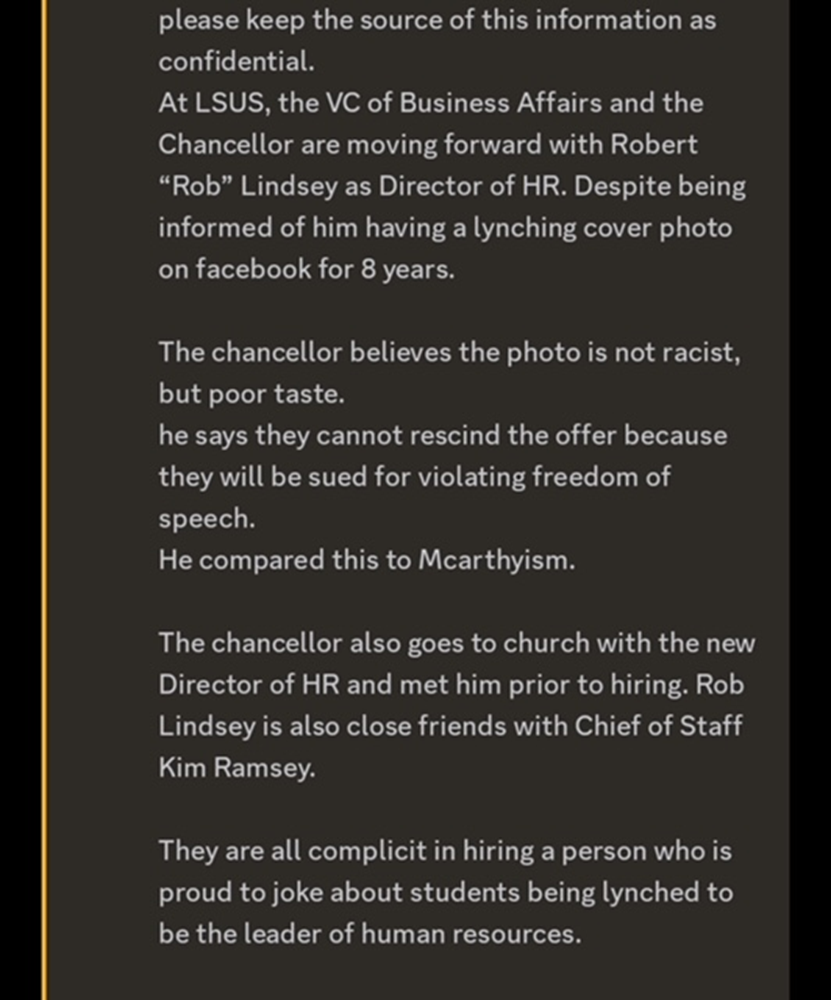
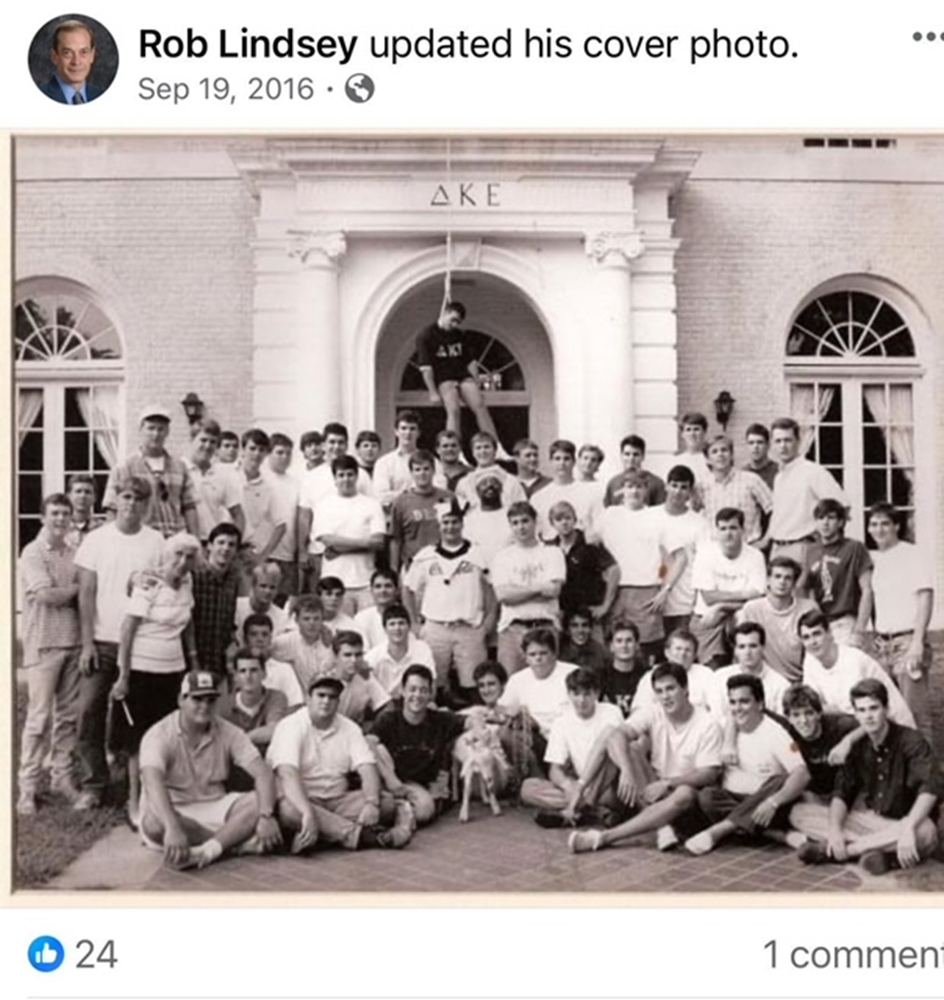
Smith, at LSUS, hired a human resources director who, for the past eight years, has maintained a Facebook profile cover photo of his fraternity that included a simulated lynching. Did I mention that he’s the HR director at a public state university?

Smith, of course, didn’t see the photo as racist, but simply “poor taste,” according to the post below that was supposed to be “confidential.” Smith added that he attended church with the HR director, Robert Lindsey and that Lindsey was also “close friends with Chief of Staff Kim Ramsey.”

Well, then, that certainly clears up that little lynching photo issue.

So, it appears that controversy is no stranger to Smith – just as pandering to corporate interests at the expense of faculty members is no stranger to LSU.

Like what you read here? Please help us continue our work. Click on the yellow DONATE button to the upper right of this post and contribute what you feel you are comfortable with by credit card. Unlike Don the Nodfather, your contribution is not a recurring payment; it’s a one-time donation – unless YOU specify otherwise. As always, you have our eternal gratitude for your support.

Jeff Landry’s long-term strategy is becoming more and more apparent with each passing day of the 2024 legislative session.

By ramming through grooming courses for Louisiana public school students, mandating the posting of a single version of the Ten Commandments in each school classroom, stacking the State Ethics Board, gutting necessary social programs while committing untold millions to private school funding, and other similar legislation, it’s become obvious that he wants a gaggle of lawsuits filed against his administration. I mean, he’s begging for ’em; that must be his game plan.

It doesn’t matter to him if he loses; he’s void of any real political philosophy other than to stick his finger in the air to see which way the wind is blowing.

But by setting up a series of lawsuits, he has guaranteed members of the bar, attorneys in good standing, that the state money machine will keep pumping out financial payback for all the lawyers who contributed to his campaigns. Those barristers will be retained through the attorney general’s office (which he conveniently controls through his proxy, Liz Murrill) to defend his programs. It’s simple, really: an attorney contributes $5,000 or $10,000 – or more – to his campaign and receives cases from the state that may well enrich his office by as much as $100,000, or more – of taxpayer money. It’s a dandy return on investment.

It’s the circle of life in Louisiana politics.

Two days left in our May fundraiser. Click on the yellow DONATE button to the upper right of this post and contribute by credit card. Your donation, no mater how small, helps us to continue shining our light into the dark recesses of public chicanery.