Feeds:
Posts
Comments

There’s something intrinsically sick about an obsession over what someone is reading.

Michael Lunsford and his Citizens for a New Louisiana don’t want a “new” anything. They want control over others’ thinking. It’s the openly espoused agenda of the national Repugnantcan Party as so often expressed by the likes of Ron DeSantis.

It’s really unfortunate that this group finds it necessary to concentrate its efforts of censorship and repression in the name of Christianity and decency. It seems that he and his organization are pulling their talking points directly from the books of Leviticus, Numbers, and Deuteronomy which, among other things, advocates the killing of gays and total domination over women – especially sexually.

Lunsford has never to my knowledge advocated killing anyone but he has spewed unfounded – and libelous – accusations toward decent, honest people who probably have a greater understanding of the real teachings of Christianity than he could ever hope for.

The man is an agent of hate and vitriol. It’s as simple as that. He’s sounding much like this idiot Nick Fuentes on TikTok, who actually calls for the burning of women at the stake. (Reader discretion advised: language)

Lunsford claims he wants a “new Louisiana,” and that’s commendable. There are so many areas in which this state could improve: teacher pay, healthcare, literacy, poverty, hunger, environment, corruption, crime, gender pay discrepancy, and the list could go on indefinitely.

But instead, he chooses to zero in on an effort to ban books – censorship – in open violation of the First Amendment.

My question to him is this: Why are you so concerned about what kids might read? As I said in an earlier post, straight kids more than likely aren’t interested in reading books about a kid with two daddies at home. And if a kid is gay, you ain’t gonna change him by banning books.

Lunsford probably (I don’t know this for certain) subscribes to the debunked belief that gays can be changed to straight through counseling and rehabilitation.

They cannot and let me say this unequivocally: Absent harassment from people like Lunsford (and, regrettably, me, when I was in high school), gays are probably happier and better adjusted psychologically that most of us straights who seem to find so much time to fret about gays and what other people are doing in the privacy of their homes.

I know several gays (one, a dear friend, recently died of a heart attack and I miss his humor and his terrific intellect) and they are, without exception, well-adjusted, productive, and creative.

Lunsford is so terrified that children will be adversely influenced – or molested – by gays. Here are the facts: in as many as 93 percent of abuse cases, the child knows the person already and 47 percent of abusers are family members. How are you going to protect against that, Lunsford?

Of course, as one might expect, a study conducted by the BAPTIST PRESS predictably says that gays are more likely to molest kids. But a likely more reliable source, the NATIONAL LIBRARY OF MEDICINE, says that the risk of adult gays molesting children ranges from 0 to 3.1 percent.

If Lunsford is so concerned about protecting children, maybe he should take a look at the real sources of porn for kids: the Internet and cell phones. Porn is widely accessible online and kids do send sexually explicit photos to each other on their phones.

But you see, he can make more noise and garner more financial support by keeping his fight local and taking on innocent school librarians. That’s really low and sleazy.

Because of the Repugnantcan intellect of people like Matt Gaetz, Marjorie Taylor-Greene, Ted “Cancun” Cruz, Donald Trump (who the hell ridicules people with physical deficiencies?), and Lunsford, we have moved perilously closer to the mentality of a third world country.

As an illustration of how obsessed Lunsford is with his Quixotic library quest and to what absurd level he is willing to take his fight, he actually posted on Facebook a message that he is holding books he “unilaterally” (read: arbitrarily) removed from the Lafayette Public Library and that the public is invited to come to his office to view the books – “Appointment recommended.”

Could that be because he first wants to be sure he’s through reading them?

I don’t know. It’ probably a rhetorical question.

Were they not so frightening, the people behind Michael Lunsford’s Citizens for a New Louisiana would be almost comic in their efforts to stymie our basic freedoms.

Almost.

But they’re not, you see, because like their co-conspirators at the national level, the objective of the Repugnantcan Party is to strip us of our right of expression, our right of association, our right to read what we choose, and our right to watch which movies and television shows.

Extreme? Alarmist? Scaremongering? Call it what you wish but tread carefully before you call it specious hogwash. It was no less a personage than Henry Kissinger who said even paranoid people have real enemies.

The Supreme Court, now so heavily weighted to the right, has already struck down two important, long-standing fundamental rights: women’s right to control their own bodies and the rights of those convicted of crimes to APPEAL THEIR CONVICTIONS on the basis of poor legal representation, a ruling that removes the final safeguard against wrongful convictions and executions of innocent people.

Justice Clarence Thomas has hinted that the court may well also take a second look at same-sex marriage, voting rights, and even something as personal as contraception. Thomas himself could also be affected should the court take under consideration interracial marriage (then again, he may see it as an opportunity to rid himself of wife Ginny).

Sens. Rick Scott and Lindsey Graham have also intimated that the sharp reduction or perhaps even the elimination of Social Security, Medicare, and Medicaid.

Likely to remain undisturbed, however, are laws THAT ALLOW GIRLS TO MARRY at ages at young as 12 in Massachusetts; 13 in New Hampshire; 14 in North Carolina; 15 in Hawaii, Kansas, Maryland, Mississippi, and Utah – all with parental consent and some with judicial consent. In all, 32 states and the District of Columbia generally have established 16 as the minimum age for marriage for females.

That is, or course, because women have long been considered chattel property in this country. Women weren’t even given the right to vote until 1920 when the 19th Amendment was ratified. And if you don’t think I’m right consider that the national GENDER PAY GAP shows that men earn between 18 percent and 19 percent more than their women counterparts in similar positions.

Of 50 states and the District of Columbia, Louisiana ranks 49th, just ahead of Utah and Wyoming, with a pay gap of 27 percent. A male’s average pay in Louisiana is $55,428 compared to $40,442.

So now, we have Michael Lunsford and his Citizens for a New Louisiana setting its agenda for combatting any tax issue, censoring the content offered by libraries and generally dictating other facets of our lives.

In its mission statement posted on its Web page, Citizens for a New Louisiana ostensibly advocate for transparency. But its been difficult to learn who the non-profit’s financial angels are because by law, they’re not required to divulge that. Nice. Transparency in everything except where they get their money.

We do know that one of his backers is a property management executive named Will Mills, III. Mills doesn’t just support Citizens for a New Louisiana, however. He has poured hundreds of thousands of dollars into various political campaigns, including $78,500 to the Repugnantcan Party of Louisiana, $9,500 to Public Service Commissioner Mike Francis, and $7,500 to Attorney General Jeff Landry who has participated in a spate of lawsuits ranging from environmental issues to overturning the 2020 presidential election. He even sued a reporter over the reporter’s audacity to request public records.

They preach transparency on the part of others but exempt themselves.

And make no mistake, they’re coming after every library in the state. They have only contempt for the First Amendment while holding the Second Amendment up as a sacred right. They want it both ways and the next logical step (as already articulated by this group) is public school curricula.

As already articulated by former Secretary of Education Betsy DeVos, the goal of the Repugnantcan Party is to gut public education and replace it with a system of private and charter schools so that they may set their own curricula that will exclude mentions of the Civil War, the struggle for civil rights, gender equality and anything else they find “objectionable.”

This struggle over library books is just the first shot across the bow of individual rights, folks. Get ready. This is for the long term.

Below is the mission statement of Citizens for a New Louisiana lifted from their Web page:

MISSION

Fostering prosperity in Louisiana’s overall economy by simplifying complex issues, promoting TRANSPARENCY in LOCAL GOVERNMENT, and providing sound public policy insights based on thorough research and conservative principals.

principal

prĭn′sə-pəl

adjective

  1. First or highest in rank or importance. synonymchief.
  2. Of, relating to, or being financial principal, or a principal in a financial transaction.

principle

prĭn′sə-pəl

noun

  1. A basic truth, law, or assumption.
  2. A rule or standard, especially of good behavior.
  3. The collectivity of moral or ethical standards or judgments.

Michael Lunsford, who also named the wrong school in Livingston Parish, might wish to visit a library to take a look at a dictionary to learn the proper usage of the word principle.

(Full disclosure: I am the last one to poke fun at incorrect usage of words. I’ve done so myself, but I just couldn’t resist puncturing the ego of someone of such self-importance as Lunsford.)

MEMO

To:         Every single parish, university, and public school library in Louisiana

From:    Michael Lunsford

               President, Citizens for a New Louisiana, and alleged author,

               Radical Right-Wing Repugnantcans,

               And self-serving demagogues

Message:           

We’re coming for your books, your meetings, and your jobs. If we have to destroy your reputation to accomplish our objective, we will not hesitate to do so. We have no principles or delusions of decency.

Strong? Perhaps. Offensive? Maybe. Accurate? Absolutely.

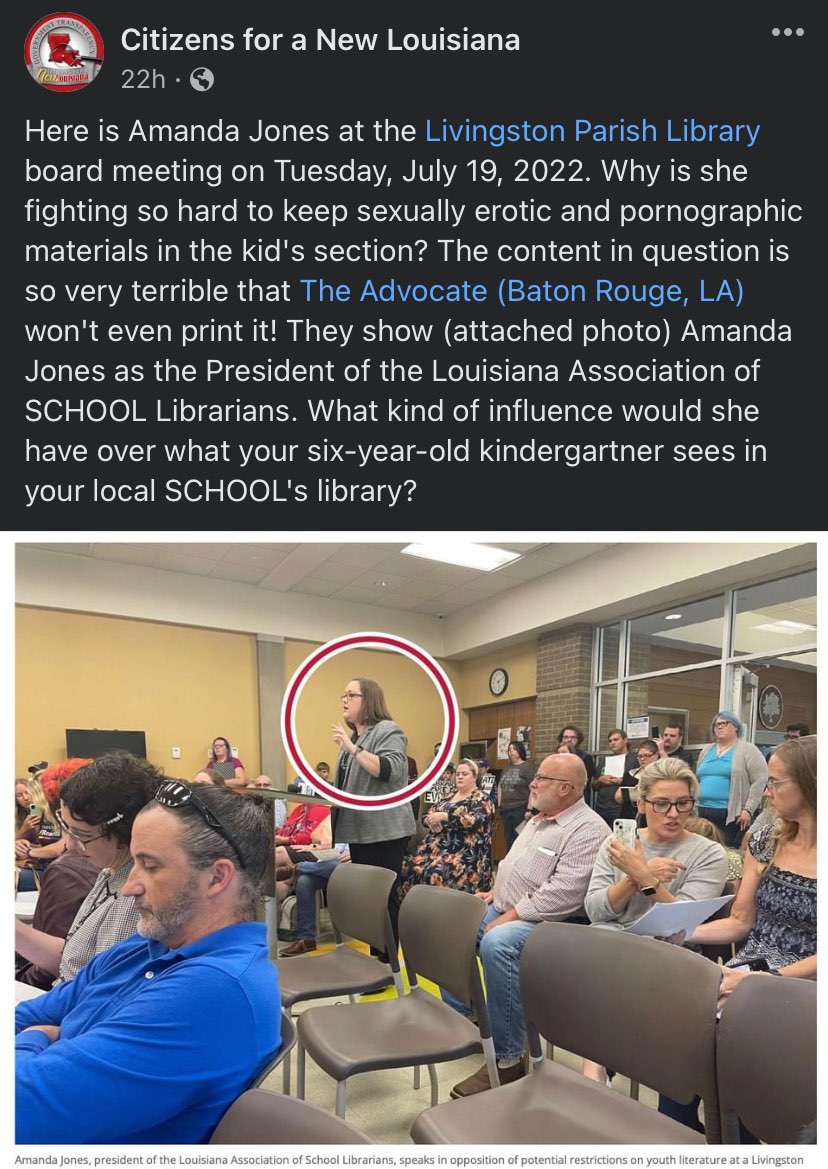
He has already managed to stack the Lafayette Parish Board of Control (“control” being the key word here) and he’s set his sights on Livingston Parish. His is a campaign being carried out, ironically, in the name of decency. It’s anything but decent, as evidenced by the personal attack on middle school librarian in Livingston Parish, Amanda Jones:

Something tells me you’d better be able to prove this. The alternative is you would be wise to lawyer up. Libel can be an expensive lesson.

Probably wouldn’t have too much influence on that 6-year-old kindergartner since Amanda Jones works at Live Oak Middle School. It’s a math thing; you wouldn’t understand.

Uh, just for the record, genius, wrong school. The gymnasium at Live Oak Junior High was hit by lightning and was destroyed by the ensuing fire. “This woman,” as you so dismissively referred to her, is the librarian at Live Oak Middle School, a couple of miles away. Get your damn facts straight before you go shooting off your bigoted, misinformed mouth.

Make no mistake. Michael Lunsford is on a campaign of censorship and he won’t stop until he’s smeared, libeled, and besmirched every librarian who stands in his way and he may well be coming to your parish, your school, your university next.

And he’s got money – and the Repugnantcan Party – behind him in his efforts.

What kind of reptilian, slithering, lowlife would attack a person he doesn’t even know, probably has never met, like this?

I’ll tell you who. A coward who doesn’t even have the courage to attach his name to his libelous attacks. He hides behind anonymity in his online defamations while putting on an angelic demeanor in public.

He is, in short, your typical Repugnantcan operative, sticking his nose into people’s lives in such as manner as to be as disruptive, as destructive, and as vile as possible while carrying out his vulturous campaign.

For more on Lunsford and his organization, go HERE to read the thorough work of journalist for the Lafayette publication The Current, by Leslie Turk.

Lunsford got shot down in Livingston Parish last week but rest assured, he’ll be back. His kind don’t take no for an answer and they’re persistent to the point of being more than a little nauseating.

Yesterday, in Lafayette, the Library Board of Control, appropriately “controlled” by Lunsford’s handpicked appointees, attempted to fire head librarian Cara Chance but the board, headed by President Robert Judge who was obviously in over his head when it came to conducting a controversial meeting, withered under the protest of a crowd of a roomful of Chance supporters.

Judge, read a two-page opening statement (which he neglected to make available to attendees or the media) that was difficult to hear in the back of the room. But he took a shot at the reporting of the Acadiana Advocate (sister publication to the Baton Rouge Advocate), which he described as “inaccurate, as usual.” When a public official says something like that, it generally means the reporter has scored a direct hit.

What Judge was going to such lengths to deny was that Chance was being considered for termination over her resistance to banning objectionable books. It was, he said, for insubordination, for which board member David Pitre, in the most indignant manner he could muster, declared he had no patience for. Well, bully for him. Apparently, he had all the patience in the world for Judge’s misdirection and obfuscation.

Because, make no mistake, this was all about censorship. The insubordination charge, which surfaced only minutes before the meeting started, was pure and unadulterated B.S.

This was a power play with Lunsford’s fingerprints all over it. And this wannabe powerbroker doesn’t even reside in Lafayette Parish – he lives in St. Martin, not that any of that matters to him.

Backed by local property managers Will Mills, III, Jeremiah Supple, and attorney Steven Durio (Durio’s name cropped up in my book Murder on the Teche, about the 2010 murder of New Iberia orthodontist Dr. Robert Chastant), Lunsford and his Citizens for a New Louisiana, managed to defeat a critical school tax proposal back in 2017 and a library tax the following year.

Interesting name for his group, considering there’s little “new” about the same old power politics of Louisiana where those with the bucks manage to roll over everyone else.

Did I mention that Mills and Supple are property managers? Could it be honest convictions and pure intentions that moved them to support Lunsford’s opposition to the library tax or could it have been some underlying reason like say, the defeat of any tax would lower the taxes on their property holdings? Nah, that couldn’t be it.

The self-appointed guardians of all that is decent are hell-bent on protecting our young-uns from the evils of the flesh by not allowing them access to those sinful books that dare mention the existence of gays or even the mention of sex or (gawd forbid) satanic or (gasp) critical race theory.

Critical race theory? Hell, we can’t be teaching kids about how their granddaddies hurled insults and even rocks at little black kids who just wanted to go to a decent school with bathrooms that worked and classrooms that were heated in winter. We can’t let them know our police turned vicious dogs loose on blacks and that college students (also our forebears) poured milkshakes over their heads at the lunch counter. So, let’s keep books like Ruby Bridges Goes to School and Martin Luther King and the March on Washington the hell outta our liberries. (Ruby Bridges integrated William Frantz Elementary School in New Orleans in 1960.)

Lunsford, obviously encouraged over the success of defeating the library tax quickly immersed himself in another controversy the following year over a proposed themed Story Time at the library and managed to kill that project as well. The ACLU entered the picture over that s**t storm and won a lawsuit against the parish, which only served to further enflame Lunsford and his buddies.

Citizens for a New Louisiana managed to block a Black History presentation after Lunsford, through the Parish Council, managed to stack the Library Board of Control with his group’s lap dogs, who took things a step further by banning any theme display at the library.

That’s when Chance insubornated (we’ll pretend that’s a real word) herself by daring to erect a display that included the mention of gay marriage and the board went bananas, popping a blood vessel or two or three in the process.

It attempted to get Library Director Danny Gillane to axe Chance, but Gillane went on vacation or abstained or something and punted to the board which called yesterday’s meeting.

Here’s the real irony that many in attendance seemed to miss:

Chance was scheduled for major surgery today (Tuesday, July 26) and asked the board to delay Monday’s meeting until she recovered well enough to participate. It summarily refused.

But on Monday, when it came to facing down an angry crowd that was in no mood for chicanery on the part of the board, it cratered like a soggy paper cup and voted to defer action until next month, thereby delaying action on the board’s terms and not for any courtesy shown Chance.

And Lunsford? Well, he was a no-show.

As for Amanda Jones at Live Oak Middle School? She ain’t taking the crap thrown at her lying down.

She has filed criminal complaints against Lunsford and Ryan Thames, that “anonymous” person who posted his hit piece under the clever moniker Bayou State of Mind.

That’s exactly what it’s going to take – fighting back. These slugs cannot be allowed to attack decent people with impunity. Alex Jones of Infowars is learning that lesson as I write this. He is in court in Austin, Texas, right now to defend a defamation lawsuit over his idiotic claim that the victims of Sandy Hook were actors. If there’s a shred of just remaining in this world, he should lose his shirt – and baggy pants.

As for libraries featuring books about gays and CRT, I will take the latter issue first. The fight for equal rights is part of this country’s history. It’s legitimate to have kids learn about it. The very idea of one man “owning” another is repulsive and repugnant. Yet this country condoned it, even to the point of considering a black as a fraction of a man. Talk about hypocrites. Whites refused to acknowledge blacks as equals but allowed, no required, black nannies to nurse white babies and while slave owners fathered children by black slave women.

I can see where some would not want kids to learn that part. I understand why we wouldn’t want our children to know that our ancestors practiced such double standards. The truth hurts.

If you don’t already know, I am steadfastly against censorship in any form. If marijuana is supposed to be a “gateway” to harder drugs, then censorship is no less a gateway to further erosion of our basic freedoms. It’s guaranteed in the Bill of Rights and is every bit as important as the Second Amendment. Never forget that. If you don’t like a book, then damnit, don’t read it. It’s that simple. If your kid isn’t gay, he isn’t gonna read gay literature. If he is gay, you ain’t gonna change him by banning some book. Get that through your head, Lunsford.

As for gays and porn in the libraries? Has Lunsford ever heard of the Internet or cell phones? Kids today send nude photos of themselves to the opposite sex over their Smart Phones and they can get all the internet smut they can handle with the click of a mouse.

And to tell you the truth, I’ll bet you some of those morality marshals have taken a peek or two at a few online porn pages themselves.

I will be having more on this subject, I promise you.

Karma. That bitch.

What Gov. John Bel Edwards could not – would not – do, her gambling addiction did.

Oh, Karen Carter-Peterson leaves a legacy, all right, even as she is charged in a bill of information on a single count of WIRE FRAUD, stealing from the Louisiana Democratic Party that she ostensibly led, to feed the hungry beast at the gaming tables.

The state senator who blocked the appointment of Louisiana’s top gaming regulator – not over a political matter or a philosophical difference, but for reasons rooted in her own weakness and her insatiable attraction to the casinos.

She resigned from her state senate seat earlier this year, in the middle of the legislative session, in fact, in the apparent hope that that would enough to keep prosecutors from her door.

It wasn’t.

While she was siphoning off money from the party and from her campaign funds, she was systematically DESTROYING the Democratic Party which she was elected to lead back in 2012. LouisianaVoice published a story about her FAILURES as a party leader back in November 2017.

In her nine-plus years at the helm, she stacked the State Democratic Executive Committee with her own appointees and then, once she had the votes to do so, had her board approve her an annual stipend of $36,000, plus expenses. She paid her sister $13,000 for two months’ “organizational/grassroots consulting work” in 2015 and placed Stephen Handwerk in a $100,000-a-year position even as parish executive committee membership positions went unfilled and state party membership declined.

Gov. Edwards wanted desperately to replace her at the head of the party, but he didn’t dare do so for fear of alienating his solid black base of support. Because of his impotency in placing strong leadership, the party has limped along, badly crippled in an already crimson red state.

She made a run for Congress to replace US Rep. Cedric Richmond in April 2021, but lost to State Sen. Troy Carter.

In resigning in April this year, she said she had received treatment for depression and addiction and that she had managed to refrain from gambling, which she described at the time as an “insidious” disease which she said was the single biggest cause of suicide.

On Wednesday, her attorney, Brian Capitelli, issued a statement in which he said, “She is sincerely remorseful for her compulsive behavior resulting from this addiction and has made full repayment of funds used as a result of her addiction. She has been forthright, honest, and cooperative with the U.S. Attorney’s Office in their investigation.”

It seems like we’ve heard that song and dance before. And aren’t they all remorseful – after they’re caught? The next step in the two-step process is usually to find religion.

She paid $50,000 in restitution to the state Democratic Party on Wednesday. It remains to be seen whether or not that was “full repayment,” as her attorney claims.

Why she found it necessary to dip into party and campaign funds is something of a mystery, given that she is quite wealthy in her own right. Of course a gambing addiction has a way of eroding wealth.

Last year, Carter-Peterson put the kibosh on the reappointment by Edwards of Ronnie Jones as chairman of the Louisiana Gaming Control Board.

A quirk in the law allows a single lawmaker to veto an appointment if the appointee lives in the legislator’s district and Jones had the misfortune to have been residing in Carter-Peterson’s district at the time. Because she had been caught sneaking into a casino after she had voluntarily placed her name on the list of people prohibited from entering a Louisiana casino.

Jones is convinced that Carter-Peterson blamed him for the news leak of the incident, but she would never admit that was the reason. Instead, she said the board needed new blood and that Jones was “too close” to the industry he regulated.

Jones, who has since moved to Virginia, didn’t buy her explanation.

“I believe the consensus sentiment is that I spent 45 years in public service and served with honor, dignity, and integrity,” he said.

“The jury is still out on Sen. Peterson.”

Prophetic words, indeed.

Some might even call it karma.

In an unabashed, brazen effort to generate a little interest in my books, I’m going to start doing what the Baton Rouge Advocate is doing with an LSU football book written by one of its reporters: I’m going to start publishing excerpts of a few of my books in the hopes a few of you will read the sample chapters and feel compelled to order them. (How’s that for sheer audacity and shameful pandering? Well, if Frump can be his own shill for his picture book, I can hawk mine, so there.)

Following is a sample chapter from my book It’s All TheIRS. It’s a book about a man who is erroneously hit with major taxes, penalty and interest that he’s convinced he doesn’t owe. He decides to fight back. I won’t tell you the ending but I will say that I have researched IRS abuse and have documented each of the cases I cite in the book (with the exception of the protagonist’s assessment, which is fiction. But all the others really happened to American citizens, earning the IRS the label of America’s only legalized terrorist organization.).

You may order your copy by clicking on the yellow DONATE button in the column to the right of this post to pay $25, which includes mailing, or you may sent a check for $25 to:

Tom Aswell, P.O. Box 922, Denham Springs, Louisiana 70727.

BE SURE TO INCLUDE YOUR MAILING ADDRESS IN EITHER CASE.

Enjoy:

“I’ve invested twenty years of my life with the IRS,” Fletcher said as they walked. “I was hired right out of college and it’s the only job I’ve ever had. I loved the work at first but then I started to see what was occurring and I guess you could say I developed a conscience. I tried to talk to my superiors about the hard line being taken, creating additional hardships where it wasn’t necessary. I saw businesses padlocked and closed down rather than giving the owners a chance to negotiate settlements of tax liabilities. It didn’t make sense to me. By closing them down, they were making sure the individual wouldn’t ever be able to pay his taxes, plus they were cutting off the potential for future taxes. It was a lose-lose situation.

“I asked why it was done this way and I got some pretty interesting answers.”

“Such as?” Ken asked when Fletcher paused and looked around.

“Such as the collections manager didn’t like this person, or they were going to make an example of that person. But more often than not, it was done for statistical purposes, to close a case. Performance evaluations were done on the basis of the number of cases closed. If a taxpayer was allowed to set up a repayment schedule or to negotiate, that necessarily meant the file had to remain open and that just couldn’t be tolerated.”

He paused to pick over some fresh vegetables. “We’ve got company,” he said without looking up. “FBI would be my guess, but don’t look. There’re two of them, about thirty yards behind us.”

Danny veered off to the right and, taking his time to check out surrounding tourists as casually as he could, he circled around until he was about fifteen feet behind the two dark-suited men. As he walked, he raised his camera and began clicking away. He’d taken about a dozen shots when one of the men looked back and saw him. Both men turned and approached the photographer as Tom and Ken started toward them from the other direction.

“Who are you and why’re you taking pictures?” one of the men demanded. Danny kept shooting and one of the men reached for the camera.

“I wouldn’t do that if I were you,” said a voice behind them. It was Ken, once again mustering his most authoritative bluster.

Forgetting Danny for the moment, they turned toward the voice. “What?”

“I said I wouldn’t do that.”

“Who’re you?”

“I just happen to be an attorney who knows the Bill of Rights like the back of my hand and you’re in serious danger of violating three or four of that man’s basic rights as an American citizen. But I’m sure I don’t have to explain that to you.”

Tom scribbled at a furious pace and Danny kept taking pictures to the obvious discomfort – and displeasure – of the two men who, like the three in the Café Du Monde earlier, suddenly realized they had business elsewhere and left without another word.

When they rejoined Fletcher, he was still looking at the produce.

“We had one case,” he said, picking up where he left off before the interruption, “where this young guy had just received his MBA and had gone to work for a computer company. He had three kids, one of whom had cancer, so he and his wife were thrilled that he got what looked like such a great job with benefits. He moved up in the organization and was soon given check signing responsibilities for the office’s day-to-day needs like utilities, rent, and supplies. He was one of several employees with signatory authority at the bank but he had no responsibility for payroll and tax obligations. That was reserved for the owners.”

Fletcher reached the end of one row and made two right turns and started back down the other side as the others trailed alongside and behind. Tom took notes and Danny, through taking pictures for the time being, watched for other unwelcome visitors.

“Then the company began to experience financial problems. Unbeknownst to our boy – I’ll call him John – the company’s owners had a past history of tax problems and they had already started setting up operations in another state. They did this by raking off cash and by transferring inventory and corporate assets to the new location without John’s or anyone else’s knowledge. They let John manage his office but told him payroll and taxes were being paid from the new office. He was still getting his paychecks, so it never occurred to him they were lying.

“One day an IRS collections officer – I won’t tell you his name, but his initials were Norwell Fletcher – dropped by John’s office. He was the senior ranking employee available to meet with me. I informed him that the company was delinquent in its payroll and withholding taxes. I had my marching orders, so I had no choice but to demand immediate payment or I would have to close down the office. The poor kid didn’t know what had hit him. He just went slack-jawed on me. He called the owners and they assured him there had been a mistake and that they’d straighten everything out.

“Well, they didn’t and a few days later they informed John that the company was folding and that he’d have to find employment elsewhere. He did. Got a great job with a big contracting firm with full benefits and a good salary. He landed on his feet without ever missing a beat.”

“What happened with the IRS?” Scott asked.

Fletcher dropped his eyes, smiled, and shook his head. “Well, it wasn’t pretty.”

“Like I said, he was in his new job, doing great, but then one day an IRS collections officer – not me – and a representative of the IRS Criminal Investigation Division were waiting for him when he got to his office. They told him he was under suspicion of diverting corporate assets and other actions that they said frustrated the collection of employment and withholding taxes. He was advised to get an attorney. His company immediately placed him on administrative leave, pending the outcome of the investigation.

John’s attorney and the collections officer met a week or so later and the collections officer told his attorney that John wasn’t the focus of the investigation, that they were after his former employer who had a history of tax evasion. He said the IRS wanted to prosecute John’s former employers on criminal charges and if he cooperated, the IRS would recommend leniency for any liability he may have had in the matter. John agreed to cooperate and insisted that his duties were only on the day-to-day business affairs of the local office. His attorney explained to him that anyone who is responsible for payroll tax compliance can be personally liable if he willfully failed to collect and remit the taxes.

“John reiterated his claim that he was not the one in the company who was responsible for payroll tax compliance. That duty belonged to the owners, who had assured him that the matter was being taken care of.”

By now, they were back at the Café Du Monde and after waiting several minutes, they managed to get a table in the open-air part of the café. They sat down and ordered more coffee.

“The IRS disagreed. They said since his signature was on file at the bank and he had the power to sign checks to pay for everyday operations of his office, he was as much a target as the owners. The leniency offer was suddenly forgotten as soon as he agreed to cooperate and he received an assessment of $750,000. In all my years with the agency, I’d never seen anything so blatantly unfair,” he said, turning to Scott. “Until your case came across my desk.”

“What happened with John’s case?” Scott asked. No one else had spoken since Fletcher had started telling his story.

“His attorney tried to reason with the agency. He told them the assessment was unreasonable and impossible to collect from the young family, that it would ruin them financially. He explained that his client’s youngest child was suffering from cancer. He reminded them they’d promised leniency and that his client had cooperated fully. The IRS turned a deaf ear. John and his wife made an offer in compromise that would have been difficult, but not impossible, to repay. It was rejected out of hand. The IRS was totally unreasonable.

“Then, a few years ago, the IRS tried to prosecute John for the tax deficiency, which by then had ballooned to over a million dollars. The presiding judge was aghast, but his hands were tied from a legal standpoint. The law dictated that John be held liable, even though the judge said the law was unjust and a travesty. ‘This man has been stripped of his assets and now is facing an un-dischargeable debt of more than a million dollars. My advice, not from a legal standpoint, but from a humanitarian standpoint, is for John and his family to leave for some more civilized country and try to start life all over again.’

“And that’s what he did,” Fletcher said. “He was forced to leave his own country by his own government for actions over which he had no control. The last I heard he was somewhere up in Canada.” He fell into silence and stirred his coffee absently as the others sat unspeaking.

“I fought ‘em,” he said finally. “I tried and tried to get ‘em to pull in their horns on this boy, but they wouldn’t listen. John’s case became an obsession with the IRS. They were determined to make an example of him and they did.

“Then you came along,” he said, looking up at Scott. “They were still drunk with power when your case came up and it was similar in some respects to John’s so they figured they had another slam-dunk. I argued with ‘em again, but they wouldn’t listen. They sent you and Ms. Kennedy those letters over a fake signature. Those were facsimile signatures; I hope you know that – that’s their tactic – to send out letters with fake signatures.”

“We’re familiar with them,” Ken said.

“When they sent them, they placed a copy in your files. I saw them and went ballistic. So now here I am, exiled to New Orleans where I can’t embarrass anyone in the agency.”

“O.k., now this is important to us,” Ken said. “Why did you fight them so hard on Scott and Lisa’s cases?”

“Because we knew where Kennedy was. There was no reason on earth not to go after him, but they wanted to get the two of you instead. I can’t explain why they did it the way they did, but I do know that they were fully aware of the whereabouts of Drew Kennedy all the time. They sure as hell don’t want me talking to you. That’s apparent from the presence of our five visitors today. They’re very upset with me and they don’t know what to do with me.”

“They’re gonna really be upset when they see the story,” Ken said.

“I hope so. You run the story; every word of what I’ve told you is true and I have nothing to hide. They can’t hurt me and they can’t hurt you if you don’t let them.”

“I think I have the next installment for my web page,” Scott said. Think I’ll run a couple of the photos of the feds, too.” Then he remembered something from his first encounter with the Atlanta IRS office. “By the way, why doesn’t James Pierson take phone calls?

Fletcher burst out laughing. “What’s so funny?” Scott asked. My letter was signed by James Pierson and I was given a telephone number to call. When I called it, I was told James Pierson doesn’t take phone calls.”

“He doesn’t.”

“Why not?”

“He doesn’t exist,” Fletcher said. “The IRS sends out deficiency letters to individuals and businesses over a facsimile signature of a fictitious name. It’s a code they use. When you call and ask for the person whose name is on the letter, they automatically know why you’re calling and how to route your call.”

“That’s subterfuge!” Scott said. “It shouldn’t be allowed. They should be required to sign a real person’s name on those letters. We’re entitled to that much. I’m really pissed.”

“That’s why I called you,” Fletcher said, smiling.

They listened to Fletcher for another hour as he told them what they could expect in the way of retaliatory actions from the IRS in the coming weeks.

“The first thing they did was to put a three-digit code on your IRS master file. The code can be either the number ‘148’ or ‘168,’” he said.

“What’s that mean?” asked Scott.

“It’s a special code that designates you as a tax malcontent,” Ken said.

“More specifically, a ‘148’ designates you as an illegal tax protestor,” Fletcher said. “It’s for anyone who’s suspected of taking part in tax evasion schemes or inciting tax rebellion. That designation virtually guarantees that you’ll be placed under intense scrutiny by the IRS. ‘Priority consideration’ will be assigned to your returns which means all your future tax returns will be flagged and screened by special auditors and agents. It also means, in practice, that you lose your taxpayer rights, including the opportunity to appeal.”

“Jesus, that’s sounds pretty serious. You think I’m a ‘148,’ then?” Scott asked.

“If you’re lucky. You could be a ‘168.’ That means you would be considered a ‘potentially dangerous taxpayer. Once you get that tag, there is no due process, no grievance procedure. A maximum-security prisoner would have more rights, more avenues of redress.”

“That would be pretty tough to hang on someone, wouldn’t it?”

“Mr. Tanner, any agent can convince a manager that a taxpayer is dangerous. I’ve seen taxpayers get a ‘168’ stamped on their file for just getting emotionally upset. Others have gotten the designation for simply attending meetings of tax protest groups when they were seen by agents who monitor meetings of such organizations.”

“They monitor tax protest groups? Isn’t that against the law or something?”

“Mr. Tanner, nothing is against the law where the IRS is concerned, even profiling. They operate with impunity. Once you’re labeled a ‘148’ or ‘168,’ there is no procedure for expunging the code from your master file. And from that point forward, when you deal with a revenue officer, he will have an armed escort.”

Scott was silent, stunned that a law-abiding citizen of a country founded on the principal of tax protests could be subjected to such treatment. What the hell happened to free speech?

“If an IRS employee sees a ‘148’ or a ‘168’ on your master file it means you will never get the benefit of the doubt. You’ll get no breaks and even years of good behavior won’t get you off the hook. And most of the time, you’ll never even know you’ve had your file designated.”

Scott and Ken looked at each other. It was Lisa who broke the silence. “Do you think there’s a chance we’ll have a ‘148’ or ‘168’ put on our files?”

“Oh, I don’t think there’s any doubt you already have, probably a ‘168,’” Fletcher said.

“That’s so damned unfair,” Sydney said. “The IRS tags us with a tax bill that’s not ours and we get labeled as dangerous tax protestors. Where the hell do they get off doing this to us?”

“That’s just for starters,” Fletcher said. “They’re gonna be watching your every move. You’ve already seen evidence of that today. They’ll be following you everywhere you go. They’ll try to shut your business down, put you out of business, and they’ll start levying penalties and interest like you could never believe. You owe $600,000 now. Before you can ask them their interest rate, it’ll jump to $750,000, then a million, and they’ll never offer you an explanation, a financial breakdown.

“They’re going to monitor your private telephone calls – your residence and business lines, so be damned careful what you say. They’ll open your private mail and if they get desperate enough, they’ll even burglarize your home and offices. Be extra careful of walk-in volunteers or customers; they may be plants, undercover agents, and they’ll be wired. If they can drive a wedge between you and Mrs. Kennedy or even between you and your wife or Mr. Bates, they’ll do it to get you to testify against each other.

“They’ll lie, misrepresent themselves, threaten, and even entrap you. If they do use informants, you won’t get the chance to confront them, question them, or cross examine them. They’ll seize property and money held by others but owed to you. They’ll even seize the property of third parties who owe the IRS nothing but who may be holding something for you. For example, if you have equipment stored in a warehouse, they can not only seize the equipment, but the warehouse as well. And they’ll do it.”

“You’re just trying to cheer us up, right?” Scott said.

“Let me tell you some stories,” Fletcher said, taking a bite from his beignet and washing it down with a gulp of coffee.

“I know of a case where they slapped a $16,000 delinquency on this poor guy. He set up a repayment plan where he would pay the IRS $250 per month. Eight years later, he’s paid them $24,000 and his balance is now $18,600. He’s trapped for life. Unless he wins the lottery, he’ll probably never be able to pay them back. If you get hit with a big assessment, you’d be insane to enter into a repayment plan with them, given the interest and penalties they impose. Hell, no one even knows what their interest rate is; it’s whatever they want it to be. Same with penalties.”

“What’re the options?” Scott asked.

“A bank. Borrow the money from the bank. They won’t charge anywhere near the interest rates the IRS does, and they don’t have penalties. Of course, with some people, it would be impossible to get the bank to lend them the money, so that would compound the problem.

“Another story. Three clothing stores in Colorado were audited. The auditor asked some questions about the stores that revealed his ignorance of retail accounting procedures. The stores’ owner told the auditor that based on what she could see of his accounting skills, he’d ‘be better off dishing up chicken-fried steak in an interstate diner in Texas.’ Beautiful quote, but ill-advised. Three weeks later IRS agents raided the stores, froze the bank accounts, and seized the entire inventory. Word was the IRS agents told customers that the owner was a drug dealer. They hit her with a $325,000 assessment, the equivalent of a financial death penalty, and even tried to seize her mother’s home. She demanded a fresh audit that subsequently showed she actually owed only $3400, but the IRS wouldn’t return her assets to her unless she signed a waiver guaranteeing she would not sue over the violations of her rights. Did I mention that the IRS will also try to blackmail you? She refused their ‘offer’ and she did sue over the wrongful disclosure of tax return information to the TV program Inside Edition. The clothing stores’ summer clothes were finally returned – just in time for Christmas. A federal judge eventually found the IRS liable for $325,000 in compensatory and punitive damages, plus attorney’s fees.”

He took another long drink of coffee and set the cup down. “I wanted this meeting so I could tell you all this. I wanted you to know what could happen if you continue to pursue the course you’ve laid out. “I also wanted to tell you face to face how important it is that you stay the course. What you’re doing is important and the stakes are extremely high. If you back down, the IRS will come out of this stronger and meaner than ever. You’re already marked with a three-digit code, so you may as well hunker down for a long fight.”

“Would you excuse us just a minute?” Ken asked.

“Sure. Take your time. I’ll be right here.”

Scott, Sydney, Ken and Lisa walked outside and stood in the hot summer sunshine talking back and forth for several minutes. Tom and Danny were not asked to join them. Fletcher watched their animated conversation. Finally, they returned to Fletcher’s table and stood in a circle around the IRS agent.

“What?” said Fletcher, looking up at the four smiling faces.

“Mr. Fletcher,” Ken said, “do you know anything about running a non-profit legal defense fund?”