“There will come a time when Donald Trump will be gone – but your dishonor will remain.”
— Rep. Liz Cheney (R-Wyoming), to her Repugnantcan colleagues in her opening statement in the House Select Committee’s hearings on the Jan. 6, 2021, Capitol insurrection on Thursday. (For some reason, the names Ted Cruz, John N. Kennedy, and Lindsey Graham come to mind.)
President Joe Biden and several activists have ramped up their demands that the LEGAL AGE for purchasing guns be increased from 18 to 21 and that assault weapons be BANNED altogether..
An idea whose time has come. Again. You see, we once had such a PROHIBITION on assault weapons. It was enacted in 1994 following a mass shooting the previous year on a schoolyard in Stockton, California, that claimed the lives of five children and injured 29 others, including a teacher.
Ten years later and the Repugnantcan Party had taken firm control of Congress and the ban was allowed to expire quietly, though President Obama attempted, without success, even after Sandy Hook, to renew the ban.
Now, with people like Ted “Cancun” Cruz, John “Weed Killer” Kennedy, Steve KKK. Scalise, Clay Pigeon Higgins, and scores of like-minded mental giants, no one is talking seriously about a ban. In fact, no Repugnantcan in Congress supports even raising the age limit for purchase of a kid killer. That would include, of course, every single member of our congressional delegation of the Repugnantcan stripe: Sens. Kornpone Kennedy and Bill Cassidy, and Reps. Scalise, Higgins, Mike Johnson, Julia Letlow and Garret Graves.
But really, who truly needs and assault weapon? I’ve said here before that if you need a 30-round clip to take out that buck, then you should consider another hobby. Hunting just ain’t your strong suit. And that goes for Betsy Devos and her grizzly bears in the classroom and for Cassidy’s feral hogs, as well.
A reader correctly pointed out that AR-15s are technically not “assault” weapons, but are semi-automatics that require one to squeeze the trigger with each shot. But they are capable of accommodating 15-, 30-, 42-, and even 100-round clips, which makes them a bit more deadly than your typical bolt-action.
Assault weapons are designed for one purpose and one purpose only: war. They are killing machines intended for the military to use in times of war. Killing human beings. They were not designed to be placed in the hands of a bunch of well-intentioned, but ill-trained citizens. And if my reader will pardon my impudence, when they’re used to slaughter innocent children at point-blank range, they are “assault” weapons in the truest sense of the word.
(Another reader questioned my courage in the case of a school shooting while noting that I had never served in the military and that in the end, he would have my back. Well, he was wrong about my military experience. While his apparent role model Trump did not serve, I did. Maybe he got us confused. But I also seriously doubt I could really count on him in a crisis, his boisterous, puffed-up claim notwithstanding. But that’s another argument for another day.)
I just can’t understand why politicians are dancing all around the real issue: keeping these weapons out of the hands of the nut cases. Yeah, I know if you ban them, only the gangstas, the bad guys, will have them. But you have to start somewhere and I suggest making the penalty for possession an assault weapon severe enough to at least make them take notice.
If they’re banned altogether, it would be much more difficult for the likes of the Columbine shooters to obtain the weapons through a “straw-man” purchase the way they did 23 years ago. Eric Harris was 18 and Dylan Klebold 17 when they went on that rampage that left 15 dead, including themselves. The Parkland, Florida, shooter was 19, the Sandy Hook assassin was 20, and the killers at Buffalo and Uvalde were each 18.
Those ages have prompted knee-jerk reactions like arming teachers and raising the legal purchase age for an assault weapon from 18 to 21. Arming teachers is pure insanity; the last thing we need is a Dodge City shoot-out in a room full of hysterical children and is raising the minimum age for legal purchase really going to help?
No!
Harris and Klebold were both under 18 at the time their weapons used at Columbine were purchased. The simply had a friend who was 18 make the buy – from an unlicensed gun dealer – for them. Do you really believe an 18-year-old wouldn’t have a 21-year-old friend who could purchase an AR-15 for him?
Let’s take a moment to examine the mental maturity of the average male.
We’re all blessed with something called the frontal cortex. That’s part of the brain and as the name implies, it’s at the front of the head – and it’s the very last part of the human brain to reach full maturity, generally in the mid-twenties.
Not 18, not 21, but the mid-twenties, as in 25 YEARS OF AGE.
There are two frontal lobes – the left and right hemispheres. Both lobes are the home of our personalities with the left lobe being the most dominant, working on such mundane tasks as logical thinking and analytical reasoning.
Our brain develops in a back-to-front fashion. The rear part of the brain starts to develop first, and the development moves from the rear to the front. The Prefrontal cortex is developed last. It is why teenage till young adulthood is critical as in this time frame, the prefrontal cortex is still developing, and our experiences, social interactions, and learning can impact the development of this region.
And again, the frontal cortex does not mature until the mid-twenties.
In some cases, never. An online story in today’s Baton Rouge Advocate tells of a 66-year-old man in Walker, in Livingston Parish where I call home, who was arrested for threatening, not once, but twice, to shoot a Florida Vietnamese-American US representative.
Charles T. Germany, who resided in trailer 31 at a mobile home park, twice called the office of Rep. Stephanie Murphy and, believe it or not, left voice messages saying:
“Yeah. Um, emergency response would be nice. You democratic buffoons. What are you doing to our f****** country? What the hell? I swear to God. If I could get up there, I’d kill every one of you. Y’all the stupidest mother******* on this planet. What the f*** is wrong with you? Don’t you see what you doing to this country? That buffoon you got as a president, which he got elected very wrongly and you know it, look at his son. What the f*** are you doing in our country? I’ll kill you myself, you b****.”
And:
“Hello? Some congresswoman. You Joe Biden f****** piece of s***. F*** you!”
Of course, he got a visit from the black SUVs in short order, as well might be expected.
Like I said, some frontal cortexes take a little longer to mature.
“All I’m asking for is the right to the same weapons that I paid for the Taliban to own.”
– White Nationalist Michael Malice
Seriously? This guy really wants his hands on Stinger missles given the Afghan rebels (the Taliban would ultimately take possession of the Stingers and use them against us) by Reagan? Isn’t it enough that the AR-15 assault weapons used in all these mass shootings in the US were meant only as weapons of war and not for hunting or stalking school children? But now this clown apparently wants stingers, too?
Full disclosure: This was a “Quote of the Day” from today’s Hayride (wonder where they got the idea?)
Please send this ad to as many people as you know out there in cyber-space. Put it on tik-tok, facebook, twitter, whatever, just get it out there.
Better yet, some of you fat cats reading this could actually help fund a massive TV ad campaign in every TV market in the state. We have a so-called senator running for reelection. He calls himself John N. Kennedy. We call him Foghorn Leghorn, Kornpone…or worse. He’s an embarrassment to the state and himself. This ad is tailor-made for him and his Repugnantcan brethren.
Brethren like Steve Scalise, Clay Higgins, and Mike Johnson. At least Garret Graves gives the appearance of trying to get some things done, though he still casts some pretty questionable votes. Julia Letlow doesn’t appear to be doing any real harm other than voting in lock-step with whatever the Republican Party tells her. I can give her the benefit of the doubt.
But no matter, run this ad until we are begging for lawyer ads or prescription drug ads for a needed change of pace.
It’s quick, it’s short, it’s graphic, and it’s effective. Here it is:
No, I’m not referring to the mass shootings which now seem to be a daily occurrence, though my rhetorical question might well apply to those senseless acts.
But rather, I am asking (again, rhetorically) if the bought and paid-for Republicans will ever reach down into their hearts and finally say enough is enough and something must be done to stem the proliferation of assault weapons in this country.
Columbine (13 killed), Sandy Hook (26 dead), Margaret Stoneman Douglas (17 murdered), Aurora, Colo. (12), Aurora, Illinois (6), Orlando (50), Las Vegas (60), Pittsburgh (11), Buffalo (10), Uvalde, Texas (21), Tulsa (4), and just yesterday, Ames, Iowa (3 dead).
Will it ever stop?
The question truly is rhetorical because the Republicans just don’t have the resolve to turn their collective backs on the NRA money and to say that guns are the problem.
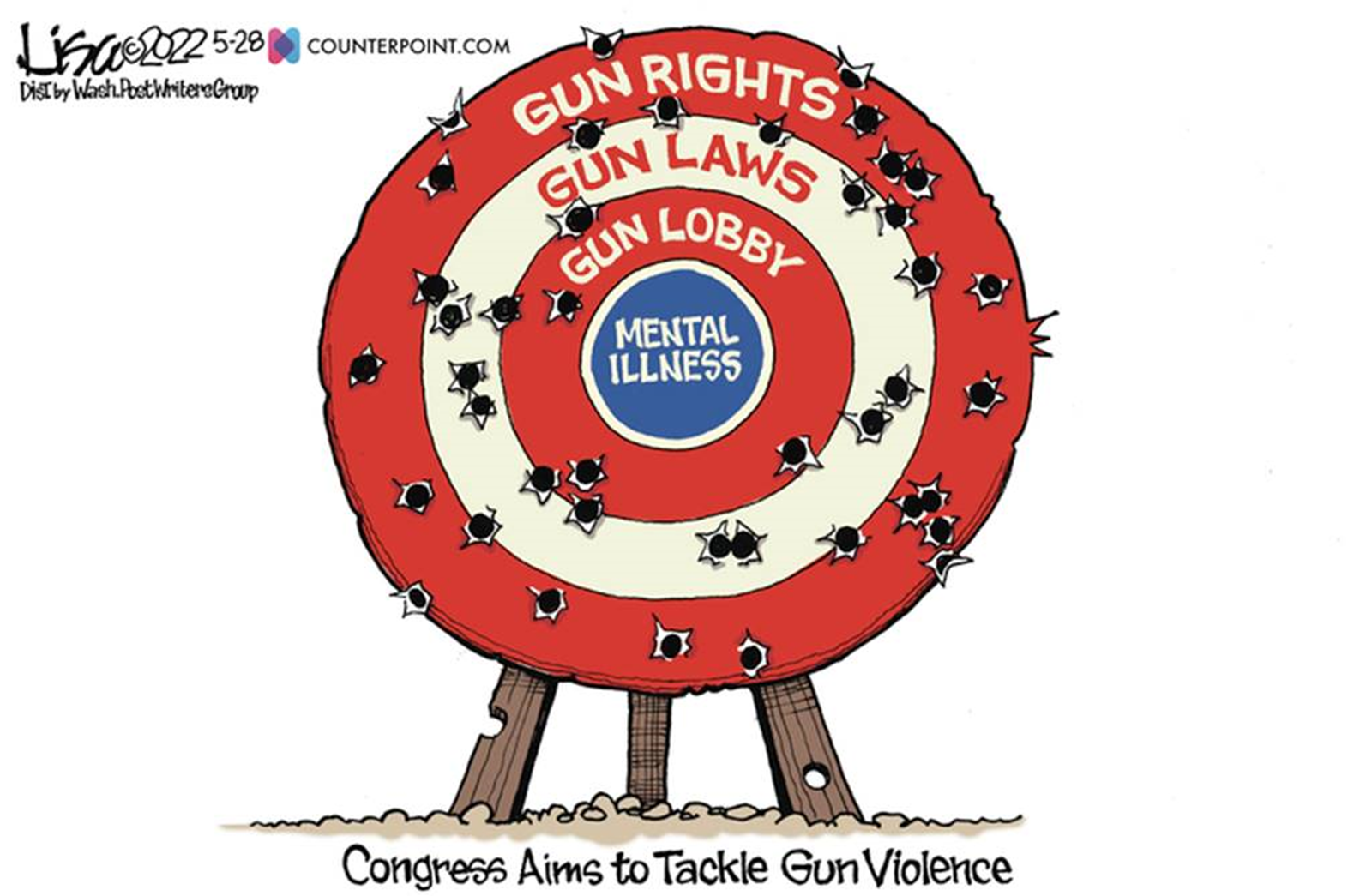
Instead, we have blame for the spate of killings and the carnage that seems to have become almost routine being leveled at marijuana, single parents, rock music, video games, mental illness, the Internet and, believe it or not, ABORTION.
And the justification for assault weapons pretty much runs the gamut, too.
Our very own US senators chimed in with John Neely Kennedy, that erstwhile Democrat-turned-Republican when the political winds shifted in Louisiana, declaring that the need for IDIOT CONTROL was more critical than gun control. How’s that for slapping a Band-Aid on a gaping AR-15 wound?
Question is, Mr. Kennedy, while you are advocating for better mental health for the masses, do you have a place people with such needs can go? It seems that most of the mental health centers in Louisiana have been boarded up, creating something of a Catch-22 for your solution to a growing crisis.
Perhaps this story from four years ago might provide more insight into Mr. Kennedy’s compassion for kids:
Yes, feral hogs are a problem, a big problem, especially for farmers. They can destroy a crop virtually overnight but I don’t think the aforementioned assassins, armed with AR-15s, were out for feral hogs. They were intent on killing innocent people. Among the 233 victims listed above, at least 72 were children.
Yet the gun-rights advocates clink to the 2nd Amendment as if it were the Holy Grail even as Florida’s Republican Gov. Ron DeSantis seems hell-bent on abolishing the 1st and 4th, Amendments and the US Supreme Court just effectively SHATTERED the protection of the 6th Amendment. (The highlighted link, by the way, comes from the conservative Washington Times.) To read the same story from another source, go HERE.
Sen. Lindsey Graham (R-S.C.) says he is open to negotiating a reasonable solution to the slaughter. But we’ve heard his B.S. before. Remember, when following the restoration of order after the Jan. 6, 2021 insurrection, HE SAID, “All I can say is count me out. Enough is enough.” In no time, he was back to his usual Trump sycophantic self.
It’s critical that we don’t treat these shootings as just another news cycle and then move on to the next story about a six-toed monkey that can play Chopin on the accordion. We cannot allow TV news to serve only as a buffer to keep prescription drug ads from bumping together. We need substance in our news reporting and stories like these dreadful shootings must not be allowed to fade into the background so Republicans can conveniently avoid having to face cold, hard facts.
But if past is truly prologue, as Shakespeare told us in The Tempest, then the Buffalo, Uvalde, Tulsa and Ames stories will produce breathless stories by network correspondents before they quickly become old news.
We cannot allow that to happen. We must continue beating the drum of reform until, like Poe’s Tell-Tale Heart, the Republicans in Congress hear enough from their constituents to know that the time for change has come.
Persistence is the only hope for meaningful reform and we cannot afford to shrink from that duty. We must emulate Fred Guttenberg, whose 14-year-old daughter was killed at Marjory Stoneman Douglas High School in 2018. Guttenberg has been a constant thorn in the side of Republicans who would gladly walk away from their responsibility. He has never quit fighting the good fight and recently took US Rep. “Gym” JORDAN to task for his accusation of Democrats for “political theater” in their “PROTECTING OUR KIDS ACT.”
Why do you think Ted “Cancun” Cruz not only attended the NRA convention in Houston just days after the Uvalde shooting, but had the gall to POST A VIDEO of him participating in a charity poker tournament even as victims of the shooting were being buried. It was probably (and I emphasize the word probably) the most insensitive thing Cruz has done since he split for Cancun with his family during the 2021 freeze that left millions of Texans without heat or electricity.
It was bad enough that he could see nothing wrong with participating in the tournament even as funeral services were being held for victims, but to post the damn video on the Internet was especially crass, even for Ted Cruz.
Others, such as Rep. Greg Steube (R-Florida) take the offensive in DEFENDING their blue steel babies.
Whenever I see some macho dude in Walmart or Chili’s with a gun stuck in his belt, I want to advise him to at least get a holster because if it goes off where it is, he could well blow his brains out.
So, what are some of the solutions, other than thoughts and prayers, being offered up by these concerned Republicans? Well, Cruz says schools need fewer doors. John Kennedy advocates fewer idiots while Bill Cassidy just wants to shoot feral hogs. Missouri Rep. Bill Long is convinced that abolishing abortions will do the trick.
In Louisiana, as well as in other states, legislators are advocating that teachers be armed so that they can confront the bad guys. But if the cops in Orlando, or Parkland, Florida, or Uvalde aren’t willing to risk confronting a gunman with an AR-15, why should we expect teachers to do so?
Last time I checked, that wasn’t part of the education curriculum at any university in Louisiana. Isn’t it enough that teachers are already vastly underpaid and must still dig into their private funds to purchase classroom resource material? Isn’t it enough that politicians are looking over teachers’ shoulders to be sure they aren’t teaching something called CRT? Isn’t it enough that political hacks are telling teachers which textbooks are appropriate and which are not? Isn’t it enough that elementary school teachers find themselves changing students’ soiled clothing and middle- and high-school teachers are risking injury breaking up fights? Now we expect them to wear body armor and arm themselves against a shooter armed with an assault weapon?
I don’t freakin’ think so. Where the hell does Rep. Danny McCormick think he comes off as some sort of problem solver with that scatter-brained idea? Well, he has plenty of company. His bill, HB 37, passed the House by a 65-26 vote. Want to know who voted how? Click HERE.
Remember this, you knee-jerk a—holes, if that bill becomes law and some well-meaning teachers accidentally shoots and kills a kid, it’s on you. You can take the grim satisfaction in the knowledge that you helped kill a kid. The flip side is a teacher taking down a would-be killer, but the odds are far more in favor of the former scenario than the latter. You know it, and I know it.
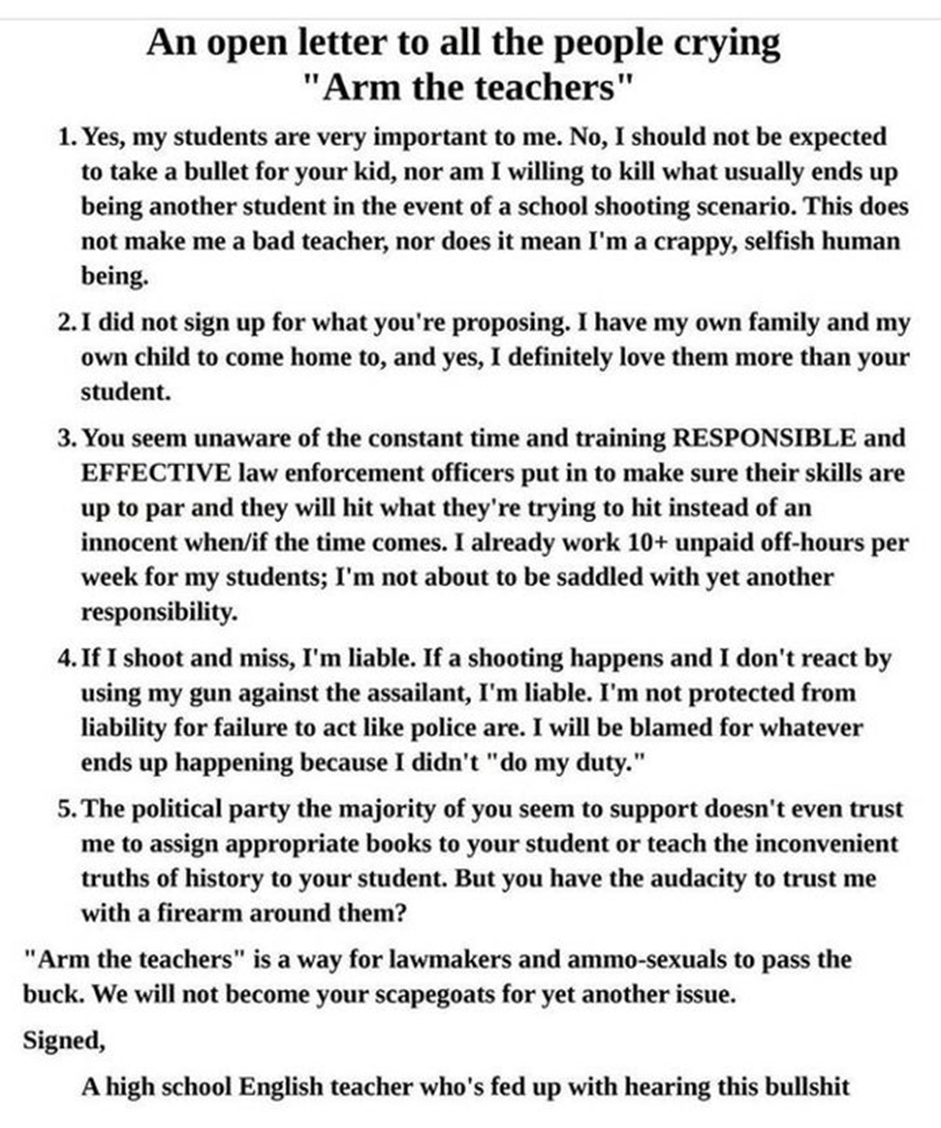
Here is the reaction of one teacher to the suggestion that she be armed, locked and loaded:
Will it ever stop?
No, I’m not referring to the mass shootings which now seem to be a daily occurrence, though my rhetorical question might well apply to those senseless acts.
But rather, I am asking (again, rhetorically) if the bought and paid-for Republicans will ever reach down into their hearts and finally say enough is enough and something must be done to stem the proliferation of assault weapons in this country.
Columbine (13 killed), Sandy Hook (26 dead), Margaret Stoneman Douglas (17 murdered), Aurora, Colo. (12), Aurora, Illinois (6), Orlando (50), Las Vegas (60), Pittsburgh (11), Buffalo (10), Uvalde, Texas (21), Tulsa (4), and just yesterday, Ames, Iowa (3 dead).
Will it ever stop?
The question truly is rhetorical because the Republicans just don’t have the resolve to turn their collective backs on the NRA money and to say that guns are the problem.
Instead, we have blame for the spate of killings and the carnage that seems to have become almost routine being leveled at marijuana, single parents, rock music, video games, mental illness, the Internet and, believe it or not, ABORTION.
And the justification for assault weapons pretty much runs the gamut, too.
Our very own US senators chimed in with John Neely Kennedy, that erstwhile Democrat-turned-Republican when the political winds shifted in Louisiana, declaring that the need for IDIOT CONTROL was more critical than gun control. How’s that for slapping a Band-Aid on a gaping AR-15 wound?
Question is, Mr. Kennedy, while you are advocating for better mental health for the masses, do you have a place people with such needs can go? It seems that most of the mental health centers in Louisiana have been boarded up, creating something of a Catch-22 for your solution to a growing crisis.
Yes, feral hogs are a problem, a big problem, especially for farmers. They can destroy a crop virtually overnight but I don’t think the aforementioned assassins, armed with AR-15s, were out for feral hogs. They were intent on killing innocent people. Among the 233 victims listed above, at least 72 were children.
Yet the gun-rights advocates clink to the 2nd Amendment as if it were the Holy Grail even as Florida’s Republican Gov. Ron DeSantis seems hell-bent on abolishing the 1st and 4th, Amendments and the US Supreme Court just effectively SHATTERED the protection of the 6th Amendment. (The highlighted link, by the way, comes from the conservative Washington Times.) To read the same story from another source, go HERE.
Sen. Lindsey Graham (R-S.C.) says he is open to negotiating a reasonable solution to the slaughter. But we’ve heard his B.S. before. Remember, when following the restoration of order after the Jan. 6, 2021 insurrection, HE SAID, “All I can say is count me out. Enough is enough.” In no time, he was back to his usual Trump sycophantic self.
It’s critical that we don’t treat these shootings as just another news cycle and then move on to the next story about a six-toed monkey that can play Chopin on the accordion. We cannot allow TV news to serve only as a buffer to keep prescription drug ads from bumping together. We need substance in our news reporting and stories like these dreadful shootings must not be allowed to fade into the background so Republicans can conveniently avoid having to face cold, hard facts.
But if past is truly prologue, as Shakespeare told us in The Tempest, then the Buffalo, Uvalde, Tulsa and Ames stories will produce breathless stories by network correspondents before they quickly become old news.
We cannot allow that to happen. We must continue beating the drum of reform until, like Poe’s Tell-Tale Heart, the Republicans in Congress hear enough from their constituents to know that the time for change has come.
Persistence is the only hope for meaningful reform and we cannot afford to shrink from that duty. We must emulate Fred Guttenberg, whose 14-year-old daughter was killed at Marjory Stoneman Douglas High School in 2018. Guttenberg has been a constant thorn in the side of Republicans who would gladly walk away from their responsibility. He has never quit fighting the good fight and recently took US Rep. “Gym” JORDAN to task for his accusation of Democrats for “political theater” in their “PROTECTING OUR KIDS ACT.”
Why do you think Ted “Cancun” Cruz not only attended the NRA convention in Houston just days after the Uvalde shooting, but had the gall to POST A VIDEO of him participating in a charity poker tournament even as victims of the shooting were being buried. It was probably (and I emphasize the word probably) the most insensitive thing Cruz has done since he split for Cancun with his family during the 2021 freeze that left millions of Texans without heat or electricity.
It was bad enough that he could see nothing wrong with participating in the tournament even as funeral services were being held for victims, but to post the damn video on the Internet was especially crass, even for Ted Cruz.
Others, such as Rep. Greg Steube (R-Florida) take the offensive in DEFENDING their blue steel babies.
Whenever I see some macho dude in Walmart or Chili’s with a gun stuck in his belt, I want to advise him to at least get a holster because if it goes off where it is, he could well blow his brains out.
So, what are some of the solutions, other than thoughts and prayers, being offered up by these concerned Republicans? Well, Cruz says schools need fewer doors. John Kennedy advocates fewer idiots while Bill Cassidy just wants to shoot feral hogs. Missouri Rep. Bill Long is convinced that abolishing abortions will do the trick.
In Louisiana, as well as in other states, legislators are advocating that teachers be armed so that they can confront the bad guys. But if the cops in Orlando, or Parkland, Florida, or Uvalde aren’t willing to risk confronting a gunman with an AR-15, why should we expect teachers to do so?
Last time I checked, that wasn’t part of the education curriculum at any university in Louisiana. Isn’t it enough that teachers are already vastly underpaid and must still dig into their private funds to purchase classroom resource material? Isn’t it enough that politicians are looking over teachers’ shoulders to be sure they aren’t teaching something called CRT? Isn’t it enough that political hacks are telling teachers which textbooks are appropriate and which are not? Isn’t it enough that elementary school teachers find themselves changing students’ soiled clothing and middle- and high-school teachers are risking injury breaking up fights? Now we expect them to wear body armor and arm themselves against a shooter armed with an assault weapon?
I don’t freakin’ think so. Where the hell does Rep. Danny McCormick think he comes off as some sort of problem solver with that scatter-brained idea? Well, he has plenty of company. His bill, HB 37, passed the House by a 65-26 vote. Want to know who voted how? Click HERE.
Remember this, you knee-jerk a—holes, if that bill becomes law and some well-meaning teachers accidentally shoots and kills a kid, it’s on you. You can take the grim satisfaction in the knowledge that you helped kill a kid. The flip side is a teacher taking down a would-be killer, but the odds are far more in favor of the former scenario than the latter. You know it, and I know it.
Here is the reaction of one teacher to the suggestion that she be armed, locked and loaded:
I invite you to listen to a couple of reactions to the Uvalde shooting. The first is by NBA Golden State Warrior head basketball coach Steve Kerr. To hear his reaction, click HERE.
The second is by Jimmy Kimmell. He has trouble getting through his comments, but you can hear it all by clicking HERE.
Finally, here are a couple of 2021 Christmas cards from members of the US Congress:
Rep. Thomas Massie (R-Kentucky) and family 2021 Christmas cardRep. Lauren Boebert (R-Colo.) and family 2021 Christmas card(With apologies to James Carville)
LouisianaVoice does not accept advertising because we insist on an independent voice. Likewise, we do not charge a subscription fee for our blog.
That is not to say we do not have expenses—lots of them. Moreover, we would love to add a reporter to provide even better coverage of the underbelly of Louisiana politics.
Your contribution would help us immensely in meeting our growing expenses. Simply click on the “Donate” button here and contribute whatever you feel appropriate.
Thank you.
Tom Aswell, Publisher
Got a tip?
Got a news lead for LouisianaVoice to investigate? Have a suggestion for a story? Your identity will never be revealed. Just send an email to louisianavoice@outlook.com
Read my books!
Read more Books!
Order your Piyush Bumper Sticker Now!
Click image to order
$2.50 each or three for $6.00










 Louisiana Voice