Wow. Did Lane Kiffin ever deliver. LSU dismantled Clemson Saturday night in a beat-down of truly epic proportion. And the entire college football world was watching, even after a two-hour lightning delay complete with monsoon-like rain. LSU is the talk of college football. Paul Finebaum, ESPN pundit who began his professional career writing for The Shreveport Journal, said LSU has become the team “nobody can look away from.”
The SEC and commissioner Greg Sankey aren’t looking away. The SEC has filed an amended lawsuit against LSU in federal court alleging a “lack of institutional control,” laying out the process for expelling a member institution, and seeking a ruling to do so by virtue of their First Amendment right of “free association.” A vote is scheduled among conference presidents Thursday to proceed. Sankey needs eleven university presidents to vote yes.
The lawsuit specifically notes Kiffin’s comments at halftime of the Clemson game and the post game comments as well. The lawsuit also states neither the university president nor the Athletic Director – both hand-picked puppets of the governor and Lee Mallett – have issued any statements to the contrary or taken any action to rein in Kiffin. Nor, it alleges, has the Board of Supervisors stepped in.
At halftime Kiffin said as he was leaving the field following a brief interview, “Imagine if we had pro players.” In post-game comments Kiffin declined to address the issue when asked except to say whether people agreed or not, he was doing what he thought was right for those players.
But what has Sankey riled and the other SEC teams upset with is LSU has seemingly given Lane Kiffin a blank check to do as he pleases and that scares the hell out of them. None of them like Kiffin as a person or like how he has mastered the modern era of college football quicker and better than anyone else. Kiffin demonstrated at Ole Miss his understanding of the modern game and his ability to coach could transform a program. He took Ole Miss to places the Rebels haven’t been in sixty years or more, relevant on a national level. And by taking Clemson apart with a roster of fifty new players, and with no restraints at a school such as LSU, Kiffin demonstrated he could set the agenda in college football.
But according to the amended lawsuit Sankey is offended. He and the other schools don’t wish to associate with LSU. LSU doesn’t represent their “values.” It probably has nothing to do with Greg Sankey losing power by the minute. Sankey lost influence with the politicians that were writing legislation. He lost conference prestige to the Big Ten, and he lost leadership to Big Ten commissioner Tony Petitti. He lost almost every court case to a judge, including the one in Baton Rouge. Sankey likely has little appetite for losing to Lane Kiffin and LSU. And apparently, he intends to make LSU pay for all that losing.
The accusation should come as no surprise as Sankey’s strategy in his power play. LSU is set up perfectly for it, by their own hands. Actually, by Governor Jeff Landry’s hands, which are all over the cesspool this has become. It goes without saying a strong athletic director would have nipped all this in the bud long ago – which is why Landry’s first move was to fire Scott Woodward on Trumped up accusations of signing a coach for too much money and agreeing to an expensive buyout and whatever else he chose to make up and then double-down on.
With Woodward out of the way and at the urging of now chairman of the Board of Supervisors Lee Mallett, Landry had the board name Verge Ausberry AD because Verge would either help them accomplish their aims or get out of their way. Landry then chose Wade Rousse to act as figurehead president and approve their coaching hires. And Landry and Mallett got who they wanted – Lane Kiffin as football coach and Will Wade as basketball coach.
The role Wade plays in all this cannot be dismissed. He hasn’t been mentioned but his roster has several international club “pros” as well as one player, R.J. Luis, who left college early, signed with Boston, played in the NBA “G” league, but was granted another year of eligibility in the lawsuit ruled on in Baton Rouge last week. Wade is another “I did it my way” coach and college basketball is an even more sordid mess than college football has ever been. Sankey is certainly aware of this as well. Never mind that this past basketball season Alabama played a former NBA “pro” for several games without Sankey threatening to kick them out of the league.
So, our governor and his boy took over the university and hired the coaches they wanted for their teams. Kiffin has certainly delivered. Say what you want about him but the LSU team that took the field Saturday night was better coached, better prepared, more disciplined, and executed better than anything Brian Kelly ever put on the field, or Ed Orgeron with the exception of 2019. If given the opportunity Will Wade could very much do the same. He has before, here at LSU and elsewhere. Two coaches with little respect for the “rules” and no adults in the room. That’s the image Greg Sankey will try to paint for both the conference presidents and the courts. Landry and Mallet set it up perfectly for him.
LSU, Lane Kiffin, Greg Sankey, and the SEC have become the actors playing out the final conclusion to more than 40 years of inaction by the NCAA. More than any other issue facing college athletics this issue at LSU will be the turning point. Maybe the SEC will vote to expel LSU. Maybe they will kick the Tigers out or maybe they’ll just use the threat to coerce. Maybe university presidents won’t give Sankey the authority. Anything could happen. But because it has come to this either Congress will pass legislation – for good or ill – or there will be a complete restructuring of college athletics very soon, with all possibilities open.
Should we thank Landry, Mallet, and their puppets Rousse and Ausberry for forcing the issue that could start to bring some order to the chaos? Surely that wasn’t what any of them intended when they hired Kiffin and Wade. Whatever order comes out of this won’t be the most desirable but order we will get. Someone is going to walk away from this with rule-enforcing authority. If it’s conferences and commissioners like Sankey and Petitti it will be a bit slower but much more suited to the modern world. If it’s Congress and the NCAA via legislation then the problems will just continue only no one will be able to challenge the relics and dinosaurs inhabiting the NCAA, so some order will result.
But all most fans want is more of what they got Saturday night, and as long as they get it “F*** the world!” That was the halftime message in a viral leaked audio from the LSU locker room. Kiffin was firing up his team not to let up in the second half. He told them to make sure the other team knew who was on their schedule. He said the world already wanted them to lose, already hated them, so …
It’s a message that plays well in the locker room. On local sports radio former Tigers and pros Jacob Hester and Matt Flynn played the clip. Jake said, admiringly, “I didn’t know he had that in him.” It’s a message that plays well to fans, especially after dishing out an ass whipping like that. It’s a message that even plays well to the national audience. LSU is a team you either love or hate. Or love to hate. But it’s not a message playing well at the SEC offices or with commissioner Sankey. He seems to be in a “shoot the messenger” frame of mind.
When you dot every i and cross every t and still cannot get authorities to give your complaints serious consideration, you have to wonder what the purpose might be in establishing an avenue to register complaints in the first place.
Cases in point: the Louisiana Attorney Disciplinary Board and the Office of the Disciplinary Counsel.
Without advocating for one party or the other, it just seems when a party to a legal dispute has what appears to be a legitimate concern, there should be a legitimate response—like a real inquiry into those concerns as opposed to a superficial one-size-fits-all dismissal with no resolution of the perceived problem.
In the matter of Ragland v. Ragland, it appears that repeated (4) requests for and (4) granting of continuances at considerable attorney fees to Katherine Ragland would merit more than cursory rejections by the disciplinary counsel’s office of Ms. Ragland’s complaints of unnecessary and costly delays in her case, not to mention the continued smearing of her character.
To her most recent complaint, the response said, in part, “Our burden of proof is clear and convincing evidence…”
“Clear and convincint evidence?” It would seem that would not necessarily be a prerequisite for an investigation of the complaint; that, I was always taught, was a requirement of an actual conviction. And without an investigation, there’s not much chance of a conviction.
Perhaps that’s the objective; avoid serious investigations to avoid the nasty process of embarrassing a fellow member of the bar.
The background of this case is extensive and, admittedly, complicated, but essentially, Ms. Ragland is contending:
Attorney Ebony Cavalier repeatedly appeared on behalf of the IRIS Domestic Violence Intervention Center “and requested continuances resulting in renewed temporary restraining orders (TROs) remaining ‘in full force and effect’” despite an IRIS spokesperson’s assertion that the agency was in no way involved in her case and that Cavalier’s participation was merely a “courtesy to the court” for docket-management purposes.
“This contradiction is extraordinarily serious,” Ms. Ragland wrote. “IRIS Domestic Violence Intervention Center is not an ordinary private entity. It is a specialized domestic violence organization carrying institutional credibility, implied expertise, victim advocacy authority, and perceived professional evaluation regarding allegations of abuse. Accordingly, repeated official representations that an attorney was appearling “on behalf of IRIS” in domestic abuse TRO proceedings naturally conveyed to the court, opposing parties, appellate courts, and the public that an independent domestic violence organization had some substantive basis for participating in, supporting, or legitimizing continuation of the TRO proceedings. ‘Under Louisiana law, continuances extnding TRO proceedings require “good cause.” The repeated use od ITIS’s name and institutional status in connections with continuances and TRO renewals created the appearance that an independent domestic violence organization had reviewed he matter and supported continuation of amergency abuse-related resrictions, when representations asserted IRIS was not actually involved in the case in any substantive capacity. This conduct materially prejudiced me, contributed to the prolonged continuation of TRO restrictions, reinforced abuse allegations through institutional appearance rather than competent evidence, and contaminated both the trial court and appellate record with the false appearance of independent domestic violence agency involvement.”
Ms. Ragland also wrote, “These repeated appearances and requests for continuances became part of the permanent appellate record. Accordingly, the repeated representation that Ebony Cavalier was appearing ‘on behalf of IRIS Domestic Violence Intervention Cener’ was not an isolated clerical issue. It became embedded in the official procedural history of the case and was later repeated and reinforced by the appellate court itself.”
Back to that “burden of proof”: It would seem if the Office of the Disciplinary Counsel wanted some sort of proof, it needed only consult the court records. Instead, Ms. Ragland received a four-paragraph letter that said, among other things, “The ODC appreciates your concern for the maintenance of professional standards by all attorney in our state…” In other words, take a hike.
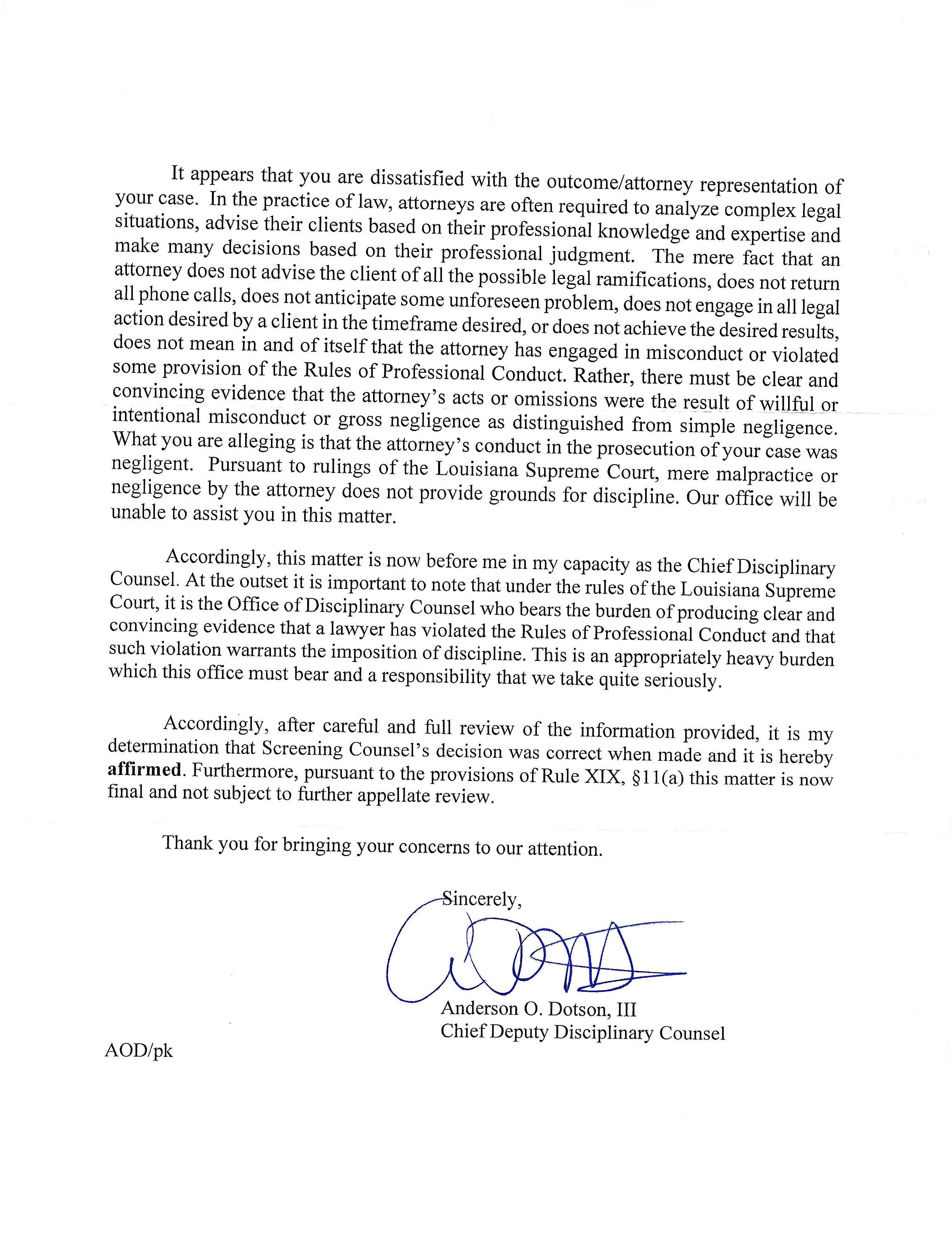
She received a similar generic rejection from the Louisiana Attorney Disciplinary Board’s Chief Disciplinary Counsel Anderson O. Dodson, III who was kind enough to include Supreme Court Rule XIX, which said in part (in boldface type), Objections to screening decisions shall be reviewable by the Chief Disciplinary Council (Dotson, III), but are within counsel’s discretion and not otherwise subject to appellate review.”
Dotson III then took the occasion to lecture Ms. Ragland as though she were a toddler:
LouisianaVoice has from time to time questioned the interminable delays, the appearance of bias against or for certain attorneys in family court and the unwillingness of some judges to hear both sides of an issue before making decisions that seem to defy all logic.
This brief record of Ms. Ragland’s frustrations and the offhand manner in which the disciplinary board and disciplinary counsel treated her complaints, no matter how well-constructed they might be, only reinforces the appearance that protection of their own is of paramount concern to the board—even at the expense of emotionally and financially-strapped victims of the courts.
The exchange is enough to prompt this question:
If a detailed, item-by-item complaint outlining the sequence of events in minute detail is not sufficient to warrant a full-scale investigation, just what are the criteria for action?
Will Livingston Parish give away the store in making too generous concessions the way Louisiana Economic Development would prefer in order to obtain that data center in Walker or will parish leaders follow the example of West Feliciana Parish and dig their heels in refusing to grant a 10-year property tax exemption?
West Feliciana leaders, casting their eyes northward to Richland Parish, must’ve have seen the concessions being granted Meta for its $50 billion data center being built there. The state, in surrendering sales tax revenue of up to 80 percent on the purchase of materials and equipment will cost the state MORE THAN $3.3 BILLION, according to Sherwood News. And that doesn’t even take into consideration the loss to the parish in the 10-year property tax exemptions.
Louisiana Economic Development (LED), of course, wanted to offer similar concessions to Hut-8 in West Feliciana for its $10 billion data center but the parish was determined not to cede property tax revenue. State sales tax exemptions were granted by LED on the purchase of steel, cement and other equipment and materials.
Louisiana provides a sales and use tax exemption for purchases related to data centers certified by LED. The exemption applies to eligible data center equipment and certain expenditures made for the development, acquisition, construction, lease, repair, refurbishment, expansion, or renovation of a qualified data center.
The exemption may also apply to other parties involved in the project, including affiliates of the data center and contractors or subcontractors performing work at the project site.
The West Feliciana Parish School Board did a major construction project with dales tax revenues from the River Bend Nuclear Plant but that money was denied the board by Gov. Jeff Landry and the legislature from the Hut-8 project.
HOUSE BILL 827 of the 2024 regular session of the Louisiana Legislature, authored by Rep. Christopher Turner (R-Ruston) passed the Senate on final vote of 35-0 and likewise breezed through the House by 83-4 in becoming Act 827.
As originally written, HB 827 provided state and local sales and use tax rebates on the sale of “certain communications service equipment and data center equipment” and was originally intended for rebates on FIBER-OPTIC AND DATA CENTER equipment.
But by the November special session that year, it had become HOUSE BILL 10 by Rep. Mark Wright (R-Covington). You have to scroll down to the bottom of page 130 to find the changes which scrapped the rebates and offered instead garden-variety tax exemptions.
Like HB 827, this one also passed easily in the Senate by a 38-0 vote and by an 80-19 vote in the House on the way to becoming Act 11.
Those two bills were for the benefit of Meta’s huge data center in Richland Parish. But West Feliciana, as already pointed, out opted out of the 10-year property tax exemption in its insistence on not giving away the farm.
The bottom line is West Feliciana has received $10 million from the $10 billion project while the State of Louisiana will reap a comparatively low $25 million from the $100 billion Space X venture in Vermilion Parish. West Feliciana is also getting $16 million in water system improvements that Hut-8 is installing to have adequate fire protections numbers. Additionally, the parish is expected to see about $90 million a year through its PILOT scheme but to date has received only the aforementioned $10 million.
It should be noted that Anthropic will be paying the bulk of that money the parish gets because its equipment will be in Hut-8’s buildings.
So, with all those numbers being bandied about, what are the options for Livingston Parish?
Will LED prevail in granting exemptions galore in order to attract whoever it is that will preside over the facility in Walker (early but unofficial reports identify the company as Microsoft) or will parish officials insist on not giving up property tax revenue that can help build infrastructure, pay teachers and law enforcement more?
HOUSE BILL 922 by Rep. Rodney Schamerhorn (R-Hornbeck) would have done just that but efforts by the Louisiana Public Service Commission and the House Commerce Committee killed his bill in committee.
Schamerhorn said the only thing his bill did was to codify assurances made by Entergy officials in meetings in Washington and later in Shreveport that it would be responsible for bearing 100 percent of the costs of improvements and expansions to generating capacity for the data centers. “We have to protect the citizens of this state” from increases in electricity costs, he said in testifying in support of the bill back in March
Instead, Louisiana citizens have zero statutory protection from significant rate hikes, prompting one opponent of the data centers, a member of Louisiana Citizen Advocacy Group (LACAG) to say, “Multi-billion-dollar corporations get our money. We get a ‘pledge’ from them and the NDA-signing Louisiana politicians covering for them. We deserve better.
“Data centers consume massive amounts of power. If tech giants don’t pay 100 percent of their infrastructure costs, your monthly electric bill goes up to subsidize them. Right now there is no law stopping Entergy from offloading those costs onto your family,” the LACAG member said.
Her concern appears to be well-placed.
In Arkansas, Entergy FILED A LAWSUIT against the Arkansas Democrat-Gazette in an effort to keep the newspaper from publishing leaked details of a major electricity deal for a new Google data center in that state.
The documents revealed that Google might be responsible for only about one-third of its actual $1.6 billion infrastructure costs for a solar plant built to power the data center. Arkansas residents would be on the hook for the remainder.
Fortunately for freedom of the press, a federal judge ruled in favor of the newspaper—this time.
Many industry sources downplay claims that data centers will be responsible for rate hikes but the truth is it’s far too early to say with any certainty.
Other energy experts, however, DISAGREE. They say energy demand from data centers cannot help but create a demand for more and more energy and as these energy-ravenous centers continue to be built, the result will ultimately result in increases in costs of electricity for U.S. households.
Consumers in the West and Northeast have already seen electricity costs increase and experts say there is no reason to believe the trend won’t continue.
Livingston Parish, like West Feliciana, may have no say in what the state does in granting exemptions on state sales taxes. The state, in fact, has already thwarted an effort to codify an informal agreement by Entergy that would have committed the utility to bear 100 percent of the cost of infrastructure and generating upgrades for the benefit of Meta.
Livingston Parish President Randy Delatte, while denying he or any parish officials have signed nondisclosure agreements, admitted at much in testimony before the parish planning commission in may of 2024 and Parish Council member Ricky Goff also admitted signing an NDA in his testimony before the zoning commission last November.
Meanwhile, Delatte, in saying there was no data center project he could announce, nonetheless told the Baton Rouge Advocate last week that a data center would result in $140 million in annual property taxes, lending speculation that preliminary talks about such a project are more than mere conjecture.
LouisianaVoice runs on independence, not advertising. No subscription fees — just the stories Louisiana politicians don't want told. If that's worth something to you, we'd appreciate your support.