Feeds:
Posts
Comments

Archive for the ‘Vitter’ Category

With all that’s going on with the Louisiana State Police, it has become easy to overlook the fact that we will be voting in a little more than two weeks for someone to try to undo the damage done by eight years of the Jindal carnage inflicted upon this state. (Don’t worry, we’ll get back to the State Police in a day or so.)

The governor’s race, unlike those of past years, has failed to generate a lot of interest among voters. That’s probably because the media has convinced us that U.S. Sen. David Vitter is a lock to be our next governor. I mean, who could possibly get excited over an election when we’re being told that it’s inevitable that the pariah of femininity will be our next governor?

Speaking of the media, the questions posed in the televised debates thus far have been nothing short of disgraceful. It’s no wonder that people are turned off by this year’s election. How, after all, does Kim Davis even begin to figure in the issues facing Louisiana’s next governor? That question was just plain stupid and a huge waste of time.

And who put the media in charge of anointing winners even before an election? Do our votes actually count anymore? (We will be addressing those questions shortly.)

First of all, what self-respecting Republican woman in Louisiana would ever cast a vote for someone like Dave Vitter? For that matter, what Republican woman would ever allow her husband to vote for this man who has only contempt for women as exhibited by the fact that:

  • He frequented prostitutes in Washington, D.C. and New Orleans;
  • He kept an aide, Brent Furer, on his payroll for more than a year after Furer held his ex-girlfriend hostage, threatened to kill her and in fact, attacked her with a knife. Vitter denied Furer was assigned to women’s issues. Furer’s title? Legislative Assistant on Women’s Issues.
  • He voted a year ago to block the Paycheck Fairness Act despite the fact that Louisiana ranks second-worst in the nation in gender pay disparity.

We say Republican women only because we feel it’s a foregone conclusion no Democrat woman would ever vote for this man who continues to refuse to address his personal and public issues with women.

But all that aside, let’s look at the real reason that Vitter is considered a favorite to make the runoff against Democrat John Bel Edwards.

Money. Lots of money.

And that brings us to the questions we posed earlier: Who anoints the winners and do our votes really count?

First of all, a super PAC is established for his benefit. Super PACs are the scourge of the democratic process, folks. End of discussion. And his Super PAC, ironically dubbed The Fund for Louisiana’s Future in what must have been someone’s idea of a cruel joke, had more than $3 million on hand at the end of 2014. And that doesn’t even count the money he has raised directly in corporate and special interest contributions.

The very existence of the Super PAC teetered on the edge of legality and was approved only after a court fight. Super PACs are barred from coordinating with candidates’ campaigns but if you believe Vitter has not involved himself in the decision-making process of The Fund for Louisiana’s Future, I’ve got some beautiful beachfront property near that Bayou Corne sinkhole in Assumption Parish for sale really cheap.

If you trust Vitter even for a nano-second, I’ve got a straitjacket in just your size.

His Super PAC aside, Vitter has another $4 million on hand as we head into the final stretch for the first primary on Oct. 24. As anyone not in a coma must surely know, The Fund for Louisiana’s Future has already initiated a media blitz attacking Vitter’s two Republican opponents, Lt. Gov. Jay Dardenne and Public Service Commissioner Scott Angelle on the assumption that he must eliminate them to get into the runoff. He apparently is holding off on attacking State Rep. John Bel Edwards until the second primary.

Compare that to $1.6 million for Darden who has yet to crank up his TV ad campaign, $1.4 million for Edwards, and $1 million for Angelle.

Far more telling, however, is an examination of who contributes and where those contributions are coming from.

For that, we pulled only the contributions of those giving the maximum allowable $5,000. To go deeper would have just taken far too much space.

Before we begin our look into the contributions, ask yourself this question: If you give $100 or even $250 to a candidate and he is elected and down the road your interests conflict with a donor who coughed up the $5,000 maximum, who do you think will get the politician’s ear? What chance would you have in such a scenario? We thought so.

This is not a hypothetical, folks. This is real. It’s not Monopoly money. It’s money poured into campaigns by special interests who have a reason for parting with their money—and the reason is not their hunger for good, honest government that motivates them.

Remember that if you remember nothing else when you walk into that voting booth on Oct. 24.

You are a moving part in a very large machine that is being lubricated with cash in order to turn out legislation that benefits any number of special interests, none of whom even knows who you are. When you exit the voting booth, that big money has no more use for your services—until the next election cycle.

Cold? Callused? Jaded? Yes, yes, and yes. But we at LouisianaVoice are pragmatists, not idealists. We as a society do not pledge allegiance to the flag; we pledge allegiance to the oil companies, the banks, Wall Street, and major contractors. Sorry if we burst anyone’s bubble, but facts are facts, unpleasant though they may well be. Here’s another little factoid: the Pledge of Allegiance was written by a socialist. Chew on that for a while, tea partiers.

Looking just at $5,000 contributions, we find that Vitter had 970 donors putting up the maximum, or $4.85 million. That’s a huge—very huge—chunk of his total contributions. Of that 970, there were 164 (17 percent) from out of state. That’s $820,000—more than the total of all the $5,000 contributions to Edwards and only $30,000 less than those of Dardenne.

Angelle barely had a third as many $5,000 contributors (340 for $1.7 million). Of those 340, no fewer than 81 (24 percent) were from out of state. Like Vitter, the $5,000 contributors made up a sizable block of his total campaign contributions. Where does that leave the $5, $10 and $20 contributors in the overall scheme of things?

From those figures, the numbers dropped precipitously for Dardenne and Edwards. Dardenne received 170 contributions of $5,000 each for a total of $850,000, about half of his total contributions, according to records obtained from the State Ethics Commission. Sixteen, or 9.4 percent, were from out of state.

Edwards recently issued a press release touting the low number of out-of-state contributors to his campaign. Records show that he received 114 contributions of $5,000 each for a total of $570,000. Only three of those, or 2.6 percent, were from out-of-state, in his case, all three from Texas.

This is an important election and Louisiana citizens need to get up off the couch, put down that bag of chips and forget about football for the few minutes that it takes to act on this state’s future.

No matter who wins, it is going to be difficult, if not impossible, to get this state back on the course of recovery after eight years of neglect, abuse, and outright corruption. The new governor is going to inherit a massive deficit, all manner of problems from higher education and public education, the state hospital privatization mess, a world-leading incarceration rate, corporate welfare (Stephen Waguespack’s protestations notwithstanding), and one of the highest poverty rates in the country, to name but a few.

So here is one last question to ask yourself before you enter that voting booth:

Do you vote for the candidate who had the most money to saturate the television airwaves with ads containing half-truths and outright lies, a candidate who is bought and paid for by Wall Street, the pharmaceutical firms, big oil, the major banks and similar special interests or do you vote for the candidate who you truly feel will devote his efforts to addressing the state’s problems head-on?

The state’s future dos not belong to The Fund for Louisiana’s Future. That vote-buying Super PAC is not even in Louisiana; it’s in Washington, D.C.

The state’s future instead belongs to you.

The choice is yours.
Read Full Post »

No sooner did we call U.S. Sen. David Vitter out for potential improprieties for using his Senate franking privileges to gain an edge over his three opponents in this year’s gubernatorial election than our old friend C.B. Forgotston send us evidence of an even more flagrant misuse of his office for similar reasons.

It’s enough to make you wonder what the hell goes through these politicians’ minds except that we already know: they are so convinced they are above the law that they couldn’t care less what the great unwashed think about their flaunting of the rules.

We’ve previously reported Jindal’s acceptance of tainted campaign contributions from the Horsemen’s Benevolent and Protective Association (non-profits are prohibited from making campaign contributions), laundered money from a St. Tammany Parish bank board of directors (without the 11 directors’ awareness they were “contributing” $5,000 each to Jindal) and the head of Florida’s largest-ever Ponzi scheme who funneled $30,000 in contributions to Jindal from himself, his wife and his law firm.

Within an hour of posting the story about Vitter’s use of franking privileges to promote his gubernatorial campaign, LouisianaVoice’s email exploded with messages about Jindal’s latest post on the governor’s web page, paid for by Louisiana taxpayer dollars.

The first email was from Forgotston, who has fired off a letter to Inspector General Stephen Street demanding an answer to his inquiry as to the legality of Jindal’s “press release” on Tuesday.

So what, exactly, is all the fuss about?

Quite simply, Jindal used the state computer and web page (and presumably a state employee) to gin out a “press release” personally attacking one of Jindal’s probable opponents for the Republican nomination for president under the headline “Gov. Jindal: Senator Paul unsuited to be Commander-in-Chief.” http://www.gov.louisiana.gov/index.cfm?md=newsroom&tmp=detail&articleID=4965

Paul, a U.S. Senator from Kentucky, is an announced candidate for the Republican nomination. https://randpaul.com/

And what did Paul do or say that prompted Jindal to ignore legal constraints on the use of state web pages? Apparently, Paul said something to the effect that ISIS exists because of the U.S. hawkish foreign policy—a claim, by the way, that we cannot entirely disagree with.

“This is a perfect example of why Senator Paul is unsuited to be Commander-in-Chief,” Jindal whined.

Except he did his whining on a state-funded web page and that immediately invoked the wrath of a number of readers and Forgotston, who once worked as a legal counsel for the legislature, is not the one you want to tick off when it comes to matters concerning the state constitution.

In his email to Street, Forgotston began by describing the Jindal press release as “a violation of Louisiana Constitution, Article XI, 4.”

In case you don’t want to take the time to open the link, it says that while there is no prohibition against the use of public funds to disseminate factual information about a proposition appearing on an election ballot, “no public funds shall be used to urge any elector to vote for or against any candidate or proposition, or be appropriated to a candidate or political organization.”

“It (the press release) clearly urges a vote against U.S. Senator Rand Paul for President of the United States,” he said. “The press release was issued by state employees (the release contained the names of Shannon Bates Dirmann and Shannon, Deputy Communications Director for the Governor’s Office) and has no disclaimer that public funds were not used.

“If this is not a violation of the law, please advise why it isn’t,” Forgotston said. He ended his email by writing, in all caps, “A RESPONSE IS REQUESTED,” which he said “is not directed to any recipients of his email other than the State Inspector General.”

In case any of our readers also would like to submit a similar question to the OIG, here is Street’s email address: stephen.street@la.gov.

Forgotston said he will also share his concerns with Legislative Auditor Daryl Purpera.

As Forgotston himself is fond of saying: you can’t make this stuff up.


Read Full Post »


U.S. Sen. David Vitter could be setting himself up for a repeat of ethics complaints over a perceived use of his Senate franking privileges in his campaign for governor.

The congressional franking privilege, which originated in 1775, allows members of Congress to send official notices, brochures and updates to constituents back home under their signature without having to pay postage. Congress, through legislative appropriations, reimburses the U.S. Postal Service for franked mail it handles.

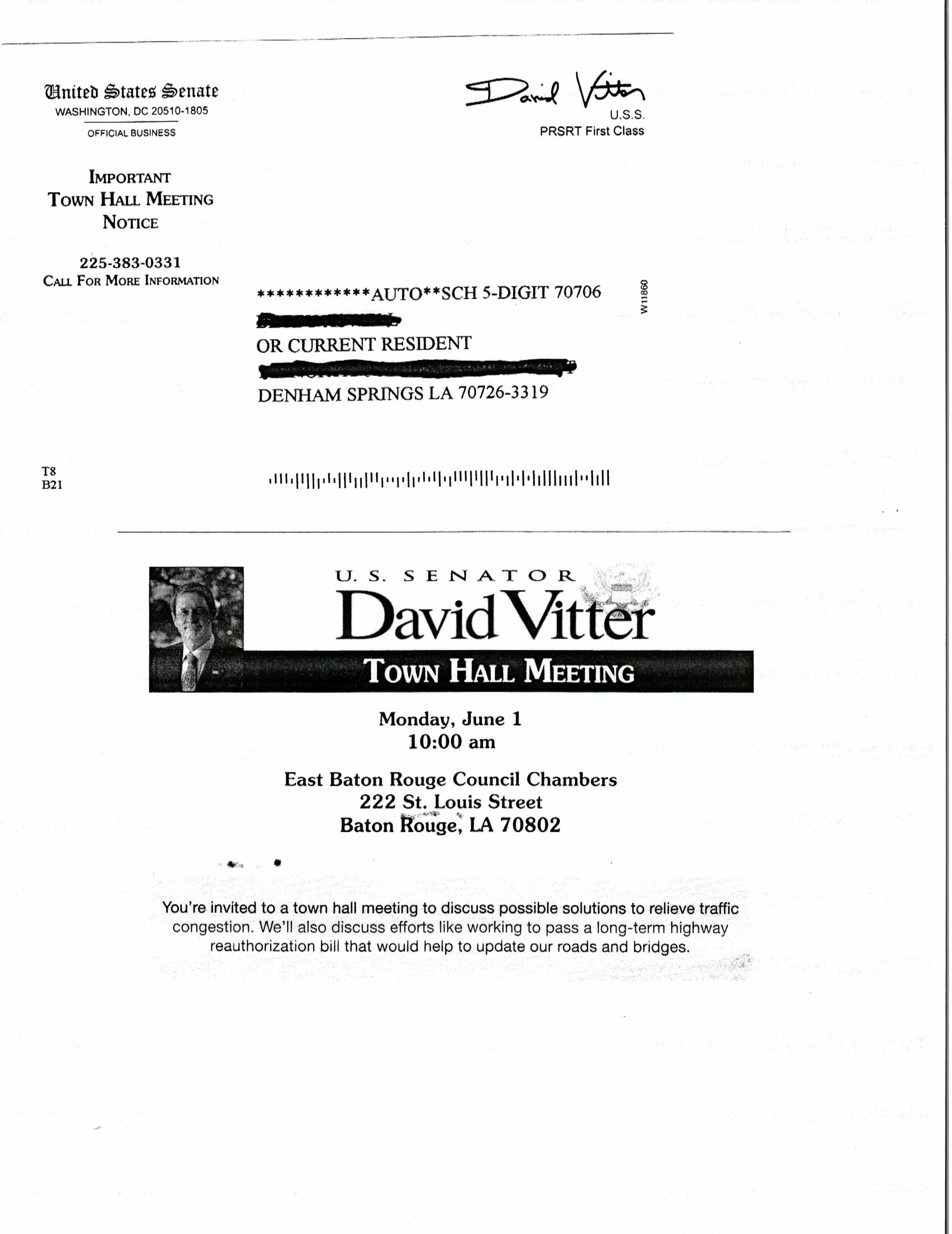
Vitter is not a candidate for re-election in the 2016 election but instead is running to succeed Bobby Jindal as governor against three other candidates. He is making full use of his franking privileges to announce town hall meetings across the state to address local issues. One such mail-out has caught the attention of LouisianaVoice.

Reform efforts over the past two decades have reduced overall franking expenditures from $113.4 million in fiscal year 1988 to $16.9 million in FY 2014 and even then, many of the mail-outs are simply tossed unread by recipients back home. Much of that reduction can be attributed to a shift to electronic communications rather than any real reform of the practice.

Franking has come under wide criticism by opponents of the privilege who say it:

  • Is financially wasteful;
  • Has become outdated with the introduction of other forms of communication, i.e. e-mail;
  • Is abused for private and political gain;
  • Gives unfair advantages to incumbents in congressional elections.

The last two could be cited as giving Vitter an unfair edge in this fall’s governor’s race. While he is not running for re-election, he is a candidate for governor and his Senate franking privileges could be looked upon as an unfair advantage over fellow Republicans—Public Service Commissioner Scott Angelle and Lt. Gov. Jay Dardenne—and Democrat State Rep. John Bel Edwards who are also running for governor.

Franking rules strictly prohibit incumbents from actually soliciting votes when the mail-outs are done on the taxpayer dime but they do not preclude addressing hot button issues like immigration, social security, veterans’ benefits, etc.

In 2009, Louisiana Democratic Party Chairman Chris Whittington filed an official ethics complaint against Vitter for his verbal attacks on U.S. Rep. Charlie Melancon, an eventual opponent in Vitter’s 2010 re-election campaign. Those attacks were made in local meetings pursuant to mass mail-outs by Vitter via the franking privilege.

Whittington said Vitter, by explicitly invoking the name of Melancon in his so-called town hall meetings, publicized in advance by franking mail-outs, crossed the line from official business (the supposed purpose of franking) to campaigning.

Though the words “vote for…” never appeared in any of Vitter’s mailings, reports from his town hall meetings across the state made it clear that he mentioned Melancon often. Vitter in turn charged that the Democrats were trying to “shut down the debate and suggest that it’s somehow out of bounds. Well, it’s not out of bounds because this is still America,” he said.

http://www.dailykos.com/story/2009/08/22/770585/-LA-Sen-Louisiana-Dems-File-Ethics-Complaint-Against-Sen-Vitter#

In Vitter’s most recent franking mail-out, he issued an invitation to one of his town hall meetings on Monday, June 1 in the chambers of the East Baton Rouge Council “to discuss possible solutions to relieve traffic congestion. We’ll also discuss efforts like working to pass a long-term highway reauthorization bill that would help to update our roads and bridges,” the announcement said. IMAG0721(CLICK ON IMAGE TO ENLARGE)

While strictly interpreted, such a discussion could easily be passed off as a federal concern with federal roads and highways crisscrossing East Baton Rouge Parish. That, along with the unquestioned problem of traffic congestion experienced by local motorists, could easily be construed by Vitter as a Senate-related issue.

We have no way of knowing at this point, but it would seem a safe bet that similar town hall meetings have been or will be announced by Vitter via franking in other parts of the state to discuss other pressing problems.

But coming as it does in the middle of what promises to be a heated election season in Louisiana, it would appear to give Vitter a decided—and unfair—advantage over his three opponents who do not have the luxury of free campaign mail-outs.

Nor would it be the first time Vitter has skated on the edge of campaign rules.

In January of 2014, Vitter was up against a state law that prohibited him from using his seven-figure campaign funds amassed as a federal office-holder for a state campaign.

No problem for a manipulators like Vitter and Charlie Spies, a Republican lawyer who was instrumental in launching Mitt Romney’s largest super PAC. In early 2013, Spies created the Fund for Louisiana’s Future and registered the super PAC both federally and in Louisiana in order “to support Sen. Vitter whether he ran for re-election to the Senate or for governor.”

Thus did Vitter become perhaps the first politician in the U.S. to be the largest single funder of his own super PAC.

A former general counsel for the Federal Election Commission said Vitter’s funding of his own super PAC, unprecedented to that point, raised the issue of the separation of super PACs and a candidate’s campaign “to a new level.”

Another observer, Paul Ryan, senior counsel for the Campaign Legal Center, said the existing Louisiana prohibition of the use of federal campaign funds in a state campaign was the only plausible reason for a candidate ceding control of his own campaign funds by transferring cash from his federal campaign to his gubernatorial campaign.

http://www.nationaljournal.com/politics/how-david-vitter-shattered-another-campaign-finance-rule-20140601

Stand by, folks. This election campaign promises to be a tad out of the ordinary, even by Louisiana’s unique standards.

Read Full Post »

It’s funny in a sick, perverted kind of way when you think about it.

Come to think of it though, that’s entirely appropriate; the Bobby Jindal administration has been nothing but seven years of sick, perverted exercises in futility and failed policies. It’s enough to make other states laugh at us—and they probably are.

Foremost among his many efforts at “reform” preached by this incoherent governor is his insistence on something he refers to as “freedom of choice” for parents of students in grades K-12. http://www.breitbart.com/big-government/2015/02/10/jindal-urges-parental-choice-limited-government-and-end-to-teacher-tenure-in-sweeping-education-policy-plan/

Speaking at the Brookings Institute in 2012, he said the U.S. does not provide equal opportunity in education. https://www.youtube.com/watch?v=nDCU-VlSgX0

Yet, when it comes to freedom of choice and equal opportunity for students in Louisiana’s colleges and universities, Jindal appears perfectly willing to “let them eat cake.”

Even as LSU and other universities and colleges face financial exigency in the face of another round of budget cuts, this time as much as $600 million and as more than 1,000 LSU students marched on the State Capitol on Thursday in protest, where was Jindal?

Out of state, as usual.

Damn him.

Damn his blasé attitude toward doing his job as the elected governor of Louisiana at a time when the state is in dire need of leadership.

Damn his resolve not to repeal corporate tax breaks, his administrations’ failure to properly audit severance tax payments to the oil and gas companies who have bankrolled his campaigns to the tune of about $1 million.

JINDAL SWINDLE

Following the rally Thursday, dozens of students converged on the Senate Education Committee which was meeting in the bowels of the Capitol. The five committee members, who for the most part, talked among themselves instead of listening as a witnessed testified on a bill about student records, paid the obligatory lip service in welcoming the students and then politely suggested they move up one floor to the Senate Finance Committee “because that’s where the money is,” according to one member.

Except it isn’t there. There is no money because of Jindal’s haphazard, slipshod, snow-cone stand brand of administration.

One Education Committee member even suggested that the students keep going—up “to the fourth floor.”

“Except no one’s there,” said another member, eliciting laughter at probably the most accurate statement made thus far this session.

It’s not, of course, as though Jindal is solely to blame for this fiasco. The legislature is complicit in allowing him to run roughshod over the citizens of this state on his way out the door and (he somehow still believes) to the White House.

If you don’t believe the legislators must share the blame in this, then explain how an attempt this week to finally accept Medicaid funds to help provide health care for 240,000 low-income Louisianians never got out of committee. Explain how attempts to increase the minimum wage and close the gender wage gap fail time after time but somehow legislation to allow the teaching that the earth is only 9,000 years old passes muster.

Therefore, the protest by the LSU students, one of those demonstrations inspired by social media, was the perfect opportunity for the four announced candidates for governor in this fall’s election.

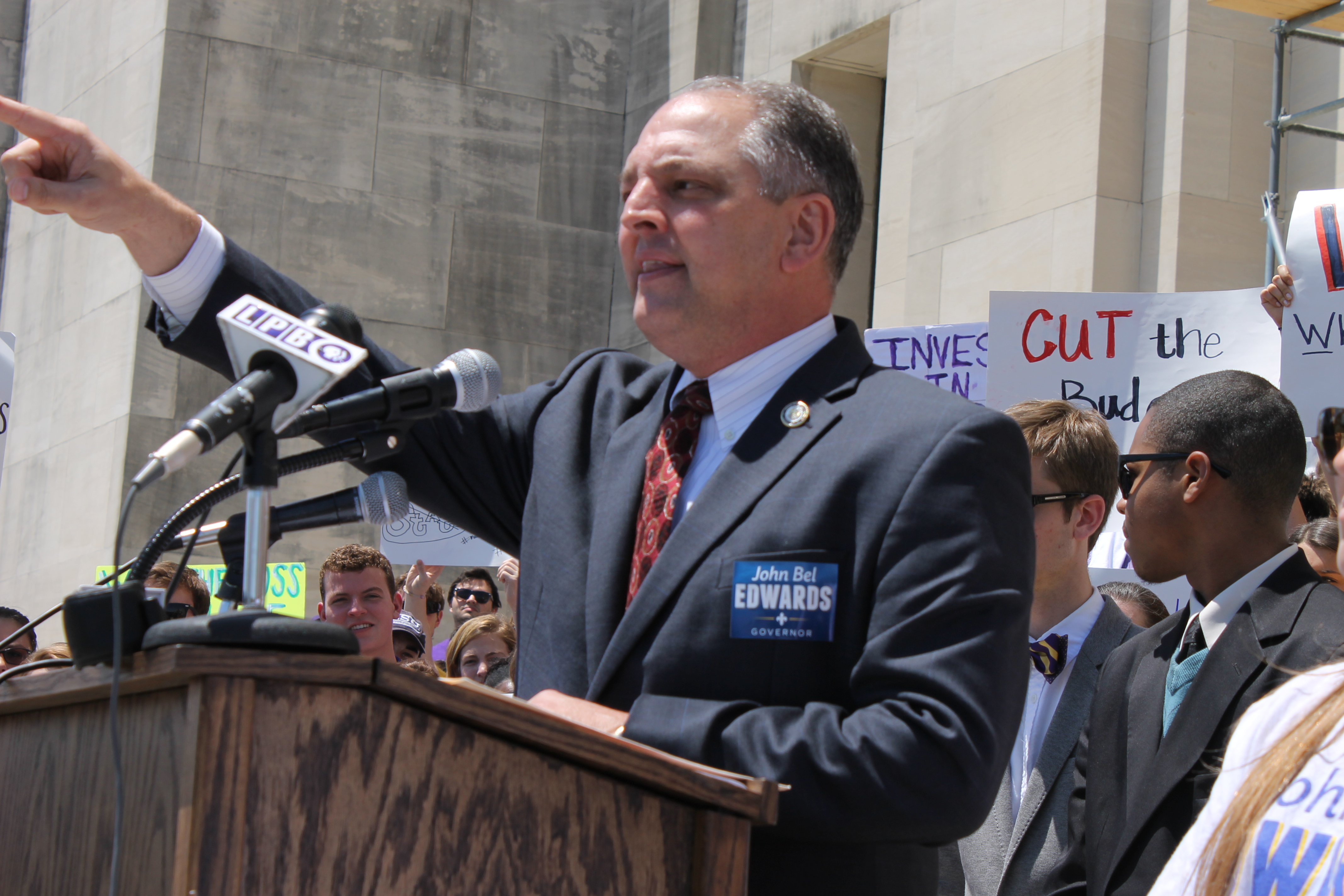
It would have been if they had all showed up. Perhaps that’s why State Representative John Bel Edwards (D-Amite) and the lone Democrat among the four candidates, got such an enthusiastic response from the students crowded onto the steps in front of the Capitol.

JOHN BEL EDWARDS

Rep. John Bel Edwards addresses LSU students on Thursday (click on image to enlarge).

Lt. Gov. Jay Dardenne, the only one of the four to hold an undergraduate degree from LSU and a former LSU Student Government President was apparently so busy he could only send a representative from his office. A missed opportunity if there ever was one.

Edwards tried to downplay the significance of that. “Well, to be fair, I was already in the building,” he laughed. “I didn’t have to go far.”

But neither did Dardenne. His office is across the street from the Capitol and LSU’s right fielder could probably peg a strike to his office window from the Capitol steps.

But Public Service Commission member Scott Angelle and U.S. Sen. David Vitter also were conspicuously absent. Nor was a single member of the LSU Board of Supervisors in attendance.

Of course, it would have been a sham for Angelle to make an appearance. He is, after all, joined at the hip with Jindal. Granted, Angelle was a Kathleen Blanco holdover, but held over he was and Jindal even made him his legislative liaison. Jindal also named him as interim Lieutenant Governor when Mitch Landrieu was elected mayor of New Orleans, and then appointed him to the LSU Board of Supervisors (that’s the same board that fires LSU presidents on a whim, costs the state hundreds of thousands of dollars defending a defenseless attempt to deny access to public records, and which gives away state hospitals in a deal that had been rejected by the federal government). http://www.nola.com/opinions/index.ssf/2015/03/lsu_board_jindal_resign.html

But why Vitter didn’t show is something of a mystery; there were so many attractive co-eds at the protest, after all.

Edwards told the students that he has “spent seven years fighting Jindal’s budgets. I did not vote for the budget last year and my solemn promise to you is that I will never vote for a budget that cuts funding for higher education.”

Edwards, who holds his undergraduate degree from West Point, received his law degree from LSU Law School. He told the students they are facing the potential of a 90 percent increase in tuition this fall. As expected, that was met with a chorus of boos. “No state has cut funding to higher education more than Louisiana,” he said. “I have a personal interest in seeing higher education fully funded. My daughter is a freshman at LSU.

“If you look behind you, you see a statue of Huey Long,” he said. “Say what you will about Huey Long, but at a time this state was in the throes of the Great Depression, Huey Long found money to build LSU, build roads and bridges throughout the state and to establish a great state hospital system. If he could find money to do all that during the Depression, we should be able to fund education today.”

But as Jindal prattles on about choice for students of K-12, he seems to have forgotten about the choice of post-secondary students: the choice to obtain an affordable education, the choice to remain in Louisiana and attend a tier 1 university, the choice to avoid devastating student loans that put graduates in deep financial holes even before their careers begin.

Read Full Post »

The Oct. 11 primary election for governor is still seven months off but it’s never too early for conducting polls to see the early seeding of candidates and an early poll has shown a surprisingly strong showing by Democratic State Rep. John Bel Edwards of Amite. MARCH 6 POLL

The poll, dated March 6, was conducted on March 5 by Triumph Campaigns. A survey of 1,655 participants, it was the first public poll completed since two of the gubernatorial candidates launched paid media buys or since several public debates were held in that race.

The poll also measured voter preferences for lieutenant governor, attorney general and commissioner of insurance.

With a margin or error of 2.4 percent, Edwards trailed U.S. Sen. David Vitter by only two percentage points, 35 percent to 33 percent. A further breakdown shows Vitter with 23 percent “definitely” favoring him and 12 percent as “probable.” Edwards had 16 percent “definite” and 17 percent “probable,” the poll shows.

Lt. Gov. Jay Dardenne is running third with 15 percent (8 percent definite and 7 percent probable), while Public Service Commissioner Scott Angelle trails with 7 percent (3 percent definite and 4 percent probable). The remaining 11 percent were undecided.

Breaking the race down by political party preference, 53 percent favored a Republican candidate and 47 percent preferred a Democrat. The percentages were nearly identical on the question of which party best represents respondents’ point of view with 54 percent saying Republican and 46 percent leaning toward Republican.

The poll also reflects that 69 percent of respondents do not feel the state is headed in the right direction while less a third, 31 percent, feel the state is on track.

To the question of approval of the job being done by Gov. Bobby Jindal, 63 percent disapproved, 27 percent approved and 10 percent were undecided. The 27 percent approval rating represents a new low approval rating for the state’s mostly absentee governor who was out of the state a full 45 percent of the time in 2014, according to the Baton Rouge Advocate.

Of the respondents polled 54 percent were female and 46 male; 48 percent were registered Democrats, 35 percent Republican and 17 percent independent. 69 percent were white, 27 percent black, 1 percent Hispanic and 3 percent “other.”

For lieutenant governor, Baton Rouge Mayor-President Kip Holden leads with 33 percent, followed by Billy Nungesser at 23 percent and John Young at 20 percent. State Sen. Elbert Guillory (R/D/R-Opelousas) had 4 percent.

Attorney General Buddy Caldwell appears to be in trouble early on, locked in a dead heat with Democrat Jacque Roy at 30 percent with Republican Jeff Landry at 20 percent and the remaining 20 percent undecided.

State Insurance Commissioner Jim Donelon, with 45 percent, appears to have a solid lead for re-election over challenger Matt Parker at 13 percent. The remaining 41 percent were undecided. Those numbers could be skewed considerably should State Treasurer John Kennedy opt to run for attorney general but he is as yet unannounced.

Indeed, the numbers are expected to shift considerably in all races once the full-fledged media blitz is launched by the various candidates and as PAC money flows into the coffers of candidates favored by business, oil and other special interests.

Read Full Post »

« Newer Posts - Older Posts »