There already has been speculation that Louisiana Sen. John Kennedy, aka Kornpone, aka Foghorn Leghorn, was at most a co-conspirator with Dementia Don in some backroom plan to oust Kristi Noem, aka ICE Barbie, aka dog-killer, from her leadership post at Homeland Security or at least was complicit in his DUST-UP with her during this week’s hearings of the Senate Judiciary Committee.
“Do you think Kennedy set a trap for Noem?” one reader asked in an email to LouisianaVoice.
“Does This mean President Trump put Kornpone up to vigorously attacking her in the hearing day before yesterday or that he simply told Kornpone he planned to fire her before the hearing?” wrote another, adding, “In either case, that explains Kornpone’s willingness to grill her despite his fealty to President Trump and his appointees.”
My response was I don’t know the answers to those questions but it could well have been the consequences of her attempting to shift responsibility for her $200 million ad campaign that Kennedy questioned onto to Agent Orange his own self. You just don’t do something like that in this never-never land of wackadoodle. You just don’t blame the boss–especially this idiotic, paranoid, narcissistic boss.
But it’s important to remember Noem is just one cog in this grinding machine and it’s critical that we keep applying pressure until they’re all gone: Pam Bondi, Stephen Miller, Steve Bannon, JD “Couch-boy” Vance, Pete Segseth, Trump himself and each and every single one of his cabal.
In politics, especially Louisiana politics, there is always a back-story. Always. And with the current administrations in Washington and Baton Rouge, one can also figure that Jeff Landry fits somewhere in the equation, a story line we’re reveal a little further down. But first:
As recently as last November, it was announced with no little fanfare that physician/veterinarian/pharmaceutical salesman/former congressman/former gubernatorial candidate/former Louisiana Surgeon General Ralph Abraham was being appointed PRINCIPAL DEPUTY DIRECTOR at the Centers for Disease Control and Prevention. He actually assumed the post on Jan. 5 of this year.
Just what a principal deputy director’s responsibilities are was not clearly stated but in a federal government that loves long, strung-out, meaningless titles, I would assume the title carried the full weight of something akin to the Assistant Under Deputy to the Chief of Staff of the Supervisor of Broom Closets for the Subcommittee on Secondary Studies for Staff Inquiries of Chemtrail Reports.
Abraham cavalierly said the MEASLES OUTBREAK SPIKE was the “cost of doing the business” because of the “porous” borders allowing “global and international travel,” despite the fact that only about 10 percent of measles cases detected since Jan. 20, 2025—the date Dementia Don took the oath of office a second time—were from other countries. He somehow didn’t seem to be concerned that many of the outbreaks occurred in pockets of low-vaccination rates.
Regardless, barely two months down the road from taking over his prestigious appointment, he announced his departure from CDC, saying he was leaving to “address unforeseen family obligations.”
CDC was effusive in its praise of Abraham as he headed for the exit, saying in a formal statement that he led “with clarity and discipline, advancing the CDC’s mission to protect the health and safety of the American people.”
How could CDC possibly quantify such hogwash after only two months on the job?
And about those “unforeseen family obligations…” Well, I don’t know if U.S. Rep. Julia Letlow is immediately family, but it turns out he is stepping down to lead her embattled campaign in challenging another physician, Bill Cassidy, for the U.S. Senate seat Cassidy has held for 11 years. Cassidy, meanwhile, is seeking another six-year-term. The smart money says he won’t win.
Letlow’s late husband Luke, was once Abraham’s chief of staff and close advisor, so there’s that. Luke, of course, ran and was elected to succeed Abraham when he stepped down as 5th District Representative to run for governor—but died of COVID-19 before he could take office.
It is of no little irony, given his former chief of staff’s death from COVID, that Abraham has consistently been a critic of COVID vaccination mandates and of the requirement that citizens wear masks in public, going back to the 2020 pandemic’s peak. No matter, after Luke’s death, Julia, an earlier unsuccessful candidate for the presidency of the University of Louisiana-Monroe, stepped up to run for the vacant office and, with Abraham’s assistance, won.
Now, about that back-story mentioned in the opening paragraph. But first, this warning: The current three-way race for the Repugnantcan nomination for Senate is conjuring up memories of a 1950 Democratic campaign down in Florida in which incumbent U.S. Rep. GEORGE SMATHERS won a close race by famously saying his opponent, Claude Pepper, was a “known extrovert” who practiced “celibacy” before marriage, who “matriculated” in college, who practiced “nepotism” with his sister-in-law, who had a sister who was a “thespian,” and a brother who was a “practicing homo sapien.”
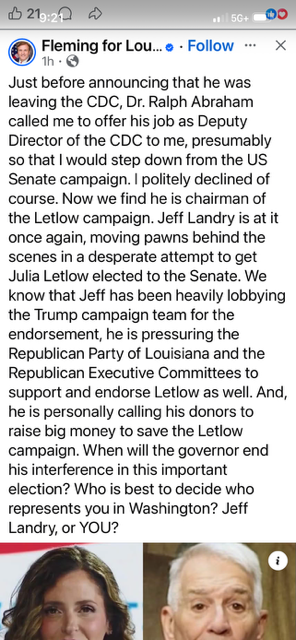
But rather than telling the story myself, I’ll let State Treasurer John Fleming, himself a former U.S. Rep. and now Louisiana State Treasurer and (for now) a bitter opponent of Gov. Jeff Landry, yet another former member of Congress (boy, this is getting confusing) tell it in his own words:
Wait. What? Is Fleming saying that Abraham offered him a federal post in exchange for dropping out of the Senate race? People actually do that?
Well, in his 2015 campaign for attorney general against incumbent Buddy Caldwell, there was also, like Fleming, a third candidate, Geraldine “Geri” Broussard Baloney. She was eliminated in the first open primary and it was at that point that things started to get a little murky as they often tend to do in Louisiana.
Baloney, after meeting with Lendry, endorsed him. But was some kind of deal cut in exchange for her endorsement? Well, upon his win over Caldwell, he subsequently hired Baloney’s daughter, QUENDI BALONEY, in the AG’s fraud section despite her having previously been charged with 11 felony counts of credit card fraud and theft. She eventually pleaded guilty to three counts, according to court records from Henrico County, Virginia. She was sentenced to six years in prison, all of it suspended.
So, bottom line: an individual who pleaded guilty to fraud is placed in the fraud section of the attorney general’s office after her mother endorsed Landry in the runoff. Weird? Hell no, not in Louisiana; it’s just business as usual.
But there’s an added twist to the plot in this ongoing backroom saga.
The rumor mill has it that Letlow still wants to head up a Louisiana university (though Landry’s starting to run out of schools now that he’s already placed five political allies as university presidents).
Anyway, the plan, according to reports, is for Letlow to win (the odds of which are seeming to dwindle as the fight between her and Cassidy intensifies and Fleming appears to be gaining ground), immediately resign so that Landry can appoint her to head some college—and then appoint himself to the vacated Senate seat.
When you see the handwriting on the wall that says you’re in competition with Rhonda Santis and Greg Abbott for the title of WORST GOVERNOR IN AMERICA, dooming you to a single term as governor, that scenario suddenly doesn’t seem so far-fetched.
I’m certainly not one to moralize or pass judgment on others but there’s just something morbidly stomach-turning about anyone who would profiteer off the bodies of six (so far) American Gis or Iranian school children by placing bets on the date of an invasion of Iran.
But, eerily coincidentally (or not), that’s what happened when six anonymous accounts were created on the prediction market Polymarket, turning a slick $1 million profit by betting the U.S. would launch strikes against Iran by…Feb. 28.
Red flags went up immediately on the suspicion (I would have chosen the term near-certainty) of insider trading. It’s dang-nigh impossible to prove because there is no requirement that users of Polymarket identify themselves and because Polymarket accepts bets in (ahem) crypto, Mr. Trump’s currency of choice.
There have always been war profiteers, be they munitions manufacturers, arms dealers or mercenaries. Nearly a century ago, Marine Gen. Smedley Butler, who fought in four wars and at the time of his death in 1940, was the most-decorated Marine in U.S. military history (16 medals, including five for heroism and two Medals of Honor), said that war was the business of selling death to enrich armament bosses, not to protect the soldier in the trench.
And we know, dating back to Dementia Don’s first term, in 2017, he DISCLOSED CLASSIFIED INFORMATION to Russian government representatives and he also shared national defense information on social media and made private disclosures and repeatedly mishandled classified intelligence.
And we also know certain billionaire FOD (friends of Donand) reaped millions, possibly billions and Trump himself may have profited $140 MILLION from the takedown of Venezuelan President Nicolás Maduro.
And now we’re hearing early reports that as much as $529 million was traded ON THE TIMING OF THE ATTACK ON IRAN, a trend Bloomberg said could indicate insider trading. Moreover, Bubblemaps CEO Nicolas Vaiman said information involving potential military action coupled with Polymarket’s anonymity “can create incentives for informed participants to act early.”
Making wagers over the bodies of war casualties—both military and civilian—would have to go down as one of the most morally despicable, appallingly reprehensible actions a human being could ever take–even for this gang of thugs.
And even with the speculation that the Wag the Dog action of Trump in an effort to deflect attention from his alleged exploitation (read: rape) of children, it’s a toss-up as to which activity is the most heinous.
And now for the final question for your careful consideration:
Would any of you, MAGHATS or anti-MAGHATS, for one nano-second, put it past Trump or Donnie Jr. or Mouth-Full-of-Teeth Eric to have been behind the creation of those secret betting accounts? Or Kash Patel, of Pete Hegseth, or Steve Bannon or Stephen Miller?
If you’re completely honest with yourself, I already know your answer.
Not saying they are, but hell, I wouldn’t be surprised to learn of the involvement of a certain Texas attorney general or a Louisiana special envoy to Greenland, for that matter. That just seems to fit the Repugnancan makeup.
“Iran’s key nuclear enrichment facilities have been completely and totally obliterated.”
–Donald Trump, June 22, 2025.
“The world is far safer after President Donald J. Trump’s highly successful, decisive precision strikes against the Iranian regime’s key nuclear facilities.”
–Official White House statement, June 25, 2025
“Mission accomplished!”
–President George W. Bush, May 1, 2003
“Major combat operations in Iraq have ended.”
–George W. Bush, My 1, 2003
“Those we lost were last seen on duty. Their final act on this Earth was to fight a great evil and bring liberty to others.”
–George W. Bush, May 1, 2003
“[W]e grieve for the true American patriots who have made the ultimate sacrifice for our nation, even as we continue the righteous mission for which they gave their lives…”
–Dementia Don Trump, March 1, 2026
“Brownie, you’re doing a heckuva job.”
–George W. Bush, to FEMA Director Michael Brown on Sept. 2, 2005,
following landfall of Hurricane Katrina. Ten days later, Brown resigned.
The moral of all this: if their lips are moving, it’s likely B.S. you’re hearing.
“In the South, we give fair warning before we crack a jaw.”
–Rep. Clay (for brains) Higgins (R-Lafayette), who once served as a (stateside) National Guard MP, on U.S. bombing of Iran.
So, Clay, how’s that jaw-cracking working out for us so far? A brief recap:
American casualties:
Vietnam (20 years): 58,220 killed, 153,303 wounded (total 211,454 casualties more than 90% of total Baton Rouge population and 1.12 times population of Shreveport.
Total in those three failed experiments in cracking jaws: 64,947 Americans killed, 205,618 wounded. Total casualties of 279,565 equates to 1.2 times the population of Baton Rouge.
LouisianaVoice does not accept advertising because we insist on an independent voice. Likewise, we do not charge a subscription fee for our blog.
That is not to say we do not have expenses—lots of them. Moreover, we would love to add a reporter to provide even better coverage of the underbelly of Louisiana politics.
Your contribution would help us immensely in meeting our growing expenses. Simply click on the “Donate” button here and contribute whatever you feel appropriate.
Thank you.
Tom Aswell, Publisher
Got a tip?
Got a news lead for LouisianaVoice to investigate? Have a suggestion for a story? Your identity will never be revealed. Just send an email to louisianavoice@outlook.com
Read my books!
Read more Books!
Order your Piyush Bumper Sticker Now!
Click image to order
$2.50 each or three for $6.00






 Louisiana Voice