Feeds:
Posts
Comments

Archive for the ‘Transparency’ Category

Our October fund raiser enters its final five days and we still need assistance to help us offset the cost of pursuing legal action against an administration that prefers to conduct its business behind closed doors and out of sight of the people to whom they are supposed to answer.

We also are launching an ambitious project that will involve considerable time and expense. If Gov. Bobby Jindal does seek higher office as it becomes more and more apparent that he will, the people of America need to know the real story of what he has done to our state and its people. Voters in the other 49 states need to know not Jindal’s version of his accomplishments as governor, but the truth about:

  • What has occurred with CNSI and Bruce Greenstein;
  • How Jindal squandered the Office of Group Benefits $500 million reserve fund;
  • The lies the administration told us two years ago about how state employee benefits would not be affected by privatization;
  • The lies about how Buck Consultants advised the administration to cut health care premiums when the company’s July report said just the opposite;
  • How Jindal attempted unsuccessfully to gut state employee retirement benefits;
  • How Jindal attempted to sneak a significant retirement benefit into law for the Superintendent of State Police;
  • How Jindal appointees throughout state government have abused the power entrusted to them;
  • How Jindal has attempted a giveaway plan for state hospitals that has yet to be approved by the federal Center for Medicare & Medicaid Services (CMS);
  • How regulations have been skirted so that Jindal could reward supporters with favorable purchases and contracts;
  • How Jindal fired employees and demoted legislators for the simple transgression of disagreeing with him;
  • How Jindal has refused Medicaid expansion that has cost hundreds of thousands of Louisiana’s poor the opportunity to obtain medical care;
  • How Jindal has gutted appropriations to higher education in Louisiana, forcing tuition increases detrimental to students;
  • How Jindal has attempted to systematically destroy public education in Louisiana;
  • How Jindal has refused federal grants that could have gone far in developing internet services for rural areas and high speed rail service between Baton Rouge and New Orleans;
  • How Jindal has rewarded major contributors with appointments to key boards and commissions;
  • How Jindal attempted to use the court system to persecute an agency head who refused to knuckle under to illegal demands from the governor’s office;
  • How Jindal has manipulated the state budget each year he has been in office in a desperate effort to smooth over deficit after deficit;
  • And most of all, how Jindal literally abandoned the state while still governor so that he could pursue his quixotic dream of becoming president.

To this end, LouisianaVoice Editor Tom Aswell will be spending the next several months researching and writing a book chronicling the Jindal administration. Should Jindal become a presidential contender or even if he is selected as another candidate’s vice presidential running mate, such a book could have a national impact and even affect the outcome of the 2016 presidential election.

This project is going to take time and involve considerable expense as we compile our research and prepare the book for publication in time for the 2016 election.

To accomplish this, we need your help.

If you are not seeing the “Donate” button, it may be because you are receiving our posts via email subscription. To contribute by credit card, please click on this link to go to our actual web page and look for the yellow Donate button: https://louisianavoice.com/

If you prefer not to conduct an internet transaction, you may mail a check to:

Capital News Service/LouisianaVoice

P.O. Box 922

Denham Springs, Louisiana 70727-0922

Read Full Post »

Never let it be said that LouisianaVoice isn’t willing to save the state a little money.

Remember that survey of Division of Administration (DOA) employees that revealed severe morale problems throughout state government? Well, in case you don’t, here’s the link to our story on that survey: https://louisianavoice.com/2014/10/02/employee-survey-of-doa-employees-reveals-simmering-morale-problem-no-one-more-popular-than-jindal-in-poll/

It turns out the state shelled out $25,000 to IBM for that survey that showed employees simply are not happy with the administration, scoring it abysmally low in trust, employee recognition, senior leadership values, communication from management, senior leadership vision, opportunity for advancement, employee involvement in decision making, and prospects for positive change.

Basically, the survey showed that state leadership languishes far below the national norm. In a word, it sucks.

But $25,000 to learn that? We could have told the administration that for…oh say, $5.

So who authorized the expenditure of scarce state funds for such a worthless piece of research when the conclusions were long evident to state employees and certainly should have been to the administration?

Well, it turns out that Deputy Commissioner of Administration Ruth Johnson signed off on the contract with IBM on June 24.

Johnson, you might recall, retired on June 21, 2012, from her $130,000 per year job as head of the Department of Children and Family services. She moved out of state but returned on May 27, 2013, as Director of Accountability and Research for DOA at $150,000 and less than four months later, on Sept. 30, 2013, was promoted to Assistant Commissioner at $170,000 per year. As if that were not enough, on Feb. 24 of this year, she was again promoted to the title of Director in the governor’s office at $180,000. Bottom line: in just 16 months, she retired and returned, netting in the process a pay increase of $50,000 per year—more than the average state employee makes in a year.

That will do wonders for employee morale.

LouisianaVoice made a public records request on Oct. 3 for the request for proposals (RFP), the contract and payment history for the survey contract with IBM.

On Oct. 6, DOA responded to our request:

  • Your public records request, dated October 3, 2014, was received by the Division of Administration. We are conducting a search for records.  Once the search is finished, the records will be reviewed for privileges and exemptions.  We will contact you as soon as the review is completed.

Three weeks later, on Oct. 24, DOA finally complied with a six-page document. Apparently, there was no RFP for a vendor—just a sketchy six-page document and even more significant, there were no redactions, no privileges or exemptions. There was only a delay of three full weeks—14 working days—in complying with our request.

Louisiana Revised Statute 44:1 says:

  • All books, records, writings, accounts, letters and letter books, maps, drawings, photographs, cards, tapes, recordings, memoranda, and papers, and all copies, duplicates, photographs, including microfilm, or other reproductions thereof, or any other documentary materials, regardless of physical form or characteristics, including information contained in electronic data processing equipment, having been used, being in use, or prepared, possessed, or retained for use in the conduct, transaction, or performance of any business, transaction, work, duty, or function which was conducted, transacted, or performed by or under the authority of the constitution or laws of this state, or by or under the authority of any ordinance, regulation, mandate, or order of any public body or concerning the receipt or payment of any money received or paid by or under the authority of the constitution or the laws of this state, are “public records.”

Louisiana Revised Statute 44:33 says:

  • If the public record applied for is immediately available, because of its not being in active use at the time of the application, the public record shall be immediately presented to the authorized person applying for it.  If the public record applied for is not immediately available, because of its being in active use at the time of the application, the custodian shall promptly certify this in writing to the applicant, and in his certificate shall fix a day and hour within three days, exclusive of Saturdays, Sundays, and legal public holidays, for the exercise of the right granted by this Chapter.

Louisiana Revised Statute 44:37 says:

  • Any person having custody or control of a public record, who violates any of the provisions of this Chapter, or any person not having such custody or control who by any conspiracy, understanding or cooperation with any other person hinders or attempts to hinder the inspection of any public records declared by this Chapter to be subject to inspection, shall upon first conviction be fined not less than one hundred dollars, and not more than one thousand dollars, or shall be imprisoned for not less than one month, nor more than six months.  Upon any subsequent conviction he shall be fined not less than two hundred fifty dollars, and not more than two thousand dollars, or imprisoned for not less than two months, nor more than six months, or both.

Meanwhile, LouisianaVoice has learned that DOA has launched an intensive witch hunt for our source on the employee satisfaction survey, which apparently was supposed to be a closely-guarded state secret. And while we really hate to even let them know this and spoil the fun, the funniest thing is they are so far off base in their search. They don’t have the foggiest idea that our sources are not even in a single building; they’re scattered throughout state government because apparently state employees place more trust in what we write than what the administration says.

So guys, have fun in your search because every time you think you’ve found one, three more pop up. You can’t stop the truth. Hell, you can’t even slow it down.

Given the results of the survey, it’s easy to understand why DOA wanted to keep the survey from public view. What’s not so easy to comprehend is why the Jindal administration is so hell-bent on keeping everything it does from public scrutiny.

We will make this observation, however: When an administration goes to such great lengths to shield its actions from public view and when that same administration expends an inordinate amount of time and effort in attempting to determine the source of leaks of such benign, non-sensitive information as a simple employee survey, one can only deduce that administration has far more to hide than a simple satisfaction survey.

And paranoia, it seems, feeds upon itself.

Read Full Post »

In reading Destiny’s Anvil, a novel about Louisiana politics by New Orleans writer Steven Wells Hicks, one sentence near the end of the story was so profound that it jumped off the page at us:

  • The responsibility for building and maintaining our way of open and honest government belongs in the hands of those who elect our leaders and not the leaders themselves.

The very simplicity of that one sentence, so succinct and straightforward a summation of what our government should aspire to, should be the credo which dictates the acceptance of every campaign contribution, every promise made and every action carried out by every elected official in America.

Sadly, it does not. And most certainly, it does not in Louisiana, especially where generous donors to the campaigns of Gov. Bobby Jindal (R-Iowa, R-New Hampshire, R-Florida, R-Anywhere by Louisiana) are concerned.

LouisianaVoice has learned that one major donor and its principals not only benefitted from several contracts worth more than $240 million, but also appear to have been given preferable treatment in the purchase of a state building at a bargain price at the expense of taxpayers.

The electorate of this state has capitulated in that responsibility, choosing instead to acquiesce to backroom deals fueled by campaign contributions and to actions concealed in secrecy and carried out for political expedience or personal gain instead of for the common good of the citizenry.

Remember last month when we wrote that Timmy Teepell in 2010 issued a directive to Tommy Teague, then the CEO of the Office of Group Benefits that a request for proposals (RFP) be crafted in such a way as to favor a specific vendor and that then-Commissioner of Administration Angéle Davis resigned shortly thereafter?

At the time, Teepell was Jindal’s Chief of Staff. The RFP was for vendors to provide health care coverage to state workers primarily in northeast Louisiana. Vantage Health Plan of Monroe subsequently landed the 26 month, $70 million contract, effective July 1, 2010. Six months later, on Jan. 1, 2011, a second one-year contract of $14 million awarded to Vantage to provide a Medicare Advantage plan for eligible OGB retirees and on Sept. 1, 2012, Vantage received yet another four-month $10 million contract under an emergency rule to provide an HMO plan to OGB members.

Since Jindal took office in January of 2008, Vantage has been awarded six contracts totaling nearly $242 million.

In addition to the claim of the 2010 directive to Teague to “write a tightly-written” RFP, LouisianaVoice has learned the Jindal administration may have deliberately circumvented the usual procedure for selling state property in order that Vantage could purchase a six-story state office building in Monroe last year.

By legislative fiat, the administration was within its legal rights to sell the State Office Building in Monroe to a chosen buyer without going through the bid process but it may have done so at a cost to state taxpayers.

Senate Bill 216 of 2013 by Sens. Mike Walsworth (R-West Monroe), Rick Gallot (D-Ruston), Neil Riser (R-Columbia) and Francis Thompson (D-Delhi) passed overwhelming in both the House and Senate and was signed into law by Jindal as Act 127, clearing the way for the sale of the former Virginia Hotel at 122 St. John Street.

By law, if a legislative act is passed, the state can legally bypass the public bid process but there are several indications that the administration may well have gone out of its way to accommodate Vantage and its President, Dr. Patrick Gary Jones through the Louisiana Department of Economic Development (LED).

The cooperative endeavor agreement between Vantage and the state was executed by Vantage Executive Vice President Mike Breard and LED Undersecretary Anne Villa on Aug. 28, 2013.

Vantage paid the state $881,000 for the six-story, 100,750-square-foot building and an adjoining 39,260-square-foot lot and one-story office building. The cost breakdown was $655,000 for the hotel and $226,000 for the adjoining property.

The Virginia Hotel was constructed in 1925 at a cost of $1.6 million and underwent extensive renovations in 1969 and again in 1984, according to documents provided LouisianaVoice by DED.

But LouisianaVoice has learned that there was at least one other potential buyer interested in the Virginia Hotel/State Office Building and indeed, documents obtained from LED contained no fewer than three references to fears by Vantage officers that if the building were put up for public auction, the bids might make the costs prohibitive to Vantage.

Melody Olson and husband Kim purchased the nearby Penn Hotel for $341,000 and poured $2 million into converting it into condominiums.

The late Shady Wall, a colorful state representative from Ouachita Parish, lived in the Penn’s penthouse. (Wall once wedged a pencil between a stack of books and the “yes” button at his House desk and went home for the day, officially casting “yes” votes on every matter that came up in the chamber after his departure.) The Olsons now reside in that same penthouse.

Melody Olson told LouisianaVoice that she and her husband wanted to purchase the Virginia and convert it into a boutique hotel but were never given the opportunity.

“It was sold through the Department of Economic Development and never was offered for public bid,” she said. “We never got the chance to make an offer.”

One internal LED memorandum said that Vantage Health Plan (VHP) “approached LED to help arrange the sale in order to avoid typical State surplus real property requirements of public bidding. VHP fears that public bidding would allow a developer utilizing various incentive programs to pay an above market price that VHP would find hard to match.” (Emphasis added.) IMAG0379
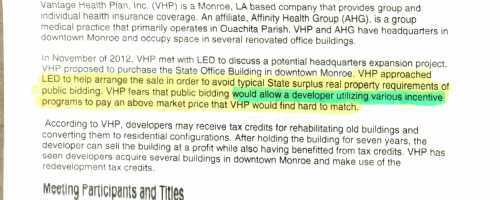
(CLICK ON IMAGE TO ENLARGE)

Another document appears to be an internal memorandum that provides an overview of a 2012 meeting about the sale. It indicates that LED Secretary Stephen Moret, Sen. Walsworth, LED Legislative and Congressional Liaison Mandi Mitchell and LED Director of Contract Performance Shawn Welcome were in attendance on behalf of the state and Dr. Jones and his son-in-law Michael Echols, Director of Business Development, representing Vantage.

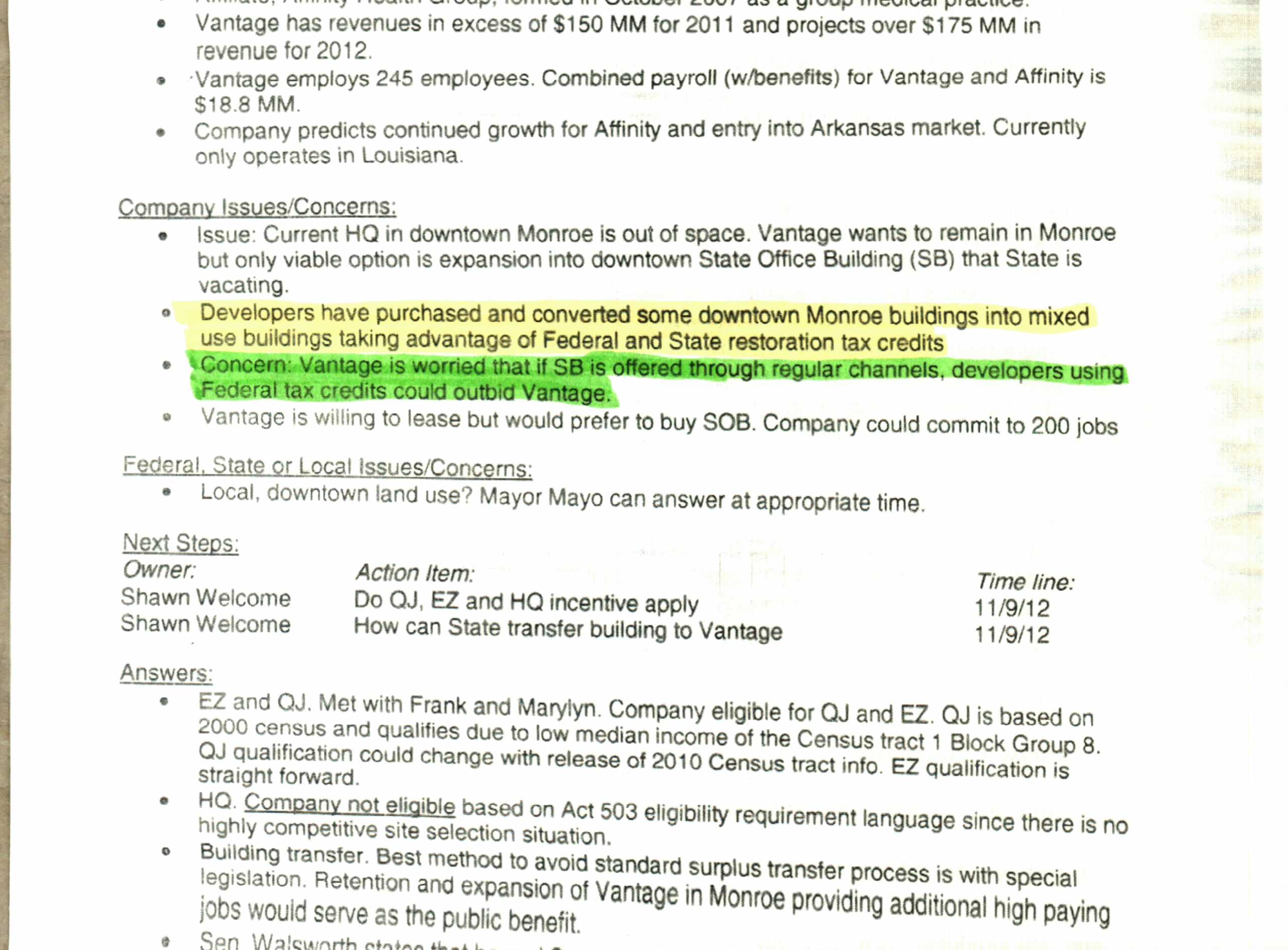
Under a heading entitled Company Issues/Concerns there were these two notations:

  • “Developers have purchased and converted some downtown Monroe buildings into mixed use buildings (by) taking advantage of federal and state restoration tax credits.”
  • “Concern: Vantage is worried that if SB (state building) is offered through regular channels, developers using federal tax credits could outbid Vantage.” IMAG0377
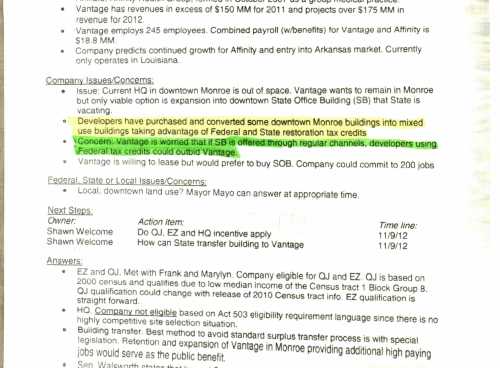
(CLICK ON IMAGE TO ENLARGE)

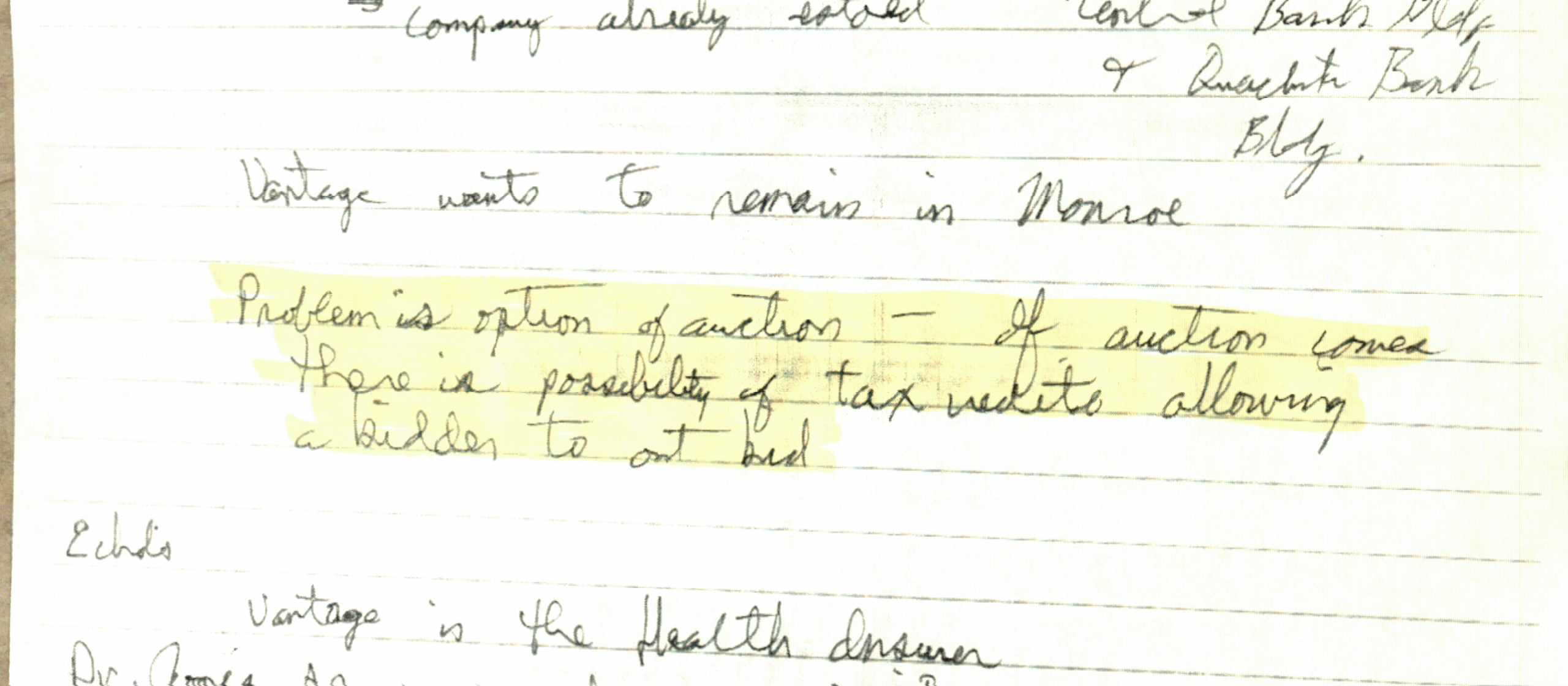
Finally, there was a handwritten note which described another meeting on Nov. 1, 2012. Besides the notation that “Sen. Riser supports,” there was this:

  • “Problem is option of auction—if auction comes there is possibility of tax credits allowing a bidder to out-bid.”

IMAG0378

(CLICK ON IMAGE TO ENLARGE)

Finally, there was a hand-scrawled notation at the bottom of a typewritten page containing employment estimates by Vantage through 2024 which directed that an “approach” be written “specific to Vantage.”

And while Vantage repeatedly cited concerns about other potential buyers obtaining state and federal incentives which they might use to thwart their purchase plans for the building, Vantage was not shy about seeking incentives from the state for its own benefit.

Documents obtained from LED show no fewer than 20 applications or notices of applications for various state incentive programs, including Enterprise Zone, Quality Jobs Program and property tax exemptions for renovations to existing offices in Monroe or expansion into new offices in Shreveport, Mangham, West Monroe, New Orleans and even into Arkansas.

Nor were Vantage and its corporate principals shy about flashing cash for political campaign contributions.

Campaign finance records show that Vantage its affiliate, Affinity Health Group, their corporate officers and family members combined to contribute more than $100,000 to various political campaigns, including $22,000 to Jindal and $11,000 to three of the four Senators who authored the bill authorizing the sale of the Virginia Hotel to Vantage: Thompson ($5,400), Walsworth ($4,500), and Riser ($1,000.

Read Full Post »

Call it what you will—strong-armed politics, intimidation, extortion, blackmail or bribery—the result is the same: the fix appears to be in on the administration’s claim of a $178.5 million budget surplus developed by a “new and improved” accounting procedure.

Except the numbers don’t seem to add up to a surplus, but rather the possibility of an even greater deficit that first indicated by State Treasurer John Kennedy.

LouisianaVoice has learned that the $320 million in mystery money suddenly discovered by the administration and trumpeted by Commissioner of Administration Kristy Nichols may actually be $500 million or more. But even that may be suspect in the way it affects whether or not there is an actual surplus or in reality, a deficit.

As an indication that the administration was taking care of business, LouisianaVoice also learned that members of the Joint Legislative Committee on the Budget (JLCB) had been called in by the governor’s office in groups of two and three over the past several days for “come to Jesus” meetings in order to dissipate opposition to the administration before it can develop.

In those meetings, committee members supposedly were not-so-subtly reminded of pending capital outlay projects in their respective districts that could sudden be placed in peril should the wrong questions get asked in committee.

But hey, folks, if you think the Jindal administration is the gold standard of ethics and wouldn’t really do that, you are so very wrong. Nothing that has taken place over the past six-plus years that would invalidate a comparison to Huey and Earl Long.

The circling of the wagons even went so far as JLCB Chairman Jim Fannin’s (R-Jonesboro) refusal of an otherwise routine request by one committee member to allow a fellow House member represent him as a proxy at today’s (Friday, Oct. 17) meeting in order to ensure there would be no surprises at the meeting.

Committee chairmen must approve a request from any committee member to have a non-member of that committee sit in as his or her proxy.

Even the meeting itself appeared to be a sham. When the committee convened at 9 a.m. Friday, Fannin announced he would not take up the issue over the budget surplus/deficit until the legislative auditor could provide a report on the financial picture.

It is extremely rare for a committee chairman to deny a request for a proxy, but when Rep. James Armes (D-Leesville) asked that Rep. Kenny Havard (R-Jackson) be allowed to sit as his proxy, Fannin refused. Efforts by LouisianaVoice to reach Havard for a comment were unsuccessful.

But if you watched any of the proceedings of the House Appropriations Committee on Sept. 25 which met to hear testimony about the proposed changes to the state’s group benefits plan, it’s easy to understand Fannin’s actions.

Fannin also chairs the Appropriations Committee and during that Sept. 25 meeting, Havard asked some pretty tough questions of Nichols and OGB CEO Susan West.

Havard probably represents more state employees as constituents in East and West Feliciana parishes than any other representative outside Baton Rouge because of the presence of the Louisiana State Penitentiary at Angola and the Louisiana War Veterans Home and East Louisiana State Hospital in Jackson. So naturally, he would be concerned about the hardship the OGB changes are going to impose on state employees and retirees.

Accordingly, it was only natural that Fannin would not want any surprises during the committee hearing which turned out to be no hearing at all so Armes’ otherwise routine proxy request was rejected out of hand.

Fannin, who several months ago, switched from Democrat to Republican and is firmly ensconced in the Jindal camp (though it’s difficult to understand why anyone would throw his lot in with this governor whose popularity in Louisiana rivals only that of President Obama—other than his apparent desperation to hang onto his chairmanship), so it’s understandable, in a quirky sort of way, that he would do the administration’s bidding.

In fact, LouisianaVoice has also learned that Fannin has a report from the administration that contains a year-by-year breakdown as to where the mystery dollars came from to make up the surprise surplus.

That report is not public and Fannin is supposedly the only legislator who is privy to its existence and its contents.

The numbers, we are told, go all the way back to 1998, during the latter part of the Mike Foster administration, instead of to 2002 as originally reported, and the money consists of self-generated funds the Foster, Blanco and Jindal administrations never recognized for appropriations.

So, when Jindal faced a real deficit at the end of the fiscal year just ended on June 30, he scraped the bottom of the barrel, figurative and literally, to come up with the funds and voila! The amount was more in the neighborhood of $500 million instead of the $360 first reported.

The problem is, however, the $500 million may have already been spent and if so, it would create an actual deficit of some $360 million instead of the $141 million initially claimed by Kennedy. And it certainly would not create a surplus.

And taking the scenario to its logical conclusion in this Alice in Wonderland world of Louisiana politics, State Treasurer John Kennedy, the one person who should be the one kept abreast of all budgetary developments, the one person responsible for accounting for every dollar spent, is being kept in the dark along with other legislators who would like to have some answers.

Commissioner of Administration Kristy Nichols, instead of sitting at her desk and sniping at Kennedy for questioning her numbers, could just as easily pick up the phone and call Kennedy to invite him over, or even offer to walk across Third Street, take the elevator up to the third floor of the State Capitol, and sit down with the Treasurer and explain how the administration arrived at its numbers.

A truly transparent, ethical and accountable administration owes the citizens of this state that much at a minimum.

But don’t hold your breath.

Read Full Post »

Editor’s note: State Rep. John Bel Edwards (D-Amite) sparred verbally with Commissioner of Administration Kristy Nichols and Office of Group Benefits (OGB) CEO Susan West at the Sept. 25 hearing by the House Appropriations Committee on proposed coverage plans for OGB members. Edwards, the minority leader of the House and Chairman of the House Democratic Caucus, is an announced candidate for governor in 2015.  He wrote the following piece in an effort to display his frustration over his inability to obtain definitive answers or public documents and records from the administration—and to explain how the administration, as a matter of routine, conceals information from legislators.

By State Rep. John Bel Edwards

At a committee meeting convened last month to address the fiscal “emergency,” at the Office of Group Benefits, Commissioner of Administration Kristy Nichols testified that the premium reductions in 2013 and 2014 that drained OGB’s $500 million fund balance were fiscally sound.

At that hearing, I repeatedly asked if OGB’s actuary – Buck Consultants – had recommended those premium reductions and if they recommended reducing the fund balance. Nichols and an OGB CEO Susan West repeatedly refused to answer. I, along with other legislators at the hearing, asked for copies of Buck Consultants’ recommendations.

Weeks later and I’m still waiting for those reports.

What I do have is an email from Buck Consultants to the OGB CEO that clearly states: “We did not recommend a decrease of 7% effective August 1, 2012, or an additional decrease of 1.77% effective August 1, 2013. Further, we were not asked to provide any recommended rate adjustments for any fiscal years beyond what we provided for Fiscal Year 2012/2013.”

Of course the actuary did not recommend cutting premiums by almost 9 % while health care costs are rising by 6% a year. The consultants knew that would be irresponsible and cause claims payments to greatly exceed premium revenue and drain OGB’s fund balance.

Clearly, the OGB premium reductions that ran the fund balance into the ditch were not actuarially driven. Those premium reductions were driven by the Jindal administration’s desire to spend OGB’s fund balance elsewhere in the budget. When OGB reduced premiums, 75% of the savings went to the state and the Jindal administration was able to spend that money wherever they wanted.

Now that the fund balance is drained and still hemorrhaging at the rate of $16 million a month, the Jindal administration called this self-inflicted wound an “emergency” and proposed raising costs to OGB members – those working and those retired – by $189 million. These higher out-of-pocket expenses will not be shared by the state.

Our state workers, school teachers, support workers, and university staff and faculty and retirees cannot afford this. They do not deserve this. About 25,000 of our retired OGB members are not eligible for Medicare, and many active OGB members bring home as little as $700 per month.

I asked the Attorney General’s Office for an opinion about the legality of Jindal’s effort to unilaterally impose new plans with the exorbitant out of pocket cost increases on workers and retirees. The attorney general’s opinion shows Jindal failed to comply with the Administrative Procedure Act.

This entire debacle has thankfully been slowed down to ensure public notice, public input and legislative oversight as legally required. It is critically important that the administration act in good faith and genuinely consider the testimony and the plight of affected OGB members as well as its own culpability in needlessly causing the “emergency.”

The Jindal administration must honestly answer subsequent inquiries from the public and from legislators and seek ways to lessen the impact to OGB members. The administration must ditch the ill-conceived plan changes and start from scratch with a willingness to increase premiums reasonably and share in the costs of restoring the soundness of OGB.

The recently discovered $178.5M surplus provides the means to both shore up the fund balance and reduce the cost increases on OGB members. The illegal cost increase forced on OGB members in August must be refunded without forcing members to formally request or sue for the refund.

The legislature must finally assert itself as an independent and equal branch of government to provide exactly the kind of check and balance on the Jindal administration provided by the Louisiana Constitution and demanded by the people of Louisiana. We now have this opportunity as there will be legislative oversight hearings on both the emergency and ordinary rules. We must rise to the occasion.

Read Full Post »

« Newer Posts - Older Posts »