Feeds:
Posts
Comments

Archive for the ‘Transparency’ Category

First of four-part series:

Officially, it’s Louisiana Revised Statute (L.R.S.) 44:1 et seq., or informally, the Louisiana Public Records Act.

It’s a sister statute to L.R.S. 42:4.1 et seq., otherwise known as the Louisiana Open Meetings Law.

Both are state laws enacted to give us the right to examine public documents and to attend meetings of public bodies in order to know what our elected representatives and political appointees are doing that affect our lives.

But to some in positions of authority, from city marshals to the previous governor’s office, they are merely suggestions.

And that’s what’s keeping Louisiana courts a little busier these days.

Today begins a four-part installment on ways in which certain public servants circumvent or even ignore the state’s public records law.

Under L.R.S. 44:1 et seq., a public body is defined to include a “political subdivision, or any committee, subcommittee, advisory board, or task force thereof.”

Public records include “all books, records, writings, accounts, letters and letter books, maps, drawings, photographs, cards, tapes, recordings, memoranda, and papers, and all copies, duplicates, photographs, including microfilm, or other reproductions thereof, or any other documentary materials, regardless of physical form or characteristics, including information contained in electronic data processing equipment, having been used, being in use, or prepared, possessed, or retained for use in the conduct, transaction, or performance of any business, transaction, work, duty, or function which was conducted, transacted, or performed by or under the authority of the constitution or laws of this state, or by or under the authority of any ordinance, regulation, mandate, or order of any public body or concerning the receipt or payment of any money received or paid by or under the authority of the constitution or the laws of this state.”

Custodian is defined as “the public official or head of any public body having custody or control of a public record, or a representative specifically authorized by him to respond to requests to inspect any such public records.

“It shall be the duty of the custodian of the public records to provide copies to persons so requesting.

“In any case in which a record is requested and a question is raised by the custodian as to whether it is a public record, such custodian shall within three days, exclusive of Saturdays, Sundays, and legal public holidays, of the receipt of the request in writing for such record notify in writing the person making such request of his determination and the reasons therefor. Such written notification shall contain a reference to the basis under law which the custodian has determined exempts a record, or any part thereof, from inspection, copying, or reproduction.” (Emphasis added.)

Under L.R.S. 44:31, the right to examine records is clearly spelled out:

  • Providing access to public records is a responsibility and duty of the appointive or elective office of a custodian and his employees.
  • Any person may inspect, copy, reproduce, or obtain a reproduction of any public record.
  • The burden of proving that a public record is not subject to inspection, copying, or reproduction shall rest with the custodian.

LOUISIANA PUBLIC RECORDS ACT

There is no ambiguity in the law. It’s all right there in black and white. Yet, there are those, notable of them Superintendent of Education John White, former Commissioner of Administration Kristy Nichols, the LSU Board of Supervisors, a city marshal, and some judges who steadfastly abide by their own set of rules that were—and are—in stark contrast to what the law enunciates in concise language that any layman can easily comprehend.

Two key words are now routinely ignored: Public, as in public records, and Servant, as in public servant.

Almost exactly three years ago, in April 2013, the Baton Rouge Advocate and the LSU Daily Reveille filed suit against the LSU Board of Supervisors to obtain a complete list of candidates for LSU President, a position awarded to F. King Alexander. After winning at the district court level, the First Circuit Court of Appeal split the baby by partially reversing 19th JDC Judge Janice Clark’s ruling that the names of all 35 candidates must be turned over to the public. The First Circuit ruled that only the four finalists for the post and not the entire 35 names must be made public. http://theadvocate.com/news/11213914-123/lsu-wins-partial-reversal-in

The First Circuit also overturned Judge Clark’s sanctions against LSU which would have had the university having to pony up some $50,000 in fines.

LouisianaVoice has participated in the running battle over public records, winning one, losing one and winning a partial victory in a third that is currently on appeal.

The first case involved a request for records from the Louisiana Department of Education. When those records were not forthcoming, we sued and won a judgment of $2,800 plus court costs and attorney’s fees. That judgment was paid by DOE shortly after the decision by Judge Clark.

We later sued the Division of Administration but our suit was tossed by District Judge Mike Caldwell who helped DOE attorneys formulate their objections from the bench. But soon we were back before Caldwell in a second public records suit that rendered a strange decision, a token slap on the wrist to Nichols who then appealed.

In that case, we had several public records request outstanding, including one in which we made our request in October 2015. On the same day we made our request, we had a state representative file an identical request through House Legislative Services. The legislator had the records in two days. In January of 2016, three months later, we still did not have the records, including the one given the legislator within two days, so we sued. Wonder of wonders, no sooner was the lawsuit served than presto! DOA hand delivered a disc containing the requested records.

Prior to trial, DOE offered to settle our case for attorney fees and court costs. We declined.

So we again entered the courtroom, again presided over by Judge Caldwell, confident that we had a solid case. According to our calculations, DOA owed fines of $100 per day for each day in which each of the requests went unanswered—a total of about $45,000. Caldwell, in his infinite wisdom, awarded us eight days on one request, or $800, plus court costs and attorney fees. He also ruled that Nichols would be personally liable, meaning a check would not be forthcoming from DOE but from her personal checking account.

Then Nichols did a curious thing: she appealed. She appealed an $800 judgment to the First Circuit. And even though Caldwell held her personally liable, the taxpayers are picking up the legal costs of her appeal and those costs aren’t cheap. But since she appealed, we did likewise, asking the First Circuit to overrule Caldwell and assess the full $45,000. Arguments have not been scheduled on the appeals but it is our contention if the lower court decision is upheld or better yet, if the appellate court decides to impose the full amount, or somewhere in between, Ms. Nichols should be required to pay her own legal costs. It was her decision, after all, to take a personal penalty up the ladder.

Tomorrow: Superintendent of Education John White personifies the contempt with which officials treat requests for public records—and adverse court judgments by concocting non-existent rules along the way that delay justice by requiring plaintiffs to jump through imaginary hoops to collect what’s owed them.
Read Full Post »

State Police Commission member William Goldring claims in an email that he ceased making political contributions after he received a letter from former Gov. Bobby Jindal’s office nearly three years ago informing him of a constitutional prohibition against political activity.

Copies of campaign reports obtained by LouisianaVoice, however, indicate that four companies controlled by Goldring contributed more than $95,000 to various political campaigns subsequent to the July 3, 2013 letter.

The State Police Commission is currently wrestling with an investigation of political contributions by the Louisiana State Police Association (LSTA) even as three commission members, including Goldring, have come under scrutiny for their own contributions to political campaigns.

Meanwhile, LouisianaVoice has learned of a bill currently pending in the legislature that would repeal the constitutional prohibition against political activity not only by commission members and state police, but state civil service workers as well.

Senate Bill 76 by State Sen. Ryan Gatti (R-Bossier City) calls for a constitutional amendment to be approved by voters that would repeal the prohibition against political activity but would leave intact the prohibition against civil service employees seeking political office. http://www.legis.la.gov/legis/ViewDocument.aspx?d=978216

Gatti’s bill, which would require two-thirds passage of both chambers, would delete the passage of the current law that says no person shall “solicit contributions for political purposes from any classified employee or official” while leaving in the prohibition against “use or attempt to use (one’s) position in the state or city service to punish or coerce the political action of a classified employee.”

All that sounds great in theory but we also know how the subtleties of the system work. Refuse to contribute to the boss’s candidate and suddenly the employee begins to get less than favorable performance reviews. He starts getting written up for minor infractions considered insignificant before. The chances for promotion dwindle and eventually disappear altogether.

That’s precisely why Civil Service was created in Louisiana in the first place by Gov. Sam Jones (1940-1944). Gov. Earl Long (1944-1948) dismantled Civil Service in favor of the old spoils system but Gov. Jimmie Davis reinstated Civil Service during his second term (1960-1964).

It’s not enough, apparently, to siphon contributions from the lobbyists, state contractors and PACs, but now they want to bleed state employees already fearful for their jobs after the eight-year reign of terror by Bobby Jindal. To put it simply as possible, this bill would be nothing but a return to the Huey Long Deduct Box era.

While restricting political activity on the part of classified employees, civil service rules also give them protection from just the kind of coercion they will be forced to endure should Gatti’s bill succeed. And if you don’t believe that intimidation will become a reality, I have a beautiful bridge in Brooklyn I’ll sell you cheap.

But back to Goldring, Freddie Pitcher and Commission Chairman Franklin Kyle, the three whose political contributions have put them in the spotlight because of their role in investigating political contributions by LSTA.

LouisianaVoice made another public records request, this one for “all correspondence from any commission members relative to any notice of resignation from the commission.”

We learned from that request that each of the three fell back on the explanation that they didn’t know the rules. That’s a thin excuse. For Pitcher who served as a district court judge and then as a judge on the First Circuit Court of Appeal, pleading ignorance of the law is especially disappointing.

This is the email string we received pursuant to our request:

From: Franklin Kyle
Sent: Tuesday, March 29, 2016 5:15 PM
To: Freddie Pitcher Jr.
Cc: Cathy Derbonne; Lenore Feeney; Thomas Doss; lfgrafton; Donald Breaux; Calvin W. Braxton, Sr.; Bill Goldring
Subject: RE: State Police Commission / Resignation

Freddie:

 I appreciate this email, and completely understand your position.  I, too, in my first term, was appointed, sworn in, and given an extensive rule book in which to abide by.  It is a cumbersome document, but admittedly one that was provided.  I think it would behoove all new in-coming commissioners to be fully briefed on the restrictions placed upon their appointment by the Executive Director and staff so these issues will not occur in the future.  Had that been done, I am confident that this issue would have never arisen. 

 With regards to your service on the Commission, I can’t thank you enough for your time, insight, and experience in dealing with the charges of this body.  You have truly been an asset to the Commission, and a wonderful blessing to work with.  On behalf of the entire Commission and staff, I wish the best in all you do.

 Franklin Kyle, Chairman


From: Freddie Pitcher Jr.
Sent: Tuesday, March 29, 2016 3:15 PM
To: Franklin Kyle
Cc: Cathy Derbonne; Lenore Feeney; Thomas Doss; lfgrafton; Donald Breaux; Calvin W. Braxton, Sr.; bill@
Subject: Re: State Police Commission / Resignation

Dear Chairman Kyle,

After reading Bill Goldring’s email I feel compelled to weigh in on the conversation regarding Commission members making campaign contributions. Like Bill, I did not have the benefit of an orientation when I was sworn in as commission member. Nor was I made aware of such prohibition when Bill or our esteemed Chairman was made aware of the prohibition. It was not until this controversy regarding the State Trooper’s Association members questioning the use of association funds to make campaign contribution that I was made privy to the rule  through Commissioner Braxton. I then had to call Cathy to find that my name was being mentioned very prominently in a Blog that was reporting on the contribution issue. But for the last minute heads up, I would have been completely caught off guard by the reporter last week who wanted to know if I was being forced or pressured to step down from the Commission. As you may have read, I responded by stating that “I am stepping down of my on volition.”

 Now that I am fully aware of the prohibition,  I feel that I must step down as a Commission Member so I will not feel constrained in my desire to help persons who I would like to support politically. I ran for elective office twice and would not have been successful but the campaign contributions I received from my friends and supporters. 

 Like all of us who serve on the Commission, it was a fulfillment of my civic responsibility. At no time during my service was I presented with an issue where I was conflicted because a contribution I may have made. And had one presented itself I surely would have recused myself.

 I wish the Commission members and staff all the best as you carry out the charge of the Commission.

 Freddie Pitcher 


On Mar 29, 2016, at 12:42 PM, Bill Goldring wrote:

Cathy,

After reading Franklin Kyle’s letter, I felt a need to go the record to be responsive. When first asked to go on the Louisiana State Police Commission by Governor Jindal I hesitated, in that over many decades I had been asked by many governors to serve on various boards and commissions, all of which I had turned down (i.e. Louisiana Board of Regents). Only because of my keen interest and involvement and support of law enforcement for the past 30 years, did I accept. Upon joining the commission there was absolutely no orientation or rules that were given to me. Approximately 3 years ago, there was a vacancy on the commission and I was asked who might be a suitable candidate to fill the spot. I suggested a prominent businessman, Boysie Bollinger who was accepted and sworn in. Within 24 hours he resigned when his attorney informed him of a ruling forbidding anyone on the commission to make political contributions or be involved in a political campaign. Mr. Bollinger personally called me to make me aware of the ruling which I was never informed. I then called and wrote to the governors office to get a full explanation of the responsibilities of commission members, which were never given to me. Since then I have been solicited personally (orally and by mail) by hundreds of people who I have continually turned down as well as sent them a copy of my enclosed correspondence. Just a few are listed below (feel free to contact them).

U.S. SENATOR DAVID VITTER

U.S. SENATOR MARY LANDRIEU

MAYOR MITCH LANDRIEU

U.S. SENATOR WILLIAM CASSIDY

U.S. CONGRESMAN CEDRIC RICHMOND

U.S. CONGRESSMAN JOHN FLEMING

CITY COUNCILPERSONS STACY HEAD, LATOYA CANTRELL AND SUSAN GUIDRY.

 I certainly take my duties and responsibilities seriously and have abided by the framework and regulation of the commission. There is no reward or personal gain by my serving on the Louisiana State Police Commission and only do so as a civic responsibility.

 With regards,

Bill Goldring

 PS- as a final note, I fully understand rules and regulations put on state troopers, but cannot understand commission members having to adhere to same in that we do not come in contact with the public.

It’s perception, Mr. Goldring and when you’re in public service, perception is everything.

Candor is part of the equation making up perception and you haven’t been completely candid.

While Goldring did in fact cease all individual political contributions following that 2013 letter from Jindal Executive Counsel Thomas Enright, companies that he controls most certainly did not.

LETTER TO GOLDRING

Among the recipients of his corporate generosity were legislators, political action committees, State Treasurer John Kennedy, New Orleans Mayor Mitch Landrieu, failed attorney general candidate John Young, Gov. John Bel Edwards, and several minor candidates.

CRESCENT CROWN CONTRIBUTIONS

MAGNOLIA MARKETING

REPUBLIC NATIONAL DISTRIBUTION

SAZERAC


Read Full Post »

There are three or four of us who every Sunday morning break out into a round robin email dissection of the latest op-ed column by LSU-Shreveport political science associate professor Jeff Sadow. While we invariably disagree with Sadow’s philosophical position, we have finally arrived at a consensus that The Advocate is striving for balance on its opinion pages.

On Tuesday (March 1) I received a copy of the following blog post by Michael Kurt Corbello, Ph.d. and a former classmate of Sadow. I immediately contacted Dr. Corbello, a political science associate professor at Southeastern Louisiana University, to inquire if he would be willing to post his comments on as a guest columnist on LouisianaVoice. To our delight, he consented. Following is his column:

By Michael Kurt Corbello

Copyright 2016

     Numbers can be pesky things, a great source for truth, or a weapon to mislead.  Scientists like numbers because they are transparent, until human beings interpret them or insinuate that they have done so.  I am a political scientist who teaches my students “math is the language of objectivity!”  Yet, three-plus decades of research and teaching have taught me the pitfalls of data collection and interpretation for someone trying to conduct scientifically valid research, even if it proved me wrong.  In partisan politics, many divest themselves of scientific validity, some accidentally, others purposefully, and still others because they fail to admit their biases.  We all have biases, but numbers have a way of cutting through those most cherished.

Recently, Jeff Sadow for The Advocate (See “Lawmakers should call Edwards’ bluff on TOPS, Medicaid,” The Advocate, February 27, 2016) criticized Gov. John Bel Edwards’ budget plan during the special session of the Louisiana State Legislature, arguing that the governor “refuses to meaningfully pare a state government that ranks well above the national average in per capita spending” [emphasis added].  Sadow didn’t indicate sources supporting these value statements, so I collected the most recent data and examined it. In fact, the only way to arrive at the columnist’s conclusion that Louisiana ranks “well above the national average in per capita spending” is to make it all up!

I looked at the most recent U. S. Census data estimates of state populations for 2015. I combined this with data from the National Association of State Budget Officers, State Expenditure Report (Fiscal 2013-2015) (Table A-1 in the downloadable report). In 2015, total state general fund and federal fund expenditures per capita ranged from a low of $3,724 (Florida) to a high $18,644 (Alaska), with a national average per state of $6,717. Louisiana ranked 22nd out of fifty states, in the middle of the pack, at $6,365 per capita. That’s right! Louisiana was $352 per capita below the state averages nationwide! Among 16 southern states, Louisiana ranked 7th in total state general fund and federal fund expenditures per capita, about $134 per capita above the state averages in the south.

Notice that while Louisiana spent a total of $29.7 billion in 2015, $10.15 billion of this was federal funds, $2,173 per capita (ranked 14th), or about $200 per capita above the state averages nationwide. The Louisiana state portion of total state spending was $19.58 billion. Nationwide, state general fund expenditures averaged $4,744 per capita. Louisiana averaged $4,192 in per capita state general fund spending, placing it 23rd, or $552 per capita below the state averages nationwide!

Now, I don’t mind voters, politicians, and citizens calling into question the spending and priorities of state government. All of us should be vigilant in our efforts to take care of our community of needs, while reigning in the natural and selfish human inclinations to abuse the system! However, looking at this data, it is difficult to make the argument that, compared to other states, Louisiana has a spending problem. Whether we look at per capita spending or gross dollar amounts, Louisiana was in the middle of the pack of fifty states, with one exception: We ranked 14th in State Federal Fund Expenditures! For that matter, Louisiana was one of eight southern states (including Arkansas, Delaware, Kentucky, Maryland, Mississippi, Tennessee, and West Virginia) in which state federal fund expenditures per capita were above the average per state nationwide ($1,973 per capita). In other words, we are dependent upon everyone else for a huge amount of resources in our state budget. Why? Because of our history of poverty, low levels of education, and lack of economic development (regardless of the deadbeat mantra always coming from Bobby Jindal and his apologists)! Imagine if we in Louisiana really did have to pay for our own spending!

The fact remains that we do not live in the 18th century, with the luxury to implement a minimalist government, not if we want to have a competitive position in a world driven more and more by competitive people of high intellect, hard work, creativity, technological knowledge and skill!  Anyway, those pesky numbers, they must be liberals!

For a closer look at the data used to draw my conclusions (and to refute The Advocate’s columnist), please click on the following link to my blog: http://corbellopolitics.blogspot.com/2016/02/an-advocate-writer-does-it-again-why.html


Read Full Post »

The recent broadside by the Louisiana State Troopers Association (LSTA) directed at LouisianaVoice for what LSTA described as our “abysmal lack of journalistic ethics” was apparently an open declaration of war against anyone, including retired state troopers who are members of LSTA, who would dare question actions by the association.

The not-so-subtle attack on both the retirees and LouisianaVoice, when taken in context with an article from LSTA Magazine a couple of years back, is laced with more than a little irony—and hypocrisy.

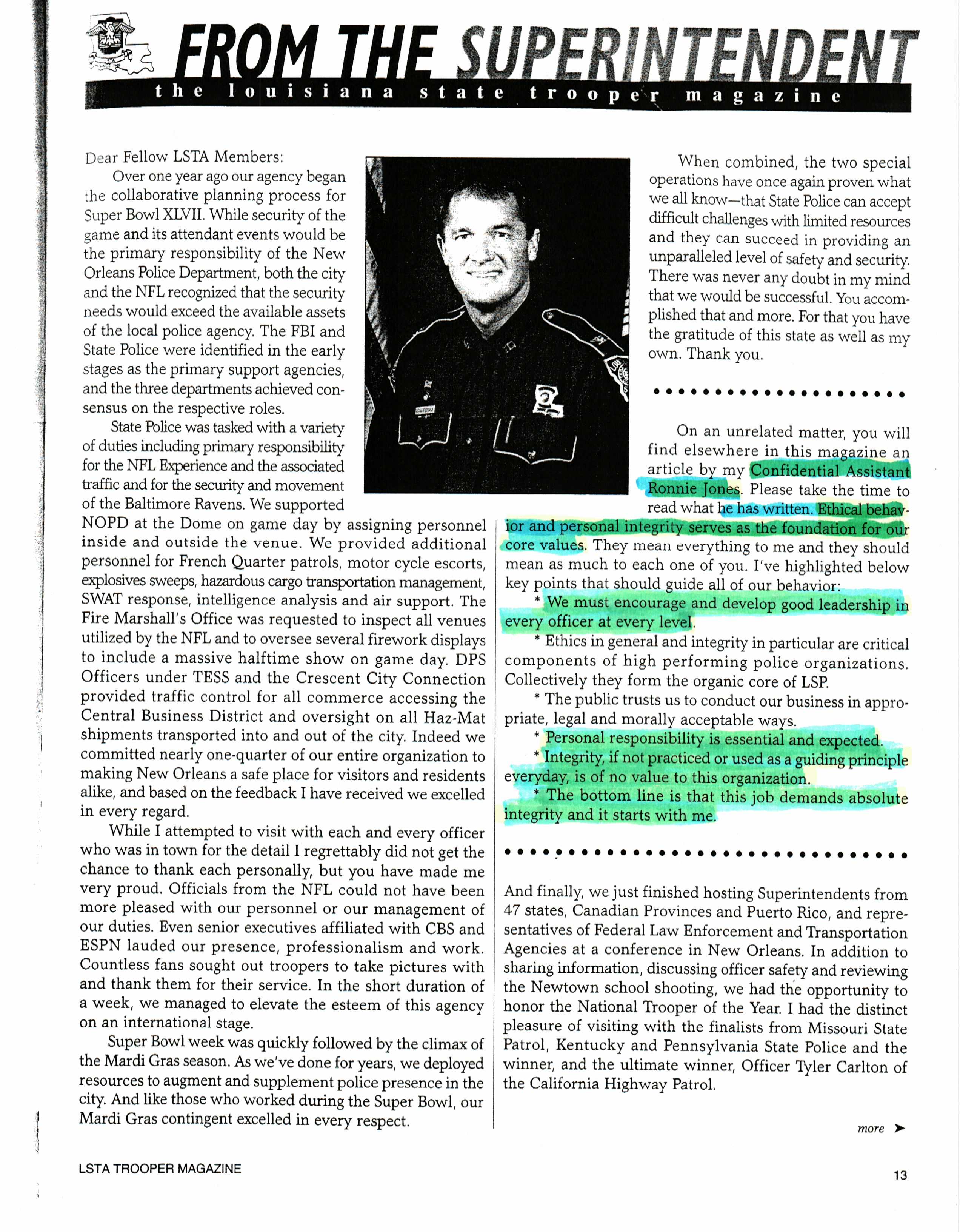
State Police Superintendent Mike Edmonson introduced the piece in his From the Superintendent comments on page 13 of the publication: MESSAGE FROM EDMONSON

(CLICK ON IMAGE TO ENLARGE)

“Ethical behavior and personal integrity serves as the foundation of our core values,” he wrote, adding that those traits “mean everything to me.”

He went on to write:

  • We must encourage and develop good leadership in every officer at every level.
  • Ethics in general and integrity in particular are critical components of high performing police organizations. Collectively they form the organic core of LSP.
  • The public trusts us to conduct our business in appropriate, legal and morally acceptable ways.
  • Personal responsibility is essential and expected.
  • Integrity, if not practices or used as a guiding principle every day, is of no value to this organization.
  • The bottom line is that this job demands absolute integrity and it starts with me.

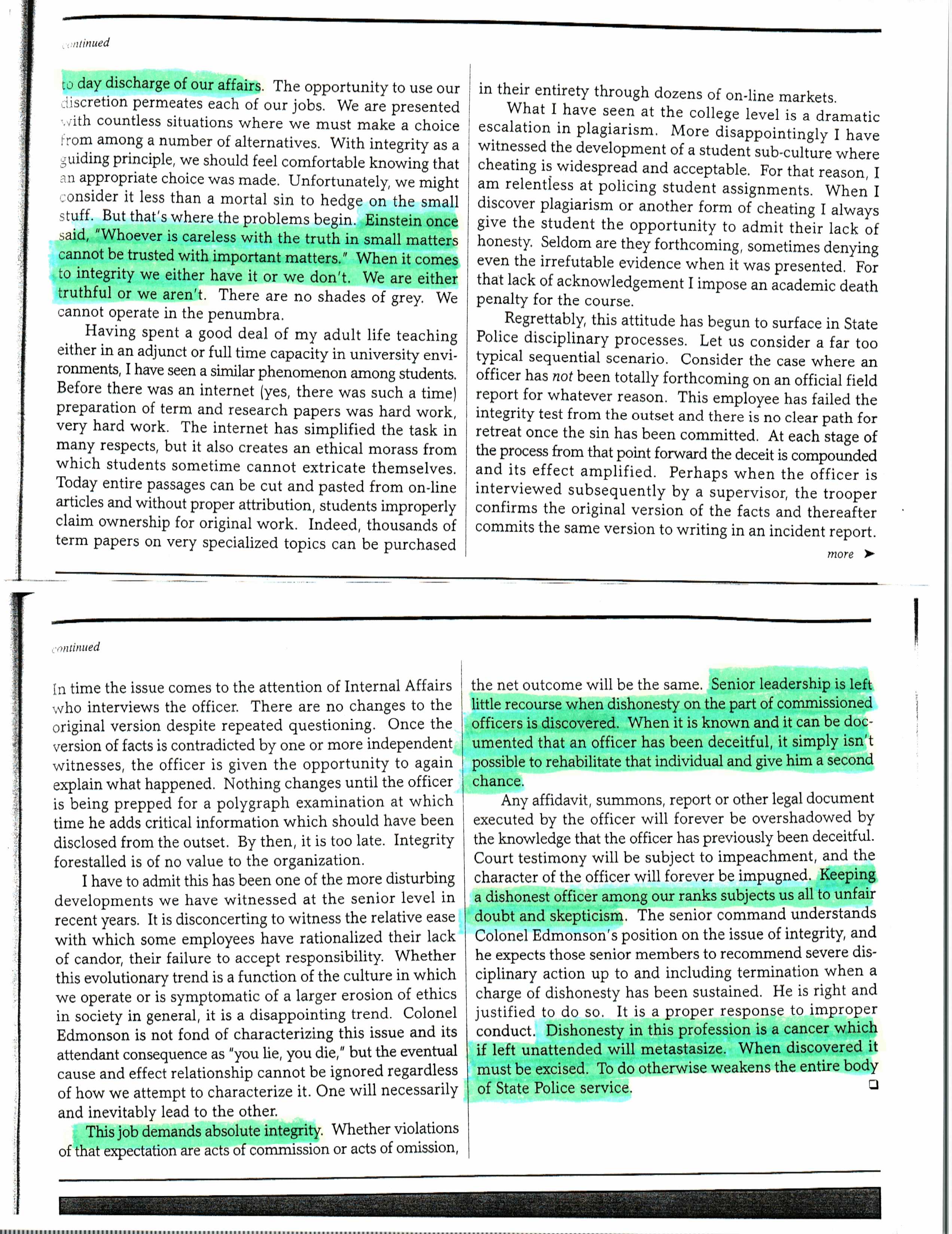
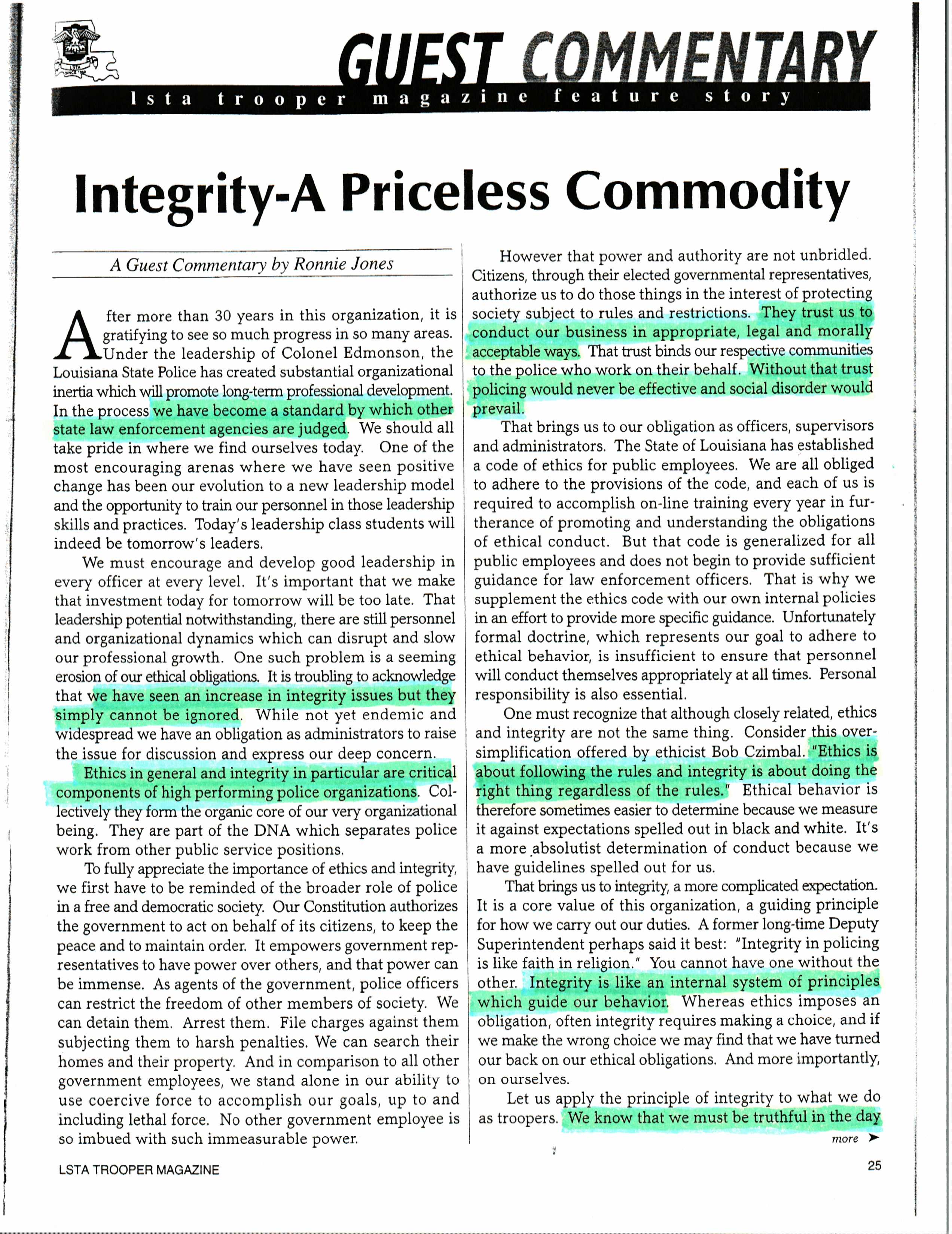
Edmonson cited a second article under the heading of Guest Commentary in the same issue, one written by his then confidential assistant Ronnie Jones (now chairman of the Louisiana Gaming Control Board) which began on page 25.

INTEGRITY 1

INTEGRITY 2

(CLICK ON IMAGES TO ENLARGE)

In his article, which was two pages long but spread over three pages, Jones said LSP had become “a standard by which other state law enforcement agencies are judged.” Not to question Jones’s “integrity” in truth in reporting, but we would like to see that declaration quantified. Just who is it who judges other state law enforcement agencies by LSP standards? (Just asking.)

“Ethics in general and integrity in particular are critical components of high performing police organizations,” he wrote. “Collectively they form the organic core of our very organizational being.”

Wait. What? Go back up to the second bullet point that Edmonson supposedly write in his From the Superintendent message. Did Jones plagiarize his boss or did Edmonson pull a fast one with his message by having Jones ghost write it for him?

“They trust us to conduct our business in appropriate, legal and morally acceptable ways,” Jones wrote. To paraphrase Ronald Reagan in his debate with President Jimmy Carter, Well, there it is again (see bullet point three above). Integrity would seem to dictate that someone come clean here and clarify who wrote what. Honesty should demand it.

“Ethics is about following the rules and integrity is about doing the right thing regardless of the rules,” Jones pontificated. (See our post from Sunday, Feb. 28.) https://louisianavoice.com/2016/02/28/state-troopers-association-issues-letter-to-its-membership-attacking-louisianavoice-and-others-who-question-activities/

Jones then waxed philosophical when he quoted physicist Albert Einstein: “Einstein once said, ‘Whoever is careless with the truth in small matters cannot be trusted with important matters.’ When it comes to integrity, we either have it or we don’t. We are either truthful or we aren’t.” https://louisianavoice.com/2014/07/11/generous-retirement-benefit-boost-slipped-into-bill-for-state-police-col-mike-edmonson-on-last-day-of-legislative-session/

“This job demands absolute integrity,” he wrote.

“Keeping a dishonest officer among our ranks subjects us all to unfair doubt and skepticism,” he continued. “Dishonesty in this profession is a cancer which if left unattended, will metastasize. When discovered it must be excised. To do otherwise weakens the entire body of state police service.” https://louisianavoice.com/2015/12/08/state-police-lt-sneaked-underage-woman-into-mississippi-casino-in-2010-subsequently-named-commander-of-troop-f/

Come to think of it, the writing styles of Jones and whoever penned that letter to the LSTA membership certainly are similar.

We’re just sayin’…

Read Full Post »

On Thursday (Feb. 25), we posted a story that contained several news developments. Those included the approval of the one-cent sales tax, Moody’s downgrade of the state’s credit and the announcement of Public Service Commissioner Foster Campbell’s entry into the race for the U.S. Senate seat now held by retiring Sen. David Vitter.

Also mentioned in passing was the call we received from someone conducting a so-called “independent poll” about the upcoming Senate race.

We bracketed the term “independent poll” with quotation marks because it took only a few questions from the “pollster” to realize the questions were quite obviously written on behalf of—and possibly even by—U.S. Rep. John Fleming, the good doctor/UPS store/Subway sandwich shop/payday loan entrepreneur from Minden.

Unfortunately, that is the way virtually all polls commissioned by candidates are conducted: loaded questions intended to steer the respondent’s answers in a certain direction so as to enable the candidate to release the “results” that put him or her in a favorable light.

With Fleming, however, it is more than a little difficult to put him in a favorable light. He is just that repulsive and his candidacy for Senate could well be a blessing in disguise. Should he lose—and at the moment, State Treasurer John Kennedy would appear to be the clear favorite—then the state will be rid of what one blogger called “today’s most hateful Republican stooge.”

http://downwithtyranny.blogspot.com/2009/09/todays-most-hateful-republican-stooge.html

Should Kennedy or any of the other half-dozen or so candidates win, then Fleming can go back to selling foot-longs.

It’s bad enough that Fleming pulled down more than $5 million in 2008 the year he was first elected, but he did so while refusing to contribute to the health care of most of his 500 employees. The precious few who did qualify were forced to pay a $3,300 deductible.

A couple of years ago, Fleming was critical of LouisianaVoice for what he perceived as our position of favoring “redistribution of wealth.” We responded that the only “redistribution of wealth we were able to document was the upward flow of wealth to Wall Street, pharmaceutical companies and big oil and gas. It was at that point that Fleming did what he does best: he blocked us from further correspondence on Facebook. So much for public discourse and accountability to the electorate (yes, we are aware we don’t vote in his district, but he habitually does the same thing to his constituents).

We also wrote about his payday loan company. Payday loan companies, which, by the way, our wonderful legislature has refused to rein in, feed on low-income, unsophisticated citizens by charging impossibly high interest rates that only perpetuate the problem of recurring, increasingly high debt for those struggling to survive. (That same legislature has exacerbated the problem by repeatedly refusing to increase the minimum wage in Louisiana.)

It was at that point that his mouthpiece, aka public relations flak, contacted us, asking if we would print a retraction to the story about his payday loan company, which the mouthpiece claimed was a corporation set up solely for Fleming’s employees (that’s nice, pay low salaries and then take the money back via high interest loans).

Our response was that we would be happy to print a retraction if (a) he could prove the story was untrue and (b) he would reveal to us how many medical malpractice lawsuits had been filed against Fleming’s medical practice.

We never heard from him again.

But back to that poll:

The questions were couched in such a way as to make every other candidate (except for Campbell who at the time, had not announced as a candidate) look like some type of evil predator bent on devouring the livers of the electorate. For instance, were aware that John Kennedy was a Democrat who supported John Kerry for President (in 2004) but later switched to Republican?

Wow! That’s a real killer.

How do you feel about John Fleming, who despite humble beginnings, brought himself up by his bootstraps to become a successful businessman who founded several businesses and who was a successful physician?

Short answer: “He’s an idiot.”

And “even though there has never been a Supreme Court Justice appointed in an election year…..”

Whoa. Hold it right there, lady. That’s a lie.

Nonplussed, she soldiered on: “President Obama intends to fill the vacancy…”

Not true. There have been six Supreme Court justices confirmed during a presidential election year since 1900—two by Nixon, one each by Herbert Hoover, Franklin Roosevelt, Gerald Ford and Ronald Reagan. http://www.vox.com/2016/2/15/10998836/supreme-court-nomination-election-year

Okay, Lewis Powell and William Rehnquist were actually confirmed in December of 1971—a couple of weeks shy of the actual calendar election year, but well within the 12 months leading up to the election. Same for the confirmation of Ford’s nominee John Paul Stevens (December 1975). But Anthony Kennedy, Reagan’s nominee, was confirmed in February of 1988.

Going back a tad further, Franklin Roosevelt nominated Frank Murphy who was confirmed in January of 1940 and Herbert Hoover nominated Benjamin Cardozo who was confirmed in February of 1932.

Let me ask you a question, Ms. Pollster: How do you feel about Fleming’s apparent willingness to tell an outright whopper just for the purpose of obtaining a favorable (to him) answer to a poll question?

For that matter, how do you feel about Fleming’s consistently voting against working families even though he represents a district where the median income is only about $35,000 per year?

  • He opposed a bill whereby small businesses with 25 employees or fewer with wages of less than $40,000 would qualify for tax credits of up to 50 percent of the costs of providing health insurance. (Of course, he favored tax credits for the wealthy and for big corporations).
  • He opposed help for seniors with drug costs in the Part D donut hole that would have cut the costs of brand name drugs by 50 percent and which would have eventually eliminated the donut hole altogether.
  • One of his first votes in Congress was to oppose SCHIP, the proposal to provide medical insurance to 11 million needy children. (Fortunately, that bill passed by a huge margin of 290-135.

So there. Take your little poll and stick it in the same place where Fleming’s head resides.

Read Full Post »

« Newer Posts - Older Posts »