Feeds:
Posts
Comments

Archive for the ‘Taxes’ Category

The past is prologue

                                    —William Shakespeare (The Tempest)

In 1936, Mississippi Gov. Hugh White successfully pushed through the state legislature his answer to President Franklin Roosevelt’s New Deal so despised by southern states.

Mississippi could grow and prosper through his landmark “Balance Agriculture with Industry” program, according to Mississippi native Joseph B. Atkins, author of the little-known but important book Covering for the Bosses. The book is an examination of how newspapers in the South refused to give fair coverage to labor unions in their attempt to gain equitable working conditions for workers first in the textile mills and later the automobile industry.

https://books.google.com/books?id=o6AfWT79t2MC&pg=PA237&lpg=PA237&dq=shadows+in+the+sunbelt+1986&source=bl&ots=7Wb_bKCn48&sig=FIjJetyw-Li-lCk0c3zN_muV3MA&hl=en&sa=X&ved=0ahUKEwjL-Ob4k4_LAhWFPiYKHchPD50Q6AEIUDAJ#v=onepage&q=shadows%20in%20the%20sunbelt%201986&f=false

According to Atkins, White figured he could attract industry to Mississippi through the then-radical concept of offering attractive tax incentives and promises of low wages—and, of course, no unions.

The program, Atkins writes, eventually became a model for the entire South and today, Mississippi, in the latest rankings of the best states for business, can be found sitting firmly in….47th place among the 50 states, ranked ahead of only (in order) Kentucky, Louisiana, and West Virginia. In fact, the South can lay claim to six of the bottom 10 spots in the national rankings. They also include Arkansas (42nd) and Alabama (45th). Tennessee was only slightly better at 38th. Virginia (10th) and North Carolina (15th) were the only southern state in the top 20. http://247wallst.com/special-report/2016/02/17/the-best-and-worst-states-for-business-2/

So what went wrong with White’s grand scheme for Mississippi? Simply put, the same thing that doomed Louisiana, Alabama, Arkansas and Tennessee to the bottom one-fourth of the heap. They gave away their tax bases while at the same time condemning their citizens to lives of low wages and poor benefits. And Wal-Mart was first in line to fully exploit the plethora of incentives, be they the 10-year property tax exemptions, Enterprise Zone initiatives or some other inducement.

Wal-Mart, described by Wall Street Journal writer Bob Ortega in his book In Sam We Trust as “an amoral construct with one imperative: the profit motive.”

In October 2005, Atkins writes in Covering for the Bosses, that an internal Wal-Mart memo was leaked which revealed the true, impersonal attitude of the corporate office toward its 1.3 million American workers, 30 percent of whom are part-time workers.

In her memo to Wal-Mart executive vice president M. Susan Chambers complained of the costs of long-term workers. The company, she said, spent 55 percent more on them than on one-year workers even though “there is no difference in (the employee’s) productivity.” She said because Wal-Mart pays an associate “more in salary and benefits as his or her tenure increases, we are pricing that associate out of the labor market, increasing the likelihood that he or she will stay with Wal-Mart….The least health, least productive associates are more satisfied with their benefits than other segments and are interested in longer careers with Wal-Mart,” she said.

In plain language, she was advocating throwing older workers to the curb in favor of newer, lower-salaried workers.

Yet Wal-Mart has shoved its way to the public trough, securing some $100 million in economic development subsidies from the state in 20 cities from Abbeville ($1.67 million) to Vidalia ($1.65 million), from Shreveport ($6.3 million) to New Orleans ($7 million), from Monroe ($3.9 million) to Sulphur ($1.8 million).

Nationally, estimated annual subsidies and tax breaks to Wal-Mart and the Walton family total $7.8 billion per year. This for six Walton heirs whose collective net worth of $148.8 billion is more than 49 million American families combined. http://www.americansfortaxfairness.org/files/Walmart-on-Tax-Day-Americans-for-Tax-Fairness-1.pdf

A congressional report estimated that each Wal-Mart store in America generated an average of $421,000 in Medicaid, SNAP and public housing costs to taxpayers. That’s in addition to the estimated $1 billion taxpayers anted up in local and state government subsidies to have a Wal-Mart in their communities. Wal-Mart workers, who earn less than $10 an hour (about $18,000 per year), are offered a family health care plan with a $1,000 deductible costing $141 per month.

And remember that warm fuzzy “Made in USA” advertising campaign of Wal-Mart in which Wal-Mart in 2013 said it was starting a 10-year plan to increase spending on U.S. made products by $250 billion? Well fuggeboutit. It didn’t happen and last October, the company removed the “Made in the USA” logos from all product listings on its Web site after the Federal Trade Commission caught the company (gasp) lying. http://fortune.com/2015/10/20/walmart-made-in-the-usa/

Instead, much of its merchandise, clothing in particular, comes from third-world sweatshops where workers are paid pennies per hour in wages and children work up to 20 hours per day to make the clothing we purchase from Wal-Mart. https://www.dosomething.org/us/facts/11-facts-about-sweatshops

And here’s a real eye-opener.

In her book Cheap, author Ellen Ruppel Shell reveals a dirty little secret most consumers are unaware of: name-brand clothing sold at Wal-Mart aren’t quite what consumers think they are. “Discounting dilutes brands, making it less certain that they are a mark of quality,” Shell writes. http://www.nytimes.com/2009/07/19/books/review/Shapiro-t.html?_r=0

Hundreds of brands “slice and dice their offerings for various markets, selling different products in different types of stores for different prices under the same brand,” she said. “Chains such as Wal-Mart, Best Buy, Target and Home Depot have items manufactured ‘to their specifications,’ meaning that the brand name is almost devoid of meaning.”

That means a television with a model number available only at Wal-Mart is not really a Sony or a Samsung, for example, but a Wal-Mart television.

“Brands have become an end in themselves,” she writes. “…It is not the brand alone that entices discount shoppers; it is the high value we link to the brand versus the low price we pay that is so seductive.”

In recent years, Louisiana taxpayers have subsidized the construction of Wal-Mart stores in two affluent suburbs to the tune of a $700,000 tax credit. A tax credit is a dollar for dollar reduction of a tax liability meaning a $1 tax credit reduces one’s taxes by a full dollar. Bear in mind, these subsidies were Enterprise Zone projects. The Enterprise Zone program is designed specifically to lure business and industry into areas of high unemployment in order to help economically depressed areas. Instead, one of these stores were built in St. Tammany, one of the most affluent communities in the state.

Likewise, $330,000 in Enterprise Zone tax credits were awarded in 2013 to Lakeview Regional Medical Center in St. Tammany Parish for an upgrade to its facilities which created a grand total of five new jobs.

As far back as 2012, then-Secretary of the Department of Economic Development Stephen Moret said the Enterprise Zone program no longer fulfilled its purpose. http://www.nola.com/politics/index.ssf/2012/12/louisiana_economic_development_1.html

A Legislative Auditor’s report agreed, saying that 75 percent of new jobs, 68 percent of new businesses and 60 percent of capital investments were made outside the EZs. http://app1.lla.state.la.us/PublicReports.nsf/92629A33AAE8C55F862579EB0072ACEB/$FILE/00029DFA.pdf

That’s because unlike other states, Louisiana’s Enterprise Zone program allows the generous five-year tax breaks for retail establishments, businesses whose salaries traditionally are at the low end of the pay scale. Those include, besides Wal-Mart, chain stores like Walgreens and Raising Cane’s chicken outlets.

“Most of the projects are larger companies investing in relative affluent areas in Louisiana today,” Moret said in something of an understatement. He said that fact alone underscored the importance of making changes to the program.

Were changes made? No. In fact, in 2013, the year after his comments, the state awarded EZ tax credits totaling $19.6 million for projects that produced 4,857 new jobs which in turn generated about $10 million in state income taxes, or a net loss of more than $9 million to the state.

Meanwhile, Atkins quotes author Bill Quinn as saying Wal-Mart “has done more to stomp out Middle-class America than all other discount houses put together.”

Yet, the official policy of Louisiana has been to continue to give generous tax breaks to a company that underpays its employees, deceives customers into thinking they are “buying American” when in reality, they are propping up third-world sweatshops whose workers churn out second line brand names under slave-like working conditions.

Read Full Post »

By Stephen Winham

Every day we hear the same thing: “If we could just get rid of those dedications, we could fix the budget and not have to always hit higher education and health care so hard when times are tough. There are plenty of things we could cut without hurting anybody or anything.”

It sounds so easy. You hear, in very broad terms, how the budget has grown and how out-of-bounds spending has gotten. Our current budget totals about $25 billion, of which $10 billion is federal. I will focus on state funding in the official revenue forecast – about $10.4 Billion in the current year, with strongest emphasis on the $7.9 Billion in state general fund spending we can most readily control. The official forecast numbers for next year are $10.4 billion and $8.2 billion, respectively.

We hear about $4.3 billion in dedicated funds ($3.5 billion in the currently-proposed FY 2016-2017 budget) that could be eliminated and go a long way toward fixing our budget problems. What we rarely hear about is the additional $4 billion in the state general fund that is allocated and/or protected by the State Constitution.

For starters, almost a half billion dollars comes directly off the top of the general fund, but IS NOT APPROPRIATED. That’s right, you don’t see or hear much about this money because it is not appropriated – rather, it is a direct draw on the state’s general fund.

If you go to page 177 of the FY 2016-2017 Executive Budget, you will find Schedule 22, Non-Appropriated Requirements. This schedule allocates $496.5 million from the state general fund in the treasury, pursuant to the State Constitution, for the following:

$404.8 M – General Obligation Bond Debt Service

[IMPORTANT DIGRESSION: G. O. Debt service is increasing by over $211 million (109%) next year due to one-time savings utilized in the current year from defeasance of debt – In other words, this is part of the one-time “fix” in the current budget that has to be covered next year.]

$90.0 M – General Revenue Sharing – goes to local governments as a partial offset for local property tax revenue lost due to the State Homestead Exemption

$ 1.7 M – The Interim Emergency Board – provides emergency funds during the budget year

Now I ask you, which of these would you be willing to vote out of existence? Eliminating or changing them would require constitutional amendments and a vote of the people.

The one of these three I would not cut, for sure, is our $405 million in debt service. Defaulting on our debt would cause immediate loss of a marketable bond rating and send a message to the rest of the country that we are truly bankrupt.

Cutting the other $91.7 million in non-appropriated items would have very serious implications, particularly for local governments. Even if you think local governments shouldn’t get the revenue sharing, how do you think they would make it up, if they didn’t?

In addition to non-appropriated allocations, the State Constitution also mandates general fund spending for a number of appropriations. The state’s Minimum Foundation Program for public elementary and secondary education is required by the constitution and has a $3.4 Billion state general fund appropriation. You might be inclined to cut administration and other programs in the Department of Education, but are you willing to vote for a constitutional amendment eliminating basic state support for our public schools, or even allowing for substantially reducing it? You may not directly use public education, but you have to agree we absolutely have to have it and it should be funded at no less than its current level. The education provided by our public schools is vital and is finally improving. We can’t afford to lose the ground we’ve gained.

So, between just the General Obligation Bond debt service and the MFP requirements for next year, we have $3.8 Billion of General Fund (46% of the total) expenses it would be simply stupid to cut.

In addition to the MFP, another $600 million of our general fund expenditures are currently required by the State Constitution. State supplemental pay for local law enforcement alone is $124 million of this. Also included are salaries of statewide elected officials and the costs of elections. You might not be happy with the salaries of your statewide elected officials, but we have to pay them and I don’t think you could possibly support not having the money to hold elections. If you think locals ought to fully fund the salaries of law enforcement personnel, where do you think they might get the money to do so?

[Digressing again and focusing on local government funding for a moment, what if we decided to cut it all? Except for capital outlay projects, we indirectly fund recurring local services, so we would, in essence, be shoving our problem down to the local level – and we all live somewhere.  If local governments were unable to raise local taxes to support the services, they would be eliminated or significantly degraded.  If they were able to raise local taxes to support them, how would the taxpayers see a difference?]

What other general fund expenditures, currently considered mandated should we consider cutting? How about the $130 million in appropriated debt service (in addition to G. O. Debt)? How about the $400 million plus it costs to incarcerate adult inmates in our state prisons? Or, the $157 million we pay local sheriffs to house state inmates? The $27 million we pay in District Attorney and assistants’ salaries? How much of the $73 million legislative and $160 million judicial general fund appropriations are we and the legislature willing to cut? How much of the $848 million in general fund we consider sacrosanct because of federal mandates should we cut and what will happen if we do? How much can we realistically cut from our Medicaid program and still attempt to meet the health care needs of our citizens?

Finally, how about the elephant hiding behind the sofa, our annual payments via the state payroll system toward the Unfunded Accrued Liabilities of our state retirement systems? I’m no actuary, but using the actuarial reports generated by the Legislative Auditor, I estimate annual payments toward this liability, in state funds, is no less than $600 million and growing rapidly because of the way the amortization is structured. The State Constitution requires this debt to be liquidated by 2029.

We often hear that 67% of our general fund budget is non-discretionary. Let’s pretend we don’t have to do a lot of these things and, just for the sake of argument, say only 55% should not be touched. That still leaves only $3.7 billion of state general fund on the table subject to cut and we certainly aren’t going to cut over half of that to solve a projected $2 Billion problem next year. And, by the way, remember that any of the current year deficit not liquidated this fiscal year will, by law, have to be added to that problem.

Take a look at John Bel Edwards’ first Executive Budget. It is balanced to the official revenue forecast of general fund revenue. Look at what is cut and where. Look closely.

http://www.doa.la.gov/opb/pub/FY17/FY17_Executive_Budget.pdf

For more details, look at the supporting document:

http://www.doa.la.gov/Pages/opb/pub/FY17/FY17ExecBudget.aspx

Now, finally, let’s get back to those dedicated funds. The Legislative Auditor has just released a comprehensive document detailing these dedications. He points out there were 370 dedicated funds in Fiscal Year 2013-2014 (the last year for which complete documentation is available), 344 statutory and 26 constitutional. Let’s see which ones of these we want to eliminate.

How about the $1.4 Billion Transportation Trust Fund? Our roads are in great shape, right? Plus, we blow part of this on public safety rather than roads and public safety certainly isn’t important, is it?

How about the $159 million in Lottery proceeds? Surely we can find a better use than education for that money. The $184 million in the Medicaid Trust Fund for the Elderly? We only have to change a statute to cut the old folks off. The Oil Spill Contingency Fund at $52.7 million? We never have oil spills, do we? And, why should we share $39 million of our severance taxes with the parishes where the minerals are severed? TOPS is draining us dry, so let’s free up that money and spend it elsewhere.

I’m being facetious, but, seriously, don’t you think there is a constituency for every one of those 370 dedications (except maybe the 21 that have no revenue or expenditures)? How many times have dedications been studied and how many have been eliminated so far? The Joint Legislative Committee on the Budget has reviewed 25% of these dedications every other year since 2009, but has made no recommendations for modifying or eliminating any of them.

Whatever we do with dedicated funds can’t and shouldn’t be done overnight. Many of them support local governments, but the Transportation Trust Fund is the largest of them all and, in addition to the Department of Transportation, other state departments and agencies derive substantial operating funds from dedications, most notably the Public Service Commission, the departments of Environmental Quality, Wildlife and Fisheries, Economic Development, Agriculture and Forestry, Natural Resources and Public Safety Services.

Shouldn’t we look at each dedicated fund in depth to determine it source, its purpose, and the extent to which collections exceed needs? Isn’t this just what the Joint Legislative Committee on the Budget should have done? Wouldn’t it have made a lot more sense to examine the historical inflows and outflows of each of these dedicated funds before creating a $442 million Overcollections Fund from their balances in FY 2014? This was yet another statutory dedication and a big reason statutory dedications spending rose so much. Worse, we then used the Overcollections Fund to pay for recurring expenses elsewhere – a significant part of why we are in our current mess.

Obviously, some collections in excess of needs should revert to the general fund. Others, justifiably, should not. In many cases, these funds are created from fees people pay for which they expect certain services. Some dedications to locals are used to service bonds.

Should we continue to look at potential modifications or eliminations of statutory dedication as a partial solution to our problems? Absolutely, but given our history and the realities of today, should we place an inordinate amount of blame for our current problems on them, or expect a miraculous cure to emerge from further study? I frankly don’t see why we would.

I urge you to look at the Legislative Auditor’s report here:

http://app.lla.state.la.us/PublicReports.nsf/0/13D9277344A19B9086257F560076E83A/$FILE/0000CAA1.pdf

It will give you a much better understanding of the dedications and is formatted in such a way as to drill down from a relatively high level to a very detailed level, so you can stop where you’d like and still gain valuable insight.

Let’s face it, as Gov. Edwards has said, if it is so easy to cut the budget, why has it not been cut to size long before now? This is particularly true in light of the fact we had a governor who travelled the United States for the past 8 years professing to be a budget cutter extraordinaire. If he actually cut expenditures to meet revenues and wrought such an economic miracle why do we find ourselves so out of whack? No, Virginia, it’s not just oil prices.

State Treasurer John Kennedy and others point to things the administration should do to eliminate fraud, abuse, and waste in state government. Who can disagree? To the extent these occur, we are all losers – the biggest are the intended beneficiaries of the services.

It is important that citizens believe their tax dollars and fees are being spent as wisely as possible or, at the minimum, that somebody is consistently and comprehensively trying to ensure this is the case. In my opinion, the accountability for this lies with the administration, not the legislative auditor or anybody else.

The administration has not yet provided specifics or even examples of what it plans to do about specific contracts that make no sense, bureaucratic structures that may be bloated, and more effective and efficient delivery of health care services. Gov. Edwards has said he will do something about these things, but he is yet to provide even anecdotal evidence like Kennedy and others to support his claim.

The executive branch needs to hold its appointed officials to the highest standards and demand they investigate dedications and everything else in the departments they are paid well to manage toward doing everything they possibly can to make our government as efficient and responsive as it can be. The public needs to know this is being done. They should not have to see an increasing succession of negative findings by the Legislative Auditor or, worse, disturbing reports of mismanagement and abuse in the media and elsewhere that go largely unanswered.

But, all that said, can these efforts bear fruit overnight? Can they come close to eliminating the gap? Look deeper than the rhetoric and you have to answer “no” and “no.”

One more link is below – an excellent presentation by the Louisiana House Fiscal Division done just a month ago. Check it out:

http://house.louisiana.gov/housefiscal/0112_16_OS_FiscalBriefing2.pdf

There is a lot of really good information out there from a variety of sources inside and outside government. Our decision-makers need to use it.


Read Full Post »

True to form, some legislators are already diving for cover or accusing higher education officials of crying wolf over the state’s lack of support for state colleges and universities. Either way, it all amounts to a shameless attempt to shift the blame as a means of deflecting attention from their pitiful performance over the past eight years

Some of those doing the loudest protesting might want to look inward to examine the hypocrisy of their current positions on funding higher education.

Sen. Conrad Appel (R-Metairie), for example. Appel opined in a Senate Education Committee meeting on Monday that he just didn’t think it is fair that education leaders are getting the public all worked up with scare tactics and doomsday propheteering—not to be confused with his own profiteering, of course.

“This is the first day of the process and the news media is flashing all this stuff up and getting the people all worked up,” Appel said in accusing higher ed leaders of sensationalizing the real impact of budget cuts and of creating what he termed “a self-fulfilling prophecy.”

Of course, Appel is not one to pass up a good opportunity when he gets the chance. As Chairman of the Senate Education Committee two years ago, he was in a unique position to know of the pending deal between Discovery Education and the Louisiana Board of Elementary and Secondary Education (BESE) in time to sink between $5,000 and $24,999 into Discovery Communications stock just in time to make a killing. APPEL REPORT PDF

Senate Education Chairman Appel purchases Discovery stock week before company enters into state Techbook agreement

Since 2003, former and current members of the Louisiana House and Senate have used more than $710,000 of their personal campaign funds to purchase tickets to LSU athletic events. This despite the existence of several opinions issued by the State Board of Ethics specifically prohibiting the purchase of athletic tickets “for any personal use unrelated to a campaign or the holding of public office.” (Emphasis ours) http://ethics.la.gov/EthicsOpinion/DocView.aspx?id=7169&searchid=1e6d42e0-0081-4d47-b252-2473624ce865&dbid=0

LSU SPORTS PAYMENTS FROM CAMPAIGN FUNDS

So now we have legislators like State Sen. Mike Walsworth (R-West Monroe) criticizing taking higher education officials to task for suggesting that schools might close and TOPS may be ended because of a mere $970 million budgetary shortfall this fiscal year and a pending $2 billion budget hole for next fiscal year.

Walsworth, it should be noted, used $4,210 of his campaign funds in 2013 and 2014 on LSU athletic events.

But that pales in comparison to State Sen. Norbert Chabert (R-Houma) who went ballistic over a report that his alma mater Nicholls State University in Thibodaux might be forced to close temporarily. http://www.thenewsstar.com/story/news/2016/02/15/even-best-case-nicholls-close-temporarily/80403372/

“This is the first I’ve heard of it,” he said. “I think it’s unnecessary and a bad call. Are you telling me that the university in the fifth largest market in Louisiana that serves 6,300 students is going to close? This isn’t going to happen.”

Of course not, Norby. And Merrill Lynch, AIG, Lehman Brothers, Washington Mutual and a few hundred banks weren’t going to bite the dust starting back in 2008 either, were they? And shoot, Bernie Madoff was a man to be trusted with our investments, right? https://en.wikipedia.org/wiki/List_of_bank_failures_in_the_United_States_(2008%E2%80%93present)

While while we ponder the wisdom of Chabert’s assurances, it might be worth noting that since 2009, he spent a cool $35,750 on tickets to LSU athletic events. It seems it’s okay to plow OPM (other people’s money—and that’s what campaign funds really are) into athletics, but don’t let university come crying about the shortage of funding for academics or the deplorable conditions of university infrastructure.

It would also be timely to point out here that athletics are not the only expenditure items for legislators’ campaign funds. There are the expensive meals, the leasing of luxury automobiles, Saints and Pelicans tickets, payments of ethics fines for campaign violations (expressly prohibited but done with impunity), and in at least one case, one legislator paying his personal federal income taxes with campaign money. https://louisianavoice.com/2015/05/11/hidden-in-plain-sight-campaign-funds-provide-opulent-lifestyle-of-meals-game-tickets-and-travel-for-legislators/

But because the focus for the moment is on higher education, we will limit our examination of campaign expenditures to LSU sports.

Here are some of the more flagrant cases we found:

  • Senate President John Alario, one of those who signed off on Grover Norquist’s no-tax pledge, spent more than $19,000 on LSU tickets;
  • Rep. James Armes (D-Leesville): $11,500 since 2008;
  • Rep. John Berthelot (R-Gonzales): $19,280 since 2011;
  • Rep. Thomas Carmody (R-Shreveport): $21,660 since 2010;
  • Rep. Patrick Connick (R-Marrero): $24,540 since 2008;
  • Rep. Michael Danahay (D-Sulphur): $17,600 since 2008;
  • Former Rep. Noble Ellington (recently appointed as legislative director for Gov. Edwards): $46,500 since 2002);
  • Sen. Dale Erdy (R-Livingston): $24,000 since 2003;
  • Former legislator and former Alcohol and Tobacco Control Commissioner Troy Hebert: $13,700 since 2009);
  • Rep. Frank Hoffman (R-West Monroe): $22,700 since 2009;
  • Former House Speaker Chuck Kleckley (R-Lake Charles): $31,900 since 2008;
  • Rep. Bernard LeBas (D-Ville Platte): $18,400 since 2009;
  • Sen. Danny Martiny (R-Metairie): $13,800 since 2002;
  • Sen. Jonathan Perry (R-Kaplan): $21,000 since 2009;
  • Former Rep. Erich Ponti (R-Baton Rouge): $18,700;
  • Former Rep. Joel Robideaux (R-Lafayette): $23,600 since 2004;
  • Sen. Gary Smith (D-Norco): $33,800 since 2002;
  • Sen. Francis Thompson (D-Delhi): $15,100 since 2010;
  • Former Sen. Sherri Buffington (R-Shreveport): $23,800 since 2009.

Buffington, then Sherri Cheek, is the same legislator who, in January 2004 traveled to New Orleans to attend the NCAA national championship football game between LSU and Oklahoma but forgot his tickets. No problem. She simply called State Police and arranged for a Pony Express-type relay by state troopers from Shreveport to New Orleans to deliver the six tickets. When word of the special deliver leaked out, she expressed her regret (don’t they always feel just awful—after they’re caught?) and said she would repay State Police $448.50, based on her computation of 12 hours of trooper pay. http://www.freerepublic.com/focus/f-news/1060246/posts

So while certain members of the legislature grandstand over the current and projected budgetary issues, it is important to remember they are a large part of the problem.

And higher ed is by no means the only fiscal issues before the legislature during the current special session.

There are grave cuts being proposed for health care which will be covered in greater detail in future posts here.

But a quick overview shows drastic cuts to programs serving the elderly, those on dialysis, the developmentally disadvantaged, hospice, and, of course, the disastrous venture into privatizing state hospitals.

It’s going to be difficult for legislators to rail against those with real needs to help keep them alive or well. To do so would truly expose the hypocrisy of those who claim to represent their constituencies.

As we said in an earlier post, this is the one chance lawmakers have to get it right. Rhetoric will not save the day. Denial will not solve the problems. Continuing the same fiscally irresponsible practices will not plug the gaping hole in the state budget.

And this is not the time to be point fingers or scolding administrators.

The time is now and the place is here to come together and to do what must be done to solve the state’s multitude of problems.

Anything less and wholesale recalls should be initiated immediately as soon as this session is over.

Read Full Post »

The time has come to stop blaming Bobby Jindal. (Yeah, I know, I probably won’t. The man simply spread too much carnage during his eight clueless years occupying one office in theory while running for another in runaway delusional fantasy.)

But now it’s a new day and the torch of ineptness has been passed to his enablers, holdover members of the Louisiana House and Senate.

Legislators convened in Baton Rouge Sunday in special session to address a $900 million budget deficit for the remainder of this fiscal year and to take steps to head off a $2 billion budgetary shortfall for the next fiscal year, which begins July 1.

They have one chance to get it right. One chance, and one only.

If their performance over the last eight years is any indication, they won’t. Here’s why:

Louisiana elected officials who have signed the Americans for Tax Reform pledge
Paul Hollis* State Representative Republican
John Alario State Senate President Republican
Jack Donahue State Senate Finance chairman Republican
Gerald Long State Senator Republican
Fred Mills State Senator Republican
Barrow Peacock State Senator Republican
John Smith State Senator Republican
Steve Carter State Representative Republican
Greg Cromer State Representative Republican
Cameron Henry State Representative Republican
Dorothy Hill State Representative Democrat
Valarie Hodges State Representative Republican
Sam Jones State Representative Democrat
Dee Richard State Representative No Party
Alan Seabaugh State Representative Republican
Scott Simon State Representative Republican
John Schroder State Representative Republican
Kirk Talbot State Representative Republican

*Paul Hollis signed the federal Americans for Tax Reform pledge when he was running for U.S. Senate. He is not listed as one of the people who signed onto the state government pledge.

These are returning legislators who swore an oath to a man who does not live in Louisiana, who has never held office. Yet, he appears to command loyalty from a handful of legislators who feel it is more important to serve his interests over those of their constituents, the ones who elected them to office. (Rep. Dee Richard of Thibodaux told LouisianaVoice last year that when he signed the pledge, he had no idea who Norquist was and had never heard of him.)

The late C.B. Forgotston called it “the lowest of a lot of low points” in Louisiana’s sorry legislative history. He said legislators, who had “already abdicated their constitutional responsibility to Bobby Jindal” were pleading with a non-resident of Louisiana “for help doing their jobs.”

Eleven state representatives—we called them “The Elastic Eleven” at the time—turned their collective backs on their constituents in particular and on the state in general in order to suck up to Norquist and to advance their own political agenda. In short, they were afraid to take a bathroom break without Norquist’s permission.

Their letter to Grover Norquist sought his blessing before they voted to pass the Student Assessment for Valuable Education, or SAVE credit program, which created money out of thin air via a higher education tax credit to cover a nonexistent student fee. https://louisianavoice.com/2015/06/08/eleven-republican-members-of-house-ways-and-means-committee-go-groveling-to-grover-norquist-for-direction/

Now, thanks to that little shell game, Louisiana’s colleges and universities teeter on the brink of unmitigated disaster. It’s not as if we were never warned: https://louisianavoice.com/2015/06/05/save-guest-columnist-wonders-if-grover-norquist-holding-compromising-videos-of-louisiana-legislators-bobby-jindal/

So why should we expect a different outcome now?

For one thing, we no longer have a delusional governor hell bent on leaving Louisiana in the broad daylight for the White House. Now we have a grownup on the fourth floor and not a gaggle of adolescent Milton Friedman theorists who refuse to acknowledge the obvious.

LouisianaVoice offers a guest column by Dayne Sherman on the threat to higher education as well as this link to Stephen Sabludowsky’s Bayou Buzz political blog: http://www.bayoubuzz.com/bb/item/1061467-jon-bel-edwards-dogged-by-kill-lsu-save-the-tigers-mentality

Dayne Sherman resides in Ponchatoula. He is the author of two novels and he blogs at http://talkaboutthesouth.com/

Below is his guest column:

Don’t blame the messenger for TOPS crisis

Similar to Rip Van Winkle, Louisiana just awoke from a long sleep. Eight years to be exact. While Jindal wrecked the state, the citizens snoozed, except for a few political watchdogs here and there howling in the night to no avail.

The moment Louisiana resurrected was Thursday, Feb. 11 at 4 PM. Louisiana Gov. John Bel Edwards announced TOPS payments to universities were being suspended. TOPS, college scholarships, is the most beloved socialist welfare program in Louisiana history.

Residents went from deep slumber to screaming in minutes. With college football also on the chopping block, we now know the dead can indeed rise from the grave.

It’s time to face the facts. Louisiana has an enormous structural deficit, approximately $1 billion this year, and $2 billion next fiscal year.

However, despite a Republican governor in Jindal and a Republican dominated House and Senate who created this fiscal crisis, some are incredibly, amazingly, and even ignorantly blaming the new governor—just a month in office—for these cuts.

It can’t be said enough, as everyone should realize, Jindal and the senators and representatives we elected are to blame for this fiasco. John Bel Edwards was one of those heralding voices who fought the foolishness, and he was elected to fix the mess.

Look, Edwards wants to protect TOPS and higher education. But Louisiana can’t cut its way to prosperity, nor can the state print money. The special legislative session ironically starts on Valentine’s Day, though love will not be in the air.

This budget crisis can be fixed with responsible tax increases and realistic cuts, which is all Edwards has suggested. It’s simple but will take intestinal fortitude.

The Republicans in the House, led by Taylor Barras (the figurehead Speaker) and Cameron Henry (the real Speaker), have done nothing but try to hamstring the Edwards administration in order to score political points. Sources say plans have been crafted to end the session as soon as it starts and go home with nothing accomplished as a way to cripple the new governor.

Therefore, I am calling for a new Speaker vote on the first day of the session. Remove Barras and send Henry to the kiddie table where he belongs. I don’t care which Republican takes the helm, as long as he or she is willing to work with Edwards and quit playing obstructionist games detrimental to Louisiana.

My advice for those who care about Louisiana is to go see their legislators. Look them straight in the eye and say the Washington-style politics is over. Fix the budget and protect TOPS or resign. Raise taxes, craft a responsible budget, and save the state. No more failures. No more excuses. Put Louisiana first.

Read Full Post »

© 2016

A joint investigation by LouisianaVoice and Fox8 News has revealed that a federal investigation has been launched into allegations that former Louisiana Office of Alcohol and Tobacco Control director Troy Hebert used his position to extort sex from a woman who experienced problems with ATC over a liquor license for her New Orleans restaurant.

New Orleans businessman Amer Bader, who initially told LouisianaVoice he had been visited by the FBI, told a former ATC agent he exchanged text messages with Hebert. In those texts, he accused Hebert of extorting sexual favors from a woman friend of Bader’s who was experiencing problems in licensing her restaurant with ATC. He later said it was not he who was visited by federal agents, but his friend who runs the Star Steak House on Decatur Street.

The restaurant, according to the former agent, was delinquent in paying its taxes and its license expired on May 31, 2015. Following an appearance at ATC in Baton Rouge, Hebert allegedly contacted her and offered to help, according to the source who voluntarily came forward. The two began meeting for dinner, the anonymous source told LouisianaVoice via email on Dec. 18. She said Hebert eventually took the woman to an apartment he keeps above the Copper Monkey Grill at 725 Conti St. in New Orleans where they engaged in sex.

She said the woman, whom she identified as Sarah Palmer, took photos of the interior of the apartment on her cell phone and that she also saved text messages from Hebert despite his admonition to delete the photos and texts. Those photos and text messages were eventually turned over to the FBI, the source said.

Hebert, in response to Bader’s text messages, reportedly claimed that he did not seduce the woman but that she seduced him.

LouisianaVoice reached Hebert by phone late Tuesday and asked for a statement. Hebert requested that we put any questions in writing and email them to him, so we did:

  • Did you in fact offer to help (Sarah Palmer) with her licensing?
  • Did you offer to help her financially with paying for her children’s school?
  • Did you issue temporary permits so she could continue to sell alcohol?
  • Does the director of ATC have authority to issue temporary permits in cases of delinquent sales tax remittances?
  • Did you dismiss the case against her? If so, why?
  • Did you have sex with Sarah Palmer?
  • Did you exchange emails with Amer Bader regarding your relationship with Sarah Palmer?
  • Who provided legal representation for restaurant and bar owners before the ATC when you were director?

Hebert offered this written statement by email:

“Like Paul Harvey use to say, this is ‘the rest of the story.’

“Star Steak House in the French Quarter was facing suspension/revocation of their alcohol permit because Ms. Palmer’s Middle Eastern manager, who is a convicted felon, was breaking the law and pocketing thousands of state sales tax dollars from the business.

“At the ATC hearing, Ms. Palmer stated that she was committed to keeping her business open legally and her 20-plus employees working. She was advised that she would have to remove her manager from any and all dealings with the business and work out a payment plan with the Department of Revenue (LDR) to pay all taxes owed the state.

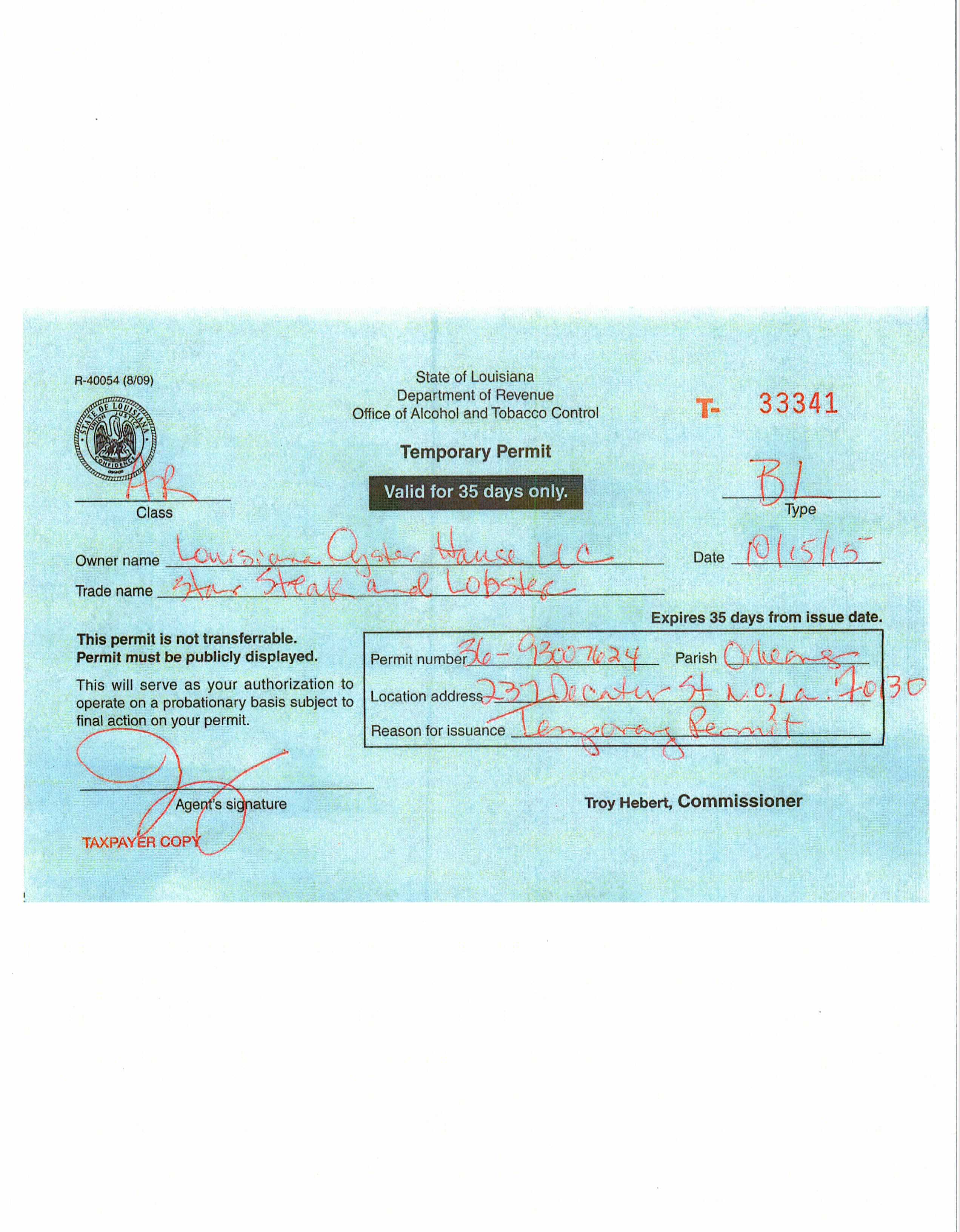
“She was granted a temporary permit to give her and LDR time to work out a payment plan in which they did. It is customary to grant several 35-day temporary permits rather than permanent ones to ensure that all details have been worked out. Ms. Palmer was asked on several occasions to finalize the proper paper work to resolve this issue completely, which she did not. At that point and time, no more permits were issued and ATC learned the business had actually closed. Because you cannot collect from a business that no longer exists, the charges were dropped.

“At no point and time did I or ATC do anything illegal or unethical and the records and policy clearly reflect that. It is standard procedure to try and allow a business to remain open, if possible, in order for the state to collect the taxes owed as well as save innocent people’s jobs. ‘You can’t get blood out of a turnip.’ To try and suggest otherwise is simply a ploy to discredit me and a great agency for doing our job dealing with those who don’t do theirs.

“During the course of this time, Ms. Palmer’s manager, whom I suggested that she fire, began threatening me. Due to the numerous other threats and the torching of my car, I reached out to the FBI for help and protection of my family and I (sic).

“Your sources that say the FBI is investigating me must have their wires crossed. Why would the FBI investigate me for doing my job and was threatened for doing so? Common sense says that if there is an investigation, it is about the people who threatened my life and family for fighting for the good law-abiding taxpayers of our state.

“I love my wife and children with all my heart and would never do anything to jeopardize that or put them in harm’s way.

“As a respected public servant for 25 years and now a private citizen, any malice, defamation, suggestions or slander from your reporting against my character that will cause irreparable harm to me personally, professionally or politically will be dealt with in the court of law. I do not mean to come across disrespectful, but sometimes you cannot put the toothpaste back in the tube.”

He also included a copy of a Nov. 19, 2015, letter to U.S. Attorney General Loretta Lynch in which he claimed he and his family had been threatened. In his letter, he said FBI offices in New Orleans and Baton Rouge had declined to assist him.

Hebert also forwarded an email from Palmer to him dated Oct. 13, 2015 which said, “I am proposing the following terms in order to satisfy my tax issues with the state.

  • 10 percent down on the balance that I currently owe;
  • Remaining money owed would be paid over a course of 12 months as long as I stay current on the money due each and every month.”

That email, however, was not part of the file on the restaurant obtained from ATC by LouisianaVoice, an indication it was a private communication between Palmer and Hebert and outside official channels.

In a separate email to WVUE-TV, he also said, “Is it your station’s policy to report such damaging allegations against someone’s reputation from only a source and not an actual confirmation from the FBI?”

The FBI, of course, neither confirms nor denies the existence of criminal investigations.

LouisianaVoice obtained public records from ATC which show that Hebert issued a “Commissioner’s Findings and Order” on Sept. 9 in which he suspended the woman’s license upon finding there was “sufficient evidence to support a finding that the permittee (Louisiana Oyster House, dba as Star Steak and Lobster at 237 Decatur Street) did violate the provisions” of:

  • LA. R.S. 26:75/26:295 (proper permit not held, first offense) and
  • LA R.S. 26:91B/16:287B (failure to pay state sales tax, first offense). HEARING NOTE PAGE 1

HEARING NOTE PAGE 2

(CLICK ON IMAGES TO ENLARGE)

The confidential source, who has requested anonymity, said the day following the hearing attended by Palmer, she received a call from Hebert “offering to help her get her license back.”

In a Dec. 18 email to LouisianaVoice, the source said, “He wanted to meet her for a drink to discuss it. She met with him and he told her he would reinstate her license if she would go out with him. She agreed and went to dinner with him at a local restaurant. He was accompanied by two of his bodyguards (ATC agents) who remained outside the restaurant while he dined with her. He even took her to his French Quarter apartment on top of the Copper Monkey Bar on Conti St. He revoked the suspension of her license the next day, and did not make her pay the fine. He continued to go out with her and have sex with her,” she wrote. copper monkey3

She said that Palmer “has evidence of her relations with him consisting of pictures and text messages. She has kept quiet until now for fear that he will retaliate against her business.”

The following day, Dec. 19, she sent another email in which she reiterated her claim that Palmer possessed photos of Hebert’s apartment on her cell phone. “He has also sent her numerous text messages from his state-issued cell phone telling her how much he wants to see her. Two weeks ago, he called her and said be sure to erase the text messages but she didn’t because she did not trust him. He even told her that he was going to help her with some money for her kids’ schools. She also has not had to pay the fines. He keeps pushing them back. She believes they will disappear before the new commissioner takes office.”

A temporary permit was in fact issued on Sept. 11, according to records obtained from ATC offices in Baton Rouge. Subsequent temporary permits were issued on Oct. 15 and Nov. 20. Each permit was marked “Valid for 35 days only.” SEPT. TEMPORARY PERMIT

OCT. TEMPORARY PERMITNOV. TEMPORARY PERMIT

And while each of the temporary permits bore the name and title of ATC Commissioner Hebert, the person who signed each of them was Judy Pontin, executive management officer for ATC’s New Orleans office.

Pontin is the sister of Chris Young, a New Orleans attorney who represents bar and restaurant owners before ATC and who is a lobbyist for the Beer Industry League of Louisiana. Another brother is John Young, former Jefferson Parish President and unsuccessful candidate for lieutenant governor in last fall’s statewide election. Pontin was hired by Hebert on Nov. 4, 2013 at a salary of $71,000. JUDY PONTIN

JUDY PONTIN

On Jan. 6, just four days before he left office, Hebert issued a second “Commissioner’s Findings and Order” on the restaurant but this time he wrote, “After reviewing the evidence and all relevant testimony, the Commissioner finds the following:

“There is not sufficient evidence (emphasis ours) to support the finding that the permittee did violate the provisions of:

  • LA R.S. 26:75 & 26:275—Proper Permit not held;
  • LA. R.S. 2691B & 26:287B—Failure to Pay Sales Tax. DISMISSAL LETTER PAGE 1DISMISSAL LETTER PAGE 2

“It is hereby ordered that this matter be dismissed,” he wrote as one of, if not the final act in his capacity as ATC commissioner.

There followed on last Wednesday (Jan. 20), a flurry of several quick emails pertaining to the application process for renewal of the restaurant’s license, a development that does not square with Hebert’s claim that the restaurant had closed. The first, at 9:52 a.m., was a forward from ATC attorney Linda Pham to fellow attorney Jacqueline Wilson of an earlier (8:18 a.m.) message from a Lorie Hebert and given “high importance,” which said, “I received a phone message from an atty. David Corkern about this mandatory case set for today at 2:30 p.m.” The reference was to the license for Star Restaurant and Corkern was the attorney for manager Sarah Palmer.

At 9:31 a.m., Pontin forwarded a pdf attachment to Wilson and at 10:04 a.m., Pontin sent an email to Palmer saying, “Please see attached the 2015 renewal application we discussed as per or (sic) phone conversation. If you have any further questions please do not hesitate to call. That was likely the same attachment that Pontin had sent to Wilson at 10:04 a.m.

The anonymous source, who has sent 11 separate emails to date, said she had seen text messages from Hebert to Palmer and “there are witnesses who followed their dinners.”

Seven of her emails were sent between Dec. 18 and Dec. 27. Then her messages went dark before suddenly resuming on Saturday (Jan 23). “I have stayed clear because FBI is now actively involved,” she said on Saturday by way of explaining why her communications ceased for nearly a month. “They have made contact with Palmer and have seized photos, emails and text messages,” she said.

“The FBI now has evidence but is expanding (its) investigation further,” she said. “The investigation (is) going in this direction: Hebert makes trouble for a business. Then his number-one assistant Judy (Pontin), maiden name Young, sister to (attorney) Chris Young, sends word to (the) targeted business to hire Chris Young and pay big fees to get them off Hebert’s radar. Once Young is hired (and the) fee paid, problem disappears. Once (the) deal is done, Chris Young calls his sister Judy in Hebert’s office and the coverup begins.”

Asked how she knew Palmer, she said simply, “She is a girlfriend of mine.”

Tomorrow: LouisianaVoice examines political contributions by New Orleans strip clubs which were passed over in ATC’s “Operation Trick or Treat” sweep of the French Quarter in October.


Read Full Post »

« Newer Posts - Older Posts »