Feeds:
Posts
Comments

Archive for the ‘State Police’ Category

While some observers might correctly point out that the re-hashing of stories about State Fire Marshal Butch Browning is old news, we feel there is relevance in demonstrating the Jindal administration’s general acceptance of and a high tolerance for questionable and inappropriate behavior on the part of his appointees and their subordinates.

The flagrant abuse of power has become so rampant in the offices of the State Fire Marshal, State Police Superintendent and the Louisiana Office of Alcohol and Tobacco Control that even if the governor’s office feels it can afford to ignore the brewing problems, we cannot.

Besides the FEMA billings in connection to work his subordinates performed in the 2011 tornado cleanup in Alabama—more than $11,000 in overpayments to 13 employees was eventually refunded—and his wearing of unauthorized military medals from two wars and a third military engagement, State Fire Marshal Butch Browning also came under investigation by State Police and the Louisiana Office of Inspector General (OIG) for another matter involving injuries to two teenagers in St. Helena Parish.

Browning managed to emerge from the three-pronged probe virtually unscathed, “retiring” in April of 2012 in the middle of the investigations only to be reinstated 12 days later in his same positon but with a raise in pay of $8,000 per year, state Civil Service records show.

Despite the allegations of fraud and mismanagement leveled against Browning, his boss, State Police Superintendent and Deputy Secretary of the Department of Public Safety (DPS) Mike Edmonson, gave him a clean bill of health and the Louisiana Legislature, acting as surrogate for the Jindal administration, acted quickly. The House Appropriations Committee aimed its retaliatory guns on the second investigative agency, the Office of Inspector General and its Director Stephen Street, placing them squarely in the administration’s crosshairs.

Even as his boss, State Police Superintendent and Deputy Secretary of the Department of Public Safety (DPS) Mike Edmonson, was praising Browning on the occasion of what turned out to be a 12-day “retirement,” saying citizens of Louisiana were “fortunate” to have him as State Fire Marshal and that his commitment to fire safety and prevention was “unparalleled,” a state trooper had been assigned in April of 2012 to work alongside OIG to investigate “several complaints.”

We touched on the allegations of payroll fraud and of his wearing unauthorized military combat medals from wars that ended before he was born. Among the decorations worn by Browning were the Army Occupation Medal, the Meritorious Service Medal, the Air Force Good Conduct Medal, the Defense Meritorious Service Medal, the Kosovo Campaign Medal, the Legion of Merit, the Korean Service Medal, the Army Reserves Overseas Training Ribbon, the Marine Security Guard Ribbon, the National Defense Service Medal, and the Navy Expeditionary Medal. Apparently, the only military branch in which he did not distinguish himself was the U.S. Coast Guard.

But there were other, more serious incidents almost a year before which the OIG was also investigating—obstruction of information about a carnival ride accident and Browning’s improperly selling used weapons to employees—which would ultimately lead to attempts to strip OIG of its legislative appropriation, in effect abolishing the office.

We prefer to simply call it teaguing after Gov. Bobby Jindal’s infamous practice of fire and demoting dissidents as he did Tommy and Melody Teague, the husband and wife team he fired six months apart, beginning first with Melody Teague.

On May 14, 2011, a ride called the “Zipper” malfunctioned at a Greensburg carnival in St. Helena Parish northwest of Hammond and injured two teenage siblings as they were getting off the ride only seven hours after deficiencies were ignored by a State Fire Marshal’s Office inspector only seven hours earlier. The ride’s emergency brake should also have been checked during the inspection, but it was not, the OIG investigation revealed. http://oig.louisiana.gov/assets/docs/reports/CID-12-035.pdf

Carter and a second Fire Marshal investigator, Joseph LeSage, both told investigators that the accident would not have occurred had a properly installed parking brake and control switches been installed according to manufacturer’s specifications, the report said.

Failure to check emergency brakes is in violation of National Association of Amusement Ride Safety Officers guidelines.

Browning, however, suppressed the report by insisting that the accident was caused by operator error, the report said.

Even more serious, Fire Marshal Investigator Donald Carter told Browning “several times at the accident scene” that the inspector’s allowing the ride to operate with improper equipment may expose the Fire Marshal’s office to legal liability, the OIG report said. That statement is important because of the blanket defense of Browning subsequently thrown over the entire investigation by Edmonson in a letter to Street.

The OIG report also said Browning authorized the sale of guns in violation of regulations. While law enforcement officers may purchase weapons being retired from service, non-law enforcement personnel are ineligible to purchase the weapons. Browning nevertheless authorized their sale to employees who were not commissioned law enforcement officers.

It was in the middle of the two concurrent investigations that Browning announced his “retirement” to accept a superintendent at an unnamed petrochemical plant in Ascension Parish only to return 12 days later with an $8,000 per year pay raise and complete exoneration from Edmonson even though the OIG’s report accusing Browning of suppressing the carnival ride investigative report would not be released for another six months.

But even though the OIG report would not be released until Nov. 13, 2012, someone must have had an inkling of what it would say for the wheels were put in motion by the administration mere days after Browning’s pay raise and return to work.

Joe Harrison (R-Napoleonville), State President of the American Legislative Exchange Council (ALEC), offered an amendment to House Bill 1, the state’s operating budget, to pull the $1.7 million appropriation for Street’s office, a move that would have effectively shut down its operations for the first time since it was created in 1988.

Wow, talk about reprisals! Harrison said the OIG was “pretty much redundant” and that its functions overlapped those of the State Police and the Attorney General’s office. The House Appropriations Committee apparently agreed, approving the amendment by an 11-4 vote.

But invoking the name of the State Police and the Attorney General as a justification for abolishing the OIG is hardly a sound argument given the performance of the State Police in its investigation of Browning and Edmonson’s thinly disguised attempt to pad his retirement benefits and the Attorney General’s oft-demonstrated reluctance to get involved in any investigation of wrongdoing on the part of state agencies other than jumping on board the FBI investigation of former Department of Health and Hospital (DHH) Secretary Bruce Greenstein.

While newspaper editorials and columnists and the Public Affairs Research Council came to the defense of OIG, Browning’s boss, Col. Mike Edmonson fired off a scathing, eight-page letter in which he vehemently attacked the OIG report and defended Browning unconditionally.

In our next installment, we will examine the political fallout from the OIG investigation initiated by a Jindal legislative ally as well as Edmonson’s response to that investigation which was hand-delivered to Street’s office and media comments supportive of OIG.

All in all, it’s just another behind-the-scenes look at how the administration attempts to shape and mold the legislative process to the benefit of Jindal and his appointees and to the detriment of anyone who happens to get in his way.

Read Full Post »

Given the chance, a reality TV show profiling our state elected officials and political appointees would surely eclipse Duck Dynasty in the ratings—except viewers outside Louisiana would swear the stories were nothing but lowbrow fiction.

When Gov. Bobby Jindal announced the appointment of Butch Browning as State Fire Marshal shortly after taking office in 2008, for example, it turned out to be one of a series of appointments that have come back to embarrass the administration [aside from the fact that the administration appears immune to embarrassment]. Yet, as with almost all the other poor choices, he is resistant to making needed changes in leadership—thereby solidifying his image as a Stand by My Man governor.

The lone exception to that mindset is Bruce Greenstein, former Secretary of the Department of Health and Hospitals—but that dismissal came only after word leaked out of a federal investigation of possible improprieties surrounding a contract Greenstein awarded to his former employer.

While Troy Hebert, Director of the Office of Alcohol and Tobacco Control (ATC) and State Police Superintendent Mike Edmonson have garnered the lion’s share of negative attention, Browning, for the most part, has managed to fly beneath the radar despite several events that occurred during his watch that probably should have demanded closer examinations and, in just about any other administration, dismissal.

Over the next few days, LouisianaVoice will be conducting the scrutiny that Jindal obviously eschews as we look at some of the eye-opening events and practices within the State Fire Marshal’s office.

Browning was appointed on March 8, 2008, barely a month after Jindal began his first term. “Ensuring the safety of Louisiana children and families is an incredibly important mission and the state has benefitted from his leadership, knowledge and service,” Jindal said in a canned press release at the time.

Browning began his public career as a deputy sheriff for East Baton Rouge Parish in 1986 and was named Gonzales Fire Chief in 1998.

“I passionately share the vision of Gov. Bobby Jindal and Col. Mike Edmonson to come together as one,” he said somewhat prophetically at the time of his appointment.

Browning managed to keep his nose relatively clean for a couple of years but in mid-April of 2012 Browning resigned, albeit briefly, in the midst of a pair of simultaneous investigations of his office to accept a job in an area plant, saying the offer was “too good to pass up,” only to return—with a substantial raise in pay—less than two weeks later.

His brief retirement and return just happened to coincide with an investigation launched that, oddly enough, Browning claimed later to be unaware of and which prompted efforts in the Legislature to abolish the investigating agency, a subject to which we will return later in this series. It’s all part of the surreal Louisiana political atmosphere to which we seem to have become inured.

His problems actually originated when the Metropolitan Crime Commission in New Orleans forwarded allegations of mismanagement and fraud against Browning in late 2011.

Among those allegations were claims that Browning’s employees traveled to Tuscaloosa, Alabama, in May of 2011 as one of many recovery teams dispatched there following a series of deadly tornadoes. Those employees, the accusations said, were instructed to bill the Federal Management Emergency Administration (FEMA) for 18-hour work days. The complaint said the hours were billed even though the employees took two days off to attend LSU-Alabama baseball games. It also said that while FEMA did not pay the firefighters, the state did. FEMA, however, was unable to confirm whether or not it had paid the firefighters.

Two other allegations accused Browning of suppressing a finding that a certificate should not have been issued by one of his inspectors for a carnival ride on which two teenagers were subsequently injured and that he paid two members of his office to serve as drivers and security for attendees to a National State Fire Marshal’s conference in New Orleans.

Meanwhile, it was learned that Browning was making public appearances in his dress uniform, complete with military medals from World War II and the Korean War—except for one inconvenient little oversight: he never even served in the military, much less served in either of the two wars. In fact, he wasn’t even born until well after the conclusion of both wars.

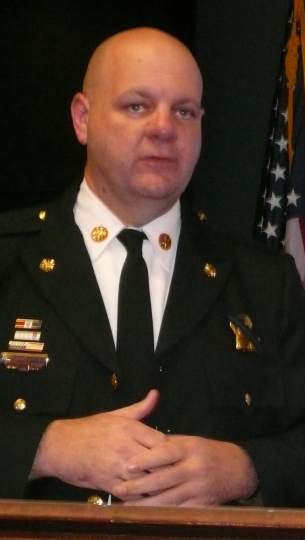
BUTCH BROWNING

Browning proudly wears military medals in this file photo.

There also is the pesky federal law called the Stolen Valor Act, which makes it a federal misdemeanor for anyone to wear military commendations they did not earn.

That brought the wrath of veterans down upon Browning. “We take pride in what we wear,” said one Marine officer. “Marines don’t hand out ribbons like candy. You have to earn it.” A couple of others called his wearing the medals and ribbons “disrespectful” and U.S. Rep. Steve Scalise (R-New Orleans) said, “There’s nothing more disgraceful than trying to present yourself as someone who served in the military when you didn’t.”

“We’ve been informed that Mr. Browning never served in the military, yet he was wearing military ribbons awarded to every branch of the military service that span World War II, the Korean war and the Kosovo campaign,” said Rafael Goyeneche, President of the Metropolitan Crime Commission who called Browning’s wearing the ribbons “problematic.”

Every branch of the military service? Well, at least he was an equal opportunity fraud, though he did explain that he received the ribbons from the Gonzales Fire Department where he served as chief before his appointment to the State Fire Marshal’s post by Jindal.

On April 18, 2012, Browning, while denying that he was the target of any investigation, suddenly announced his “retirement,” saying he was accepting a job offer as a superintendent at a petrochemical plant in Ascension Parish that he described as “too good to pass up.” His resignation was effective immediately, he said.

But passion apparently trumped too good to pass up for on April 30, just 12 short days later, he was reinstated as he gushed, “my passion is public service.”

But his return reportedly presented a problem. Sources told LouisianaVoice that when he resigned, he was paid for 300 hours of unused annual leave, or about $13,000. When he returned, he was required to repay the money but those same sources said he no longer had the money.

But records show that State Police Superintendent Mike Edmonson, who doubles as Deputy Superintendent of the Department of Public Safety (DPS) and apparently as DPS problem solver, simply bumped Browning’s salary by $8,000 per year, from $92,000 to $99,000 even though he returned at the same Assistant Secretary position as before—apparently so he could afford to repay the $13,000. How many of us would quit our jobs for 12 days in exchange for an $8,000 raise in pay?

Problem solved.

Well, not quite.

While Edmonson was laudatory in welcoming Browning back into the fold, Goyeneche was not nearly so forgiving of Browning—or of Edmonson, for that matter—and the political fallout was almost instantaneous.

Edmonson, metaphorically spreading rose petals in Browning’s path, said the DPS Internal Affairs Section had investigated the allegations and found “no factual evidence” to support the claims. “That investigation has shown me that Butch did not abuse his power or violate the public trust,” he added.

This from a man who, only two years later, would attempt to engineer a lucrative $55,000 a year increase to his own retirement through a furtive, last-minute amendment to an otherwise unrelated Senate bill steered past an unsuspecting and distracted legislature in the closing hours of the 2014 session—with the abetting of Gov. Bobby Jindal and the author of the amendment, State Sen. Neil Riser (R-Columbia).

Edmonson said Browning’s worst sin was to sign papers as a matter routine but which he did not thoroughly read but which were done with no criminal intent or fraud. He said he told Browning he wanted him back on the job—apparently sans military decorations—after an “outpouring” of public support.

Goyeneche, meanwhile, was livid and described the expedited exoneration of Browning as “Louisiana politics at its worst” (see the LouisianaVoice masthead) and unconscionable. “I think this is a political decision and not a decision based on its merits as Fire Marshal,” Goyeneche said. “If the standard is going to be whether Butch Browning broke the law then this is a sad day in Louisiana. State police make decisions every day to discipline officers on administrative issues and this is someone who has made several managerial blunders.”

Browning, for his part, said he welcomed input that would result in positive changes. “The integrity of the Office of State Fire Marshal is one of my top priorities,” he pontificated with self-puffery. “It’s what the public expects.”

In the coming days, we will examine how Browning, with a little help from his friends, manages to continue to survive integrity breaches and how a critical report by one state investigative agency result in a legislative effort to abolish the agency—kill the messenger, as it were—rather than consider correcting deficiencies investigators cited in Browning’s office.


Read Full Post »

Our October fund raiser enters its final five days and we still need assistance to help us offset the cost of pursuing legal action against an administration that prefers to conduct its business behind closed doors and out of sight of the people to whom they are supposed to answer.

We also are launching an ambitious project that will involve considerable time and expense. If Gov. Bobby Jindal does seek higher office as it becomes more and more apparent that he will, the people of America need to know the real story of what he has done to our state and its people. Voters in the other 49 states need to know not Jindal’s version of his accomplishments as governor, but the truth about:

  • What has occurred with CNSI and Bruce Greenstein;
  • How Jindal squandered the Office of Group Benefits $500 million reserve fund;
  • The lies the administration told us two years ago about how state employee benefits would not be affected by privatization;
  • The lies about how Buck Consultants advised the administration to cut health care premiums when the company’s July report said just the opposite;
  • How Jindal attempted unsuccessfully to gut state employee retirement benefits;
  • How Jindal attempted to sneak a significant retirement benefit into law for the Superintendent of State Police;
  • How Jindal appointees throughout state government have abused the power entrusted to them;
  • How Jindal has attempted a giveaway plan for state hospitals that has yet to be approved by the federal Center for Medicare & Medicaid Services (CMS);
  • How regulations have been skirted so that Jindal could reward supporters with favorable purchases and contracts;
  • How Jindal fired employees and demoted legislators for the simple transgression of disagreeing with him;
  • How Jindal has refused Medicaid expansion that has cost hundreds of thousands of Louisiana’s poor the opportunity to obtain medical care;
  • How Jindal has gutted appropriations to higher education in Louisiana, forcing tuition increases detrimental to students;
  • How Jindal has attempted to systematically destroy public education in Louisiana;
  • How Jindal has refused federal grants that could have gone far in developing internet services for rural areas and high speed rail service between Baton Rouge and New Orleans;
  • How Jindal has rewarded major contributors with appointments to key boards and commissions;
  • How Jindal attempted to use the court system to persecute an agency head who refused to knuckle under to illegal demands from the governor’s office;
  • How Jindal has manipulated the state budget each year he has been in office in a desperate effort to smooth over deficit after deficit;
  • And most of all, how Jindal literally abandoned the state while still governor so that he could pursue his quixotic dream of becoming president.

To this end, LouisianaVoice Editor Tom Aswell will be spending the next several months researching and writing a book chronicling the Jindal administration. Should Jindal become a presidential contender or even if he is selected as another candidate’s vice presidential running mate, such a book could have a national impact and even affect the outcome of the 2016 presidential election.

This project is going to take time and involve considerable expense as we compile our research and prepare the book for publication in time for the 2016 election.

To accomplish this, we need your help.

If you are not seeing the “Donate” button, it may be because you are receiving our posts via email subscription. To contribute by credit card, please click on this link to go to our actual web page and look for the yellow Donate button: https://louisianavoice.com/

If you prefer not to conduct an internet transaction, you may mail a check to:

Capital News Service/LouisianaVoice

P.O. Box 922

Denham Springs, Louisiana 70727-0922

Read Full Post »

As if the administration’s handling of bogus criminal accusations against former Commissioner of the Louisiana Office of Alcohol and Tobacco Control Murphy Painter wasn’t already embarrassing enough after Painter’s acquittal ended up costing the state $474,000 in reimbursement of his legal fees and expenses, a recent civil court decision has added insult to injury.

Bobby Jindal (R-Iowa/New Hampshire/Florida/Anywhere but Louisiana) thought he could make an example of Painter over the then-ATC commissioner’s refusal to bend the rules for New Orleans Saints owner Tom Benson, whose family and businesses have poured some $40,000 into various Jindal political campaigns.

Painter twice rejected applications by SMG (formerly Spectacor Management Group), the Mercedes-Benz Superdome management firm, for a permit to erect a large tent at Benson’s Champions Square adjacent to Benson Towers across from the Superdome. The tent was to house beer sales by Anheuser-Busch distributor Southern Eagle and approval of the permit was sought by Southern Eagle, SMG, the Louisiana Stadium and Exposition District (LSED) board and a law firm representing SMG. Altogether, the Benson family, LSED board members, SMG, its law firm and Southern Eagle had combined to pour more than $203,000 into Jindal campaigns between 2003 and 2012.

When Jindal executive counsel Stephen Waguespack insisted that the permit be expedited, Painter asked that he put his concerns in writing but Waguespack refused.

Not only did Jindal fire Painter when his commissioner insisted that the permit application for the Champions Square tent be complete and proper, he even had Painter indicted on criminal charges of stalking a female employee. Present at the firing ceremony were Waguespack, State Police Superintendent Mike Edmonson, and another member of the governor’s legal staff.

The subsequent criminal prosecution of Painter fell apart and his acquittal carried a stipulation that the state pick up the tab for Painter’s legal fees and affiliated costs.

Now, a civil trial jury has determined unanimously that the female former employee, Kelli Suire, defamed Painter even though the Louisiana Office of Risk Management, most likely at the insistence of Jindal’s Division of Administration, settled Suire’s claims against the state in 2011 without Suire’s ever having been required to sit for a sworn deposition in the apparent hope the settlement would bolster the state’s case against Painter.

Oops.

Painter’s defamation suit against Suire was bifurcated, meaning it was to be tried in two parts. The first part, the part just completed, was to settle the question of actual liability. Had Suire been found not guilty of defamation, the second part to determine actual monetary damages would have been unnecessary.

Unfortunately for Jindal’s chances to avoid further embarrassment over the sloppy manner in which the Painter matter was handled, such was not the case and the damages part will be tried next.

Throughout the entire matter, Painter has made clear that he wanted his day in court.

The liability trial was heard in U.S. District Court for the Middle District of Louisiana before Judge Shelly Dick and a seven-person jury. Following a three-day trial, the jury took about three hours.

Painter was represented at trial by attorney Al Robert, Jr., and Suire by Jill Craft.

The issues in the case first arose on Aug. 16, 2010, soon after Suire filed a complaint with the Louisiana Office of Inspector General (OID) alleging a myriad of allegations against Painter. The lead OIG investigator at the time, Shane Evans, now employed by the East Baton Rouge Coroner’s Office, testified that he met with Suire and that he personally chose to use the words “stalking” and “harassing” to describe the nature of Suire’s complaints in his application for a search warrant.

Painter also has a civil lawsuit pending against OIG which alleges the agency’s investigation, which began in August of 2010, was improperly conducted.

Robert said the jury’s verdict confirmed the finding of an outside investigator hired by the Louisiana Department of Revenue (DOR) under which ATC operates. The investigator determined that Painter’s actions did not violate DOR anti-harassment policy. Moreover, when questioned by the DOR investigator, Robert said, Suire “admitted that Painter did not make unwelcome sexual advances toward her and that he did not request sexual favors or engage in verbal or physical conduct of a sexual nature toward her. Inexplicably, the Office of Inspector General ignored this investigation when it chose to move forward with its investigation of Mr. Painter,” he added.

“This has been a long, four-year ordeal to clear my name of the lies and untruths that Ms. Suire—and those working with her—used to damage my character and reputation,” Painter said.

In her instructions to the jury, Judge Dick said defamation requires proof of a false or defamatory statement made to a third person or persons. “A person who utters a defamatory statement is responsible for all republication that is the natural and probable consequence of the person’s statement,” she said.

Suire, in her defense, did not deny making the statements but said rather that her statements were subject to “privilege,” or inadmissible, Judge Dick said, acknowledging that Suire’s communications did in fact “occasion a conditional or qualified privilege.”

Therefore, in order for Painter to prevail, she said, he “must prove that (the) defendant abused this privilege by acting with actual malice.” Such a finding, the judge said, would require that Suire either knew the matter to be false or acted in reckless disregard as to its truth or falsity.

Suire currently resides in Florida.

Read Full Post »

  • The Louisiana Office of Alcohol and Tobacco Control (ATC).
  • The Louisiana Department of Public Safety (DPS).
  • The Louisiana Fire Marshal’s Office.

From liquor permit rejections, wholesale firings of agents that may have been racially motivated and amateurish investigative tactics at ATC to a multitude of questionable activities at the State Fire Marshal’s Office to attempts to sneak a hefty retirement benefit through the legislature for the state’s top cop, Louisiana’s three major enforcement agencies appear to be riddled with procedural matters bordering on federal EEO violations, investigative cover-ups and back door politics which sometimes blur ethical and legal lines and which reach all the way into the governor’s office.

The latest incident involves an ATC agent who apparently sent a teenage undercover operative into Hook’d Up Bar and Grill in Hammond in an attempt to purchase alcohol. The girl, age 17, was accompanied by a 21-year-old female. The older woman purchased a drink but waitress Ashleigh Burdett refused to comply with the 17-year-old’s repeated requests for another cup so the drink could be divided.

Burdette said she refused the requests, telling the girl, “I can’t do that because you’re a minor.”

Fortunately for Burdette and the establishment’s owners, a video camera captured the entire sequence of events, including the older customer leaving the table to go the restroom just after 10 p.m., whereupon the 17-year-old picked up the older woman’s drink and walked outside with it.

ATC agent Jeff Barthelemy then entered the establishment and wrote a warning to the business and a $500 citation to Burdette, both for serving a minor.

“The fact of watching my staff carding her, telling her no, going as far as to give two checks to each individual showing that the underage person was not served, it’s kind of disheartening,” said Jennifer Mier who co-owns the business with husband Mark Mier.

Mark Mier, interviewed by LouisianaVoice, said he was scheduled to meet with ATC Commissioner Troy Hebert on Wednesday in an attempt to get the matter ironed out but Mier was still upset at the idea of sending a 17-year-old undercover operative in an attempt to purchase alcohol.

“The legal age for purchasing alcohol is 21 so why couldn’t they have sent a 19- or 20-year-old in instead of a 17-year-old. That was a very ill-advised thing to do with someone that young. I would never have done that.”

Hebert, who has been the subject of several stories by LouisianaVoice for the manner in which he arbitrarily fires employees, particularly African-American agents and for his insistence that all employees rise from their desk and offer a cheer “Good morning” when he enters a room, defended the practice of using operatives that young. “We use 16- and 17-year-old operatives to make sure that we’re only catching the worst violators out there.”

Huh? Did he really say that?

“I appreciate people that are there to keep us safe,” Jennifer Mier said, “but when the line gets crossed, when someone with authority chooses to use it just because they decide they’re going to, that’s not acceptable.

As strange as Hebert’s comment about “catching the worst offenders” was, the most curious comment by him was when he said, “ATC goes above and beyond to make sure we don’t use trickery. At ATC, we’d actually like to not write any violations across the state.”

That is odd indeed, given the fact that Hebert keeps a log of how many citations and how much in fines each agent issues and writes up agents who do not produce the number and amounts expected.

By established procedure, two agents are supposed to be involved in each case when underage operatives are used to attempt to purchase alcohol and at least one agent has to witness the sale.

But Hebert has fired so many agents that there are not enough to go around for each bust so ATC contracts with civilians such as the 21-year-old woman who accompanied the teenager into Hook’d Up. The contractors are paid an hourly rate but they are expected to produce an illegal sale or ATC will cease using them for undercover operations. Accordingly, the contractor is under pressure and has the incentive to ensure that an illegal sale will be made in order to continue collecting the hourly fee.

But what Hebert did to the owners and waitress at Hook’d Up pales in comparison to what he has done to a decorated retired Army Reserve major who has been attempting to open a restaurant and bar in the New Orleans French Quarter.

Tracy Riley, you see, is black and as LouisianaVoice has previously reported, Hebert has lost racial discrimination lawsuits and currently has others pending after vowing and then making good on that promise to rid his department of blacks.

So intent on carrying out his denial of her license was he that he even went so far as to file an official complaint with her commander when prior to her retirement that she had the audacity to show up at ATC headquarters to check on her permit—in uniform. In a Sept. 30, 2013, letter to Maj. Gen. Peter Lennon in Belle Chasse, Hebert cited what he called “unbecoming conduct” demonstrated by Riley for appearing at Hebert’s offices in full military uniform.

In a meeting at ATC headquarters, Barthelemy told Riley that being granted a permit was a privilege, not a right. He then admonished Riley and her son, saying that when they were in the ATC building, they were to conduct themselves “respectfully.”

As Riley and her son were leaving, Barthelemy asked Riley if she was on active duty and the name of her commanding officer.

This from an enforcement agent whose agency which works closely with State Fire Marshal Butch Browning who drew criticism and even resigned temporarily only to be cleared of wrongdoing over reports that he was wearing military ribbons and medals from World War II and the Korean Conflict on his dress uniform—and Browning never even served in the military.

Something’s a little out of kilter here, folks, and LouisianaVoice will be delving into the Browning Ribbongate issue in the coming days.

“I trust that the unbecoming conduct demonstrated by this military member will be handled accordingly and respectfully request to be notified of any corrective action taken,” Hebert wrote.

Riley was subsequently reprimanded for wearing her uniform while on personal business but the violation certainly didn’t equate to the war crimes offense Hebert made it out to be—especially given the timing of his Sept. 30 letter to Gen. Lennon.

Less than three weeks earlier, on Sept. 12, 2013, the French Quarter Business Association (FQBA) sent its own letter to Hebert complaining about Riley’s establishment, the Rouge House Supper Club, located at 300 Decatur Street.

Jeremy DeBlieux, president of FQBA, said in his letter to Hebert that he understood that a special event permit was granted to Riley to operate during the annual Essence Festival in July of 2013 but that the Rouge House “did not adhere” to provisos set forth in the temporary permit.

“We believe the owner’s blatant disregard to the city’s special event provisos and the unpermitted operations to date has indicated their intent,” DeBlieux said. “The business has clearly operated as a nightclub, rather than a supper club. Nightclub is not a permitted use at this specified location. We believe, with good reason, as a business association in the French Quarter, we should formally oppose the granting of alcoholic beverage permit to The Rouge House.”

So there you have it. Alcohol is strictly taboo in the New Orleans French Quarter.

On Dec. 5, Hebert denied Riley’s permit in a letter that gave as the reasons for denial as:

  • Operating without a valid state alcoholic beverage permit;
  • Misstatement or suppression of fact in application by failing to report managers and provide verification of suitability, failure to report owner Dale Riley (Riley’s husband) and provide affidavit showing that he meets the qualifications and conditions as set out in statute and failure to provide information on landlord as required.
  • Failure to submit fingerprints of members (of) the company.

“If the aforementioned reasons(s) for denial is corrected within 60 days, you may request rescission of this decision,” Hebert wrote.

Riley said she has repeatedly requested meetings with Hebert to discuss her plight and to request a probationary permit but he has refused to meet with her. Moreover, she says she overheard an employee tell an agent that Hebert did not want to talk to her.

She did meet with Barthelemy who told her his only reason for meeting with her was to inform her that when she was in the ATC building she was to be respectful, Riley said. “He would not even discuss my application.”

ATC did conduct surprise inspections of The Rouge House but found the establishment either closed with no activity. In one undated report, agents noted they had conducted “surveillance” for 36 minutes and found the business closed. It is somehow difficult to imagine it taking 36 minutes to determine an establishment is closed. The report said the ATC agent “spoke with owner of Star Steak and Lobster in reference to the target location. Pictures attached.” A sticky note was attached to the report which said, “Pictures show no activity.” The sticky note contained the initials “TAR.”

On another occasion, a “full walk-through” was conducted by the agent from 12:45 a.m. to 1:00 a.m. Again, the report, like all the others, was not dated. “Upon arriving at the location I found it open for business,” the agent’s report said. “I completed a full walk-thru of the location and found no alcohol on the premises. There were no customers in the location either. The kitchen was open and food was available to be purchased.”

Despite receiving only two complaints (actually four separate statements from individuals relative to the two complaints) that The Rouge House was operating, ATC spent considerable man-hours and expense in conducting at least 21 separate surveillance and investigative assignments only to find the business closed on each occasion.

One of the complaints was from an individual claiming to be a graduate of Xavier University who also appeared to be not only an authority on permits and licenses but clairvoyant as well in saying the club “will be serving alcohol on Friday, Aug. 16 (2013) with NO alcohol permit or license.”

Riley, unaware of the close association between Gov. Jindal and Hebert (Hebert’s wife is the Jindal children’s pediatrician) and of the fact that Jindal appointed Hebert after his ill-fated attempt to frame former Commissioner Murphy Painter, attempted to obtain help from the governor’s office but we all know how that went.

Now she is seeking justice through the courts. She filed a formal appeal in June in Civil District Court in New Orleans.

And if history is any indication, the administration is well on the way toward yet another in a long line of legal defeats.

LouisianaVoice, in the coming days and weeks, will be taking closer looks at the state’s three major enforcement agencies.

Read Full Post »

« Newer Posts - Older Posts »

