Feeds:
Posts
Comments

Archive for the ‘State Police’ Category

When it comes to making a distinction between the duties of official public servant and campaign worker during the administration of Gov. Bobby Jindal, the lines are often blurred as individuals move back and forth between state and campaign payrolls seamlessly and with few apparent changes in their duties.

Jindal deftly juggled the payroll of his closest advisers between his campaign payroll and taxpayer-funded salaries as part of his staff in his two successful runs for the governor’s office in 2007 and 2011, civil service and campaign records show.

At least three of those moved just as easily from the governor’s office in Louisiana to the re-election campaign of Florida Gov. Rick Scott in 2014 and Timmy Teepell moved from Jindal’s 2007 campaign manager to his chief of staff once Jindal took office and he later left briefly to work for the national Republican Governors Association as brother Taylor Teepell moved from advisor to former Mississippi Gov. Haley Barbour to first deputy legislative director and later deputy chief of staff for Jindal.

Timmy Teepell left Jindal’s office following the 2011 election to head up the southern office of OnMessage, a political consulting firm out of Maryland to which Jindal has paid more than $5 million from 2007 through the end of 2013.

Jindal’s campaign paid Teepell $110,000 in 2007 and $120,000 for four months during 2010 (Aug. 1 through Nov. 4) and five months during 2011 (July 1 through Nov. 30) but from Jan. 14, 2008 through July 30, 2010 and from Nov. 5, 2010, through July 1, 2011, he worked as Jindal’s chief of staff at a salary of $165,000 per year—paid by Louisiana taxpayers.

Teepell did receive one payment of $3,880 from Jindal’s campaign on Nov. 11, 2010—10 days after he begin his second stint as Jindal’s chief of staff but the overlap was probably a delayed payment for campaign work done before he re-joined the governor’s staff.

Taylor Teepell, worked for six months in Jindal’s 2007 campaign, earning $29,000 before going to work for former Mississippi Gov. Haley Barbour who was serving as president of the Republican Governors Association.

Taylor Teepell entered Jindal’s office on Nov. 21, 2011, as older brother Timmy was departing. He first came on board as deputy legislative director at $90,000 but in less than a year, on Oct. 16, 2012, was named deputy chief of staff and given a raise to $130,000, the same salary Jindal makes. This was in the middle of a period in which state classified workers have received no pay raises.

Other attempts by Jindal to shuttle supporters back and forth between campaign and public payrolls are almost laughable in their transparent efforts to make everything appear to be above board.

Take the case of Melissa Sellers who received $35,600 from the Jindal campaign between March 30 and Nov. 8, 2007 and another $12,860 in two separate payments of $6,430 on Oct. 14 and Oct. 24, 2011. Jindal won re-election to his second four-year term on Oct. 22, 2011.

Civil Service records show that Sellers began as a state employee in the governor’s office as press secretary on Jan. 15, 2008—the day after Jindal was inaugurated for his first term—at a salary of $85,000. After being promoted to director of communications and given a raise to $90,000, she resigned on Oct. 7, 2011 but returned to the governor’s office in the same role only 18 days later, on Oct. 25. The campaign payments were during her brief hiatus from the governor’s office.

That means she pulled in $12,860 for working 18 days for Jindal’s campaign—a pay scale of more than $300,000 per year. But if the Oct. 24 represented a 10-day pay period (the first paycheck was on Oct. 14), then her first pay period would have extended at least as far back as Oct. 4—three days before her resignation from her state job. In any case, it appears there may well have been some overlap between the time she started working for the campaign and the date she resigned from the governor’s office.

More significant than her salary, however, was the timing of the move. By that time, Jindal and everyone else in the state knew he would win re-election easily over only token opposition, so what was the purpose of her taking an 18-day break from the governor’s office to work in a campaign that was already in coasting mode?

But then, upon returning to the governor’s office on Oct. 25, she remained barely more than a month, leaving again on Dec. 1, ostensibly to enroll in seminary to study for the ministry—a commitment that apparently did not last very long.

Instead, she next turned up in the re-election campaign of Florida Republican Gov. Rick Scott and now serves as his chief of staff. Along the way, she managed, along with two other Jindal campaign workers, to become involved in a scandal that resulted in Scott’s firing of popular Florida Department of Law Enforcement (FDLE) Commissioner Gerald Bailey.

The three—Sellers and husband and wife team Frank and Meghan Collins—managed to acquire the dubious identity of “The Louisiana Mafia” for the heavy-handed manner in which they attempted unsuccessfully to jerk Bailey around.

They first demanded that state police provide transportation for Scott campaign workers but Bailey refused, explaining that he was obligated by law to provide transportation for the governor and his wife, but not campaign aides.

Next, the Florida Republican Party attempt to foist a $90,000 check onto the FDLE as payment for shuttling campaign workers but Bailey again said no, that it would be inappropriate for his department, which is supposed to be independent of partisan politics, to accept money from a political party.

Scott, or those representing him, then attempted to bring Bailey into a conference call to discuss Scott’s platform for the coming four years but again Bailey declined to involve his department in partisan politics.

And when he complained to Scott’s chief legal counsel, that he had received solicitations for campaign contributions to Scott on his state computer, the attorney, Pete Antonacci, advised him to “just delete” the emails—in violation of Florida law prohibiting the destruction of state records.

And then there is Frank Collins, one of the “Louisiana Mafia,” who should still be smarting from his experience in Jindal’s office.

Paid only $7,500 to work four months in Jindal’s 2007 campaign, he eventually succeeded Sellers as press secretary, but at $65,000—which was $20,000 less than Sellers made for the same position three years earlier. He left on Oct. 6, 2012, and like Sellers and wife Meghan, eventually ended up with Scott’s re-election campaign and now works as Scott’s deputy chief of staff while Meghan Collins is a spokesperson for the Florida Department of Education.

Jonathan Ringo is a $110,000-a-year director in the governor’s office who once told Robert Burns—but then denied that he ever said it—that the Office of Inspector General “concurred” in Burns’ removal from the Louisiana Auctioneer Licensing Board. Before bellying up to the public trough, however, he was paid more than $18,000 by Jindal’s 2007 campaign.

Matthew Parker has been director of legislative affairs for the governor’s office at $120,000 per year since Oct. 16, 2012. Before that, from Nov. 28, 2011 until being named to his current position, he was director of intergovernmental affairs at $95,000 per year.

But other than Timmy Teepell, Parker was the highest-paid Jindal campaign staffer, knocking down nearly $35,000 in seven months in 2007 and more than $79,400 in the first 11 months of 2011 for a grand total of more than $114,000.

Perhaps it’s only coincidence that Parker is Timmy Teepell’s brother-in-law.

The two lowest-paid employees in the governor’s office who also worked for his campaign at least have the consolation of getting frequent rides in state police helicopters.

Tyler Brey, who received $18,500 for working for seven months in the 2011 campaign, went on the state dime on March 11, 2013 as a $33,000-per-year external affairs liaison, whatever that fancy title entails. Last Oct. 1, even as state classified employees were going without a pay increase for a fifth consecutive year, Brey received a $1,300-per-year raise to $34,300. Brey also made 42 trips on the state police ‘copter, always accompanying Jindal as his sycophant, to such exotic getaways as Monroe, Springhill, Ruston, Jena, Winnfield, Delhi, and Mansfield, among others.

One of those trips Brey made with Jindal and communications director Kyle Plotkin, was to Minden on Feb. 3, 2013, eight days before he officially became a state employee.

The other frequent flyer was Daniel Kirk, who was paid $24,000 by the Jindal 2007 campaign before joining the governor’s office on Jan. 14, 2008, the same day Jindal was inaugurated for his first term.

He started as a $35,000-a-year administrative assistant and four months later was named a program manager at the same salary. But on Feb. 22, 2010, he was named a director in the governor’s office. It wasn’t altogether clear what a director does, but it must be pretty impressive considering he got a $30,000 bump in pay—to $65,000 but still $45,000 less than fellow director Ringo.

Kirk got to visit some of the same locales as Brey and got the added treat of flying to Georgetown in LaSalle Parish and Kinder in southwest Louisiana. He and Jindal also made a hop to Columbia, home of State Sen. Neil Riser, just about the time U.S. Rep. Rodney Alexander was getting ready to announce his retirement so that Riser could run for his seat—unsuccessfully, it turned out.

In all, Kirk made 49 trips with Jindal in the state police helicopters, 19 of those during the 2011 election year and the other 30 in 2010, the year leading up to Jindal’s re-election run.

It’s impossible to say with any certainty that Jindal and his campaign-workers-turned-state-employees were using the state helicopters for campaign purposes, but with Jindal making nearly 200 ‘copter trips in 2010 and 2011, often accompanied by Sellers, Kirk or Timmy or Taylor Teepell or Brey, compared to only 86 during the next three years combined, one has to wonder.

And with the controversy sparked by Sellers and Meghan and Frank Collins in Florida in their attempts to commandeer state vehicles for campaign purposes, one also has to wonder if the “Louisiana Mafia” was only trying to repeat in Florida what they may have done with impunity in Louisiana in 2010 and 2011.

Read Full Post »

Three people, including a married couple, who previous worked for Gov. Bobby Jindal have been implicated in purported campaign irregularities and demands that state police provide transportation for campaign workers in Florida in last year’s gubernatorial campaign that resulted in Florida Gov. Rick Scott’s firing the state’s top law enforcement officer following his re-election.

The two, Melissa Sellers and Frank Collins, worked for a time in Jindal’s office and Sellers worked briefly for both Jindal and in his 2011 re-election campaign.

Sellers was Scott’s campaign manager and since the election has been serving as his chief of staff.

The Florida incidents appear to have been the result of a clash between a feeling of entitlement carried over from their stints working for Jindal and Florida Department of Law Enforcement (FDLE) Commissioner Gerald Bailey who refused to allow his department, which is supposed to be independent, from becoming involved in partisan politics.

Bailey’s office denied requests by Scott’s campaign that it transport Meghan Collins, a campaign staffer who was assigned to first lady Ann Scott. FDLE said while it was responsible for providing transportation for the governor and the first lady, campaign workers were not allowed to avail themselves of state transportation vehicles.

Since Scott’s re-election, Collins was moved onto the state payroll as chief spokesperson for the Department of Education.

Her husband, Frank Collins, worked for Jindal from Jan. 14, 2008, immediately after Jindal first took office, until his resignation Oct. 6, 2012. He was first employed as assistant press secretary at a salary of $35,000 but was promoted to press secretary and received a salary increase to $65,000 on Dec. 2, 2011. He was named a policy assistant on April 17, 2012 at the same salary and remained at this post until he resigned to join the Scott campaign with his wife.

Sellers began in Jindal’s office one day later than Collins, on Jan. 15, 2008, as press secretary at a salary of $85,000 (no complaints of lower pay for the same job there) and on Oct. 2 that same year, she was promoted to Director of Communication and raised in pay to $90,000.

Inexplicably, she resigned on Oct. 24, 2011, only to return the next day at the same position and same salary, civil service records show, until she resigned again on Dec. 2, 2011, to join the Scott campaign in Florida.

Meghan and Frank Collins and Sellers quickly became known in Florida as the “Louisiana Mafia” as tensions mounted over demands made on Bailey, whose office was in charge of investigating wrongdoing by Florida public officials. http://www.tampabay.com/news/politics/legislature/gov-rick-scotts-ouster-of-fdle-commissioner-followed-months-of-tension/2213534

Bailey was asked Scott or his staff to take part in a June 2014 conference to discuss “the governor’s platform for the next four years. Bailey refused, saying he felt it inappropriate for him, as a law enforcement officer, to participate in partisan politics.

Bailey also complained to Scott’s chief legal counsel Pete Antonacci that he had received solicitations to contribute to Scott’s re-election on his state computer. Antonacci, he said, simply told Bailey to “just delete it.” In Florida, like Louisiana, it is illegal to destroy public records.

Scott said no state employees received email solicitations unless they gave an email address to the campaign but Bailey said he never provided his email address to the campaign.

Perhaps the incident that might cause some in Louisiana, particularly in Shreveport, to recall the George D’Artois-Jim Leslie saga of 1976 occurred in March of 2014.

The Florida Republic Party, acting on Scott’s behalf, sent a $90,000 check to FDLE to cover the costs of transporting Scott campaign workers (supposedly that included members of the “Louisiana Mafia”) in state vehicles to ensure that no state cars were used for campaign purposes.

D’Artois, Shreveport’s Public Safety Commissioner at the time, had, on the other hand, attempted to pay Shreveport advertising executive Jim Leslie for his work on D’Artois’ re-election campaign with a city check, which Leslie refused. D’Artois re-sent the check, telling Leslie to take it and keep quiet but Leslie threatened to go public if the commissioner persisted. In July of 1976, Leslie, who had worked on behalf of proponents of Louisiana’s Right to Work bill, was gunned down in a Baton Rouge motel parking lot after attending a party to celebrate passage of the bill. D’Artois was later implicated in the murder but died before he could be tried.

Like Leslie, Bailey refused the money from the Florida GOP, saying it had no legal authority to accept it and that moreover, it was inappropriate to accept money from a political party. A second check was written to the state general revenue fund in April of 2014. “We properly reimbursed the state,” said Scott spokesperson Jackie Schultz. “Everything was paid for properly,” she said.

But the damage was done and Scott, like Jindal, apparently is not the forgiving sort.

Bailey, 67, a veteran of more than 35 years in law enforcement, 30 of those with FDLE and the last eight as the state’s top cop, said Antonacci arrived at his office on the morning of Dec. 16 with a three-word ultimatum: “Retire or resign.”

He said he was told by Antonacci to write a brief letter of resignation, pack his things and leave his office by 5 p.m. His two-paragraph made no mention of the word “resignation,” even though Scott continues to insist Bailey resigned. “He resigned. I’ll say it again, Commissioner Bailey did a great job.”

But Bailey said Scott is lying. “I did not voluntarily do anything,” he said. “If he said I resigned voluntarily, that is a lie.”

Sellers, 32, who has been Scott’s chief of staff for five weeks now and who is considered his most influential adviser, has declined to comment. “I have nothing further to say on the record,” she said.

FDLE, which has about 1,700 full-time employees and a $300 million budget, has been investigating a series of suspicious inmate deaths in state prisons and also has been assisting in the search for human remains at the former Dozier School for Boys in Marianna.

The agency also has investigated the destruction of emails during Scott’s transition to the governor’s office in 2010.

Public records obtained by LouisianaVoice have revealed that Sellers and others who worked in Jindal’s 2011 re-election campaign, took numerous trips on state police helicopters. We will examine those flights in subsequent posts.

Read Full Post »

If more conclusive proof that Gov. Bobby Jindal has simply mailed in his administrative duties for the final three years of his administration, a quick review of his use of State Police helicopters to call on constituents throughout the state should do the trick.

He has availed himself the use of the ‘copters in years 2012, 2013 and the first eight months of 2014 just 86 times combined for all three years compared to 93 during the first 10 months of 2011, the year he was re-elected, and 100 times during 2010, records show.

Following 2010 and 2011, his usage of the helicopters dropped precipitously, to 34 in 2012, 39 in 2013, and just 13 through August of 2014.

Prior to the 2011 October election, Jindal was hopscotching all over the state to visit Protestant churches, primarily in north Louisiana, and to hand out federal checks to local officials. He has not visited a single church since the election.

On occasions, the state police helicopters were used to take the entire Jindal family to destinations that would appear to have no connection to state business.

For example, in early December of 2010 (the exact date is obliterated but the trip fell between two others—on Dec. 2 and Dec. 6—the state police helicopter transported the Jindal family to Natchitoches during the time of the Natchitoches Christmas Festival of Lights.

The Jindals participated in the 85th Annual Festival of Lights on Dec. 3 of that year, according to local news sources.

Earlier that year, on Feb. 9, the Jindals were flown in the state police ‘copter to New Orleans to attend the victory parade to celebrate the New Orleans Saints’ Super Bowl championship.

On July 6, 2011, Daniel Kirk, program manager of the Governor’s Program on Abstinence, and Gene Mills, executive director of the Louisiana Family Forum, accompanied Jindal and his press secretary Kyle Plotkin on a jaunt to Monroe and Pineville. No purpose for the trip was provided on the flight logs but Jindal was at the First Baptist Church of West Monroe on that date to sign into law a bill designed to deter women from having abortions.

Mills, you may recall, in 2012 called the issue of school bullying “agenda-driven propaganda” and referred to a bill to prevent bullying as an introduction to “a sexually-charged political agenda” into schools.

We suppose Mills was given a free ride on the state helicopter by virtue of his position, but we can’t help but wonder if he will also offer free rides to all those corporate executives who get those generous tax breaks from the state or if state employees will get the same treatment when Jindal signs a pay raise for civil service workers.

Oh, wait! Sorry, we drifted off into fantasy land there for a moment.

Official trips in the state police helicopters other than routine patrol were significantly fewer than those taken by Jindal.

There were 39 non-patrol state police flights in the ‘copters in 2010 compared to Jindal’s 100 trips. The same was true in 2011 when Jindal took 93 trips and state police administrative personnel recorded only 32 flights.

But in 2012, 2013 and 2014, the numbers evened out considerably. In 2012, for instance, Jindal had use of the helicopters on 34 occasions and LSP administrative personnel took 33 flights. In 2013, it was 39 for Jindal and 40 for LSP personnel. The only year in which LSP personnel used the helicopters more than Jindal was during the first eight months of 2014 when state police took 21 flights compared to only 13 for Jindal.

One of the more curious flight log notations was when state police were needing the helicopter for pursuit of a criminal suspect on December 19, 2013, but Jindal apparently had the craft tied up on a flight to New Orleans.

Flight logs show that Jindal had use of the helicopter from 1 p.m. to 6 p.m. and that state police then deployed the aircraft for the pursuit and subsequent felony arrest from 7 p.m. to 8 p.m.

Perhaps Jindal should have gone along on that chase. Then, in addition to running as the fiscal conservative who slashed government spending in Louisiana and as the family values candidate who vetoed anything resembling rights for those of different gender, skin color or lifestyle, he could also run as the straight-up law and order candidate.

He could have even worn that camo clothing he donned for his Christmas card for a much better political photo op.

Read Full Post »

In our lowlights review for the first six months of 2014, we were reminded by State Rep. Jerome “Dee” Richard (I-Thibodaux) that we had omitted a major low point in Louisiana politics.

Accordingly, we will preface our second half with the June veto by Gov. Bobby Jindal of HB 142 by Richard and Sens. Francis Thompson (D-Delhi) and Mack “Bodi” White (R-Central) which was pass unanimously by both the House (84-0) and Senate (37-0).

Called by Richard as the only “piece of legislation that would’ve done anything in the form of reform,” HB142 called for a reduction in consulting contracts. Richard said the bill also “would’ve provided transparency in the way the state hands out contracts” and would have provided savings that would have been dedicated to higher education.

“It just made too much sense to Bobby,” Richard said.

Jindal, on the other hand, said the bill would “hinder the state’s efforts to continue to provide its citizens with timely, high-quality services.”

Such high-quality services as paying $94,000 to a firm to assistant students to learn to play during recess; paying consulting fees to Hop 2 It Music Co. or to the Smile and Happiness Foundation.

Jindal also said the bill would “cause significant delays and introduce uncertainty to executing a contract” and would “discourage businesses from seeking opportunities to provide services to the people of Louisiana.”

Which now brings us to the second half of political news that could only occur in Louisiana.

JULY

Troy Hebert back in the news:

Three former ATC supervisors, all black, have filed a federal lawsuit in the Baton Rouge’s Middle District claiming a multitude of actions they say Hebert took in a deliberate attempt to force the three to resign or take early retirement and in fact, conducted a purge of virtually all black employees of ATC.

Baton Rouge attorney J. Arthur Smith, III filed the lawsuit on behalf of Charles Gilmore of Baton Rouge, Daimian T. McDowell of Bossier Parish, and Larry J. Hingle of Jefferson Parish.

The lawsuit said that all three plaintiffs have received the requisite “right to sue” notice from the U.S. Department of Justice pursuant to Equal Employment Opportunity Commission (EEOC) complaints.

So, where are all those savings we were promised?

To probably no one’s surprise except a clueless Gov. Bobby Jindal, the takeover of the Louisiana Office of Group Benefits (OGB) by Blue Cross Blue Shield of Louisiana a scant 18 months ago has failed to produce the $20 million per year in savings to the state.

Quite the contrary, in fact. The OGB fund balance, which was a robust $500 million when BCBS took over as administrators of the Preferred Provider Organization (PPO) in January of 2013, now stands at slightly less than half that amount and could plummet as low as an anemic $5 million a year from now, according to figures provided by the Legislative Fiscal Office.

There is no tactful way to say it. This Jindal’s baby; he’s married to it. He was hell bent on privatizing OGB and putting 144 employees on the street for the sake of some hair-brained scheme that managed to go south before he could leave town for whatever future he has planned for himself that almost surely does not, thank goodness, include Louisiana.

So ill-advised and so uninformed was Jindal that he rushed into his privatization plan and now has found it necessary to have the consulting firm Alvarez and Marcel, as part of their $5 million contract to find state savings, to poke around OGB to try and pull the governor’s hand out of the fiscal fire. We can only speculate as to why that was necessary; Jindal, after all, had assured us up front that the privatization would save $20 million a year but now cannot make good on that promise.

We can save, but we have to let you go…

The Jindal administration announced plans to jettison 24 more positions at the Office of Group Benefits (OGB) as a cost cutting measure for the cash-strapped agency but is retaining the top two positions and an administrator hired only a month ago.

Affected by layoffs are eight Benefits Analyst positions, three Group Benefits Supervisory spots, one Group Benefits Administrator, seven Administrative Coordinators, an Administrative Assist, two Administrative Supervisors, one IT Application Programmer/Analyst and one Training Development Specialist.

All this takes place at a time whe OGB’s reserve fund has dwindled from $500 million at the time of the agency’s privatization in January 2013 to about half that amount today. Even more significant, the reserve fund is expected to dip as low as $5 million by 2016, just about the time Jindal leaves town for good.

Completing the trifecta of good news, we also have learned that health benefits for some 200,000 state employees, retirees and dependents will be slashed this year even as premiums increase.

Neil Riser helps Edmonson revoke the irrevocable:

One of the single biggest state political stories of the year was the surreptitious attempt of State Sen. Neil Riser to slip an amendment into an otherwise nondescript bill ostensibly addressing procedures in handling claims against police officers that would have given State Police Superintendent Mike Edmonson an illegal $55,000 per year retirement boost.

Events quickly began to spin out of control after Riser first denied, then admitted his part in the ruse and as retired state police opposed the move and public opinion mounted against the move, Edmonson, after first claiming he was entitled to the raise, finally relented and said he would not accept the increase.

Meanwhile, Jindal, who signed the bill, was eerily quiet on the issue despite speculation he was behind the attempt to slip the increase into the bill.

State Sen. Dan Claitor, just to make sure Edmonson didn’t go back on his word, filed suit to block the raise and a Baton Rouge judge agreed that the bill was unconstitutional.

The bill, which quickly became known as the Edmonson Amendment, along with the Office of Group Benefits fiasco, constituted the most embarrassing moments for a governor who wants desperately to run for president.

AUGUST

Selective—and hypocritical—moral judgments

Gov. Bobby Jindal weighed in early on the kissing congressman scandal up in Monroe. When rookie U.S. Rep. Vance McAllister was revealed on video exchanging amorous smooches with a female aide, Jindal was all over him like white on rice, calling for his immediate resignation.

Jindal’s judgmental tone was dictated more by the philosophical differences between the two (McAllister wanted the state to expand Medicaid, Jindal most assuredly did not) than any real issues based on morals as Jindal’s silence on the philandering of U.S. Sen. David Vitter who did a tad more than exchange affectionate kisses.

Edmonson Amendment spawns other state police stories:

LouisianaVoice, in its continuing investigation of the Department of Public Safety (DPS), learned that a number of DPS employees enjoy convenient political connections.

  • Dionne Alario, Senate President John Alario’s daughter-in-law, is a DPS Administrative Program Manager;
  • Alario’s son, John W. Alario, serves as a $95,000 per year director of the DPS Liquefied Petroleum Gas Commission.
  • DPS Undersecretary Jill Boudreaux retired on April 28 from her $92,000 per year salary but the day before, she double encumbered herself into the position and reported to work on April 30 in the higher position of Undersecretary. Commissioner of Administration Angéle Davis ordered her to repay the 300 hours of annual leave (about $46,000) for which she had been paid on her “retirement,” but Davis resigned shortly afterward and the matter was never pursued.
  • DPS issued a pair of contracts, hired the contractor as a state employee, paid her $437,000 to improve the Division of Motor Vehicles and ponied up $13,000 in airfare for trips to and from her home in South Carolina. The contractor, Kathleen Sill, heads up a company called CTQ but the company’s web page lists Sill as its only employee.
  • Boudreaux’s son-in-law Matthew Guthrie was simultaneously employed in an offshore job and was on the payroll for seven months of the State Police Oil Spill Commission.
  • Danielle Rainwater, daughter of former Commissioner of Administration Paul Rainwater was employed as a “specialist” for State Police.
  • Tammy Starnes was hired from another agency at a salary of $92,900 as an Audit Manager. Not only was her salary $11,700 more than state trooper Jason Starnes, but she is in charge of monitoring the agency’s financial transactions, including those of her husband.

Thanks, retirees; here’s your bill for medical coverage:

LouisianaVoice was first to break the news that the Jindal administration was planning to force retirees out of the Office of Group Benefits by raising premiums astronomically and slashing benefits.

The news sparked waves of protests from employees and retirees alike, prompted legislative hearings at which Commissioner of Administration Kristy Nichols looked more than foolish in their attempts to defend the ill-conceived plan.

The entire fiasco was the result of the Jindal administrations foolish decision to cut premiums, which allowed the state to be on the hook for lower contributions as well. The money the state saved on matching premiums went to help patch those recurring holes in the state budget. Meanwhile, because of the lower premiums, the $500 million OGB reserve fund shrank to about half that amount as OGB spent $15 million per month more than it received in premiums.

All this occurred just three years after then-Commissioner of Administration Paul Rainwater, in a letter on the eve of the privatization of OGB, promised the continuation of quality service, rates that would be “unaffected” with any increases to be “reflective of medical market rates.” More importantly, he emphatically promised that benefits “will NOT change.”

HHS_2013_SNPS_35_Day

OCTOBER

What premium decrease?

Contrary to the testimony of Commissioner of Administration Kristy Nichols that Buck Consultants recommended that the Office of Group Benefits reduce premiums for members, emails from Buck Consults said exactly the opposite. State Rep. John Bel Edwards (D-Amite) had asked Nichols during legislative committee hearings who recommended the decrease and she replied that the recommendation came from Buck. All witnesses before legislative committees are under oath when they testify.

Surplus, deficit, tomato, to-mah-to:

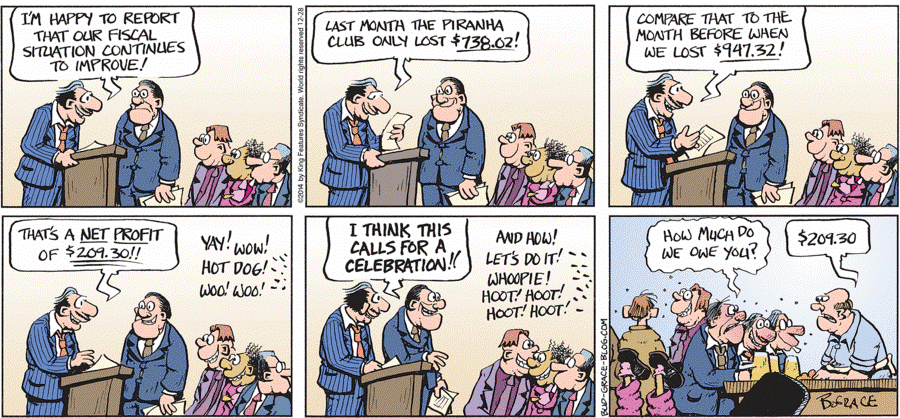
Nichols “discovered” a previously unknown “surplus” of $320 million in mystery money that set off a running dispute between her office and State Treasurer John Kennedy—an argument that eventually made its way before the Joint Legislative Committee on the Budget.

With a tip of our hat to cartoonist Bud Grace, we are able to show you how that surplus was discovered:

JINDAL SURPLUS SECRET

(CLICK ON IMAGE TO ENLARGE)

Murphy Painter vindicated, Jindal humiliated:

Jindal’s attempted prosecution persecution of fired Director of the Office of Alcohol and Tobacco Control Murphy Painter blew up in the governor’s face when Painter was first acquitted of criminal charges, costing the state nearly half a million dollars in reimbursement of Painter’s legal fees, but Painter subsequently won a defamation suit against his accuser.

Secret survey no longer a secret but “no one” more popular than Jindal:

A survey to measure state employee satisfaction in the Division of Administration (DOA) should be an eye opener for Commissioner of Administration Kristy Kreme Nichols and agency heads within DOA.

Meanwhile, LouisianaVoice has learned that Gov. Bobby Jindal (R-Iowa, R-New Hampshire, R-Anywhere but Louisiana) received some exciting news this week when a new poll revealed that no one was more popular among Republican contenders for the GOP presidential nomination.

The excitement was short-lived, however, when the actual meaning of the numbers was revealed.

It turns out that in a CNN poll of New Hampshire voters, Jindal tied with Rick Santorum with 3 percent, while “No one” polled 4 percent, prompting Comedy Central’s Stephen Colbert to joke that Jindal should adopt the slogan “Jindal 2016: No one is more popular.”

To shred or not to shred:

The controversy surrounding the sweeping changes being proposed for the Office of Group Benefits just got a little dicier with new information obtained by LouisianaVoice about the departure of Division of Administration executive counsel Liz Murrill and the possibly illegal destruction of public records from the Office of Group Benefits (OGB) and the involvement of at least two other state agencies.

While it was not immediately clear which OGB records were involved, information obtained by LouisianaVoice indicate that Murrill refused to sign off on written authorization to destroy documents from OGB.

We first reported her departure on Oct. 14 and then on Oct. 22, we followed up with a report that Murrill had confided to associates that she could no longer legally carry out some of the duties assigned to her as the DOA attorney.

But now we learn that the issue has spilled over into two other agencies besides OGB and DOA because of a state statute dealing with the retention of public documents for eventual delivery to State Archives, a division of Secretary of State Tom Schedler’s office.

Reports indicate that Schedler became furious when he learned of the destruction or planned destruction of the records because records should, according to R.S. 44:36, be retained for three years and then delivered to the state archivist and director of the division of Archives, records management and history.

NOVEMBER

Secret grand jury testimony of Greenstein made public:

The Louisiana Attorney General’s office, in an unprecedented move, released the 100-plus pages of testimony of Bruce Greenstein, former Secretary of the Department of Health and Hospitals but the testimony did little in revealing any smoking gun related to the state’s $180 million contract with CNSI. About the only thing to come out of his testimony was the indication of an incredible bad memory in matters related to his dealings with his former bosses at CNSI and a razor-sharp recall of other, more insignificant events.

Approval? We don’t need no stinkin’ approval:

The very first state agency privatized by Gov. Bobby Jindal was the Office of Risk Management (ORM) and after the state paid F.A. Richard and Associates (FARA) $68 million to take over ORM operations and then amended the contract to $75 million after only a few months, the agency was subsequently transferred three times to other firms. The only hitch was a specific clause in the original contract with FARA that no such transference was allowable without “prior written approval” from the Division of Administration. The problem? When LouisianaVoice made an FOIA request for that written approval, we were told no such document existed.

Edwards’ Last Hurrah:

Former Gov. Edwin Edwards, one of the most successful, colorful and charismatic politicians in Louisiana history, lost—decisively. Republican Graves Garrett rode the Republican tide to easily hand Edwards his first political defeat, dating back to his days on the Crowley City Council. Some may remember when Buddy Roemer led the field in 1987, forcing Edwards into a runoff. Technically, though, Edwards did not lose that election because he chose not to participate in the runoff, thus allowing Roemer to become governor. But he would return in 1991 to win his unprecedented fourth term.

DECEMBER

Friends of Bobby Jindal seeking donations:

A new web page popped up seeking donations for the Friends of Bobby Jindal, raising speculations of an attempt at a higher office (president?) since Jindal can’t run for governor again.

The new web page cited a speech by Jindal at a foreign policy forum at which he called for increased military spending.

Gimme the keys to the cars:

The Public Service Commission (PSC) became the second state agency (the State Treasurer’s office was the first) to openly defy Jindal when the administration demanded that the PSC relinquish possession of 13 vehicles as part of the administration’s cost-cutting measures.

We have already examined State Rep. Jerome “Dee” Richard’s attempt to cut consulting contracts which was passed unanimously by both the House and Senate but vetoed by Jindal.

But there was another veto that should be mentioned in context with Jindal’s penny wise but pound (dollar) foolish fire sale approach to state finances.

Earlier this year, State Sen. Jack Donahue (R-Mandeville) managed to get overwhelming passage of a bill that called for more oversight of the tax break programs by the state’s income-forecasting panel.

But Jindal, who never met a tax break he didn’t like, promptly vetoed the bill, saying it could effectively force a tax increase on businesses by limiting spending for the incentive programs.

Only he could twist the definition of removal of a tax break for business into a tax increase even while ignoring the fact that removal of those tax breaks could—and would—mean long-term relief for Louisiana citizens who are the ones shouldering the load. And for him to willingly ignore that fact borders on malfeasance.

Another (yawn) poor survey showing:

24/7 Wall Street, a financial news and opinion company, released a report which ranked Louisiana as the 11th worst-run state in America.

Louisiana, in ranking 40th in the nation, managed to fare better than New Jersey, which ranked 43rd, or eighth worst, something Jindal might use against Gov. Christ Christie if it comes down to a race between those two for the GOP nomination.

Louisiana had “one of the lowest median household incomes in the nation,” at just $44,164, the report said “and 10.7 percent of all households reported an income of less than $10,000, a higher rate than in any state except for Mississippi. Largely due to these low incomes, the poverty rate in Louisiana was nearly 20 percent (19.8 percent) and 17.2 percent of households used food stamps last year, both among the highest rates in the nation. The state’s GDP grew by 1.3 percent last year, less than the U.S. overall.

May we pray?

Meanwhile, Jindal prompted more controversy by having his favorite publisher and LSU Board of Supervisors member Rolfe McCollister run interference in securing the LSU Maravich Center for a political prayer event in January of 2015. The event will be sponsored by the controversial American Family Association and will not (wink, wink) be a political event, Jindal said.

And that, readers, is where we will leave you in 2014.

For 2015, we have an election campaign for governor to look forward to.

Just when you thought it couldn’t get any worse.

Read Full Post »

A confrontation reminiscent of the one nearly 50 years ago between the managing editor (yours truly) and the family news editor at the Ruston Daily Leader has arisen between Gov. Bobby Jindal and the Louisiana Public Service Commission (PSC) and if the late Wiley Hilburn were alive today, he might well find the latest one just as amusing.

Hilburn was on hand when I needed a camera to cover a breaking news story. The only problem was, the news camera was broken and the only one available was a cheap one Publisher Tom Kelly had purchased for use by family news editor Virginia Kavanaugh for her section. “Give me your camera,” I said as I hung up the telephone and stood from my chair across from her. “I have to get a picture of a wreck on I-20.”

“No,” said Mrs. Kavanaugh. “You can’t have it. It’s for my use.”

In complete exasperation and more than a little frustrated at this unexpected lesson in humility, I looked over at Hilburn who had just walked in with a news release from Louisiana Tech University. The look I got in return told me I was on my own. “But I’m the managing editor!” I finally blurted. It was the only thing that came to mind in response to her unexpected insubordination. As I write this, I swear I can still hear Hilburn laughing at the absurdity of the scene that unfolded before his eyes. He would repeat that story for my benefit for years to come, laughing just as hard as he did that morning at the very audacity of my naïve belief that in some parallel universe, my managing editor badge trumped her title as family news editor.

And I never got that camera.

Now the PSC has ripped a page from Mrs. Kavanaugh’s playbook and it’s just as funny.

Jindal, in a desperate attempt to scrape together a few pennies to cover what at last estimate was a deficit of about $141 million, is conducting a fire sale of what state assets still remain after he disposed of state buildings and parking garages in years past to patch similar budget holes.

The administration wants to sell some 700 state vehicles, including 13 assigned to the PSC but commissioners voted unanimously Wednesday (Dec. 17) to direct the PSC staff not to relinquish the vehicles because, the commission lacks funds with which to rent cars and to sell them would hinder its work.

Jindal planned to confiscate the vehicles to be sold with the others early next year in yet another cost-cutting move. The administration says the PSC vehicles aren’t used enough to justify their upkeep.

(The same might be said for some of the governor’s highly-paid appointees. And let’s not even discuss the cost of overtime, lodging, travel and meals for state police security details that accompany the governor on all of those trips to Iowa, New Hampshire and Washington.)

It should be noted that the $141 million shortfall was before the latest plunge in oil prices which Jindal conveniently blames for the fiscal mess in which the state finds itself—again. Legislative Auditor Daryl Purpera is scheduled to give a presentation tomorrow (Thursday, Dec. 18) to the Joint Legislative Committee on the Budget and early indications are the governor’s office and Commissioner of Administration Kristy Nichols aren’t going to be very happy.

The $1.4 million anticipated from the sale of the vehicles represents a shade less than 1 percent of the $141 million deficit (which may be even more after the legislative auditor’s report) and is only a tiny fraction of the $25 billion state budget.

“Of the 13 state vehicles at the Public Service Commission, 11 of them are driven less than 15,000 miles a year,” said Jan Cassidy, Assistant Commissioner of Administration for Procurement. “The cost of maintaining underutilized vehicles is greater than the cost of reimbursing employees for travel when it’s necessary,” she said.

The $1.4 million anticipated from the sale of the vehicles would not be net since the state would be required to either pay employees for use of personal vehicles or pay for rental of cars through a contract the state has with Enterprise Car Rentals.

The administration put agencies on notice about the planned sale last week, giving them two weeks to turn over vehicles designated for auction.

“Reducing state expenses requires all state agencies to review their priorities and ensure they are spending taxpayer dollars appropriately,” Cassidy said.

One of those voting to defy the governor was Scott Angelle who once served in Jindal’s cabinet. A dispute between the PSC and the governor’s office has been simmering and the vehicle flap is only the latest issue as things have reached a boiling point.

The PSC has been critical of a recent practice by the administration and the legislature to take over funds paid to the PSC as fees by regulated companies. Members say the action amounts to an unconstitutional tax levy while the governor and legislator argue for the right to use the fees as part of the state budget. That outcome of that argument is now pending in court.

We can only assume that state police vehicles were exempt from the fire sale order. But with this administration, who knows?

Nor was there was any immediate word on whether or not the administration would attempt to seize the PSC vehicles, which would just be another log on that smoldering fire.

But somewhere within the walls of the Governor’s mansion (he’s rarely on the fourth floor of the State Capitol, we’re told), Bobby Jindal must be incredulous as he exclaims perhaps to wife Supriya or, to a curious butler, “But I’m the governor!

Read Full Post »

« Newer Posts - Older Posts »

