Corruption.
As the March 12 opening day of the critical 2018 regular session approaches, and with the looming possibility of the call of a special session to address fiscal Armageddon, it’s an important word for Louisiana citizens to remember.
Corruption.
In a state where administrators, legislators, and judges all seem to be in it for personal enrichment, it’s a word that has become synonymous with political office—from small town mayors, city councils and police chiefs to the highest levels of state government.
Corruption.
Like a cancer, corruption metastasizes until it adversely affects every aspect of our lives: education, economics, environment, health, and not least, trust in our elected officials.
Michael Johnston and Oguzhan Dincer, both former fellows at Harvard Law School’s Edmond J. Safra Center for Ethics, recently collaborated to conduct their fourth Corruption in America Survey, an undertaking first initiated in 2014 and repeated annually.
Since 2016, the survey has been hosted by the newly-founded Institute for Corruption Studies, an independent research institute within the Illinois State University’s Department of Economics.
More than 1,000 news reporters/journalists covering state politics and issues related to corruption across 50 states participated in the survey. Reporters from every state except North Dakota and New Hampshire participated.
Click HERE to read the complete results.
To no one’s surprise, Louisiana ranks among the worst states in terms of executive, judicial, and legislative sleaze—in both legal and illegal corruption.
What, exactly, it meant by legal and illegal corruption? After all, corruption is corruption, is it not?
Well, yes and no. Illegal corruption was defined by Dincer and Johnston as “the private gains in the form of cash or gifts by a government official in exchange for providing specific benefits to private individuals or groups.”
How Gauche. Everyone knows that in Louisiana the preferred method is legal corruption, which the two researchers defined as “the political gains in the form of campaign contributions or endorsements by a government official, in exchange for providing specific benefits to private individuals or groups, be it by explicit or implicit understanding.”
For evidence of that, one need look no further than the LouisianaVoice STORY of Aug. 28, 2016, to see how Bobby Jindal, Attorney General Jeff Landry, and a gaggle of legislators fell all over themselves in protecting the big oil and gas companies from their responsibilities to clean up after themselves. Here is a more detailed look at .
Who better to serve as director of the Louisiana Offshore Terminal Authority than former State Sen. Robert Adley of Bossier Parish, the top recipient of OIL AND GAS CAMPAIGN CONTRIBUTIONS?
And Bobby Jindal handed out appointments to the most influential boards and commissions to his biggest campaign contributors like candy on a Halloween night and even upgraded a major highway in South Louisiana to benefit a company run by another large contributor.
Dincer and Johnston said that official legal corruption is moderately to very common in both the executive and legislative branches of government in a “significant” number of states, “including the usual suspects such as Mississippi, New Jersey, and New York,” but that “Alabama, Kentucky, and Louisiana are perceived to be the most corrupt states” in the executive, legislative, and judicial branches.
Illegal Corruption
Only 13 states were found to have moderately common to very common illegal corruption in their executive branches. Louisiana was one of those 13.
Only four states had illegal judicial corruption deemed to be moderately common (Alabama and Louisiana) or very common (Arkansas and Kentucky). Dincer and Johnston wrote that even a finding of only slightly common in illegal judicial corruption “is still worrying since it is the judicial branch of the government that is expected to try government officials charged with corruption.”
“State legislators are perceived to be more corrupt than the members of the executive branches in a number of states,” the researchers said.
To illustrate that, the survey found just six states with legislative illegal corruption that was very common (Alabama, Arkansas, Kentucky, and Louisiana) or extremely common (Oklahoma and Pennsylvania).
Legislators were found by LouisianaVoice to have leased luxury vehicles for family members, purchased season tickets to college and professional athletic sports teams, hired family members as campaign staff, paid personal income taxes and state ethics fines—all with campaign funds and all of which were illegal.
One legislator even profited by conveniently investing in Microsoft just as his committee was pushing through approval of one of the company’s software programs at the same time other states were taking similar action. The simultaneous approvals gave Microsoft stock a significant boost.
Legal Corruption
“Legal corruption is perceived to be more common than illegal corruption in all branches of government,” the report said, with Louisiana, Alabama, and Wisconsin scoring highest in legal corruption “in all branches of government.”
Those same three states, along with Arkansas, topped the list in legal corruption in the judicial branch where legal sleaze “is perceived to be ‘very common,’” it said, noting that in all four states, judges are elected as opposed to states where judges are chosen on merit and in which judicial corruption is not as common.
“…We expect our courts to rise above the day-to-day pressures and expectations of politics,” the report said. “That they apparently do not raises serious questions about the ways judges are elected in many states, how their campaigns are financed, and whether conflicts of interest arise as those who contribute to judicial campaigns are allowed to appear before those same judges as cases are tried.”
Louisiana, Alabama, and Wisconsin were joined by Arizona, Florida, Maryland, Missouri, New Mexico, North Carolina, Oklahoma, Texas, Hawaii, Illinois, Kentucky, Oregon, Georgia, New Jersey, and New York as states where legal executive corruption was found to be either “very common” or “extremely common.”
Legal legislative corruption was found to be “extremely common” in 12 states: Louisiana, Alabama, Georgia, Indiana, Maryland, Missouri, New Jersey, New York, Oklahoma, Oregon, South Carolina, and Texas.
Aggregate Corruption
Across the board, in terms of legal and illegal corruption in all three branches of government, few states do it better than Louisiana, results of the survey reveal, with the state ranking in the upper tier of corruption in all six listings.
That finding prompted the authors of the report to say that corruption in state government “is not just a matter of contemporary personalities and events, but is rather a result of deeper and more lasting characteristics and influences.
Nowhere, it would seem, is that truer than in Louisiana. Following is just a partial list of Louisiana public officials who have come face-to-face with corruption charges of varying degrees:
Louisiana Executive Corruption
Sherman Bernard: The first Louisiana Insurance Commissioners to be convicted, he served 41 months for extortion and conspiracy.
Doug Green: The second State Insurance Commissioner to go to jail, he was convicted on three counts of money laundering, 27 counts of mail fraud, and was sentenced to 25 years in prison.
Jim Brown: The third consecutive Louisiana Insurance Commissioner served six months for lying to the FBI.
Richard Leche: Louisiana Governor sentenced to 10 years in prison for accepting kickbacks on the purchase of 233 state trucks.
Edwin Edwards: Louisiana Governor sentenced to 10 years in prison after his conviction of extortion in connection with the awarding of state riverboat casino licenses.
Charles Roemer: Commissioner of Administration under Gov. Edwin Edwards, was convicted on one count of conspiracy to violate federal racketeering laws, violating the statute and engaging in wire and mail fraud as a result of the FBI’s Brilab operation which also resulted in the conviction of New Orleans mob boss Carlos Marcello. Roemer served 15 months in federal prison.
Jack Gremillion: Louisiana Attorney General of whom it was once said by Gov. Earl K. Long, “If you want to hide something from Jack Gremillion, put it in a law book,” was sentenced to three years in prison for lying to a federal grand jury about his interest in a failed loan and thrift company.
Gil Dozier: Louisiana Agriculture Commissioner, initially sentenced to 10 years in prison for extortion and racketeering but had eight years added after presiding federal judge learned Dozier had attempted to tamper with a juror and to hire a hit man for an unidentified target.
George D’Artois: Shreveport Public Safety Commissioner was implicated in the 1976 murder of Shreveport advertising executive Jim Leslie but he died in surgery before he could be tried.
Cyrus “Bobby” Tardo: former Sheriff of Lafourche Parish sentenced to 29 years, five months after pleading guilty in 1989 to solicitation for murder, conspiracy, possessing an unregistered destructive device and using an explosive to damage a sheriff’s car. His victim? His successor and the man who defeated him for reelection as sheriff, Duffy Breaux.
Duffy Breaux: Lafourche Parish Sheriff sentenced to four years, nine months in prison for conspiracy, mail fraud, obstruction of justice in 1995.
Eugene Holland: The first of three consecutive St. Helena Parish sheriffs to be convicted of a federal crime, sentenced to 16 months in prison for the theft of public funds to cover his utility bills and to pay for renovations to his house and barn. Pleaded guilty in 1996.
Chaney Philips: The second of three consecutive St. Helena Parish sheriffs to serve prison time after his conviction on nine counts of conspiracy, mail fraud, engaging in illegal monetary transactions, theft involving a federally-funded program, money laundering, and perjury—all related to his time not as sheriff but as parish assessor before being elected sheriff. Sentenced to seven years.
Ronald “Gun” Ficklin: Third consecutive St. Helena Parish sheriff to be convicted of federal criminal charges. Sentenced to five years, three months for trafficking cars with altered vehicle identification numbers, altering VINs, mail fraud, helping convicted felon possess a fun. Pleaded guilty in 2007.
Jiff Hingle: Plaquemines Parish Sheriff pleaded guilty in 2011 to conspiracy to commit mail fraud and bribery, sentenced to 46 months in prison.
Bodie Little: Winn Parish Sheriff convicted in 2012 of drug trafficking, sentenced to 13 years, four months in prison.
Royce Toney: Ouachita Parish Sheriff, pleaded guilty in 2012 to hacking a deputy’s email and phone records and then trying to cover up his snooping. Sentenced to four years’ probation.
Walter Reed: St. Tammany Parish District Attorney (22nd JDC) sentenced to four years in prison in April 2017 for conspiracy, wire fraud, mail fraud, money laundering, making false statements on tax returns. Sentence on hold during appeals process.
Harry Morel, Jr.: St. Charles Parish District Attorney (29th JDC) pleaded guilty in April 2016 to obstruction of justice in FBI inquiry into whether he used his position to solicit sex from women seeking official help. Sentenced to three years in prison.
Aaron Broussard: Former Jefferson Parish President pleaded guilty in 2012 to conspiring to accept bribes from a parish contractor. Sentenced to 46 months in prison. While parish officials other than district attorneys and sheriffs are not generally listed here, Broussard is because of his high national profile following Hurricane Katrina.
Ray Nagin: New Orleans Mayor convicted in 2014, sentenced to 10 years in prison for bribery, wire fraud, money laundering, conspiracy, tax evasion for illegal dealings with city vendors. As with the case of Broussard above, mayors not normally included in this list because of the sheer volume. But because of his high profile following Katrina and as mayor of state’s largest city, it was decided to include him.
Louisiana Legislative Corruption
Larry Bankston: Former chairman of the Senate Judiciary B. Committee that handled gambling legislation was convicted in 1997 on two counts of interstate communications in the aid of racketeering involving alleged bribes from a Slidell video poker truck stop owner. Sentenced to 41 months in prison. Re-admitted to Louisiana State Bar by State Supreme Court. Currently suing State Attorney General for the cancellation of his contract to represent a state agency.
Gaston Gerald: State Senator convicted in 1979 of extorting $25,000 from a contractor. Sentenced to five years in prison. Re-elected while in prison and put a prison acquaintance on Senate payroll as an aide before he was expelled from the Senate in 1981.
Sebastian “Buster” Guzzardo: State Representative among more than 20 persons, including the leader of the New Orleans Marcello crime family and three reputed New York mobsters, convicted in the Worldwide Gaming investigation. Conviction was for conducting an illegal gambling business and for aiding a mob-controlled video poker company. Sentenced in 1996 to three months in prison.
Girod Jackson, III: State Representative who pleaded guilty in 2013 to tax evasion and tax fraud in connection with his business dealings with the Jefferson Parish Housing Authority. Sentenced to three months in prison, nine months of home detention despite recommendations of 12 to 18 months imprisonment.
William Jefferson: 18-year veteran of U.S. House of Representatives convinced in 2009 on 11 of 16 felony counts for taking bribes in connection with a Nigeria business deal. Seven of the 11 counts on which he was convicted were overturned on appeal. Sentenced to five years, five months after appeals. In 2006, following Hurricane Katrina, Jefferson interrupted rescue operations by using a Louisiana National Guard detachment to recover personal effects from his home. (His sister, Orleans Parish Assessor, also sentenced to 15 months in prison after admitting to funneling $1 million in public funds to her family’s bogus charities.)
Charles Jones: State Senator from Monroe, convicted in 2010 of filing false tax returns and for tax evasion, sentenced to 27 months in federal prison and ordered to pay more than $300,000 in restitution. Was re-admitted to Louisiana State Bar on Monday (Jan. 29, 2017).
Harry “Soup” Kember: State Representative was sentenced to five years in prison after his 1986 conviction of mail fraud for pocketing part of a $150,000 state grant he secured for a constituent’s company.
Derrick Shepherd: State Senator sentenced to three years in prison in 2010 after admitting that he laundered money for a corrupt bond broker, netting $65,000 for the scheme.
Rick Tonry: Served only four months as a U.S. Representative from the 1st Congressional District after pleading guilty in 1977 to receiving illegal campaign contributions, promising favors in return for contributions and for buying votes in the 1976 Democratic primary.
Louisiana Judicial Corruption
Ronald Bodenhimer: The 24th Judicial District Judge was among four judges to be caught up in the FBI Wrinkled Robe investigation of Jefferson Parish Courthouse corruption and one of two to receive jail time. He was sentenced to 46 months in prison after pleading guilty in 2003 to planting drugs on a critic of his New Orleans East marina, for bond splitting, and for attempting to fix a child custody case on behalf of Popeyes Chicken Founder Al Copeland.
Wayne Cresap: The 34th JDC Judge for St. Bernard Parish was sentenced to five years in prison after pleading guilty in 2009 to accepting more than $70,000 in bribes and for letting inmates out of jail without paying their bonds.
Alan Green: Another of the four Judges of the 24th JDC in Jefferson Parish. Sentenced to 51 months in prison after his 2005 conviction of a $10,000 mail fraud scheme to take bribes from a bail bonds company.
William Roe: The 25th JDC Judge for Plaquemines Parish was sentenced in 2010 to three months in prison for unauthorized use of movables for pocketing more than $6,000 in reimbursements for legal seminars that he attended as judge. The money should have been deposited in a public account instead.
Thomas Porteous, Jr.: Only the eighth federal judge to be removed from office by impeachment in the Republic’s history, he was convicted in 2010 by the U.S. Senate on four articles charging him with receiving cash and favors from lawyers who had dealings in his court, used a false name to elude creditors, and deliberately misled Senators during his confirmation hearings. As if to underscore the gravity of the charges, all 96 senators present voted guilty on the first article which addressed charges during his time as a state court judge and his failure to recuse himself from matters involving a former law partner with whom he was accused of granting favors for cash.
There are scores of other examples, including city and parish elected officials, local police chiefs, and even a legislator who resigned rather than be expelled for spousal abuse. And former Louisiana State Penitentiary at Angola Warden Burl Cain retired in 2016 under an ethics cloud even though he was official cleared of ethics charges. His son, Nate Cain and Nate’s former wife, Tonia, were indicted in August 2017 on 18 federal fraud charges over purchases he was said to have made with state credit cards during his tenure as warden of Avoyelles Correctional Center in Cottonport.
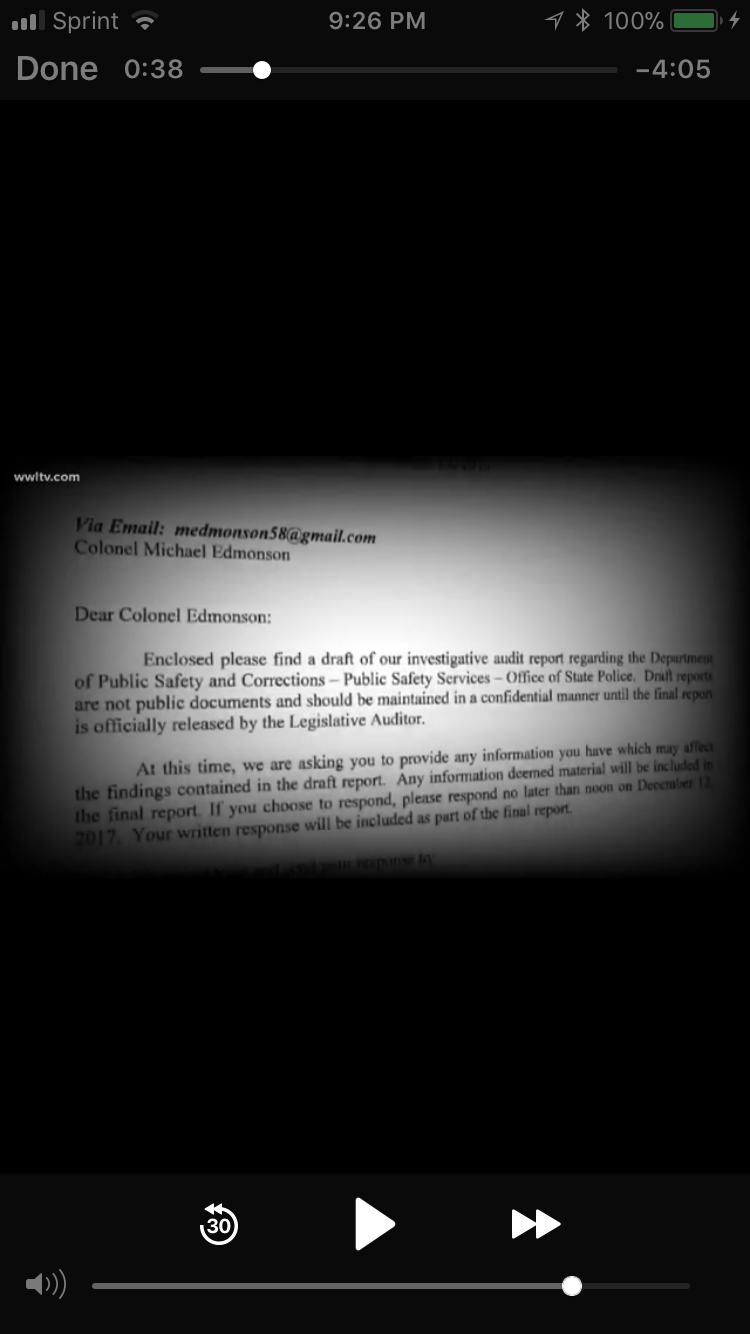
Additionally, LouisianaVoice over the past three years documented numerous instances of abuse of power and outright corruption from troop commanders all the way up to the upper command of Louisiana State Police.
There were dozens more not listed and sadly, there will continue to be corruption in all three branches of state government so long as the people of this state continue to look away and ignore the widespread malfeasance and outright skullduggery.
And by ignoring the problem, we are necessarily condoning it.
Read Full Post »






 Louisiana Voice