Feeds:
Posts
Comments

Archive for the ‘Public Records’ Category

After literally dozens of stories by LouisianaVoice since 2014 about Louisiana State Police (LSP) problems through mismanagement from the top, it appears—finally—that matters may be coming to a head with Monday’s arrest of two current and two former state troopers a total of 98 counts of filing false public records, injuring public records, felony theft and malfeasance in office.

Along with the formal LSP news release announcing the four arrests, unconfirmed reports have former State Police Superintendent Mike Edmonson and his attorney involved in preliminary negotiations for a plea bargain on unspecified charges but believed to be connected to the October 2016 trip in which four troopers drove a state vehicle to a convention in San Diego via tourist stops in Las Vegas and the Grand Canyon.

An official of the Metropolitan Crime Commission in New Orleans even voiced his belief that all the problems of LSP as reported on since 2014 by LouisianaVoice could be laid at the feet of one man: Edmonson.

While the latest arrests stem directly from a news story by New Orleans TV investigative reporter LEE ZURIK last November revealed state troopers were being paid for working Local Agency Compensated Enforcement (LACE) patrol that they in fact did not work, LouisianaVoice reported two years earlier that Rogers was falsifying records in connection to his LACE patrol. LACE is a cooperative program in which local district attorneys pay state police for beefed-up patrol to catch traffic offenders.

In the end, of the 98 counts amassed by the four current and former troopers, 75 were lodged against Rogers. All the counts against the four were in connection to their work in the LACE program, the LSP PRESS RELEASE release said.

The two current state troopers were Master Trooper Daryl Thomas (two counts of filing false public records and one count of felony theft (greater than $15,000), and Wayne Taylor (14 counts of injuring public records and one count of malfeasance in office. Thomas, of New Orleans, currently makes $89,400 per year and Taylor, of Rapides Parish, earns $62,600 per year.

The two former troopers were Byron Sims, a $109,000-per-year polygraphist with 22 years’ experience before leaving LSP (four counts of filing false public records and one count of felony theft greater than $21,000), and Rogers (74 counts of injuring public records and one count of malfeasance in office.

FILING FALSE PUBLIC RECORDS, under Louisiana Title 14 is the filing of any forged or wrongfully-altered document or any document containing a false statement or false representation of a material fact.

INJURING PUBLIC RECORDS is the intentional falsification or concealment of any record or document filed in any public office or with any public officer.

Both are felonies.

Much of the legwork in bringing the charges against Rogers was done by the office of Calcasieu Parish District Attorney John DeRosier.

In Rogers’s case, an LSP INTERNAL AFFAIRS REPORT dated October 20, 2015 said he wrote tickets on his regular detail but putting a later date on the ticket to make it appear he had written it on his LACE detail when in fact he was not even working the LACE shift for which he was paid. Other times, he would put later times for his traffic stops to make it appear he had worked his entire detail when, in fact, he had not.

The IA investigation, provided to LouisianaVoice by the New Orleans Metropolitan Crime Commission, initially delved into only Rogers’s 2015 LACE overtime but when discrepancies were discovered, it was decided to expand the investigation to include 2013 and 2014 but then Rogers resigned, effective Nov. 6, 2015 and the investigation was terminated.

Inexplicably, Rogers had a change of heart and on March 7, 2017, sent an EMAIL to Troop D Commander Benny Broussard in which he (a) claimed he had resigned in “good standing,” and (b) said he would like to return to his former job. Ironically, in that email he said, “I was clear (sic) of every claim except altering times on tickets. I am guilty of writing times on tickets later than the stop actually was.”

The only logical reason for writing the wrong times was to cover up his absence from duty by writing driver citations for a small part of the beginning of his shift and then taking the rest of the day off.

One source told LouisianaVoice that Rogers and another former trooper, Ronnie Picou, should not have been able to disappear from their shifts if they had been under a proper level of supervision. “Most jobs have supervisors (who) would notice when someone is not there,” the source said. “Most police supervisors would care about their troopers and check on them if they disappeared. Most police supervisors believe their job is important and officers must be present to accomplish that important job.”

“They were not supervised by people who care about their officers or the citizens they serve. They were supervised by Lt. Paul Brady and Capt. Chris Guillory.

Brady helped popularize the coined term “Brady Days,” an unwritten policy that gave troopers time off for issuing DWI citations, which can encourage arrests of people who were not actually impaired. Brady supervised Picou who was initially fired after LouisianaVoice requested records on alleged payroll fraud. Brady supervised Picou when an LSP investigative report showed he was absent from duty much of the time.

Brady was suspended for reportedly ordering Troopers to claim more time than they worked. Those allegations were also discovered after LouisianaVoice made public records requests. Brady also supervised Rogers. Sources reported Picou and Rogers were able to shuck their duties under the supervision of Brady, leaving their fellow troopers and citizens abandoned.

LouisianaVoice has received reports that the allegations which led to the arrest of Rogers were known to LSP for years. Rogers was under the protection of Brady and Guillory, former Troop D Commander. Capt. Guillory reportedly has a position in Baton Rouge but he lives in Sulphur.

LSP knew about Rogers, Picou, Brady and Guillory and did nothing until forced by public exposure.

Instead, Edmonson, rather than take proactive measures to eliminate problems exposed in Troop D, went to considerable lengths to expose LouisianaVoice’s SOURCES–until it became painfully obvious that the primary problem was Edmonson.

Perhaps Anthony “Tony” Radosti, Vice-President of the Metropolitan Crime Commission, said it best when he told LouisianaVoice on Monday, “Jimmy Rogers was a symptom. Mike Edmonson was the disease.”
Read Full Post »

If you are unfortunate enough to become the victim of a crime, you wouldn’t want to compound your problems by having it occur in Iberia Parish.

The Iberia Parish Sheriff’s Office, it seems, has problems keeping up with its investigative records.

What’s more, there seems to be a problem maintaining a consistent explanation as to why a record is no longer available.

But then, the Iberia Parish Sheriff’s Office is not exactly the model you want to hold up as a model of efficiency, forthrightness, or competence.

Take the 2006 murder of Jamon Rogers, for example.

Ricardo Irvin entered a GUILTY PLEA in 2009 to the killing, that much is known.

But when a freelance writer recently made a routine request for the file on the investigation of the killing he was told:

  • The sheriff’s office’s computer was hacked last August and the records are no longer accessible;
  • If you want the record, you’ll have to get a subpoena.

Well, of course that raised the obvious question of how would a subpoena help if the records were hacked and are “no longer accessible”?

Somehow, those two explanations just don’t reconcile.

It’s similar to the old joke about the lawyer’s answer to a lawsuit that his dog bit a man walking past his office:

  • My dog doesn’t bite;
  • I keep my dog inside a fence;
  • I don’t own a dog.

But that’s nothing new for the Iberia Parish Sheriff’s Office.

After all, in March 2014, Victor White III was stopped by Iberia Parish deputies who said they found marijuana and cocaine on his person. He was placed in a deputy’s patrol car, his hands cuffed behind his back. But while cuff, deputies said, he somehow managed (a) to get a gun and (b) to commit suicide by shooting himself…in the chest.

Lloyd Grafton of Ruston, an expert retained by the White family, said the entry wound was more to the right side than frontal area and that the bullet exited from White’s left side. “There is no way he could have shot himself the way they (officials) described it, with his hands cuffed behind his back,” Grafton said.

Grafton isn’t your typical hired gun retained by attorneys to say whatever supports their case. He is a veteran of twenty-one years as a special agent for the Justice Department’s U.S. Bureau of Narcotics and Dangerous Drugs and with the U.S. Treasury as a special agent for the Bureau of Alcohol, Tobacco and Firearms. He has what is commonly known as street creds.

Last month, Iberia Parish Sheriff Louis Ackal quietly settled a federal lawsuit brought by White’s family. As has become a trend in civil lawsuits, terms of the settlement were sealed and White’s family was prohibited by a confidentiality clause from disclosing the settlement amount.

Word is, the settlement was paid from sheriff’s department funds and not by an insurance carrier because Ackal’s liability policy was cancelled because of either unaffordable premiums because of repeated violations of basic rights or because no insurance company wants anything to do with providing coverage for the department.

But then again, maybe the department’s policy was simply lost in that massive computer “hacking” last August.

Pursuant to the puzzling response to the freelance writer, LouisianaVoice made an identical request for the investigation records under terms of the Public Records Act of Louisiana (R.S. 44:1 et seq.).

The response this time came from someone named Steve Elledge, general counsel for the sheriff’s office:

“According to the records custodian at the Bureau of Investigations, that investigation case file cannot be located,” read the terse email from Elledge on Wednesday. “Therefore, we are unable to comply with your public records request.”

We couldn’t resist being a bit flippant over what looks from our vantage point as a deliberate effort to avoid compliance with state law:

“You’ve ‘lost’ the file on a murder investigation? Really? Your office yesterday informed another person making the same request that (a) the sheriff’s office records were ‘hacked’ and therefore unavailable and (b) if he wanted the record he would have to get a subpoena. My question is how would a subpoena help if the records were hacked and unavailable?

“When did this ‘hacking’ occur and why was nothing ever publicized about it? There were no news stories about the records being hacked.

“Convenient, to say the least. I wonder if a court order might make them reappear?”

There has been no further correspondence between LouisianaVoice and the sheriff’s office.

Read Full Post »

Anyone remember Allyson Campbell?

If not, that’s understandable. After all, it’s been a couple of years since we had a STORY about her exploits in the 4th Judicial Court in Monroe. She’s the Monroe News-Star society columnist who showed up occasionally at her supposed full-time job as law clerk for 4th JDC Judge Wilson Rambo (gotta love that name; wonder if they have a judge named Rocky?).

On Wednesday, 12 of the 13 judges of the First Circuit Court of Appeal (only Judge Curtis Calloway did not hear arguments) dealt the self-promoting columnist/clerk a major setback when it ruled in an en banc (full court) decision that she does not enjoy “absolute immunity” from her actions in destroying court files and that a lawsuit against her may go forward.

But it was the dissenting opinion of one of the three judges who gave written opinions that makes for the best reading.

The ruling comes nearly two years after Louisiana Inspector General STEPHEN STREET found there was no “sufficient cause” to bring charges against Campbell for what witnesses said were repeated instances of her destroying or concealing trial briefs. For that matter, Louisiana State Police and the Louisiana Attorney General’s office also declined to pursue the matter, leaving only one state official, Legislative Auditor Daryl Purpera, with the integrity and courage to call Campbell out for her actions.

She was also the central figure in:

  • The controversy that erupted when the Ouachita Citizen made a legal request for public records from the court—and was promptly sued by the judges for seeking those same public records.
  • The filing of a lawsuit by Judge Sharon Marchman against four fellow judges and Campbell over Campbell’s claiming time worked when she was actually absent—including time when she was in restaurants and/or bars for which she claimed time—and the four judges who Judge Marchman said were complicit in covering for her.
  • A complaint by Monroe attorney Cody Rials that Campbell had boasted in a local bar that she had destroyed Rials’ court document in a case he had pending before Judge Carl Sharp so that Sharp could not review it. One witness interviewed by Judges Sharp and Ben Jones quoted Campbell as saying that she had “taken great pleasure I shredding Rials’ judgment” and that she had given Rials a “legal f—ing.”

Now a DECISION by the First Circuit Court of Appeal, in overturning a lower court’s 2015 decision, has held that a lawsuit by Stanley Palowsky, III, against Campbell for damages incurred when she “spoliated, concealed, removed, destroyed, shredded, withheld, and/or improperly handled” his petition for damages against former business partner Brandon Cork may proceed.

At the same time, the First Circuit ruled that the five judges he added as defendants—Stephens Winters, Sharp, Rambo, Frederic Amman and Jones—for allowing Campbell “free rein to do as she pleased and then conspiring to conceal (her) acts” enjoyed “absolute immunity” from being sued and were dismissed as defendants despite their repeated denials that any documents were missing from the Palowsky file.

Palowsky argued that Campbell undertook her acts with malice and to obtain advantages for his opponents in the lawsuit. Moreover, he argued that Campbell’s supervising judges, Amman and Rambo, “did not just sit back quietly and let Campbell commit such acts, they actively worked and schemed to cover up her actions.”

Palowsky also said that Campbell’s wrongdoings “have been reported time and again by different attorneys in different cases and investigated time and again by defendant judges but have nevertheless been allowed to continue. It is now painfully apparent that not only has Campbell been unsupervised and uncontrollable for years, but defendant judges have actively schemed to allow her conduct to continue unabatedly (sic).”

Campbell, who doubles as a society columnist of sorts (if one really stretches the definition of the term) for the News-Star, is obviously her own biggest fan—unless you count her stated infatuation for Cork’s attorney Thomas Haynes, III, about whom she wrote in one of her columns that he…had the “IT” factor, “a somewhat undefinable quality that makes you and everyone else around stand taller when they enter the room, listen a little more closely, encourage you to take fashion or life risks, make each occasion a little more fun and generally inspire you to aim to achieve that ‘IT’ factor for yourself.”

If they taught that method of courtroom coverage in my Louisiana Tech journalism classes, I must have been absent that day.

Needless to say, the First Circuit upheld the lower court in expunging that paragraph from Palowsky’s petition.

In fact, the lower court struck 46 paragraphs from his lawsuit against Campbell and the five judges, but the First Circuit restored 21 paragraphs to the petition. The 25 it allowed to remain removed involved matters not directly related to Campbell’s alleged destruction of files, the judges said.

In 2014, Campbell published a column entitled, “A Modern Guide to Handle Your Scandal,” in which she wrote, “Half the fun is getting there, and the other half is in the fix.” She then went on to advise her readers to “keep the crowd guessing. Send it out—lies, half-truths, gorilla dust, whatever you’ve got.” She told readers, “You’re no one until someone is out to get you.”

(There’s a line in there somewhere about Trump, but it’s just too easy.)

In July 2015, she wrote in her column, “It’s not cheating if it’s in our favor.”

That paragraph was removed from Palowsky’s petition as was one that noted that on one occasion, 52 writ applications went missing for more than a year before it was discovered that Campbell had used the applications as an end table in her office.

Say what?!!?

One paragraph left in the petition was one in which Palowsky pointed out that the five judges might not be out of the woods yet, if the Louisiana Judiciary Commission does its job. The Louisiana State Constitution provides as follows: “On recommendation of the judiciary commission, the (Louisiana) Supreme Court may censure, suspend with or without salary, remove from office, or retire involuntarily a judge for willful misconduct relating to his official duty, willful and persistent failure to perform his duty, persistent and public conduct prejudicial to the administration of justice that brings the judicial office into disrepute, conduct while in office which could constitute a felony, or conviction of a felony.”

It would appear in consideration of the judicial protection of Campbell, a case could be made that the judges are guilty at least of slipshod management at best and criminal malfeasance at worst.

All the judges in the 4th JDC recused themselves when Palowsky sued and his case was heard by Ad Hoc Judge Jerome Barbera, III, who cited in his Dec. 11, 2015, ruling dismissing the five judges as defendants an 1871 ruling that said, “It is a general principle of the highest importance to the proper administration of justice that a judicial officer, in exercising the authority vested in him, shall be free to act upon his own convictions, without apprehension of personal consequences to himself.”

Even though Palowsky was claiming that the judges protected Campbell despite their full knowledge of what she had done, Barbera said, “Allegations of bad faith or malice are not sufficient to overcome judicial immunity.”

Another way of putting it is that the judges are untouchable and that their edicts, like those of the Pope, are infallible, divinely inspired.

Barbera extended the immunity to Campbell but the First Circuit opinion, written by  Judge Page McClendon, overturned Barbera on that point. While two of the Appeal Court judges, Vanessa Whipple and Guy Holdridge upheld immunity for the five district court judges in their written opinions, all three rejected the idea of immunity for Campbell and all three voted to reinstate 21 of the paragraphs in Palowsky’s petition.

But it was that third judge, William Crain, who wrote that none of the defendants deserved immunity from events in the 4th JDC.

“Judicial immunity is of the highest order of importance in maintaining an independent judiciary, free of threats or intimidation. But it is a judge-created doctrine policed by judges.” (emphasis mine)

He also said that when judicial actors “perform non-judicial acts, they are not protected by this otherwise sweeping immunity doctrine.

“The duty to maintain records in cases involves many non-judicial actors and can only be considered a ministerial, not judicial act,” he wrote.

“For the same reasons (that) the law clerk is not immunized for her non-judicial acts related to maintaining court records, the judges are not immunized for allegedly aiding, abetting, then concealing those acts. Failing to supervise a law clerk relative to a non-judicial act is not a judicial act for purposes of immunity.

“The doctrine of judicial immunity does not shield judicial actors from civil liability for criminal acts (and) while later cases suggest judicial immunity extends even to judicial acts performed with malice, those cases do not immunize judicial actors from criminal conduct grounded in malice or corruption.

“Extending the doctrine of judicial immunity to include civil liability for alleged criminal conduct, as in this case, risks undermining the public’s trust in the judiciary, which I cannot countenance.”

So, how, you might ask, has Campbell managed to withstand the barrage of charges of payroll fraud, absenteeism, records destruction, and critical audit reports and still keep her job?

And continue to flaunt her actions in a newspaper column?

That can be explained in one word: Connections.

Campbell’s father is George Campbell, an executive with Regions Bank. George Campbell is married to the daughter of influential attorney Billy Boles who was instrumental in the growth of Century Telephone and who is a major contributor to various political campaigns.

Allyson Campbell is also the sister of Catherine Creed of the Monroe personal injury law firm of Creed and Creed. Christian Creed, Campbell’s brother-in-law, contributed $5,000 to Attorney General Jeff Landry’s 2015 campaign, which could explain, in part, why the AG backed off its investigation of Campbell the following year.

In a town the size of Monroe, those connections are sufficient, apparently.

Read Full Post »

What do Louis Ackal and Jerry Larpenter have in common?

Well, among other things:

They’re both sheriffs of parishes they run with dictatorial methods—Ackal in Iberia Parish and Larpenter in Terrebonne;

Neither will hesitate to take whatever actions they deem necessary to silence any voice of dissent—from pulling off a RAID of a critic’s home in Terrebonne to turning DOGS loose on defenseless inmates of the Iberia Parish jail;

And both reportedly have the same legal counsel.

But the similarities go even further.

An Ackal critic who had the audacity to initiate a recall effort against the sheriff found himself ARRESTED for manslaughter after a single-vehicle accident in which he was not even involved. (Those bogus charges, brought by a cooperative district attorney, were very quietly dropped after LouisianaVoice’s story of the heavy-handed techniques.)

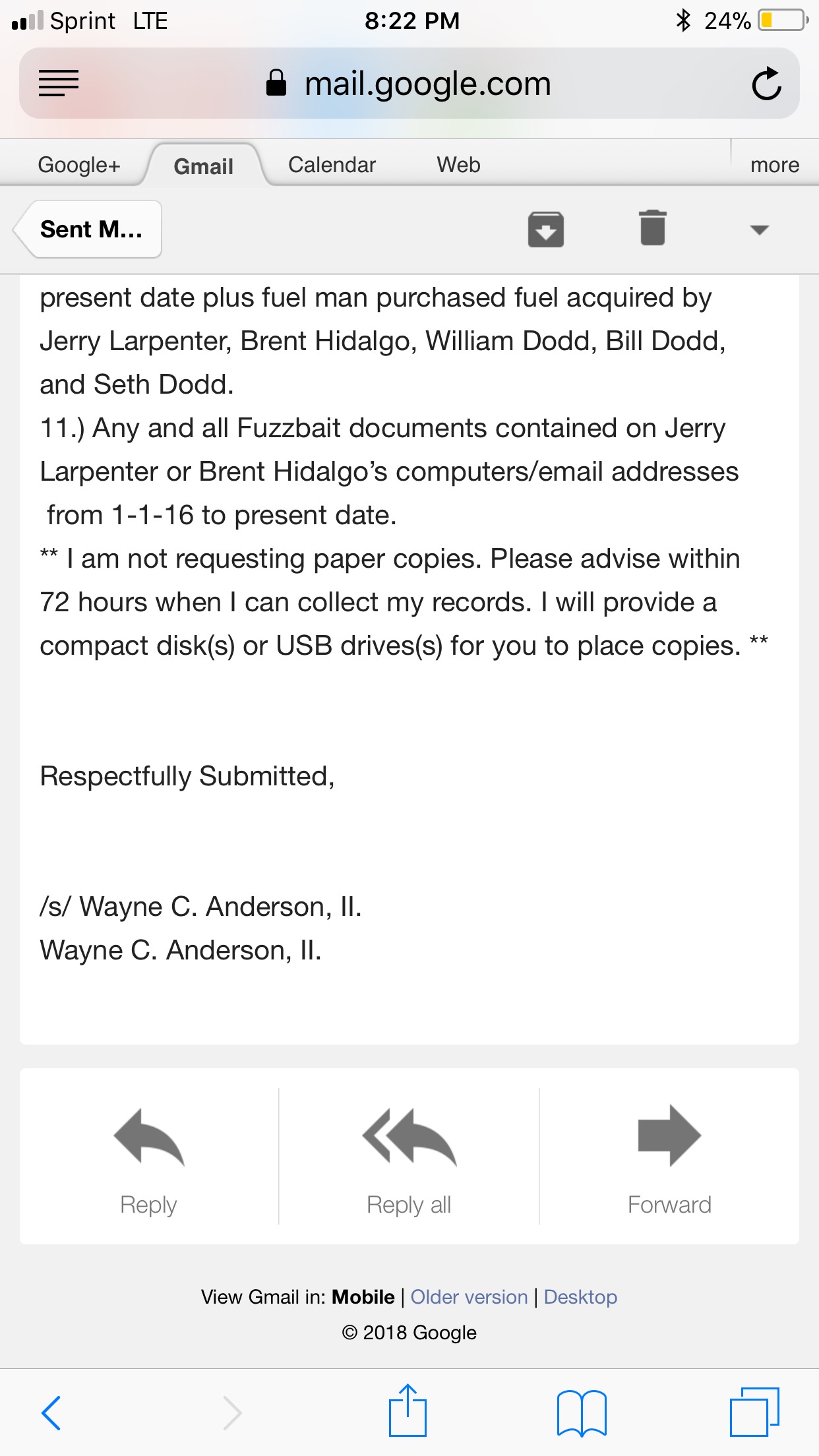
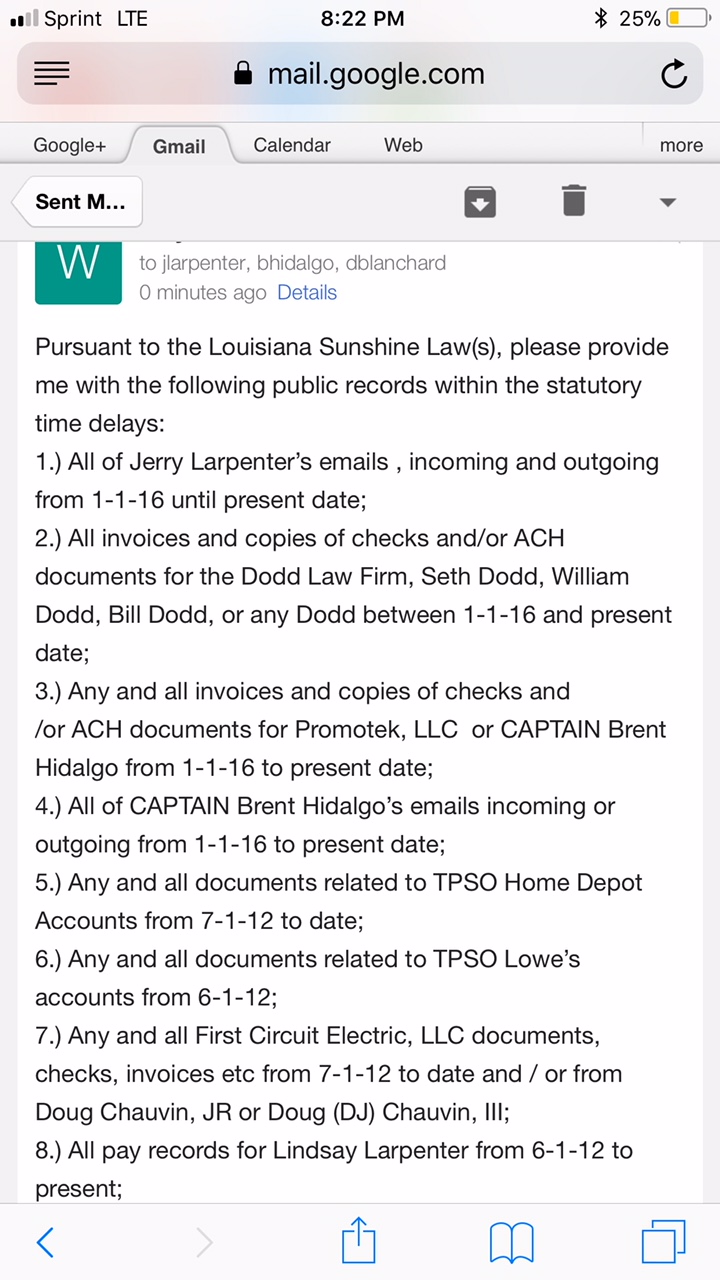
Larpenter, meanwhile, has taken a step to make it very costly for his critic (the one whose home he raided) to obtain what anywhere else would be routine public records—records that he or anyone else is legally entitled to see.

Wayne Anderson’s home was raided and his computers seized by Larpenter after Anderson posted internet blogs critical of Larpenter. That raid was quickly ruled unconstitutional by the federal courts and the Andersons sued and won a substantial monetary settlement from Larpenter believed to be in the neighborhood of $250,000.

Anderson submitted his request that included, among other things, all invoices and copies of checks paid to the Dood Law Firm, Seth Dodd, William Dodd, Bill Dodd, “or any Dodd,” from Jan. 1, 2016 through the present date.

Dodd is the legal counsel for Larpenter and, according to unconfirmed reports, also represents Ackal.

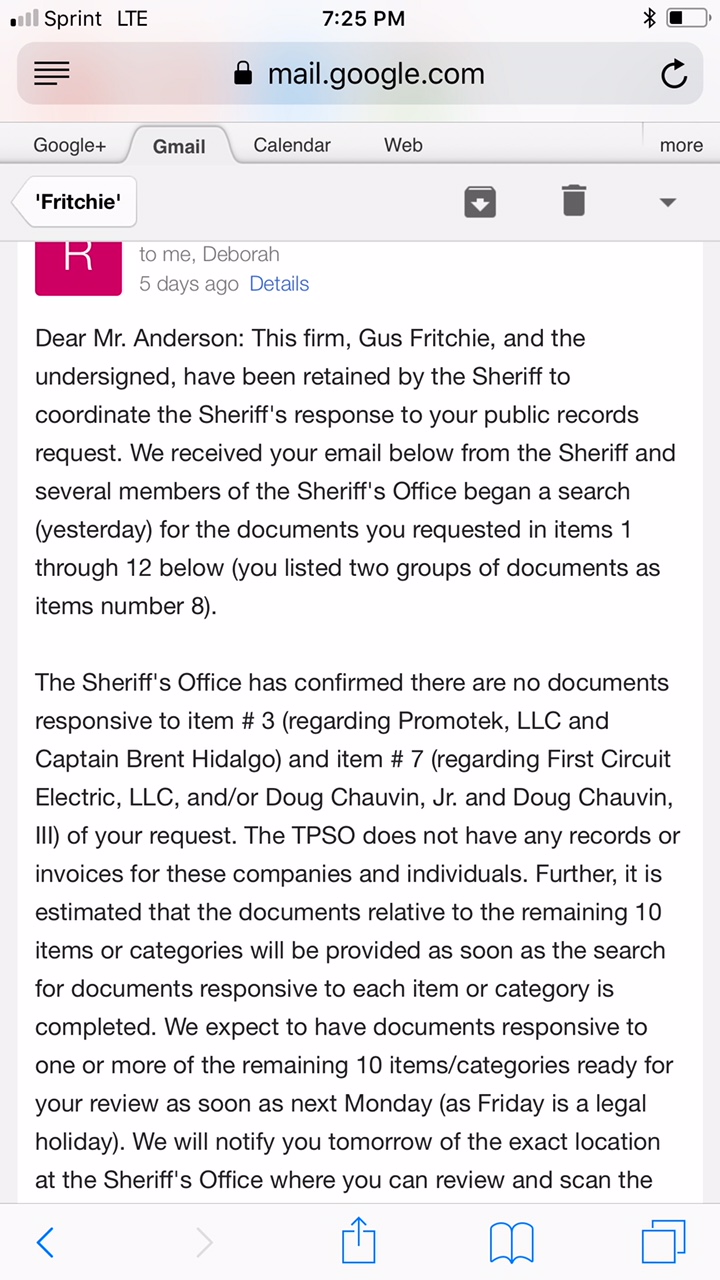
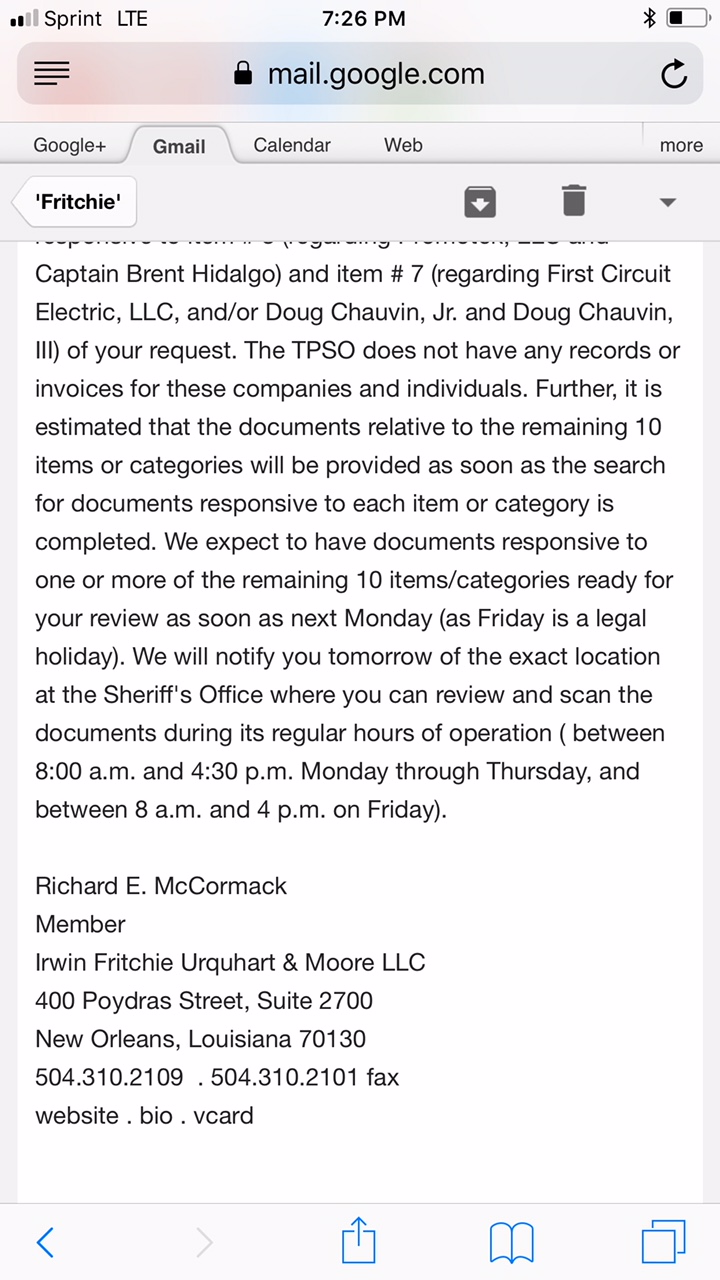
Soon after submitted his request, Anderson received an electronic communication from Richard McCormack, an attorney with the New Orleans firm of Irwin Fritchie Urquhart & Moore. McCormack informed Anderson that his firm had been “retained by the sheriff to coordinate the sheriff’s response to your public records request.”


As one with considerable experience in requesting and obtaining public records on behalf of LouisianaVoice, I can say that I find it quite unusual that the good sheriff would find it necessary to retain a high-priced legal team not to ascertain what is and what is not public record, but simply to “coordinate the sheriff’s response” when a clerical employee would be fully capable of performing such duties.

I’m just guessing here, but I would estimate their rate to be in the neighborhood of $300 per hour—and don’t think for one scintilla of a nano-second that they will put just one attorney on this project when they could put two or three and really run up the tab. From what we hear, the firm has two of its attorneys working on a way to make a routine public records request punitive.

And just what is Bill Dodd’s function, anyway? (Every time I hear that name, I think of Earl Long’s reference to another Bill Dodd during his 1959 gubernatorial campaign, the current Bill Dodd’s father, as “Big, bad, bald Bill Dodd.”)

As near as I can make out, his job was harassment, if reports coming out of Terrebonne are true. Dodd says emphatically that they are not.

When the Andersons asked the sheriff’s insurance company who issued their settlement check, things went south in a hurry. The Andersons say no one from the insurance company ever appeared on the court record on the sheriff’s behalf, leading them to believe Larpenter may have misled the insurance company about their claim.

Soon after they made their inquiry, they said Dodd called one of the couple’s supervisor and threatened to sue for tortuous interference and damage to his reputation.

Dodd, contacted by LouisianaVoice adamantly denied that. “I haven’t threatened to sue anybody,” he said. “I’ve been practicing law long enough that I don’t have to threaten to sue anyone, I just sue ‘em.”

C’mon, Dodd, you ain’t talking to someone who just fell off a turnip truck. There’s not a lawyer alive who won’t “threaten” to sue if a threat can achieve his purpose. The “threat” to sue is one of the most dependable arrows in an attorney’s quiver. I only wish I knew the number of times I’ve been “threatened” with a lawsuit if I published a story. Only twice have they followed through with an actual lawsuit and on both occasions, I prevailed.

Another big factor in both sheriffs’ success in maintaining a death grip on their jobs is a local press that seems reluctant to take them on. The Daily Iberian has denied that is less than aggressive in covering the exploits of Ackal but readers have expressed a general lack of in-depth coverage by the paper.

Unfortunately, the threads linking Ackal and Larpenter are the rule, not the exception. Those threads are strong, they link more than just these two sheriffs and that link runs straight through the Louisiana Sheriffs’ Association.

I have just completed the manuscript for what I feel is a revealing book about Louisiana’s sheriffs and the muscle they flex in Louisiana politics.

The working title of the book is Louisiana’s Rogue Sheriffs: A Culture of Corruption.

It will probably be about a year before the book is actually published. I will keep you abreast of the schedule as I know more.


Read Full Post »

This post is almost certain to earn me an invitation to never enter Iberia Parish as long as Louis Ackal is sheriff. That’s okay. I’ve received similar invitations from other sheriffs down through the years.

But the truth is, Ackal is a menace and is quite probably the last person in Iberia Parish who should be permitted to wear a badge and to carry a gun.

He not only presides over a department that abuses inmates, but when a local citizen, an African-American, initiated a recall effort against Ackal, he ended up arrested for manslaughter in connection with a one-car accident in which he was not even involved.

On July 8, 2016, Donald Broussard was rear-ended by a hit-and-run driver In Lafayette Parish who minutes later collided head-on with an 18-wheeler and was killed in adjacent Iberia Parish. Yet it was Broussard who was indicted on a charge of manslaughter by an Iberia Parish grand jury on March 19, 2017.

And more recently, Ackal has settled two lawsuits against his department—one involving the deliberate shooting of a dog, a family pet, and the other involving the death of a prisoner while handcuffed in a sheriff’s department squad car.

Four years ago, on March 3, 2014, 22-year-old Victor White III was stopped by Iberia Parish deputies. The deputies said marijuana and cocaine were found on White but who really knows? Evidence planted by unscrupulous law enforcement authorities is certainly not unprecedented. I’m not saying drugs were planted in this White’s case. He was placed in a sheriff’s department patrol car, his hands cuffed behind his back. While cuffed, deputies said, he somehow managed to get a gun and “committed suicide” by shooting himself in the back.

A coroner’s report released five months later, however, said White shot himself in the chest, a feat that would seem to defy all laws of physics. That White’s hands were never tested for gunpowder residue only served to cast further doubt on the official version of events. Still, the parish coroner, Dr. Carl Ditch, insisted White’s death was a suicide.

Lloyd Grafton, an expert retained by White family, weighed in on the evidence. Grafton, of Ruston, is a veteran of twenty-one years as a special agent for the Justice Department’s U.S. Bureau of Narcotics and Dangerous Drugs and with the U.S. Treasury as a special agent for the Bureau of Alcohol, Tobacco and Firearms. He also served on the Louisiana State Police Commission. Today, he serves as an expert witness in cases involving alleged excessive force by law enforcement.

He said the entry wound was more to the right side than frontal area and that the bullet exited from White’s left side. “There is no way he could have shot himself the way they (officials) described it, with his hands cuffed behind his back,” Grafton said.

On May 19, 2015, U.S. Rep. Cedric Richmond of Louisiana’s Second Congressional District, wrote a gut-wrenching three-page letter to then-U.S. Attorney General Loretta Lynch in which he requested an investigation into mistreatment to the deaths of eight people who were in the custody of the Iberia Parish Sheriff’s Office. In his letter, he cited several suspicious incidents that occurred at the Iberia Parish Sheriff’s Office during Ackal’s tenure:

  • In 2008, a man alleged that a deputy beat him so badly during an arrest that he coughed up blood and then a muzzle was put over his mouth. The man later settled a suit with the Sheriff’s Office for $50,000.
  • In 2009, Michael Jones, a 43-year-old man who suffered from bipolar disorder and schizophrenia, died in the jail after an altercation with then-Warden Frank Ellis and then-lieutenant Wesley Hayes. This year, a judge ruled that two Sheriff’s Office employees were responsible for Jones’ death. The judgment in the case totaled $61,000.
  • In 2009, former inmate Curtis Ozenne alleged that officers began a contraband sweep by forcing him to remain in the “Muslim praying position” for nearly three hours. Mr. Ozenne alleged he was kicked in the mouth multiple times, threatened with police dogs and then his head was shaved. In his complaint, Mr. Ozenne also alleged that Sheriff Ackal threatened him with a dog and watched as an officer struck him with a baton for smiling. Mr. Ozenne’s suit against the Sheriff’s Office was later settled for $15,000.
  • In 2009, Robert Sonnier, a 62-year-old mentally ill man, died as the result of a fatal blow delivered by an IPSO Deputy in the course of a physical altercation. After Mr. Sonnier was unable to receive a psychological evaluation authorized by his wife, he was left in a wheelchair to stew in his own waste for several hours. He eventually became agitated which led to altercations with Deputies that resulted in Sonnier being pepper sprayed twice and eventually leading to the fatal blow.
  • In 2012, Marcus Robicheaux, an inmate at Iberia Parish Jail, was pulled from a wall and thrown to the ground as IPSO correctional officers ran a contraband sweep. A deputy’s dog then attacked Mr. Robicheaux, biting his legs, arms and torso, as the deputy stomped and kicked the prone inmate. The whole three-minute incident was captured on video from the jail’s surveillance cameras.

Ackal and several deputies were eventually indicted but when the judge showed up in federal court in Lafayette impaired, the case was transferred to Shreveport where, with the help of high-priced legal counsel, he was a acquitted, though several of his deputies were either convicted or copped pleas.

Federal Judge Donald E. Walter, who said he never liked sentencing those who appeared before him in court, told the deputies that they were “the worst.”

“So many law enforcement officials are out there risking their lives for little pay. All I can say is you had lousy leadership,” he said. “How sad this is for all concerned.”

Interestingly enough, the local newspaper, The Daily Iberian, reports precious little of the sheriff’s travails. Whether that is because of fear of reprisals on Ackal’s part or for other, less noble reasons is unclear. Either way, it’s a sad commentary when the local press can be cowed into submission by any politician—even one with a gun.

Take that settlement with the family of Victor White last month, for instance. As has become a disturbing trend in recent years, the terms of the settlement were sealed so the taxpayers of Iberia Parish who paid the tab will never know how much that monumental screw-up has cost them in terms not only of the settlement itself but the legal defense of Ackal and his deputies, as well.

And The Daily Iberian certainly isn’t going out of its way to learn how much the settlement was. In fact, search though you might, you won’t even find a story in The Daily Iberian about the settlement at all. Nothing. Nada. Nil. Zip. Zilch. Nary a word. Way to uphold the integrity of the Fourth Estate, guys. But if you want to do something on this story, you can check out this Lafayette television station’s WEBSITE. At least they have some inkling of what a real news story looks like.

And then there is this April 4 STORY about Ackal settling yet another lawsuit last month, this one for $75,000 after one of Ackal’s deputies shot a two-year-old Presa Canario dog after deputy Lucas Plauche’s body cam recorded him saying to the animal, “Dog, you’re about to die, you understand me? You’re about to die.” Plauche could be heard chuckling but the video ended just before he shot the dog in its owner’s yard.

Oh, and that story, by the way, ran in The Shreveport Times, nearly 200 miles north of New Iberia. Nary a word in The Daily Iberian, however.

In most cases, public bodies are insured against such liability. Not the Iberia Parish Sheriff’s Office, however. Its liability insurance premiums increased dramatically in recent years with the increasing number of complaints that were settled and its coverage was eventually dropped.

The citizens of Iberia Parish have a right to know the total cost of suits and settlements that Ackal is responsible for. The fact that The Daily Iberian, for whatever reason, makes no effort to perform even a scintilla of investigative reporting is irrelevant. Ackal owes Iberia Parish residents an explanation.

And then he owes it to them to resign.

Read Full Post »

« Newer Posts - Older Posts »