Feeds:
Posts
Comments

Archive for the ‘Public Records’ Category

ETHICS DILEMMA

(CLICK ON IMAGE TO ENLARGE)

“No former elected official, including a legislator, no former member of a board or commission, nor agency head for two years shall assist another person for compensation in connection with a transaction, or render service on a contractual basis for or be employed/ appointed to any position involving the agency by which he or she was formerly employed or in which he/she formerly held office.” (LA Rev Stat § 42:1121)

“…Kristy Nichols is leaving the public sector to become Ochsner Health System’s vice president of government and corporate affairs, the Jindal administration announced today.” (Baton Rouge Business Report, Sept. 15, 2015)

So Nichols will be going to work for Ochsner as a lobbyist. And while state law precludes her lobbying the legislative or executive branches for two years, there appears to be no prohibition to her lobbying local governments (parishes and municipalities) on the part of Ochsner.

Kristy, anticipating the end of her boss’s rocky tenure in January, found her own golden parachute at Ochsner. We don’t know her salary at Ochsner, but we’re guessing it’ll be six figures. Taken at face value, that would normally be the end of the story.

But with this gang, there’s always more than meets the eye. And thanks to our friend C.B. Forgotston who helped us connect the dots, we’re able to shed a little more light into how she parlayed three years of repeated budget crises into such a high-profile private sector job.

Remember the great state hospital privatization fiasco and the contract with 50 blank pages? http://www.modernhealthcare.com/article/20130602/INFO/306029998

The contract obligated the state to long-term spending obligations that will extend decades beyond the Jindal years. Let’s ignore for the moment the fact that the Center for Medicare and Medicaid Services has yet to approve the deal. Instead, let’s explore the Nichols-Ochsner connection.

It was two years ago that the LSU Board of Supervisors signed off on that contract to hand over operation of state-owned hospitals in Lake Charles, Houma, Shreveport and Monroe. The blank pages were supposed to have contained lease terms. Instead, the LSU board left those minor details to the Jindal administration (read: Commissioner of Administration Kristy Nichols).

Eventually details about the contracts emerged, including that of the Leonard J. Chabert Medical Center in Houma. And, thanks to the Louisiana Public Affairs Research Council, that is where we’re able to bring the picture into focus.

Leonard Chabert Medical Center was opened in 1978 as a 96-bed facility with 802 employees but by the time it was privatized, it was down to 63 beds.

In 2008, a hospital-based accredited Internal Medicine residency program was begun. In 2011, the hospital’s revenue was 47 percent uncompensated care for the uninsured, 29.5 percent Medicaid, 13 percent Medicare, 5.5 percent state general fund and 6 percent interagency transfer from other departments with only 1 percent being self-generated.

When the Jindal administration moved to unload state hospitals, Chabert was partnered with Southern Regional Medical Corp., a nonprofit entity whose only member is Terrebonne General Medical Center (TGMC).

TGMC was slated to manage Chabert with assistance with a company affiliated with (drum roll)…..Ochsner Health System, Louisiana’s largest private not-for-profit health system with eight hospitals and 40 health centers statewide.

So what were the terms of the agreement? Five years with an automatic renewal after the first year in one-year increments to create a rolling five-year term.

Though Southern Regional is not required to pay rent under terms of the agreement, the Terrebonne Parish Hospital Service District No. 1 is required to make annual intergovernmental transfers of $17.6 million to the Medicaid program for Southern Regional and its affiliates. Here are the TERMS OF THE OCHSNER DEAL AT LEONARD CHABERT MEDICAL CENTER

Here’s the kicker: the cooperative endeavor agreement (CEA) calls for supplemental payments of $31 million to Ochsner. It’s no wonder the Houma Daily Courier described the deal as “a valuable asset to Ochsner’s network of hospitals” and that the deal “expands Ochsner’s business profile.”

Between 2009 and 2013, Ochsner’s revenue doubled from $900 million to $1.8 billion and the deal only means more revenue for Ochsner, the Daily Courier said. http://www.houmatoday.com/article/20140325/articles/140329692?p=3&tc=pg

We’re certain it’s just coincidence that the LSU Board signed off on a blank contract that the Jindal administration would fill in after the fact.

And it’s just by chance that Kristy Nichols, as Commissioner of Administration, was responsible for that task.

And of course it was just happenstance that Ochsner received that $31 million payment and a mere two years later, just as her reign at DOA was ending, saw the need to bring Kristy aboard as vice president of government and corporate affairs.

So there you have it. All you have to do is follow the money.

Read Full Post »

For political junkies and political reporters out there, this is just the ticket and it’s coming out party is tomorrow, Tuesday, Sept. 8, just in time for Louisiana’s fall elections.

Freagle, a free political social network designed to connect voters and candidates to engage the way our founders intended, will debut in Louisiana on Tuesday, Sept. 8.

LouisianaVoice anticipates it will make regular use of the site in order to keep its readers updated on political candidates.

Freagle.com will provide a personalized political platform on which voters can customize their issue and election preferences in order to cut through the noise and spin of our current political dialogue to learn who is on their ballot and where those candidates stand on the particular issues they care about.

“Freagle is designed to connect voters to the candidates on their ballot and provide a simple mechanism for learning about where they stand and what they will do if elected,” Freagle founder and CEO Niki Papazoglakis said. “It also allows candidates to easily engage with voters on the topics they care about individually without expensive micro-targeting and polling.”

Freagle is currently operating at: http://www.freagle.com/ . The full site will be live on Tuesday.

Citizens who use Freagle can easily determine who is on their ballot, in their specific precincts. The site will use the voter’s address to automatically connect them to the races on their ballots, but voters also have the ability to manually follow races in other districts. Voters are verified so there are no trolls or political operatives.

“I hope that by making it easy and convenient for voters to be informed and engaged on elections and amendments, more people will turn out to the polls this fall and feel confident that the votes they cast are for the people and topics that best reflect their personal views,” Papazoglakis said. “Ultimately, I hope that Freagle is a catalyst to re-engage voters in this representative democracy and get us back to a citizen-led government.”

Freagle’s other features will include:

  • Simple means of comparing candidates. Election forums will allow voters to conduct side-by-side comparisons of the candidates in each race on their ballot and on individual issues.
  • On-Demand candidates’ debates. Voters can pose questions to all candidates in a race who subscribe to Freagle from the Election Forum wall rather than individually through other venues like websites, Facebook or Twitter and without having to be selected or have timed responses in live forums.
  • My Ballot tool. Voters can research and make voting decisions throughout the election cycle and print their choices before going to the polls.
  • Verification. Voters are verified so there are no trolls or political operatives.

Papazoglakis said Freagle would also be a valuable tool for the news media. “The media will have a simple place to track all of the elections from a single location including who has qualified in each race, where the candidates stand on the issues, and how they are engaging with voters, “ she said. “In addition, comprehensive campaign finance reports are easily accessed from each candidate’s profile.”

Freagle will feature a custom report from the state Ethics Commission that will have significantly more information than the standard download from the Ethics website, Papazoglakis said, adding that the site will also include all campaign contributions for each candidate.

News media outlets wanting more information about Freagle should contact Papazoglakis at (225) 615-4570 or niki@freagle.com.

Read Full Post »

Even as grieving friends, relatives and fellow state troopers were gathering to say goodbye to slain Troop D State Trooper Steven Vincent in Lake Charles last weekend, a State Police Internal Affairs investigation was well underway into alleged payroll irregularities on the part of Troop D Commander Capt. Chris Guillory.

One report received by LouisianaVoice indicates that Guillory reassigned a supervisor to administrative duties after he and his subordinates declined to participate in what they felt was payroll fraud stemming from travel to Baton Rouge for new firearms qualification.

Meanwhile, a potential confrontation between Guillory and the man who filed a complaint against him was averted when a sheriff’s deputy escorted Dwight Gerst from a visitation for Vincent at the Rosa Hart Theater at the Lake Charles Civic Center on Friday, Aug. 28.

Gerst, who was friends with and who was trained by Vincent, attended the wake but said he was cursed by Guillory while he was standing in line and a sheriff’s deputy subsequently escorted him from the visitation. “I was there to honor and pay my respects to a friend,” Gerst said.

LouisianaVoice published a story on Aug. 17 about Guillory’s refusal to accept a formal complaint about threats Gerst said Trooper Jimmy Rogers made against him. Gerst then took his complaint to State Police headquarters in Baton Rouge but it was never followed up by Baton Rouge, he said.

But now, Internal Affairs is conducting what appears to be a full-blown investigation into a number of allegations involving Guillory, including but not limited to the payroll irregularities and prescription drug abuse.

One of the payroll issue stems from a trip Troop D troopers made to Baton Rouge earlier this year to qualify with new weapons issued the troopers. LouisianaVoice has learned that troopers were instructed to charge extra hours for the round trip and time spent qualifying.

Guillory is said to have reassigned one supervisor to administrative duties after he and his subordinates declined to participate in padding their time sheets.

LouisianaVoice in late July made a public records request of State Police for an opportunity to review all time sheets for the pay period that Troop D personnel traveled to Baton Rouge to fire the newly issued weapons.

On Aug. 18, State Police Attorney Supervisor Michele Giroir notified us by letter that the time sheets, along with numerous other requested public records had become the subject of an ongoing investigation being conducted by Louisiana State Police. “Therefore, these records are not subject to release at this time,” Giroir wrote.

It appears the request by LouisianaVoice for the records sparked the investigations into the suspected payroll irregularities. Reporting sources indicated they had not wanted to take information to LouisianaVoice but did so after reporting the problems internally only to see the investigation focus more on discovering the source of the reporting than in identifying and stopping misconduct.

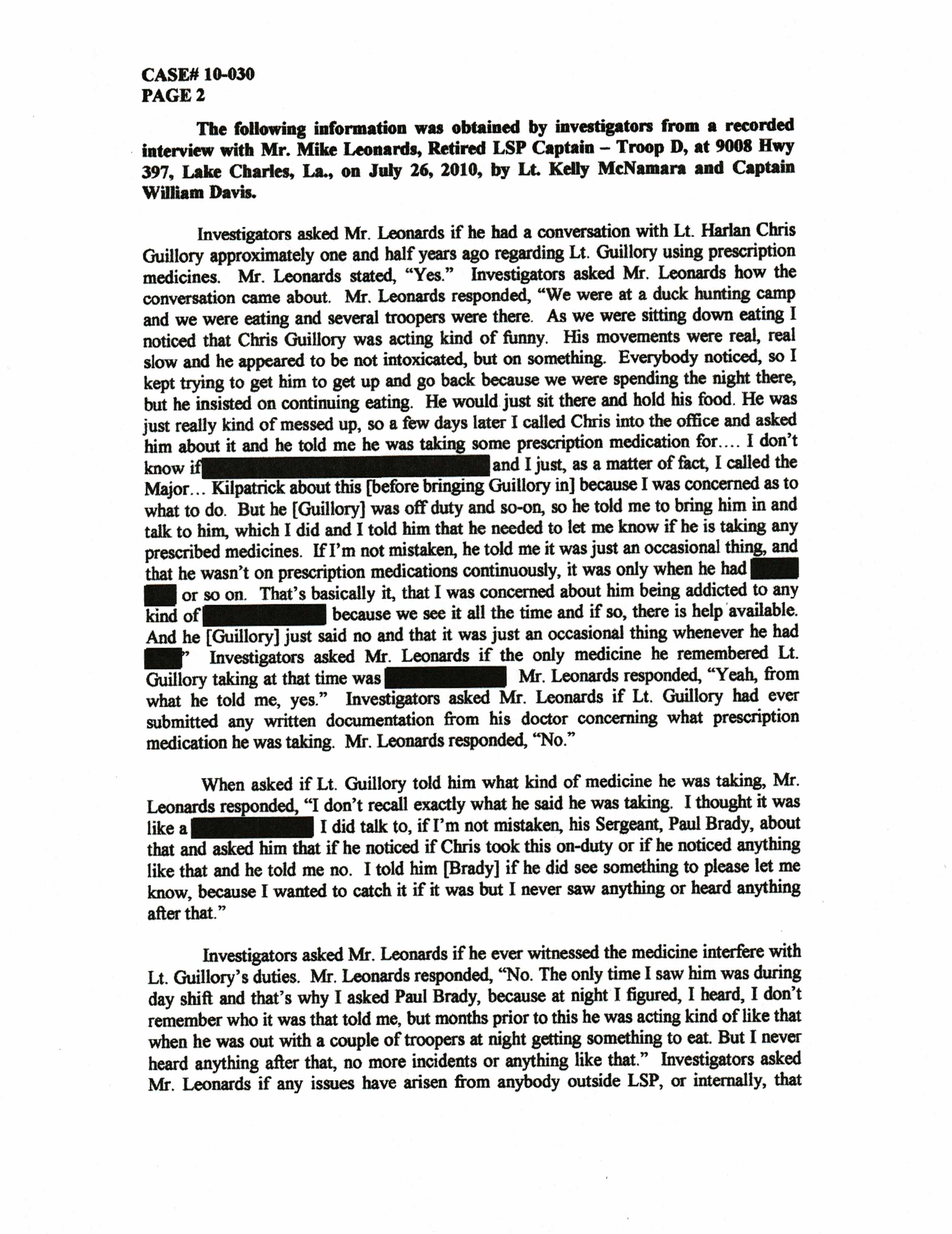
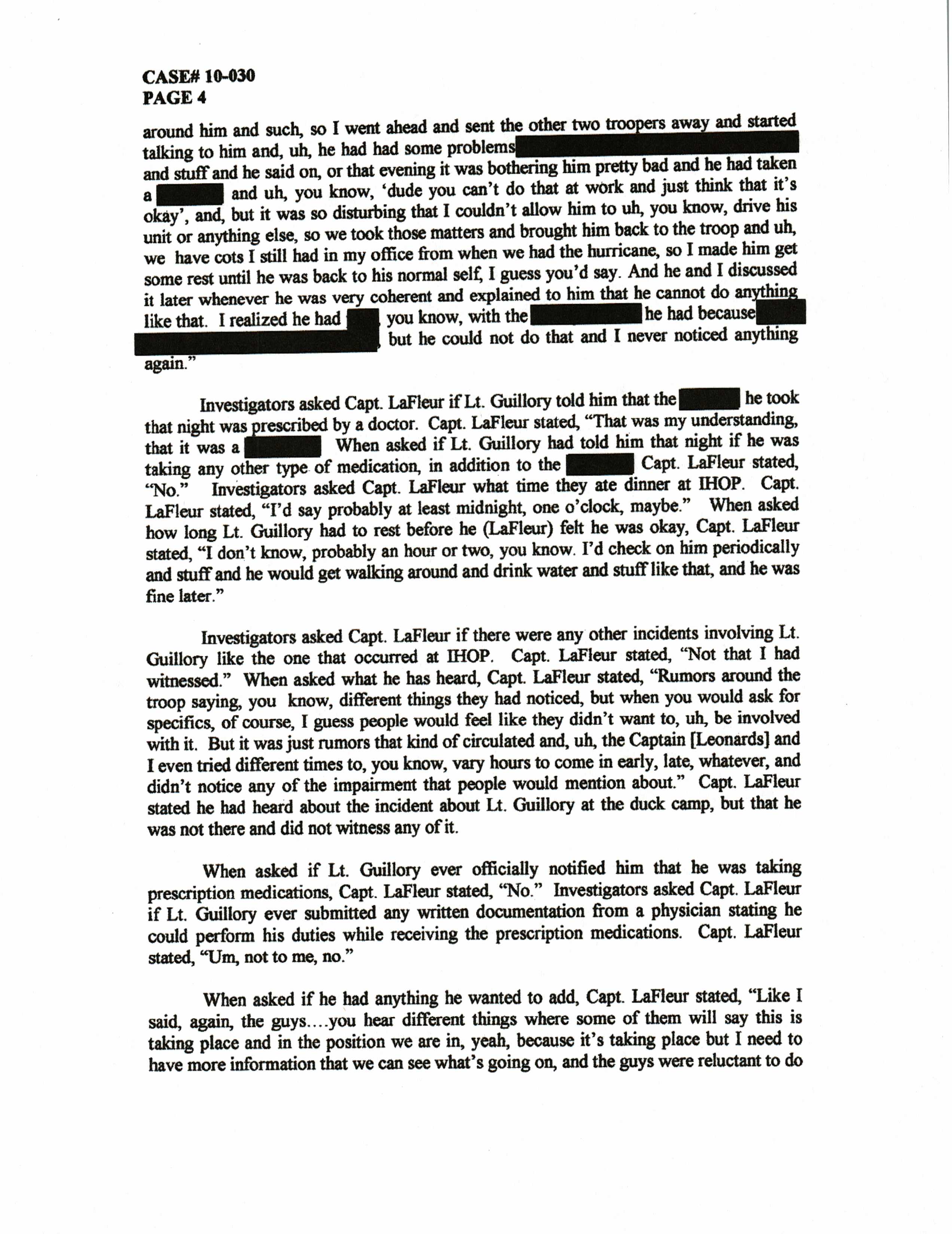
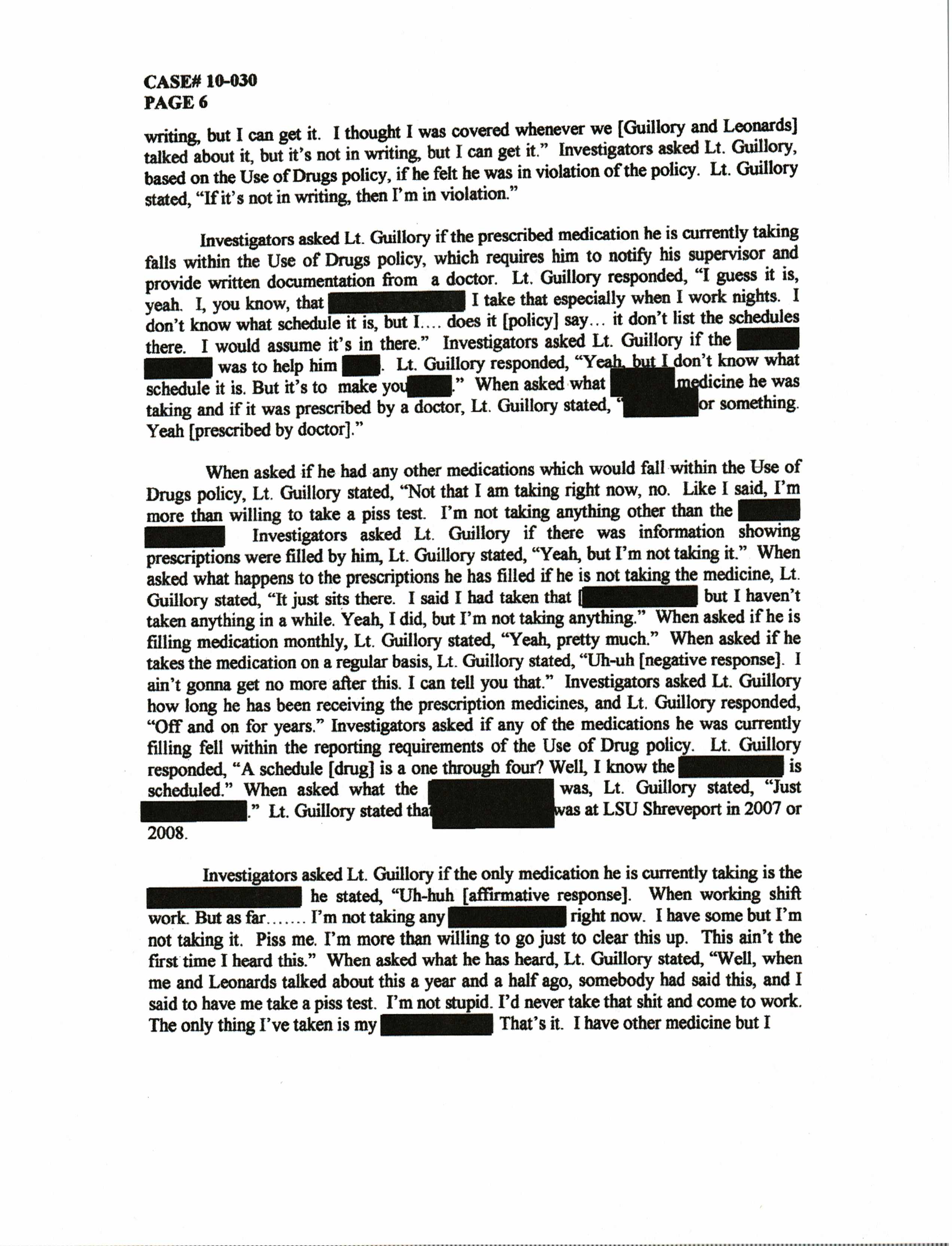
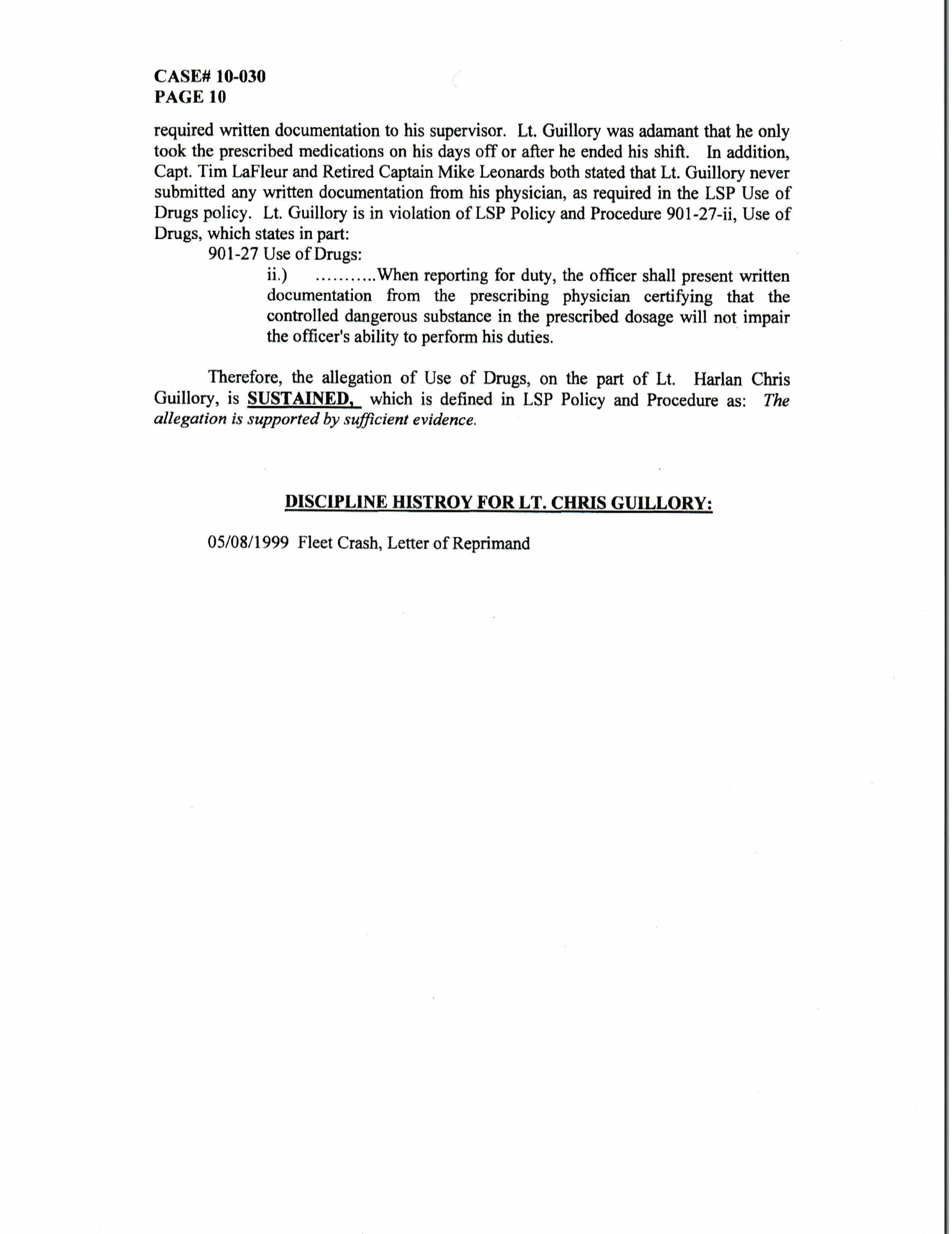
Giroir did, however, release a 10-page investigative report of an investigation of the possible abuse of prescription drugs by Guillory. “…Guillory may have taken, or is currently taking, a prescribed controlled dangerous substance, which is required to be reported as per LSP Policy and Procedure…,” the report said.

The report alluded to instances of Guillory’s being observed driving erratically in his patrol vehicle. One state police official reported that Guillory was at a restaurant and had to be driven back to Troop D to sleep on a cot until returning to normal. Guillory denied to investigators that he slept on the cot. It was also reported he experienced difficulty manipulating utensils at a restaurant while eating in a restaurant with other troopers.

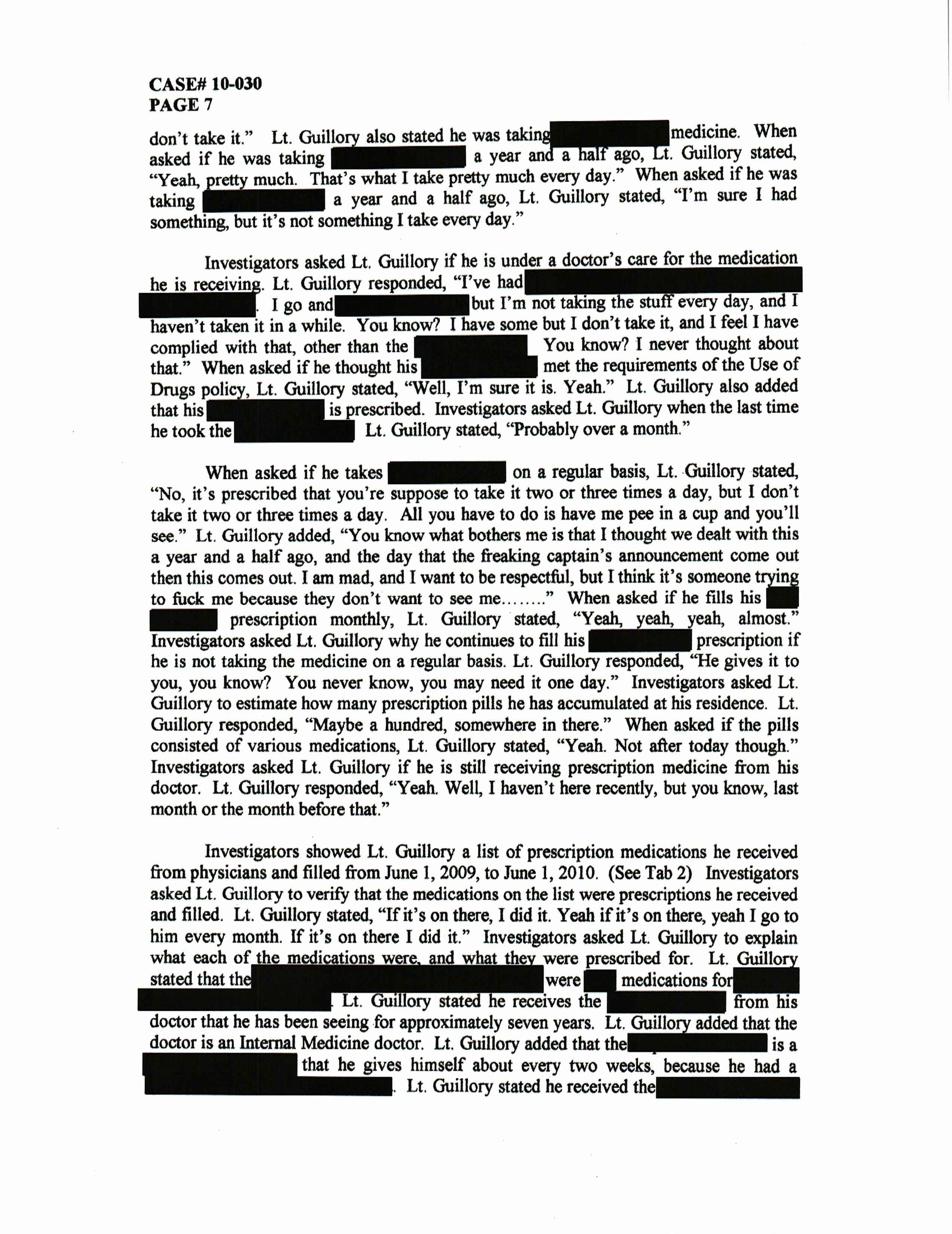
The 10-page investigative report was heavily redacted, but it was evident that Guillory first told investigators he was in compliance with LSP drug use policy but later admitted he was not. He told investigators he was obtaining prescriptions from three different doctors and that he had accumulated “maybe a hundred” pills at his home. He admitted to investigators that he occasionally doubled up on his dosage but that it was not an everyday thing.

The type pills prescribed to Guillory was redacted, but LouisianaVoice has learned that they were believed to be OxyContin which is normally prescribed for only 15 days because of addiction risks and is intended for use by terminal cancer patients and chronic pain sufferers.

State police investigators described the drugs as a “the cocktail.” According to law enforcement experts, the cocktail is a combination of pain killers, muscle relaxers, and anti-depressants.

Guillory reported that he flushed the medications after being interviewed by Internal Affairs. Shortly after the investigation was concluded, he was reprimanded for violating the State Police drug use policy. He was promoted to the rank of captain and became commander of Troop D subsequent to the investigation but later received a letter of reprimand for violation of prescription medication notification regulations from State Police Superintendent Mike Edmonson.

Here is the 10-page redacted report, along with the letter informing the Region II Command Inspector of the investigation, followed at the very bottom by a link to Edmonson’s letter of reprimand to Guillory—after he was promoted to captain. (CLICK ON EACH IMAGE TO ENLARGE):

IMAG1108

IMAG1110IMAG1111IMAG1113IMAG1114IMAG1115IMAG1116IMAG1117IMAG1118IMAG1119

Here is the GUILLORY REPRIMAND letter of Sept. 28, 2010.

Read Full Post »

The Louisiana Auctioneers Licensing Board doesn’t like former board member Robert Burns. Neither does the board’s attorney, convicted felon Larry Bankston.

That’s understandable. They haven’t like him since he uncovered payroll fraud and other irregularities and was bounced off the board by Bobby Jindal, whose idea of accountability is to hold whistleblowers fully accountable. When he was shown the door, Burns began video recording board meetings. During one meeting he even captured the board’s attorney saying Jindal’s office had advised the board not to worry about a legislative auditor’s report critical of illegal payments and illegal pay raises to part time executive assistant Sandy Edmonds.

Burns can be much like a canker sore when he puts his mind to it—irritating, always there, and impossible to ignore. But there’s nothing in the state public meeting statutes that says spectators—or media—must be liked. In fact, when the media (and Burns, through his newly-launched Web blog, is a member of the media whether that fits the board’s definition or not) become too cozy with public officials, then they no longer serve their purpose as the public watchdog.

Today (Aug. 31), we received a disturbing email from Burns. The Louisiana Auctioneer Licensing Board is considering turning off and removing his video recorder if he leaves it unmanned to go to the restroom or leaves the room for any other reason. “Frequently I am the only one in attendance” at board meetings, Burns wrote. True, the Auctioneer Licensing Board flies pretty much under the radar and attracts little to no media attention other than from Burns.

“If I need to go to the restroom or something,” he continued, “I leave the video camera running while on its unipod.” (I still don’t know why he doesn’t invest in a tripod which, unlike a unipod, is free-standing, but that’s another story.)

The AGENDA released for Tuesday’s (Sept. 1) meeting contains item number 8, which says:

  • Revision of Board Meeting Rules- In the event that the public videos or records the proceedings, such equipment must be manned at all times. Any equipment left unattended will be removed and turned off.

Now I am no attorney, though Mr. Bankston is, or at least he has been since he got the Louisiana Supreme Court to reinstate his licenses after his release from prison.

In 1994, then-State Sen. Bankston (D-Baton Rouge), chairman of the Senate Judiciary Committee (appropriately enough), met in his law office with one Fred Goodson, owner of a video poker truck stop in Slidell. There followed a discussion of a plan to manipulate the legislative process so as to protect the interest of video poker companies.

And what did Bankston get as quid pro quo? Well, it seems he owned a beachfront condominium in Gulf Shores, Alabama, so Goodson agreed to pay Bankston $1,555 per month for the “non-use” lease of the condo—a bribe, as it were.

Indicted on October of 1996, he was convicted on two counts of racketeering the following year and sentenced to a 41-month sentence in federal prison and ordered to pay a $20,000 fine.

He was released on Nov. 6, 2000, and served the remainder of his term in a half-way house in Baton Rouge. He was disbarred on March 9, 2002, retroactive to Nov. 19, 1997, but on Feb. 5, 2004, with only one dissenting vote, the Supreme Court’s disciplinary committee recommended that he be re-admitted to the bar.

So today, he provides legal advice to the Auctioneer Licensing Board—a board that winks and looks the other way at payroll fraud on behalf of one of its part time employees.

“If the proposed rule passes,” Burns wrote, “the board apparently believes it has the right to ‘remove and turn off’ any video recording equipment left running. I see nothing in the statute that requires any equipment to be manned, nor do I see where they have any authority to tamper with my video equipment, much less ‘remove it.’

“This is just another effort by a public body hell-bent on deterring public transparency,” he said, adding that he was going to go on the assumption that Attorney General Buddy Caldwell “has been perfectly willing to aid and abet” in the proposed action.

Duly indignant over this flagrant violation of state law, I fired off my own email to the board which first cited the applicable state law on public meetings:

  • The law grants the public the right to attend and record the deliberations of public bodies including city and parish governing bodies; school boards; levee boards; port commissions; boards of public utilities; planning, zoning and airport commissions; other state, local or special district boards, commissions or authorities with policy making, advisory or administrative functions; and committees or subcommittees of those bodies. Judicial proceedings are exempted.

After providing that remedial lesson on the law, I wrote:

I am given to understand this item is to discuss a new rule which would allow the board to turn off Mr. Burns’ video recorder should he have to leave the meeting for a few minutes for any reason. I have a problem with this and I am personally prepared to take you to court over both.

First of all, you have no right to tamper with his video equipment. It is perfectly within the law for him to record the meetings as per the section on public meetings laws highlighted above. Whether he happens to be in the room at the time or not is irrelevant. It is his equipment, not yours, and he has every right under law to record any open meeting.

Moreover, if you follow through on this action, I will pay the costs of Mr. Burns’ filing a lawsuit holding the board chairperson and its legal counsel personally liable for all applicable fines and legal costs. Mr. Burns will not only file suit for damages under the open meetings laws but for harassment and intimidation, as well.

There’s another twist in this sordid soap opera. Item 2 on the agenda calls for a discussion of Burns. He recently lost a public records lawsuit against the board, not because he was wrong in his contention, but because, in the presiding judge’s words, the office of Attorney General Buddy Caldwell gave the board bad advice.

Be that as it may, the agenda said that the discussion of Burns may require an executive session.

Not so!

The only reason for an executive, or closed session is to discuss ongoing negotiations, pending litigation or personnel matters. In the case of Burns, he is not an employee of the board, so any claim of discussing personnel would be invalid as would any claim of ongoing negotiations. As for pending litigation, it is no longer pending. The ruling has been made and the case is over, so all excuses for executive session are out the window. So, if there is to be a discussion of Burns, he has every right under law to insist that all such discussion be done in open session for all (including video cameras) to see and hear. If the board does otherwise, it will be yet another claim in future litigation.

In fact, the board is now skating dangerously close to civil rights violations, which would throw any lawsuit into federal court.


Read Full Post »

A former reserve law enforcement officer from southwest Louisiana has filed a formal complaint against a state trooper and his then-captain over an ongoing feud with State Trooper Jimmy Rogers that was the subject of an earlier LouisianaVoice story. https://louisianavoice.com/2015/08/12/the-stark-reality-of-jindal-administrations-double-standards-found-in-discipline-of-state-trooper-for-text-phone-threats/

The latest complaint marks the second time Rogers has become confrontational with individuals in Troop D and yet he has been assigned to work in the Troop D area school systems as a State Police School Resource Officer.

It is the third formal complaint that Dwight Gerst has attempted to file against Rogers and the second against Maj. Chris Guillory after Guillory refused to act on—or even accept—Gerst’s first complaint against Rogers last year. State Police Internal Affairs likewise never followed up on Gerst’s complaint that the state trooper stalked him at his home and at his child’s school in his state police vehicle.

Guillory refused to accept Gerst’s initial attempt at filing the complaint against Rogers, telling Gerst that he had “a problem” with Gerst and would not talk about his complaint until his “problem” was resolved. That “problem” was a festering dispute with Rogers that began in earnest when Gerst picked up two children from school and drove them home. Gerst says he had a reciprocal agreement with a neighbor whereby either parent could pick up the other’s child after school, but one of the children he picked up was Roger’s child.

Rogers, however, would seem to have problems of his own, judging from that heavily redacted nine-page disciplinary letter to him from State Police Commander Col. Mike Edmonson. In that Nov. 19, 2010, letter, Rogers was informed he would receive a 240-hour reduction in pay (a 10 percent reduction for 30 pay periods, which amounted to a $4,845.60 cut in pay) for repeated verbal threats of bodily harm and arrest directed to another man with whom he was feuding.

A court document filed by the mother of Rogers’s child and obtained by LouisianaVoice described Rogers as having “a lengthy history of abuse as well as (a) violent temperament.” The petition further said that Rogers had threatened to kill her and her family. The woman also requested that Rogers be entitled to supervised visitation of the child.

Despite the discipline meted out by Edmonson for the threats against the mother and her family, and despite Gerst’s attempt to file the complaint against him that was refused by Guillory, and never acted upon by State Police hierarchy, Rogers was nevertheless reassigned by Guillory this year as School Resource Officer to work in the Troop D area schools. SCHOOL RESOURCE OFFICER

Last August, Gerst picked up the neighbor’s nine-year-old child and Rogers’s five-year-old child who was left in the care of the older child. He said he took the children “straight home,” a distance of some 400 yards and then notified Rogers via text. Upon receiving the text, Rogers became infuriated. He subsequently pulled Gerst over at the school and demanded proof that he was authorized to pick up his own son and a niece and nephew. Gerst said Rogers was in uniform and was driving a state police vehicle in which two children were riding at the time.

When Guillory refused to accept Gerst’s formal complaint against Rogers, Gerst took his complaint up the chain of command, to State Police headquarters in Baton Rouge but that complaint was never addressed by Baton Rouge.

A state police spokesperson acknowledged on Monday (Aug. 17), however that Internal Affairs was investigating “some serious allegations” at Troop D Though he did not specify what the nature of those allegations were, they are probably related to Gerst’s latest complaint filed last week.

Following his complaint to State Police headquarters last year, Gerst was arrested and booked on $15,000 bail for two misdemeanor counts of contributing to the delinquency of a minor. Though the Calcasieu Parish Sheriff’s Office declined to make an arrest, it was made at the behest of the Calcasieu Parish District Attorney’s Office. Rogers and Guillory were said to have met with the district attorney representatives to push for the charges against Gerst.

After the prosecution presented its case at Gerst’s trial, the case was apparently so weak that the presiding judge issued a directed verdict of not guilty before Gerst’s attorneys even found it necessary to put on a defense. A directed verdict is an order given when the presiding judge finds that no reasonable jury could reach a decision to the contrary.

In his latest complaint, Gerst said he knew Rogers and the two communicated regularly. He said he picked up his neighbor’s nine-year-old daughter who was with Rogers’s five-year-old. “It was a hot day and I thought that someone was not able to pick the children up because children that young seem too young to walk home without supervision,” he said. “I had authorization from the parents to pick up the nine-year-old from school and they had the same permission for picking up my children. Jimmy was very angry and I told him it would not happen again.” He said after that incident, Rogers began stalking him. “He parked outside my home while off duty in his state police patrol vehicle and in uniform on several occasions.”

Later, he said he was in line to pick up his child at school and Rogers was behind him in his marked unit and in uniform. “He put the nine-year-old and his son in the patrol vehicle,” he said. “He then approached me (and) demanded I get out of my vehicle. He then questioned me about my authority to pick up my niece and nephew from school. The stop was made with two children in his state police vehicle. He left the children in the vehicle while he questioned me about whether I had authorization to be there,” Gerst said.

Gerst said he attempted to file a complaint at Troop D. “I met with Captain Guillory,” he said. “Lt. Cyprien was also present. Before I got the chance to tell Guillory that I wanted to file a complaint, he informed me that if I was there to file a complaint, he would not accept a complaint from me. He said he thought I had problems and he was not doing anything until there was a disposition on my case from the sheriff’s office. He further said that he had a problem with me personally and professionally and he would not accept any complaint I may have.”

After being turned away by Guillory, Gerst said he contacted State Police Internal Affairs. “I attempted to file a formal complaint on Rogers,” he said. “I also attempted to file a complaint on Guillory for refusing to take my complaint. I had to drive to Baton Rouge to file my complaint (and) I have yet to hear the disposition of either complaint.”

Gerst said that after filing the complaint in Baton Rouge, he feels that he has been the victim of retaliation that included the revocation of his law enforcement commission. The worst part of that retaliation, he said, “was the subsequent arrest and prosecution. At trial, the prosecutor informed my defense attorney that he knew the charges were not justified but the state police (were) pushing it. We were not required to put up a defense and the judge issued a directed verdict of not guilty.”

In his latest complaint, Gerst also cited Guillory for his refusal to accept his initial complaint against Rogers last year.

Read Full Post »

« Newer Posts - Older Posts »