Feeds:
Posts
Comments

Archive for the ‘Public Records’ Category

During the Bobby Jindal years in Louisiana, it was well documented that seats on prestigious boards and commissions were the rewards for generous campaign contributions.

Seats on the LSU Board of Supervisors, the Board of Supervisors of the University of Louisiana System, the Louisiana Stadium and Exposition District (Superdome), or various levee boards came at a price and those who wanted the seats ponied up. http://www.nola.com/politics/index.ssf/2013/11/bobby_jindals_political_appoin.html

Even the job of monitoring Louisiana’s hundreds of boards and commissions went to the director of the Committee to Re-Elect Bobby for an eight-month period from mid-October, 2012 to June 28, 2013, thus insuring that board appointees would do the bidding of the governor.

That, apparently, is the way politics work just about everywhere.

In Florida, a large enough campaign contribution can even buy justice—or stymie justice, as the case may be.

Pam Bondi, attorney general in the Sunshine State (talk about a misnomer), solicited—and received—a $25,000 contribution from the Donald Trump Foundation and once the check cleared, she promptly dropped her office’s investigation of Trump University, conveniently citing insufficient grounds to proceed. http://finance.yahoo.com/news/florida-ag-asked-trump-donation-075016133.html

And in Bossier City, less than $20,000 in campaign contributions has smoothed the way for the transfer of the city’s water and sewer department to a private Baton Rouge firm—at a first-year cost of more than $1 million to the city, and the loss of about 40 jobs in the department.

http://www.ksla.com/story/32159296/public-private-partnership-in-bossier-city-threatens-dozens-of-jobs

http://www.ktbs.com/story/32163755/bossier-city-council-considers-privatizing-water-sewer-operations

Word has been filtering down to LouisianaVoice for some time now that Caddo Parish is the new New Orleans in terms of political corruption. Apparently elected officials across the Red River have been paying attention to both Caddo Parish and to Bobby Jindal’s love of privatization as well as his thirst for campaign contributions.

The city council voted unanimously Tuesday (June 6) afternoon to approve the PUBLIC PRIVATE PARTNERSHIP AGREEMENT with Manchac Consulting Group out of Baton Rouge.

Typical of the seemingly growing penchant of public officials for operating out of earshot of the public, more than 100 employees of the Water and Sewer Department have been told nothing over the last several months of negotiations. City officials have refused to provide information to workers even though an organizational chart proposed by Manchac reflects half the current staffing in some departments.

On Tuesday, the vote was 7-0 to approve a five-year contract with Manchac Consulting to oversee the city water and sewer treatment plants, distribution lines and daily operations at a first-year cost of a little more than $1 million the first year, including $120,000 upon city officials’ signing the contract.

Campaign finance reports show that at-large council member David Montgomery received $2500 from Manchac, $2500 from its CEO Justin Haydel, $2500 from Atakapa Construction Group, which includes Haydel and Manchac President Kenneth Ferachi as officers, $2500 from Manchac Senior Project Manager Christopher LaCroix, and $999 from Ferachi—a total of $10,999.

Council member Scott Irwin received $500 each ($2000 total) from Atakapa, Ferachi, Haydel and Manchac Consulting Group.

Bossier City Mayor Lorenz “Lo” Walker received $6,644 total, including $2500 from Manchac Consulting, $3,144 from Haydel (including $2,144 in an in-kind contribution for a fundraising dinner in Baton Rouge), and $1000 from Atakapa Construction.

An Associated Press story pointed out that the Trump family foundation contribution, received by a political group supporting Bondi’s re-election, was received on September 17, 2013 and was in “apparent violation” of rules regulating political activities by charities.

But hey, what’s a little obstacle like a federal law when you’re trying to buy your way out of trouble? It was The Donald himself, after all, who is on record as saying he expects and receives favors from politicians to whom he gives money.

The commitment to pay Manchac more than $1 million over the next 12 months may be completely above-board—we hope so, anyway—but taken in context with the way city officials kept their own employees in the dark even as the mayor and two council members took contributions from the prospective vendor, it just doesn’t look good. And, as they say: perception is everything.

Public employees, after all, are prohibited—as they should be—from accepting anything of monetary value from vendors or contractors. So why should elected officials be held to a completely different (read: double) standard of ethical behavior?

Before we leave this topic, it should be pointed out that politicians will only do what they can get away with. If the voters lower the bar, then our public officials will respond accordingly. Only if we demand accountability, will officials be accountable. A compliant legislature not held accountable by voters allowed Jindal to rape this state for eight years. Likewise, our failure to insist on statesmanship instead of demagoguery, decorum instead of buffoonery, serious discussion of the issues instead of meaningless rhetoric, sanity instead of hysteria, has created candidates like Donald Trump.

If we consistently look the other say and say that’s just the way it is, that’s the way it will always be.

And we will have no one to blame but ourselves.

We will have done it to ourselves.


Read Full Post »

An official complaint over the appointment of Louisiana State Police (LSP) Maj. Jason Starnes as Interim Undersecretary of Management and Finance has produced another LSP major: a major CYA maneuver at State Police headquarters to backtrack and act as though the “promotion” never occurred.

At the same time, the Louisiana State Police Commission has rescinded last November’s action by the commission to approve a last-minute longevity pay increase plan for state police who last year received two separate pay increases totaling about 30 percent.

http://www.nola.com/politics/index.ssf/2015/07/state_troopers_get_hefty_back-.html

The longevity pay plan would have locked troopers into automatic pay raises based on years of service and was part of Bobby Jindal’s exit strategy as he headed out the door of the governor’s office near the end of his term.

But on June 1, Cathy Derbonne, LSPC Executive Director, published TRANSMITTAL SHEET NO. 58  on the LSPC Web page that pointed out that Article X, Section 48(C) of the Louisiana Constitution mandates that “any rule determination affecting wages or hours shall have the effect of law and become effective only after approval by the governor and subject to appropriation of sufficient funds by the Legislature (emphasis Derbonne’s).

“As of June 1, 2016, an approval by the Governor has not been received and there is currently insufficient funding to implement the revisions,” she wrote.

“The Revision of State Police Commission Rule Chapter 6 Uniform Pay and Classification Plan is hereby rescinded in its entirety,” she wrote (emphasis Derbonne’s). The pay plan approved by the LSPC last November is contained in GENERAL CIRCULAR 180

Starnes, a classified member of LSP, was recently transferred by State Police Superintendent Mike Edmonson to an unclassified non-state police service position as Interim Undersecretary, Custodian of Records of the Office of Management and Finance within the Louisiana Department of Public Safety and Corrections (DPS).

That move, the complaint says, was in violation of Rule 14.3(G), which says:

  • No classified member of the State Police shall be appointed, promoted, transferred or any way employed in or to any position that is not within the State Police Service.

In addition to the points cited in the official complaint, LouisianaVoice pointed out last month that the promotion of Starnes placed him in direct supervision of his estranged wife, Tammy, Audit Manager for LSP. https://louisianavoice.com/2016/05/16/mike-edmonsons-appointment-not-official-yet-senate-committee-set-to-consider-his-confirmation-on-tuesday/

LouisianaVoice also revealed that since his separation from his wife, Starnes had been residing in the LSP Training Academy’s VIP quarters. The VIP quarters at the academy is also known as the “Charlie Dupuy Suite,” so named because Edmonson’s Chief of Staff Charlie Dupuy also resided there during his own divorce from his first wife.

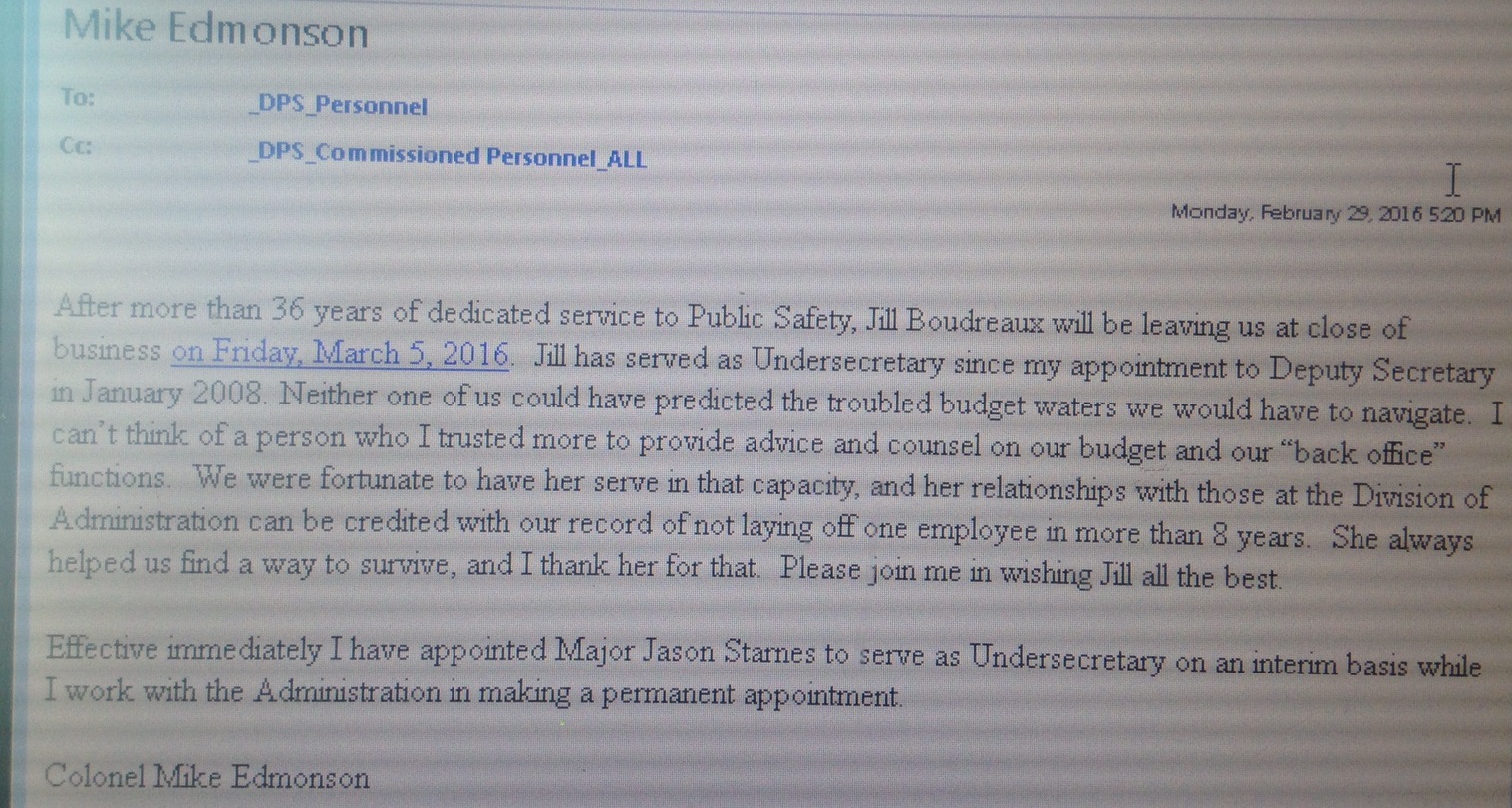
Starnes has since denied he is staying at the LSP Training Academy and more significantly, he has said he is not acting in the capacity of Undersecretary of Management and Finance despite this February memorandum from Edmonson announcing his appointment:

EDMONSON NAMED

(CLICK ON IMAGE TO ENLARGE)

Starnes’ name has since been quietly removed from the DPS Management and Finance Web page and replaced by that of Edmonson who is listed as Deputy Secretary and Custodian of Records. http://mfn.dps.louisiana.gov/

The Office of Management and Finance page contains a link to the undersecretary but when readers click on the link, a “Message from Undersecretary” heading pops up. Beneath that are only the words “Coming Soon.”

That has to be one of the more obvious moves by Edmonson to obscure a major departmental administrative blunder on his part.

The effort to promote someone in his inner circle illegally, Taken with his clumsy but almost successful effort to steer a bill amendment through the Legislature in the waning hours of the 2014 session that would have given him a retirement pay hike of some $30,000 and the documented cases of inconsistent and inadequate investigations and punishment (or outright ignoring) of wrongdoing within his agency, should give pause to the Senate and Governmental Affairs Committee which is scheduled to vote on his confirmation today (Monday, June 6).


Read Full Post »

It seems that certain state officials are finding a new means of discouraging Louisiana citizens from seeking information about the way the public’s business is being conducted. This new tactic is nothing less than a form of official harassment that is both chilling and dangerous.

Transparency and accountability in government are currently hot news topics. Last week (May 26), a local Baton Rouge group, Leaders with Vision, held a lunch meeting and discussion with the theme, “Are Louisiana Sunshine Laws adequate in today’s 21st Century World?” Participants included Sen. Dan Claitor; Rep. Dee Richard; Former Baton Rouge Advocate Executive Editor and transparency advocate Carl Redman and LouisianaVoice Editor Tom Aswell.

Both the state and the federal government recognize the need for transparency in the democratic process. Louisiana passed the Louisiana Public Records Act, also known as Louisiana’s Sunshine Law, in 1940 – more than 25 years before President Lyndon Johnson signed the federal Freedom of Information Act (FOIA) in 1966. Anyone can request public records and the purpose of the request does not need to be stated. In fact, the custodian of the record is not allowed to ask the purpose. The major exemptions are pending criminal litigation; juvenile status offenders; sexual offense victims; security procedures; trade secrets; and some public employee information.

Unfortunately, not everyone in government agrees with the concept of transparency and accountability. We have public officials suing constituents in an obvious effort to prevent them from accessing public records. Two recent examples follow.

On May 27, A LouisianaVoice REPORT revealed that several judges in the 4th Judicial Circuit Court filed a lawsuit against The Ouachita Citizen and Publisher Sam Hanna, Jr to prevent the publication from seeking public records to which they were legally entitled. In this case, judges are suing a publication to prevent them from accessing public records concerning the court operation and their presumably dirty laundry.

Now we find that closer to home, John White has likewise filed a LAWSUIT against Mike Deshotels and Dr. James Finney over public record requests that they made to the Louisiana Department of Education (LDOE) – most likely because they have hit a nerve.

On May 31, 2016, Dr. James Finney detailed the history of the suits in a letter to the Governor, John White, the Louisiana Board of Elementary and Secondary Education (BESE) members, and various state staff how the lawsuit came about:

As you may recall, I sent you an email March 12 (attached below) describing the status of several pending record requests that I had placed with John White and the Department of Education.  I also mentioned the existence of a lawsuit (Finney vs White, 6395333, attached).  That lawsuit, which was filed May 22, 2015, was set for trial in late April.

However, on April 11, Mr. White’s attorney requested and was granted a continuance, presumably to become better prepared for trial and to resolve a scheduling conflict with the Department’s sole witness.  Rather than prepare for trial, however, it seems that Mr. White instead instructed his attorney to file two lawsuits against me which appear to be groundless, unnecessary, and against the public interest. Meanwhile, Mr. White and his staff have made no effort to address the 35 pending requests which are subject of my lawsuit.

The first new lawsuit (White vs Finney, 647827, attached) addresses five requests I made in fall 2015, five that I made in February of this year, and one that I made in March. In the lawsuit, Mr. White apparently is asking the judge to create special conditions on Louisiana’s public records law. It seems that, for whatever reason, Mr. White is bending over backward to make sure the public has no idea what statistical distributions LEAP, iLEAP, or EOC test scores follow.  Are they symmetric?  Skewed?  Bimodal? Uniform?  Nor does he, it seems, wish the public to have any means of verifying that School or District Performance Scores have been fairly and accurately calculated.

The second new lawsuit (White vs Deshotels et al, 647953, attached) attempts to reverse favorable judgments Mr. Deshotels received in two prior lawsuits, and apply that reversal (which seems unlikely given that the 19th JDC is not an appellate court) to a subsequent request by Mr. Deshotels and also to one of my requests.  He seeks to use Mr. Deshotels and I as pawns, and cost us additional time and money, to establish a data-suppression policy that was already soundly rejected at court.

I have repeatedly requested meetings with Mr. White and/or his staff to work out arrangements that allow the public to have access to important public records without compromising student privacy nor causing the Department undue burden. I have consistently been rebuffed. And now we’re tangled in litigation in three different divisions of the local district court.

Most of my requests to date, and all that are subject to litigation thus far, could be collected into the following six categories. I trust you would consider these all to be important and of potential public interest:

  • calculation details regarding Value-Added Modeling as performed by the Department
  • voucher programs’ exact enrollments and costs, and demographics of voucher students
  • test-score distributions and technical reports
  • details of School and District Performance Score calculations adequate to verify accuracy and credibility
  • charter schools’ enrollments, charters and leases, and other information
  • exact enrollment numbers with no more suppression than is absolutely required to protect the anonymity of an individual student

I urge you as a body to ask Mr. White to defend his position regarding data secrecy, and his preference for litigation over useful dialogue. Is the department in service to the public, or to test-creators, charter networks and private schools? Have the school grades and Value-Added measures been calculated fairly?  How will we ever know? Is Southern politeness more important than democracy? Is it appropriate to sue citizens rather than responding properly to public record requests?  Please ponder those questions carefully, and provide the appropriate guidance to the Superintendent who is employed at your pleasure.

Thank you.

Dr. James Finney

As one might expect, the suits against Deshotels and Finney are funded by you, the taxpayer, as the LDOE has brought the suit using LDOE funds. Deshotels and Finney are on their own when it comes to legal fees related to these suits. Just to be clear:  You are covering the costs for John White to sue private citizens to prevent them from exercising their constitutional rights.

Of course, Deshotels and Dr. Finney intend to pursue the suit in the courts, rather than ask for a dismissal, to press forward on their requests to this public information that is critical to determining the impact of various policies on our children’s education and the efficacy of the charter experiment in Louisiana. (Remember the last time the government experimented in the south? It happened at Tuskegee.)

As Mercedes Schneider recently noted in her blog deutsch29, “Suing private citizens over public record requests is a new low for an already sorry excuse of a state superintendent. However, it seems that with White, no low is too low.” https://deutsch29.wordpress.com/2016/05/31/la-superintendent-john-white-sues-citizens-who-made-public-records-requests/

The use of virtually unlimited financial and legal resources (at taxpayer expense, no less) to beat down citizens with limited funds to fight back poses an unprecedented and dangerous threat to the very checks and balances upon which our government is founded.

When will Governor Edwards tire of this excuse for a superintendent and encourage the BESE board to bring John White’s tenure up for a vote? Let’s get the BESE members on record as to whether they stand for Louisiana’s children or for the out-of-state interests that bought their seats. Let’s decide, once and for all, if BESE stands for accountability or for secrecy.

For Edwards, the Legislature, and BESE to sit back and do nothing about this infringement upon the public’s right to know should be seen as an endorsement of clandestine activity worthy only of our distrust and fear.

Read Full Post »

LSP has manufactured its own loophole for denying public records requests.

Col. Mike Edmonson apparently has come to the conclusion if he makes the decision not to formally punish, the public has no right to know why. In other words, if someone is victimized by a member of the department of public safety and Edmonson deems it is not worthy of punishment, the public has no right to review the decision.

On the contrary, it would seem to us that when someone is exonerated, this is all the more reason to produce the information. LSP further claims when those who resign in lieu of the completion of an investigation the investigative report is not subject to release.

We think Edmonson is tired of the public’s learning of far too many instances of misconduct at LSP followed by a mindset of circling the wagons. He has initiated a pattern of issuing no punishment in an apparent effort to hide misconduct. The reason for not administering punishment is in the investigation file. Many of the investigation files from LSP have shown to be seriously biased in favor of some while very severe for others.

Typically, LSP has denied public records requests for investigation files when the department finds no wrongdoing stating. The standard response to requests for the information generally reads: “The investigative report you requested is not subject to release as the individual right to privacy afforded by Article 1 Section 5 of the Louisiana Constitution of 1974 outweighs the public’s right to review.”

We maintain the investigation file is a public document and serves a legitimate public interest.

The reference to Article 1 Section 5 of the LA Constitution is a mirror of the 4th Amendment of the US Constitution to protect citizens from unreasonable search and seizure. The amendment specifically lists, “person, property, communications, houses, papers, and effects.” We have no access to those nor does LSP without a properly issued warrant as the amendment states. If it is illegal for us to access, it is also illegal for LSP to have obtained it.

We have accumulated a growing list of denials based on this fantasyland God-like authority bestowed upon himself by himself (Edmonson).

Captain Chris Guillory

LouisianaVoice has received a response to a complaint filed against Captain Chris Guillory for lying to LSP internal affairs investigators. A citizen said that Guillory refused to accept his complaint against a State Trooper in Troop D. The response to the complaint from LSP states in part, “A determination has been made that Captain Guillory did not make a false statement to IA” with his denial that he refused to accept the complaint. The complainant provided an audio tape directly contradicting two documented statements made by Guillory to LSP internal affairs. You can review it here https://www.youtube.com/watch?v=zd-JV3rKjko.

LSP will not release the investigation file because Edmonson did not punish his friend Guillory. The public is denied the right to know why Guillory was not found in violation. We have the tape and we have the LSP documentation listing Guillory’s statement two times denying unequivocally he refused to take the complaint.

LSP has found no wrongdoing by Guillory involving the recently terminated Trooper Ronald Picou even though he was responsible for the investigation of the exact same allegations in 2013, the “Brady Day” investigation, or the investigation involving the padding of time sheets by Brady. He has emerged without any formal discipline.

Guillory has since been removed from his command at Troop D. He has been given a larger command in Baton Rouge. Sources have informed us Guillory’s new position is in violation of state police commission rules on residency because he lives in Sulphur but works in Baton Rouge. Sources further report Troopers are authorized three hours one way for travel to Baton Rouge. That means Guillory works two hours out of every eight hour day.

LT Paul Brady

We requested the documentation involving the investigation into “Brady Days,” paid time off for arresting someone for DWI in violation of quota and payroll fraud laws—so named the Troop D supervisor who allowed, indeed, encouraged the practice. Sources indicate Brady days was an unwritten policy at Troop D under some supervisors and this was confirmed by IA investigators. We were informed there was no finding of wrongdoing on Brady’s part. But again, we were denied access to any investigation findings.

Brady was cleared even though he was the supervisor for Trooper Picou who was recently terminated. Picou was proven to be neglectful of duty. Brady was paid to be a supervisor and sources say if he would have simply done his job Picou might still have his.

But again, because there was no disciplinary action taken against Brady, the investigation record remains out of the public’s reach.

A recent complaint has been filed against Troop D personnel alleging a wrongful DWI arrest. Sources say the arresting Trooper was a beneficiary of paid time off for Brady days but was also punished for not accumulating a sufficient number of DWI arrests.

Trooper Jimmy Rogers

Rogers suddenly resigned amid the beginning of the massive investigations at Troop D. We were denied access to his records because LSP did not complete the investigation. This is another method of Edmonson escaping culpability for poor leadership—ask them to resign so no one finds out. Sources report Rogers resigned after it was discovered he was committing payroll fraud on parish-funded overtime details known as Local Agency Compensated Enforcement (LACE). Rogers was reportedly issuing citations on his regular shift but claiming them on different dates in order to accrue overtime.

Accepting excess money for violating state issued permit/bribery

We requested the investigation files involving a Trooper who accepted extra money for moving oversized loads in violation of the state issued permit and possibly bribery. It was discovered after another Trooper refused the extra payment. The response was to make the Trooper give the extra money back. We were notified no complaint was filed so they did not investigate it.

In a letter from LSP dated April 27, 2016, we were again notified no complaint was filed. All of our other requests resulted in the investigation of the allegations but they skipped this one. The excuse that they do not investigate misconduct until someone files a complaint is silly. A complaint has since been lodged with LSP so maybe they will finally investigate.

We are not done

The failure to release records at the discretion of one man with a proven track record of unethical behavior and poor decision making should not be allowed to stand. The public has a right to know about the circumstances surrounding a resignation in lieu of termination amid an investigation.

They further have a right to know why a public employee was found to have committed no wrongdoing—if for no other reason than to fully clear the employee’s name and his public standing. There is no reason to hide such information unless indeed, there is something to hide.

LouisianaVoice is exploring legal remedies for these denials.

Read Full Post »

Editor’s note: Just when you think good, old-fashioned investigative reporting has gone the way of LINOTYPE MACHINES and hot lead typesetting, the Baton Rouge Advocate conducts a thorough probe of operations at the Louisiana State Penitentiary that has resulted in a wave of resignations if no indictments.

And then there is a twice-weekly publication up in West Monroe called The Ouachita Citizen headed by Publisher Sam Hanna, Jr. His paper’s ongoing investigation into the Fourth Judicial District Court is making a lot of people very uncomfortable and with good reason. So uncomfortable, in fact, that several judges in the 4th JDC actually filed a lawsuit against Hanna and The Citizen to prevent the publication from seeking public records to which they were legally entitled. Such action by the judges is unprecedented and appears frighteningly Nixonesque in its brazen attempt to thwart legitimate efforts to inform the citizens of Ouachita Parish. It’s the kind of action that should send chills down the spine of the electorate. Hanna has vowed to refuse to pay court costs assessed in that litigation. He has lost advertising revenue as a result of his coverage of the court.

Following is a lengthy story by Citizen reporters Zach Parker and Johnny Gunter published yesterday (Thursday, May 26) by the paper. One major point raised is the apparent conflict of interest in the Attorney General’s office conducting an investigation of the 4th JDC while at the same time defending four of the judges in a lawsuit brought against them by a fifth judge.

By Zach Parker and Johnny Gunter

The Citizen

Inquiries by The Ouachita Citizen into Fourth Judicial District Attorney Jerry Jones’ involvement in an investigation of Fourth Judicial District Court show the district attorney offered a false account of his communications with investigators, filed misleading court documents and did not refer this newspaper’s criminal complaint to authorities involved in the investigation.

Those activities formed part of Jones’ efforts to downplay the investigation into possible wrongdoing at the court as well as his involvement in the probe.

The investigation concerned allegations that law clerk Allyson Campbell committed payroll fraud and destroyed or concealed court records. Those accusations also are the focus of separate lawsuits, one filed in district court by Monroe businessman Stanley R. Palowsky III and the other in federal court by Fourth Judicial District Court Judge Sharon Marchman.

Jerry Jones restricts probe’s scope

In July 2015, Jerry Jones called on the Office of State Inspector General and Louisiana State Police to investigate public corruption. At that time, he was tight-lipped about the scope of the investigation, at first refusing to comment though he later clarified the investigation concerned Fourth Judicial District Court.

As revealed in comments to The Ouachita Citizen as well as to other media outlets, Jerry Jones restricted the scope of the investigation to an audit of the court’s finances released March 2, 2015 by the Louisiana Legislative Auditor’s Office. That audit said some court employees may have earned pay for hours not worked. As first reported by The Ouachita Citizen and later confirmed in open court, Campbell was the subject of auditors’ comments.

However, there were other allegations concerning Campbell that Jerry Jones sidestepped during interviews, repeatedly claiming the probe concerned the audit only. During interviews, he downplayed any outcome of an investigation into payroll fraud since Campbell was a salaried employee, not hourly, in spite of the allegations concerning falsified time sheets approved by court judges.

In March 2015, Ouachita Citizen reporter Johnny Gunter submitted a criminal complaint to Jones’ office, asking the district attorney to investigate not only allegations that Campbell had committed payroll fraud but also accusations by Palowsky and Monroe attorney Cody Rials that Campbell had destroyed or concealed documents they had filed with the court in their separate legal matters.

Little more than a week before the Inspector General and State Police launched their joint investigation, The Ouachita Citizen learned Jones had not begun an investigation, requested any documents or information from court officials in response to the newspaper’s criminal complaint.

Through The Ouachita Citizen‘s inquiries and reports, more details emerged concerning the scope of the court investigation. In a June 30, 2015 interview, retired Judge Ben Jones, who is the court’s administrator, informed The Ouachita Citizen that he had discussed the newspaper’s criminal complaint with Jerry Jones.

“He (Jerry Jones) indicated to us (the court) that he would respond to your criminal complaint and take appropriate action at such time that he thought appropriate,” Ben Jones said. “We are prepared, should he act on that criminal complaint, we are prepared to cooperate, and that’s what we’ll do. But at this point, he has not asked us for any information, any documents, or initiated any investigation.”

During that interview, Ben Jones repeatedly said Jerry Jones would conduct an investigation into the matters raised by The Ouachita Citizen‘s criminal complaint “with integrity” and would show court officials no special privileges.

Ben Jones was one of five district court judges named defendants along with Campbell in Palowsky’s lawsuit. In his lawsuit, Palowsky accused Ben Jones and judges Carl Sharp, Wilson Rambo, Fred Amman and Stephens Winters of covering up Campbell’s activities, a claim reiterated in Marchman’s lawsuit in U.S. District Court.

In the district attorney’s interviews with the press, Jerry Jones said the investigation into the court did not involve any judges.

Jerry Jones gives false account of communications with investigators

The Ouachita Citizen learned Jerry Jones concealed his communications with investigators as well as offered the newspaper conflicting accounts of a report on the investigation’s findings.

When asked in an April 25 interview whether he had engaged in any communications with the Inspector General or the State Police concerning the investigation, he said, “No. None at all.”

The District Attorney further distanced himself from the investigation at that time and said, “I haven’t had any communication with them other than having my assistant ask (Inspector General) Stephen Street about the status of the report,” referring to whether a report had been prepared on any findings in the court investigation.

He made that statement to the newspaper in spite of the fact that his office had received a letter from Street 10 days before, a letter which represented a report on the investigation’s findings. Street’s April 15 letter claimed there was no “sufficient cause” to file criminal charges against Campbell on the accusations of payroll fraud or document destruction was first reported by The Ouachita Citizen. According to that letter, Street was concluding his office’s investigation into the matter.

“Because the available facts do not provide sufficient cause for the arrest of Ms. Campbell for any criminal offense, we are closing our file and taking no further action on this matter,” Street wrote. “Ms. Campbell was interviewed and denied destroying or hiding any court records or pleadings. She stated that her work schedule was approved by her supervisor and that she worked the hours for which she was paid. Judge Carl Sharp supported her claim that all court documents were always available to him. He also confirmed that Ms. Campbell was a salaried employee whose hours were sometimes irregular.”

In a May 11 interview, The Ouachita Citizen asked Jerry Jones why he had misinformed the newspaper by saying he’d had no communications with investigators though he’d received the April 15 letter from Street. In response to that query, he again denied he had engaged in any communications with investigators.

The Ouachita Citizen then asked Jerry Jones about his written correspondence with Street: He declined to comment, saying he couldn’t answer that question and had referred his office’s investigation to the Attorney General’s office.

The Ouachita Citizen then informed him that the newspaper had obtained a copy of the April 15 letter revealing correspondence between Street and Jerry Jones on the investigation, at which point the district attorney paused and then said, “Okay, I made a mistake. You’re not getting another word out of me.”

Throughout the investigation Jerry Jones sought to distance himself from the court probe though the Inspector General’s letter as well as The Ouachita Citizen‘s inquiries to State Police all referred to the district attorney’s involvement. According to the newspaper’s inquiries, he was calling the shots in the investigation though he said he wasn’t investigating and didn’t have the manpower in his office to conduct such an investigation.

“We keep it separate,” he said in the April 25 interview. “I’m not investigating.”

Following The Ouachita Citizen‘s May 11 interview, Jerry Jones informed the newspaper that State Police had completed a written report that contradicted the findings revealed in Street’s April 15 letter. He said he would ensure the newspaper was provided with a copy of the State Police report he claimed existed.

The Ouachita Citizen submitted an inquiry and a public records request to State Police about the purported report, asking to obtain a copy. However, State Police authorities informed the newspaper that Jerry Jones had told them the investigation should be considered open, a status that would bar the release of documents pertaining to the investigation, including the unseen State Police report.

According to a May 11 statement from State Police spokesman Maj. Doug Cain, State Police investigators were awaiting clearance from Jones to release the investigative report.

Later that day, State Police informed The Ouachita Citizen that record would not be released, per instructions from Jerry Jones.

“The district attorney for the 4th JDC is awaiting additional information and the matter is considered still open at this time,” wrote Michele M. Giroir, State Police attorney supervisor in a May 11 email. “Therefore, pursuant to R.S. 44:3(A)(1), the records are exempt from disclosure at this time.”

Records dispute DA’s claim he transferred case to AG

Since early last year, Jerry Jones has repeatedly told The Ouachita Citizen he was not investigating but had referred that responsibility to the Attorney General’s office.

“You people keep saying I’m investigating, but I’m not,” he said. “I sent that to the AG’s office.”

At that time, Buddy Caldwell was Attorney General and had appointed a taxpayer-paid defense for Campbell in spite of questions raised by The Ouachita Citizen about the legality of that appointment. Caldwell’s involvement in the defense of Campbell later was cited as grounds for naming him a defendant in Marchman’s lawsuit.

In support of his claim he had transferred the responsibility of investigating to the Attorney General, Jerry Jones produced last year a motion to recuse he had filed at the Ouachita Parish Clerk of Court’s office in the court record for Stanley R. Palowsky III v. W. Brandon Cork and others, the lawsuit in which the allegations against Campbell first surfaced.

His Dec. 5, 2014, Motion to Recuse said, “Now into this Honorable Court comes Jerry L. Jones, Fourth Judicial District Attorney, who, with respect, represents: The District Attorney recuses himself and his office in the above captioned case and moves that same be sent to the Attorney General’s Office.”

However, Jerry Jones’ motion to recuse has laid untouched in the court record and was never sent to the Attorney General’s office, according to Ouachita Parish Clerk of Court Louise Bond.

Earlier this week, The Ouachita Citizen asked to review the court record for Palowsky v. Cork, which is secured in Bond’s office since, she said, it’s a “high profile case” and she did not want any parties claiming their documents had gone missing from it, referring to accusations from Palowsky that Campbell had either destroyed or concealed documents he filed in that same case.

After a review of the record by Bond and The Ouachita Citizen, there was no indication that Jerry Jones’ motion to recuse had ever been sent to the Attorney General’s office.

“I don’t see anything that shows we sent anything, but there’s nothing on there that shows where it should be sent,” she said.

Bond confirmed with her deputy clerks that the DA’s document had not been sent there. It hadn’t been sent because Jerry Jones’ document didn’t indicate who or where the motion should be sent, though it asked the Clerk of Court’s office to handle the matter.

“I checked and nothing was sent,” Bond said. “But there’s nothing on here showing us who at the Attorney General’s office should receive it or where even to send it.”

Bond told The Ouachita Citizen that the deputy clerk, B.J. Graham, who accepted Jerry Jones’ filing no longer worked at the Clerk of Court’s office. Graham had quit, according to Bond.

According to Bond, normally a mover in a legal matter will either indicate they have sent copies of the filing to other parties in the matter. If the filing does not bear the name, address or contact information of the person it should be sent to, like the DA’s filing, then the mover will attach a cover sheet with instructions, Bond said.

“Most of the time they say please serve to so-and-so, or it shows that they’ve already sent copies, but there are no instructions, either on a cover sheet or on the motion itself,” Bond said.

Jones’ motion to recuse was later signed as a judicial order by Judge Carl Sharp: “It is ordered that the Fourth Judicial District Attorney’s Office is recused from the above captioned case and same be sent to the Attorney General’s Office.”

Sharp is a defendant in both Palowsky’s and Marchman’s lawsuits. He is accused of covering up Campbell’s activities. Sharp also is one of the judges for whom Campbell clerks. Additionally, Sharp defended Campbell against the payroll fraud allegations during an interview with Inspector General investigators, according to Street’s letter.

Jerry Jones’ motion to recuse and Sharp’s order are available for viewing at www.ouachitacitizen.com

The Ouachita Citizen contacted the Attorney General’s office on numerous occasions, through telephone and email, to ask whether they had received any correspondence from Jerry Jones, including his recusal. Attorney General spokesperson Ruth Wisher suddenly ceased all communications with The Ouachita Citizen last week in spite of earlier pledging to answer the newspaper’s questions by Thursday, May 19. Attorney General Jeff Landry and Assistant Attorney General Shannon Dirmann also did not respond to communications from The Ouachita Citizen.

Two days after the Attorney General office’s last communication with The Ouachita Citizen concerning its questions, Landry’s office filed a pleading in Marchman’s federal lawsuit on behalf of Caldwell, the former Attorney General and defendant in the judge’s lawsuit.

Absence of investigation a key point in public records dispute

The Ouachita Citizen recently learned Jones did not refer the newspaper’s criminal complaint to some authorities investigating the court. Inspector General Stephen Street said state law protecting Inspector General records meant he could not reveal whether Jerry Jones had sent his office the newspaper’s criminal complaint or not.

“Due to OIG (Office of Inspector General) statutory confidentiality, I am unable to confirm or deny the receipt of the complaint to which you refer,” Street wrote in an email.

However, State Police did not receive the newspaper’s criminal complaint, according to Cain, the State Police spokesman.

“We are unaware of any complaint from The Ouachita Citizen through the DA’s office,” Cain said.

The Attorney General’s office did not respond to questions from The Ouachita Citizen about whether Jerry Jones had sent them this newspaper’s criminal complaint.

The Ouachita Citizen‘s criminal complaint was prompted by the district court’s refusal to produce public records from Campbell’s personnel file that could shed light on the allegations of payroll fraud and document destruction. The day after The Ouachita Citizen submitted its criminal complaint, the court sued the newspaper, asking for an ad hoc judge to determine whether Campbell’s right to privacy outweighed the public’s right to know.

In spite of The Ouachita Citizen submitting its criminal complaint with Jones in March 2015, there was no investigation called to target the court until after an ad hoc judge had ruled against this newspaper, declaring Campbell’s personnel file off-limits to public records requests.

During a court hearing before the ad hoc judge, The Ouachita Citizen argued the public should be granted access to Campbell’s personnel file since its public records requests – stemming from the allegations of payroll fraud – concerned public tax dollars (referred below as the “public fisc”). In response, the court argued there was no need for judicial intervention to make Campbell’s personnel file available to the public since the district attorney could exert his office’s authority to investigate if there were any reasonable grounds present in the newspaper’s criminal complaint.

Delivering the court’s argument was Monroe attorney Jon Guice, who also represented the five district court judges in Palowsky’s lawsuit and is a defendant in Marchman’s lawsuit.

“The response to his argument about the protection of the public fisc is it is handled by the law and you need not intervene in that,” Guice continued during the May 19, 2015 hearing on the public records requests. “His client (The Ouachita Citizen) is well aware that the legislative auditor sent a copy of its findings to the district attorney.

“They have also asked the district attorney to avail himself of that report and to do his duties to investigate, and if there is an issue there for him to address it. So, this court need not feel as though it has a duty of protection of the public fisc when there is an expressed officer, i.e., the district attorney who the legislative auditor has provided its findings and whom the paper has asked to honor his obligation. So if there is something there then that’s the way that is to be handled.”

After the ad hoc judge ruled against The Ouachita Citizen, details in Palowsky’s and Marchman’s lawsuits have suggested Guice, Ben Jones, the court administrator, and other court officials manipulated the documents present in Campbell’s personnel file before the ad hoc judge reviewed it to determine whether it was subject to The Ouachita Citizen‘s public records requests.

Jerry Jones later told The Ouachita Citizen he had agreed with Ben Jones to postpone acting on The Ouachita Citizen‘s criminal complaint until after the ad hoc judge had ruled in the court’s case against the newspaper.

When Ben Jones was asked about that arrangement during a June 30, 2015 interview, he said, “I am not prepared to say I had any agreement with Jerry Jones to wait until after the final judgment but he has elected, obviously, to delay any action until, I mean, to my knowledge, no action has been taken so far.”

“I have no idea when any action might be taken, but I take him at his word that he will respond to the complaint, and he has indicated that he would honor his obligation to respond to the complaint,” Ben Jones continued. “That’s all I can tell you about that. I have talked to him, but I’m not at liberty to say everything about that conversation.

“But I will say this to you. I know Jerry Jones and I am convinced that any investigation that he initiates will be one done with integrity. I absolutely believe that to be the case. He will go wherever the findings take him. That’s how he is, and that’s a good thing. It is our expectation that he will show us no special privileges or special deference. I expect him to respond to the request that he investigate with integrity, and I don’t fear that at all.”


Read Full Post »
« Newer Posts - Older Posts »

