Feeds:
Posts
Comments

Archive for the ‘Public Records’ Category

By Robert Burns (Special to LouisianaVoice)

Audience members attending the regular monthly meeting of the Louisiana State Police Commission (LSPC) on Thursday could be forgiven for believing they were attending the wrong meeting. During brief recesses, many attendees were observed commenting about the lack of tension and anxiety that have been so prevalent in past meetings.

With the exception of one hostile exchange between board member Calvin Braxton and Chairman T. J. Doss, the meeting was devoid of the hostility which has dominated so many of its meetings over the last several years. That hostile exchange arose from item five of the meeting’s agenda, which called for retaining the promotional test scores for 2016, with them remaining valid for another year. At its previous meeting, the educational authorities explained that, because of significant changes in the content of the examination, everyone should be required to retest to qualify for a promotion.

Braxton’s frustration stemmed from his contention that he had the full and enthusiastic support of Chairman Doss right up to the point of the meeting, at which time Braxton claimed Doss “had a totally different story” and opposed his measure, thus “making me look stupid.” Doss countered in saying, “I’m one vote,” and then stated that Braxton’s memory of their conversations was “quite selective.” Braxton, clearly irked by that remark, said, “Well, I tell you what,” and then decided not to complete his sentence and concluded, “I’m done with it.” He then apologized to the audience and to the troopers.

Leon “Bucky” Millet, retired trooper, has long voiced his complaints entailing the Commission, and, at the request of board member Eulis Simien, Jr., Millet, a watchdog over the Commission who has intensified his oversight over the last two years, submitted all his complaints in writing. One of those complaints entailed Millet’s contention that a “conflict” exists regarding Chairman Doss, as an active trooper, simultaneously serving as Chairman of the Commission. Perhaps subscribing to the theory that the best defense is an aggressive offense, Chairman Doss stunned Millet, other board members, and the audience by voluntarily agreeing to forego any promotional testing (and thus any promotions) during the duration of his 3 ½ year term as Chairman. Millet acknowledged that would allay any concerns he had regarding any conflict.

Next, Commission Executive Director Jason Hannaman addressed Millet’s complaint regarding “prohibited political activity” entailing the law firm of Taylor, Porter by indicating that the complaint “appears without merit” because the law firm is not a member of the Commission and therefore not subject to the same restrictions as members are subjected. The Commission voted unanimously to accept Hannaman’s report on the matter.

Next, Hannaman addressed the Jason Starnes appointment. He tiptoed around the prospect that former LSP Colonel Mike Edmonson may have initially improperly appointed Starnes to a position, but he indicated that the action was corrected via Starnes’ appointment to another newly-created position (Chief Administrative Officer). Upon Hannaman concluding his report, member Eulis Simien, Jr. voiced displeasure with “the manner in which the approval for that position came about.” He specifically referenced him, along with other members, being under a clearly-false perception that the position would entail no increase in pay.

In reality, Starnes received a substantial increase in pay from the creation of the position. Millet then stated that Simien previously asked Edmondson if the position was being created for Jason Starnes, and that Edmonson “emphatically denied” that the position was being created for Starnes. Simien stated that his recollection of his question was “directed at a position and not for any particular person.” Millet acknowledged that may well be the case, but that, “in my wildest imagination, the position wouldn’t be created for anyone but Jason Starnes.” The Commission voted to accept Hannaman’s report with the caveat that “misleading information had been provided.” Members Monica Manzella and Harold Pierite, Sr. abstained based upon them not having been board members at the time the position was approved.

Next, Hannaman addressed nominations to fill Commission vacancies. Hannaman indicated proper procedures for notifying colleges of vacancies and requesting names of those colleges to fill those vacancies were followed until around 2008. Thereafter, Hammaman indicated the colleges “were not notified by the Executive Director of the LSPC” and that, therefore, “in turn, the colleges failed to send nominations to the governor to fill vacancies that occurred.” Hannaman indicated corrective action was taken on or around October 13, 2016 to require the executive director to notify colleges and universities going forward and further indicated that governor(s) had acted properly in that the Louisiana Constitution “provides that they shall make appointments if the colleges fail to make nominations.”

Millet stated past actions by governors were tantamount to “speeding but there was no speed limit sign.” Commissioners Jared Caruso-Riecke, echoing sentiments first espoused by Simien, said he, Simien, and Manzella were “appointed under the procedure being complained about” but emphasized that all of their appointments “were legal.” Riecke also added that no “legal burden” existed for the Commission to notify the colleges but it just did so as a practice but, going forward, since the Commission had implemented a rule to notify colleges, notices would go out going forward. Simien echoed those sentiments. Millet indicated he was satisfied with the Commission’s corrective actions.

Next, the issue of WAEs (when actually employed) employees was addressed. Ginger Krieg, Human Resources Manager for Louisiana Public Safety, emphasized that, in order to qualify for these positions, one must have graduated from the LSP Academy; however, Millet countered that he could supply names of WAE employees who aren’t such graduates and referenced one “making $80,000 a year for coming in a day or two a week.” The Commission committed to having a full list of WAE employees for the next meeting, after which time the Commission will decide which positions for which it will seek job descriptions and duties for those employees.

The Commission also discussed records retention and the potential requirement for a written investigative report by former Commission legal counsel Taylor Townsend. The Commission committed to send Townsend a written request that all Commission files be returned, and it also instructed legal counsel Lenore Feeney to research whether Townsend was in fact required to issue a written report of his findings (she indicated she felt a written report was indeed required).

Also discussed was Millet’s complaints entailing malfeasance in office and payroll fraud. Chairman Doss indicated that matters such as that must be investigated by the appropriate law enforcement authorities and not by the Commission. Millet was accepting of that statement.

Audience members openly discussed why the Commission’s meeting today differed so markedly from those of the recent past in terms of transparency and tranquility. One frequent attendee indicated she felt the Commission had little choice because it had been “pressured” into changing by blog and newspaper exposure. Another regular attendee referenced the prospect that the absence of the overbearing shadow of former Col. Mike Edmonson resulted in Commission members, employees, and others feeling far more relaxed. Perhaps the best question to ask regarding the stunning improvement in meeting atmosphere is “does it really matter what brought it about?”

Read Full Post »

Louisiana State Police (LSP) captains were called in to headquarters in Baton Rouge on Monday to hear the news that had already leaked out across the state that Superintendent Mike Edmonson was stepping down but officially, the head of LSP’s public information office said he knew nothing of reports that he said were “above my pay grade.”

But truth be told, after the way LouisianaVoice has latched onto the sorry story at LSP, had I been in Doug Cain’s position, I probably would’ve done the same thing. I hold no ill will toward him because he was in an unenviable position. On the one hand, his job is to inform the public but on the other, he had a boss to whom he answered. I’m old enough to grasp the realities of the situation.

That boss, while defiantly denying he would resign as late as last Friday when LouisianaVoice first said he was on his way out (and we did say it first), ended his 36-year career at State Police with a whimper today with his announcement that he would resign his position as the longest-tenured superintendent in LSP history.

Today’s online edition of the Baton Rouge Advocate carried the STORY of Edmonson’s announced retirement and in so doing, tied his decision to the “widening controversy” surrounding that San Diego trip taken by Edmonson and 15 subordinates to see him receive a national award.

But that trip, including the side trip taken to Las Vegas and the Grand Canyon by four troopers in a state vehicle en route to San Diego, is not the story of what is really wrong at LSP. As one veteran observer of law enforcement noted, the San Diego trip is a mere symptom of a much larger problem festering in the bowels of State Police headquarters. It was never the story.

This was a story of a State Police Superintendent who once told a group of sheriffs at a roundtable meeting at Ruth’s Chris Steakhouse in Baton Rouge that when it came to choosing between State Police and the sheriffs, his loyalty was with the sheriffs.

There are the ever-persistent rumors of parties, too many parties being held in conjunction with official functions. They simply did not coalesce with what the image of law enforcement is supposed to be about.

There are reports, growing in number even as this is being written, of junkets to New York in private jets paid for by a police uniform vendor, to the Washington Mardi Gras celebration paid for by a local contractor, to Cancun on the private jet of a north Louisiana supporter, and of trips to gaming conferences in the company of the owner of video poker machines (Edmonson is ex-officio member of the State Gaming Commission).

There were seemingly endless reports documented and posted by LouisianaVoice of inconsistent discipline of State Troopers, depending on whether or not the trooper was in the inner circle of the Edmonson clique.

A trooper with multiple prescriptions for a controlled narcotic, instead of being disciplined for showing up to work impaired, was promoted and made commander of Troop D in Lake Charles.

A married lieutenant who, along with a few buddies and a couple of single female “bartenders,” took a borrowed limo to a Vicksburg casino. At the casino, he took one of the girls, who was underage, onto the floor of the casino to play blackjack. He was apprehended by Mississippi gaming officials and tried to negotiate his way out of the situation by proclaiming he was a Louisiana State Police lieutenant and “can’t we work something out?” He was fined $600 by Mississippi officials and promoted to commander of Troop F by Edmonson.

A trooper who twice had sex with a female while on duty (once in his patrol car, no less), was barely disciplined at all.

Troopers at Troop D were given days off for making a minimum number of DWI arrests, no matter if the driver was actually drinking. Just make the arrest and let the district attorney dismiss the case—you’ll still get credit for the stop—that was the unwritten policy.

Another trooper at Troop D owned a daytime construction company. So, instead of working a full shift at night, he would work a couple of hours and then go home to sleep the rest of the night so he could work his private job during the day. This was allowed to go on for an extended period of time until LouisianaVoice revealed what was taking place.

Department of Public Safety (DPS) Undersecretary Jill Boudreaux was allowed to take a buyout for early retirement but stayed retired only a single day before coming back with a promotion and about $55,000 in early buyout money which she was ordered to return—but did not. https://louisianavoice.com/2014/08/24/edmonson-not-the-first-in-dps-to-try-state-ripoff-subterfuge-undersecretary-retiresre-hires-keeps-46k-incentive-payout/

When she finally retired for good, Edmonson, appearing before a compliant State Police Commission stacked with his supporters, pushed through the creation of a new lieutenant colonel position to take over her duties. In pitching the position, he told the commission that it would create no additional cost and that it was not being designed specifically for Maj. Jason Starnes.

Guess what? Starnes got the job, the promotion, and a $25,000 raise. Now he administers Management and Finance for LSP despite having no accounting degree or background. When member Lloyd Grafton asked about Edmonson’s promise of no additional expense, no one on the commission seemed to remember.

It was Grafton who first used the term “money laundering” when discussing how the Louisiana State Troopers Association (LSTA) funneled LSTA funds through the personal checking account of its executive director David Young so that political contributions could be made to key political candidates. Young subsequently submitted expense reports for reimbursement of the campaign contributions. Grafton should know a little about money laundering: he is a retired ATF agent.

The LSTA did refuse Edmonson’s request that the association pen a letter to Governor-elect John Bel Edwards recommending that Edmonson be reappointed superintendent. Edwards reappointed him anyway.

And, going back to 2014, there was that surreptitious amendment inserted onto an otherwise benign bill in the closing minutes of the regular legislative session. State Sen. Neil Riser (R-Columbia) did the honors in introducing the amendment. Passed overwhelmingly over the promise that it would have no financial impact on the state budget, it instantly awarded Edmonson a healthy bump in retirement income.

Edmonson had, years earlier, entered what was referred to as DROP, a special retirement plan that was said to be “irrevocable” which at the time locked in his retirement at about $76,000. At the time the amendment was approved, it would have meant an additional $55,000 to his retirement but with the recent pay increases pushing his salary to its current level of $177,400, it would have meant a retirement increase of a whopping $101,000.

LouisianaVoice was notified of the amendment via an anonymous letter. That was when Mike Edmonson first appeared on our radar.

Then State Rep. John Bel Edwards, who unwittingly voted for the amendment, subsequently called for House Speaker Chuck Kleckley to investigate the maneuver but the invertebrate Kleckley refused.

State Sen. Dan Claitor (R-Baton Rouge) then filed suit in 19th Judicial District Court in Baton Rouge and a district court judge struck down the amendment.

Edmonson, true to form, at first denied any knowledge of the amendment but later admitted that one of “his people” came up with the idea and he gave the approval.

That was pretty much in line with the blaming of his secretary for using a signature stamp to approve overtime pay for that San Diego trip and his decision to throw the four who drove to San Diego under the bus for taking an unauthorized detour—even though it has since been learned by LouisianaVoice that he knew the route the four were taking and was in touch by text and phone the entire trip.

That’s the Edmonson persona. He has consistently shirked responsibility for actions that could cast him in a bad light and basked in the glow when things went well. He even is said to have told a retiring trooper—a veteran of two tours in the Mideast wars, no less—that he was a coward and a disgrace to his uniform in a late-night telephone conversation.

While other media have only recently joined in the investigation of LSP and Edmonson (and make no mistake, it was heartening to see them doing solid investigative work), LouisianaVoice has been there all along. This was not a sprint to LouisianaVoice, it was a marathon. And if this sounds a little vain and boastful…well, it is.

And it isn’t over. LouisianaVoice has pending numerous public records requests with LSP on other matters within the agency. We do not intend to let Edmonson’s resignation diminish our ongoing examination of why one man was allowed to bring a great department into such disrepute and disgrace.

The rank and file Louisiana State Troopers deserve better.

Read Full Post »

Gov. John Bel Edwards has seen and heard enough.

Or has he?

Today, Edwards apparently decided the advantages of keeping the Louisiana Sheriffs’ Association happy by retaining Louisiana State Police (LSP) Superintendent did not outweigh the political liabilities.

A formal announcement was said to have been scheduled for today that Michael Edmonson will step down after 36 years with LSP and slightly more than nine years as the state’s top cop. Now, it looks as though a “retirement” announcement won’t be forthcoming until Monday at the earliest.

State Police public information officer Maj. Doug Cain denied the report. “I just talked to the colonel and he said he is not resigning, nor has he been asked to resign.” he said.

Calls to the governor’s office for comment were not returned.

An interim superintendent will be named by Edwards until a permanent replacement can be found, LouisianaVoice has learned. Speculation that Edmonson’s second in command, Deputy Superintendent Lt. Col. Charles Dupuy would be elevated to Edmonson’s post apparently is not true as sources say Dupuy will not get the post.

Dupuy was among those who took that trip to San Diego back in October and it was his state vehicle in which four troopers drove to San Diego with stops in Las Vegas and the Grand Canyon.

Even before the California trip, Edmonson has been the subject of scrutiny by LouisianaVoice since July 2014. It was then that State Sen. Neil Riser slipped an amendment to an otherwise benign bill in the last hours of the regular legislative session which would have given Edmonson an illegal retirement increase. Initial reports said that increase would have been around $55,000.

His retirement was frozen at a rate based on his $76,000 per year salary at the time he entered DROP. The amendment would have adjusted that retirement based on his salary of $131,000 in 2014. Since that time, however, his salary has been increased to $177,500 which would have ended up giving him an additional $101,500 in retirement income had Claitor not filed his legal action voiding the illegal maneuver.

Edwards was among those in the House who voted in favor of the bill with the amendment attached which would have allowed Edmonson to circumvent requirements of the so-called DROP program which froze his retirement at a rank lower than his present colonel rank. The decision to enter DROP was supposed to be irrevocable but the bill allowed Edmonson, and coincidentally, one other trooper, to make an end-run around the requirements.

Even as then-Rep. Edwards was calling unsuccessfully for then-House Speaker Chuck Kleckley to call for an investigation into the matter (Kleckley refused), State Sen. Dan Claitor filed suit in 19th Judicial District Court and obtained a ruling legally blocking the raise.

But LouisianaVoice continued revealing lapses in Edmonson’s leadership of LSP. Those included cases of payroll fraud; promotions of a trooper who had a documented prescription addiction but was promoted nonetheless to troop commander; and another who was promoted to troop commander after being caught by Mississippi authorities sneaking an underage woman into a Vicksburg casino; examples of token punishment for other troopers, including one who twice had sex with an informant while on duty—once in his patrol unit, were also reported by LouisianaVoice.

LouisianaVoice has presented LSP with scores of public records requests in efforts to determine how the LSP metes out punishment on those troopers found in disfavor as well as how it spends its money.

A recent request for a record of expenditures at Mardi Gras in New Orleans, other than on those who were detailed to the event for security, was met with a response that there were no such records for expenditures other than for SECURITY.

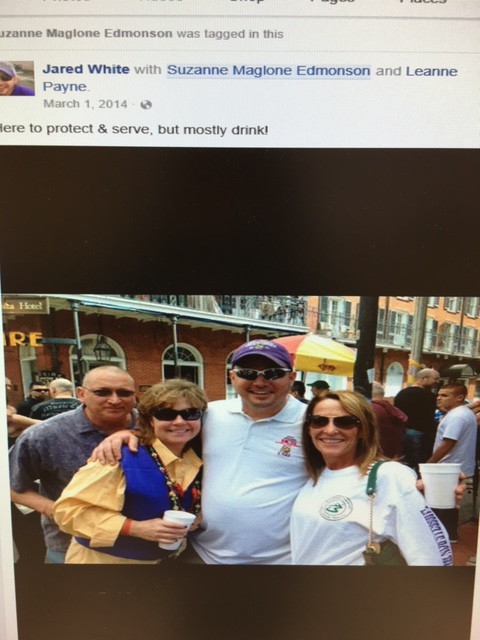
But Suzanne Edmonson, wife of the LSP Superintendent, posted this 2014 Facebook photo with the caption “Here to protect & serve but mostly drink.”

This photo, as well as other photos and messages, have been removed from Suzanne Edmonson’s (on right) Facebook page.

Edmonson was first appointed Superintendent by Gov. Bobby Jindal in January 2008. Prior to that, he was best known as the ever-present bodyguard first for Nick Saban and then for Les Miles at LSU football games. Before that, he was public information for LSP and had never served in a supervisory capacity.

He was reappointed by Edwards in January 2016 as a trade-off for the much-needed endorsement of the Louisiana Sheriffs’ Association in his 2015 runoff election against U.S. Sen. David Vitter.

Edwards’ brother, Daniel Edwards, is the sheriff of Tangipahoa Parish and his office was raided by the FBI last year as part of an ongoing investigation by the federal Drug Enforcement Agency.

Gov. Edwards has steadfastly stood behind Edmonson throughout his superintendent’s turbulent tenure marked by sporadic rumors of partying and lax administration of subordinates, particularly his troop commanders who were pretty much given free rein.

He also has been linked to the Louisiana State Troopers Association’s (LSTA) political contributions even though he says he has nothing to do with the LSTA operations. But LouisianaVoice was able to document that Edmonson approached LSTA right after Edwards’ election victory over Vitter to request the association to write a letter to Edwards endorsing him for reappointment.

LSTA’s board denied that request but did wash members’ money through the personal bank account of its executive director, David Young. Jindal and Edwards, at different points in time, each received $10,000 from Young, who subsequently filed expense reports for reimbursement from LSTA.

Edwards returned his contributions but Jindal never did.

Earlier this week, the FBI walked in on a board meeting of LSTA and served each of its board members with subpoenas to appear before a federal grand jury. The date of that grand jury has not been announced. In all, 18 subpoenas were served on current and former board members and Young.

In another surprise move, former Lafayette Parish Sheriff Donald Breaux resigned from the Louisiana State Police Commission (LSPC). He was the second member to quit the commission in just over a month. Commission executive director Cathy Derbonne resigned under pressure, prompting Lloyd Grafton, a retired career federal agent, to also resign, saying he had tried without success to bring integrity to the board.

Following that meeting yesterday, commission members Eulis Simien and Calvin Braxton met with Gov. Edwards for more than an hour. Braxton, contacted by LouisianaVoice, acknowledged that the meeting took place, “but I’m not saying what was discussed,” he said.

LouisianaVoice will have more details about Edmonson’s resignation as they become available.

Read Full Post »

Anyone who thought retired State Police Lieutenant Leon “Bucky” Millet would eventually get tired of calling out State Police Superintendent Mike Edmonson, the Louisiana State Troopers Association (LSTA) or the Louisiana State Police Commission (LSPC) just doesn’t know Bucky Millet—or wife Vivian, for that matter.

Both have been fixtures at LSPC’s monthly meetings for more than a year now, driving in all the way from Lake Arthur, and at times have been a real pain in the posteriors for the commission. Millet has warned commissioners on more than one occasions that continuing to allow Edmonson to stack the commission with his lap dogs will eventually come to no good. Looking back, his repeated warnings have suddenly gone from the predictions of a disgruntled retiree to the prophetic words of someone with unerringly keen insight—and foresight.

Millet, fed up with the direction being taken by the organization he once served so proudly, has now fired off formal complaints to Gov. John Bel Edwards, Attorney General Jeff Landry, Inspector General Stephen Street, State Police Lt. Col. Murphy of the Louisiana Department of Public Safety’s (DPS) Bureau of Investigations, and East Baton Rouge Parish District Attorney Hillar Moore.

In his separate letter to each of the five, he called for an investigation of possible malfeasance and payroll fraud on the part of four State Troopers who took an unmarked State Police vehicle to California last October.

While LSPC Chairman State Trooper T.J. Doss and other commissioners have chosen to ignore his monthly warnings and have been generally dismissive of his questions the way a busy parent would dismiss a child’s questions, the LSPC now finds itself in the uncomfortable position of observing from the sidelines as a formal investigation gets underway of the very agency it is supposed to have been overseeing.

That investigation by auditors from the Division of Administration (DOA) was ordered by Gov. John Bel Edwards after it was learned that Edmonson had 15 of his subordinates (including the four who drove the vehicle assigned to Deputy Superintendent Charles Dupuy) to San Diego to witness Edmonson receiving an award for which a former State Trooper of the Year was originally nominated. LSP headquarters, meanwhile, is using an earlier 2015 unsuccessful nomination of Edmonson for the award as justification for stiffing Maj. Carl Saizan’s nomination.

It’s not as if the LSTA hasn’t tried to silence the affable Millet. After Millet and three other retirees challenged the association’s laundering more than $45,000 in illegal campaign contributions through its executive director’s personal checking account, LSTA took quick action. After it became evident that they weren’t going away, the association, without explanation or comment, simply revoked their memberships.

LSTA is supposed to be an association of active and retired state troopers established to work to benefit troopers, retirees and their families and to work for better conditions for troopers. But it’s evident those benefits extend only to those who keep their mouths shut. Apparently, there is some hidden clause in its bylaws that prohibits dissention among the ranks.

Again, if that move was intended to silence Millet, it only backfired by making him even more vocal and more determined than ever to ask questions and to challenge decisions. He has proven himself to be a nettlesome irritation over the pathetic, so-called “investigation” of the LSTA members who authorized the contributions, as well as the association’s endorsement of Edwards—its first-ever political endorsement.

Natchitoches attorney, former legislator and political ally of Edwards Taylor Townsend was hired by the LSPC under a $75,000 contract to conduct the pseudo-investigation after commission legal counsel Lenore Feeney said she could not conduct such an investigation. Neither, apparently, could Townsend, even though that didn’t prevent him from accepting payments under his contract. The final product of his investigation was not a written report as one might reasonably expect, but simply an oral recommendation that “no action be taken.” Not exactly the most bang for the buck.

Like the San Diego trip’s $72,000 costs in travel, lodging, meals and salary, Townsend’s contract stands as another $75,000 frittered away with nothing, repeat, nothing to show for it.

Doss and his allies on the commission must have thought they’d dodged a bullet despite fellow commissioner Lloyd Grafton’s observation that the entire affair looked a lot like “money laundering” to him. He should know. Grafton, a former federal DEA agent who was instrumental in thwarting a coup d’état in the Caribbean island nation of Dominica, is no stranger to sniffing out money laundering. He eventually resigned from the commission in disgust over what he called a “lack of integrity.”

Millet, tired of constantly having to bicker with Doss and other commission members, has now taken the next logical step, spurred on by that San Diego episode, in filing his complaint.

While he is asking for an investigation of the four who drove, it is critical to remember they took a vehicle permanently assigned to Edmonson’s second-in-command—pretty clear evidence that they didn’t act on their own volition but were instructed to drive some 2,000 miles in order to help bolster Edmonson’s ego. That raises the question of who ordered the four to pile into that Expedition and head west?

Accordingly, no investigation should be held without including Edmonson (who had to have ordered them to drive the vehicle) and Dupuy, whose vehicle was used—obviously with his permission.

But Millet is more concerned about the overtime charged by each of the four, including 12 hours each for seven days of travel. Two legs of their trip, from the Grand Canyon to Las Vegas, and from Las Vegas to San Diego were trips of about 250 miles or so that should have taken about four hours each but for which each man charged 12 hours. That’s 96 total hours—32 hours at overtime rates—to travel about 500 miles.

While it’s probably a waste of time to ask Street to conduct an investigation given the effectiveness displayed by his office over the past several years, any investigation undertaken by Paul would be even more fruitless; he’s being asked to investigate the actions of Edmonson, his boss. That ain’t happening.

But if Landry launches his own investigation, the results should be fascinating when compared to that of the governor’s office, given the acrimonious relationship between the two offices and given Landry’s obvious desire to run against Edwards in 2019.

But all of those will pale in comparison to the ticklish position T.J. Doss will find himself in if Millet does the expected and requests another investigation—by the LSPC.

We have speculated on this site several times in the recent past as to what Doss, a state trooper who owes his position as commission chairman to Edmonson (not to mention his job), will do if called upon to investigate his boss.

As the late C.B. Forgotston would say if he were still with us: You can’t make this stuff up.

Read Full Post »

It was Memorial Day weekend in Baton Rouge last year, the weekend of the BAYOU COUNTRY SUPERFEST that had country music fans flocking to LSU’s Tiger Stadium. LSU subsequently cancelled its contract with promoters and this year’s event will take place in the Louisiana Superdome in New Orleans.

But this story isn’t about Bayou Country Superfest.

It was several hours after the final performance of one night of the three-day event, around 3 a.m., in fact, that a black SUV was pulled over by a Baton Rouge police officer at the corner of Perkins and Acadian, only a few blocks south of I-10.

The officer, a member of the city’s DWI Strike Force, suspected the driver of driving while impaired, perhaps even intoxicated. In the SUV was a woman, a blonde. She was not the driver’s wife; she’s a brunette.

The driver, violating all protocol, exited his SUV and started toward the officer who, alarmed, is said to have pulled his weapon just before recognizing the driver as a high-ranking member of the governor’s administration.

Instead of escalating, as the situation could easily have done, the driver was inexplicably allowed to proceed on to his destination, driving that black SUV. He was not arrested, issued a citation or even asked to submit to a field sobriety test and the matter was quickly hushed up. Even the city officer, when asked about the incident, denied it ever happened. But later, when asked about the incident by a fellow officer, rather than deny it occurred, said instead, “I can’t talk about that.”

Yet the stories continue to persist nearly nine full months after the stop that the officer denies ever took place. LouisianaVoice was even given the officer’s name by no fewer than eight different, independent sources. At least when Bobby Jindal’s Commissioner of Administration Paul Rainwater was pulled over for DWI, there was no attempt to keep the arrest quiet and he paid his fines and court costs for the offense. The only thing that raised eyebrows was when State Police Superintendent Mike Edmonson showed up and gave him a ride home—a courtesy no ordinary citizen sans political connections would likely be accorded.

Who made the decision to allow the driver to go on his way? It’s unlikely the officer would have assumed the responsibility for such a decision fraught with all kinds of downsides on his own. That would mean there had to be an order from up the chain of command within the Baton Rouge Police Department. The question then, is at what level of the command was the decision made, mid-level or from the very top?

Baton Rouge Police Chief Carl Dabadie is probably on his way out. At least that’s the indication given by former State Sen. Sharon Weston Broome who was recently elect Baton Rouge’s new Mayor-President and inaugurated on Jan. 2, though Dabadie appears to be fighting to keep his job.

This is not to say Dabadie was ever even aware of the stop but if (and of course, at this stage, that’s a very speculative if)…if he is the one who put the kibosh on the stop and potential arrest of the state official, both men need to go. Immediately.

If he had any records of the pullover expunged from the police log, he could be found guilty of injuring public records under Louisiana R.S. 14:132 and he conceivably could face imprisonment. At any rate, if any records of the stop were destroyed on his watch, he must be held accountable for destruction of public records.

If records were never tampered with, then somewhere there is a paper trail that still exists, perhaps by now buried somewhere in the bowels of the BRPD.

LouisianaVoice is continuing to investigate the matter. We’ll let you know if anything develops. If not, the story probably will evaporate as did the ghost stop of a black SUV at 3 a.m. during the 2016 Bayou Superfest.

Read Full Post »

« Newer Posts - Older Posts »
