Feeds:
Posts
Comments

Archive for the ‘Privatization’ Category

If the Retired State Employees Association (RSEA) goes forward with filing a legal challenge to the proposed changes to health care coverage for state employees, retirees and their dependents, it may have a significant hook on which to hang its case in a report submitted by a company contracted by the Jindal administration which attempted to base its plan changes at least in part on that same report.

If you’re confused, you should be for Commissioner of Administration Kristy Nichols laid the decision to make the changes in the Office of Group Benefits (OGB) plan at the feet of Buck Consultants but the firm’s report is in direct contradiction to the testimony of Nichols at the Sept. 25 hearing of the House Appropriations Committee.

The proposed health benefit changes are so radical for some 230,000 OGB members that the RSEA has scheduled a meeting with a law firm which has tentatively agreed to take the case on a pro bono basis, says Frank Jobert, RSEA’s executive director. http://theadvocate.com/sports/southern/10465870-123/retirees-considering-legal-challenge

RSEA is looking at the failure to go through the necessary legal procedures for approval of changes in plan benefits and “diverting” money from the OGB fund balance which has dwindled from a high of more than $500 million to less than half that amount and which is projected to go broke next year if changes are not implemented.

Nichols has consistently blamed the financial condition of OGB on rising costs she attributed to the Affordable Care Act (Obamacare). Critics, however, point to three straight years of decreased premiums that allowed the state to commit fewer state funds to its 75 percent match which in turn allowed the administration to divert those monies to cover budget holes even as the reserve fund continued to shrink.

Nichols was consistently evasive when asked during last month’s hearings of the House Appropriations Committee, three times managing to evade the direct question of who the actuary was who recommended decreases in premiums over three consecutive years.

Finally, State Rep. John Bel Edwards (D-Amite), who had already asked the question once without getting an answer, observed, “In fiscal 2013, there was a 7.11 percent reduction in premiums followed by 1.8 percent even though health care costs were going up by 6 percent.”

In questioning Nichols during the Appropriations Committee hearing, Edwards had accused the administration of taking a “self-manufactured crisis” and turning it into an emergency “because we had a fund balance that was healthy.

“We had OGB members who were relatively happy with the plan and today we have an unhealthy fund balance and OGB members who are very unhappy.”

He then asked again, “What actuary told you these reductions were sound?”

Nichols, who was already halfway out the door—before the committee meeting adjourned—on her way to taking her daughter to a One Direction boy band concert in the New Orleans Smoothie King Arena where she watched from the luxury box assigned to Gov. Bobby Jindal (R-Iowa, R-New Hampshire, R-Anywhere but Louisiana), replied, “Buck Consulting recommended a 2.25 percent decrease for calendar 2012.”

https://louisianavoice.com/2014/10/01/watching-kristy-kreme-nichols-responding-to-legislators-like-watching-jerry-lewis-movie-mixture-of-exasperation-humor/

Well, not exactly. When one reads pages ii and iii of the summary report of the Buck Consultants Actuarial Valuation at 7/1/2013, a starkly different message is conveyed.

http://www.doa.louisiana.gov/osrap/library/afr%20packetts/2014OGB_OPEBValuationReport.pdf

On Page ii, under the CLAIMS AND PREMIUM EXPERIENCE heading, the report says:

  • “Overall, the plan had favorable claims experience, resulting in a gain. The gain was offset by losses associated with premiums not increasing as expected. See Substantive Plan discussions below.”

Under SUBSTANTIVE PLAN on Page iii, the report says:

  • “It is our understanding that the Plan premium rates, used both to determine contributions from the various employer agencies and to set contributions required from the retirees, were set artificially low to draw down the OGB’s reserve fund… (emphasis added.) As noted above, premium rates were again lower than expected for this year’s valuation.”

Moreover, an email from Buck Consultants representative Tom Tomczyk to OGB CEO Susan West dated Sept. 28 (three days after the Appropriations Committee hearing) says, “The 2.25percent (rate decrease) was not a recommendation for January 1, 2012, but only used to validate our projections for the Fiscal Year 2012-2013. We did not recommend a decrease of 7 percent effective August 1, 2012, or an additional decrease of 1.77 percent effective August 1, 2013. Further, we were not asked to provide any recommended rate adjustments for any fiscal year beyond what we provided for Fiscal Year 2012-2013.”

In fact, according to that same email, Tomczyk said Buck Consultants was asked in late 2011 for its projection of the indicated rate increase for Fiscal Year 2012-2013. “At that time, based on the most recent claims information available, we projected a rate increase (emphasis added) of 1.75 percent needed as of July 1, 2012.”

An earlier email, on Nov. 12, 2013, from Tomczyk to West’s predecessor, Charles Calvi, who served as CEO of OGB from Jan. 9, 2012, to Jan 31, 2014, concluded, “We have not been asked to provide recommendations for rate adjustments since calendar year 2012.”

The consulting firm’s report, dated July 2014, noted significant decreases in several areas of net liabilities to OGB and gains in areas that benefitted the agency’s bottom line, according to two financial experts who were shown the report.

“As I see it, the Buck report directly contradicts the way Ms. Nichols has presented this,” one said. “Unless I do not understand plain English, Buck says, ‘Overall, the plan had favorable claims experience, resulting in a gain.’ How can a clear gain be a loss by anybody’s definition?”

He noted the following:

  • The actuarial accrued liability (AAL) for July 2013 was $103 million less than what had been projected in July of 2012, meaning that OGB was in better shape on July 1, 2013, than had been predicted. The AAL also increased by only $157 from last year when it had been projected to increase by $260 million.
  • The amount paid in claims was less than predicted and actually decreased the AAL by $195 million—and would have decreased it even more had premiums not been less than projected.
  • The report clearly attributes a loss to OGB of $388 million—totally a result of reduced premiums through Fiscal Year 2012 and that this loss was increased by additional decreases in premium rates in Fiscal Year 2013.
  • The report, on Page iv, minimizes the effect of the Affordable Care Act (ACA) on these calculations and points out that the ACA provided improvements in Part D coverage.

“I am frankly shocked at this report and what has been said about this whole thing by others,” he said. “Either I am totally stupid or it blows all previous explanations away.”

Edwards, commenting on the contents of the Buck Consultants report, said, “Nothing in this supports Kristy Nichols.”

Read Full Post »

You have to hand it to Commissioner of Administration Kristy Kreme Nichols. When she has something to do, she is completely One Direction-al about it.

As the minutes ticked by during the House Appropriations Committee’s seven-hour hearing on the Office of Group Benefits on Sept. 25, and as Division of Administration (DOA) Executive Counsel Liz Murrill and the rest of the DOA pack occupied themselves by texting during heart-wrenching testimony from those who will be adversely affected by rising deductibles and co-pays, Kristy fidgeted.

She continued to fidget and to be as evasive as possible with her answers to questions from legislators until she suddenly “got an important phone call” and left the committee room. She did not return before the meeting finally adjourned.

In fact, it was not a telephone call that pulled her from the meeting at all.

One Direction, the latest boy band to make little girls squeal, was playing in the Smoothie King Arena in New Orleans and Kristy and her daughter (and possibly some of her daughter’s friends) watched the concert from the special Arena luxury suite assigned to Gov. Bobby Jindal (R-Iowa, R-New Hampshire, R-Anywhere but Louisiana).

Kristy Kreme at the Smoothie King. Has a certain ring to it, doesn’t it?

Kristy Kreme could have told the audience the truth. Certainly OGB members, mostly retirees, who had traveled from all over the state to testify and to get answers would have understood that a teeny bopper band was more important to Kristy Kreme than the medical coverage of 230,000 state employees, retirees and dependents.

But you see, telling the truth simply is not her style.

Witness her repeated claims that the OGB $500 million reserve fund was reduced to only about half that amount because of Obama Care and rising health care costs. She made that claim repeatedly, blaming those two factors and those alone for the drawdown of the reserve fund when everyone on the committee and those in the audience knew better.

Everyone in attendance knew that three consecutive years of premium reductions in the face of rising costs was the reason the fund has been all but depleted. She would never admit that even though everyone knew that Jindal lowered the rates so that the state’s 75 percent contribution to member premiums would be reduced also, thus leaving money that would have gone to premium payments for Jindal to use to plug gaping holes in his budget.

Remember when Kristy Kreme’s predecessor, former Commissioner of Administration Paul Rainwater wrote that comforting letter to OGB members in April of 2011 in an effort to debunk all those rumors about increased costs and raids on the reserve fund? No? Well, we have it right here: https://www.groupbenefits.org/portal/pls/portal30/ogbweb.get_latest_news_file?p_doc_name=4F444D324D5441344C6C4245526A51344E7A413D

In that letter, Rainwater said members would continue to receive quality service and coverage, benefits would NOT change, and OGB’s administrative oversight would continue, “securing the continued success of all the plans.”

“As for the allegation that OGB’s surplus will somehow be ‘stolen,’” Rainwater continued, “let me be absolutely clear: this claim is categorically untrue.”

But that was yesterday, as Chad and Jeremy sang back in the 60s, and yesterday’s gone. Let us return to the AWOL Kristy Kreme.

Even as she was invoking her super powers to convince legislators and audience members that she had only the best interest of OGB members at heart and that the depletion of the reserve fund was beyond the control of the administration, the report of Buck Consultants, hired by Kristy Kreme said on page iii of its summary: IMG_9230

  • It is our understanding that the Plan premium rates, used both to determine contributions from the various employer agencies, and to set contributions required from the retirees, were set artificially low to draw down the OGB’s reserve fund, and it is our further understanding that this is a temporary deviation from the Plan’s substantive plan, which continues to provide for the legislated 75-25 cost-sharing under a “full subsidy” from the State. Our valuation anticipates that the 21 percent premium deficiency will be gradually eliminated on a uniform basis over five years from fiscal year 2015 through fiscal year 2019 through increases in retiree premium rates in excess of the underlying assumed health trend. The actuary notes that in the prior valuation at July 1, 2012, the plan incurred a loss of $388 million associated with premium rates lower than anticipated.

For the entire Buck Consultants report, click here. http://www.doa.louisiana.gov/osrap/library/afr%20packetts/2014OGB_OPEBValuationReport.pdf

State Rep. John Bel Edwards (D-Amite) said he had received a copy of the Buck report earlier. “Nothing in this supports Kristy Nichols,” he said.

Edwards has been a vocal critic of the proposed OGB changes, claiming that the increased co-pays and deductibles will create unnecessary hardships on retirees, some of whom are facing co-payments and deductibles higher than their monthly income.

The entire OGB affair has become so confusing that many OGB members were turned away from the first meeting held in Baton Rouge on Monday to explain the changes. Jindal fired about two dozen OGB workers in the last round of firings and Kristy Kreme immediately found it necessary to contract with Ansafone of San Diego, California, and Ocala, Florida which has been trying to hire 100 people in each state to man telephone banks to answer questions about Louisiana’s plan.

Kristy Kreme has already found it necessary to dispatch one OGB employee to San Diego to train Ansafone employees and now $107,000-a-year OGB Chief Operating Officer Bill Guerra is in San Diego conducting training sessions on how to answer questions from OGB members.

DOA, by the way, is supposed to be strapped for cash and there is a statewide freeze on out of state travel but apparently found it necessary to send Guerra to California for a month.

So, let’s recap:

  • Jindal fires most of the OGB employees, including director Tommy Teague, and turns over a perfectly smooth-running agency to Blue Cross/Blue Shield (BCBS) with promises of no changes in benefits or premiums.
  • Less than two years after BCBS takes over, the OGB reserve fund is depleted by one half.
  • The administration fires two dozen more employees because of a lack of work and then enters into a $1.3 million contract with a California company to respond to questions from Louisiana residents.
  • Kristy has to hire two executives from BCBS to help OGB CEO Susan West who apparently is not up to the task. One of those, who ostensibly serves under West, is paid a higher salary than West.
  • Kristy Kreme Nichols attempts to mislead legislators and OGB members by repeatedly saying Obamacare is responsible for rising health costs and the depletion of the OGB reserve fund. No one buys her story.
  • Kristy tells State Rep. John Bel Edwards that the OGB actuary, Buck Consultants, recommended a decrease in premiums but a single paragraph from the Buck Consultants report summary contradicts that claim.
  • Two OGB executives have been sent to California to attempt to teach Ansafone employees how to respond to questions from Louisiana residents.
  • Kristy Kreme ducks out on legislators near the end of the Sept. 25 hearing by the House Appropriations Committee to take her daughter to a One Direction concert in New Orleans where she and her daughter occupy Jindal’s suite at the Smoothie King Arena.
  • A survey of employee job satisfaction conducted in 21 agencies in the Division of Administration reveals widespread dissatisfaction and distrust of the administration. Understandably, the survey has never been released and its contents were not divulged until LouisianaVoice recently obtained a copy.

And now, Jindal is offering foreign policy advice to President Obama with the release of a “policy paper” that calls for more defense spending. http://www.nola.com/politics/index.ssf/2014/10/bobby_jindal_takes_on_obama_fo.html

Read Full Post »

A survey to gauge state employee job satisfaction in the Division of Administration (DOA) should be an eye opener for Commissioner of Administration Kristy Kreme Nichols and agency heads throughout DOA—but it probably won’t be.

Meanwhile, LouisianaVoice has learned that Gov. Bobby Jindal (R-Iowa, R-New Hampshire, R-Anywhere but Louisiana) received some exciting news this week when a new poll revealed that no one was more popular than Jindal among Republican contenders for the GOP presidential nomination.

The excitement was short-lived, however, when the actual meaning of the numbers was revealed.

It turns out that in a CNN poll of New Hampshire voters, Jindal tied with Rick Santorum with 3 percent, while “No one” polled 4 percent, prompting Comedy Central’s Stephen Colbert to joke that Jindal should adopt the slogan “Jindal 2016: No one is more popular.”

Adding insult to injury, a Public Policy Poll also showed that in a head-to-head showdown with former Gov. Edwin Edwards for governor, Edwards would win with 47 percent of the vote to Jindal’s 43 percent, with 10 percent undecided.

Not the numbers on which to base an ambitious run for the White House.

The employee survey, conducted by IBM/Kenexa to rate overall job satisfaction revealed DOA employees scattered throughout 22 state agencies grouped within DOA were generally less content, scoring well below the national norm in the areas of:

  • Trust (47.8 percent);
  • Employee recognition (39.2 percent);
  • Senior leadership values (55 percent);
  • Communication from management (42.8 percent);
  • Senior leadership vision (33.2 percent;
  • Opportunity for employee advancement (28.2 percent), and
  • Employee involvement in decision making (57.8 percent).

Moreover, only 28.3 percent of respondents believed that positive change will occur as a result of the survey, compared to 31.6 percent who felt the survey would produce change and 40.2 percent who were unsure.

There were no records available to indicate how much the survey cost but The Department of Economic Development contracted with Kenexa Technology in 2011 to conduct a similar survey. The contract cost for that survey of a single agency was $19,900.

Not only did state employees throughout the 22 agencies in DOA reflect an overall pessimistic outlook, the 52.7 percent response rate (553 employees responded) was well below the IBM/Kenexa benchmark of 80 percent which served as a barometer of the general skepticism of state employees in general under the Jindal administration.

That’s certainly not difficult to understand, given the manner in which Jindal has gone about gutting agencies by laying off employees in wholesale numbers, privatizing agencies, attempting first (unsuccessfully) to slash state retirements and most recently going after medical benefits by manufacturing a crisis at the Office of Group Benefits (OGB) in order to declare an emergency to increase deductibles and co-pays which he hopes will drive retirees out of OGB

Meanwhile, Kristy addresses the morale problem by insisting that agency directors strong arm employees to participate in the Louisiana Marathon so she can win her participation bet with Department of Health and Hospitals Secretary Kathy Kliebert.

As an added incentive, she announced on Thursday that her participating employees would be treated to a barbeque cookout Saturday on the grounds of the governor’s mansion.

And who wouldn’t want one of those TeamKristy T-shirts with the nifty slogan “We Run Louisiana,” coined by Texter-in-Chief Liz Murrill?

There was no immediate word on whether or not Jindal would take time out of his doomed quest for the Republican presidential nomination to attend.

Capture

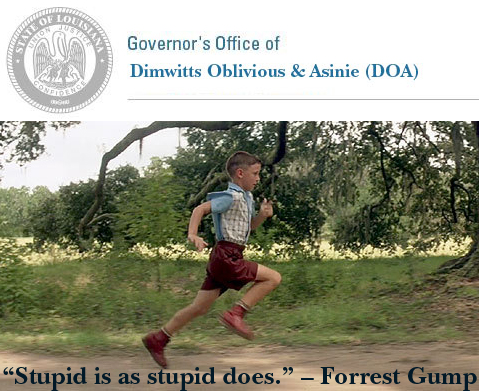
Forgive the misspelling of dimwits and asinine in the photo. We’ll explain how to use Spellcheck to our computer graphics techie over at GOHSEP. (He doesn’t care; he’s leaving.)

Read Full Post »

Even as the Jindal administration was announcing that it was capitulating to the desires of the attorney general and state legislators to delay implementation of new proposed health coverage plans for state employees and retirees, the Office of Group Benefits (OGB) was quietly issuing a request for proposals (RFP) for actuarial services beginning Jan. 1, 2015.

https://www.groupbenefits.org/portal/pls/portal30/ogbweb.get_latest_news_file?p_doc_name=4D7A4D774E4445794D793551524559334E444531

Greg Cromer (R-Slidell) and John Bel Edwards (D-Amite) asked several times during the hearing the identity of the actuary who recommended three consecutive years of premium reductions in the face of rising health care costs and it wasn’t until the fourth time the question was asked that an answer was forthcoming.

“In fiscal year 2012 there was a 3 percent erosion of the fund balance,” Edwards said. “Yet, in fiscal 2013, there was a 7.11 percent reduction in premiums followed by 1.8 percent even though health care costs were going up by 6 percent. What actuary told you those reductions were sound?”

“Buck Consulting recommended a 2.25 decrease for calendar 2012,” Commissioner of Administration Kristy Nichols said.

Edwards then asked if Buck Consulting was still under contract to the state.

“That contract is being bid,” Nichols said.

“I would hope so,” Edwards responded.

State records indicate Buck had a $2.1 million contract with OGB to provide actuary and consulting services. That contract ran from Dec. 1, 2009 through Jan. 1, 2012. Additionally, Buck had another $600,000 contract from June 1, 2011, to June 1, 2013, “to assist in advising the Division of Administration with regard to public retirement systems and insurance benefits for public employees, actuarial services” at $250 per hour and per diem payments of $165.

Buck Consultants is a subsidiary of Affiliated Computer Services which in turn was purchased by Xerox in 2009. Jan Cassidy, sister-in-law of 6th District Congressman and U.S. Senate candidate Dr. Bill Cassidy, worked as Regional Vice President of Business Development for ACS and Xerox for nearly four and one-half years before going to work for DOA in December of 2012 as Assistant Commissioner in Procurement and Technology at a salary of $150,000 per year. A search of state contract records in March of 2013 by LouisianaVoice turned up four contracts with ACS totaling $45.55 million.

ACS contributed $10,000 to the campaign of Gov. Bobby Jindal (R-Iowa, R-New Hampshire and R-Anywhere but Louisiana) in 2003 ($5,000), 2008 ($4,000), and 2009 ($1,000), Jindal’s campaign records show.

LouisianaVoice, in March of 2013, noted several contracts between ACS and other states, cities, and even the federal government which drew sharp criticism over problems experienced by the company as well as questionable contracts in Texas and Alabama.

https://louisianavoice.com/2013/03/15/doa-hires-jan-cassidy-sister-in-law-of-cong-bill-cassidy-at-150000-previous-employers-records-are-less-than-stellar/

But ACS wasn’t the only entity in that organization with problems. Buck Consultants was sued by Providence, Rhode Island in 2013 because, the city claimed, Buck miscalculated $700,000 per year in savings the city anticipated through pension reform. Instead, Mayor Angel Taveras said, the cost to the city was expected to be $10.8 million over the next 28 years.

http://www.google.com/url?sa=t&rct=j&q=&esrc=s&frm=1&source=web&cd=1&ved=0CB4QFjAA&url=http%3A%2F%2Fwww.pionline.com%2Farticle%2F20130226%2FONLINE%2F130229899%2Fprovidence-ri-sues-buck-consultants-over-pension-savings-calculations&ei=0sIsVMTAE4OOyASQpIKIBQ&usg=AFQjCNEiIVz3kvxYoTszpqnKeonAQGq_-A&bvm=bv.76477589,d.b2U

In California, Buck Consultants was also accused of making several mistakes in its actuary for the Mendocino County retirement system, prompting the county to cancel its contract with the firm in March of 2011. Buck Consultants paid the county nearly $600,000 as a settlement of its dispute in September of that same year. http://www.ukiahdailyjournal.com/ci_17656902

http://www.ukiahdailyjournal.com/ci_18951388

In a case that should sound familiar to OGB members who have been following events since the privatization of the agency, retirees in Stanislaus County, California, in 2009 sued the county retirement board over its decision to shift $60 million in reserves to ease the county’s pension obligations for fiscal year 2009-10. http://www.modbee.com/2009/12/24/984878/retirees-challenge-stancera-over.html

And now OGB “is seeking proposals from actuarial and consulting (actuary) providers for a contract that will allow for benefit design, rate development, RFP scoring, and other analytical and financial support activities for the state health insurance plan,” the RFP says.

The actuary chosen for the contract “will provide methods for, and calculation of, health plan premiums for OGB health plans and other support services.”

So while Kristy Kreme continues to insist that the current plans for OGB do not call for increased premiums, only higher co-pays and deductibles, it’s interesting to note that the contract being sought by OGB certainly leaves the door open for premium adjustments down the road and it isn’t difficult to guess which way those adjustments will go.

The RFP says that OGB projects medical plan expenditures of almost $1.284 billion in fiscal year 2015, which begins next June 1. Of that amount $56.9 million will be in administrative costs, the RFP says, adding that OGB will require “ongoing consulting and assistance with benefit development, rate setting, risk adjustment determinations, financial analysis, analysis of claims and encounters, evaluation of expenditures, budget projections, trend calculations, causes and discovery of trend, evaluation of multiple benefit options, and financial and other reporting requirements as may be necessary to administer” the health plan.

Should Buck Consultants submit a proposal and should it be the low bidder, someone other than Kristy Nichols might wish to talk to the folks in Providence, R.I., Mendocino or Stanislaus counties in California to do a little vetting before a contract is awarded.

This consultant-happy administration has made a horrible mess of things with OGB since 2011. There’s no need to continue down that same road of bad decisions.

Read Full Post »

Listening to Commissioner of Administration Kristy Kreme Nichols’ responses to questions during last Thursday’s House Appropriations Committee hearing over changes to the state Office of Group Benefits (OGB) health plans, one word kept coming to mine: bromides.

Bromide is defined by Merriam-Webster as “a statement that is intended to make people feel happier or calmer but (which) is not original or effective,” and by Wikipedia as “a phrase or platitude that, having been employed excessively, suggests insincerity or a lack of originality in the speaker.”

No matter which definition one might choose, that is precisely what legislators and members of the audience were treated to during the seven-hour hearing at the State Capitol.

Keep in mind as you read this that subsequent to the hearing last Thursday, the administration of Gov. Bobby Jindal (R-Iowa, R-New Hampshire, R-Anywhere but Louisiana) retreated from its plans of the gang rape of 230,000 state employees, retirees and dependents so that the administration can follow the law for a change and proceed through the legal process of obtaining approval of the proposed benefit changes for OGB members. https://louisianavoice.com/2014/09/30/in-need-of-aloe-vera-after-being-burned-by-appropriations-committee-last-week-ogb-announces-enrollment-extension/

Katrina Jackson (D-Monroe), for example, sparred with Nichols on the issue of the $1.3 million contract with Ansafone, Inc. of San Diego and Ocala, Florida to field phone calls from OGB members. “Where is the project work plan?” Jackson asked. “No one at OGB knew what it was when I called. No one on the committee has received any project work plan. We have a $1.3 million contract for phone service. Is this something that Blue Cross/Blue Shield (BCBS) should be doing?”

“We had no other choice but to ramp up our customer service for open enrollment,” Nichols said.

Jackson again asked if fielding questions from members should be something BCBS should be doing to which Nichols responded, “OGB has always retained a customer service component.”

Jackson said legislators were told three years ago that privatization of OGB “would be helpful to members, not harmful. We fixed something that was not broken and now it’s broken. We were doing pretty good but then for some reason we offered the business to BCBS, everyone shifts to that and our utilization costs go up.”

Jackson finally got Nichols to concede that utilization is a major issue. “Vendors have to 100 percent accountable for managing utilization with us. To the extent that the request for proposals (RFP) and current contract did not explicitly mandate that, we need to in the future.”

We’re glad we could clear that up for you.

Kenny Havard (R-Jackson) asked Nichols why the Administrative Procedures Act, which lays out a step by step procedure for the adoption of rule changes. For a complete list of APA requirements, click here: apa

“We are,” Nichols said.

“You’re doing that now,” Havard countered. “But you didn’t before. If you’d done it before, we wouldn’t be here now. Who decides what laws we have to follow and which ones we do not have to follow in this?”

“The legislature sets laws and we try to follow,” Nichols replied.

“Everything we do lately ends up in court and that’s exactly where this is heading,” Havard shot back. “We’ve created a problem that we’ve put on the backs of state workers. We have people making $500 a month and you’re about to raise their insurance (costs) and somebody needs to answer for it because we’ve created a problem and blaming it on somebody else. I don’t support Obamacare but I also don’t support Jindalcare.

“We lowered premiums so the state would not have to put up its share and now the fund balance is dwindling,” he said. “I just want to know who made the decision that we didn’t have to follow the APA.”

“We are following the APA,” Nichols continued to insist. In our opinion, the plan of benefits does not have to be promulgated because it’s in the OGB authority.”

State Sen. Ed Murray (D-New Orleans) attempted to question Nichols but soon grew frustrated at her evasiveness and gave way to Rep. Greg Cormer (R-Slidell) who asked but did not receive a definitive answer: Did an actuary give the opinion on the rate decrease of 7 percent? Cormer told OGB CEO Susan West, “If you were a private insurer, the Department of Insurance would have already taken you over” because of the agency’s mismanagement.

Jack Montoucet (D-Crowley) asked Nichols, “Where would OGB be today had we not made all the changes, if we’d left them alone and let them do their job? To me, it wasn’t broken. I never got a call in six years (prior to privatization) complaining about OGB. Today, I gotta tell you, Jesus Christ, I’m getting phone calls every day and this (new plan) hasn’t even been implemented. That’s scary.”

Nichols, as she did most of the day, stammered and fumbled for an answer. “All public employee health plans are experiencing the same thing,” she finally said, but then said that the cost increases “could have been prevented if we’d structured the HMO correctly in the beginning.”

Joe Harrison (R-Gray) went further than the others in calling for a special legislative session to deal with the OGB crisis and noted that there were no problems with the agency during the tenure of Tommy Teague, who was fired as CEO on April 15, 2011.

“Mr. Teague had a solvent plan and I’ve yet to hear any in the administration tell me why we moved away from that plan,” Harrison said.

“I would ask that we have a special session on this,” he said. We have more than 200,000 lives we are adversely affecting. There are other options to this. Many in the insurance and health care industry have looked at this and (have) said there are better ways to go.”

The hardest questions, however, came from Rep. John Bel Edwards (D-Amite). Following up on a question asked earlier by Rep. Greg Cromer (R-Slidell), Edwards asked if the recommendations for premium decreases three consecutive years were made by an actuary.

“I was not with OGB then,” West said. “I don’t have that information with me…”

“It’s been three hours since that question first came up,” Edwards said.

“I don’t have that information with me,” West repeated.

“It’s been three hours since that was asked,” Edwards said again. “That’s three hours in which those reports could have been brought over here. Who made the decision to reduce premiums by 9 percent total in fiscal years 2013 and 2014?”

“Ultimately, the administration,” Nichols said.

“The OGB director?”

“I wasn’t at DOA in fiscal year ’13,” Nichols said. “I don’t know where the recommendation came from.

When Edwards elicited testimony from Nichols and West that the OGB policy board had not met in more than a year even as the OGB fund balance was dwindling by $16 million per month, he asked, “Was there a lack of a quorum because there weren’t enough members appointed to the board (by the governor) or that they weren’t showing up for meetings?”

“A combination of both,” West said.

“So we have a situation where (the decision was made) to reduce premiums by 2.25 percent in 2012 which drained the fund balance by 3 percent knowing costs were going up 6 percent, and an additional reduction of over 7 percent the next year and an additional reduction of almost 2 percent the following year all the while with costs of health care going up and we were surprised that the fund balance went down?

“This is a self-manufactured crisis that you are now saying is an emergency because we had a fund balance that was healthy,” Edwards said. “We had OGB members who were relatively happy with the plan and today we have an unhealthy fund balance and OGB members who are very unhappy. In fact, I would not that not a single OGB member came to testify today who support any of those plans—not a single one of them.”

Edwards if there was to be discussion of stability for OGB, “we can’t leave it in the hands of whoever’s been running it for the last two years…”

He then asked Nichols when the decision was made to follow the rule of promulgation as mandated in the APA.

“The general counsel advice to OGB,” Nichols said, “was a plan of benefit changes should not be required to be promulgated…”

DOA general counsel Liz Murrill stopped texting long enough to interject, “We had the conversation at the beginning of September.”

“When was the decision made?” Edwards repeated.

“At the beginning of September,” Murrill said.

“The (OGB policy) board looked at what you wanted to do in July so you knew what you wanted to do by July 30. If you had started the rule promulgation process by August 30, you could get through the entire process before January 1. You didn’t do that.”

Nichols, in a weak attempt to defend the emergency rule procedure in lieu of promulgation, asked, “Why was OGB allowed to implement 41 emergency rules in the past?”

“I suspect because nobody challenged it,” Edwards shot back. “Typically, you don’t follow the law unless you get challenged and that’s the real precedence that you’re following.”

Saying a Pew Survey shows that Louisiana is the third stingiest state in the nation in providing health coverage for public employees, Edwards said there is a “tremendous disconnect between saying we had an inflated reserve fund that it needs to be right-sized and today saying we have an emergency because the fund balance is not enough and it’s on its way (from a high of $520 million) to $8 million.”

He then again asked the question that no one had answered to that point. “In fiscal year 2012 there was a 3 percent erosion of the fund balance. Yet, in fiscal 2013, there was a 7.11 percent reduction in premiums followed by 1.8 percent even though health care costs were going up by 6 percent. What actuary told you those reductions were sound?”

“Buck Consulting recommended a 2.25 decrease for calendar 2012,” Nichols said.

“If you don’t have an emergency, then what you’re going to start on January 1 is invalid and you’re causing a bigger problem than if you simply go through the ordinary rule making process,” Edwards said. “Anyone who’s adversely impacted by having to pay a higher deductible or higher co-pays by an invalid emergency rule has a right to have that money returned to them.

“The safest thing to do if you are really worried about the taxpayers of the state of Louisiana is to give very serious thought to stopping the emergency rule making process, go forward with the ordinary rule making process and have whatever plans survive that process implemented in a year that doesn’t start until they (the rules) become final.

“Public meeting notices, meeting requirements, and oversight by the legislature are all very, very important. We had people today saying this was the first opportunity that they had to come and voice their objections. That’s an important part of this whole process.”

Read Full Post »

« Newer Posts - Older Posts »


