Feeds:
Posts
Comments

Archive for the ‘Politicians’ Category

Did the former director of the Louisiana Office of Alcohol and Tobacco Control strong-arm New Orleans-area night club owners to contribute to the campaign of one of the candidates for governor in last fall’s elections?

A confidential source told LouisianaVoice that club owners and businesses in Orleans and Jefferson Parish were pressured during two separate meetings prior to the Oct. 24 primary election to contribute to the gubernatorial campaign of Public Service Commissioner Scott Angelle.

There is no evidence that Angelle knew about or approved of the alleged coercion to contribute to his campaign.

Ten businesses or individuals subsequently contributed more than $30,500 to Angelle’s campaign, all of which was given prior to the primary election in which Angelle finished third to eventual winner John Bel Edwards and U.S. Sen. David Vitter.

Why would club owners be asked to contribute to Angelle? One possible explanation might be that ATC Director Troy Hebert thought Angelle’s election represented his best chance for reappointment. Hebert resigned on Jan. 10, the day before John Bel Edwards became governor.

None of the 10 contributed to either of the other three candidates for governor though seven of them also contributed more than $19,000 to John Young’s unsuccessful campaign for lieutenant governor, campaign records show.

John Young’s brother, attorney Chris Young, represents numerous New Orleans clubs and bars in proceedings before the ATC. Chris Young also serves as a lobbyist for the Beer Industry League of Louisiana. Their sister, Judy Pontin, serves as ATC’s $71,000-per-year “executive management officer” in ATC’s New Orleans office.

The timing of Operation Trick or Treat, a joint sting operation conducted by ATC and Louisiana State Police, also raises the question of whether there may have been a pattern of selective investigations of French Quarter strip clubs, particularly in New Orleans, last September and October.

Eighteen clubs in Orleans and Jefferson Parish were subjected to the investigation. Seventeen of the 18 did not contribute to Angelle. Only Larry Flynt’s Hustler Club among those that contributed was among those clubs visited in Operation Trick or Treat, according to a list obtained from ATC by LouisianaVoice. No violations were found there.

In all, nine clubs were found in violation of infractions of underage alcohol sales, drug use and/or prostitution.

Were club owners who contributed to Angelle and/or Young deliberately passed over during the joint LSP-ATC operation? Or were they just lucky?

Did the undercover investigation just happen to coincide with the run-up to the 2015 election for governor and lieutenant governor? Were those clubs who had their liquor licenses pulled targeted for their failure to follow through with political contributions? And did the license revocations help eliminate French Quarter competition for favored clubs?

A source close to the events contacted LouisianaVoice by email several weeks ago. Writing under an assumed name, the source said that prior to the Oct. 24 primary election, Hebert held private meetings with several club owners “to shake down the businesses” for contributions to Angelle’s campaign fund. She said the meetings were held “on top of Oceana Restaurant on Conti and in Metairie on Veterans Highway at Cajun Canyons Restaurant” (Cajun Cannon), run by former Saints quarterback Bobby Hebert (no relation to Troy Hebert). It wasn’t immediately clear if she meant the rooftop of the Oceana or on the top floor of the restaurant.

Bobby Hebert’s Cajun Cannon Restaurant & Bar is located at 4101 Veterans Memorial Blvd., but nowhere in the Secretary of State’s corporate records is Hebert listed as an officer of that or any other corporate entity in Orleans or Jefferson Parish.

Instead, the trade name Bobby Hebert’s Cajun Cannon is listed at 5828 Marcia Ave. in New Orleans—the same address as several other corporations.

Oceana Restaurant is located at 739 Conti Street, the same address as Oceana Enterprises, LLC. Wassek N. Badr is listed as both the registered agent and the only officer of Oceana Enterprises.

And this is where it gets really confusing.

The name Badr, or Bader, crops up in several other corporate filings in New Orleans, all with the same 5828 Marcia Ave. address as Bobby Hebert’s Cajun Cannon nightclub.

Others with Wassek Badr’s name listed as officer include Cajun Estates of 5828 Marcia, Cajun Conti, LLC, and Cajun Cuisine, LLC, both of 739 Conti (same address as Oceana Restaurant), and MRW Orleans, LLC (Mohamad Wassek Bader and Rami Wassek Badr), 5828 Marcia.

Moe Wassek Badr is listed as the agent and only officer of Cajun Maple, LLC, of 5828 Marcia while Mohamad “Moe” Badr is given as agent and only officer of Olde Creole Palace, LLC. And Rami Badr is listed as agent and only officer of Cajun Broad, LLC, both located at 5828 Marcia.

Additionally, Morton Bader is named as agent for Cajun Estates.

Amer Bader is listed in corporate records as a member of Wasek Badr, LLC, and it is Amer Bader who has said that he exchanged text messages with Hebert in which he accused Hebert of extorting sexual favors from a woman experiencing licensing problems with ATC. https://louisianavoice.com/2016/01/26/fbi-said-investigating-troy-hebert-for-using-office-to-extort-sex-from-woman-in-exchange-for-fixing-licensing-problems/

Campaign finance reports filed by Angelle would seem to indicate the meetings at Oceana and Cajun Cannon were likely held on or around Sept. 16 and Oct. 12, 2015, since all the contributions to Angelle were on those two dates.

Two contributions of $5,000 each were made on Sept. 16 by Hospitality Consultants and Magnolia Enterprises, records show, and Caire Hotel & Restaurant Supply gave $500 on that same date.

On Oct. 12, Quarter Holdings and ITMC Enterprises contributed $5,000 each to Angelle’s campaign, Bourbon Heat and Promenade Entertainment gave $2,500 each, and HDV No. 1, SB Entertainment, and CATS 701 each gave $1,666.66.

Here are those contributors to Angelle and the dates of their contributions:

  • Hospitality Consultants: $5,000 on Sept. 16, 2015;
  • Magnolia Enterprises, Inc.: $5,000 on Sept. 16;
  • Caire Hotel & Restaurant Supply, Inc.: $500 on Sept. 16;
  • Quarter Holdings: $5,000 on Oct. 12;
  • JTMC Enterprises: $5,000 on Oct. 12;
  • Bourbon Heat: $2,500 on Oct. 12;
  • Promenade Entertainment, LLC: $2,500 on Oct. 12;
  • HDV No. 1, LLC: $1,666.67 on Oct. 12;
  • SB Entertainment, Inc.: $1,666.67 on Oct. 12;
  • CATS 701 Bourbon, LLC: $1,666.66 on Oct. 12

Here are the seven who also contributed more than $19,000 to John Young’s unsuccessful campaign for lieutenant governor, according to campaign reports obtained from the State Board of Ethics:

  • Quarter Holdings, LLC: $5,000 on Dec. 29, 2014;
  • Magnolia Enterprises, Inc.: $3,000 on Feb. 26, 2015 and $1,000 on April 29, 2015;
  • SB Entertainment, Inc.: $1,666.67 on Aug. 21;
  • CATS 701 Bourbon, LLC: $1,666.67 on Aug. 24;
  • HDV No. 1, LLC: $1,666.66 on Aug. 24;
  • JTMC Enterprises, LLC: $834 on Aug. 24;
  • Bourbon Heat, LLC: $2,500 on Aug. 28, 2014 and $2,500 on Aug. 26, 2015.

Besides those businesses, also conspicuously absent from the list of clubs investigated by the joint ATC/LSP sting operation was Rick’s Cabaret. Rick’s bills itself on its web site as “New Orleans’ finest gentlemen’s experience.” Located at 315 Bourbon Street, it is within three blocks of all nine strip clubs which had their licenses suspended. Because of its proximity to the other clubs, it would stand to gain financially from business lost by the penalized establishments because of their inability to sell alcoholic beverages.

Robert Watters, owner of Rick’s Cabaret, is said to be friends with both Troy Hebert and State Police Superintendent Mike Edmonson.

The corporate records on the businesses are equally confusing.

Magnolia Enterprises and Quarter Holdings, LLC, share the same agent, Marcus Giusti, and at least one officer, Kishore V. Motwani. Additionally, Aaron K. Motwani is an officer in Magnolia Enterprises. Kishore Motwani also is an officer for Quarter Holdings, Inc. All three share the same Canal Street mailing address.

Neither CATS 701 Bourbon, which runs Cat’s Meow Club at that address, nor HDV No. 1, which operates Larry Flynt’s Hustler Club, list any officers on the Secretary of State’s corporate web site, but they list the same Reno, Nevada address as their domicile. Along with SB Entertainment, they give Durand, Michigan, as their mailing address and SB Entertainment lists two corporate officers, both in Reno.

Bourbon Heat, LLC lists Huey Farrell as its agent and Angelo and Regina Farrell as officers while Jude Marullo is both agent and officer for Promenade Entertainment, LLC. Likewise, Warren Reuther, Jr., is agent and the only officer listed for Hospitality Consultants.

Pat O’Brien is listed as manager of Pat O’Brien Developments, LLC while only agents and no officers are given for JTMC Enterprises, LLC and Caire Hotel & Restaurant Supply, Inc.

Attempts to reach spokesmen for the businesses who contributed to Angelle to determine if they were pressured to give to his campaign were unsuccessful.


Read Full Post »

© 2016

A joint investigation by LouisianaVoice and Fox8 News has revealed that a federal investigation has been launched into allegations that former Louisiana Office of Alcohol and Tobacco Control director Troy Hebert used his position to extort sex from a woman who experienced problems with ATC over a liquor license for her New Orleans restaurant.

New Orleans businessman Amer Bader, who initially told LouisianaVoice he had been visited by the FBI, told a former ATC agent he exchanged text messages with Hebert. In those texts, he accused Hebert of extorting sexual favors from a woman friend of Bader’s who was experiencing problems in licensing her restaurant with ATC. He later said it was not he who was visited by federal agents, but his friend who runs the Star Steak House on Decatur Street.

The restaurant, according to the former agent, was delinquent in paying its taxes and its license expired on May 31, 2015. Following an appearance at ATC in Baton Rouge, Hebert allegedly contacted her and offered to help, according to the source who voluntarily came forward. The two began meeting for dinner, the anonymous source told LouisianaVoice via email on Dec. 18. She said Hebert eventually took the woman to an apartment he keeps above the Copper Monkey Grill at 725 Conti St. in New Orleans where they engaged in sex.

She said the woman, whom she identified as Sarah Palmer, took photos of the interior of the apartment on her cell phone and that she also saved text messages from Hebert despite his admonition to delete the photos and texts. Those photos and text messages were eventually turned over to the FBI, the source said.

Hebert, in response to Bader’s text messages, reportedly claimed that he did not seduce the woman but that she seduced him.

LouisianaVoice reached Hebert by phone late Tuesday and asked for a statement. Hebert requested that we put any questions in writing and email them to him, so we did:

  • Did you in fact offer to help (Sarah Palmer) with her licensing?
  • Did you offer to help her financially with paying for her children’s school?
  • Did you issue temporary permits so she could continue to sell alcohol?
  • Does the director of ATC have authority to issue temporary permits in cases of delinquent sales tax remittances?
  • Did you dismiss the case against her? If so, why?
  • Did you have sex with Sarah Palmer?
  • Did you exchange emails with Amer Bader regarding your relationship with Sarah Palmer?
  • Who provided legal representation for restaurant and bar owners before the ATC when you were director?

Hebert offered this written statement by email:

“Like Paul Harvey use to say, this is ‘the rest of the story.’

“Star Steak House in the French Quarter was facing suspension/revocation of their alcohol permit because Ms. Palmer’s Middle Eastern manager, who is a convicted felon, was breaking the law and pocketing thousands of state sales tax dollars from the business.

“At the ATC hearing, Ms. Palmer stated that she was committed to keeping her business open legally and her 20-plus employees working. She was advised that she would have to remove her manager from any and all dealings with the business and work out a payment plan with the Department of Revenue (LDR) to pay all taxes owed the state.

“She was granted a temporary permit to give her and LDR time to work out a payment plan in which they did. It is customary to grant several 35-day temporary permits rather than permanent ones to ensure that all details have been worked out. Ms. Palmer was asked on several occasions to finalize the proper paper work to resolve this issue completely, which she did not. At that point and time, no more permits were issued and ATC learned the business had actually closed. Because you cannot collect from a business that no longer exists, the charges were dropped.

“At no point and time did I or ATC do anything illegal or unethical and the records and policy clearly reflect that. It is standard procedure to try and allow a business to remain open, if possible, in order for the state to collect the taxes owed as well as save innocent people’s jobs. ‘You can’t get blood out of a turnip.’ To try and suggest otherwise is simply a ploy to discredit me and a great agency for doing our job dealing with those who don’t do theirs.

“During the course of this time, Ms. Palmer’s manager, whom I suggested that she fire, began threatening me. Due to the numerous other threats and the torching of my car, I reached out to the FBI for help and protection of my family and I (sic).

“Your sources that say the FBI is investigating me must have their wires crossed. Why would the FBI investigate me for doing my job and was threatened for doing so? Common sense says that if there is an investigation, it is about the people who threatened my life and family for fighting for the good law-abiding taxpayers of our state.

“I love my wife and children with all my heart and would never do anything to jeopardize that or put them in harm’s way.

“As a respected public servant for 25 years and now a private citizen, any malice, defamation, suggestions or slander from your reporting against my character that will cause irreparable harm to me personally, professionally or politically will be dealt with in the court of law. I do not mean to come across disrespectful, but sometimes you cannot put the toothpaste back in the tube.”

He also included a copy of a Nov. 19, 2015, letter to U.S. Attorney General Loretta Lynch in which he claimed he and his family had been threatened. In his letter, he said FBI offices in New Orleans and Baton Rouge had declined to assist him.

Hebert also forwarded an email from Palmer to him dated Oct. 13, 2015 which said, “I am proposing the following terms in order to satisfy my tax issues with the state.

  • 10 percent down on the balance that I currently owe;
  • Remaining money owed would be paid over a course of 12 months as long as I stay current on the money due each and every month.”

That email, however, was not part of the file on the restaurant obtained from ATC by LouisianaVoice, an indication it was a private communication between Palmer and Hebert and outside official channels.

In a separate email to WVUE-TV, he also said, “Is it your station’s policy to report such damaging allegations against someone’s reputation from only a source and not an actual confirmation from the FBI?”

The FBI, of course, neither confirms nor denies the existence of criminal investigations.

LouisianaVoice obtained public records from ATC which show that Hebert issued a “Commissioner’s Findings and Order” on Sept. 9 in which he suspended the woman’s license upon finding there was “sufficient evidence to support a finding that the permittee (Louisiana Oyster House, dba as Star Steak and Lobster at 237 Decatur Street) did violate the provisions” of:

  • LA. R.S. 26:75/26:295 (proper permit not held, first offense) and
  • LA R.S. 26:91B/16:287B (failure to pay state sales tax, first offense). HEARING NOTE PAGE 1

HEARING NOTE PAGE 2

(CLICK ON IMAGES TO ENLARGE)

The confidential source, who has requested anonymity, said the day following the hearing attended by Palmer, she received a call from Hebert “offering to help her get her license back.”

In a Dec. 18 email to LouisianaVoice, the source said, “He wanted to meet her for a drink to discuss it. She met with him and he told her he would reinstate her license if she would go out with him. She agreed and went to dinner with him at a local restaurant. He was accompanied by two of his bodyguards (ATC agents) who remained outside the restaurant while he dined with her. He even took her to his French Quarter apartment on top of the Copper Monkey Bar on Conti St. He revoked the suspension of her license the next day, and did not make her pay the fine. He continued to go out with her and have sex with her,” she wrote. copper monkey3

She said that Palmer “has evidence of her relations with him consisting of pictures and text messages. She has kept quiet until now for fear that he will retaliate against her business.”

The following day, Dec. 19, she sent another email in which she reiterated her claim that Palmer possessed photos of Hebert’s apartment on her cell phone. “He has also sent her numerous text messages from his state-issued cell phone telling her how much he wants to see her. Two weeks ago, he called her and said be sure to erase the text messages but she didn’t because she did not trust him. He even told her that he was going to help her with some money for her kids’ schools. She also has not had to pay the fines. He keeps pushing them back. She believes they will disappear before the new commissioner takes office.”

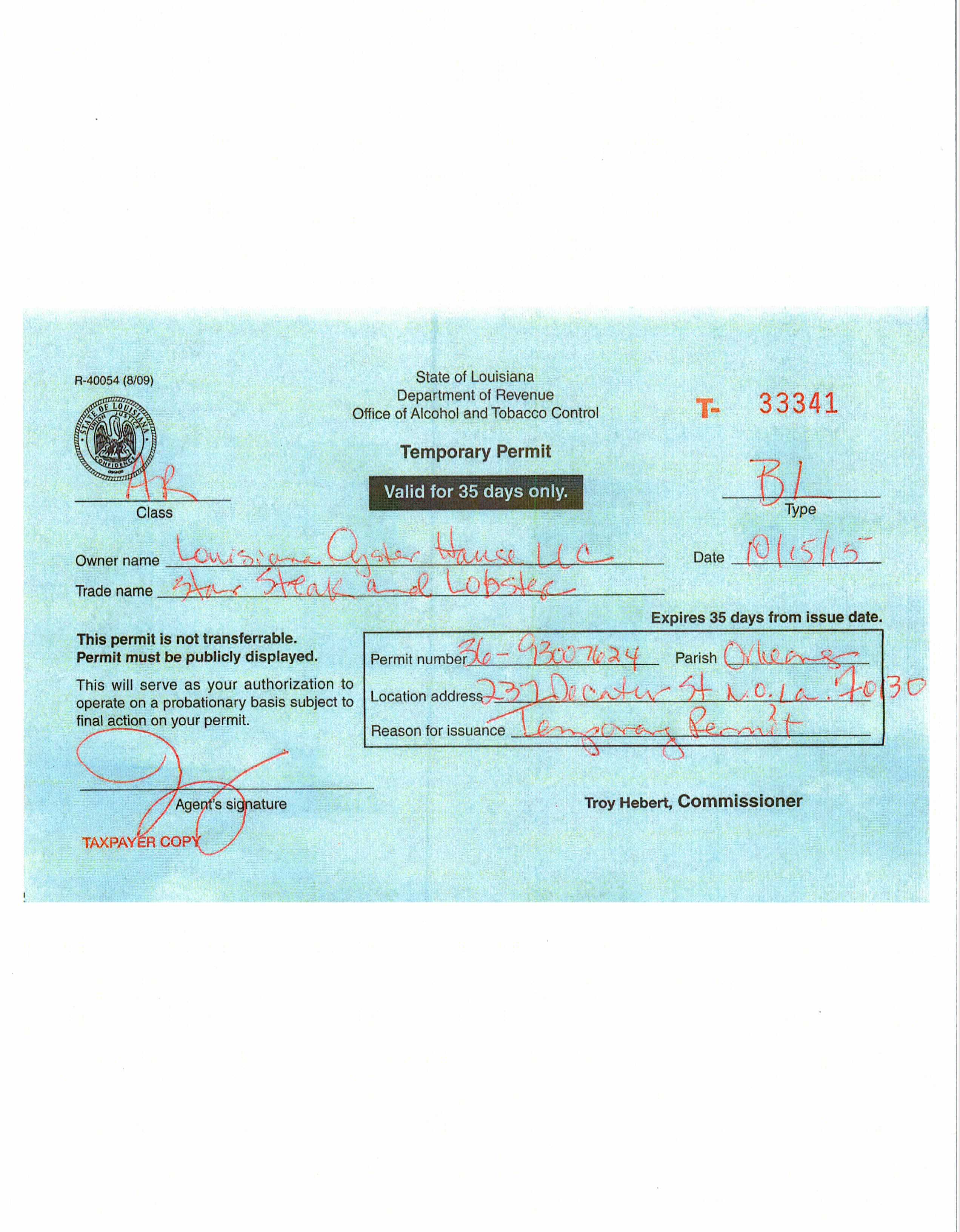
A temporary permit was in fact issued on Sept. 11, according to records obtained from ATC offices in Baton Rouge. Subsequent temporary permits were issued on Oct. 15 and Nov. 20. Each permit was marked “Valid for 35 days only.” SEPT. TEMPORARY PERMIT

OCT. TEMPORARY PERMITNOV. TEMPORARY PERMIT

And while each of the temporary permits bore the name and title of ATC Commissioner Hebert, the person who signed each of them was Judy Pontin, executive management officer for ATC’s New Orleans office.

Pontin is the sister of Chris Young, a New Orleans attorney who represents bar and restaurant owners before ATC and who is a lobbyist for the Beer Industry League of Louisiana. Another brother is John Young, former Jefferson Parish President and unsuccessful candidate for lieutenant governor in last fall’s statewide election. Pontin was hired by Hebert on Nov. 4, 2013 at a salary of $71,000. JUDY PONTIN

JUDY PONTIN

On Jan. 6, just four days before he left office, Hebert issued a second “Commissioner’s Findings and Order” on the restaurant but this time he wrote, “After reviewing the evidence and all relevant testimony, the Commissioner finds the following:

“There is not sufficient evidence (emphasis ours) to support the finding that the permittee did violate the provisions of:

  • LA R.S. 26:75 & 26:275—Proper Permit not held;
  • LA. R.S. 2691B & 26:287B—Failure to Pay Sales Tax. DISMISSAL LETTER PAGE 1DISMISSAL LETTER PAGE 2

“It is hereby ordered that this matter be dismissed,” he wrote as one of, if not the final act in his capacity as ATC commissioner.

There followed on last Wednesday (Jan. 20), a flurry of several quick emails pertaining to the application process for renewal of the restaurant’s license, a development that does not square with Hebert’s claim that the restaurant had closed. The first, at 9:52 a.m., was a forward from ATC attorney Linda Pham to fellow attorney Jacqueline Wilson of an earlier (8:18 a.m.) message from a Lorie Hebert and given “high importance,” which said, “I received a phone message from an atty. David Corkern about this mandatory case set for today at 2:30 p.m.” The reference was to the license for Star Restaurant and Corkern was the attorney for manager Sarah Palmer.

At 9:31 a.m., Pontin forwarded a pdf attachment to Wilson and at 10:04 a.m., Pontin sent an email to Palmer saying, “Please see attached the 2015 renewal application we discussed as per or (sic) phone conversation. If you have any further questions please do not hesitate to call. That was likely the same attachment that Pontin had sent to Wilson at 10:04 a.m.

The anonymous source, who has sent 11 separate emails to date, said she had seen text messages from Hebert to Palmer and “there are witnesses who followed their dinners.”

Seven of her emails were sent between Dec. 18 and Dec. 27. Then her messages went dark before suddenly resuming on Saturday (Jan 23). “I have stayed clear because FBI is now actively involved,” she said on Saturday by way of explaining why her communications ceased for nearly a month. “They have made contact with Palmer and have seized photos, emails and text messages,” she said.

“The FBI now has evidence but is expanding (its) investigation further,” she said. “The investigation (is) going in this direction: Hebert makes trouble for a business. Then his number-one assistant Judy (Pontin), maiden name Young, sister to (attorney) Chris Young, sends word to (the) targeted business to hire Chris Young and pay big fees to get them off Hebert’s radar. Once Young is hired (and the) fee paid, problem disappears. Once (the) deal is done, Chris Young calls his sister Judy in Hebert’s office and the coverup begins.”

Asked how she knew Palmer, she said simply, “She is a girlfriend of mine.”

Tomorrow: LouisianaVoice examines political contributions by New Orleans strip clubs which were passed over in ATC’s “Operation Trick or Treat” sweep of the French Quarter in October.


Read Full Post »

When Louisiana State Troopers Association (LSTA) legal counsel Floyd Falcon defended political contributions in the 2015 gubernatorial campaign by LSTA, he cited a 1992 legal precedent which he said permitted the activity.

Apparently he had not counted on being outmaneuvered by a retired state trooper who was perfectly able to do his own legal research to counter Falcon’s argument at last week’s hearing before the State Police Commission.

Several retired state troopers, represented by spokesman Scott Perry, a retired captain with 26 years’ experience with LSP, appeared before the commission on Thursday (Jan. 14) to voice objections to the funneling of LSTA funds through its executive director David Young.

Perry was joined by retired Lt. Leon Millet who said more than $45,000 in political contributions were made without the knowledge or consent of the LSTA membership and that the action appeared to be a violation of the state constitution and State Police Commission regulations.

Perry, on Friday, followed his Thursday verbal request for an investigation with a written request. “Please accept this correspondence as a formal request pursuant to State Police Commission Rule ‘Chapter 16, Investigations,’” he wrote. Perry asked that the commission “investigate the allegation of Prohibited Political Active, 14.2 (A) (1), 14.2 (A) (4), 14.2 (A) (8), in regards to political endorsements and contributions.

“This request is made specifically against classified members of the Office of State Police acting in their capacity as elected officers of the Louisiana State Troopers Association.”

Following Perry’s address to the commission on Thursday, Falcon told the commission it had no authority to investigate LSTA because it is a private organization not subject to oversight by the commission.

Commission members agreed but pointed out that it is empowered to investigate illegal or questionable activity by individual state troopers. The commission is the equivalent of the Louisiana Civil Service Commission which serves the dual purpose of protecting the rights of state employees and investigating illegal or improper activities by state employees.

Falcon cited the 1992 case of Cannatella vs. the New Orleans Department of Civil Service. In that case, the Fourth Circuit Court of Appeal overturned a 30-day suspension handed down to police Sgt. Ronald Cannatella for violation of a city civil service rule prohibiting political activity. http://scholar.google.com/scholar_case?case=718580336782666189&q=cannatella+v.+department+of+civil+service&hl=en&as_sdt=8000006&as_vis=1

Cannatella was president of the Police Association of New Orleans (PANO) in January 1990 when PANO decided to endorse a candidate for mayor. PANO had polled its membership beforehand and Cannatella subsequently appeared at a public forum to announce the endorsement. The appellate court noted that Cannatella believed he was acting “pursuant to what he believed was a function of his position as the president of PANO.”

The court said that while the prohibition against political activity is “exclusively limited to commissioners and classified civil service employees and officers,” the prohibition “does not extend to a labor organization such as PANO, or its spokesperson, merely because its members are classified civil service employees.”

No sooner was Falcon finished citing the Cannatella case than Perry, who now works as an investigator for the Office of Inspector General, was on his feet. Perry presented a copy of a 2001 ruling by a three judge panel of the Fifth Circuit Court of Appeal. The ruling he held, while not a legal precedent, nevertheless differed significantly with the Cannatella case and was identical to the circumstances of the LSTA action.

In the case of Kenner Police Department vs. Kenner Municipal Fire & Police Civil Service Board, five officers who signed off on a contribution check in their capacity as members of the executive board of the city police association were fired.

In the opinion written by Judge Clarence McManus, the Fifth Circuit said that while Cannatella held that members of PANO had the right to endorse a candidate without exposing the members to penalties under the civil service laws, “…Cannatella is not controlling or binding on this court, as counsel for appellants seems to suggest.”

It said Cannatella is distinguishable because it involved a different statute governed by a different provision of the constitution. “In this case the appellants are indeed classified civil service employees. Therefore, the prohibition against political activity clearly applies to them,” the decision said. But, the court noted, the officers claimed they did not individually make any campaign contributions, but rather PACK did. (PACK is an acronym for Police Association for the City of Kenner.)

The court said the appellants’ assertion that the contribution and endorsement were actions taken by PACK and not the fire appellants individually “is simply untenable. As for the contention that being members of a labor union exempts them from any and all responsibility under the civil service laws, we find this argument unpersuasive. To allow the appellants to do indirectly through the union or an association that which they cannot do directly as classified civil service employees will permit them to circumvent the statute’s prohibition.” (Emphasis ours)

The civil service board held that the campaign contribution check “was personal action taken by the officers individually, and not an action of the association,” said the appellate court in upholding their termination.  http://caselaw.findlaw.com/la-court-of-appeal/1285153.html

LouisianaVoice broke the story of the LSTA contributions on December 9. https://louisianavoice.com/2015/12/09/more-than-45000-in-campaign-cash-is-funneled-through-executive-director-by-louisiana-state-troopers-association/

In the LSTA case, Young acknowledged that he made the contributions in his name and was subsequently reimbursed by the organization.

In a statement that would seem to conflict with LSTA’s own legal counsel’s argument, Young said there were questions about the ability of state employees making political contributions. “So in order to avoid any of that,” he told the Advocate, “if I make a contribution as a non-state employee, there could never be a question later that a state employee made a contribution.”

Except there now are questions. Commission Vice Chairman W. Lloyd Grafton of Ruston observed that it “almost makes me think there was something suspect here because of the check writing. Why wouldn’t the association have made the contribution? It looks like someone was trying to circumvent something.”

Prior to that date, on Dec. 4, LouisianaVoice broke another story that State Police Superintendent Mike Edmonson attempted to prevail upon the LSTA board to write a letter to then Gov.-elect John Bel Edwards endorsing Edmonson for reappointment to lead state police for another four years.

On Nov. 30, the board voted unanimously not to write the letter. Edwards subsequently reappointed Edmonson anyway, largely on the strength of the endorsement of the Louisiana Sheriffs’ Association and the Louisiana Police Chiefs’ Association.

Edmonson twice denied that he had requested the LSTA board’s endorsement but LSTA Interim President Stephen LaFargue confirmed to LouisianaVoice, also on two separate occasions, that Edmonson asked him about the prospects of LSTA sending a letter to Edwards asking that Edmonson be reappointed.

“Col. Edmonson attended the board meeting and he told me he was going to apply for reappointment,” LaFargue said. “He then asked about the possibility of the LSTA board writing a letter of endorsement. I told him I didn’t know, that it would have to be taken up by the board.” Because of questions raised by LouisianaVoice, the board subsequently agreed unanimously not to write the letter to Edwards.

A meeting summary of a Troop I (Lafayette) affiliate meeting noted that LaFargue also “took responsibility” for the LSTA’s endorsement of Edwards in the Nov. 21 runoff election against U.S. Sen. David Vitter. Edwards defeated Vitter by a 60-40 percentage point margin.

Edwards also was one of several candidates who received contributions from LTSA. Edwards spokesman Richard Carbo told the Baton Rouge Advocate last Thursday that the governor had no knowledge that Young was reimbursed by LSTA and that Edwards would return the $8,000 received from LSTA through Young “if the contributions were made improperly.” http://theadvocate.com/news/14574305-124/head-of-state-police-group-says-nothing-wrong-with-his-political-donations-gov-edwards-said-he-will

Louisiana State Police Commission Chapter 14 to which Perry referred specifically says that no member of State Police shall:

  • Participate or engage in political activity, including, but not limited to, any effort to support or oppose the election of a candidate for political office or support or oppose a particular political party in an election;
  • Make or solicit contributions for any political purpose, party, faction, or candidate;
  • Directly or indirectly, pay or promise to pay any assessment, subscription, or contribution for any political party, faction or candidate, nor solicit or take part in soliciting any such assessment, subscription or contribution, and no person shall solicit any such assessment, subscription or contribution of any classified employee in the State Police Service.

http://laspc.dps.louisiana.gov/laspc.nsf/c4b8169248104d4286256ead0069b9bd/582526be4d41dca786256ea000667ce2?OpenDocument

So in the end, we have:

  • State police officers who comprise the LSTA board making a political endorsement in direct contravention of rules and regulations.
  • The Superintendent of State Police leaning on the LSTA board in an effort to get the board to send the new governor a letter endorsing him for reappointment.
  • The executive board of the LSTA, comprised of state police officers under the jurisdiction of the State Police Commission making the decision to make more than $45,000 in political contributions—contributions that were laundered through its non-state employee executive director—by the director’s own admission, and without bothering to poll its membership for approval.

All three of which were in violation of State Police Commission regulations.

Any questions?


Read Full Post »

Gov. John Bel Edwards hasn’t even issued the call yet for a special legislative session to deal with the state’s budgetary woes and already state lawmakers appear to have the collective attention span of a gypsy moth.

A couple of years ago, a person who knows me well (my wife) commented that after Bobby Jindal leaves office, I would have nothing to write about. She’s dead-on with most of her evaluations but with this one, she failed to take into account we still have a legislature.

That’s the body that allowed Bobby Jindal to run roughshod over this state for eight long years with hardly a peep of protest. And that’s the body that must, in the final analysis, be held accountable for the damage inflicted by Bobby.

The legislature allowed Jindal to rape higher education. It looked the other way when he gave away the state hospitals. It was shamefully mute when he closed or privatized mental health hospitals and cut funding for the developmentally disadvantaged.

No questions were asked when it was revealed on this blog that Department of Public Safety Undersecretary Jill Boudreaux picked up an extra $46,000 in spare change by taking advantage of a retirement incentive offer (along with an additional $13,000 in unused leave) in April of 2010 only to return to work the next day—at a promotion from deputy secretary to undersecretary (Funny, when Sally Clausen did that at the University of Louisiana System, the mainstream media was apoplectic).

Lawmakers blindly went along with a last-minute amendment to a bill in the closing hours of the 2014 session that would have given State Police Superintendent Mike Edmonson an additional $50,000 or so in retirement income in violation of an irrevocable decision he had voluntarily made years before that locked in his retirement. Only when LouisianaVoice stumbled upon the amendment and publicized it was action taken to rescind the amendment.

So now here we are in January of 2016, staring down the barrel of a $2 billion-plus budgetary shortfall for next fiscal year and about $700 million just to make it to the end of this fiscal year (June 30).

I’m about to make citizens angry at legislators’ lack of focus. I’m going to make women furious at lawmakers’ lack of sensitivity towards equal pay for them. I’m about to make those struggling to feed a family on minimum wage wonder (actually, they’ve never stopped wondering) if anyone in elective office even cares. And I’m about to send state employees who have gone for years without a pay raise into orbit.

And no matter which group you fall into, you can look to the legislature as the cause of your continued struggles.

And just so you don’t forget, I want to remind you that it is legislators like Senate President John Alario (R-Westwego) who use not their own money, but campaign contributions to dine at the finest New Orleans restaurants, purchase season tickets to LSU athletic events and to Saints and Pelicans pro football and basketball games, and to lease luxury vehicles like BMWs and Mercedes. Others use funds to pay fines for campaign violations (the ultimate irony) and to even pay personal federal income taxes as well as to purchase season tickets to athletic events.

The Baton Rouge Advocate on Wednesday (January 13) ran a front page story about Legislative Fiscal Officer John Carpenter’s attempt to convey to House members just how severe the state’s financial plight really is.

So the House members were riveted to Carpenter’s presentation, hanging onto every word, right?

Wrong. Elizabeth Crisp, writing for The Advocate, said the budget talk was “met with mild interest” from members “who mingled about and talked throughout the more than two hours of presentations.” http://theadvocate.com/news/14553820-123/state-house-members-hear-gloomy-budget-outlook

The chamber was called to order, she said, in an attempt to quiet the “loud chatter” and some members posed questions in an attempt to get fellow members’ attention, “though it had little effect,” she wrote.

What the hell? I mean, WHAT THE HELL?

Did we send a bunch of juvenile delinquent dumbasses to Baton Rouge to party and have a good time at taxpayer expense? Apparently so.

If these legislators had kids who got their hands on dad’s credit cards and maxed them out and the kids started chattering and laughing during the lecture on fiscal responsibility that followed, dad would—and should—jerk a half-hitch in them. We, in our parental roles, should remind these jerks, these spoiled brats in no uncertain terms why they were elected.

Remember State Sen. Neil Riser (R-Columbia)? He’s the one who slipped the infamous Edmonson Amendment in during the closing hours of the 2014 session. That was the amendment that would’ve kicked Edmonson’s retirement up by some $50,000.

Well, guess what? Though he was frothing at the mouth to get Edmonson his money in 2014, he went on record today (January 13, 2016) as opposing any increase in the minimum wage. Greg Hilburn, writing for the Monroe News-Star, quoted the incoming chairman of the Senate Labor Committee as justifying his opposition to an increase: “The Louisiana economy is struggling,” he sniffed.

Well, DUH!

Yes, Senator, the economy is struggling. When you have people trying to exist on $7.25 an hour, they’re going to struggle. They won’t be able to purchase appliances, cars, or homes, the very consumer products that drive the economy. Where did you get your economics degree, Senator? Oh, that’s right, I forgot. You run a couple of mortuaries. Do they teach economics in embalming school? I bet you don’t pass up an opportunity to increase prices on those shiny coffins, do you? How much do you charge for a funeral today as compared to say, ten years ago? Five years ago? One year? Betcha a dollar to a doughnut those rates haven’t remained stagnant.

There was no one in Louisiana more skilled than C.B. Forgotston at chronicling the antics of those he referred to as the leges. C.B. sadly is no longer with us, so it falls to those of us who can only aspire to his observational skills to keep Louisiana’s citizens abreast of the shenanigans of the 144 members of the Louisiana House and Senate.

With that said, here’s another reason the economy in Louisiana is struggling: Women in Louisiana, on average, make 66 cents for every dollar paid a man for the same job. Where is the equity in that, Senator?

Here’s a news flash for you. Politico Magazine has just issued its annual “States of our Union” report. Any guesses as to where Louisiana ranks?

If you said 50th, you would incorrect. We’re 51st. It seems the District of Columbia was also included in the rankings (coming in at 39th overall).

There’s a thing called the Gini coefficient, or Gini index, factored into the rankings. The Gini coefficient is a measure of statistical dispersion intended to represent income distribution, or more accurately, to reflect income disparity (the gap between the haves and the have-nots).

In that measure, the District of Columbia is the worst but we’re not far behind. We have the nation’s fourth-worst income inequality. But Neil Riser doesn’t want to increase the minimum wage.

Here are a few other rankings that contributed to the state’s overall anchor position:

  • Per capital income: 11th worst at $24,775;
  • Unemployment rate: 6th worst at 6.3 percent;
  • Percentage of population living below poverty level: 3rd worst at 19.8 percent;
  • Percentage of high school graduates: 3rd worst at 83.6 percent;
  • Life expectancy at birth: 4th worst at 75.7 years;
  • Infant deaths per 1,000 births: 5th worst at 7.49.

And just for good measure, another survey shows that Louisiana is the sixth most violent state in America with 514.7 violent crimes per 100,000 population. The state’s murder rate (10.3 per every 100,000 residents) is the highest in the nation and more than double the national rate (4.5 per 100,000 people). http://247wallst.com/special-report/2016/01/12/the-10-most-dangerous-states/2/

Statistics provided by the U.S. Department of Justice show a direct correlation between poverty and crime. http://www.bjs.gov/index.cfm?ty=pbdetail&iid=5137

But let’s not raise the minimum wage, Senator.

Here’s the real irony with Riser: he represents one of the poorest senatorial districts in the state which means he is undermining the interests of his own constituents. Could it be he does not want to pay his employees more?

At least Edwards has signed an executive order expanding Medicaid which will provide health care to some 300,000 citizens who were denied it under the Jindal administration.

And finally, for those state employees who have gone without raises, I’m sure by now you are well aware that state troopers received back-to-back raises totaling some 30 percent over a six-month period last year. http://theadvocate.com/news/legislature/12940806-123/state-troopers-get-hefty-back-to-back

But did you know that Edmonson is working quietly behind the scenes to implement an automatic annual pay increase for state troopers in addition to the usual merit raises (which, we need not remind you, have been denied other state employees)?

That’s right. He calls it a “longevity” increase and if he is successful, it will give state troopers, many of whom already make six-figure incomes, automatic raises each and every year, merit be damned. Longevity means by virtue of hanging onto one’s job, troopers get automatic raises.

While state employees may belong to a union (The American Federation of State, County and Municipal Employees—AFSCME—is the main player), state civil service rules prohibit state employees from striking. But why not a state employee association? That’s a pretty benign term. We have RSEA, the Retired State Employees Association of Louisiana. Members pay their own dues and a state employee association could be set up in the same manner. No one has the authority to ban an employee association—especially if there is no payroll deductions for dues. And for the more sensitive types, it removes the stigma of the word union from the discussion. (People forget, however, that it was unions’ efforts that ended child labor in oppressive sweat shops. Unions gave us the 40-hour work week. They fought for a minimum wage and for our retirement and medical benefits. And it was unions that led the fight for equal rights for women and minorities. We should never lose sight of those facts because unions, like ’em or not, were instrumental in creating America’s middle class that Republicans seem hell-bent on eliminating.)

An association, after all, would only be a large social club—sort of like that other organization…what’s it called? Oh, yeah, the Association of Louisiana Lobbyists. Or maybe the Fraternal Order of Police.

And such an association would never call for a widespread sickout of state employees in order to make a point (wink, wink) on an issue like say, longevity pay increases for state police while civil service employees continue without even cost of living increases for years on end.

Seriously, if leges (with apologies to C.B.) don’t get their collective heads out of… (and we’re not talking about sand here), they will end up creating just such an organization. People (teachers, state employees, women, minorities—all voters, mind you) are tired of being dumped on. They’re tired of patchwork budgets, tired of legislators turning deaf ears on their problems, tired of the elitist attitudes and campaign-funded perks of the power structure.

They want solutions and the leges would be wise to pay attention in class and to take their jobs seriously—or get out so someone else will.


Read Full Post »

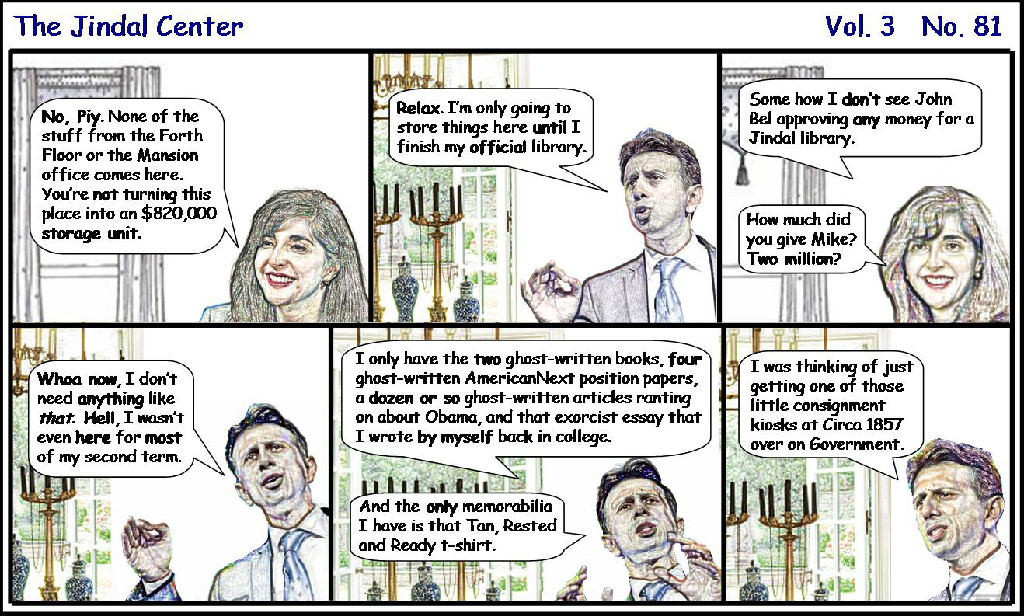
JINDAL MEMENTOES

(CLICK ON IMAGE TO ENLARGE)

Did Bobby Jindal take one last opportunity to defy a state law on his way out the door this week?

Technically, he may have.

Consider the wording of Senate Bill 190 by State Sen. Dan Claitor (R-Baton Rouge):

The legislature recognizes that it is essential to the maintenance of a democratic society that public business be performed in an open and public manner, and that the citizens be advised of and be aware of the performance of public officials and the deliberations and decisions that go into making public policy. Toward this end, the provisions of this Section, as well as the rest of this Chapter, shall be construed liberally so as to facilitate, rather than hinder, access to public records.

SB 190 was signed into law by Bobby Jindal as Act 145. The bill was designed to lift the veil of secrecy on documents originated by Louisiana’s governors. The new law applies to all documents generated by the governor, his chief of staff, deputy chief of staff and his executive counsel. http://www.legis.la.gov/legis/ViewDocument.aspx?d=959869

Records of the office of the governor relative to fiscal or budgetary matters, Including, but not limited to records of communications between the legislative auditor’s office and the office of the governor relative to fiscal or budgetary matters, shall be public records.

It exempts for eight years intra-office communications by the governor’s staff.

Record(s) of the office of the governor relating to intra-office communications of the governor and his internal staff may be privileged from disclosure.

But after eight years, even those intra-office communications between staff members shall become public, according to the act.

Any exemption granted by this Section shall lapse eight years after the creation of the record to which the exemption is applicable. After the lapse of eight years, the records of the office of the governor, as maintained by the state archivist and deposited with the state archives program pursuant to R.S. 44:417, shall be public record.

Most important of all, the bill, which became law effective at 12:00 noon on Monday, requires that the governor and his staff preserve all records generated and originated within the executive branch and to transfer all records to the archives division of the secretary of state.

The governor and his internal staff shall preserve all records to which this Section is applicable and at the conclusion of his term of office, the governor shall transfer all such records to the custody of the archives division of the secretary of state. For purposes of this Section, “internal staff” of the governor includes the governor’s chief of staff, deputy chief of staff, executive counsel, and director of policy, but shall not include any employee of any other agency, department, or office.

All this sound well and good. Others had tried and failed to shed the light of public disclosure on the governor’s office. Similar bills had either died a quiet death in committee or, if passed, were vetoed by Jindal.

So how did Claitor’s bill manage to obtain Jindal’s signature enacting it into law?

Well, for starters, it was passed as Jindal’s term was winding down. But even then, word is that Jindal said he would veto Claitor’s bill if it were to take effect while he still occupied the fourth floor of the State Capitol.

So in effect, what Jindal was saying was transparency was a grand and wonderful thing so long as it did not apply to him. It was fine and dandy for his successor to be held accountable but he was determined to veto the bill if it took effect while he was still in office.

No problem, he was assured. The bill would go into effect at precisely 12:00 noon on Monday, January 11, 2016. Jindal was scheduled to leave office exactly one minute later.

The only problem was, the program ran a little late on inauguration day and John Bel Edwards did not actually take the oath of office until 12:25 p.m.

Meanwhile, throughout the weekend leading up to this week’s inauguration ceremonies, Jindal’s minions were frantically deleting thousands of emails in the governor’s office at across the street at Division of Administration.

Obviously, Jindal felt he would no longer be in office when the bill became law and thus exempt from its provisions.

But technically, he remained in office for nearly a half-hour after the new law took effect. Therefore, he was bound by the dictates of the new statute and by deleting those thousands of emails, he was in flagrant violation of the very bill that he signed into law a scant six months earlier.

The provisions of this Act shall be given prospective application only. Any record having been used, being in use, possessed, or retained for use by the governor in the usual course of the duties and business of his office prior to the effective date of this Act shall be subject to the provisions of (the law) as it existed prior to the effective date of this Act.

Granted, many of the emails may well have been mundane in nature. Who cares, after all, what the office staff will order up to the fourth floor of the State Capitol for lunch? But others were certainly germane to the administration of state government and by deleting them, it can only make the job of Jindal’s successor more difficult.

Claitor, contacted about the procedural violation, said he was not surprised. “The administration’s pages on the state website were disappearing, too,” he said.

“In my mind,” he said, “his actions certainly violate the spirit, if not the letter of the law.”

It seems somehow ironic that Jindal’s devious, scheming tactics would in the end expose him to potential prosecution for the illegal dumping of eight years worth of emails.

The term poetic justice also comes to mind.

Read Full Post »

« Newer Posts - Older Posts »