Feeds:
Posts
Comments

Archive for the ‘Politicians’ Category

Bobby Jindal and former Director of the Louisiana Office of Workers Compensation (OWC) Wes Hataway are gone but a court decision late last month could represent a legal smack down of the way workers’ compensation claims have been handled since July 13, 2011, Jindal’s third year in the governor’s office.

The ruling by 19th Judicial District Judge Don Johnson takes direct aim at a law pushed through the Louisiana Legislature and which set up new medical treatment guidelines for injured workers which plaintiffs said violated the due process clauses of the state and federal constitutions.

In his WRITTEN REASONS FOR JUDGMENT, Judge Johnson struck down provisions which:

  • Stipulated that when a carrier/self-insured employer fails to return LWC forms within the five business days it is deemed to have denied such request for authorization;
  • Provided an automatic “tacit denial” of medical treatment;
  • Allowed OWC to enforce variances from medical treatment guidelines;
  • Denied treatment not covered by medical treatment guidelines;
  • Allowed the OWC a workers compensation carrier to arbitrarily submit—and the OWC medical director to accept—any information it desires without notifying the injured worker of the “evidence.”

The suit was brought against the Louisiana Workforce Commission (LWC) in 2013 by attorney Janice Hebert Barber and several physicians and injured workers who were denied benefits under the new law. Baton Rouge attorney J. Arthur Smith III represented each of the plaintiffs. Also named as defendants were LWC Secretary Curt Eysink, Hataway, and former OWC Medical Director Dr. Christopher Rich.

Barber said the regulations also discriminate against injured workers in that:

  • Medical benefits were denied to injured workers because their physicians could not return calls from Rich’s staff as quickly as they liked;
  • One request for medical treatment was denied because the injured worker’s attorney submitted too many pages of records to Rich;
  • Another request for treatment was denied because the case itself was 12 years old;
  • Numerous requests for treatment were denied because Rich claimed they were submitted by “bad doctors” who were “bad” only because they were too favorable to their patients, in Rich’s opinion;
  • Requests for medical procedures were denied on the basis of who owned the medical equipment which would be utilized for the procedure;
  • As of December 2012, Medical Director Rich had approved only 14 percent of all requests for medical treatment of injured workers in cases where compensability had already been determined;
  • Rich had denied requests for medical treatment in cases in which he never even spoke to the claimants;
  • Hataway repeatedly engaged in ex parte communications with attorneys and others representing workers compensation insurance carriers and self-insured employers;
  • Hataway and his staff repeatedly expressed the Jindal administration’s “positions” on issues to be litigated by workers compensation judges to the judges themselves.

Barber said in her lawsuit that the new regulations had “enriched workers’ compensation insurance carriers and has harmed injured workers in Louisiana.” She claimed that under the new regulations, the Louisiana Workers’ Compensation Corporation (LWCC), the state’s largest workers’ compensation carrier, more than doubled premium dividend payments to Louisiana employers than were paid the year before the new law went into effect.

When Jindal named his four nominees to the University Medical Center Management Corp. Board back in March of 2010, he not only was looking after some of his more generous campaign contributors, but he also placed one of them in a position of potential conflict of interest.

At the time of his appointment as medical director, Dr. Christopher Rich of Alexandria currently held three separate contracts with the state totaling more than $3.3 million and he had already run into ethical problems with one of those contracts.

Rich also was named by Jindal as one of four nominees for the proposed billion-dollar University Medical Center that was to serve as a replacement for the 70-year-old facility that was closed after its basement was flooded during Hurricane Katrina in 2005.

Like many of Jindal’s high-profile appointees, Rich, his wife Vickie and business partner Dr. Mark Dodson, also of Alexandria, combined to contribute $9,500 to Jindal’s campaigns in 2007, 2010 and 2011.

Rich had a $516,646 contract to serve as Medical Director of the Office of Workers’ Compensation (OWC) Administration that called on him to approve or disapprove medical treatments and procedures for the Office of Workers’ Compensation.

That contract is actually to Chrickie Investments, a company owned by him and his wife.

In 2009, the Louisiana Legislature passed a law which changed the process for determining whether or not medical treatment was “medically necessary.” If a workers’ comp insurance company denies a treatment request, the denial is referred to the OWC medical director, in this case, Rich.

Though the law was passed in 2009, problems with implementing the rules to enforce the new law delayed the actual enactment date of the law until July 13, 2011.

Rich testified before the House Labor Committee that he was “denying 80 percent” of all treatment requested.

At the same time he was contracted to be the sole determiner of all medical treatment for Louisiana’s injured workers, he and Dodson were partners in Louisiana Ortho Services which held a $2.3 million contract to provide orthopedic services for the state, specifically Huey P. Long Medical Center.

Huey P. Long Medical Center (HLMC) at the time was one of 10 state hospitals that made up the LSU Health Care System which is administered by the LSU Board of Supervisors which also oversees the University Medical Center Management Board on which Rich sits. HLMC was subsequently shut down by the Jindal administration.

Because he also owned an interest in Central Louisiana Surgical Hospital which also provided medical treatment to injured workers, the question of his eligibility to make decisions on medical treatment which could financially impact the hospital as well as Mid-State came before the Louisiana Board of Governmental Ethics on separate occasions.

In March 2011, the ethics board ruled that Rich was prohibited, in his capacity as Medical Director of the Office of Workers’ Compensation, from participation in any matter involving Central Louisiana Surgical Hospital.

In January 2012, however, a second opinion said there was no conflict since he had terminated his relationship with Mid-State—only six months since the state had awarded Louisiana Ortho, that $2.3 million contract. Though he no longer is affiliated with Mid-State, he remains a partner in Louisiana Ortho with Dodson who in turn remains as a partner with Mid-State. The timing and the connections, to say the least, are curious.

Rich and Dodson also were partners in a company called ACTIVEMED, Inc., which held a $523,000 contract to provide orthopedic medical services to Northwestern State University student athletes.

Activemed also provided secondary insurance, also known as a preferred provider network (PPN) for two Louisiana university college sports teams and athletes. Basically, the athletes’ primary health insurance is the first payor for sports-related injuries. Then, if the student treats with an Activemed provider and they are enrolled with Activemed, then Activemed picks up the tab for the remainder of the treatment.

This means that Drs. Rich and Dodson had direct control over which doctors Activemed refers injured students to and if those same doctors happen to treat any Louisiana workers’ compensation patients, there existed a potential conflict of interest for Rich.

Activemed’s internet web page contains no list of medical providers, nor is Activemed listed under the Louisiana Department of Insurance either as an insurance company, a third party administrator (TPA), or an adjusting company.

Read Full Post »

Here’s a story no one saw coming:

There’s political chicanery afoot in Baton Rouge.

Who’d-a-thunk it?

Okay all that was said tongue-in-cheek.

Unfortunately.

The truth is, we’ve become so inured to political sleaze in Louisiana politics that it’s become difficult to be either surprised or outraged, leaving only indifference as our emotion of choice.

All the ingredients are in place for graft, corruption, and exploitation and there are plenty of those more than willing to take advantage of the opportunity:

  • A contract to manage Louisiana’s flood recovery program worth anywhere from 16 percent to 22 percent of $1.6 billion in federal funds;
  • A former state senator, Larry Bankston, convicted two decades ago on two counts of racketeering who now advises the State Contractor Licensing Board that has managed to insert itself into the debate over the proposed contract;
  • Claims of bid irregularities by a losing bidder;
  • Support of that claim by Bankston who neglected to mention that his son worked for one of the losing bidders;
  • Cancellation by the state of the $250,000 contract so that it may be re-advertised;
  • A potential 2019 gubernatorial candidate questioning the propriety of Bankston’s employment by that state board;
  • Up to 150,000 homes and nearly half-a-million residents affected by Louisiana floods in 2016, many of whom are still waiting for the political inertia called Restore Louisiana to start things moving so they can get back into their flooded homes.

Anytime there’s big money involved, especially federal money, the potential always exists for political and legal jockeying and manipulation. The temptation can be overwhelming.

Stephen Winham recently wrote a column for LouisianaVoice on this very subject: https://louisianavoice.com/2017/03/18/forget-blaming-fema-guest-columnist-area-reporters-correctly-place-fault-with-state-for-flood-recovery-failures/

The fact that the plight of the state’s flood victims has been obscured, seemingly forgotten, in the process of too-long delayed recovery only makes the state of affairs all the more shameful and disgusting. But when you have no voice, you are quickly forgotten in the scramble for big bucks.

And the bigger the bucks, the more greed manifests itself. And the more the greed, the less focus there is on the victims. That’s the way it’s always been and apparently that’s the way it will always be.

And hardly addressed is the issue of just what the deliverables on such a contract would be. Here we have companies crawling all over each other in order to obtain a contract which represents 20 percent of the total allocation for flood recovery.

And those companies won’t put up the first piece of drywall or sheetrock. They won’t perform any plumbing or electrical work. They won’t install any flooring or apply the first coat of paint, nor will they hammer the first nail. In short, they will do nothing meaningful toward flood recovery other than to approve payments to those who do the actual work.

But they will collect up to 20 percent of the recovery money—likely more if they can succeed at the usual practice of coming back for a contract amendment a few months down the road.

This story has received fairly significant play in the Baton Rouge area but if you’ve not kept up with The Advocate’s coverage, here’s essentially what has transpired:

A team led by IEM, a North Carolina company affiliated with several Baton Rouge engineering and consulting firms, easily had the best score—by at least 16 points—among the five teams submitting proposals and also quoted the lowest price—$250 million.

But PDRM, led by CSRS of Baton Rouge, whose bid was $65 million higher, filed an official complaint with the State Licensing Board for Contractors, pointing out that IEM did not possess a commercial contractor’s license at the time of its bid.

The Request for Proposals issued by the state, however, said only that bidding companies had to possess a license or be able to obtain one. IEM did, in fact, obtain a license prior to the time bids were opened. Ironically, PDRM, the company which blew the whistle on IEM, did not possess a contractor’s license at the time it submitted its bid either.

Bankston, legal counsel for the licensing board, opined that eligible bidders needed a contractor’s license at the time of bid submissions—and the licensing board agreed. The following day, March 17, the state decided to CANCEL IEM’s contract and re-bid the project.

By offering the opinion that he did, apparently disqualifying both IEM and PDRM in the process, the winning bid would have then gone to the third lowest bidder had not the administration decided to pull the plug on the whole thing and start over.

That third company whose bid was $350 million, $100 million higher than IEM, was Rebuild Louisiana Now and was led by a Texas firm called SLS. SLS also owns a company called DRC Emergency Services. Bankston’s son, Benjamin Bankston, works as regional manager for DRC. Larry Bankston said he was unaware his son’s firm had any relationship to any of the bidding companies when he wrote his opinion.

DRC had its own legal problems back in 2012 over payments and gratuities the company was accused of giving former Plaquemines Parish Sheriff Jiff Hingle after the firm received two CONTRACTS from the then-sheriff totaling more than $3 million.

In March 2002, the Louisiana Supreme Court REVOKED Bankston’s law license after his conviction on two counts of racketeering in 1997 in connection with then-State Sen. Bankston’s sham rental of his Gulf Shores condo to video poker operator Fred Goodson for $1,555 per week.

Bankston’s conviction was UPHELD by the U.S. First Circuit Court of Appeals in July 1999.

Contracting board Chairman Lee Mallett of Iowa, said he retains “full confidence” in Bankston.

Louisiana Attorney General Jeff Landry DISAGREES. But Landry’s desire to run for governor against John Bel Edwards in 2019 is the worst-kept secret in Baton Rouge, so he’s going to do and say anything he can to embarrass the governor.

U.S. Rep. Garret Graves, also being mentioned as a potential opponent for Edwards in two years and who was instrumental in obtaining federal flood recover money for Louisiana, also takes issue with the decision to cancel the IEM contract and to start the bid process all over.

“This is very disappointing news,” Graves said, adding that the decision will only serve to further delay needed flood relief funds. “It is impossible to explain to flood victims why $1.6 billion in recovery dollars are stuck in the bureaucracy while homes remain gutted, molded and uninsulated.”

Graves said obtaining the federal money “wasn’t easy and now every time we talk to the Appropriations Committee and leadership folks, they cite the fact that we haven’t spent what we already received. It’s a concern absolutely.”

That politicians, lawyers and contractors would put their own interests ahead of those of people who have been forced out of their homes—some for a year now—only serves to drive home the point that while there has been a change of administrations in Louisiana, nothing really has changed.

Yep, there’s political chicanery afoot in Baton Rouge.

Who’d-a-thunk it?

Read Full Post »

A question for Public Service Commissioner Mike Francis:

How much is enough?

And that’s not a rhetorical question. We really want to know what your limits are.

According to Francis, a wealthy man in his own right, he should be entitled to a free lunch.

Literally.

You see, the political campaigns of Public Service Commission (PSC) members, the Louisiana Insurance Commissioner and judges at every level are financed in large part by the very ones they regulate or do business with on a daily basis.

But apparently that association is not cozy enough for Francis, who wants to remove all restrictions on accepting free meals from representatives of utilities, motor carriers, and others regulated by the PSC.

Granted, the PSC purports to hold itself to a higher standard than actual ethics rules allow. Legally, elected officials are allowed to accept up to $60 per day in food and beverage under the guise of “business” lunches or dinners. But, as Baton Rouge Advocate columnist and resident curmudgeon JAMES GILL writes, the PSC, at the urging of members Foster Campbell and Lambert Boissiere, rammed through a rule barring all freeloading.

That didn’t sit well with Francis, who is financially solvent enough to daily feed the entire commission out of his petty cash account.

Saying he wanted the commission to be run like a business, he sniffed that a working lunch is “pretty standard procedure in the real work world.”

Our question to Francis then is this: since when is government run like a business? Businesses are run to make a profit; government is run to provide services for its citizens. The two concepts are like the rails on a railroad track: they never cross though they often do appear to converge.

And then there is our follow up question to Mr. Francis: isn’t it enough that you manage to extract huge sums of money from the industries you regulate in the form of campaign contributions? Why would you need a free lunch on top of that?

After all, your campaign finance reports indicate you received $5,000 from AT&T, $5,000 from ENPAC (Entergy’s political action committee), $5,000 from Atmos Energy Corp. PAC, $2,500 from the Louisiana Rural Electric Cooperative, $2,500 from Dynamic Environmental Services, $2,500 from ADR Electric, $2,500 from carbon producing company Rain CII, $2,500 from Davis Oil principal William Mills, III, $2,500 each from Jones Walker and the Long law firms, each of whom represents oil and energy interests. There are plenty others but those are the primary purchasers of the Francis Free Lunch.

LouisianaVoice would like to offer a substitute motion to the Francis Free Lunch proposal. It will never be approved, but here goes:

Let’s enact a law, strictly enforced, that will prohibit campaign contributions from any entity that is governed, regulated, or otherwise overseen by those elected to the Public Service Commission, the Louisiana Insurance Commission, judgeships at all levels, Attorney General, and Agriculture Commissioner.

  • No electric or gas companies, oil and gas transmission companies, or trucking and bus companies or rail companies could give a dime to Public Service Commission candidates.
  • Lawyers would be prohibited from contributing to candidates for judge or Attorney General.
  • Insurance companies would not be allowed to make contributions to candidates for Insurance Commissioner.
  • Likewise, companies like Monsanto, DuPont, Dow, Syngenta, Bayer and BASF, who control 75% of the world pesticides market, and Factory farms like Tyson and Cargill, which account for 72 percent of poultry production, 43 percent of egg production, and 55 percent of pork production worldwide, could no longer attempt to influence legislation through contributions to candidates for Agriculture Commissioner.
  • Members of the Board of Elementary and Secondary Education (BESE) could no longer accept contributions from individuals or companies affiliated in any way, shape or form with education.

While we’re at it, the Lieutenant Governor’s office oversees tourism in the state. In fact, that’s about all that office does. So why should we allow candidates for Lieutenant Governor to accept campaign contributions from hotels, convention centers, and the like?

This concept could be taken even further to bar contributions from special interests to legislators who sit on committee that consider bills that affect those interests. Education Committee members, like BESE members, could not accept funds from Bill Gates or from any charter, voucher or online school operators, for example.

Like we said, it’ll never happen. That would be meaningful campaign reform. This is Louisiana. And never the twain shall meet. The American Legislative Exchange Council (ALEC) would see to that.

But wouldn’t it be fun to watch candidates scramble for campaign funds if such restrictions were to be implemented?

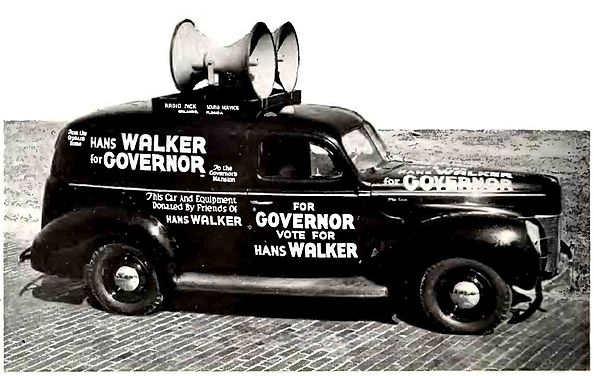
We might even see a return of the campaign sound trucks of the Earl Long era rolling up and down the main streets of our cities and towns after all the TV advertising money dries up.

Ah, nostalgia.

Read Full Post »

“No good deed goes unpunished.”

“Karma’s a bitch.”

“What goes around comes around.”

No matter how you say it, good intentions sometimes bring unjust punishment and sometimes those good intentions result in very bad results.

Just ask Donald Broussard of New Iberia.

Last July 8, Broussard was rear-ended in Lafayette Parish by a hit-and-run driver who minutes later collided head-on with an 18-wheeler in adjacent Iberia Parish and was killed.

Yet it was Broussard who was indicted by an Iberia Parish grand jury last week for NEGLIGENT HOMICIDE.

You are probably thinking about now that there has to be more to this story—and you’re right, there is more to it.

You see, Broussard did the unpardonable: On July 1, a week before the auto accident, Broussard was the impetus behind a RECALL of Iberia Parish Sheriff Louis Ackal.

Broussard was one of the organizers of the Justice for VICTOR WHITE III Foundation which filed a petition last July 1 to force a recall election.

White, you may recall, was the 22-year-old who died of a gunshot wound while in the back seat of a sheriff deputy’s patrol car in March 2014. The official report said the gunshot was self-inflicted. The coroner’s report said he was shot in the front with the bullet entering his right chest and exiting under his left armpit. White’s hands were cuffed behind his back at the time.

Ackal, of course, skated on that issue and was later indicted, tried and acquitted on federal charges involving beating and turning dogs loose on prisoners, proving beyond any lingering doubts that he is a force to be reckoned with. But when you’ve got retired federal judge and family member FRED HAIK helping with the defense, you tend to land on your feet.

All of which brings us to the latest woes to beset Broussard.

The story in Sunday’s Daily Iberian reads, “A New Iberia man who was instrumental in the drive to recall Iberia Parish Sheriff Louis Ackal last year has been indicted for manslaughter in the aftermath of an alleged road rage incident that left a Bossier City man dead in July.”

Here’s the chronology of events:

Moments before the fatal crash, Rakeem Blakes, 24, rear-ended a Cadillac driven by Broussard at the corner of Ambassador Caffery Parkway and U.S. 90 in Lafayette Parish which is just up the road apiece from Iberia Parish.

Broussard said he followed Blakes after Blakes fled the scene when Broussard approached his car but denied that he chased Blakes. “The guy hit me,” Broussard said. “I got within 20 feet of him so I could get his license plate number. I gave it (the license number) to the (911) dispatcher and they told me to fall back, so I fell back.” Broussard said reports that he had a gun were ridiculous. “I don’t even own a gun, he said. “I told the State Police they could search my car. They just handed me my license and let me go on my way.”

Broussard said Blakes was driving erratically, causing a hazard for other drivers.

Sixteenth Judicial District Attorney Bo Duhé said the case involving Broussard was turned over to his office for review in November following completion of the LSP investigation.

In what has to be one of the most convoluted reviews of any investigation, Assistant District Attorney Janet Perrodin presented the case and the grand jury last Friday returned a true bill indicting Broussard for manslaughter and “aggravated obstruction of a highway,” which led to Blakes’ death.

Unexplained in this bizarre episode was how Broussard created an “aggravated obstruction” when it was Blakes who rear-ended him and subsequently fled the scene. Duhé, in some pretty fancy verbal footwork, said state law allows a manslaughter charge to be brought when an offender “is engaged in the perpetration of any intentional misdemeanor directly affecting the person. Aggravated obstruction of a highway is the performance of any act on a highway where human life may be endangered,” he said.

That’s one helluva stretch, Mr. DA. It’s also one of vaguest laws ever cited in bringing an indictment against someone. I mean, go back and read it.

Manslaughter: when one is “engaged in the perpetration of any intentional misdemeanor directly affecting the person.”

Aggravated obstruction of a highway: the “performance of any act on a highway where human life may be endangered.”

And we know that a district attorney can make a grand jury dance a ballet in a septic tank if he so desires. It’s all in what information is provided the grand jury and what is withheld. By those definitions, any one of us could be arrested, jailed, tried and convicted at just about any time for any perceived offense.

But we won’t be. This was tailored just for Mr. Broussard who had the temerity to take on a powerful sheriff who has shown his proclivity to exact revenge against those who would dare stand up to his authority.

Broussard’s bond on the manslaughter charge was set at $75,000 and bond for the aggravated obstruction charge was set at $10,000.

Given any semblance of justice, there’s not a chance in hell of a conviction.

But whoever said there was a semblance of justice in this ludicrous drama being played out in the heart of Acadiana?

Only the most naïve of the naïve would discount a good-ol’-boy, back scratchin’ network within the local power structure, especially if it benefits a powerful sheriff bent on revenge against an adversary. Even if that adversary  is, by all appearances, innocent of any wrongdoing other than making the sheriff angry.

The recall effort eventually failed for a lack of sufficient signatures but that doesn’t mean that Ackal doesn’t have a long memory and the propensity to call in favors from friends in the right places.

And even if the charges are dropped or if Broussard is acquitted, it’s going to cost him plenty in legal fees.

And that’s how you spell revenge when you are a ruthless sheriff who can tweak the so-called justice system to do your bidding.

Read Full Post »

If there is one thing we’ve learned in the six-year existence of LouisianaVoice, it’s that if there is a political rumor floating around out there, there is generally at least a grain of truth to it.

That’s why there was no great surprise at the faint rumblings that the Louisiana Sheriffs’ Association might be making a quiet push for the appointment of Lt. Col. Charles Dupuy to succeed Mike Edmonson as Superintendent of State Police.

Never mind that in Wednesday’s meeting during which Edmonson told his staff he was stepping down, he is said to have accused Dupuy of undermining him in the aftermath of that ill-fated trip to San Diego that ultimately proved to be Edmonson’s undoing.

(Incidentally, that schmaltzy six-paragraph formal statement issued by Edmonson on Wednesday as he announced his retirement was written not by Edmonson, but by Ronnie Jones, Chairman of the Louisiana Gaming Control Board. Apparently, Edmonson was more comfortable with a ghost writer than in formulating his own, heartfelt statement.)

But back to the appointment of a successor to Edmonson.

Gov. John Bel Edwards will make the appointment and if he’s adept at political hindsight, he will proceed very carefully with making this decision. He has already been publicly embarrassed by bending to the will of the sheriffs in reappointing Edmonson. He should be extremely careful about heeding the advice of the sheriffs a second time.

If Edwards chooses to listen to the Louisiana Sheriffs’ Association (LSA) again without giving thorough and careful consideration to the qualifications of a number of capable, better qualified candidates, he will have proven himself as much of a political hack as anyone who has ever occupied the governor’s office.

There are several things the governor should consider before rushing in to anoint Dupuy as the next superintendent:

  • Dupuy is Edmonson’s second in command and as such, is very much a part of the overall problems of low morale now plaguing LSP—brought on by the proliferation of the good-ole-boy fraternity of upper management.
  • It was the state vehicle assigned to Dupuy—a Ford Expedition, that was driven by four troopers to that San Diego conference. That necessarily means Dupuy had to have approved the use of the vehicle for that purpose.
  • One of the occupants of that vehicle, Maj. Derrell Williams submitted expense reports that contained Dupuy’s signature of approval.

Dupuy was already a captain when Edmonson was appointed superintendent by Bobby Jindal in 2008. He was promoted to major on Jan. 28, 2010, two years after Edmonson’s appointment. Less than a year later, on Jan. 10, 2011, Dupuy was moved up to Deputy Superintendent for Operations Planning and Training.

Edmonson kept Dupuy on the career fast track, promoting him again on April 9, 2012, to Assistant Superintendent and Chief of Staff. Over that timeframe, Dupuy’s salary went from $80,000 to $161,300, an increase of 101.6 percent even as state civil service employees have been denied 3 percent cost of living increases.

Nor has that largesse been limited to Dupuy. His wife, Kelly Dupuy, was a sergeant making $59,800 when Edmonson was appointed top cop. Her acceleration through the ranks has been equally impressive. She was promoted to lieutenant on Oct. 27, 2009, just three months before her husband was promoted to major. She made captain on Oct. 25, 2014, and today makes $117,000 per year. That computes to a 95.6 percent pay increase since 2009.

Moreover, the current positions held by Kelly Dupuy and Edmonson’s brother, Maj. Paul Edmonson, did not exist before their respective promotions; their positions were created especially for them to be promoted into in the same manner in which a lieutenant colonel’s position was created last August at the specific request of Mike Edmonson on behalf of Jason Starnes.

If all that is not reason enough to give pause to Edwards in his decision on a successor to Edmonson, consider that Dupuy was Edmonson’s hatchet man when Edmonson literally tried to destroy the career of one of his troopers over a largely manufactured incident in 2010—all because the trooper had been involved in a previous confrontation with Dupuy. https://louisianavoice.com/2014/08/21/a-word-of-caution-to-state-troopers-dont-anger-the-powers-that-be-if-you-dont-want-legal-problems-like-case-from-2010/

So now the apparent frontrunner for Edmonson’s job is Charles Dupuy. He is being supported by the sheriffs and the sheriffs have the ear of the governor. From our vantage point, it would seem that Dupuy is positioned perfectly to move into Edmonson’s chair and to wreak havoc on those he thinks may have been our sources.

And while it’s a point of some smug satisfaction to know that the people he suspects are not our sources (he’s not even close), it concerns us that he would use his newfound power and his vindictiveness to go after innocent people who have done nothing more grievous than to try to do their jobs in an honest, straightforward manner.

And nothing will have changed. The for sale sign will still be a fixture at LSP headquarters.

So, Gov. Edwards, be very careful. You have already made two serious mistakes in listening to the LSA and by acceding to its wishes in reappointing Edmonson and Secretary of the Department of Public Safety and Corrections Jimmy LeBlanc. The situation there is every bit as much a ticking time bomb as LSP. You can ill-afford another Angola scandal and you certainly do not need to appoint someone at LSP who is just going to be a continuation of the current problems.

Without cleaning house at LSP and without making a wise appointment of a new reputable colonel with no political baggage, you will only be setting yourself up for more political problems that you don’t need and which will doubtless be exploited by those who want to see you fail.

Read Full Post »

« Newer Posts - Older Posts »

