Feeds:
Posts
Comments

Archive for the ‘Politicians’ Category

Former Director of the Office of Alcohol and Tobacco Control Murphy Painter was acquitted of all the dubious charges brought against him by the Jindal administration after Painter refused to bend the rules for granting alcohol permits to a vendor for Tom Benson’s Champions’ Square in New Orleans. (See our original story HERE.)

But now, three years after his hard-fought battle to clear his name, events are only now coming to light that illustrate just how far the Jindal administration was willing to go in violating Painter’s Fourth Amendment rights against unlawful search and seizure in order to build what it thought would be a slam dunk criminal case against him.

Instead, the state ended up having to pay Painter’s legal fees of $474,000.

Documents obtained by LouisianaVoice also show that investigators lied—or at least distorted the truth beyond recognition—about Painter and that the state tampered with and/or destroyed crucial evidence, much of it advantageous to Painter’s case.

Benson, after all, was a huge contributor to Jindal campaigns and the state’s agreeing to lease office space from Benson Towers at highly inflated rates apparently was not enough for the owner of the Saints; that liquor permit needed to be approved, rules notwithstanding, and when Painter insisted on playing by the book, he was called before the governor and summarily fired and federal charges of sexual harassment were doggedly pursued by an administration eager to put him away for good.

But he fooled them. He was acquitted, and he filed a civil lawsuit against his accuser, which he won at the trial court level but lost on appeal (See story HERE). He currently has another civil lawsuit pending against the Office of Inspector General (OIG).

Now the state is dragging that litigation out in the hopes that with his limited finances and the state’s ability to draw on taxpayer funds indefinitely, he can be waited out until he no longer has the financial resources to seek the justice due him.

Briefs, motions, requests of production of documents, interrogatories, continuances—all designed to extend the fight and to keep the lawyers’ meters running and the court costs mounting—are the tactics of a defendant fearful of an adverse ruling. If that were not the case, it would be to the state’s advantage to try the case ASAP.

And never mind that every brief, every motion, every interrogatory, every request for production, and every continuance means the state’s defense attorneys are getting richer and richer—all at the expense of taxpayers who are the ones paying the state’s legal bills.

But all that aside, LouisianaVoice has come into possession of documents that clearly show the state was in violation of Painter’s constitutional rights and that an investigator for OIG simply colored the truth in the reports of the OIG “investigation” of complaints against him.

That investigator, who now works for the East Baton Rouge Parish coroner’s office, was inexplicably dismissed from Painter’s civil lawsuit against the state by the First Circuit Court of Appeal. Painter has taken writs on that decision to the Louisiana Supreme Court as that civil litigation rocks on in its sixth year of existence. I’ll get back to him momentarily.

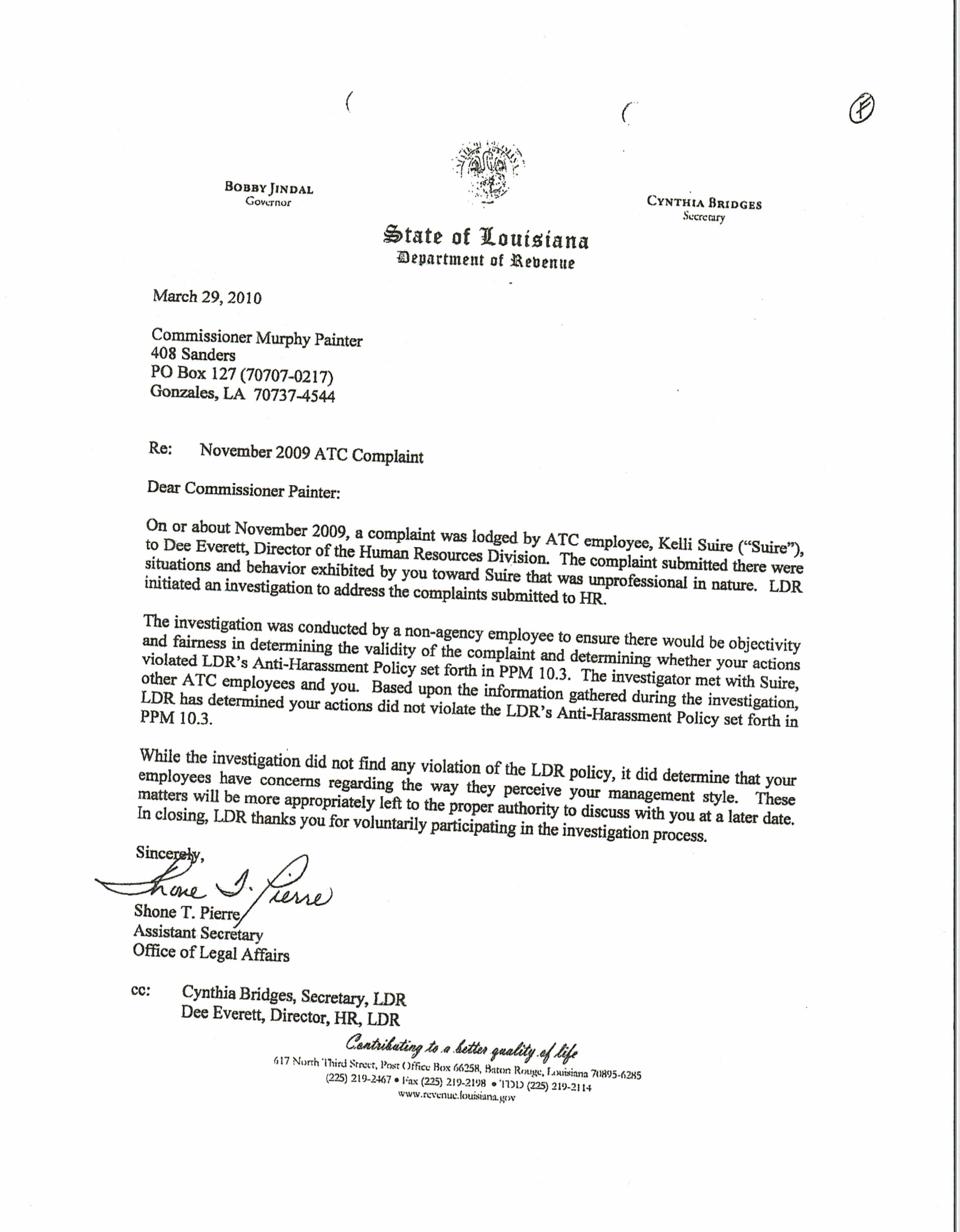
The events leading up to Painter’s firing and subsequent federal indictment began innocently enough with a March 29, 2010, letter to Painter from then-Department of Revenue Secretary Cynthia Bridges. She was writing pursuant to a complaint lodged by ATC employee Kelli Suire who would later the catalyst in Painter’s firing. Bridges, however found no violations by Painter regarding the complaint of “unprofessional” behavior toward Suire, but said concerns about his management style would be left “to the proper authority to discuss with you at a later date.”
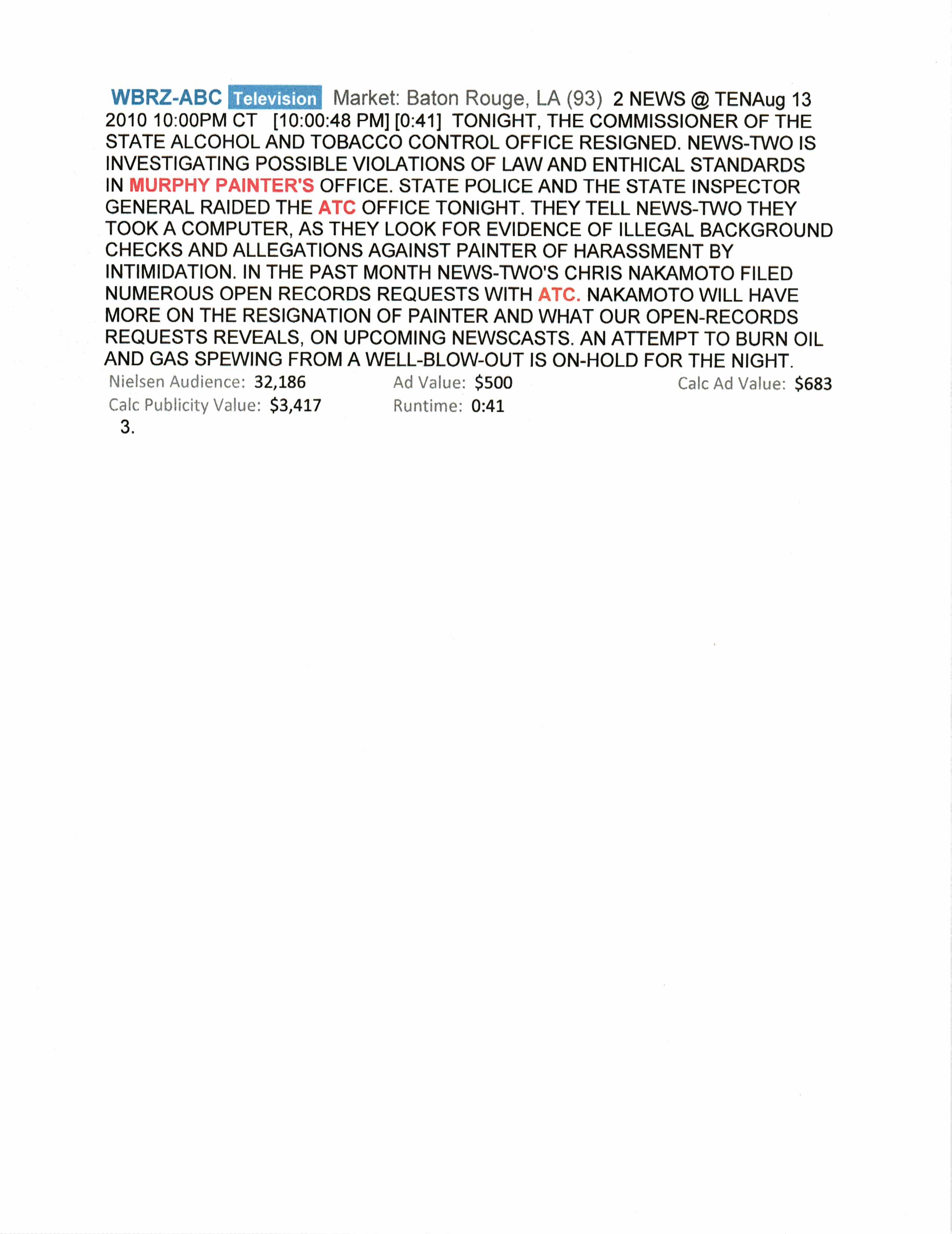
Then on Aug. 13, 2010, more than four months following Bridges’s letter, Baton Rouge television station WBRZ reported that Painter “resigned” and the OIG’s office simultaneously raided ATC offices, seizing Painter’s state desktop and laptop computers, three thumb drives, notes, affidavits, reports, maps, ATC documents, telephone reports, and a 2010 Dodge Charger assigned to Painter.
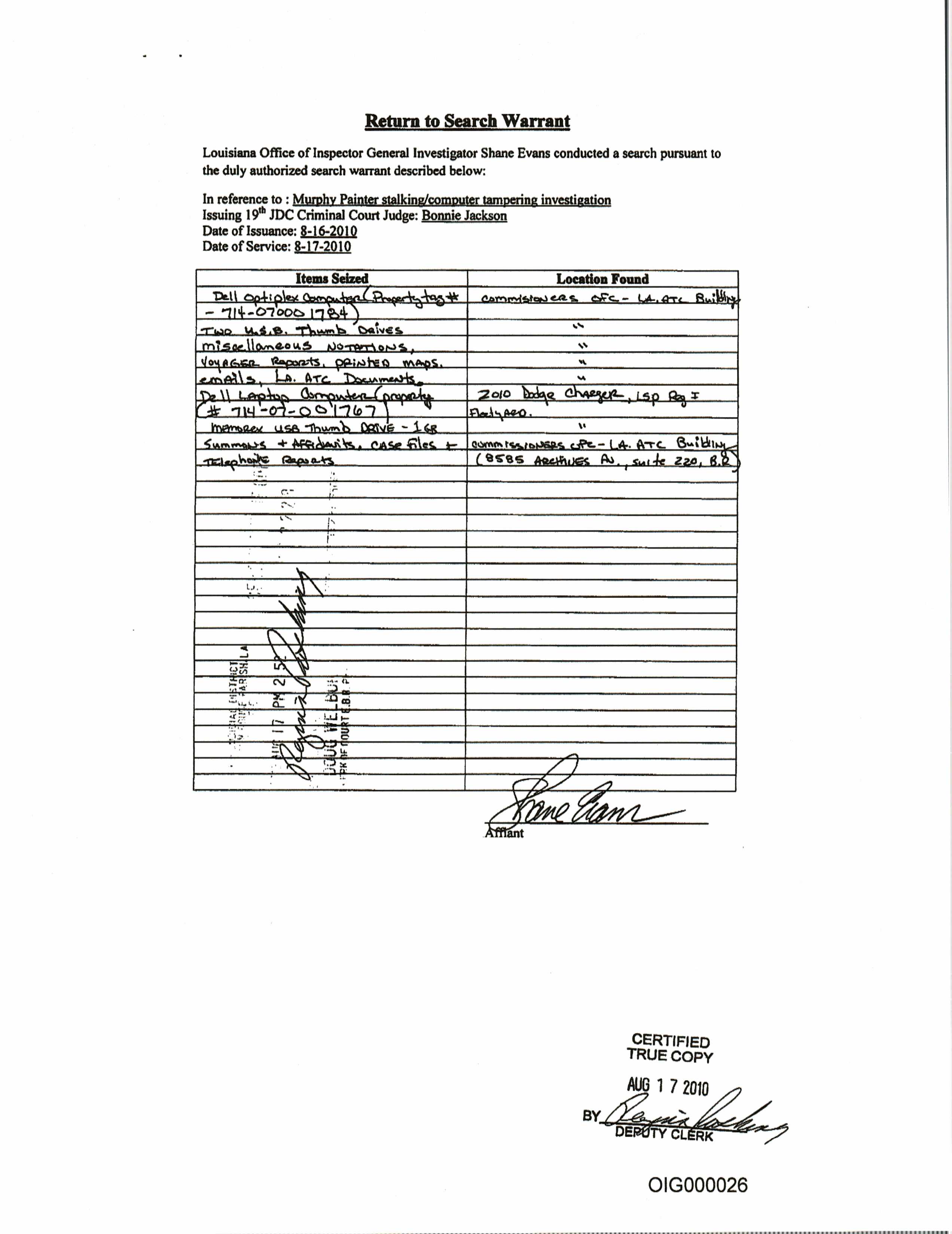
 

There was only one problem with the timing.

Bonnie Jackson, 19th Judicial District Judge, did not sign the search warrant authorizing the raid and search of Painter’s office until Monday, Aug. 16.
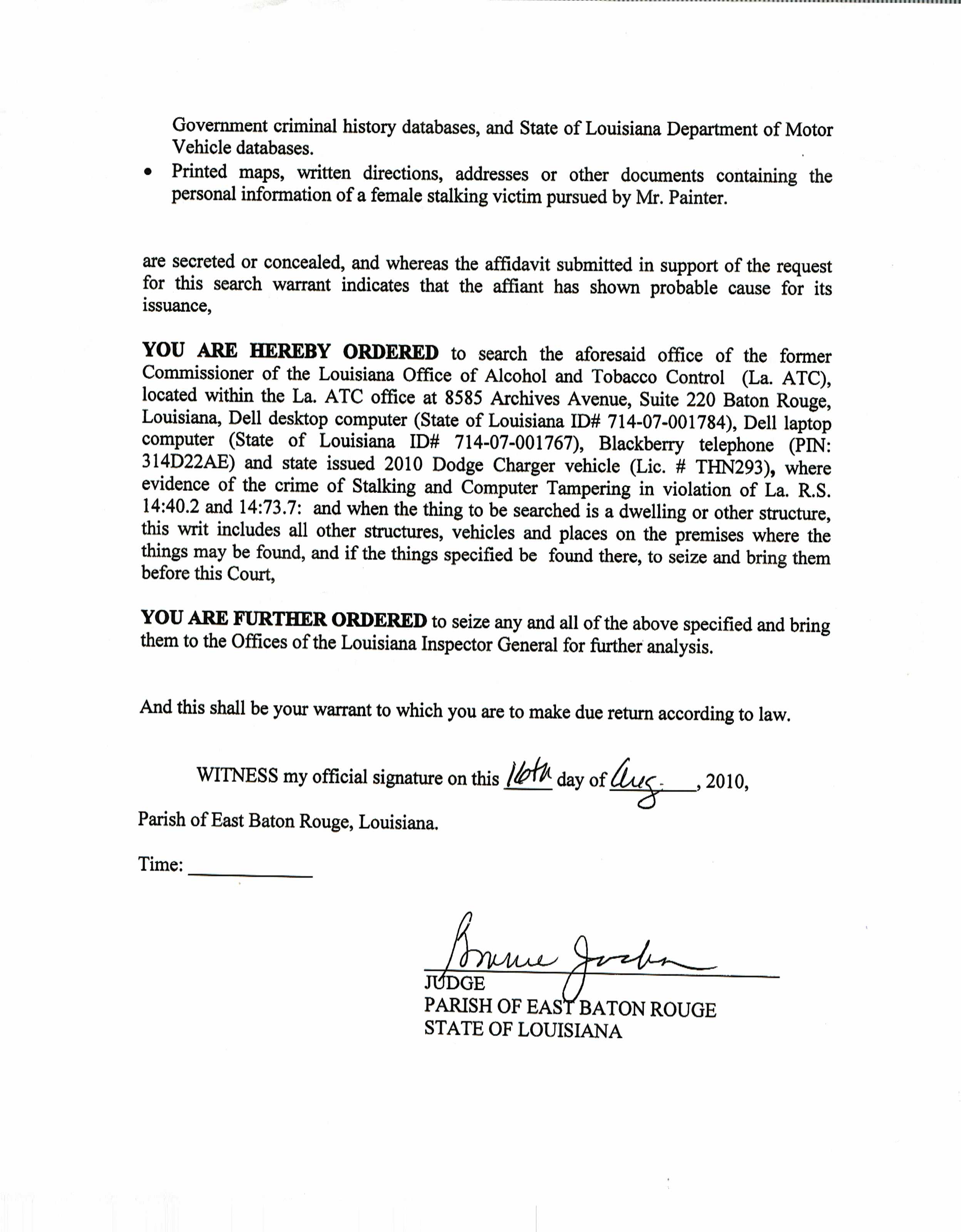
That would appear to have made the previous Friday’s raid—pulled off three days before a judge had signed the search warrant—illegal and a clear violation of the Fourth Amendment which says, “The right of the people to be secure in their persons, houses, papers, and effects, against unreasonable searches and seizures, shall not be violated, and no warrants shall issue, but upon probable cause, supported by oath or affirmation, and particularly describing the place to be searched, and the persons or things to be seized.” (Emphasis added.)

The second violation, the destruction of evidence was not learned until three years later when Painter’s computer was finally returned and he found that some 4,000 files had been deleted. Much of that, of course, would have been routine state business related to ATC operations but there was other information contained in the files, Painter says, that could have helped exonerate him from the charges that were lodged against him by the Jindal administration. It is not only illegal to destroy evidence, but also to destroy state documents—even if they do not constitute evidence.

The third violation, this one by OIG, involved the apparent misrepresentation of testimony given in interviews by an attorney and his assistant who had experienced difficulty in obtaining a liquor license on the part of his client, a business with multiple out-of-state owners, a situation which made the licensure procedure more involved.

The attorney, Joseph Brantley, and Painter had exchanged emails whereupon Painter invited Brantley to come to the ATC offices so that the problem could be worked out. “Why don’t you come by here around 3:00 p.m. or 4:00 if that works for you tomorrow and we will go over ours versus yours,” Painter said in his email at 12:26 p.m. on Sunday, Dec. 14, 2008. Brantley responded three minutes later, asking, “Is it OK if I bring the lady that has been doing the primary work (on the file)?”

OIG investigator Shane Evans, who now works for the East Baton Rouge Parish coroner’s office as its chief investigator, then laid the groundwork for the sexual harassment charges to be brought against Murphy when he wrote in a report of his interview with Brantley on Oct. 13, 2010:

“Mr. Brantley advised that Toby Edwards was a former assistant (paralegal) of his, that she is an attractive woman, and that after the meeting in late 2008, Mr. Painter granted the permit immediately.”

In his report of his interview with Edwards, also on Oct. 13, 2010, Evans wrote:

“During the meeting with Mr. Painter, he told Ms. Edwards that he had run her driver’s license and looked at her photograph. He said that was the only reason that he had granted them the meeting. (That is blatantly false: Copies of the Dec. 14, 2008, email exchange between Painter and Brantley obtained by LouisianaVoice clearly show that Painter invited Brantley to a meeting before he ever knew of Edwards’s existence.) She took his statement as the only reason he decided to meet with them is because he thought she was attractive. Ms. Edwards said his statement and demeanor made her very uncomfortable. She said she was very glad Mr. Brantley was present.

“She also said that she found it unusual that the permit had been repeatedly turned down but once she met with Mr. Painter face-to-face, her client immediately received the permit.”

Another report by OIG, the result of a second interview with Edwards on Nov. 5, 2012, described both Brantley and Edwards as “uncomfortable” during the meeting with Painter.

A second interview of Brantley on Nov. 7, 2012 produced yet a fourth OIG report that said, in part, that Edwards wore a “professional,” semi-low-cut shirt. “Mr. Brantley noticed that Mr. Painter noticed and glanced at Ms. Edwards’s chest during the meeting.

“…According to Mr. Brantley, Mr. Painter ‘clearly looked at’ Ms. Edwards’s chest,” the report says. Mr. Brantley even told Ms. Edwards that Mr. Painter was attracted to women, maybe more ‘than the average guy.’ Although Ms. Edwards would have attended the meeting anyway, Mr. Brantley took her to the meeting ‘for effect.’ He thinks that the meeting was more successful than it would have been otherwise if Ms. Edwards had not attended.

Pretty damning stuff, right?

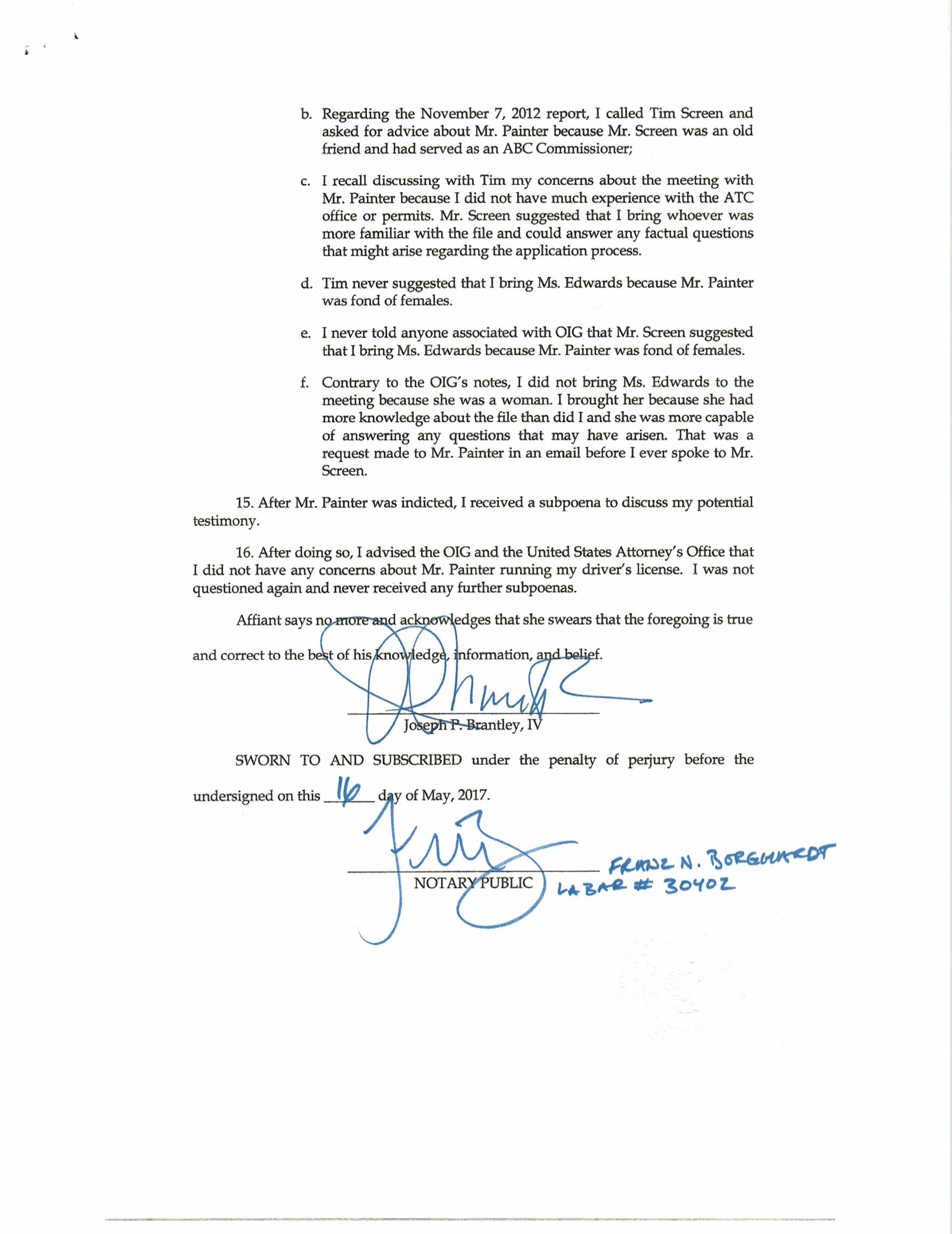
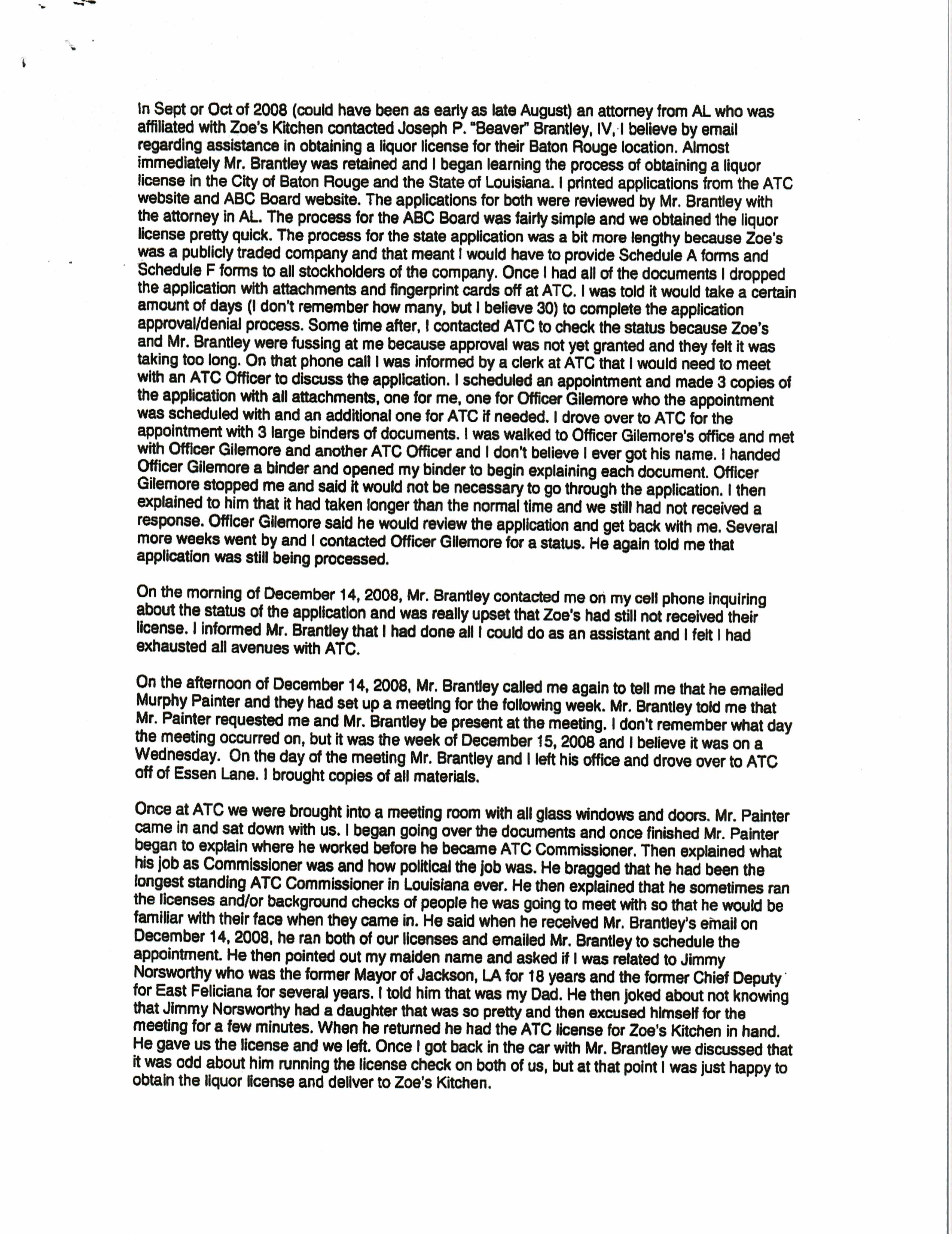
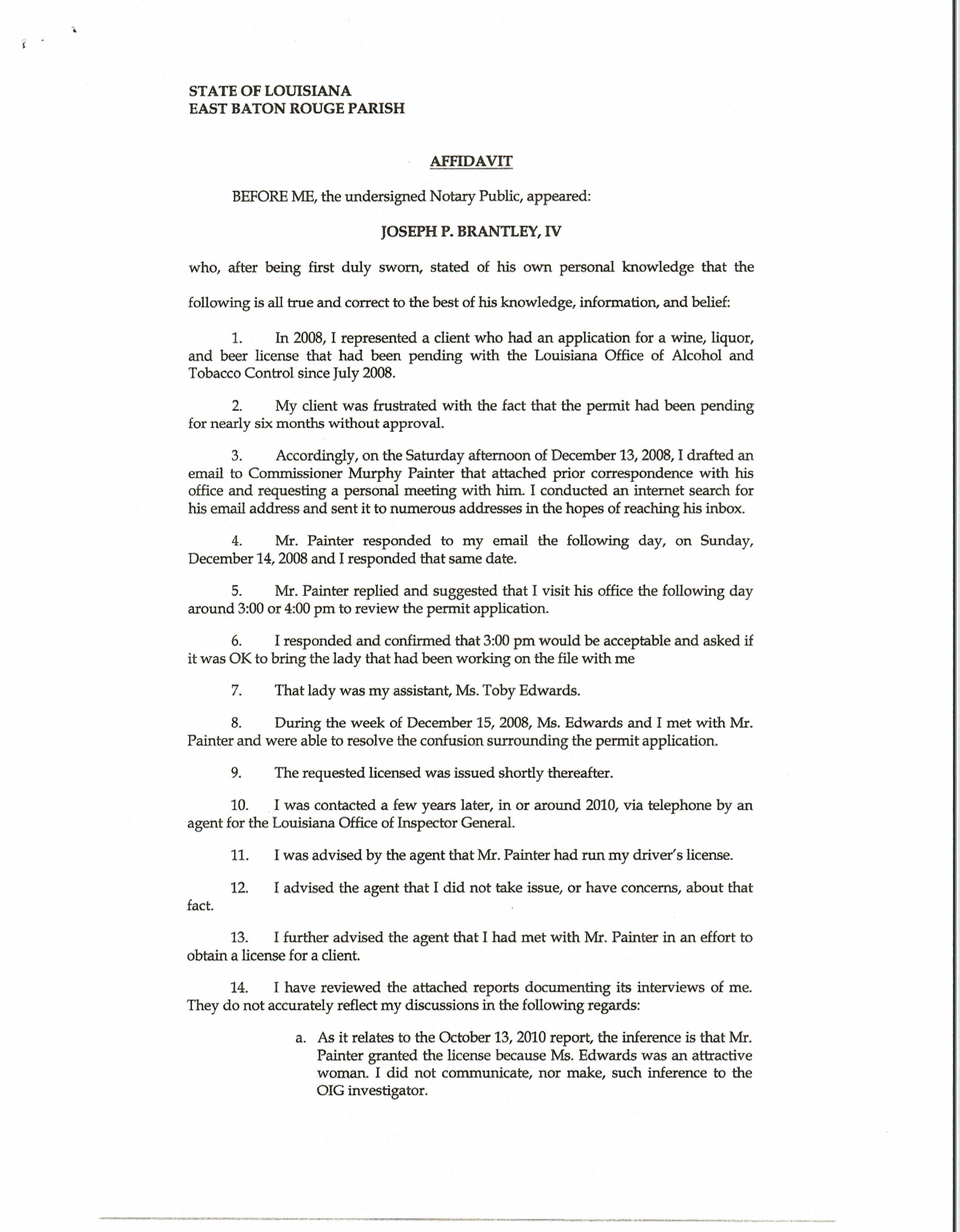
Well, it would be except for affidavits signed and sworn to by Brantley and Edwards (now Pierce), which provide quite a contrasting version of events.

Brantley, after reviewing the OIG reports, flatly denied ever telling Evans or any other OIG investigator that Edwards took part in the meeting with Painter because Painter was fond of females.

“I brought her because she had more knowledge about the file than did I and she was more capable of answering any questions that may have arisen.”

Edwards pointedly noted that the meeting took place in a room “with all glass windows and doors.” She said she also learned at the meeting that Painter was a long-time acquaintance of her father, a former deputy sheriff in East Feliciana Parish and joked to her that he didn’t know her dad “had a daughter that was so pretty.” She said he then excused himself for a few minutes and later returned with a license for Brantley’s client.

Here are both of those affidavits:
 

So, with a little tweaking of the facts, a man’s career was ruined, his occupation stripped from him and his finances gutted—all because he insisted that a major campaign contributor submit the proper forms before obtaining a liquor license for his Sunday parties outside the New Orleans Superdome.

This is Louisiana at its worst, folks, and it’s a clear example of how the political establishment can crush you if you don’t have the right contacts and sufficient financial resources to match those of the state’s taxpayers.


Read Full Post »

Before Louisiana voters trek to the polls in record low numbers on Oct. 14, there are a few things to consider about State Sen. Neil Riser, one of four candidates for the job of state treasurer, who, besides failing to help landowners being fenced out of their hunting lands, actually took campaign cash from a family member of the one erecting the fences.

Riser, author of that infamous bill amendment in the waning minutes of the 2014 legislative session that would have given State Police Superintendent Mike Edmonson an additional $100,000 or so per year in retirement benefits, has received some other interesting contributions as well.

The Louisiana Safety Association of Timbermen gave $2,500 to his senate re-election campaign in March 2014 and only 18 months later filed for BANKRUPTCY on behalf of its self-insurance worker’s compensation fund, leaving quite a few policy holders in the lurch.

Several nursing homes have contributed $2,500 each to his treasurer campaign. The nursing home industry, heavily reliant on state payments on the basis of bed occupancy, consistently benefited from favorable legislation by the Louisiana Legislature over the past decade that discouraged home care for the elderly.

But by far the biggest beneficiary of Riser’s legislative efforts is Vantage Health Plan, Inc., of Monroe which contributed $1,000 in 2015 to his Senate re-election campaign and another $1,000 to his treasurer campaign in March of this year.

Vantage has received six state contracts totaling nearly $242 million during the time Riser has served in the State Senate.

But it was Riser, along with Sens. Mike Walsworth of West Monroe, Rick Gallot of Ruston and Francis Thompson of Delhi, who pushed Senate Bill 216 of 2013 through the Legislature which cleared the way for the state to bypass the necessity of accepting bids for the purchase of the state-owned former Virginia Hotel and an adjoining building and parking lot. That was done expressly for the purpose of allowing Vantage to purchase the property for $881,000 despite there being a second buyer interested in purchasing the property from the state, most likely for a higher price.

By law, if a legislative act is passed, the state may legally skip the public bid process to accommodate a buyer. This was done even though a Monroe couple, who had earlier purchased the nearby Penn Hotel, wanted to buy the Virginia and convert it into a boutique hotel. Thanks to Riser and the other three legislators, they were never given the opportunity.

And Vantage, from all appearances, really got a bargain. The building was constructed in 1925 at a cost of $1.6 million and underwent extensive renovations in 1969 and again in 1984, according to documents provided LouisianaVoice, all of which should have made the property worth considerably more than $881,000. Read the entire story HERE.

Internal documents revealed concerns by Vantage that if the building were to be offered through regular channels (public bids), “developers using federal tax credits could outbid Vantage.”

Another document said, “VHP (Vantage Health Plan) fears that public bidding would allow a developer utilizing various incentive programs to pay an above-market price that VHP would find hard to match.”

Finally, there was a handwritten note which described a meeting on Nov. 1, 2012. Beside the notation that “Sen. Riser supports,” (emphasis added) there was this: “Problem is option of auction—if auction comes there is possibility of tax credits allowing a bidder to out-bid.”

All of which raises the obvious question of why did the Jindal administration turn its back on the potential of a higher sale price through bidding, especially considering the financial condition of the state during his entire term of office? We will probably never know the answer to that.

One might think that that kind of effort on its behalf would be worth more than a couple of thousand in campaign cash to Vantage. Vantage could have at least shown the same gratitude as the relative of the owner of 55,000 of fenced hunting property in Riser’s district.

When landowners in Winn, Caldwell and LaSalle parishes felt they were being fenced out of their hunting rights back in 2013, they did what any citizen might do: they went to their legislator for help–in this case, Riser, who paid the obligatory lip service of expressing concern for landowners Wyndel Gough, Gary Hatten, and Michael Gough but who, in the end, did nothing to assist them.

Instead, as so often happens today in politics, he sold out to the highest bidder.

One the $5,000 contributors to Riser’s campaign is none other than Hunter Farms & Timber, LLC, of Lafayette. An officer in that firm is Billy Busbice, Jr., of Jackson, Wyoming.

William Busbice Sr., one-time chairman of the Louisiana Wildlife and Fisheries Commission, and Junior’s father, is a partner in Six C Rentals Limited Partnership of Youngsville, LA. Which purchased and proceeded to fence in some 55,000 acres of prime hunting land a few years back.

The original LouisianaVoice story on that dispute can be read HERE.

All of which only serves to underscore the long-held perception that we in Louisiana, by continually electing the type of public officials who are interested only in the next big deal, get the kind of representation we deserve.

Read Full Post »

Karma, you gotta love it.

A lawsuit brought by a Houma couple against Terrebonne Parish Sheriff Jerry Larpenter has been settled for an undisclosed amount, according to a story posted online by the Houma DAILY COURIER.

The couple, Houma police officer Wayne Anderson and wife Jennifer, filed the lawsuit in U.S. District Court in New Orleans after Larpenter obtained what was quickly determined an unconstitutional search warrant in order to carry out an equally unconstitutional raid on the couple’s home and to cart off computers and cellphones while investigating ExposeDAT, an anti-corruption website that was critical of Larpenter.

Also named as defendants in the Anderson’s lawsuit were Parish President Gordon Dove, the Terrebonne Parish government, the Terrebonne Levee District and levee board member and local businessman Tony Alford. Alford and the levee district were subsequently dismissed by the Andersons and U.S. District Judge Lance Africk dismissed Dove and the parish as defendants after the parties reached a $50,000 settlement, the newspaper said.

The order signed by Africk dismissed the lawsuit without prejudice, which means the suit can be re-instituted should Larpenter not honor the settlement terms.

Wayne Anderson, whose blog was critical of Larpenter and which prompted the illegal raid, told New Orleans WWL-TV, “I think the sheriff’s finally learned that he can’t bully people and violate people’s constitutional rights. In our case, he stepped on the wrong people’s constitutional rights because we knew our rights. Hopefully, he thinks twice the next time he gets his feelings hurt.”

The paper said that Larpenter filed a request in May to dismiss the lawsuit on the grounds of qualified immunity.

That has to go down as one of the more ironic twists in the entire episode: Larpenter, ignoring the Constitutional guarantee of free speech of citizens as laid out in the First Amendment, took offense at criticism contained in a web blog and raided a person’s home on no more substantial probable cause than that and yet thinking he was protected by qualified immunity.

Judge Africk correctly denied that motion on July 19 and Larpenter, seeing the handwriting on the wall, chose to settle rather than go to trial and most likely subject himself to another judicial lecture on the Constitution.

Terrebonne, this is your sheriff.

Read Full Post »

The 17-year-old girl who was raped twice in a Union Parish jail cell in April 2016 has filed suit in Third Judicial District Court, according to a copy of the lawsuit obtained by LouisianaVoice.

The Third JDC comprises the parishes of Lincoln and Union.

Meanwhile, nearly 17 months after the rapes occurred, Louisiana Attorney General Jeff Landry’s office still has not completed its investigation.

The girl, who was thought to be high on meth, was being held in an isolation cell when Demarcus Shavez Peyton, 28, of Homer, who was awaiting sentencing after being convicted of aggravated rape in a separate case, was allowed to leave his cell and assault the girl twice in her cell.

Named as defendants in her lawsuit are the Union Parish Detention Center, the Union Parish Police Jury (which operates the detention center), the Union Parish Detention Center Commission (made up of Union Parish Sheriff Dusty Gates, District Attorney John Belton and Union Parish municipal chiefs of police).

The lawsuit says another prisoner, Darandall Eugene Boyette was also allowed into her cell with the intent to sexually assault her but “departed before committing any criminal act.”

Because the district attorney is a member of the commission that governs the detention center, Belton rightfully recused his office from any investigation and instead, requested the attorney general’s office to conduct the investigation.

And while Attorney General Landry on Tuesday issued one of his regular press releases in which he “applauded President Donald Trump’s decision to phase out of the Obama-era Deferred Action for Childhood Arrivals (DACA) program,” he still has not wrapped up what should be a routine investigation of a rape that occurred in the limited confines of a jail cell, a case where he knows the identities of the victim, the rapist, and witnesses.

Apparently, Landry is far too busy issuing press releases to worry about the victimization of a 17-year-old girl—or the obvious liability to which the defendants are exposed.

Among the claims asserted by the victim through her Monroe attorney, Jeffrey D. Guerriero, are:

  • Failure to provide a reasonably safe and secure facility for the custody of women, especially minor women;
  • Failure to protect female inmates from male sexual assault;
  • Failure to provide adequate training to employees and personnel;
  • Failure to property monitor, observe and keep proper surveillance of prison inmates;
  • Failure to properly monitor and supervise employees;
  • Failure to provide, implement and enforce proper policy and procedure for the reporting of, handling, investigation and treatment care rendered to female inmates who have been victims of sexual assault while incarcerated;
  • Failure to provide proper services to inmates who have been victims of sexual assault while incarcerated;
  • Failure to properly secure inmate cell doors;
  • Allowing convicted rapist inmates to move within the facility unmonitored and without supervision;
  • Inadequate or negligent supervision of inmates within the facility;
  • Failure to provide adequate staff to supervise and monitor inmates;
  • Failure to provide adequately trained staff and employees to maintain a safe environment for female inmates, particularly minor female inmates.

Meanwhile, Attorney General Jeff Landry on Thursday (Sept. 7) issued a press release saying, “All welfare fraud needs to be found and ended.”

But he can’t seem to complete a simple rape investigation after nearly 17 months.

Read Full Post »

Jacob Colby Perry has been CRAPPed (Crazed Reaction Against Public Participation), BLAPPed, (Blowhard Letter Against Public Participation) and SLAPPed (Strategic Lawsuit Against Public Participation) as reward for his efforts to obtain answers from the Welsh City Council, particularly as those answers pertain to expenditures of the Welsh Police Department which consistently (as in every month) exceeds the department’s budget.

And he’s a member of the town’s board of aldermen, whose job it is to oversee the town’s various budgets, including that of the Police Department.

Welsh, for those who may not know, is a small town situated on I-10 in the middle of Jefferson Davis Parish. Jeff Davis Parish is located between Acadia Parish on the east and Calcasieu Parish on the west and sits immediately north of the easternmost part of Cameron Parish.

The town has 3,200 residents.

And 18 police cars (one for every officer to take home from work). The budget for those patrol cars, which are not all purchased in the same fiscal year, is $169,000.

Other line items in the police department’s budget include:

  • Police Chief—$100,990 (of which amount, $76,120 is for the Chief Marcus Crochet: $55,000 salary, $4,207.50 in Social Security payments, and $16,912.50 for his retirement);
  • Police Patrol—$593,077 ($32,948 per vehicle);
  • Police Training—$8,000;
  • Police Communications—$295,342 ($16,400 per officer);
  • Police Station and Buildings—$52,300.

BUDGET

All that for a town of 3,200.

From June 2016 through February 2017, the monthly expenditures and monthly overages (in parenthesis) for the police department were:

  • June 2016: $105,681.35 ($24,345.77);
  • July 2016: $79,595.23 ($1,840.35);
  • August 2016: $71,348.81 ($10,085.77);
  • September 2016: $132,857.05 ($51,421.47);
  • October 2016: $78,881.21; ($2,554.37);
  • November 2016: $108,732.82 ($24,297.24);
  • December 2016: $77,098.58 ($4,337.00)
  • January 2017: $79,945.66 ($1,489.92);
  • February 2017: $84,139.83 ($2,704.25)

TOTAL: $818,280.54 ($82,360.32).

That’s a nine-month average expenditure of $90,920.06, or an average monthly overage of $9,484.48.

Projected out for the entire fiscal year, the police department’s expenditures would be $1,091,040.72 or a projected fiscal year overage of $113,813.72.

OVERAGES

Did I mention that Welsh is a town of 3,200 living souls?

It’s no wonder then, that Alderman Jacob Colby Perry, a mere stripling of 24, along with a couple of other aldermen have questions about Crochet’s budget, particular when it was learned that funds generated from traffic enforcement on I-10 is deposited in an account named “Welsh Police Department Equipment & Maintenance.”

An attorney general opinion directed to Crochet and dated Dec. 18, 2015, makes it clear that “a police department is not permitted to establish a separate fund for the deposit of money generated from traffic tickets.” Louisiana R.S. 33:422 “requires that the fines collected from tickets issued by a police officer in a Lawrason Act municipality (which Welsh is) be deposited into the municipal treasury and, thus, within the control of the mayor, clerk, and treasurer.”

The balance in that account is more than $178,000. That’s over and above all the line items in the police department’s budget cited earlier. And he never tapped those funds to cover his overages, instead calling on the board of aldermen to cover his expenditures.

“The mayor (Carolyn Louviere), along with her staff and the town clerk, knew months prior that the chief of police was over-budget and would continue to exceed his budget,” Perry said. “They did nothing.”

Instead, she and the board acquiesced to Crochet’s request of a 37.5 percent increase in his base pay (from $40,000 to $55,000) and his total compensation, including salary and benefits, of $76,120.

SALARIES

Perry said that after he and three other aldermen addressed the matter of the police department’s budget in a meeting at which Crochet was not in attendance, “the town clerk and the mayor immediately followed up by informing the chief of police. In the next meeting, he (Crochet) entered with an entourage consisting of at least 10 police officers in uniform, a neighboring municipality’s chief of police and financial adviser, and his wife. We were yelled at and intimidated.

Perry said he felt Crochet’s demeanor at that meeting may have served its purpose in that the board of aldermen amended the police department budget by $253,000, pushing the department’s budget to more than $1.2 million. “The Town of Welsh is in disrepair,” Perry said.

For his trouble, several things have happened with Perry, none of them good:

  • A recall petition was started against him;
  • Postcards were mailed to Welsh residents that depicted Perry and Andrea King, also a member of the Board of Aldermen, as “terrorists” (See story HERE) and that Perry violated campaign finance laws by failing to report income from a strip club in Texas of which he was said to be part owner and which allegedly was under federal investigation for prostitution, money laundering and drug trafficking (See story HERE);
  • He was removed from the Town of Welsh’s FACEBOOK page;
  • He has been named defendant in not one, not two, not three, but four separate SLAPP lawsuits.

Those filing the suits were Mayor Louviere; her daughter, Nancy Cormier; her son, William Johnson, and, of course, Police Chief Crochet. All four SLAPPs were filed by the same attorney, one Ronald C. Richard of Lake Charles. Can you say collusion?

Each of the nuisance suits say essentially the same thing: that Perry besmirched the reputations of her honor the mayor, both of her children, and the bastion of law enforcement and fiscal prudence, Chief Crochet.

The reason I call them nuisance suits is because Perry, as a member of the board of aldermen, is immune from libel and slander suits under the state’s anti-SLAPP statute.

As the crowning touch, the recall petition was initiated while Perry was in Japan on military orders, serving his annual two-week training.

But the plaintiffs, while trying to shut Perry up, have their own dirty laundry.

It has already been shown that the police chief is not the most fiscally responsible person to be handling a million-dollar budget. Eighteen police cars in a town of 3,200? Seriously? More than $76,000 in salary and benefits—not counting the additional $6,000 he receives in state supplemental pay? Consistently busting his department’s budget? Keeping traffic fine income in a separate account when it should go in to the town’s general fund?

And Mayor Louviere, who inexplicably wants to build a new city hall when the town is flat broke, is currently under investigation by the Louisiana Board of Ethics, according to the Lake Charles American Press AMERICAN PRESS. She also wants to shut down a bar that just happens to be adjacent to a business owned by her son.

And her son, William Joseph Johnson, who Perry says used his mother’s office in an attempt to shut the bar down, has a story all his own.

Johnson, back in 2011, was sentenced in federal court to serve as the guest of the federal prison system for charges related to a $77,000 fraud he perpetrated against a hotel chain in Natchitoches between October 2006 and January 2007. And that wasn’t his first time to run afoul of the law.

At the time of his sentencing for the Louisiana theft, he was still wanted on several felony charges in Spokane County, Washington, after being accused of being hired as financial controller for the Davenport Hotel of Spokane under a stolen identity, giving him access to the hotel’s financial operations and then stealing from the hotel.

The only thing preventing Spokane authorities from extraditing him to Washington, Spokane County Deputy Prosecutor Shane Smith said, was that “we just don’t have the funds to bring him back.” The Spokane Review, quoting court documents, said, “Police believe Johnson is a longtime con artist who has swindled expensive hotels across the country.” (Click HERE for that story.)

“William Joseph Johnson, Jr. remains on federal probation,” Perry said. “He has yet to pay back all of the restitution that he owes.

In his lawsuit against Perry, Johnson says he “has a long-standing positive reputation in his community and parish” and that he (Johnson) suffered “harm to reputation (and) mental anguish.”

So we have Perry, a student at McNeese State University, being BLAPPed (Blowhard Letters Against Public Participation) with the postcard campaign; CRAPPed (Crazed Retaliation Against Public Participation) with Crochet’s appearance with 10 uniformed officers to berate Perry at a board of aldermen meeting and an incident in which Perry said Johnson confronted him in an aggressive manner following a board meeting, and SLAPPed (Strategic Legal Action Against Public Participation) with the four lawsuits.

All this in a town of 3,200.

Former U.S. House Speaker Tip O’Neill had no idea how accurate he was when he said, “All politics is local.”

Read Full Post »

« Newer Posts - Older Posts »