Feeds:
Posts
Comments

Archive for the ‘Politicians’ Category

By now, thanks to the Internet and network TV news, virtually everyone in the U.S.—and apparently some foreign countries—knows about the ham-handed manner in which the Vermilion Parish School Board shut down one of its teacher’s comments during a recent board meeting.

The manner in which Kaplan middle school English teacher Deyshia Hargrave’s was cut off from speaking and subsequently manhandled by a city marshal was carried out with all the tact, consideration, delicacy, and diplomacy of Donald Trump discussing immigrants from $*%#hole countries.

And the fact that the school board employed the CITY MARSHAL who was previously accused of using excessive force against a 62-year-old man in poor health to carry out the handcuffing and arrest of Hargrave certainly didn’t help matters in what overnight brought national and international negative attention to Louisiana.

And the announcement by the city prosecutor that Hargrave would not be prosecuted only enhances her chances of reaping a financial settlement subsequent to the lawsuit she is almost certain to file for her rude treatment and public humiliation.

To provide a little background for anyone who may not have heard, Hargrave was at the board meeting to protest a $30,000-per-year proposed salary increase for School Superintendent Jerome Puyal (from $110,190 to $140,188) while teachers, cafeteria workers and, support staff received no salary increases. School Board President Anthony Fontana, an Abbeville attorney who has been on the board about a quarter-of-a-century, promptly gaveled her into silence, proclaiming her comments were not germane to the board’s agenda.

One report had Fontana referring to Hargrave, parish’s 2015-2016 teacher of the year, as “the poor little lady” in an INTERVIEW subsequent to the meeting. That charitable reference is almost certain to absolve him of any culpability in what has become a public relations nightmare sufficiently grievous to attract the attention of the ACLU and teachers’ unions, not to mention network television news.

But that all could have been avoided had Fontana simply consulted in advance with the good folks at Gravity Drainage District 8 of Calcasieu Parish Ward 1. Not those folks know how to shut a dissident up quietly and efficiently.

The secret is to get an attorney who isn’t afraid to threaten the dissident and a judge who can ignore the First Amendment to the U.S. Constitution and issue an order that the dissident may not make public records requests nor have any contact with any members or employees of the gravity drainage district.

Or, better yet, have a gaggle of judges file suit against a newspaper to prevent it from seeking public records from the court.

Problem solved.

Never mind that the gravity drainage district hired with Billy Broussard to remove debris from drainage canals following Hurricane Rita under a FEMA contract and then instructed Broussard to remove older pre-storm debris and that he would be paid to do so.

But when FEMA said the older debris was not part of the project, the drainage district flat-out refused to pay Broussard about a million dollars that was due him for the work. Moreover, some of that older debris consisted of large cypress logs—still very much useful in construction—which mysteriously disappeared.

So, when Broussard attempted unsuccessfully to get reimbursed for his work, RUSSELL STUTES, Lake Charles attorney for the drainage district, wrote a testy letter to Broussard in which Stutes, elevating himself to judge status, threatened Broussard with jail time “the next time any Calcasieu Parish employee is contacted by you or any of your representatives with respect to the project…”

Stutes even filed a petition for injunctive relief to bar Broussard from contacting members or employees of the drainage district and from seeking public records. Incredibly, 14th Judicial District Judge David Ritchie signed the order for the INJUNCTION that bars Broussard from his constitutionally-guaranteed right to seek answers from a public body. That right is also guaranteed under Louisiana R.S. 42:4.1 et seq.

Likewise, the judges of the 4th JDC up in Monroe filed SUIT against the Ouachita Citizen newspaper in West Monroe in order to stymie the newspaper’s efforts to obtain public records from the court.

So, you see, Mr. Fontana, it really wasn’t necessary to shoot yourself in the foot by having the city marshal strongarm Ms. Hargrave, your defense that he was authorized to do so notwithstanding. That just brought unwanted attention to a board what was already contentious in its membership makeup—some of that disharmony stemming from the performance of the very superintendent to whom you trying to give an extra $30,000 per year.

All you had to do was have the board attorney (and you are an attorney yourself) to find a judge who would sign an order for injunctive relief which, while questionable in its legality, would nevertheless have shut Ms. Hargrave up.

For a minute, anyway, to borrow a phrase from Ron “Tater Salad” White, one of my favorite stand-up comics, which he tags at the end of this joke but which is deleted from this VIDEO.
 

Read Full Post »

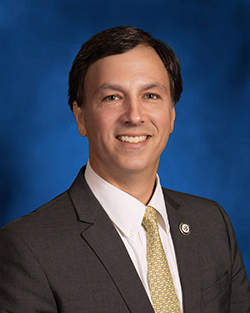
So, now Sen. John Kennedy is officially opposed to strengthening firearms BACKGROUND CHECKS.

His newest proclamation (which really isn’t new at all) raises the obvious question of whether there is any level to which he will not stoop to kiss the ring of Donald Trump and the rest of the NRA-purchased Republicans who insist that it is never the time to discuss ways to curb the number of MASS SHOOTINGS that have plagued this country for the past 35 years.

Apparently, it wasn’t enough for Sen. John Kennedy to join fellow Louisiana Sen. Bill Cassidy in voting for the so-called tax “reform” bill that is so heavily weighted in favor of the very rich but now he has underscored that Gawd-awful CAMPAIGN AD in which he said, “…love is the answer but you oughta own a hand gun, just in case.”

He even repeated the phrase during a Senate committee hearing, saying it was an old saying from back in Louisiana though, to be honest, I don’t ever recall anyone but Kennedy uttering such an inane statement.

So, obviously, while it is never the time to discuss a solution, it’s always the time to ensure that the mentally ill will have unfettered access to weapons.

Kennedy clashed with Bobby Jindal—and later with Gov. John Bel Edwards—over the budget, repeating his mantra: “We don’t have a revenue problem, we have a spending problem.” That, it turns out, was the most intelligent thing he had to say as State Treasurer. But the fact of the matter was—and is—that it was a combination of the two.

The problem is in the giveaways, as in tax credits, tax exemptions, tax incentives, and all the other breaks given away to industry that promised big jobs in exchange for keeping off the tax rolls but who failed to deliver. That spending problem created a critical revenue problem that was only partially alleviated by a 43 percent increase in college tuition.

Kennedy also proposed an across-the-board cut in state contracts. That was far too simplistic. A better solution would have been—and remains—to take a long, hard look at the multitude of contracts awarded by the sate to determine if they are really necessary.

Just as one example, the various studies of restoration of Louisiana’s coastline, like the bevy of studies awarded by the City of Baton Rouge to study traffic congestion, have brought the state no closer to resolving the problem than before tens of millions of dollars were spent on those studies.

But I digress. Kennedy, in constant search of a TV camera and microphone, has now gone beyond absurdity in opposing more stringent background checks. Does he not remember:

  • Sandy Hook?
  • Columbine?
  • Aurora?
  • Orlando?
  • Las Vegas?
  • San Bernardino?
  • Chattanooga?
  • Charleston?
  • Oakland?
  • Tucson?
  • Blacksburg?

I could go on, but what’s the point? People like Kennedy are imprisoned by their own closed minds and political calculations about how to best play to the emotions of the gun enthusiasts and to how best to go about assuring the continued flow of NRA campaign contributions. The KILLING FIELDS of America are without comparison anywhere else in the civilized world, according to statistics published by the NEW YORK TIMES.

Oops, I forgot. That should be the failing New York Times, according to Donald Trump, on whose coattails Kennedy so shamelessly ran in his senatorial campaign. So, it must be fake news, right?

Well, those figures quoted by the failing New York Times were provided by the FBI, which keeps meticulous records on such things.

Oh, I forgot again. The FBI is no longer credible, according to Grump, who arbitrarily decides who is and who is not trustworthy and who sets such a shining example for the likes of Kennedy, Bill Cassidy and the other Repugnacans in Congress who apparently are unable to make as simple a decision as when to go to the bathroom without a directive from Thumper.

Yes, I know the NRA gun-totin’ flag-waving zealots are going to have me pilloried by sundown but I can live with that and I have this to say to them:

I would rather stand for what is right for all the victims who were so needlessly slaughtered by obviously mentally disturbed people who should never have had access to weapons than to have all the campaign money the NRA dumps into the campaigns of the likes of John Kennedy.

Those are my principles, Mr. Kennedy, what, pray tell, are yours?

Read Full Post »

One of the most frustrating jobs in state government has to be that of the Legislative Auditor.

The office is charged with the responsibility of ensuring that audits and sworn financial statements of all public entities are carried out in a timely—and legally-prescribed—manner and that the books of those entities are in order.

Yet, whenever discrepancies are found and reported, little comes of the auditors’ reports. Oh, in cases where the findings are significant, such as the recent audit of the management of former Louisiana State Police Superintendent Mike Edmonson, a report will make a big splash in the media.

But then, it quickly becomes old news and is forgotten. All too often, in the end, nothing is done to actually rein in those who might be guilty of lax fiscal responsibility over their organization or worse—possible malfeasance.

Seldom is there any follow-up on the part of those who have the authority to make changes. An office or agency head continues to lead the organization with little or no disciplinary action handed down from above, be it from a department head, cabinet member, or, in some cases, the governor himself.

In short, there is little real accountability in state government. A critical audit, conducted at no small expense, points out shortcomings, a management letter is generated promising reforms, and life—and abuses of the public trust—go on unabated.

As Exhibit A, we have the Auditor’s NON-COMPLIANCE LIST, a dishonor roll that dates back as far as 2004 and which contains well over 100 agencies, offices, organizations and individuals who have failed to comply with state statutes.

The list is liberally peppered with justices of the peace, community development districts, constables, social organizations, and even municipalities, sheriffs’ offices, and clerks of court—all reflecting the widespread disregard for fiscal responsibility or, to be charitable, just plain ignorance of the law.

Any organization that has any financial relationship with the state or a parish must, depending on the size of the organization’s budget, provide a review/attestation of its financial condition, a sworn financial statement, or a full-blown audit on a yearly basis.

From Acadia to Winn, virtually every parish has at least one organization on the non-compliance list. Here are a few examples:

  • The Beauregard Parish Hospital Service District No. 1, Merryville—five times between the years 2004 and 2009: failure to produce an audit;
  • The Ward 7 Caddo Parish Constable—seven years between 2009 and 2016: no sworn financial statements;
  • The Resource Center in Caddo—10 straight years, from 2008 to 2017: no financial statements;
  • Louisiana Auto Insurance Plan, East Baton Rouge Parish—10 straight years, from 2007 to 2016: no audit;
  • Ville Platte City Marshal, Evangeline Parish—six consecutive years, from 2012 to 2017: no sworn financial statement;
  • St. Landry Parish Constable, District 8—nine years between 2005 and 2016: no sworn financial statement.

State Auditor Daryl Purpera, contacted by LouisianaVoice, acknowledged the frustration of constantly having to chase down the various offices. “It keeps us pretty busy and it costs the state money to track this in terms of both money and man-hours.”

He said state law says when any organization found to be in non-compliance for three consecutive years, that is considered malfeasance. “That law is on the books,” he said.

STATE REP. NEIL ABRAMSON

A few years back, State Rep. Neil Abramson (D-New Orleans) attempted to push through a bill in the legislature which would required any non-governmental organization (NGO) or public body to be on the Legislative Auditor’s approved list (not on the non-compliance list) in order to be eligible to receive any state funding or to conduct business with the state.

Abramson’s bill failed.

Now, who would have ever thought that?

Read Full Post »

By Morgan Statt, Guest Columnist

It’s 2005, and the National All Schedules Prescription Reporting Act (HR 1132) is on President George W. Bush’s desk ready to sign. With one fell swoop he signs the bill into law, and it grants all states $100 million in funding to aid prescription drug monitoring services. Shortly after, former Louisiana representative Billy Tauzin abandons his post in the House of Representatives and accepts a job as President and CEO of PhRMA, a major lobbying group for pharmaceutical companies. Instead of celebrating the bill being signed into law, Tauzin finds a way to dismantle the allocation of funding.

Now, let’s bring it back to present day. Today, there is an almost daily snippet of news on America’s opioid epidemic, one that has ravaged nearly every area of the country. In 2016, more than 63,600 opioid overdose deaths were reported, the highest number ever, and new reports show that the crisis is lowering the average American life expectancy.

What’s being done to combat the crisis that either directly or indirectly affects millions of Americans?

For one, states are strengthening their prescription monitoring programs, the very thing Rep. Tauzin dismantled funding for in 2005. Although these programs have been in place for a number of years, only a limited number of providers have taken advantage of their ability to detect and deter abuse. Additionally, cities and states across the country have filed lawsuits against pharmaceutical companies for their role in the crisis.

And Louisiana is one of them.

In September 2017, the Louisiana Department of Health filed a lawsuit against 16 drug manufacturers, among them OxyContin maker Purdue Pharma, at the 19th Judicial Court in Baton Rouge. The suit claims that the named companies used aggressive marketing tactics and encouraged physicians to prescribe opioids under the guise that they were not addictive.

Louisiana Attorney General Jeff Landry has said that “Louisiana is one of eight states that has more opioid prescriptions than residents.” Despite the fact that Big Pharma played a role in the opioid epidemic, will these lawsuits actually make a difference? Even if there was an astronomical payout, will these lawsuits help to end the crisis and prevent future epidemics?

The short answer is: no.

Big Pharma is like that rich, popular kid in high school we all knew. They used their money and status to manipulate peers and played off students’ desires to be a part of their inner circle.

Similarly, Big Pharma uses status and influence to get what it wants. Its targets for manipulation span multiple areas of the industry, which include the current regulations in place and clinical trials.

Before we can even have a sliver of hope that a hefty payout will change its ways, we have to tackle the pharmaceutical industry’s influence head-on to see any real impact on its actions. We can start by addressing these two areas of influence.

Drug companies have the ability to fund clinical trials.

Imagine you come out of surgery and are placed on a blood thinner to prevent any clotting from happening once you’re off the operating table. You’ve been told of the internal bleeding side effects, but there just so happens to be no known antidote on the market yet to serve as treatment if such complications arise.

This was the case for the anticoagulant Pradaxa. In 2010, the medication was met with FDA approval and put on the market without an antidote. But then severe internal bleeding incidents took place, and over 1,000 people died as a result of being prescribed the medication. Since then, manufacturer Boehringer Ingelheim has had a slew of Pradaxa lawsuits filed against it for its role in patient harm.

I bring up Pradaxa as an example because it points to issues with the clinical trial process that exist today. In a recent study conducted by Johns Hopkins University, clinical trial funding that has been traditionally provided by the National Institute of Health has fallen dramatically over the years. To supplement the lack of funding, pharmaceutical companies sponsor the trials. But, this presents the opportunity for companies with financial interest in the trial outcomes to favor positive results over any negative side effects that could occur.

In the case of Pradaxa, its industry-funded clinical trial RE-LY was met with criticism from drug safety groups for generalizing the medication’s potential population and failing to be carried out as a double-blind study. Skewed trial results led to hasty FDA approval and ultimately the creation of a $650 million settlement fund in 2014 that Boehringer Ingelheim used to settle over 4,000 claims.

Laws & regulations favor Big Pharma.

Despite legislators’ best attempts to protect consumers, certain laws & regulations currently in place often aid pharmaceutical companies’ business ventures, rather than prioritizing patient safety. One such law that has faced criticism in recent years is the 21st Century Cures Act, which loosened regulations on the drug and medical device approval process.

Although put in place to encourage innovation and quicken the ability for life-saving drugs to get to market, critics argue that the real winners of the bill were the drug companies. As part of the “loosening” of regulations, Big Pharma can now get away with using only “data summaries” instead of conducting full clinical trials to get drug approval. They’re also now able to promote off-label uses for their medications, enabling them to expand their markets – and their profits.

Ironically enough, drug companies aggressively promoted the off-label use of opioids and contributed to the rise in addictions across the country. Look no further than Insys Therapeutics’ push for non-cancer patients to take Subsys, a “powerful, fentanyl-based liquid” originally marketed for cancer patients with pain that couldn’t be treated with any other option.

As much as we’d like to pretend that lawsuits against Big Pharma can play a role in solving the opioid crisis, this isn’t the case. Drug companies’ influence stretches far and wide, and it may be time to strip that influence away little by little.

Let’s scrutinize the laws and regulations in place that give Big Pharma the upper hand. Let’s consider alternative funding sources for clinical trials that would allow little room for bias. But most importantly, let’s find a way to ensure that lawmakers, lobbyists, and other government officials are committed to doing what’s best for the American public rather than chasing that dollar sign.

(Morgan Statt is a Health & Safety Investigator for Consumersafety.org, a consumer information organization which strives to provide information about recalls and safety-related news about drugs, medical devices, food, and consumer products.)

Read Full Post »

When Judge Robert James moved to senior status on the U.S. District Court for the Western District of Louisiana on May 31, 2016, State Judge Terry Doughty of the 5th Judicial District Court (Franklin, Richland and West Carroll parishes) made one call.

That call, to U.S. Rep. Ralph Abraham, a fellow member of the First Baptist Church of Rayville, to express his interest in a federal judgeship, proved productive, but not right away. He was interviewed by U.S. Sens. Bill Cassidy and David Vitter but his nomination was not taken up by the Obama Administration.

But following the elections of Vitter’s successor John Neely Kennedy to the Senate and Donald Trump to the presidency, things changed. Follow up interviews took place, this time with Cassidy and Kennedy, and upon the recommendation of Cassidy and Abraham, Doughty was interviewed by the White House in April 2017 and officially nominated on Aug. 3.

If one follows the connections between Doughty, Abraham, and former 5th JDC Judge James “Jimbo” Stephens (since elected to the Second Circuit Court of Appeal) back far enough, some old familiar names start to pop up.

Names like former State Legislator (both the House and Senate) and now Legislative Director for Gov. John Bel Edwards NOBLE ELLINGTON, Bobby Jindal and Vantage Health Plan.

(Major League Baseball, which once held franchise rights on recycling coaches and managers, has nothing on Louisiana politicians. Edwards, when in the legislature, was a thorn in the side of Jindal but when he became governor, he couldn’t resist reappointing many of Jindal’s foot soldiers—people like like Jimmy LeBlanc, Burl Cain, Mike Edmonson, Butch Browning and Ellington.)

Now Ellington’s son, Noble Ellington, III, whose own home health care BUSINESS failed, now works as Director of Shared Savings for Vantage Healthcare in Monroe. Could politics have played a part in his hiring? We will probably never know, but the pieces were certainly in place.

AFFINITY HEALTHCARE, an affiliate of Vantage Health Plan, Inc. and which shares the same address at 130 DeSiard Street in Monroe, purchased the medical practice of Abraham’s MEDICAL CLINIC, formerly of 261 Hwy. 132 in Mangham (now the address of Affinity Health Group).

So, what’s the big deal about Vantage Healthcare?

Nothing much except back in October 2014, LouisianaVoice did a fairly comprehensive STORY about how the Jindal administration and Sens. Mike Walsworth (R-West Monroe), Rick Gallot (D-Ruston), Neil Riser (R-Columbia), and Francis Thompson (D-Delhi) conspired to circumvent the state’s bid laws in order to allow Vantage to purchase a state office building in downtown Monroe on the cheap even though there was another serious buyer interested in the property.

That building, the old Virginia Hotel, constructed in 1935, is a six-story, 100,750-square-foot building that cost $1.6 million when built. It underwent extensive renovations in 1969 and again in 1984 and was being used as a state office building when it was sold to Vantage for $881,000, a little more than half its cost when it was built more than eight decades ago. One might have expected the building, if properly maintained, to appreciate in value over the years, not depreciate by 45 percent.

The state could afford to unload the building because it owns another six-story office building containing nearly 250,000-square-feet of floor space a couple of blocks away, at 122 St. John Street in Monroe, but that seems little justification for selling the Virginia at fire sale prices.

But even with 109,000 square-feet of vacant office space available in the building on St. John, where do you think Judge Stephens and fellow Appeal Court Judge Milton Moore chose to locate their offices?

In the Vantage Healthcare building, of course.

NELASOB REPORT

LouisianaVoice has made public records requests to determine the cost to the state of housing the judges in the Vantage building instead of the state-owned building with all that available space but those records have not been forthcoming yet.

Regardless, someone in Baton Rouge needs to explain why the state is paying rent to a private entity for office space in a building which that entity received at bargain basement prices—from the state—as some sort of underhanded political favor—orchestrated by the Jindal administration’s circumvention of the state bid laws, aided and abetted by four North Louisiana legislators.

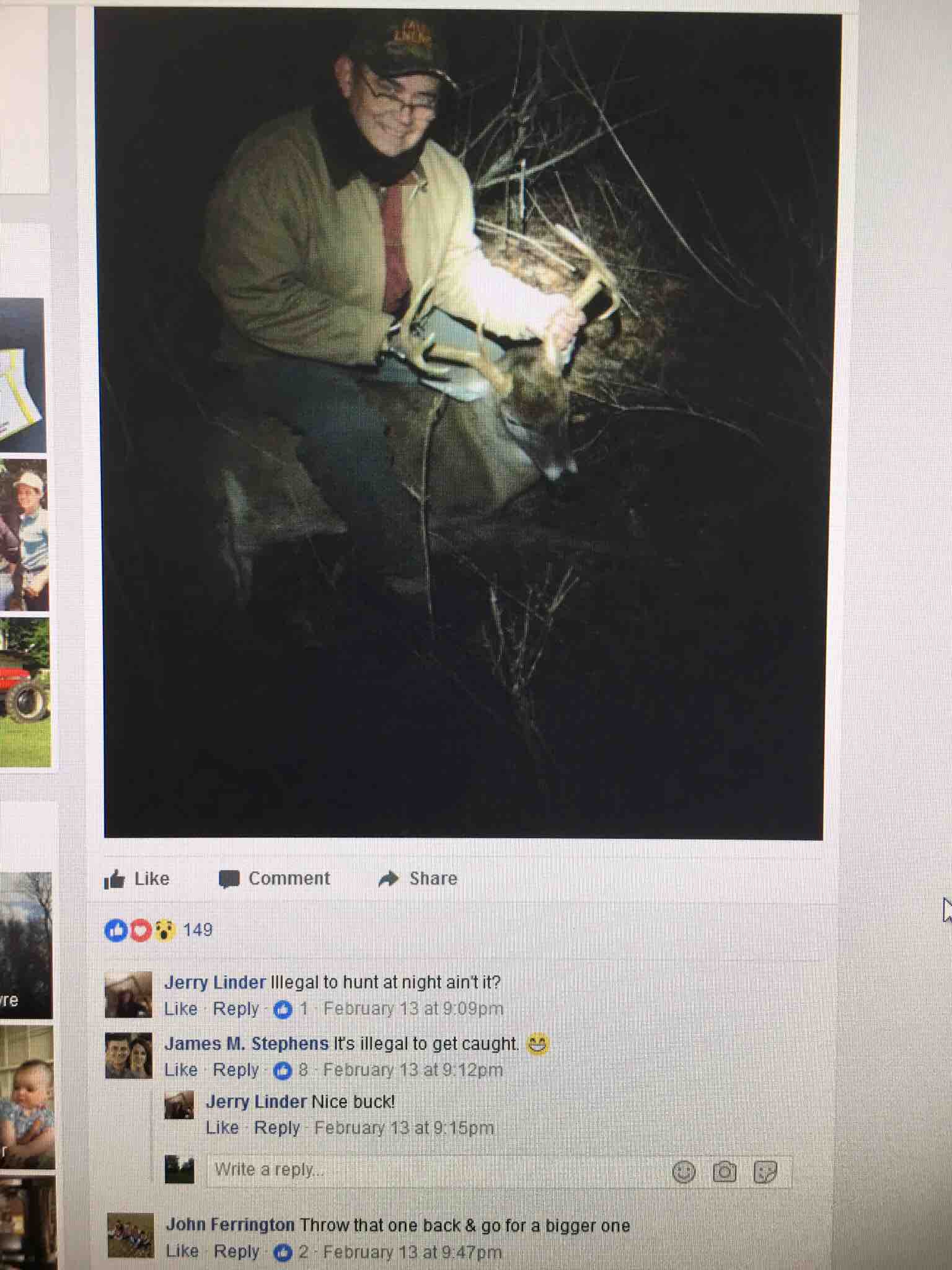
But the minor issue of where his office is housed doesn’t seem to be the type of thing that would bother Stephens anyway. After all, there is a photo, apparently posted on his Facebook page that shows him holding up the antlers of a deer he shot—at night? One person commented, “Illegal to hunt at night, ain’t it?” to which Stephens replied, “It’s illegal to get caught.”

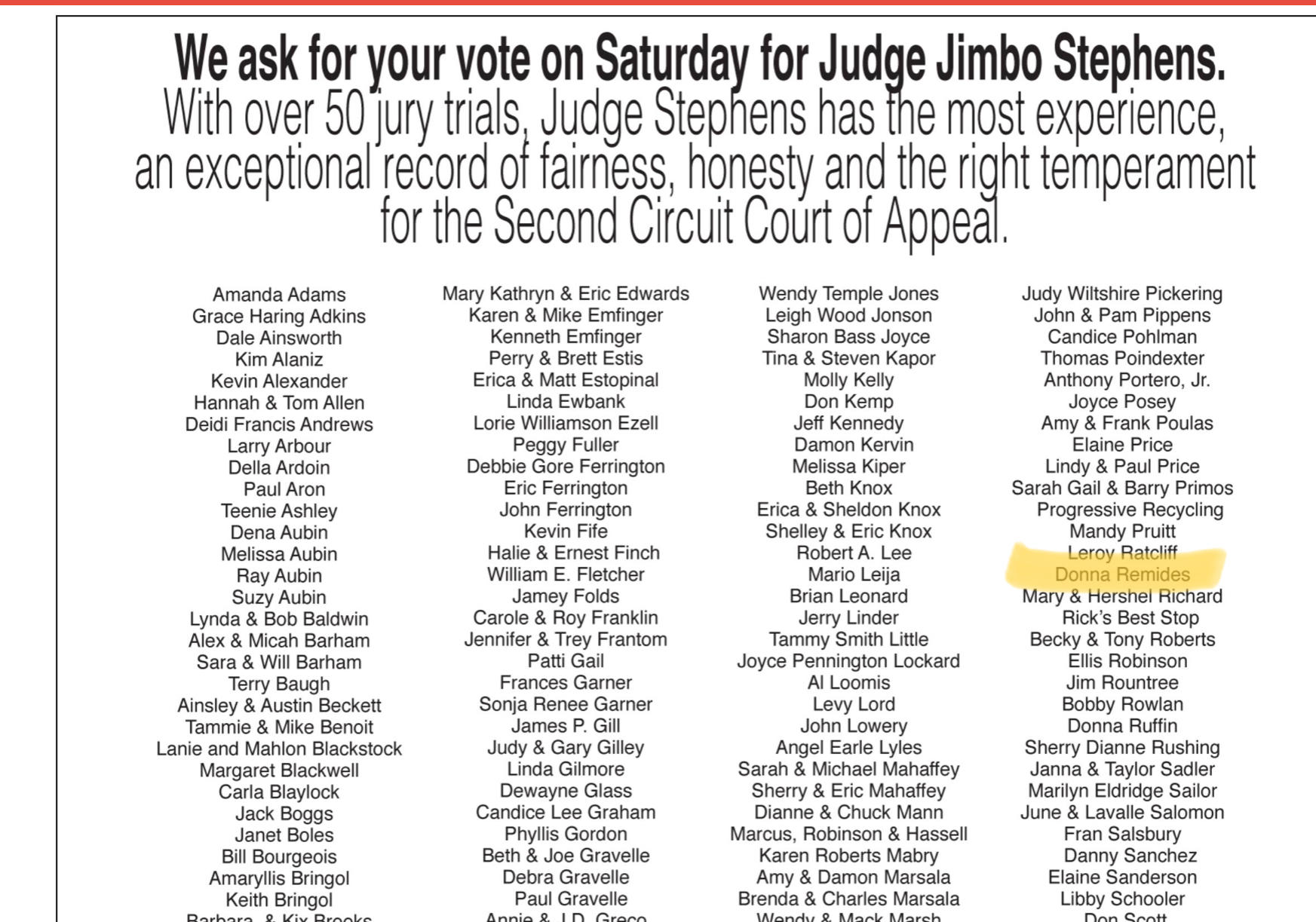
And when he was running for the appellate court in 2016, there were more than 160 people who signed onto a newspaper ad endorsing his candidacy. Among them was one Donna Remides.

(CLICK ON IMAGE TO ENLARGE)

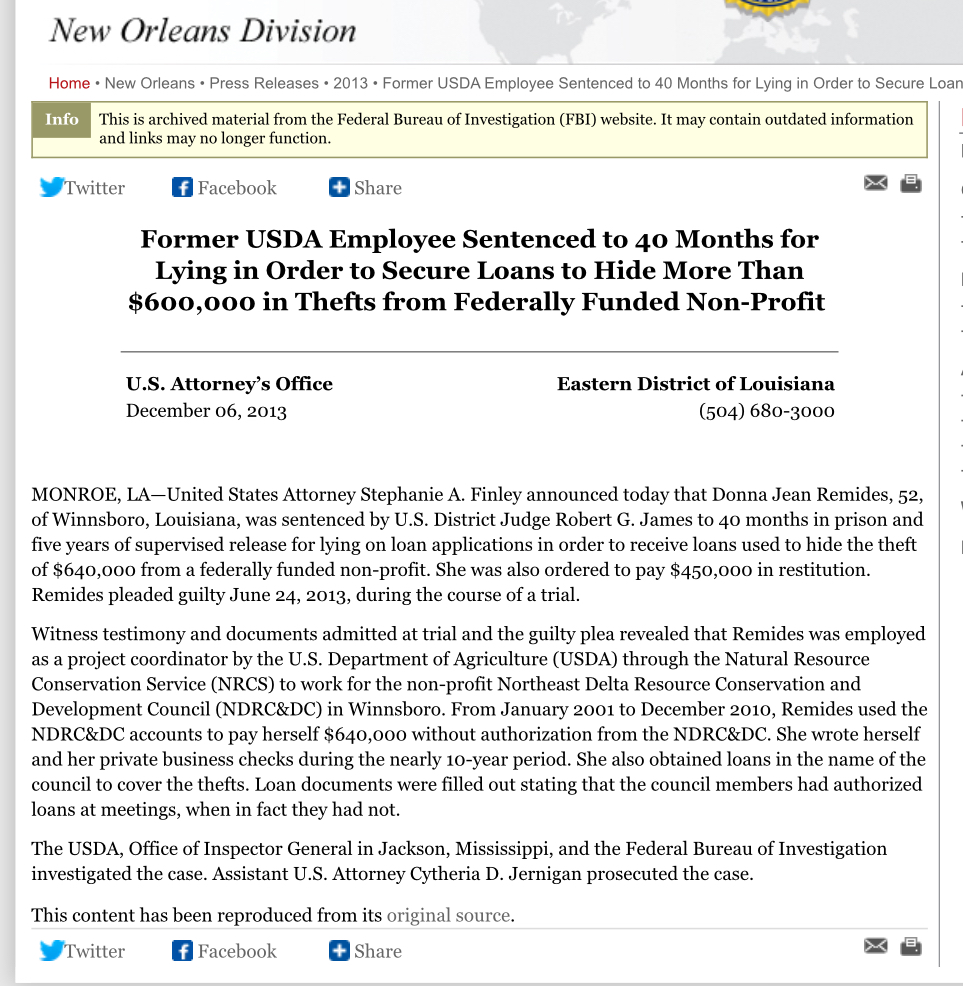
In December 2013, a press release from the U.S. Attorney’s Office in New Orleans said Ms. Remides was sentenced to 40 months imprisonment for lying in order to secure loans to hide more than $600,000 in thefts from the federally-funded non-profit Northeast Delta Resource Conservation and Development Council (NDRC&DC).

She was employed as a project coordinator by the U.S. Department of Agriculture (USDA) through the Natural Resource Conservation Service (NRCS) to work for the council in Winnsboro. From January 2001 to December 2010, she used the NDRC&DC accounts to pay herself $640,000 without authorization. She wrote herself and her private business checks during the 10-year period and obtained loans in the name of the council to cover the thefts.

Granted, Stephens has no control over who purchases a newspaper advertisement to endorse his candidacy. But that, coupled with the controversy over his refusal to recuse his pal Doughty from a trial involving a LAWSUIT against a bank with some questionable links to Doughty, the flippant remark about illegal night hunting, the office space at Vantage, the same personalities tying both judges to Vantage, Abraham and Ellington…

But then again, maybe that’s what qualifies both judges for their positions in the political climate in which we currently find ourselves.

Read Full Post »

« Newer Posts - Older Posts »