Feeds:
Posts
Comments

Archive for the ‘Politicians’ Category

By Stephen Winham

Guest Columnist

In the unfunny joke that was the latest “special” [not] legislative session there were no real surprises.  After much bickering over a small gobble-de-gook of incomplete solutions and ideas with no goal beyond getting 70 House votes for just about anything, the session finally ended with a whimper that anybody should have been able to predict after 15 days of inaction.  We are all left to ask why this debacle ever took place at all.

In the weeks leading up to the session Gov. Edwards threatened to not call it if an agreement on what to do about the “fiscal cliff” was not imminent.  Showing a distinct lack of decisive leadership, he not only went back on this threat, but failed, himself, to present a concrete proposal with a combination of cuts and taxes that would yield a recurring balance.  He never even really tried and seemed to say he was tired of doing so.

The governor presented a list of “cuts” he said he had already made, too many of which were not really cuts and a few of which were apparently duplicated.  Even the unambiguous cuts on the list begged the question of what has really changed as their result?  What pain has been inflicted and on whom? At the very least, what services have been diminished?

What evidence did the governor present that his appointees will be held accountable for making government as efficient as possible in the future, so people can have faith the revenues raised or retained will be spent wisely?  Ask anybody on the street if they believe state government is improving in that regard and the answer will most often be a resounding “No.”  This is particularly true of people who read newspapers and political blogs, listen to talk radio, and watch local television news where negative reports about state government are routine.

It is just plain common sense that people want answers to these questions. If the governor has made meaningful cuts he should be able to provide proof.  In other words, it should be possible to demonstrate the effects (not just dollar amounts) in such a way that people can judge whether the cuts should have been made and whether additional significant cuts should be made and, most importantly, specifically where?

For the coming year, the governor presented a list of cuts, but defended none of them as cuts he believed should be made.  On the revenue side, he presented a package that didn’t even fund these cuts and which he only halfheartedly supported.  About the only hope reflected in the governor’s proposal was that the mediocrity that keeps us on the bottom of practically every list of good things could continue.

The state senate waited the whole session for the house to give them something meaningful to do – Revenue bills had to originate in the house by law.  The Senate returned one bill providing tax relief to flood victims and the House concurred.

Despite having plenty of time because of a temporary two-year bridge, solid research of all pertinent issues, and promises to come forth with a plan to simply balance the budget, the house did nothing of the kind.  Instead of presenting a balanced plan of cuts and revenues, or even cuts alone, the house argued over pieces of the puzzle on the sheer basis of whether enough people would vote for them – what deals could be cut.  And cutting deals to get votes does not necessarily work to the advantage of the state or its citizens.

There was never a serious attempt to construct an enduring solution with more than a trace of desperately needed fiscal reform.  If there was a goal, it was to continue what we have had for over a decade – a questionable and temporary balance that makes as few voters and special interests angry as possible.  Thrown in were a handful of feel-good measures including ostensible Medicaid reform, a new spending cap proposal, and a promise of enhanced government transparency – none of which should require legislation.  Accomplishing their goals should be part of responsible governing.  Nobody was made happy -except those who think we should go over the cliff and see what happens.

One measure was anointed the pre-requisite and centerpiece for everything else and every day of deliberation the argument was put forth, “If we can’t renew ¼ of the expiring sales tax, we can’t move forward.”  What was so magical about that quarter of a penny?  Was it important to continue to punish the poor at least a little for being poor as a starting point, or what?  As its author, Rep. Dwight himself pointed out, the prospects for passage of his bill never really improved as the session went on.  Worse, it only took care of about a third of the gap and there was no clear plan for filling the rest of it from anywhere.  In a word, the bill was worthless.

Representatives Barry Ivey and Kenny Havard stood out as sincerely interested in doing something to help the state and its people move forward.  They both repeatedly called out their colleagues for hypocrisy and empty rhetoric. It is unfortunate Ivey did not get his February 28 motion to adjourn sine die on the floor and passed.  At least it would have saved the taxpayers the $60,000+ per day costs of the remaining days.  Sharon Hewitt and a growing number of others at least had sense enough to see the wisdom in that. Always rational, Rep. Julie Stokes attempted to move members in a progressive direction despite her Republican pedigree.  Speaker Pro Tempore Walt Leger offered progressive income tax measures to lukewarm support.  A few others voiced frustration but did little to steer what they clearly viewed as a doomed session toward success.

Republican Caucus Chair Lance Harris, himself a true expert at it, said he was tired of the blame game. Rob Shadoin agreed and restated the obvious when he said the session accomplished nothing except failing the people.  Speaking of blame, many people were happy to place it on the Black Caucus and their fellow Democrats.  If they were to blame for anything, it was for trying to get at a least a minuscule amount of progressive fiscal reform wedged in somewhere.

And speaking of partisan politics, the T Rex in the House was the desire on the part of Republicans to make the governor look as bad as possible.  Helping with that were the special interests, including that beacon of conservative light, Americans for Prosperity, founded and funded by the Koch brothers and claiming a membership of over 3 million right-minded people. How many of our elected officials pay homage to its agenda?  Its representative at the session wanted the session to go the distance in furtherance of the Louisiana Checkbook, a [non]panacea for the masses that will probably never be satisfactorily implemented regardless of legislation.  How many other budget reform laws languish in the books apparently ignored by our policy makers?  And, even when stumbled across, there is always the easy out of no money to implement them.  Forget about the will to do so.

The special session served one critical function to anybody who paid any attention to what went on.  It showed the utter lack of effective leadership in our state’s government.  It revealed who among our elected officials has the best interests of our state and its people at heart, i. e., who literally supports our form of government – and who doesn’t.

We can’t immediately recall the people who continue to ignore those of us without deep pockets, but we can replace them at election time – assuming people willing to truly represent us offer themselves for election – a daunting proposition at best.  Many current officeholders, with the validation of history, believe they don’t have to represent the bulk of us to be re-elected.  All they must do is get enough money from special interests to generate a flood of propaganda and false promises to fool enough people into voting for them.

Let’s prove them wrong.

(Editor’s note: Stephen Winham is the retired Director of the Louisiana Executive Budget Office, having served in that capacity from 1988 to 2000.)


Read Full Post »

You have to give credit to Lake Charles attorney Ron Richard: he certainly knows how to milk a case for all it’s worth in order to keep the meter running.

It apparently wasn’t enough that his four SLAPP (Strategic Lawsuits Against Public Participation) against Welsh Alderman Jacob Colby Perry were tossed by the presiding judge.

And no matter that a recall petition was initiated against Perry and that POSTCARDS were mailed to Welsh residents that DEPICTED Perry and fellow board of aldermen member Andrea King as “terrorists.”

And never mind that Mayor Carolyn Louviere desires to shut down a bar that just happens to be adjacent to a business owned by her son.

Now Richard, his four LAWSUITS against Perry—filed by him on behalf of the mayor, her son, her daughter, and Police Chief Marcus Crochet—having failed the smell test of 31st Judicial District Court Judge Steve Gunnel, who not only dismissed the four lawsuits aimed at silencing Perry’s criticism of Louviere’s administration but also awarded ATTORNEY FEES of $16,000 to Perry, is now challenging another RECALL PETITION, this one against his client, her honor the mayor.

So, it seems to boil down to the apparent belief that a recall against an alderman who seeks answers to budgetary questions is fine and dandy but to suggest a recall against the mayor who draws up that city budget constitutes a technical foul.

It’s all a sordid little mess punctuated by what appear to be excessive expenses of the police department, ($818,000 for nine months, form June 2016 through February 2017—for a town of 3,200 living, breathing souls), 18 police cars (again, for a town of 3,200), removal of Perry from the town’s Facebook page, and a mayor’s son (one of the four plaintiffs in lawsuits against Perry) who has a less than stellar past of his own.

Basically, with all that is going on there, it doesn’t really appear to be a town where most people would care to call home these days. That’s no dig on all the decent, minding-their-own-business residents living there, but a sorry commentary on the town’s leadership—if one wishes to be overly generous in calling it that.

Meanwhile, Richard manages to keep the meter running as the legal fees continue to mount for Madam Mayor. Of course, it has to be the client’s decision to retain him to pursue these objectives. He’s just a lawyer who ostensibly takes direction from his client. But often times, a client’s decision on a course of action is predicated upon the attorney’s advice, so in trying to determine who is actually calling the shots, we may just have the age-old chicken or egg question.

Still, it’s enough to make one wonder who is paying those legal bills: the client or the city?

Perhaps that’s another question for Mr. Perry to ask.

If he can get an answer, that is.

Anyone? Bueller? Bueller? Anyone?

Read Full Post »

Corruption.

As the March 12 opening day of the critical 2018 regular session approaches, and with the looming possibility of the call of a special session to address fiscal Armageddon, it’s an important word for Louisiana citizens to remember.

Corruption.

In a state where administrators, legislators, and judges all seem to be in it for personal enrichment, it’s a word that has become synonymous with political office—from small town mayors, city councils and police chiefs to the highest levels of state government.

Corruption.

Like a cancer, corruption metastasizes until it adversely affects every aspect of our lives: education, economics, environment, health, and not least, trust in our elected officials.

Michael Johnston and Oguzhan Dincer, both former fellows at Harvard Law School’s Edmond J. Safra Center for Ethics, recently collaborated to conduct their fourth Corruption in America Survey, an undertaking first initiated in 2014 and repeated annually.

Since 2016, the survey has been hosted by the newly-founded Institute for Corruption Studies, an independent research institute within the Illinois State University’s Department of Economics.

More than 1,000 news reporters/journalists covering state politics and issues related to corruption across 50 states participated in the survey. Reporters from every state except North Dakota and New Hampshire participated.

Click HERE to read the complete results.

To no one’s surprise, Louisiana ranks among the worst states in terms of executive, judicial, and legislative sleaze—in both legal and illegal corruption.

What, exactly, it meant by legal and illegal corruption? After all, corruption is corruption, is it not?

Well, yes and no. Illegal corruption was defined by Dincer and Johnston as “the private gains in the form of cash or gifts by a government official in exchange for providing specific benefits to private individuals or groups.”

How Gauche. Everyone knows that in Louisiana the preferred method is legal corruption, which the two researchers defined as “the political gains in the form of campaign contributions or endorsements by a government official, in exchange for providing specific benefits to private individuals or groups, be it by explicit or implicit understanding.”

For evidence of that, one need look no further than the LouisianaVoice STORY of Aug. 28, 2016, to see how Bobby Jindal, Attorney General Jeff Landry, and a gaggle of legislators fell all over themselves in protecting the big oil and gas companies from their responsibilities to clean up after themselves. Here is a more detailed look at .

Who better to serve as director of the Louisiana Offshore Terminal Authority than former State Sen. Robert Adley of Bossier Parish, the top recipient of OIL AND GAS CAMPAIGN CONTRIBUTIONS?

And Bobby Jindal handed out appointments to the most influential boards and commissions to his biggest campaign contributors like candy on a Halloween night and even upgraded a major highway in South Louisiana to benefit a company run by another large contributor.

Dincer and Johnston said that official legal corruption is moderately to very common in both the executive and legislative branches of government in a “significant” number of states, “including the usual suspects such as Mississippi, New Jersey, and New York,” but that “Alabama, Kentucky, and Louisiana are perceived to be the most corrupt states” in the executive, legislative, and judicial branches.

Illegal Corruption

Only 13 states were found to have moderately common to very common illegal corruption in their executive branches. Louisiana was one of those 13.

Only four states had illegal judicial corruption deemed to be moderately common (Alabama and Louisiana) or very common (Arkansas and Kentucky). Dincer and Johnston wrote that even a finding of only slightly common in illegal judicial corruption “is still worrying since it is the judicial branch of the government that is expected to try government officials charged with corruption.”

“State legislators are perceived to be more corrupt than the members of the executive branches in a number of states,” the researchers said.

To illustrate that, the survey found just six states with legislative illegal corruption that was very common (Alabama, Arkansas, Kentucky, and Louisiana) or extremely common (Oklahoma and Pennsylvania).

Legislators were found by LouisianaVoice to have leased luxury vehicles for family members, purchased season tickets to college and professional athletic sports teams, hired family members as campaign staff, paid personal income taxes and state ethics fines—all with campaign funds and all of which were illegal.

One legislator even profited by conveniently investing in Microsoft just as his committee was pushing through approval of one of the company’s software programs at the same time other states were taking similar action. The simultaneous approvals gave Microsoft stock a significant boost.

Legal Corruption

“Legal corruption is perceived to be more common than illegal corruption in all branches of government,” the report said, with Louisiana, Alabama, and Wisconsin scoring highest in legal corruption “in all branches of government.”

Those same three states, along with Arkansas, topped the list in legal corruption in the judicial branch where legal sleaze “is perceived to be ‘very common,’” it said, noting that in all four states, judges are elected as opposed to states where judges are chosen on merit and in which judicial corruption is not as common.

“…We expect our courts to rise above the day-to-day pressures and expectations of politics,” the report said. “That they apparently do not raises serious questions about the ways judges are elected in many states, how their campaigns are financed, and whether conflicts of interest arise as those who contribute to judicial campaigns are allowed to appear before those same judges as cases are tried.”

Louisiana, Alabama, and Wisconsin were joined by Arizona, Florida, Maryland, Missouri, New Mexico, North Carolina, Oklahoma, Texas, Hawaii, Illinois, Kentucky, Oregon, Georgia, New Jersey, and New York as states where legal executive corruption was found to be either “very common” or “extremely common.”

Legal legislative corruption was found to be “extremely common” in 12 states: Louisiana, Alabama, Georgia, Indiana, Maryland, Missouri, New Jersey, New York, Oklahoma, Oregon, South Carolina, and Texas.

Aggregate Corruption

Across the board, in terms of legal and illegal corruption in all three branches of government, few states do it better than Louisiana, results of the survey reveal, with the state ranking in the upper tier of corruption in all six listings.

That finding prompted the authors of the report to say that corruption in state government “is not just a matter of contemporary personalities and events, but is rather a result of deeper and more lasting characteristics and influences.

Nowhere, it would seem, is that truer than in Louisiana. Following is just a partial list of Louisiana public officials who have come face-to-face with corruption charges of varying degrees:


Louisiana Executive Corruption

Sherman Bernard: The first Louisiana Insurance Commissioners to be convicted, he served 41 months for extortion and conspiracy.

Doug Green: The second State Insurance Commissioner to go to jail, he was convicted on three counts of money laundering, 27 counts of mail fraud, and was sentenced to 25 years in prison.

Jim Brown: The third consecutive Louisiana Insurance Commissioner served six months for lying to the FBI.

Richard Leche: Louisiana Governor sentenced to 10 years in prison for accepting kickbacks on the purchase of 233 state trucks.

Edwin Edwards: Louisiana Governor sentenced to 10 years in prison after his conviction of extortion in connection with the awarding of state riverboat casino licenses.

Charles Roemer: Commissioner of Administration under Gov. Edwin Edwards, was convicted on one count of conspiracy to violate federal racketeering laws, violating the statute and engaging in wire and mail fraud as a result of the FBI’s Brilab operation which also resulted in the conviction of New Orleans mob boss Carlos Marcello. Roemer served 15 months in federal prison.

Jack Gremillion: Louisiana Attorney General of whom it was once said by Gov. Earl K. Long, “If you want to hide something from Jack Gremillion, put it in a law book,” was sentenced to three years in prison for lying to a federal grand jury about his interest in a failed loan and thrift company.

Gil Dozier: Louisiana Agriculture Commissioner, initially sentenced to 10 years in prison for extortion and racketeering but had eight years added after presiding federal judge learned Dozier had attempted to tamper with a juror and to hire a hit man for an unidentified target.

George D’Artois: Shreveport Public Safety Commissioner was implicated in the 1976 murder of Shreveport advertising executive Jim Leslie but he died in surgery before he could be tried.

Cyrus “Bobby” Tardo: former Sheriff of Lafourche Parish sentenced to 29 years, five months after pleading guilty in 1989 to solicitation for murder, conspiracy, possessing an unregistered destructive device and using an explosive to damage a sheriff’s car. His victim? His successor and the man who defeated him for reelection as sheriff, Duffy Breaux.

Duffy Breaux: Lafourche Parish Sheriff sentenced to four years, nine months in prison for conspiracy, mail fraud, obstruction of justice in 1995.

Eugene Holland: The first of three consecutive St. Helena Parish sheriffs to be convicted of a federal crime, sentenced to 16 months in prison for the theft of public funds to cover his utility bills and to pay for renovations to his house and barn. Pleaded guilty in 1996.

Chaney Philips: The second of three consecutive St. Helena Parish sheriffs to serve prison time after his conviction on nine counts of conspiracy, mail fraud, engaging in illegal monetary transactions, theft involving a federally-funded program, money laundering, and perjury—all related to his time not as sheriff but as parish assessor before being elected sheriff. Sentenced to seven years.

Ronald “Gun” Ficklin: Third consecutive St. Helena Parish sheriff to be convicted of federal criminal charges. Sentenced to five years, three months for trafficking cars with altered vehicle identification numbers, altering VINs, mail fraud, helping convicted felon possess a fun. Pleaded guilty in 2007.

Jiff Hingle: Plaquemines Parish Sheriff pleaded guilty in 2011 to conspiracy to commit mail fraud and bribery, sentenced to 46 months in prison.

Bodie Little: Winn Parish Sheriff convicted in 2012 of drug trafficking, sentenced to 13 years, four months in prison.

Royce Toney: Ouachita Parish Sheriff, pleaded guilty in 2012 to hacking a deputy’s email and phone records and then trying to cover up his snooping. Sentenced to four years’ probation.

Walter Reed: St. Tammany Parish District Attorney (22nd JDC) sentenced to four years in prison in April 2017 for conspiracy, wire fraud, mail fraud, money laundering, making false statements on tax returns. Sentence on hold during appeals process.

Harry Morel, Jr.: St. Charles Parish District Attorney (29th JDC) pleaded guilty in April 2016 to obstruction of justice in FBI inquiry into whether he used his position to solicit sex from women seeking official help. Sentenced to three years in prison.

Aaron Broussard: Former Jefferson Parish President pleaded guilty in 2012 to conspiring to accept bribes from a parish contractor. Sentenced to 46 months in prison. While parish officials other than district attorneys and sheriffs are not generally listed here, Broussard is because of his high national profile following Hurricane Katrina.

Ray Nagin: New Orleans Mayor convicted in 2014, sentenced to 10 years in prison for bribery, wire fraud, money laundering, conspiracy, tax evasion for illegal dealings with city vendors. As with the case of Broussard above, mayors not normally included in this list because of the sheer volume. But because of his high profile following Katrina and as mayor of state’s largest city, it was decided to include him.


Louisiana Legislative Corruption

Larry Bankston: Former chairman of the Senate Judiciary B. Committee that handled gambling legislation was convicted in 1997 on two counts of interstate communications in the aid of racketeering involving alleged bribes from a Slidell video poker truck stop owner. Sentenced to 41 months in prison. Re-admitted to Louisiana State Bar by State Supreme Court. Currently suing State Attorney General for the cancellation of his contract to represent a state agency.

Gaston Gerald: State Senator convicted in 1979 of extorting $25,000 from a contractor. Sentenced to five years in prison. Re-elected while in prison and put a prison acquaintance on Senate payroll as an aide before he was expelled from the Senate in 1981.

Sebastian “Buster” Guzzardo: State Representative among more than 20 persons, including the leader of the New Orleans Marcello crime family and three reputed New York mobsters, convicted in the Worldwide Gaming investigation. Conviction was for conducting an illegal gambling business and for aiding a mob-controlled video poker company. Sentenced in 1996 to three months in prison.

Girod Jackson, III: State Representative who pleaded guilty in 2013 to tax evasion and tax fraud in connection with his business dealings with the Jefferson Parish Housing Authority. Sentenced to three months in prison, nine months of home detention despite recommendations of 12 to 18 months imprisonment.

William Jefferson: 18-year veteran of U.S. House of Representatives convinced in 2009 on 11 of 16 felony counts for taking bribes in connection with a Nigeria business deal. Seven of the 11 counts on which he was convicted were overturned on appeal. Sentenced to five years, five months after appeals. In 2006, following Hurricane Katrina, Jefferson interrupted rescue operations by using a Louisiana National Guard detachment to recover personal effects from his home. (His sister, Orleans Parish Assessor, also sentenced to 15 months in prison after admitting to funneling $1 million in public funds to her family’s bogus charities.)

Charles Jones: State Senator from Monroe, convicted in 2010 of filing false tax returns and for tax evasion, sentenced to 27 months in federal prison and ordered to pay more than $300,000 in restitution. Was re-admitted to Louisiana State Bar on Monday (Jan. 29, 2017).

Harry “Soup” Kember: State Representative was sentenced to five years in prison after his 1986 conviction of mail fraud for pocketing part of a $150,000 state grant he secured for a constituent’s company.

Derrick Shepherd: State Senator sentenced to three years in prison in 2010 after admitting that he laundered money for a corrupt bond broker, netting $65,000 for the scheme.

Rick Tonry: Served only four months as a U.S. Representative from the 1st Congressional District after pleading guilty in 1977 to receiving illegal campaign contributions, promising favors in return for contributions and for buying votes in the 1976 Democratic primary.


Louisiana Judicial Corruption

Ronald Bodenhimer: The 24th Judicial District Judge was among four judges to be caught up in the FBI Wrinkled Robe investigation of Jefferson Parish Courthouse corruption and one of two to receive jail time. He was sentenced to 46 months in prison after pleading guilty in 2003 to planting drugs on a critic of his New Orleans East marina, for bond splitting, and for attempting to fix a child custody case on behalf of Popeyes Chicken Founder Al Copeland.

Wayne Cresap: The 34th JDC Judge for St. Bernard Parish was sentenced to five years in prison after pleading guilty in 2009 to accepting more than $70,000 in bribes and for letting inmates out of jail without paying their bonds.

Alan Green: Another of the four Judges of the 24th JDC in Jefferson Parish. Sentenced to 51 months in prison after his 2005 conviction of a $10,000 mail fraud scheme to take bribes from a bail bonds company.

William Roe: The 25th JDC Judge for Plaquemines Parish was sentenced in 2010 to three months in prison for unauthorized use of movables for pocketing more than $6,000 in reimbursements for legal seminars that he attended as judge. The money should have been deposited in a public account instead.

Thomas Porteous, Jr.: Only the eighth federal judge to be removed from office by impeachment in the Republic’s history, he was convicted in 2010 by the U.S. Senate on four articles charging him with receiving cash and favors from lawyers who had dealings in his court, used a false name to elude creditors, and deliberately misled Senators during his confirmation hearings. As if to underscore the gravity of the charges, all 96 senators present voted guilty on the first article which addressed charges during his time as a state court judge and his failure to recuse himself from matters involving a former law partner with whom he was accused of granting favors for cash.

There are scores of other examples, including city and parish elected officials, local police chiefs, and even a legislator who resigned rather than be expelled for spousal abuse. And former Louisiana State Penitentiary at Angola Warden Burl Cain retired in 2016 under an ethics cloud even though he was official cleared of ethics charges. His son, Nate Cain and Nate’s former wife, Tonia, were indicted in August 2017 on 18 federal fraud charges over purchases he was said to have made with state credit cards during his tenure as warden of Avoyelles Correctional Center in Cottonport.

Additionally, LouisianaVoice over the past three years documented numerous instances of abuse of power and outright corruption from troop commanders all the way up to the upper command of Louisiana State Police.

There were dozens more not listed and sadly, there will continue to be corruption in all three branches of state government so long as the people of this state continue to look away and ignore the widespread malfeasance and outright skullduggery.

And by ignoring the problem, we are necessarily condoning it.

Read Full Post »
The late comedian Andy Griffith began his classic bit entitled What it was, was Football with this line:

“It was back last October, I believe it was…”

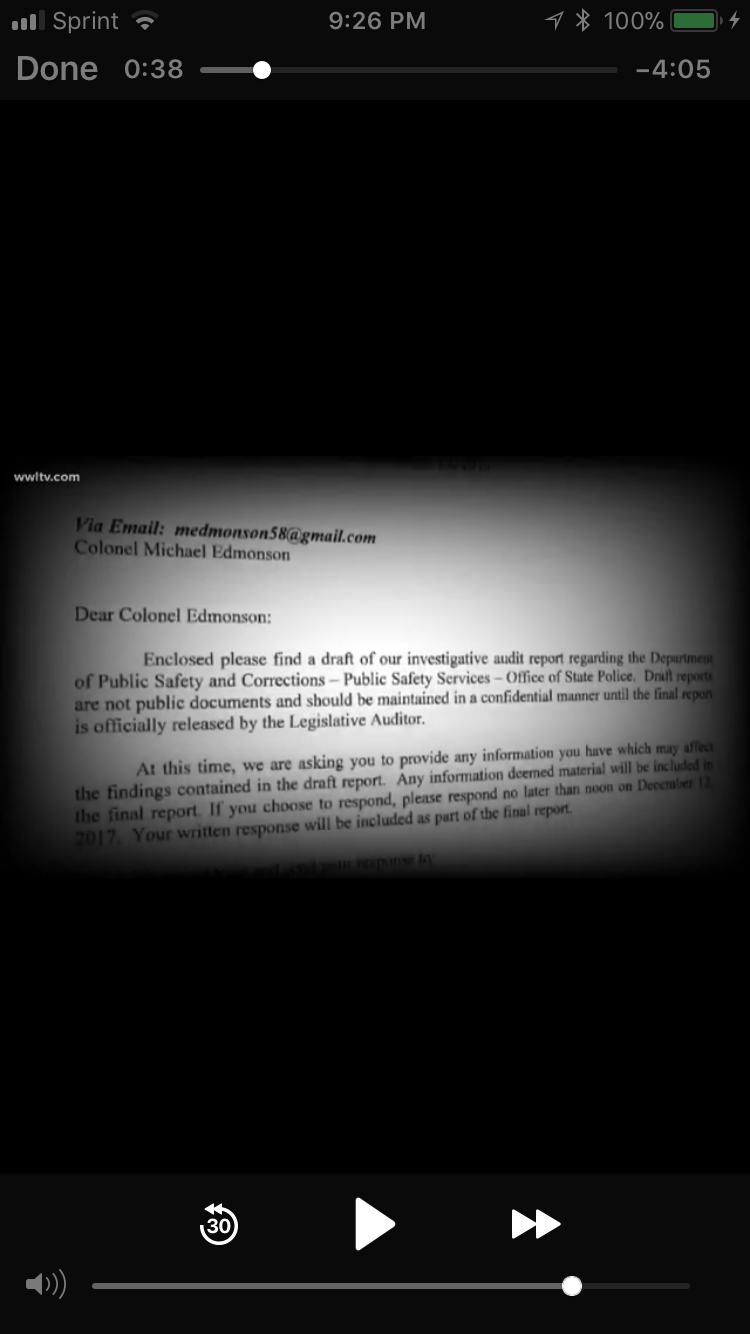
Well, it was back last December—Dec. 5, 2017, to be precise—that I speculated in my LouisianaVoice POST about the “premature” release of that Louisiana State Police (LSP) audit so critical of former LSP Superintendent Mike Edmonson that ol’ Mike most probably leaked that “premature” audit copy himself in order to set up a claim that his defense, in case of ensuring criminal charges, had been tainted.

Back on Dec. 5, I wrote: “A premature release of the audit before Edmonson had a chance to respond could conceivably prejudice the case against Edmonson. Accordingly, Edmonson (or more likely someone acting anonymously on his behalf) slipped a copy of the audit to The Advocate/WWL.”

The ploy may have worked had it not been for WWL-TV posting the auditor’s cover letter to Edmonson. That pretty much put the ball in Edmonson’s court in terms of identifying the leaker. That’s because there were only two copies of the audit draft. One went to LSP and one to Edmonson. Only the one that went to Edmonson contained the auditor’s cover letter. And when WWL abruptly removed the video from its web page when I called attention to it, that pretty much confirmed my theory.

Well, wouldn’t you know Mikey done went and done zackly I said he’d do.

Thanks in no small part to the resourcefulness of Baton Rouge Advocate reporter Jim Mustian, we now know that Mike won’t be submitting his response to the audit. That response, was initially due back on Jan. 15 and I did a post about his missing the deadline. Even then, it was pretty much a certainty there would be no response from Edmonson. It’s difficult, after all, to defend the indefensible.

But now he’s made it official through his legal counsel, Harry Rosenberg. Mustian had a STORY today that quoted Rosenberg as telling state auditors that his client was finding it impossible to “engage in a meaningful preliminary conference” with the auditor’s office “due to the premature release of the ‘draft’ audit.” SEE ROSENBERG LETTER AT END OF AUDIT

Now, folks, I’m not blessed with the ability to see into the future but this wasn’t a hard call to make. WWL’s posting of that cover letter—and its sudden disappearance from the station’s online story—along with Mike’s early protestations made his strategy oh, so very easy to decipher.

And, oh yes, that FBI INVESTIGATION also announced by Mustian on Tuesday is the latest wrinkle in the ongoing probe of his role as Louisiana’s top cop. The feds are interviewing LSP helicopter pilots and looking at flight logs. They’re making a list and checking it twice and Mike has to be feeling the heat.

So, with the news of the FBI investigation and Mike’s declining to provide his response to the audit can mean only one thing: Rosenberg, no stranger to criminal matters given his experience as a former U.S. attorney for Louisiana’s Eastern District from 1990-1993, has undoubtedly admonished his client to sit down and shut up.

That’s what lawyers do. They tell clients to zip it because they’re the smartest people in the room and they think everyone should listen to them. Except in this case, he’s probably right—if you believe the hokum that Rosenberg dropped into his letter to Legislative Auditor Daryl Purpera. Edmonson, according to Rosenberg, was nothing less than a saint who was a “consistent calming presence” during hurricanes, shootings, and floods” and that San Diego motor trip by four troopers was all their fault and none of Edmonson’s. In short, we should probably lay rose petals in his path.

There is one unanswered question about Rosenberg’s letter to the auditor, however.

He copied one other person with the letter: State Sen. Mike WALSWORTH of West Monroe.

Walsworth is a member of the Senate & Governmental Affairs Committee, but he’s not chairman or vice-chair and he’s not from Edmonson’s senatorial district, so why would he do that?

It’s enough to make one wonder if Walsworth’s name might be on those LSP flight logs and copying him with the letter was a way of giving him a heads-up. Just sayin’.

State Sen. NEIL RISER must be fuming that he didn’t get a copy of the Rosenberg letter.

In retrospect, maybe it’s unfortunate that Riser’s attempt to bump Edmonson’s retirement up by about $100,000 per year was unsuccessful. He may need the money to pay his attorney.

Read Full Post »

Jeff Landry is a man who knows the value of positive public relations.

Negative PR? Not so much.

LouisianaVoice has for months now been attempting to extract some type of information regarding the AG’s progress in investigating that April 2016 RAPE of a 17-year-old female inmate by a convicted rapist—in the Union Parish Jail in Farmerville.

And after months of not-so-artful dodging with the oft-repeated, “This matter in under investigation, therefore I cannot comment on the specifics or answer questions at this time” response of Press Secretary Ruth Wisher, there apparently has been no progress in the investigation.

Recently, though, the AG’s office has altered its method of responding to public records requests—and the method for submitting same.

Once it was sufficient to initiate an official public records request (PRR) to the AG’s Public Information Office with a simple email that began: Pursuant to the Public Records Act of Louisiana (R.S. 44:1 et seq.), I respectfully request the opportunity to review the following document(s):

Now, though, the AG has abruptly switched gears to require that inquiries be routed through a different office—which would seem to make the name of the Public Information Office something of a misnomer.

Previously, following that referencing of the state’s public records act, one would simply list the documents desired (It’s crucial that you request actual documents and not just general information: public agencies as a rule—there are exceptions—won’t respond to general requests). Here is a recent (Dec. 13, 2017) request submitted by LouisianaVoice for which no response has yet been received:

  • Please provide me a current list (and status) of all criminal investigations undertaken by the Louisiana Attorney General’s office since Jeff Landry’s inauguration.
  • Said status should include all dispositions of cases, including convictions and/or dropped charges, where applicable.

But now, Landry’s office appears to be circling the wagons. No more are we to submit request to the Public Information Officer, which makes public information something of an oxymoron. Here is our latest inquiry about the status of the investigation of that rape case which is now entering its 21st month despite the fact that authorities know the following:

  • Where the rapes (she was raped twice) occurred (in the confines of a small cell);
  • When they occurred;
  • The identity of the victim;
  • The identity of the alleged rapist (who was awaiting sentencing for a prior conviction of aggravated rape)

Here is LouisianaVoice’s request:

“Please provide me an update on the current status of the Union Parish jail cell rape case that occurred in April of 2016.

Should you respond with the usual “ongoing investigation” response, then please try to give me some indication as when this unusually lengthy investigation of a relative uncomplicated matter will be completed.”

Here is the AG’s response:

As you have anticipated, Louisiana’s Public Records Act, specifically La. R.S. 44:3(A)(1), exempts records held by the office of the attorney general that pertain to “pending criminal litigation or any criminal litigation which can be reasonably anticipated, until such litigation has been finally adjudicated or otherwise settled. . . .” Therefore, records related to open investigations are not subject to disclosure until the case is finally adjudicated or otherwise settled. 

Additionally, your request does not identify any currently existing record. The creation of periodic “status updates” is not an obligation imposed upon public bodies by Louisiana Public Records Law, La. R.S. 44:1, et seq. Please direct future requests for press releases to our Communications Division at AGLandryNews@ag.louisiana.gov. If you have any further requests to make pursuant to La. R.S. 44:1, et seq., please let me know. 

With Best Regards,

Luke Donovan
Assistant Attorney General

Well, I can certainly understand that records of pending matters are exempted but how long is Landry going to let this languish? The victim has filed suit against the state and Union Parish but that is a civil matter. The rape is a criminal investigation. And while the AG is charged with defending the civil suit, the two are separate matters handled by separate divisions.

And what, exactly, does Donovan mean by “pending criminal litigation”? We have pending civil litigation and we have pending criminal prosecution. Again, they are separate, handled by separate divisions.

But then, Landry is nothing if not a publicity hound. He loves to see his name in print. He just doesn’t have the same enthusiasm for actual work. Take the theft from the DeSOTO PARISH Sheriff’s Office that was turned over first to Landry’s predecessor Buddy Caldwell and then to him to investigate because the victim of that theft was the local district attorney, creating for him a conflict of interests.

Landry never did complete that investigation which pre-dated the Union Parish rape case by two years. It was a federal grand jury that ended up indicting the employee involved.

And finally, there is the ALTON STERLING case which, following the U.S. Justice Department’s punting on the matter, was taken up by Landry last May. Nearly 10 months later, Landry has yet to give any indication as to when he will issue a report on that shooting by Baton Rouge police.

So, Ruth Wisher is stuck with the unenviable task of trying to make her boss look good. It’s not quite as daunting a task as that of Sarah Huckabee Sanders in trying to make a silk purse of the sow’s ear that is Donald Trump, but daunting nevertheless.

The glowing press releases will continue in Landry’s unabashed quest for the governor’s office while the real work of completing the investigation of the rape of a 17-year-old will continue to get short shrift because, realistically speaking, there are no votes to be gained in protecting the rights of a meth addict.

And that, readers, is the very definition of hypocrisy.

Read Full Post »

« Newer Posts - Older Posts »


