Feeds:
Posts
Comments

Archive for the ‘Media’ Category

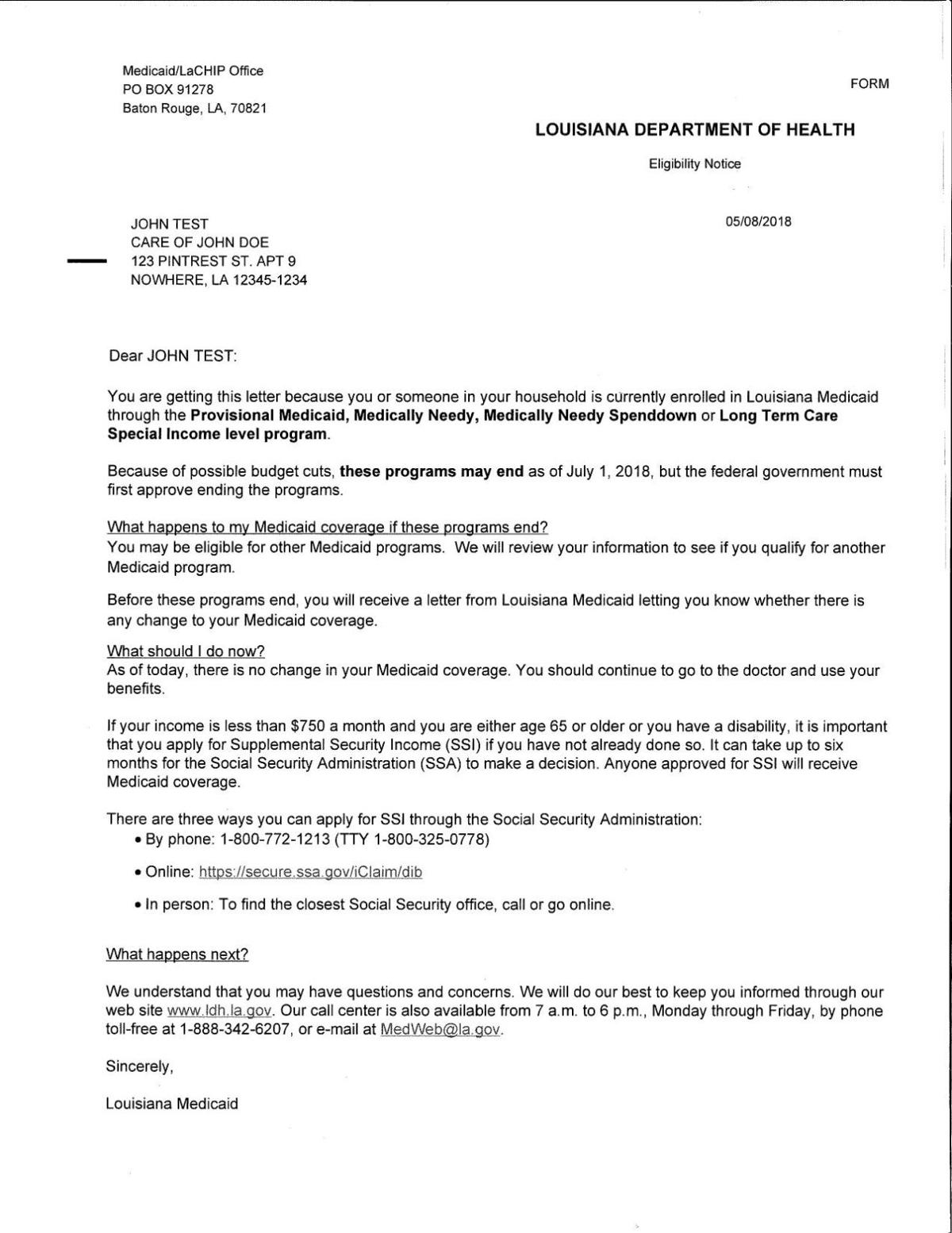
If you like political posturing, puffery, bombast, and breast-beating, then the reaction to that LETTER being sent out to 37,000 nursing home patients in Louisiana is tailor-made for political junkies like you.

The letter, sent out by the Louisiana Department of Health, got the desired reaction. CBS Evening News featured the story prominently in its Wednesday newscast, complete with a brief interview with Jim Tucker of Terrytown, operator of about a dozen nursing homes.
It’s interesting that Tucker was sought out for camera face time. He was Bobby Jindal’s Speaker of the House who abetted Jindal for eight years in gutting the state budget of services for the elderly and mentally ill. And now the roll him out in front of the cameras to cry wolf.

The Edwards administration tried to assure us, through Commissioner of Administration Jay Dardenne and LDH Secretary Dr. Rebekah Gee, that this is not Chicken Little, that the sky really will fall if budget cuts are not restored by July 1, the date that the state is projected to fall over the metaphorical fiscal cliff when $650 million in tax revenue falls off the books.

Typically, the reaction by Republicans in the legislature, the same ones who have steadfastly refused to face fiscal reality since the beginning of the Jindal accident in 2008, was to scream foul to anyone who would listen—and there were plenty who did.

Dr. Gee, of course, did her part, even tearing up as she explained to the TV cameras that hearts “are breaking over the need to do this. We can’t provide services with no money to pay for them.”

Dardenne added his bit, saying, “This letter is scary, but it’s not a tactic. This is the reality that we are facing.”

But House Appropriations Committee Chairman Cameron Henry (R-Metairie) gave the best performance. With a lock of hair hanging down over his forehead a-la the late Bobby Kennedy, he bleated, “This is premature at best, reckless at worst,” adding that the letter was designed “to scare the elderly of this state, and that is an embarrassment.” No, Cameron, you’re an embarrassment.

Ditto for Rep. Lance Harris (R-Alexandria), chairman of the House Republican Delegation, who called the letter an “unnecessary political scare tactic done to intimidate and frighten the most vulnerable people into believing they will be kicked out onto the streets if the governor doesn’t get everything he wants in the form of revenue.”

And Cameron Henry should understand that the legislature as a body is no less an embarrassment to those of us who have been forced to observe its collective ineptitude on a daily basis for 10 years now. To quote my grandfather, they couldn’t find a fart in a paper bag.

Lost in all the rhetoric is the hard fact that the administration might not have found it necessary to send out the letter—regardless whether it’s a scare tactic or reality—had the legislature made any effort to face up to its responsibility to the 4.5 million citizens of this state.

But here’s the real reality—and just remember where you read it:

Not a single nursing home patient is going to be evicted. Not one.

Want to know why?

Money.

And I don’t mean money to be appropriated by the legislature to properly fund state government, nursing homes included.

I’m talking about campaign money.

Lots of it. Tons of it.

Since 2014, individual nursing homes, nursing home owners, and nursing home political action committees have contributed more than $750,000 to Louisiana politicians, primarily legislators. Here is just a partial list of NURSING HOME CONTRIBUTIONS

And that’s just over the past four years.

More than $50,000 was contributed the campaign of Edwards.

Henry, the one who called out the administration for its “scare tactics,” received more than $10,000 since 2014.

Senate President John Alario also received more than $12,000 over the same time span.

Louisiana Public Service Commission member Foster Campbell said on the Jim Engster show on Louisiana Public Radio earlier this week that since he first ran for the legislature more than 40 years ago, the cost of seeking political office has become cost prohibitive. Foster said when he first ran for the State Senate in 1975, he borrowed $7,500 to finance his campaign. “Now, it costs hundreds of thousands of dollars” and the average person who wants to serve cannot afford to do so, he said.

I’ve always wondered why corporations and the wealthy who seem so concerned about “good government” don’t use their money to help others rather than lavish it on politicians. The money they throw at politicians and lobbyists could be put to such more productive use—but they don’t try because they don’t really care about good government. And every now and then, I can’t help wondering why that is.

But I don’t wonder about it long. The answer is obvious: power and influence.

And that’s a sorry commentary on our political system, from the local level all the way to the very top of the political pyramid.

And it’s for that reason that not a single nursing home resident will be evicted. By some miracle, repeated every year, it seems, extra money will be “found” to do what is politically expedient.

Because the money has already been spread around by those who buy influence and legislators.

Remember where you read it.

Read Full Post »

Jefferson Davis Parish and the City of Jennings have for years now been the unwanted focus of national attention because of unsolved murders of eight (at least, some say there are more) prostitutes from 2005 to 2008.

Those murders are said to have been the inspiration for the TV show TRUE DETECTIVE.

Although author ETHAN BROWN, in his book Murder in the Bayou, as well as numerous national media stories is about the eight women, some sources say the number of UNSOLVED MURDERS in the parish is higher, that the actual number is at least 13 and also includes four male victims.

And while the eight female victims who have drawn so much media scrutiny since discovery of Necole Guillory nearly a decade ago were known drug users, it’s not insignificant to note that Brown claims that each also was a police informant.

Yet, while ROLLING STONE magazine, DR. OZ and others continue to devote considerable ink and camera time to the mystery, Jennings rolls along planning for Louisiana’s Most Beautiful City competition while seemingly ignoring areas of blighted abandoned houses in the city and burgeoning drug trafficking in those abandoned homes despite repeated warnings from one of its citizens.

That citizen, Christopher Lehman, is a retired Navy veteran and a retired federal civil service employee who upon moving to Jennings, served as a community services coordinator for the Jennings Police Department but was fired after making too much noise about open narcotics transactions on his street.

His dismissal has not deterred him from photographing suspected drug deals from vehicles and abandoned houses on his street and hitting the mayor’s office with a barrage of recorded incidents he feels were also narcotics transactions.

In fact, Lehman has combined several binders of photographs, reports and other information that he turned over to the city authorities. His warnings were consistently ignored.

Lehman, it seems, knew what he was talking about. Jennings police recently arrested 10 people in a major HEROIN BUST.

The Jennings Police Department chief, Todd D’Albor, recently resigned to take a similar position as leader of the newly-formed New Iberia Police Department.

That city, of course, has its own set of problems with a sheriff under fire and having escaped conviction on federal criminal charges brought against him in connection with the mistreatment of prisoners in his jail, including the deaths of some prisoners in his custody.

The most notorious case was that of a 20-year-old black male who authorities claimed managed to obtain a gun and shoot himself in the chest—while his hands were cuffed behind him.

The sheriff’s office took over patrol of New Iberia several years ago when the police department was disbanded because of a lack of city revenue with which to fund the department. Only after residents voted approval of $500,000 to reinstate the department last year was the department resurrected.

The vote to bring back the New Iberia city police department may have been prompted in part by the city’s VIOLENT CRIME RATE which runs far ahead of the state and national averages.

It’s uncertain if the New Iberia mayor and city council examined an audit report of the City of Jennings which said that D’Albor, while heading the Jennings Police Department, used public property for his personal use, used police department personnel to run personal errands, and that he stored personal property at city facilities against city policy.

All that might cause the casual observer to question why one city with a chronic crime problem would hire a police chief from a city where eight—or 13—unsolved murders continue to pose serious questions as to what is being done to solve the murders as well as to curtail open drug deals on the streets of a city that aspires to the title of Most Beautiful.

Read Full Post »

JIM BROWN, Louisiana’s erstwhile legislator, secretary of state, gubernatorial candidate, state insurance commissioner and self-described victim of an over-zealous FBI HATCHET JOB, today has a radio talk show and publishes an Internet blog as well as dabbling in the BOOK-PUBLISHING business.

On May 6, Brown will turn 78 but as a former track star at the University of North Carolina (he was the first athlete recruited by the legendary Dean Smith), he has certainly shown no signs of slowing down.

But this isn’t about Jim Brown per se. It’s about a post by Brown that reminded me just how unfair American justice can be and how badly the FBI can screw up.

Even FBI directors and agents who screw up and are eventually promoted to director of the FBI.

Agents like James Comey and former Director Robert Mueller.

In the interest of full disclosure and as an open admission that I am not an “objective news reporter” by any stretch, I want to say it pains me greatly to write anything that puts Donald Trump, whom I detest with every fiber in my being, in a favorable light—even by comparison. I will add that I purchased Comey’s book and actually started reading it. But I put it down after a few pages of self-serving fluff about what a great kid he was growing up, how he was bullied, and how he rose above it all. It just seemed to be a little too me, me, me.

I know I will receive critical comments, and though I am no fan of Hillary Clinton, I remain firmly convinced that the accident of Donald Trump (elected with a substantial minority of popular votes) is the worst tragedy to befall this nation since the Civil War. By comparison, LBJ was a benevolent father figure, Nixon a saint, George W. Bush a towering intellect, and Bill Clinton a paragon of marital fidelity.

But here’s the thing, as Brown reminds us in his POST: Comey, abetted by his boss, then-FBI Director Mueller, literally ruined the life of an LSU professor a mere 16 years ago.

It all actually started in 2001. Mueller had been appointed FBI Director in July of that year by W. In a matter of days after the 9/11 attacks on the World Trade Center and the Pentagon, the first of several envelopes containing deadly anthrax were sent to NBC News, the New York Post and the publisher of The Sun and The National Enquirer tabloids. In October, two more such envelopes were received at the Senate offices of Tom Daschle and Patrick Leahy. In all, 17 persons fell ill and five died from anthrax inhalation.

It didn’t take long for fingers to start pointing (incorrectly) to an obscure medical doctor named Steven Hatfill who once had worked at the Army’s elite Medical Research Institute of Infectious Diseases (USAMRIID), which, coincidentally, had stocks of anthrax, according to a lengthy 2010 article in THE ATLANTIC, entitled simply, “The Wrong Man.”

Hatfill immediately became the central figure in a media circus and the FBI was happy to oblige the need to find a scapegoat for the anthrax letters. He was working at Science Applications International Corp. (SAIC), a large defense contractor, from 1999 to 2002, where he was involved in developing a brochure for emergency personnel on ways in which to handle anthrax hoax letters.

He wasn’t surprised, then, when the FBI wanted to interview him for what he thought was the agency’s pursuit of foreign terrorists. He assumed that the FBI was routinely interviewing all scientists who had worked at USAMRIID.

It didn’t seem to matter to the FBI that anthrax is a bacterium and Hatfill was a virologist who never handled anthrax.

Investigators raided Hatfill’s girlfriend’s townhouse, telling her, “Your boyfriend killed five people.” He was fired from SAIC with the official explanation being that he had failed to maintain a necessary security clearance (a disqualification that would eliminate about half of Trump’s White House staff).

And here’s where the local angle comes in. He thought he’d landed on his feet when LSU hired him as the associate director of its new program designed to train firefighters and other emergency personnel to respond to terrorist acts and natural disasters. The pay ($150,000) was to be the same as he’d made at SAIC.

But Justice Department officials, in their desperation to nail Hatfill, told LSU to “cease and desist” from using him on any federally-funded program. Accordingly, he was fired before his first day on the job. Then other prospective jobs fell through. Like the anthrax he was suspected of sending, he became toxic. One job fell through his fingers like so much sand when he emerged from a meeting with prospective employers only to find FBI agents videotaping them.

For two years, his friends were interrogated, his phone was tapped, surveillance cameras recorded his every move. (Comey recently said in his ABC-TV interview with George Stephanopoulos that if an FBI agent can’t put his investigation together in 18 months, he should be fired.)

The FBI brought in two bloodhounds from California whose handlers insisted the dogs could sniff the scent of the killer on the anthrax letters—never mind that sniffing the letters would have been lethal to the animals. When Hatfill petted the dogs, their handlers said the dogs responded “favorably,” proof that Hatfill was the killer.

If the FBI had shown even a fraction of investigative professionalism in the dog handlers’ backgrounds as they had in Hatfill’s, they might well have sent the handlers—and their dogs—packing. Defendants in California who had been convicted on the basis of the dogs’ behavior were later exonerated. In one case, a judge called the dog handlers “as biased as any witness that this court has ever seen.”

But Mueller was infatuated with the dog evidence, however, personally assuring Attorney General John Ashcroft that they had their man. Comey, asked if Hatfill might be another Richard Jewell (the Atlanta security guard wrongly accused of the Olympics bombing), was just as adamant, saying he was “absolutely certain” there was no mistake.

Well, as we all know by now, Hatfill was innocent.

Mueller and Comey’s certainty that he was the anthrax killer eventually cost the Justice Department nearly $6 million in a LEGAL SETTLEMENT. Refusing to attend the press conference announcing the resolution of the case, Mueller was less than contrite about ruining an innocent man’s life. Responding later to reporters’ questions, he said, “I do not apologize for any aspect of the investigation. He added that it would be erroneous “to say there were mistakes.”

But, Mr. Mueller…there were mistakes. There was incompetence. There was recklessness. Most of all, there was a total lack of concern for an innocent man’s life—all for the benefit of advancing the careers of ambitious men too caught up in their own careers to think of the impact their actions might have on another’s livelihood.

As much as I loathe Trump and all he stands for, I fervently hope that Mueller—and by extension, Comey—haven’t traveled down that same path in the investigation of Russian interference in the 2016 election.

And last of all, but certainly not least, thanks to Jim Brown for reminding us of a dark chapter in LSU’s history, a chapter in which there should be everlasting shame, one that ranks right alongside that of the sorry saga Ivor Von Heerden’s firing over his criticism of the U.S. Army Corps of Engineers following Hurricane Katrina (it turned out his criticisms were dead-on)—neither of which should ever be forgotten.

Read Full Post »

Anyone remember Allyson Campbell?

If not, that’s understandable. After all, it’s been a couple of years since we had a STORY about her exploits in the 4th Judicial Court in Monroe. She’s the Monroe News-Star society columnist who showed up occasionally at her supposed full-time job as law clerk for 4th JDC Judge Wilson Rambo (gotta love that name; wonder if they have a judge named Rocky?).

On Wednesday, 12 of the 13 judges of the First Circuit Court of Appeal (only Judge Curtis Calloway did not hear arguments) dealt the self-promoting columnist/clerk a major setback when it ruled in an en banc (full court) decision that she does not enjoy “absolute immunity” from her actions in destroying court files and that a lawsuit against her may go forward.

But it was the dissenting opinion of one of the three judges who gave written opinions that makes for the best reading.

The ruling comes nearly two years after Louisiana Inspector General STEPHEN STREET found there was no “sufficient cause” to bring charges against Campbell for what witnesses said were repeated instances of her destroying or concealing trial briefs. For that matter, Louisiana State Police and the Louisiana Attorney General’s office also declined to pursue the matter, leaving only one state official, Legislative Auditor Daryl Purpera, with the integrity and courage to call Campbell out for her actions.

She was also the central figure in:

  • The controversy that erupted when the Ouachita Citizen made a legal request for public records from the court—and was promptly sued by the judges for seeking those same public records.
  • The filing of a lawsuit by Judge Sharon Marchman against four fellow judges and Campbell over Campbell’s claiming time worked when she was actually absent—including time when she was in restaurants and/or bars for which she claimed time—and the four judges who Judge Marchman said were complicit in covering for her.
  • A complaint by Monroe attorney Cody Rials that Campbell had boasted in a local bar that she had destroyed Rials’ court document in a case he had pending before Judge Carl Sharp so that Sharp could not review it. One witness interviewed by Judges Sharp and Ben Jones quoted Campbell as saying that she had “taken great pleasure I shredding Rials’ judgment” and that she had given Rials a “legal f—ing.”

Now a DECISION by the First Circuit Court of Appeal, in overturning a lower court’s 2015 decision, has held that a lawsuit by Stanley Palowsky, III, against Campbell for damages incurred when she “spoliated, concealed, removed, destroyed, shredded, withheld, and/or improperly handled” his petition for damages against former business partner Brandon Cork may proceed.

At the same time, the First Circuit ruled that the five judges he added as defendants—Stephens Winters, Sharp, Rambo, Frederic Amman and Jones—for allowing Campbell “free rein to do as she pleased and then conspiring to conceal (her) acts” enjoyed “absolute immunity” from being sued and were dismissed as defendants despite their repeated denials that any documents were missing from the Palowsky file.

Palowsky argued that Campbell undertook her acts with malice and to obtain advantages for his opponents in the lawsuit. Moreover, he argued that Campbell’s supervising judges, Amman and Rambo, “did not just sit back quietly and let Campbell commit such acts, they actively worked and schemed to cover up her actions.”

Palowsky also said that Campbell’s wrongdoings “have been reported time and again by different attorneys in different cases and investigated time and again by defendant judges but have nevertheless been allowed to continue. It is now painfully apparent that not only has Campbell been unsupervised and uncontrollable for years, but defendant judges have actively schemed to allow her conduct to continue unabatedly (sic).”

Campbell, who doubles as a society columnist of sorts (if one really stretches the definition of the term) for the News-Star, is obviously her own biggest fan—unless you count her stated infatuation for Cork’s attorney Thomas Haynes, III, about whom she wrote in one of her columns that he…had the “IT” factor, “a somewhat undefinable quality that makes you and everyone else around stand taller when they enter the room, listen a little more closely, encourage you to take fashion or life risks, make each occasion a little more fun and generally inspire you to aim to achieve that ‘IT’ factor for yourself.”

If they taught that method of courtroom coverage in my Louisiana Tech journalism classes, I must have been absent that day.

Needless to say, the First Circuit upheld the lower court in expunging that paragraph from Palowsky’s petition.

In fact, the lower court struck 46 paragraphs from his lawsuit against Campbell and the five judges, but the First Circuit restored 21 paragraphs to the petition. The 25 it allowed to remain removed involved matters not directly related to Campbell’s alleged destruction of files, the judges said.

In 2014, Campbell published a column entitled, “A Modern Guide to Handle Your Scandal,” in which she wrote, “Half the fun is getting there, and the other half is in the fix.” She then went on to advise her readers to “keep the crowd guessing. Send it out—lies, half-truths, gorilla dust, whatever you’ve got.” She told readers, “You’re no one until someone is out to get you.”

(There’s a line in there somewhere about Trump, but it’s just too easy.)

In July 2015, she wrote in her column, “It’s not cheating if it’s in our favor.”

That paragraph was removed from Palowsky’s petition as was one that noted that on one occasion, 52 writ applications went missing for more than a year before it was discovered that Campbell had used the applications as an end table in her office.

Say what?!!?

One paragraph left in the petition was one in which Palowsky pointed out that the five judges might not be out of the woods yet, if the Louisiana Judiciary Commission does its job. The Louisiana State Constitution provides as follows: “On recommendation of the judiciary commission, the (Louisiana) Supreme Court may censure, suspend with or without salary, remove from office, or retire involuntarily a judge for willful misconduct relating to his official duty, willful and persistent failure to perform his duty, persistent and public conduct prejudicial to the administration of justice that brings the judicial office into disrepute, conduct while in office which could constitute a felony, or conviction of a felony.”

It would appear in consideration of the judicial protection of Campbell, a case could be made that the judges are guilty at least of slipshod management at best and criminal malfeasance at worst.

All the judges in the 4th JDC recused themselves when Palowsky sued and his case was heard by Ad Hoc Judge Jerome Barbera, III, who cited in his Dec. 11, 2015, ruling dismissing the five judges as defendants an 1871 ruling that said, “It is a general principle of the highest importance to the proper administration of justice that a judicial officer, in exercising the authority vested in him, shall be free to act upon his own convictions, without apprehension of personal consequences to himself.”

Even though Palowsky was claiming that the judges protected Campbell despite their full knowledge of what she had done, Barbera said, “Allegations of bad faith or malice are not sufficient to overcome judicial immunity.”

Another way of putting it is that the judges are untouchable and that their edicts, like those of the Pope, are infallible, divinely inspired.

Barbera extended the immunity to Campbell but the First Circuit opinion, written by  Judge Page McClendon, overturned Barbera on that point. While two of the Appeal Court judges, Vanessa Whipple and Guy Holdridge upheld immunity for the five district court judges in their written opinions, all three rejected the idea of immunity for Campbell and all three voted to reinstate 21 of the paragraphs in Palowsky’s petition.

But it was that third judge, William Crain, who wrote that none of the defendants deserved immunity from events in the 4th JDC.

“Judicial immunity is of the highest order of importance in maintaining an independent judiciary, free of threats or intimidation. But it is a judge-created doctrine policed by judges.” (emphasis mine)

He also said that when judicial actors “perform non-judicial acts, they are not protected by this otherwise sweeping immunity doctrine.

“The duty to maintain records in cases involves many non-judicial actors and can only be considered a ministerial, not judicial act,” he wrote.

“For the same reasons (that) the law clerk is not immunized for her non-judicial acts related to maintaining court records, the judges are not immunized for allegedly aiding, abetting, then concealing those acts. Failing to supervise a law clerk relative to a non-judicial act is not a judicial act for purposes of immunity.

“The doctrine of judicial immunity does not shield judicial actors from civil liability for criminal acts (and) while later cases suggest judicial immunity extends even to judicial acts performed with malice, those cases do not immunize judicial actors from criminal conduct grounded in malice or corruption.

“Extending the doctrine of judicial immunity to include civil liability for alleged criminal conduct, as in this case, risks undermining the public’s trust in the judiciary, which I cannot countenance.”

So, how, you might ask, has Campbell managed to withstand the barrage of charges of payroll fraud, absenteeism, records destruction, and critical audit reports and still keep her job?

And continue to flaunt her actions in a newspaper column?

That can be explained in one word: Connections.

Campbell’s father is George Campbell, an executive with Regions Bank. George Campbell is married to the daughter of influential attorney Billy Boles who was instrumental in the growth of Century Telephone and who is a major contributor to various political campaigns.

Allyson Campbell is also the sister of Catherine Creed of the Monroe personal injury law firm of Creed and Creed. Christian Creed, Campbell’s brother-in-law, contributed $5,000 to Attorney General Jeff Landry’s 2015 campaign, which could explain, in part, why the AG backed off its investigation of Campbell the following year.

In a town the size of Monroe, those connections are sufficient, apparently.

Read Full Post »

What do Louis Ackal and Jerry Larpenter have in common?

Well, among other things:

They’re both sheriffs of parishes they run with dictatorial methods—Ackal in Iberia Parish and Larpenter in Terrebonne;

Neither will hesitate to take whatever actions they deem necessary to silence any voice of dissent—from pulling off a RAID of a critic’s home in Terrebonne to turning DOGS loose on defenseless inmates of the Iberia Parish jail;

And both reportedly have the same legal counsel.

But the similarities go even further.

An Ackal critic who had the audacity to initiate a recall effort against the sheriff found himself ARRESTED for manslaughter after a single-vehicle accident in which he was not even involved. (Those bogus charges, brought by a cooperative district attorney, were very quietly dropped after LouisianaVoice’s story of the heavy-handed techniques.)

Larpenter, meanwhile, has taken a step to make it very costly for his critic (the one whose home he raided) to obtain what anywhere else would be routine public records—records that he or anyone else is legally entitled to see.

Wayne Anderson’s home was raided and his computers seized by Larpenter after Anderson posted internet blogs critical of Larpenter. That raid was quickly ruled unconstitutional by the federal courts and the Andersons sued and won a substantial monetary settlement from Larpenter believed to be in the neighborhood of $250,000.

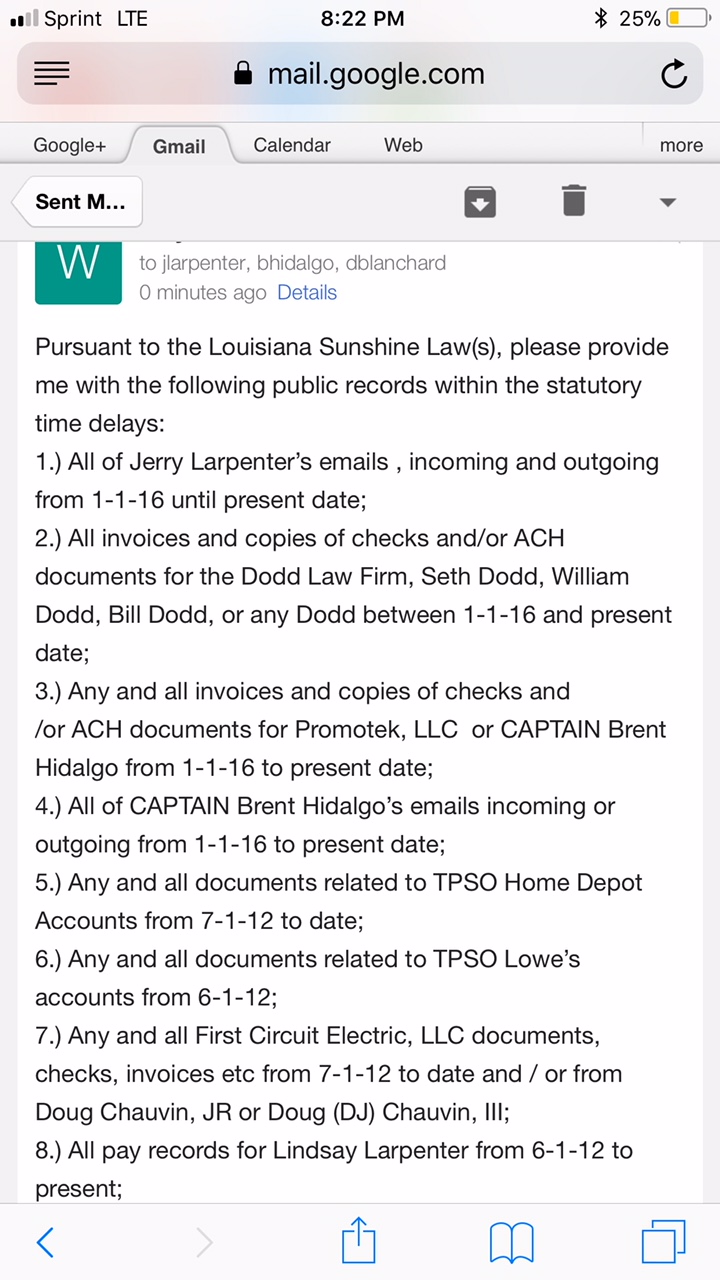
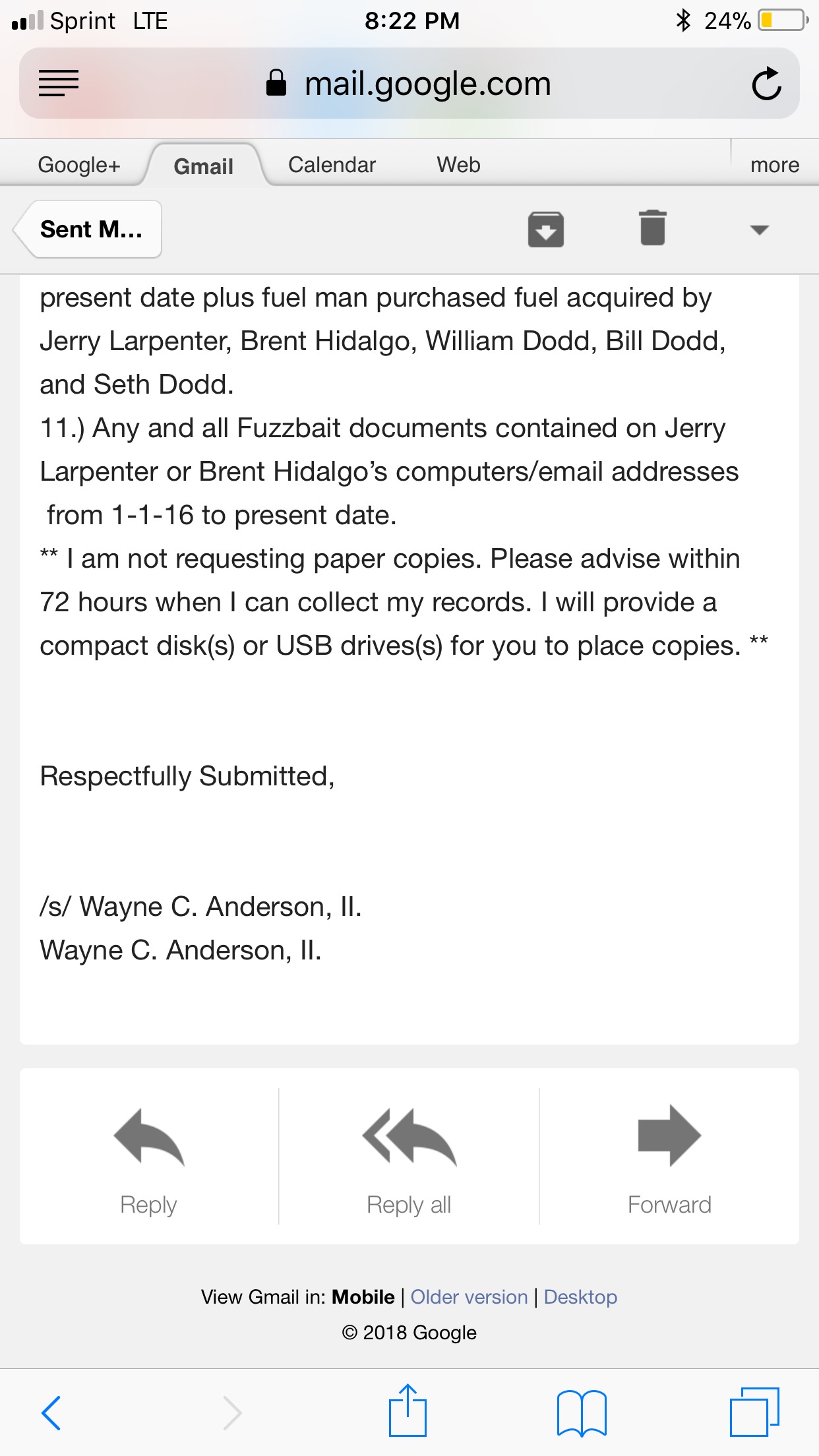
Anderson submitted his request that included, among other things, all invoices and copies of checks paid to the Dood Law Firm, Seth Dodd, William Dodd, Bill Dodd, “or any Dodd,” from Jan. 1, 2016 through the present date.

Dodd is the legal counsel for Larpenter and, according to unconfirmed reports, also represents Ackal.

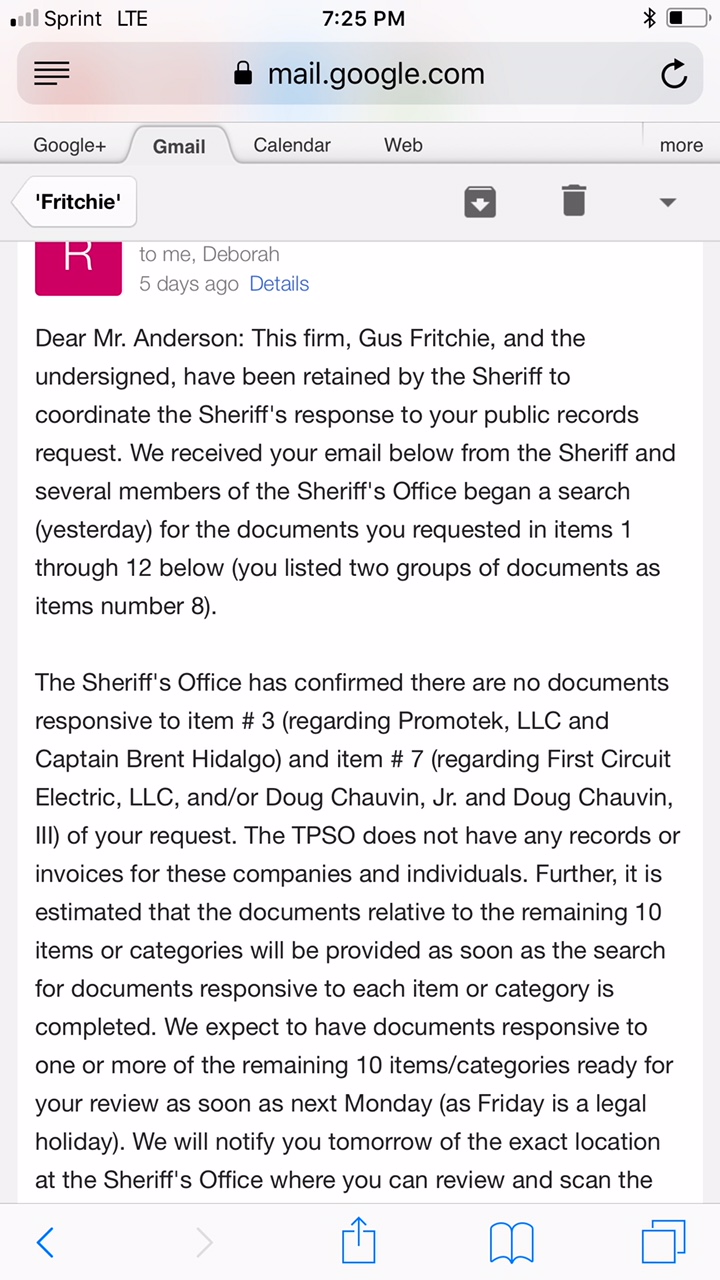
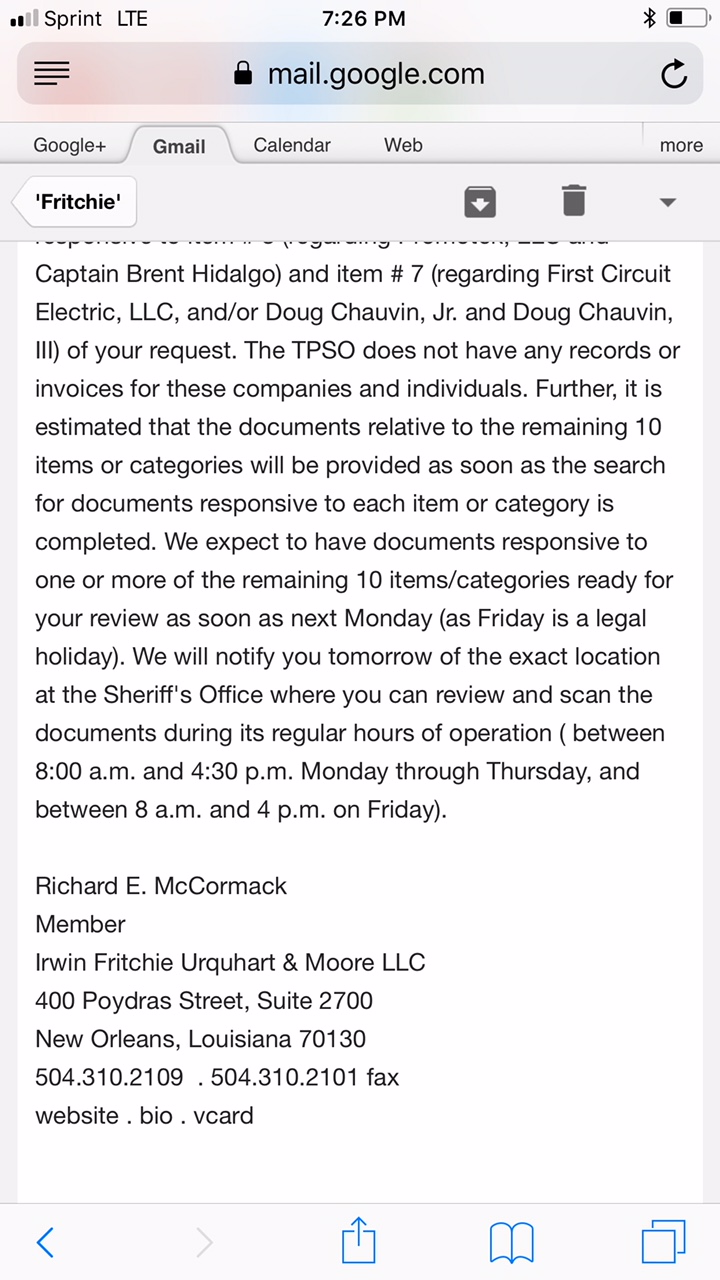
Soon after submitted his request, Anderson received an electronic communication from Richard McCormack, an attorney with the New Orleans firm of Irwin Fritchie Urquhart & Moore. McCormack informed Anderson that his firm had been “retained by the sheriff to coordinate the sheriff’s response to your public records request.”


As one with considerable experience in requesting and obtaining public records on behalf of LouisianaVoice, I can say that I find it quite unusual that the good sheriff would find it necessary to retain a high-priced legal team not to ascertain what is and what is not public record, but simply to “coordinate the sheriff’s response” when a clerical employee would be fully capable of performing such duties.

I’m just guessing here, but I would estimate their rate to be in the neighborhood of $300 per hour—and don’t think for one scintilla of a nano-second that they will put just one attorney on this project when they could put two or three and really run up the tab. From what we hear, the firm has two of its attorneys working on a way to make a routine public records request punitive.

And just what is Bill Dodd’s function, anyway? (Every time I hear that name, I think of Earl Long’s reference to another Bill Dodd during his 1959 gubernatorial campaign, the current Bill Dodd’s father, as “Big, bad, bald Bill Dodd.”)

As near as I can make out, his job was harassment, if reports coming out of Terrebonne are true. Dodd says emphatically that they are not.

When the Andersons asked the sheriff’s insurance company who issued their settlement check, things went south in a hurry. The Andersons say no one from the insurance company ever appeared on the court record on the sheriff’s behalf, leading them to believe Larpenter may have misled the insurance company about their claim.

Soon after they made their inquiry, they said Dodd called one of the couple’s supervisor and threatened to sue for tortuous interference and damage to his reputation.

Dodd, contacted by LouisianaVoice adamantly denied that. “I haven’t threatened to sue anybody,” he said. “I’ve been practicing law long enough that I don’t have to threaten to sue anyone, I just sue ‘em.”

C’mon, Dodd, you ain’t talking to someone who just fell off a turnip truck. There’s not a lawyer alive who won’t “threaten” to sue if a threat can achieve his purpose. The “threat” to sue is one of the most dependable arrows in an attorney’s quiver. I only wish I knew the number of times I’ve been “threatened” with a lawsuit if I published a story. Only twice have they followed through with an actual lawsuit and on both occasions, I prevailed.

Another big factor in both sheriffs’ success in maintaining a death grip on their jobs is a local press that seems reluctant to take them on. The Daily Iberian has denied that is less than aggressive in covering the exploits of Ackal but readers have expressed a general lack of in-depth coverage by the paper.

Unfortunately, the threads linking Ackal and Larpenter are the rule, not the exception. Those threads are strong, they link more than just these two sheriffs and that link runs straight through the Louisiana Sheriffs’ Association.

I have just completed the manuscript for what I feel is a revealing book about Louisiana’s sheriffs and the muscle they flex in Louisiana politics.

The working title of the book is Louisiana’s Rogue Sheriffs: A Culture of Corruption.

It will probably be about a year before the book is actually published. I will keep you abreast of the schedule as I know more.


Read Full Post »

« Newer Posts - Older Posts »