Feeds:
Posts
Comments

Archive for the ‘Legislature, Legislators’ Category

My longtime friend and confidant Harley Purvis, he of the booth in the back in the corner in the dark at John Wayne Culpepper’s Lip-Smackin’ Bar-B-Que House of Prayer and Used Light Bulb Emporium in Watson, had a term for the Louisiana House of Representatives passage of HB 602 yesterday:

Bats**t crazy.

And truly, that’s the only appropriate description of this house of morons who can’t seem to pass a budget but can agree that anyone with a concealed permit may enter any public school in Louisiana locked and loaded.

To give proper credit, there were 37 MEMBERS who voted nay on the bill authored by Rep. Blake Miguez (R-Erath) and Sen. Neil Riser (R-Columbia) and another nine didn’t vote.

So, what’s so terrible about HB 602 that it’s got my shorts twisted in a knot?

Well, quite simply, these two idiots think it’s perfectly okay for anyone armed with a concealed weapon to enter a school building in Louisiana—so long as they have a concealed carry permit.

And if you two idiots think you can come after me for libel for correctly calling you idiots, then bring it on, ass clowns. As for me, I’ll shout it from the highest building in Baton Rouge that you never quite completed your potty training before being elected to the Louisiana Legislature.

What person in his right mind, after the horrors of Sandy Hook and Parkland and Columbine, to name only three of the number of school shootings for which we long ago lost accurate count, would ever suggest that it’s okay for anyone, permitted or not, to enter a school building armed?

BATS**T CRAZY.

Somehow, I suspect that this has the fingerprints of the American Legislative Exchange Council (ALEC), and certainly the NRA, all over it.

Do take a careful look at the vote to see how your representative voted. Out where I live, Rogers Pope did not vote but I have every confidence that had he been present, he would have voted against the bill. He’s a former teacher and the retired Superintendent of Livingston Parish Schools.

Valerie Hodges, from further north in Livingston Parish, voted for the bill but that’s no surprise. She’s the one who voted to give state financial aid to religious-affiliated schools a few years ago and then blew a gasket when an Islamic (yes, Valerie, Islam is still a religion) applied for funding.

From Lincoln Parish, where I grew up, I’m proud to say that Rob Shadoin had the good sense to vote no.

As for Neil Riser, I’ve said before and I’ll say it again, His sponsorship of such an asinine bill is a blatant conflict of interest: He owns two funeral homes.

If I’m reading this bill correctly (and it’s pretty straightforward), it does not permit teachers, administrators, school employees, or students to arm themselves on campus. Well, thank God for small favors.

The bill also says, “Nothing…shall limit the authority of a school board or school to prohibit a person from carrying a firearm, or to regulate the carrying of a firearm, in certain venues or facilities within the school district or an individual school unless the person is otherwise authorized to do so by law.”

So, I suppose the bill still gives the locals some say-so as to the prohibition of weapons on school campuses and in school buildings.

That being the case, what is the purpose of the bill in the first place? Apparently, to open the door (so to speak) to concealed carriers should local school districts or schools fail to expressly prohibit weapons in schools or on campuses.

Present law provides that a concealed handgun permit “does not authorize nor entitle the permit holder to carry a concealed handgun in certain places, including into a school, school campus, or a school bus,” the bill says.

The bill proposes to remedy that by repealing the exception “relative to schools, school campuses, or school buses, but provides that if the concealed handgun (permit holder) is a teacher, administrator, or employee of any school acting within the course and scope of his employment or is a student of any school,” the provisions of the proposed law “shall not be construed to authorize the teacher, administrator, employee, or student of the school to carry a concealed handgun into any school, school campus, or school bus unless specifically authorized to do so by law.”

This, folks, is insanity, pure and simple.

If you have children, grandchildren or if you have a loved one who is a teacher or staff member at a school in Louisiana, I implore you to first, ask yourself what possible reason could someone have to enter a school building with a loaded gun? After you’ve pondered the logic behind that warped thinking, call your senator and demand that this irrational, this madness, be stopped in its tracks.

Call me a bleeding heart, I don’t mind. I’ll take that any day over reading or writing about bleeding children and teachers.
Read Full Post »

To some readers, this will come under the heading of extremely old news.

To others, it will be a revelation well worth the time to read if for no other reason than to remind us how those in positions to do so tend to take care of their own.

I’m talking about House Bill 1351 of the 2004 legislative session—14 years ago.

It was what insiders to the legislative process sometimes refer to as a snake because it is sneaked into the process as an apparently innocuous piece of legislation. In reality, however, it is a self-serving bill that does nothing to benefit the general population but which serves the purposes of only a small minority, a mere fraction of the population: those in control of the system.

Signed into law by Gov. Kathleen Blanco after passing both chambers unanimously (with five absences—four in the House and one in the Senate), and authored as HB 1351 by then Rep. Taylor Townsend, the bill gave sweeping powers to legislators and staff members to literally snub their collective noses at the authority of state courts.

Should you ever be subpoenaed as a witness or a defendant in a civil or criminal matter, you had best be in court clad in the proper attire, with a respectful attitude and at the appointed time lest you bring the wrath of the presiding judge down upon your spinning head. Try to ignore that subpoena or otherwise buck the system and you’re likely to be shown your new quarters in a local holding cell and with a special new nom de plume, courtesy of the occupants already there: “Fresh Meat.”

Unless you serve in the legislature or are employed by same.

In strict legalese, Act 873, which is formally referred to as R.S (for Revised Statute) 13:4163, is an “Ex parte motion for legislative continuance or extension of time, legislators or employees engaged in legislative or constitutional convention activities.”

In plain English, it’s a doctor’s excuse to skip class for extended periods of time.

With a not from appropriate authority, i.e. the clerk of the House or secretary of the Senate, a legislator or a legislative staff member, when subpoenaed for a court proceeding, may thumb his or her nose at the judge because the STATUTE gives them that authority over a court order.

It says so, right there in the second paragraph: “A member of the legislature and a legislative employee shall have peremptory grounds for continuance or extension of a criminal case, civil case, or administrative proceeding…The continuance or extension shall be sought by written motion specifically alleging these grounds.”

The statute also says the continuance (legal term for delay) is for the benefit of the legislator or legislative staff member “and may only be asserted or waived by a member or employee.” It even applies of the legislator is an attorney who enrolled as counsel of record in the court matter.

In other words, someone with important business before the court will just have to cool his heels while his attorney/legislator tends to more important matters, i.e. taking care of campaign contributors like oil and gas companies, nursing homes, pharmaceutical firms, banks and members of the Louisiana Association of Business and Industry (LABI) and the American Legislative Exchange Council (ALEC) by making sure they are not overburdened with silly requirements to pay their fair share of taxes.

And you surely wouldn’t want your legislator missing out on a fine supper at Sullivan’s or Ruth’s Chris, a gala crawfish boil or some other after-hours function because he was hung up in court representing some poor nobody in a criminal case or civil lawsuit.

Boy Howdy, talk about rank having its privilege.

This exemption even extends to legislative committees and/or subcommittees in addition to legislative sessions and constitutional conventions (the last one of those, by the way, was in 1974 but hey, why take chances?).

So next time you’re required to be in court as a plaintiff, defendant, legal counsel for either side, or a jury member, just be thankful you aren’t a legislator so heavily burdened with the state’s pressing business that you would have to decline the judge’s invitation to attend.

Read Full Post »

Something happening here,

What it is ain’t exactly clear


The 1967 Buffalo Springfield Vietnam War protest song, For What It’s Worth could be applicable to just about any scenario in Louisiana politics but probably never more so than with HOUSE BILL 727 by State Rep. Major Thibaut (D-New Roads).

Thibaut, posing as a Democrat but appearing to be anything but, apparently wants to repeal the FIRST AMENDMENT which guarantees American citizens the right of peaceful assembly.

HB 727, which has 50 additional co-authors in the House and 14 in the Senate, would amend an existing statute in accordance with the dictates of the AMERICAN LEGISLATIVE EXCHANGE COUNCIL (ALEC), which long ago wormed its way into the Republican mindset as a means of advancing its agenda.

That agenda, of course, works hand-in-hand with that of corporate America—big oil, big banks, big pharma, charter schools, and private prisons, among others—to the overall detriment of those who ultimately foot the bill—the working stiffs of middle America who continue to convince themselves that their interests are compatible.

The bottom line is this: if the corporate giants are shelling out millions upon millions of dollars to lobby lawmakers and to finance their campaigns, you can bet they’re in bed together. And when they whisper sweet nothings in each other’s ear, they ain’t discussing how to make your life easier.

And that’s HB 727 and ALEC are all about. While the seemingly innocuous bill appears only to lay out penalties for trespassing onto “critical infrastructure,” and to include “pipelines” or “any site where the construction or improvement of any facility or structure…is occurring” to the definition of critical infrastructure, the wording of the bill includes subtle landmines designed to discourage otherwise legal protests.

For instance, while criminal trespass and criminal damage has long been considered a violation of the law, the bill adds this provision:

“Any person who commits the crime of criminal damage to a critical infrastructure wherein it is foreseeable that human life will be threatened or operations of a critical infrastructure will be disrupted as a result of such conduct shall be imprisoned at hard labor for not less than six years nor more than 20 years, fined not more than $25,000, or both.”

There’s a man with a gun over there

Telling me I got to beware

The key phrase here is “wherein it is foreseeable…”

This is a pretty subjective call on someone’s part. Just who decides what is “foreseeable”?

And then there is the conspiracy clause that’s added to the bill.

HB 727, which passed the HOUSE by an overwhelming 97-3 vote with five members absent, provides if “two or more” person conspire to violate the statute, each “shall be imprisoned with or without hard labor for not more than five years, fined not more than $10,000, or both.”

Just what would constitute a “conspiracy” in this case? Well, it could mean the simple discussion of possible trespass. Whatever it is, the word “foreseeable” is thrown into the mix again. So, a protest in the proximity of pipeline construction could conceivably be construed by an ambitious prosecutor as “conspiracy” and any discussion during such a protest could become a conspiracy.

Besides being yet another windfall for the private prisons, this bill is nothing more than a means to discourage protests over pipeline construction through sensitive areas such as the Bayou Bridge Pipeline, a joint venture of Energy Transfer Partners and Phillips 66 (keep those names in mind; they’ll come up again later).

It’s also an obvious effort to placate ALEC and the oil and gas industry that has held this state, its governors and legislators captive for a century. The political leaders of this state, from the governor on down, won’t go to the bathroom without permission from Mid-Continent Oil and Gas Association, which boasts on its WEB PAGE that it is “Louisiana’s longest-standing trade association” (read: lobbying arm of the petroleum industry).

There’s battle lines being drawn;

Nobody’s right if everybody’s wrong

What’s not difficult to believe is the motivation behind nearly half of the bill’s sponsors.

Of the 51 representatives and 14 senators who signed on as co-authors of the bill, 31 (23 representatives and eight senators) combined to rake in $62,500 in contributions from Transfer Partners and Phillips 66 since January 2011.

ENERGY TRANSFER PARTNERS CONTRIBUTIONS

PHILLIPS 66 CONTRIBUTIONS

Phillips also gave $3,500 to Senate President John Alario and Energy Transfer Partners chipped in another $4,000. Additionally, Energy Transfer Partners gave $4,000 to then-Sen. Robert Adley of Bossier Parish who was appointed by Gov. John Bel Edwards as Executive Director of the Louisiana Offshore Terminal Authority, $2,000 to then-Rep. Jim Fannin of Jonesboro who served as Chairman of the House Appropriations Committee at the time.

Energy Transfer Partners also contributed $5,000 to Edwards, who is on record as SUPPORTING the Bayou Bridge project, and Phillips 66 added another $5,500.

Thibaut was not one of those. But he did specialize in accepting campaign contributions from more than 40 political action committees—including several aligned with energy interests. In all, he pulled in $105,000 from PACs since 2008, campaign records show.

Those PACs included such diverse interests as dentists, bankers, payday loan companies, optometrists, insurance, student loans, pharmaceutical companies, sugar, realtors, and nursing homes, to name only a few.

EASTPAC, WESTPAC, NORTHPAC, and SOUTHPAC, four PACs run by the Louisiana Association of Business and Industry (LABI) combined to $13,750 to Thibaut, records show, while the Louisiana Manufacturers PAC gave $11,000.

With that money stacked against them, the Bayou Bridge pipeline opponents are fighting an uphill battle, especially with leaders like Edwards already having publicly endorsed the project.

The end game, of course, is to head off a repeat of STANDING ROCK, the largest Native American protest movement in modern history over the construction of a 1,170-mile Dakota Access pipeline, of which the BAYOU BRIDGE project through the Atchafalaya Basin is a part. Opponents of the 162-mile Bayou Bridge project—from St. James Parish to Calcasieu Parish—say would harm the area’s delicate ecosystem.

Standing Rock was an ugly scene, further illustrative of how this country has time after time ripped land, basic human rights and dignity from the country’s original inhabitants, inhabitants who weren’t even recognized as American citizens until 1924 even though more than 12,000 fought for this country in World War I.

Standing Rock apparently was such a national emergency that St. Charles Parish Sheriff Greg Champagne, at the time President of the National Sheriffs’ Association, found it necessary to visit Standing Rock in 2016 and to write a lengthy self-serving account in the association’s online PRESIDENT’S PODIUM of the carnage he witnessed at the hands of the protestors whom he described in less than glowing terms.

His article prompted a lengthy REBUTTAL by Cherri Foytlin, state Director of BOLD LOUISIANA in Rayne and Monique Verdin, a citizen of the UNITED HOUMA NATION, who also were at Standing Rock. It’s difficult to believe, after reading the two missives, that they were at the same place, witnessing the same events play out.

What a field day for the heat;

A thousand people in the street

Singing songs and carrying signs

Mostly saying, “hooray for our side.”

Read Full Post »

Legislators and leaders of the Louisiana Association of Business and Industry (LABI) would do well to pay attention to the rumblings of discontent that began in West Virginia and rolled westward into Kentucky and Oklahoma.

Those same rumblings, though faint and indistinct for now, are being picked up by those in tune with the times.

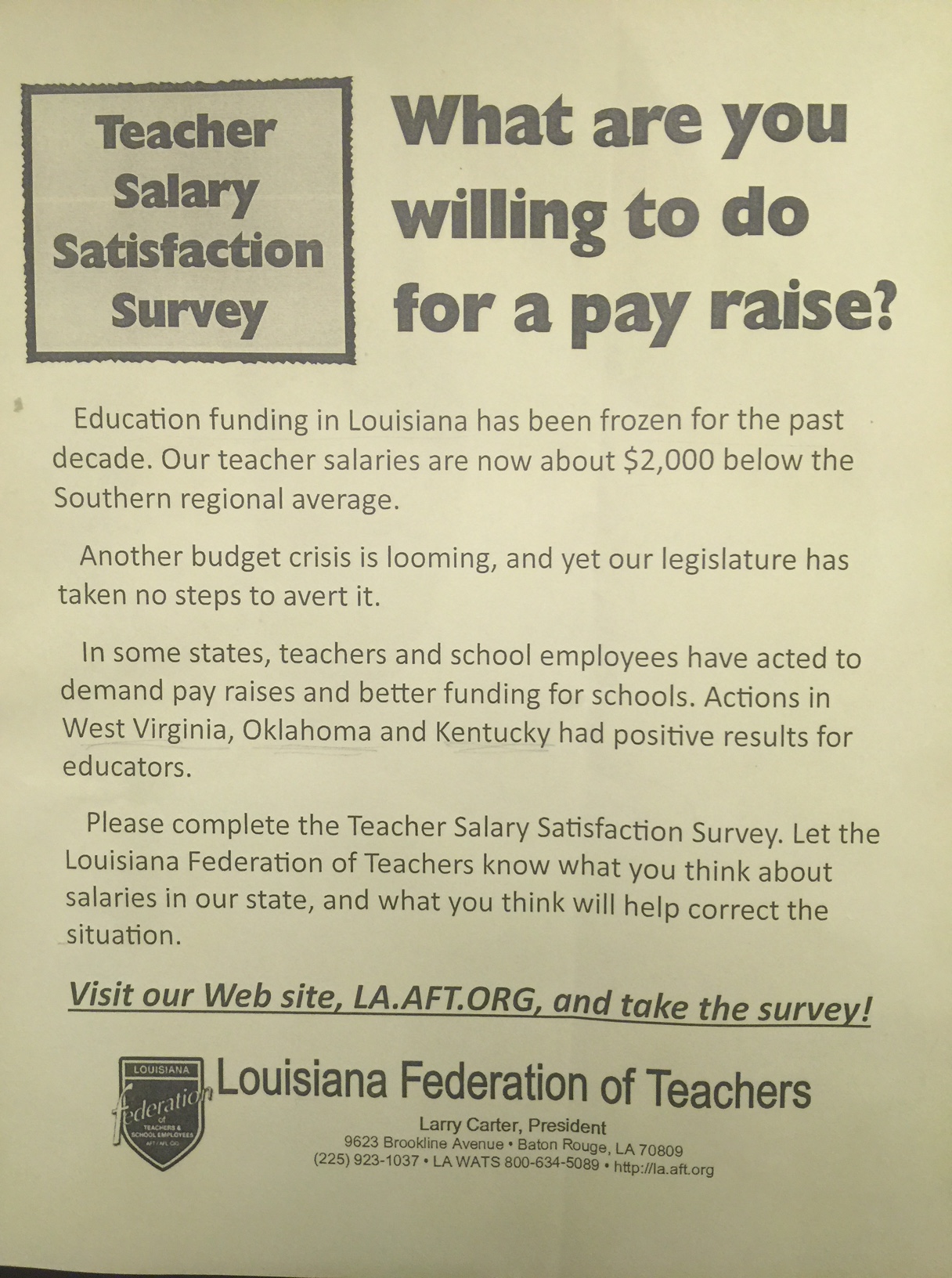
Louisiana’s public school teachers, a group to whom I owe so very much from a personal perspective and to whom I shall ever remain loyal, are quietly receiving copies of a “Teacher Salary Satisfaction Survey” being distributed by the Louisiana Federation of Teachers (LFT).

It could just as easily be called a “Teacher Salary Dissatisfaction Survey.

The flier opens with the question: “What are you willing to do for a pay raise?” and goes on to note that education funding in Louisiana “has been frozen for the past decade. Our teacher salaries are now about $2,000 below the Southern regional average.”

How can that possibly be? How could we have allowed ourselves to neglect the most dedicated, the most heroic among us for so very long?

We gave state police huge salary increases and while I don’t begrudge their pay increases, they certainly should not have come at the expense of teacher salaries.

Teachers should never have to bow down at the sacrificial altar of political servitude, yet that is precisely what has happened.

I can still remember that little presidential wannabe Bobby Jindal telling LABI that the only reason some teachers are still in the classroom was by virtue of their being able to breathe. That was just before Sandy Hook when a teacher stood between a gunman and a student and took a bullet that ended her breathing ability but which allowed a child to go on living.

I still remember teachers at Ruston High School taking an interest in the well-concealed abilities of a poverty-stricken, less-than-mediocre student and nurturing and cultivating those latent talents into eventual college material and a career in journalism. They didn’t have to do that; they could have let him slip through the cracks. But they didn’t. Thanks, Mrs. Garrett, Miss Lewis, Miss Hinton, Mr. Ryland, Coach Perkins, Mr. Peoples, Mr. Barnes. Thanks so very much. You never knew (or maybe you did) what your compassion meant to that kid.

“Another budget crisis is looming, and yet our legislature has taken no steps to avert it,” the flier says.

True. So true. The legislature has taken no steps because legislators, for the most part, are in bed with the special interests who are slowly bleeding this state to death with overly-generous tax breaks even as benefits are being ripped from our citizens. Benefits like health care, education, decent roads and bridges, flood control, the environment—benefits that we rely on our elected officials to provide.

Oh, but they haven’t forgotten the tax breaks for the Saints, the Pelicans, the Walmarts, the Exxons, the Dow Chemicals, pharmaceuticals, the movie industry, the utilities, the banks and payday loan companies, the nursing homes, the private prisons, the Koch brothers, the Grover Norquists, the American Legislative Exchange Council (ALEC), or chicken-plucking plants.

But teachers? Nope. They don’t need raises. Besides, we have virtual academies and charter schools, so who needs public education?

“In some states,” the flier reads, “teachers and school employees have acted to demand pay raises and better funding for schools. Actions in West Virginia, Oklahoma and Kentucky had positive results for educators.”

LABI, of course, would beg to differ. After all, LABI was created back in the 1970s for the express purpose of destroying labor unions in Louisiana through passage of the right to work law. I got that straight from the mouth of Ed Steimel, one of the moving forces for the creation of LABI, shortly before his death.

But let’s back up a minute and pause for reflection before you try to label me as some ranting liberal or even worse, a (gasp) communist.

Do you approve of:

  • Your annual two-week (or whatever the length of time) vacation?
  • How about the eight-hour work day?
  • The 40-hour work week?
  • Overtime?
  • Retirement?
  • Minimum wage?
  • Health benefits?
  • The abolition of sweat shops where children as young as seven or eight are required to work 12- or 14-hour days for pennies?
  • Workplace safety reforms that have drastically reduced injuries and deaths at work?
  • Sanitation laws that have cleaned up the meatpacking industry?

Well, gee, if you approve of all that, you must be a ranting liberal yourself. Or worse, a (nah, better not say it).

But just who do you think brought about those reforms? It certainly wasn’t management. Okay, the guvmint was largely responsible for the meatpacking industry reforms but for the rest, you can tip your hat to organized labor.

“Please complete the Teacher Salary Satisfaction Survey,” the flier reads. “Let the Louisiana Federation of Teachers know what you think about salaries in our state, and what you think will help correct the situation.”

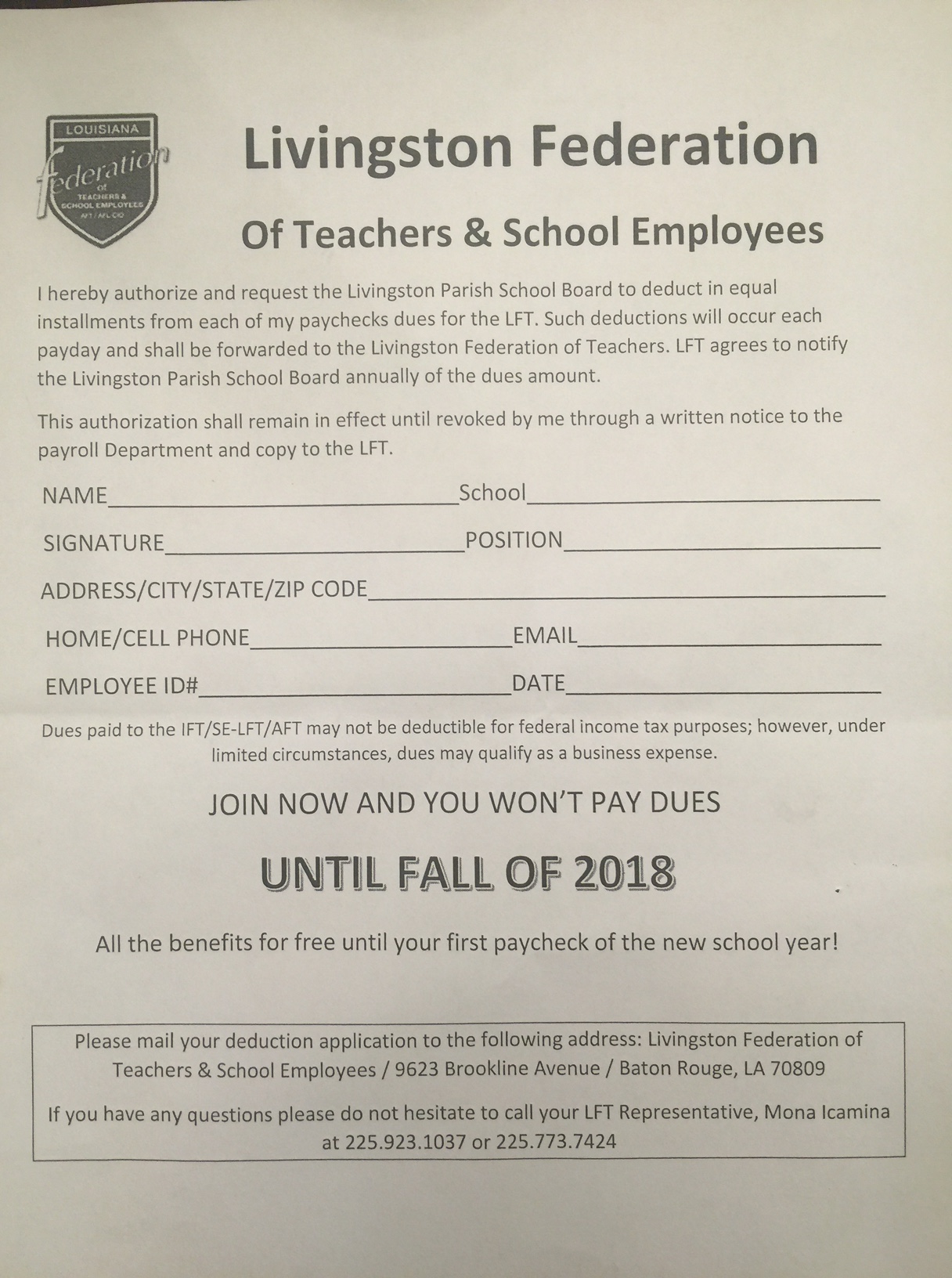
The second page is an authorization form requesting the local school board (in this case, Livingston Parish) to deduct dues for the LFT.

Legislators and LABI are being taken to class here and they’d be wise to pay attention lest they get a failing grade.

Read Full Post »

With a flurry of (count ‘em) 37 bills dealing with gambling gaming, there is probably none more interesting to the folks in Tangipahoa Parish than identical bills introduced in the Senate (SB-417) and House (HB-438) that would facilitate the move of a Bossier Parish casino to property along the Tangipahoa River.

Brent Stephens is owner of the current license for Diamond Jacks in Bossier City. He and his company, Peninsula Pacific, acquired the license for Diamond Jacks in June 2016 after Legends, the previous owner, was released from bankruptcy the previous year. Stephens operates at least two other gaming properties in Louisiana—the Amelia Belle in Amelia in St. Mary Parish following Hurricane Katrina, and Evangeline Downs in Opelousas in St. Landry Parish.

His first choice for relocating Diamond Jacks was Lake Pontchartrain in St. Tammany Parish but he encountered a couple of insurmountable snags: he couldn’t get political support and he couldn’t find any landowners willing to sell.

He then turned his attention to Tangipahoa Parish and was initially looking at sites around Manchac adjacent to I-55 but abandoned that idea for reasons known only to him.

He then settled on an area south and west of Hammond along I-12.

And though the governor has made a point of staying out of all the gaming legislation (with the exception of two: a non-gaming-related proposal involving Harrah’s Casino in New Orleans and one to permit gaming on land within 1200 feet of an authorized berthing site, both of which he supports, he has said he would sign the Tangipahoa Parish bill if it made it to his desk.

And that is one great big IF—as in, not likely.

Despite strong support from Parish President Robby Miller, the parish council, and 48 percent and a large contingent still undecided among Tangipahoa Parish voters, there remains two chances—slim and none—that the Tangipahoa River will become a Mecca for casino gamblers.

That’s because of the formation of a rather unique alliance against the proposal: Tangipahoa Parish churches and video poker.

Whoever coined the phrase that politics makes strange bedfellows was dead right. There can be no stranger bedfellows than fire-and-brimstone-breathing protestant ministers and video poker operators.

And while ministers can exert considerable influence, video poker operators are every bit as powerful, if not more so. That’s because while casino operators are prohibited from making political contributions, there are no such restrictions on the video poker industry.

Video poker interests are well-represented on both sides of the legislative aisles, meaning they spread a lot of campaign money around and enjoy substantial influence at the capitol.

Throw in State Rep. Sherman Mack and you have some formidable opposition.

  • Mack, from the Livingston Parish town of Albany, just happens to be Chairman of the House Criminal Justice Committee.
  • Mack is casting a lustful eye at the district attorney’s office for the 21st Judicial District which includes the parishes of Livingston, St. Helena and….Tangipahoa.
  • That office is currently occupied by four-term DA Scott Perrilloux who is considered vulnerable.
  • Mack does not want to be labeled as a “pro-gaming” legislator should he decide to challenge Perrilloux.

HB-438 was introduced by Rep. Stephen Pugh (R-Ponchatoula) and SB-438 by Sen. Bodi White (R-Central). Only White’s bill has made it out of committee (on March 20) and it now awaits debate on the Senate floor. Should it pass the full Senate, it will then be sent to Sherman’s committee where in all likelihood, it will die an ugly death.

And therein lies the real political story.

The bill does two things:

  • It authorizes the Tangipahoa River as a designated waterway on which gaming may be conducted, and
  • It calls for a parish-wide referendum.

But in case it passes the full Senate, makes it out of Mack’s Criminal Justice Committee, and gains approval by the full House, then and only then does the proposal move onto the State Gaming Board which would have to approve the move.

Because the Tangipahoa is barely large enough to entertain tubers and the occasional Bateau boat, it ain’t about to accommodate a full-blown floating casino. The alternative would be a “free-standing” casino and the odds of that getting approved are pretty long.

Just another example of the interesting political issues that color Tangipahoa Parish.


Read Full Post »

« Newer Posts - Older Posts »


