Feeds:
Posts
Comments

Archive for the ‘Legislature, Legislators’ Category

State Treasurer John Kennedy has sent a second letter to the executive director of the Louisiana State Police Retirement System (LSPRS) to emphasize his wish that a thorough investigation be conducted into the last second amendment to Senate Bill 294 which gave State Police Superintendent Mike Edmonson and one other state trooper huge increases in their state police pensions.

Kennedy wrote to Irwin Felps on Tuesday (July 29), saying, “I strongly oppose any delay or discontinuation of the system’s investigation of Act 859.”

SB 294 became Act 859 when Gov. Bobby signed the bill into law soon after it was adopted by the legislature on the last day of the session last month.

At first blush, it would appear that Kennedy might be responding to push back or resistance to a continued investigation but he assured LouisianaVoice that was not the case. “To my knowledge, no one has suggested that we terminate the investigation,” he said. “I just wanted to make certain that the board (the LSPRS board) understands that we still have this law on the books and we need to see what our options are in order to carry out our fiduciary responsibility to protect the system.”

Cynic-in-Chief C.B. Forgotston isn’t convinced. Observing that a majority of the LSPRS board is comprised of those who work directly for or are allied with Edmonson or Jindal, he says that a legal challenge is the only way in which to dispose of the issue once and for all.

Kennedy, in his capacity as state treasurer, is a member of the board and in his letter to Felps, he listed several reasons why he feels the board should continue its investigation to find a solution to the situation that benefits just two state troopers—Superintendent Mike Edmonson and Master Trooper Louis Bourquet of Houma.

Felps, contacted by LouisianaVoice, also said the board plans to move forward with its investigation. “We (the board) will be meeting in a couple of weeks,” he said. “Meanwhile, our legal counsel is considering options open to us in order to determine a course of action.”

Felps also said that attorney Bob Klausner of Ft. Lauderdale, Florida, has been retained to serve in an “of counsel” capacity (a term usually applied to an attorney who has been employed to aid in a particular case but who is not the lead attorney).

“He is one of the pre-eminent authorities on pensions and has worked with us in the past,” Felps said.

While the increases to the retirements for the two law enforcement officers are substantial (as much as an additional $55,000 a year in Edmonson’s case before he finally said he would not accept the increased benefits), there may be retired state troopers who, like Edmonson and Bourquet, may have entered the Deferred Retirement Option Plan (DROP), thus freezing their retirement benefits only to receive substantial promotions or pay increases which would otherwise have increased their retirements.

Kennedy listed several concerns in his letter:

  • Because the act requires that funding for the benefits would be paid from the LSPRS Experience Account, apparently to avoid increasing our unfunded accrued liability (UAL), it would appear to adversely affect the system’s ability to provide cost of living adjustments for retired members and their families. “This must not be permitted to happen to our current and future retirees and their families,” he said.
  • Should the board delay or terminate the investigation, there is no guarantee that the legislature would adequately repeal the act or even consider it and even if it did, there would be no certainty that the governor would not veto any new legislation enacted to remedy what Kennedy calls a “bad law.”
  • Assuming that Bourquet, like Edmonson, rejects the increase, either or both could change their minds, die or become disabled, either of which would trigger the benefits at such time.
  • It is unclear how a recipient of the increased benefits could effective declare that he will not accept them, which would raise other complicated procedural questions.
  • There are several questions concerning the legality and constitutionality of the amendment to SB 294 which was originally authored by Sen. Jean Paul Morrell (D-New Orleans) to deal only with disciplinary procedures when officers are accused of wrongdoing.

The unanimous passage of the amendment has caused a furor over the propriety of such tactics on the last day of the session when both houses are working feverishly to wrap up business before adjournment. As one member who voted for the bill said, “We’re all running around during those final hours trying to get our own bills through conference committee and these things can slip through.”

Sen. Neil Riser (R-Columbia) was a member of the conference committee comprised of three senators and three representatives that recommended passage of the bill. After first denying any knowledge of the amendment, he finally admitted last Friday that he was the one who had the amendment drafted and inserted into the bill.

Because Edmonson appears to be a constant companion of Jindal (he appears in the background in virtually all of the governor’s in-state photo-ops which, granted, are becoming more and more rare because of Jindal’s near constant travels out of state in pursuit of his vanishing presidential aspirations) many legislative observers remain convinced that Riser took the action at the direction of the governor’s office.

That is precisely the kind of back-door deal that Jindal swore he would never tolerate and indeed, would make state government more transparent and accountable. In truth, his every action as governor reveals the lie in that empty promise by Jindal the candidate.

But, after more than six years of his brand of transparency, the real surprise would have been if anyone had been surprised.

And that’s precisely why Forgotston remains unconvinced that anything will get done without a legal challenge to the new law.

“The only issue remaining is who will file the lawsuit,” he said. “The board of LSPRS has the primary fiduciary responsibility to do so. The legislators, especially Senator Neil Riser, have an obligation to the taxpayers to fix the fiscal mess they created.

“The only interest being neglected in this matter is that of us taxpayers.

“It is time for the legislature to join Kennedy and others in calling for LSPRS to litigate SB 294 or to do so themselves.  The taxpayers should not be left holding the bag.”

Even Clancy DuBos, a columnist for New Orleans’ Gambit magazine and WWL-TV has joined the chorus of those demanding a lawsuit to challenge the “Edmonson Amendment.”

http://www.wwltv.com/news/DuBos-Legislature-must-challenge-state-police-chiefs-secret-raise-269100661.html?ref=prev

To read the entire text of Kennedy’s letter, go here:

Treasurer Kennedy Letter to State Police Retirement 07 29 2014
Read Full Post »

By Stephen Winham

I was among a distinct minority of people in state government who thought adding DROP to our state retirement systems was a bad idea for the state from the outset. It clearly provided a good benefit for employees at a time when state salaries were not nearly so generous as today, but I was concerned about the real costs, not just to retirement systems, but to agencies’ active payrolls. I was also concerned about real and perceived inequities resulting from employees making decisions they would later regret. In my opinion, the existence of DROP in state retirement systems has generally failed to benefit the state financially or otherwise – And I find the whole concept of “Back DROP”, the State Police Retirement System option recently publicized in conjunction with the controversy over SB 294 of 2014, ridiculous on its face.

DROP for our state retirement systems seemed to at least have sensible goals when originally implemented and estimating the fiscal impact seemed relatively easy for an actuary. Simply put, an employee, who would otherwise be entitled to retire, continued working and drawing a pay check. The amount that would have been paid the retired employee in monthly retirement checks was frozen at that level and went into a DROP account each month while the employee continued to draw a salary. The employee did not have to make contributions to his/her retirement system while in DROP, so s/he got an immediate increase in net pay and could continue to get raises, though they would not increase the retirement benefit amount. When the employee actually retired s/he could get the balance in the DROP account and begin to receive monthly retirement checks.

DROP was sold as a way to retain experienced employees for a period of time beyond when they might otherwise actually retire by providing them with an additional incentive. It was also supposed to accomplish the almost contradictory goal of encouraging higher paid employees to actually retire at the end of DROP participation. This would reduce the amount of money necessary for salaries overall and/or create additional promotional opportunities and openings for other employees.

So, DROP was viewed by most as a simple, predictable benefit for both the state and its employees. But, guess what?   It has rarely worked that way and the reality of the way it does work begs the following questions:

  • How many people who participate in DROP would have really retired, when eligible, in its absence? Based on experience, the answer is very few. Therefore, the major ostensible advantage of DROP to the state, retention of experienced employees, would not seem to have actually been a state issue.
  • How many state employees with retirement eligibility are indispensable? Again, my answer would be very few. A significant percentage of indispensable employees would indicate gross understaffing, poor management planning, or both.
  • How many people who enter DROP actually retire at the end of DROP participation? My guess, again based on experience, would be significantly fewer than originally projected.

Because employees can come out of DROP and continue to work without skipping a beat, any expected salaries savings can evaporate quickly. In fact, high salaried people not already eligible for the absolute maximum in retirement benefits often continue to work an additional minimum of 3 years so they can start to accrue additional benefits to be paid as supplements to their “frozen” regular retirement checks. So, ultimate liabilities of the retirement systems are harder to project and salaries on the active payroll are often higher than they would have been otherwise.

The new option Colonel Mike Edmonson apparently wanted to take advantage of via SB 294 only exists in the State Police Retirement System and is called “Back DROP”. I had never heard of this before and still find it hard to believe it exists and was actually recommended by an actuary. It does absolutely nothing DROP was intended to do except encourage some people to simply work longer.

If I understand it correctly, under “Back DROP” the employee starts thinking about retiring and how to game the retirement system to his/her best financial advantage. As retirement eligibility approaches, s/he gets the system to run numbers so s/he can make the best choice when s/he actually retires between the following:

1. Pretending s/he entered DROP up to 3 years ago (going back to the future, in other words); or

2. Getting a lifetime benefit based on the highest average salary

Does that sound anything like DROP to you? Me, neither. It sounds like having your cake and eating it, too. Those eligible can’t possibly make the wrong decision – for them – and no pesky actuarial reductions in benefits like the Initial Benefit Option (IBO) that is available to all retirees.

Go to the following link, scroll down to “BACK DROP Plan – Only for Members Eligible for DROP after 10/01/2009” and see how you interpret the option: http://lsprs.org/retirement/options/

Now, think about it. How is it possible to get in the ballpark of figuring out how to adequately fund a benefit that doesn’t actually defer anything and lets those eligible choose the best option for them at the last possible moment?   How must the thousands of people who retired under regular DROP plans in all state retirement systems feel about the ability of anybody else to have this open-ended option?

Our retirement systems have total unfunded accrued liabilities of some $19 Billion. These liabilities did not crop up overnight but must, under existing law, be liquidated by 2029. How can any legislative action that extends state retirement benefits to those not previously eligible for them possibly do anything to help address this problem?

As Everett Dirksen said, “A million here, a million there, pretty soon you’re talking real money.” In Louisiana, we don’t seem to get the simple truth of that, and not just in our retirement policies.

Read Full Post »

(Editor’s note: this is our 1,000th post since we started LouisianaVoice a little more than three years ago. We have also surpassed the one million-word milestone. That’s roughly the equivalent of 10 full-length novels.)


Were two separate announcements made late Friday by State Police Superintendent Mike Edmonson and State Sen. Neil Riser (R-Columbia) designed to neutralize State Treasurer John Kennedy’s calls for an investigation into the amendment to Senate Bill 294 that increased Edmonson’s retirement by $55,000 a year?

If so, Kennedy said, the tactic won’t work.

Without going through all the details of the amendment, there is one additional development that has gone unreported to this point (until it was pointed out to us first by reader Stephen Winham and then Kennedy):

Funding to pay Edmonson’s extra retirement income, which could cost the state more than $1 million over Edmonson’s lifetime, would come from the state’s Employee Experience Account (R.S. 11:1332) http://law.justia.com/codes/louisiana/2013/code-revisedstatutes/title-11/rs-11-1332 which set aside funds to provide cost of living raises for retired state troopers and survivors of slain troopers.

In other words, he would be taking from retirees, widows and orphans in order to increase his retirement from the $79,000 per year, or 100 percent of his salary, at the time he entered the Deferred Retirement Option Plan (DROP), to 100 percent of his current $134,000 a year salary.

In those two announcements, issued separately, Edmonson reversed his field and said he will not accept the increased pension benefits because “It’s been too much of a distraction.”

Riser, one of six members of the Legislative Conference Committee that brought the amended bill back to the House floor on the last day of the session, meanwhile, did an even bigger flip flop in admitting that he did indeed instruct a Senate staffer to add the key amendment to the bill authored by Sen. Jean Paul Morrell (D-New Orleans).

On July 17, Riser emailed blogger C.B. Forgotston who had sent Riser an email asking what he knew about the origin of the amendment. Incredibly, Riser said in that email, “I first saw the amendment when I read the conference committee report drafted by staff. As the language was explained to me, I believed it fixed a retirement problem for the law enforcement community.”

Basically, it was a denial without his actually denying he knew about the amendment.

But on Friday, Riser fessed up that he did indeed instruct staff (in this case, Laura Gail Sullivan, legal counsel for the Senate Revenue and Fiscal Affairs Committee which Riser chairs) to add the amendment. He still, however, stuck to his story that he saw the amendment on the “last hectic day of the session” and did not know the amendment would benefit just two people—Edmonson and a Houma trooper.

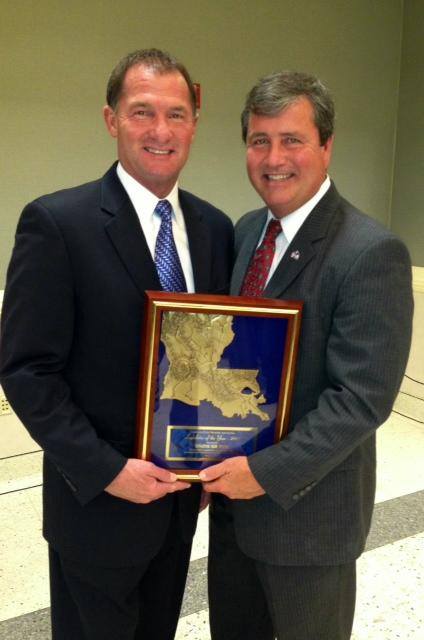
No wonder he was recently named Legislator of the Year by the Louisiana State Troopers’ Association—for the third consecutive year.

RISER AND EDMONSON

Supt. of State Police Mike Edmonson, left, and State Sen. Neil Riser (BFF)

Taken together, the Friday statements by Edmonson and Riser appear suspiciously coordinated to neutralize Kennedy’s letter of one day earlier to the executive director of the Louisiana State Police Retirement System (LSPRS) in which he posed 13 questions he said needed answers.

Riser’s belated admission of his part in the amendment addressed only one of those questions and Kennedy said Friday that the investigation “must go forward” because “we still have a bad law on the books that we have to deal with.”

That’s because Gov. Bobby Jindal put his frequent flyer miles in abeyance long enough to sign the bill into law as ACT 859, prompting some to speculate that Riser’s actions may have been dictated by the governor’s office.

Kennedy said the LSPRS board has already retained outside legal counsel to determine what legal action is available to the board which is required by law to protect the fiduciary interests of the system.

“The board will meet in August to discuss our options,” he said. “We will invite Col. Edmonson to attend to present his side of the issue. We will also invite Sen. Riser and Thomas Enright, the governor’s executive counsel.”

He said that Enright, as the governor’s legal counsel, reads every bill and makes recommendations to Jindal as to whether the bills meet legal standards and if they should be signed or vetoed.

Without waiting for that August meeting, LouisianaVoice has a few questions of our own:

  • Why did Riser first deny his culpability and appear willing to throw his legal counsel under the bus?
  • What happened to compel him to cleanse his conscience?
  • Does he feel his constituents should trust him when he comes up for re-election after this despicable lapse of moral principles?
  • Who made the decision to fund this questionable (and most likely unconstitutional) appropriation from money intended to pay for retirees’ and survivors’ cost of living adjustments…and why?
  • Did Jindal direct that this amendment be inserted on the last day of the session?
  • If not, why did Enright not catch one of several possible constitutional violations contained in the amendment?

We’re glad that Riser, even belatedly, admitted his part in this farce of legislative procedure and we feel that Edmonson did the right thing in deciding to refuse the additional retirement money.

Suspicious by nature, however, we can’t help wondering about their motivations.


Read Full Post »

State Treasurer John Kennedy has forwarded a two-page letter to the executive director of the Louisiana State Police Retirement System (LSPRS) that itemizes 13 questions Kennedy said need to be addressed concerning the $55,000 per year pension increase awarded State Police Superintendent Mike Edmonson in the closing minutes of the recent legislative session.

An amendment to Senate Bill 294, quickly signed into law by Gov. Bobby Jindal as Act 859, allowed Edmonson and one other state trooper to revoke their decision made at lower ranks to enter the state’s Deferred Retirement Option Plan (DROP). In Edmonson’s case, he entered DROP as a captain, which effectively froze his retirement calculated on his salary at that time.

He was subsequently promoted to Superintendent of State Police which carried with it a substantial pay increase that made the DROP decision a bad one—like many other state employees who made similar moves and were later promoted.

The amendment was inserted into an unrelated bill dealing with disciplinary actions to be taken with law enforcement officers under investigation by a six-member conference committee, none of whom will claim credit—or blame—for the action.

Even worse than the furtive action, most probably taken at the direction of Gov. Bobby Jindal, five of the six conference committee members appear to be unwilling to man up and discuss their actions.

Kennedy, who by virtue of his office is a member of LSPRS, wrote to Executive Director Irwin Felps:

“In furtherance of our board meeting, other discussions regarding this matter and our fiduciary obligations to all of the people the system serves, I wanted to set forth in writing, as a board member and the State Treasurer, the issues that I think must be fully investigated and answered by you, our counsel and other staff, for the board so that it can make the necessary decisions and take appropriate actions, if any, to meet its fiduciary duties. This list is not meant to be exclusive, and there may be others to be included from other members, you, counsel and others, which should be answered too and which I welcome.”

Kennedy then listed the following 13 questions which he said needed answers:

  • How many people does the act benefit?
  • Who are the people it benefits, so that they can be invited to address these issues and their involvement with our board?
  • What are all of the costs of the act to the system and its members?
  • Is it true the actuarial note setting forth the cost of the act was added three days after the bill passed and, if so, why?
  • What would be the costs to give the same retirement benefit increase resulting from the act to all troopers and their dependents that are similarly situated?
  • What is the opinion of the act of the Governor’s Executive Counsel who reviewed the bill before the Governor’s signature approving it?
  • Who sponsored the benefits-boosting conference committee amendment, so that they can be invited to address why it was offered with our board?
  • Does the amendment in question satisfy the legal requirement of proper notice for a retirement benefits bill?
  • Does the amendment in question meet the legal requirement of “germaneness” (relevance) to the amended bill?
  • Does the amendment in question violate the state constitutional prohibition against the Legislature passing a law that impairs the obligations of contracts?
  • Does the amendment in question satisfy the state constitutional requirement of equal protection of the law?
  • Does the process by which the amendment in question was adopted violate the Legislature’s internal rules or procedures?
  • What are the board’s legal options?

Copies of Kennedy’s letter were sent to State Treasury Executive Counsel Jim Napper and board members of LSPRS, Louisiana State Employees’ Retirement System (LASERS), Teachers’ Retirement System of Louisiana (TRSL), and the Louisiana School Employees’ Retirement System (LSERS).

Records denied LouisianaVoice by House, Senate

The six conference committee members who met to iron out differences in the House and Senate versions of SB 294, to which the controversial amendment was added, include Sens. Jean-Paul Morrell (who authored the original bill), Neil Riser (R-Columbia) and Mike Walsworth (R-West Monroe), and Reps. Jeff Arnold (D-New Orleans), Walt Leger, III (D-New Orleans) and Bryan Adams (R-Gretna).

We attempted to obtain records of emails between conference committee members, Edmonson, the governor’s office and the Division of Administration but the wagons were quickly circled and we got the standard runaround from both the House and Senate.

It seems by some convoluted logic that communications of legislators about legislative business that affects taxpayers is not public record.

This is the response we received from both the House and Senate:

“You request: ‘all emails, text messages and/or any other communications between Col. Mike Edmonson and members of his staff, State Sen. Neil Riser and/or any of his staff members, any other legislator and/or members of their staff, specifically Reps. Jeff Arnold, Walt Leger and Bryan Adams (and Morrell, Riser and Walsworth) and between either of these (six) members and Gov. Bobby Jindal and/or any of his staff members, including but not limited to Commissioner of Administration Kristy Nichols and/or any members of her staff, concerning, pertaining to or relevant to any discussion of the Deferred Retirement Option Plan (DROP), retirement benefits for Col. Mike Edmonson and discussion of any retirement legislation that might affect Col. Mike Edmonson and/or any other member of the Louisiana State Police Retirement System.’

“Any communication by or with or on behalf of a Legislator ‘concerning, pertaining to or relevant to any discussion of the Deferred Retirement Option Plan (DROP), retirement benefits for Col. Mike Edmonson and discussion of any retirement legislation that might affect Col. Mike Edmonson and/or any other member of the Louisiana State Police Retirement System’ falls under the ‘speech’ protected by LA con. art. III, § 8, clause 2: ‘No member shall be questioned elsewhere for any speech in either house.’ Our appellate courts have held that ‘the speech privilege extends to freedom of speech in the legislative forum; when members are acting within the “legitimate legislative sphere,’ the privilege is an absolute bar to interference. The courts have further held that conduct which falls within this ‘sphere’ of privilege is ‘anything generally done in a session of the House by one of its members in relation to the business before it.’ Copsey v. Baer, No. CA 91 0912, 593 So.2d 685, 688 (1st Cir. Dec. 27, 1991), Writ Denied 594 So.2d 876, (La., Feb. 14, 1992).

“Your request to review records concerning retirement legislation falls directly within the ‘sphere’ protected against disclosure by the Louisiana constitution. All of the records you request to review are privileged from your examination.”

So there you go, folks. You have no right to pry into the business of the State of Louisiana if it’s discussed by a legislator. How’s that for the gold standard of ethics and for accountable and transparent government?

Only Walsworth responds to LouisianaVoice email

LouisianaVoice also sent each of the six an identical email on Wednesday that said:

“Because there has been nothing but deafening silence from the six members of the conference committee that approved the egregious retirement increase for Superintendent of State Police Mike Edmonson, I thought I would contact each of you individually to give you the opportunity to explain your thought process in enacting this legislation to benefit only two people to the exclusion of all the others who opted for DROP but would now like to revoke that decision.

“To that end, I have several questions that I respectfully ask you as honorable men with nothing to hide to answer. Your continued silence will leave me no alternative but to believe you are not honorable men and that this action was taken in the session’s dying hours in a deliberate attempt to do an end around the public’s right to know what transpires in Baton Rouge.”

Here are the questions I posed to each man:

  • Did you introduce, or do you know who introduced, the amendment to SB 294? (If each of you denies any knowledge of this, the implication is simple: you take issue with State Treasurer John Kennedy’s contention that the amendment did not “fall from the heavens.”)
  • Did you have any contact with Mike Edmonson or any member of his staff prior to the amendment’s being added to SB 294?
  • At what point during the session just ended did the matter of Col. Edmonson’s retirements first arise?
  • Why was the full House and Senate not made aware of the wording of the amendment to SB 294?
  • Was it your intent that no one should know the real intent of amendment to SB 294?
  • Edmonson, on Jim Engster’s radio show, indicated it came up several weeks before the end of the session. If that is true, why was there a delay until the last day of the session to tack the amendment onto SB 294?
  • Did you have any contact relative to the amendment from Gov. Jindal’s office or the office of Commissioner of Administration Kristy Nichols?
  • If you did have contact with Mike Edmonson and/or any of his staff members, the governor’s office or Kristy Nichol’s office, would you willingly release the contents of those communications?
  • Finally, do you think it fair to do this for only two people while excluding hundreds, perhaps thousands of retirees who made similar decisions to enter DROP only to regret their decisions?

With the exception of Walsworth who responded on Thursday, the response has been a continued embarrassing silence.

Here is Walsworth’s response:

“I did not introduce the amendment.  I can only answer for myself, not others.

“I had no contact with Mike Edmonson or any member of his staff concerning this amendment.

“I believe I heard about the problems with the amendment like everyone else, through the media a couple of weeks ago.

“The last day of the session is usually very hectic.  My recollection of the events of that day was that the report came to my desk by a staffer.  I saw the amendment and asked if it effected (sic) more than one more person.

“The staffer said yes. I knew that in the past we had given this provision to several retirement systems. So I signed the report. Sen. Jody Amedee’s child was in the hospital and as Vice Chair of Senate Gov. Affairs Committee, I was in charge of the Senate going into Executive Session to handle appointments. To be honest, I do not recall what the author said when he presented SB 294 on the floor.

“I had no contact from anyone in Gov. Jindal’s office or Kristy Nichols’ office.

“It has been many years since I was on the retirement committee.  I have always been an advocate that retirees should have more choices. They should have more control of their retirement. I am sorry that this effected (sic) just these 2 individuals. I thought it would effect (sic) more.”

But the sorriest, most pathetic, most despicable thing about this entire sordid mess is that members of that conference committee are perfectly willing to throw a female staff attorney under the bus to protect their own pitiful hides.

Laura Gail Sullivan is the legal counsel for the Senate Revenue and Fiscal Affairs Committee her name is at the top of the page of the conference committee report.

Given the fact that Sen. Neil Riser was on that conference committee and, as Chairman of the Senate Revenue and Fiscal Affairs Committee, it doesn’t take a genius to come up with a pretty good guess as to who instructed Sullivan to insert the amendment.

But the fact is that with the exception of Walsworth—if he is to be believed—not one of the committee members came to Sullivan’s defense. They choose instead to let a subordinate who was following orders take the heat.

Their action, or more accurately, inaction, is the very definition of hiding behind a skirt.

These are men who will run for cover and let a staff member take the heat for their actions. And the fact that not one of them has the backbone to come forward, makes them, in our opinion, the lowest form of humanity to dare call themselves public servants.

It is our fervent hope that in 2015 they will draw formidable opponents who will be more than happy to let voters know the gutless wonders these cowards turned out to be and who will rat them out for the rodents they are.

Read Full Post »

Anyone who still wonders why Gov. Bobby Jindal trots around the country uttering his venom-laced attacks on Washington in general and the Obama administration in particular should understand something. It’s all about politics; he is simply pandering to what he perceives as his base which is, at best, an illusion.

His foaming at the mouth courtship with his invisible support group is something like playing with an imaginary friend. In Jindal’s case, we have it on pretty good authority that he had two imaginary friends as a child but they would go to the other end of the playground and never let him join them. You will notice he never shows up in any of the lists of potential major GOP presidential candidates. That’s because the Republican Party just doesn’t want to play with him.

We have to give Jindal credit for one thing, however; he backs his rhetoric with action.

In his steadfast resistance to anything Washington, we have seen him:

  • Reject $300 million in federal funding for a Baton Rouge to New Orleans high speed passenger rail connection because he doesn’t want federal control;
  • Pretend to reject $98 million in federal stimulus funds for recovery from the 2008 recession while quietly taking the funds and handing out checks to municipalities during his highly-publicized visits to Protestant churches in north Louisiana;
  • Reject $80 million in federal funding to expand broadband internet service into rural areas of the state, primarily in north Louisiana;
  • Reject $15.7 billion in federal Medicaid expansion funds because he incorrectly claimed it would cost Louisiana taxpayers up to $1.7 billion over 10 years. He provided no figures to back that claim but did defiantly say Obama “won’t bully Louisiana.” Meanwhile, more than 200,000 low-income Louisiana residents are still without medical insurance.
  • Reject the Common Core State Standards Initiative after previously voicing his wholehearted support for the standards, again saying, “We won’t let the federal government take over Louisiana’s education standards.”
  • Prevail upon the legislature to reject an increase in the minimum wage, to reject tightening regulation of payday loan companies, to ban discrimination against gays, and to reject support of equal pay for women—most probably because all such proposals have the ugly thumbprints of Washington all over them.

So, taking into account his polarizing negativity against Washington, it’s pretty easy to see that things might have been different if we’d never had this little demagogue as governor.

But then we got to wondering how Louisiana might have fared down through the years if we had always been saddled with a Jindal on the fourth floor of the State Capitol. We would probably have beaten South Carolina in being the first state to secede from the Union.

But for the sake of simplicity, let’s just go back to Franklin Roosevelt’s administration. That’s pretty fair because U.S. Sen. Huey Long (whom Jindal often seems to be trying to emulate) was about as anti-New Deal then as Jindal is anti-everything federal is today. Moreover, the nation was reeling from the Great Depression, thanks to Wall Street’s greed, just as America was suffering from the Recession of 2008, thanks in large part to Wall Street again gone amok.

Works Progress Administration projects:

  • Big Charity Hospital in New Orleans where many Louisiana physicians received their training for decades (including Congressmen Bill Cassidy and Charles Boustany, Jr.);
  • Tennessee Valley Authority (TVA) which brought electric power to Louisiana’s most rural farm communities (and without which, to paraphrase the late comic Brother Dave Gardner, they’d all be watching TV by candlelight);
  • State Capitol Annex across Third Street from the State Capitol;
  • More courthouses were constructed under the program from 1936 to 1940 than in any other period in state history. They include courthouses in the parishes of St. Bernard, Natchitoches, Iberia Parish, Caldwell, Cameron, East Carroll, Jackson, Madison, Rapides, St. Landry and Terrebonne.
  • Mumford Stadium, Bradford Hall and Grandison Hall at Southern University;
  • Himes Hall, the faculty club, and the geology building at LSU;
  • Two buildings at what is now the University of Louisiana Monroe, three on the McNeese campus, seven each at Southeastern Louisiana University and Louisiana Tech, a water tower at Grambling State University, eight additions at Northwestern State University and 12 at the University of Louisiana Lafayette, all of which significantly extended the reach of higher education in the state.
  • Scores of new elementary and high schools (including this writer’s Alma Mater, Ruston High School), as well as high school science labs, gymnasium-auditoriums, home economics cottages, athletic fields, music rooms and vocational education shops;
  • New buildings for the Hansen’s Disease Center at Carville;
  • The Huey P. Long Bridge in New Orleans;
  • Extensive improvements and updates to the French Market in New Orleans;
  • Expansion of the Audubon Zoo in New Orleans;
  • Paving of 40 miles of roadway on Barksdale Air Force Base in Bossier City as well as the clearing of 15 miles of bayous and drainage canals and the rehabilitation of 43 wooden bridges on the base;
  • Improvements to the 1,300-acre City Park in New Orleans;
  • The Louisiana State Museum in Shreveport;
  • Tad Gormley Stadium in New Orleans;
  • The old City Hall in Denham Springs;
  • Construction of the Louisiana State School for the Deaf (now housing an administration building for the Baton Rouge Police Department);
  • Post offices in Hammond, Plaquemine, Arabi; Arcadia, Bunkie, Donaldsonville, Eunice, Haynesville, Jeanerette, Leesville, Oakdale, Rayville, and Monroe;
  • Conversion of a Baton Rouge swamp into the University Lakes around which many LSU professors, former U.S. Congressman Henson Moore and current Congressman Bill Cassidy now reside;
  • Eradication program to kill malaria-carrying mosquitoes near the New Orleans lakefront.

Huey Long did everything in his power to throw up roadblocks to FDR. His reasons? He planned to run for President in 1936 and he needed to incite opposition to Roosevelt and Washington in order to build a national political base. In fact, before his death in September of 1935, Long was quite effective as fewer than three dozen PWA projects were fully authorized for the state.

Sound familiar?

Following Long’s death and with his obstructionist policy abandoned by his successors, FDR funneled $80 million into Louisiana for roads, bridges, water and sewerage systems, parks, playgrounds, public housing, library and bookmobile programs and literacy drives. That’s $80 million in 1930s dollars. About what it would take to fund that proposed broadband internet expansion for rural north Louisiana today.

So, let’s ask Jindal to hop into our time machine and travel back to September 1935 where he will run and be elected governor just in time to revive the Kingfish’s anti-Roosevelt rhetoric.

Big Charity Hospital? Who needs it? But wait. Jindal wouldn’t have that facility today to give away in his privatization plan yet to be approved by the Centers for Medicare and Medicaid Services (CMS). And without Big Charity, there probably never would have been similar state hospitals in Houma, Baton Rouge, Lafayette, Lake Charles, Alexandria, Shreveport or Monroe to close or privatize.

All those courthouses? Shoot, just drop them in the Capital Outlay bill and sell some more state bonds. We can always raise the state’s debt ceiling.

As for all those buildings on the university campuses across the state, hasn’t anyone been paying attention? We’re cutting funding for all that. Who needs public colleges anyway? Let the students get a student loan and go to ITI Technical College.

And Ruston High School? We’ll just turn that into a charter and issue vouchers to the white kids—the smart rich ones.

All those New Deal programs created jobs for Louisianians? Well, so what? There probably wouldn’t have been an unemployment problem in the first place if the workers weren’t so greedy back then and would’ve agreed to work for 15 cents an hour. That’s what happens when you raise the minimum wage.

Fast Forward 30 years

And lest we forget, we probably need to include a couple of programs President Lyndon B. Johnson rammed through Congress.

The Civil Rights Bill opened the door of opportunity for African Americans as nothing since the Emancipation Proclamation had done. And of course there was bitter opposition right down to passage—and beyond. There are those, some in elective office, who would repeal the act today, given the opportunity. The irony is that LBJ had opposed every Civil Rights measure in Congress when he was a senator but when he ascended to the presidency upon JFK’s assassination, he told one supporter, “I’m everybody’s president now.”

And, of course, there is the precursor to the Affordable Care Act, aka ObamaCare.

Of course, that would be that radical Social Security Amendment of 1965 which created Medicare and Medicaid.

There was rabid opposition to Medicare by Republicans and the American Medical Association which insisted there was no need for the federal government to intervene in the relationship between patient and physician. Today, if any politician ever tried to terminate Medicare services, he would have a blue-haired riot on his hands and rightly so.

Medicare now provides medical insurance to 50 million elderly Americans and Medicaid does the same for another 51 million low-income or disabled Americans.

Perhaps someone should ask Republican Congressmen Bill Cassidy of Baton Rouge (6th District and a candidate for U.S. Senate against incumbent Mary Landrieu) and John Fleming of Minden (4th District), and Charles Boustany, Jr. (3rd District) each of whom is a physician and each of whom opposes Obamacare, what percentage of their income as practicing physicians walked in the door as Medicare or Medicaid patients?

Then check with Jindal to see how that squares with his opposition to the welfare state and such socialistic practices.

Read Full Post »

« Newer Posts - Older Posts »


