Feeds:
Posts
Comments

Archive for the ‘Legislature, Legislators’ Category

It’s funny in a sick, perverted kind of way when you think about it.

Come to think of it though, that’s entirely appropriate; the Bobby Jindal administration has been nothing but seven years of sick, perverted exercises in futility and failed policies. It’s enough to make other states laugh at us—and they probably are.

Foremost among his many efforts at “reform” preached by this incoherent governor is his insistence on something he refers to as “freedom of choice” for parents of students in grades K-12. http://www.breitbart.com/big-government/2015/02/10/jindal-urges-parental-choice-limited-government-and-end-to-teacher-tenure-in-sweeping-education-policy-plan/

Speaking at the Brookings Institute in 2012, he said the U.S. does not provide equal opportunity in education. https://www.youtube.com/watch?v=nDCU-VlSgX0

Yet, when it comes to freedom of choice and equal opportunity for students in Louisiana’s colleges and universities, Jindal appears perfectly willing to “let them eat cake.”

Even as LSU and other universities and colleges face financial exigency in the face of another round of budget cuts, this time as much as $600 million and as more than 1,000 LSU students marched on the State Capitol on Thursday in protest, where was Jindal?

Out of state, as usual.

Damn him.

Damn his blasé attitude toward doing his job as the elected governor of Louisiana at a time when the state is in dire need of leadership.

Damn his resolve not to repeal corporate tax breaks, his administrations’ failure to properly audit severance tax payments to the oil and gas companies who have bankrolled his campaigns to the tune of about $1 million.

JINDAL SWINDLE

Following the rally Thursday, dozens of students converged on the Senate Education Committee which was meeting in the bowels of the Capitol. The five committee members, who for the most part, talked among themselves instead of listening as a witnessed testified on a bill about student records, paid the obligatory lip service in welcoming the students and then politely suggested they move up one floor to the Senate Finance Committee “because that’s where the money is,” according to one member.

Except it isn’t there. There is no money because of Jindal’s haphazard, slipshod, snow-cone stand brand of administration.

One Education Committee member even suggested that the students keep going—up “to the fourth floor.”

“Except no one’s there,” said another member, eliciting laughter at probably the most accurate statement made thus far this session.

It’s not, of course, as though Jindal is solely to blame for this fiasco. The legislature is complicit in allowing him to run roughshod over the citizens of this state on his way out the door and (he somehow still believes) to the White House.

If you don’t believe the legislators must share the blame in this, then explain how an attempt this week to finally accept Medicaid funds to help provide health care for 240,000 low-income Louisianians never got out of committee. Explain how attempts to increase the minimum wage and close the gender wage gap fail time after time but somehow legislation to allow the teaching that the earth is only 9,000 years old passes muster.

Therefore, the protest by the LSU students, one of those demonstrations inspired by social media, was the perfect opportunity for the four announced candidates for governor in this fall’s election.

It would have been if they had all showed up. Perhaps that’s why State Representative John Bel Edwards (D-Amite) and the lone Democrat among the four candidates, got such an enthusiastic response from the students crowded onto the steps in front of the Capitol.
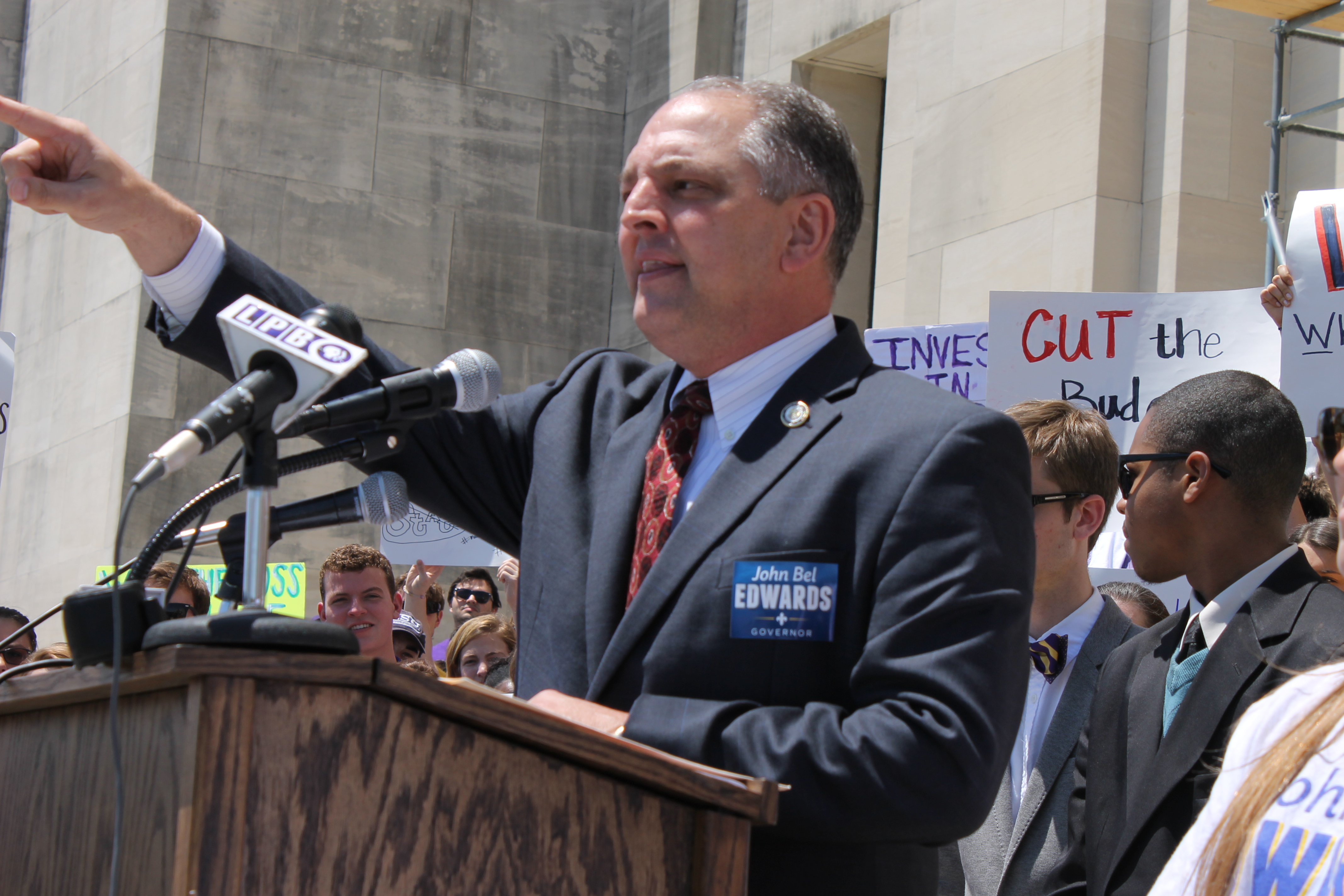
JOHN BEL EDWARDS

Rep. John Bel Edwards addresses LSU students on Thursday (click on image to enlarge).

Lt. Gov. Jay Dardenne, the only one of the four to hold an undergraduate degree from LSU and a former LSU Student Government President was apparently so busy he could only send a representative from his office. A missed opportunity if there ever was one.

Edwards tried to downplay the significance of that. “Well, to be fair, I was already in the building,” he laughed. “I didn’t have to go far.”

But neither did Dardenne. His office is across the street from the Capitol and LSU’s right fielder could probably peg a strike to his office window from the Capitol steps.

But Public Service Commission member Scott Angelle and U.S. Sen. David Vitter also were conspicuously absent. Nor was a single member of the LSU Board of Supervisors in attendance.

Of course, it would have been a sham for Angelle to make an appearance. He is, after all, joined at the hip with Jindal. Granted, Angelle was a Kathleen Blanco holdover, but held over he was and Jindal even made him his legislative liaison. Jindal also named him as interim Lieutenant Governor when Mitch Landrieu was elected mayor of New Orleans, and then appointed him to the LSU Board of Supervisors (that’s the same board that fires LSU presidents on a whim, costs the state hundreds of thousands of dollars defending a defenseless attempt to deny access to public records, and which gives away state hospitals in a deal that had been rejected by the federal government). http://www.nola.com/opinions/index.ssf/2015/03/lsu_board_jindal_resign.html

But why Vitter didn’t show is something of a mystery; there were so many attractive co-eds at the protest, after all.

Edwards told the students that he has “spent seven years fighting Jindal’s budgets. I did not vote for the budget last year and my solemn promise to you is that I will never vote for a budget that cuts funding for higher education.”

Edwards, who holds his undergraduate degree from West Point, received his law degree from LSU Law School. He told the students they are facing the potential of a 90 percent increase in tuition this fall. As expected, that was met with a chorus of boos. “No state has cut funding to higher education more than Louisiana,” he said. “I have a personal interest in seeing higher education fully funded. My daughter is a freshman at LSU.

“If you look behind you, you see a statue of Huey Long,” he said. “Say what you will about Huey Long, but at a time this state was in the throes of the Great Depression, Huey Long found money to build LSU, build roads and bridges throughout the state and to establish a great state hospital system. If he could find money to do all that during the Depression, we should be able to fund education today.”

But as Jindal prattles on about choice for students of K-12, he seems to have forgotten about the choice of post-secondary students: the choice to obtain an affordable education, the choice to remain in Louisiana and attend a tier 1 university, the choice to avoid devastating student loans that put graduates in deep financial holes even before their careers begin.


Read Full Post »

Editor’s note: Normally, we do not make a practice of publishing letters from readers as a guest column. But in this case, we make an exception because we were struck by the manner in which this writer expressed his concern for our state. With only minor editing for punctuation, syntax, etc., we offer here an essay written by a retired state employee now living in Pointe Coupee Parish.

By Kerry Phillips (Special to LouisianaVoice)

After reading this article:  https://louisianavoice.com/2015/04/24/it-wasnt-the-best-week-for-louisiana-as-state-hit-with-triple-whammy-at-least-no-1-lsu-beat-no-2-tex-am-in-baseball/,  and this article: http://bobmannblog.com/2015/04/24/for-jindal-if-the-choice-is-tax-hikes-vs-closing-lsu-its-bye-bye-lsu/, and after watching The Ed Show on April 24 on MSNBC regarding Jindal’s religious freedom bill and how he is truly now a national joke…..and finally, after reading Bobby Jindal’s op-ed in The New York Times, and not hearing anything about any of this in the news with the exception of a small article in The Advocate on the OGB fiasco, I have to say that as much as we love this great state of Louisiana, the heritage, the diversity, the culture, the beauty this state has to offer with many aspects, we will be moving AWAY from this state as soon as we possibly can.

We are at the bottom of every list possible nationwide, and thank God this info is getting out nationwide. We are a laughing stock. And I am sad. Sad for my state. Sad for the people, the young, elderly, poor, government workers, fire fighters, teachers. Should I go on?

I was born here.  I was born in Baton Rouge and attended fantastic schools there. I went to college in this state. I worked for over 30 years as a state employee. I was so proud when I first got my voter’s registration card and I have voted in every election. I retired, thinking my state would honor the commitments they made to me throughout my career.

Sadly, it seems I was fooled.

To know that our legislators are basically bought and paid for by lobbyists and special interests groups who truly have no interest in our state that we call paradise is sad. We have always been known nationwide as a “banana republic.” Now I see why.

No one should say that our citizens move away from this state because of a lack of jobs. They now move away because of this cruel joke that has been perpetrated on us by a handful of people within the last decade. None of these people even care about this state, our education, our colleges, our government workers, our healthcare, etc. What we’re seeing is robbery and pilfering by people who only care about one agenda. And that agenda has nothing to do with the welfare of the citizens of Louisiana. Nor does it have anything to do with our hospitals, our children’s education, or the workers of this state.

So when you turn on the local news and see people with arms folded, waiting and complaining about long lines at their Motor Vehicle offices, thank yourselves. When there is no hospital emergency system available for your loved ones, thank yourselves. When LSU does not exist anymore, God forbid, thank yourselves. When you fail to register your outrage when a contract giving away our state hospitals—with 50 blank pages—only to have the deal rejected by the federal government, thank yourselves.

My family and I plan to move to a more progressive state—to a state where citizens actually live in the current year/century and do not want to take us back to 1915, a state where people want to move forward in a way that benefits all citizens, not just the few. And no, it’s not because of my legislator, who has worked to improve the economy and to help state employees where I live. It’s because I am now becoming ashamed of our state and most of our legislators who helped get us in our current predicament.

I lived in Baton Rouge until we moved to the Central/Greenwell Springs area where I lived for more than 27 years. For the past 15 years, we have lived in Pointe Coupee Parish. And while I’d absolutely hate to leave this state (and it’s an extremely hard choice for me), I do think we’ve made our decision. Our state appears to be done, over with….unless…..our legislators decided to truly quit being Jindal’s lapdog. They need to quit being afraid to buck his system because his system has ruined and bankrupted our state. They need to stop allowing him to be a dictator in this state. He is not our God.

And when religious leaders—from north Louisiana, no less—oppose his religious freedom bill, we welcome their voices. We do not live with the Old Testament laws because with Jesus, a new testament was founded. Do we really want to go back? Are we going to go against what Jesus preached? I’m not. Are we going to allow Jindal’s religious freedom bill to become the hot topic offered only to deflect attention from the real issues, the disasters of his creation: the financial issues we now face that are the direct result of his ineptness?  Come on.

I pray so very hard that all of our legislators, men and women, will grow some courage and principles and do what is right for the whole of this state. I’m not stupid, though. I know legislators get benefits that no average citizen—or state employee—can get.  But, isn’t it time for them to sit back and ask themselves, “Do I really want to sell my soul for some Saints tickets or concert tickets or a fantastic meal at some expensive restaurant? Do I want to sell my soul? Or do I want to do what the citizens of this state want?”  “Do I want to do what Jesus would do?”

Heavy, thought-provoking questions to ask, I know. But, I know what I would do.

This is going to be one of the most historic legislative sessions in this state’s history. It is going to make or break our state. And I am afraid the state is going to break. And the poor, the sick, the elderly will be the ones to suffer.

Of course, there is nothing wrong with people prospering and living a great life. What’s wrong is people prospering and living a great life on the backs of other people.

And so I have this one simple plea for our legislators: For once, do what is right for the whole of the state.  I pray in earnest for that. My friends and I pray hard that the right things will be done. I would love to live here and pass on the culture and treasures this state has to offer to my grandchildren. But, if things continue on as they have for the last decade, we will have to choose differently.


Read Full Post »

The absentee Jindal administration, already under fire for its fiscal train wreck that has legislators scrambling in attempts to cover a projected $1.6 billion budgetary shortfall, had a grenade dropped into its lap on Wednesday in the form of a LAWSUIT against the administration and the Office of Group Benefits (OGB) over the method in which OGB attempted to implement adverse changes in benefits and premiums for 230,000 state employees, retirees and dependents.

Baton Rouge attorney J. Arthur Smith filed the petition for declaratory and injunctive relief in Baton Rouge District Court on behalf of six plaintiffs who are either current state employees or state retirees.

At issue is the way that OGB attempted to increase premiums and reduce benefits for members of OGB last August without complying with the state’s Administrative Procedures Act (APA) which requires promulgation (a formal declaration of intent and public hearings) of any rule changes.

Listed as plaintiffs are Marilee Cash and Aileen Hendricks of East Baton Rouge Parish, Nancy Dickie and Debra Thornton of Lafourche Parish, Rebecca McCarter of Ascension Parish and Dayne Sherman of Tangipahoa Parish. Named as defendants were the State of Louisiana, the Office of the Governor, the Division of Administration (DOA), and OGB.

They claim to be members of an organization called Louisiana Voices of Employees and Retirees for Insurance Truth and Equity, (LA VERITE). They say they chose the name because La verite is French for Truth.

The petition tracks the record of the Jindal administration and chronicles the manner in which the plaintiffs claim that the administration, abetted by the legislature, frittered away a surplus of nearly $2 million at the time Jindal took office, repeatedly used one-time revenue to cover recurring expenses, repealed the popular Stelly tax plan, passed numerous business tax breaks totaling some $367 million, approved $20 million in private school tuition and home schooling tax credits and scrapped the sales tax that businesses previously paid on utility bills.

The rollback of the Stelly plan took place despite warnings from the Institute on Taxation and Economic Policy (ITEP) that the move would cost the state more than $1.8 billion in lost revenue over a three-year period from fiscal year 2010 through fiscal year 2012, the petition says.

The lawsuit says that the repeal of the Stelly plan provided a “substantial tax savings for upper income Louisiana” and accounted for about 75 percent of the state’s budget shortfall during those three years. “This does not take into account the billions of dollars the State of Louisiana hands out in business tax exemptions and incentives ever year that have gone unexamined by lawmakers to determine if they serve legitimate public objectives or are simply wasteful luxuries that the state can no longer afford,” it says.

Citing further examples of what it describes as fiscal mismanagement, the petition notes that from July 1, 2009 through June 30, 2010, the administration spent $2.4 billion in private consulting contracts. The following year, it said, that amount increased to $4 billion. The suit cited the Office of Contractual Review’s annual reports for 2009-2010 and 2010-2011 as its source.

Plaintiffs, in their petition, say that the administration announced in January of 2011 its intention to explore the privatization of OGB’s Preferred Provider Organization (PPO) even though a Legislative Auditor’s report predicted that premiums would increase because of marketing costs for a private provider, the necessity of a private provider’s turning a profit, the requirement that private health insurance companies pay premium taxes and the requirement that private companies must purchase reinsurance.

Despite that, the lawsuit says, then-Commissioner of Administration Paul Rainwater promised that in the event of privatization, benefits would remain the same and premiums would not be increased.

Blue Cross/Blue Shield of Louisiana won the contract to administer the PPO and the new plan went into effect on Jan. 1, 2013. That same year, the administration actually reduced rates by 7.11 percent and the next year another reduction of 1.77 percent went into effect.

“While this saved money for the employees,” the plaintiffs said, “it reduced the state’s required premium (matching) payments by about twice as much, thereby reducing the state’s obligation to pay into the system even though medical expenses were increasing by about 6 percent. The rate reductions, while saving the state money it could then apply to the budgetary shortfall, it meant that OGB could no longer cover expenses from current revenue and had to dip into its reserve fund, which was about $500 million when BCBS took over operations.

OGB has been spending millions per month more than it has been taking in in premiums and the Legislative Fiscal Office has said there is a risk that the reserve fund balance could be zero by the end of the current fiscal year (June 30).

“Gov. Jindal adamantly opposed every attempt on the part of legislators to deal with the financial crisis through tax increases,” the petition says, and he “capitalized on the financial crisis of the state to advance an ideological agenda that called into question the rationale for government to perform basic services on a wide range of issues.”

In listing three causes of action, Smith said the state and OGB violated the state’s APA by attempting to make “substantial unilateral modifications to both benefits and costs under the OGB health plan.”

Some of the changes included:

  • Significantly increasing out-of-pocket maximums for all health plan options;
  • Increasing deductibles for all health plan options;
  • Increased co-pays 100 percent for plans with co-pays;
  • Increasing the out-of-pocket maximums for prescription drug benefits by $300 (from $1,200 to $1,500, a 20 percent increase);
  • Eliminating out-of-network benefits for some plan options;
  • Requiring prior authorizations for certain medical procedures;
  • Removing all vision coverage from health plan options.

The plaintiffs point out that on Sept. 30, 2014, only seven days after an attorney general’s opinion said OGB had violated the APA with its unilateral modifications of benefits, OGB issued a press release “stating its intention to publish an emergency rule reinstating the legally insufficient Aug. 1 changes.”

OGB’s emergency rule, the petition says, “was an apparent effort to retroactively ‘cure’ the illegalities found by the Attorney General in his Sept. 23 opinion. Moreover, the fact (that) the changes would not become effective until March 1, 2015, belies the claim that (there) was an ‘emergency’ which necessitated less than full compliance with the APA.”

OGB did finally comply with the APA by conducting a public hearing on Dec. 29, 2014, in the middle of the Christmas and New Year’s holiday season and after the enrollment period had already been closed, causing the plaintiffs to call the hearing a “sham.”

“With all of the proposed changes, including significant changes (made) during the enrollment period, the haste in which they were handled, and the timing of the Dec. 29, 2014, public hearing, it was very difficult for state employees and retirees to intelligently evaluate their options under these proposed plans and (to) make informed choices,” the plaintiffs said.

The petition also claims the state violated due process and contract clauses.

It claims that state agencies can only change promulgated regulations by the process of the promulgation of a new rule or regulation and that if a change is not properly promulgated in accordance with the APA, “it is not a legally effective pronouncement by the agency (not a law), and therefore, none of the abortive attempts in August, September, October and thereafter should be viewed as having changed the existing law.

“Since the contracts clauses prohibit the state from passing a ‘law’ that retroactively impairs the obligations of contract, OGB can only legally change the benefits program when it adopts through proper procedure and final rule to that effect, and that final rule cannot constitutionally be given retroactive effect.”

The petition is seeking declaratory judgments that:

  • OGB’s health care plans are in violation of the Louisiana APA;
  • Defendants have violated the Constitution of the State of Louisiana;
  • OGB has violated its fiduciary duties as prudent administrators.

It also seeks injunctive relief enjoining the applications of the OGB health care plan modifications.

The lawsuit was assigned to 19th JDC Judge Janice Clark.

Read Full Post »

Bobby Jindal has promised to find money to address the funding crisis facing Louisiana’s public colleges and universities but besides the obvious dire financial straits in which the state currently finds itself, two important obstacles must be overcome by our absentee governor: the American Legislative Exchange Council (ALEC) and Grover Norquist.

The odds of appeasing just one in efforts to raise needed funding for higher education will be difficult enough, given Jindal’s allegiance to the two. Obtaining the blessings of both while simultaneously distracted by the siren’s call of the Republican presidential nomination will be virtually impossible.

Higher education, already hit with repeated cuts by the Jindal administration, is facing additional cuts of up to $600 million, or 82 percent of its current budget, according to news coming out of the House Appropriations Committee earlier this month. http://www.nola.com/politics/index.ssf/2015/04/louisianas_higher_education_bu.html

Such a fiscal scenario could result in the closure of some schools and across the board discontinuation of programs.

Moody’s, the bond-rating service, has warned that Louisiana higher education cannot absorb any further cuts. http://www.treasury.state.la.us/Lists/SiteArticlesByCat/DispForm_Single.aspx?List=c023d63e%2Dac65%2D439d%2Daf97%2Dda71d8688dff&ID=884

Louisiana has already cut per student spending by 42 percent since fiscal year 2008 (compared to the national average of 6 percent), fourth highest in the nation behind Arizona, New Hampshire and Oregon. The actual cut in dollars, $4,715 per student, is second only to the $4,775 per student cut by New Mexico. To help offset those cuts, Louisiana colleges and universities have bumped tuition by 38 percent, 10th highest in the nation but still a shade less than half the 78.4 percent increase for Arizona students. http://www.cbpp.org/research/recent-deep-state-higher-education-cuts-may-harm-students-and-the-economy-for-years-to-come?fa=view&id=3927

But that’s all part of the game plan for ALEC, the “model legislation” alliance of state legislators heavily funded by the Koch brothers which has as its overall objective the privatization of nearly all public services now taken for granted: prisons, pension plans, medical insurance, and education, to name but a few. http://www.cbpp.org/research/alec-tax-and-budget-proposals-would-slash-public-services-and-jeopardize-economic-growth?fa=view&id=3901

Jindal has already incorporated some of ALEC’s privatization proposals, namely state employee medical insurance and elementary and secondary education. He met with less success in attempts to initiate prison privatization and state retirement reform.

ALEC also proposes abolishing state income taxes, another proposal floated and then quickly abandoned by Jindal but pushed successfully by Kansas Gov. Brownback. http://www.washingtonpost.com/blogs/wonkblog/wp/2015/04/21/vwelfap/

And then there is Norquist, the anti-tax Republican operative who founded Americans for Tax Reform and who somehow survived the Jack Abramoff scandal and thrived. http://en.wikipedia.org/wiki/Jack_Abramoff_Indian_lobbying_scandal

What strange hold does he have over Jindal?

The pledge.

Jindal, as did a couple dozen Louisiana legislators, signed onto Norquist’s “no-tax” pledge—a promise not to raise taxes under any circumstances. The pledge even prompted Jindal to veto a 4-cent cigarette tax renewal in 2011 because in his twisted logic, it was somehow a new tax. The legislature had to adopt a last-minute constitutional amendment to make the tax permanent.

Undeterred, Jindal, through communications director Mike Reed, has said he would support a cigarette tax increase this year only if it is offset with a tax cut elsewhere. This despite estimates that a higher tax would not only generate needed income for the state, but would, by encouraging smokes to quit and teens to not start smoking, create long-term health care savings for the state. His veto also flew in the face of a 1997 article that Jindal authored while secretary of the Louisiana Department of Health and Hospitals in which he said, “Society must recover those costs which could have been avoided had the individual not chosen the risky behavior only to prevent others from having to bear the costs.” http://theadvocate.com/news/11930951-123/lawmaker-proposes-154-state-cigarette

Not to be confused with the “no-go” zones of Jindal’s vivid imagination, the “no-tax” pledge apparently is a good thing for Republicans and tea partiers and is considered sacrosanct to those who have taken the oath even if it locks politicians into the impossible situation of trying to resolve a $1.6 billion budgetary crisis while not increasing revenue.

Jindal routinely runs proposed legislation by Norquist for his blessings, according to Jindal spokesperson Reed who admitted as much. http://www.nola.com/opinions/index.ssf/2015/03/in_jindals_world_tax_is_a_tax.html

Even U.S. Sen. David Vitter signed the pledge but has assured voters it won’t be binding on him as governor—a dubious promise that would make him unique among signers. After all, a pledge is a pledge and when one signs it, so what difference would it make which office he holds?

So, how does all this figure into the budget crisis for higher education in Louisiana?

In a word, privatization. Or, taking the “state” out of “state universities.”

While neither Jindal nor any legislator has dared breathe the word privatization as it regards the state’s colleges and universities, at least one Jindal appointee, Board of Regents Chairman Roy Martin of Alexandria, has broached the subject, speaking he said, strictly as an individual. http://theadvocate.com/news/11716059-123/regents-look-at-privatizing-public

The slashing of higher education budgets appears to be a pattern as governors attempt to wean colleges and universities from dependence on state funding, transitioning their status from state-supported to state-assisted to state-located. http://www.usnews.com/news/articles/2015/02/27/scott-walker-bobby-jindal-aim-to-slash-higher-ed-funding

Privatization of state colleges and universities would, of course, push tuition rates even higher, making a college education cost prohibitive for many. But that dovetails nicely with the ALEC agenda as income disparity continues to widen with ever more generous tax laws that benefit the super-rich while placing growing burdens on lower-income taxpayers. By winnowing out those who can least afford college, privatization necessarily enhances the selection process to serve the elite and at the same time, opens up additional revenue opportunities for those in position to take advantage of privatized services such as book stores, printing, food services, and general maintenance. http://gse.buffalo.edu/FAS/Johnston/privatization.html

There is already a backlog of nearly $2 billion in maintenance projects on state college and university campuses just waiting for some lucky entrepreneur with the right connections.

http://theadvocate.com/home/5997316-125/backlog-of-maintenance

States like Louisiana, by such actions as simply increasing our cigarette tax (third lowest in the nation) and being less generous with corporate tax breaks and initiatives, could have reduced the size of the spending cuts or avoided them altogether. Sadly, that was not done and those looking at someone to blame cannot point the finger only at Jindal; legislators have been complicit from the beginning and must shoulder the responsibility for the present mess.

As a result, state colleges and universities have already cut staff and eliminated entire programs to such a degree that Louisiana’s high school seniors already are considering options out of state and other states are obliging. https://lahigheredconfessions.wordpress.com/

Should the legislature adopt any measures to raise revenue for higher education, such measures likely would be vetoed by Jindal if he gets the message from Norquist to do so.

If that occurs, his palpable disregard for the welfare of this state as evidenced by his growing absence will be dwarfed by the affront of taking his cue of governance from a Washington, D.C. lobbyist as opposed to listening to his constituents who want real solutions and not political grandstanding.

But that certainly would be nothing new for Bobby Jindal.

Read Full Post »


By Stephen Winham (Special to LouisianaVoice)

I became the state budget director in 1988.  Because we had consistently spent more than we had taken in since 1984, we faced a $1 Billion dollar budget and cash flow hole in a budget less than half the size of today’s.  We literally did not have the money to pay our day-to-day bills and, like too many of our citizens, had to hold off paying them until we had the cash.  We were flat busted.

In an effort to ensure this never happened again, we enacted a comprehensive package of budget reforms, including establishing  an official revenue forecast; prohibiting the use of one-time money for recurring expenses; requiring a balanced budget from initial presentation through enactment  and to be maintained throughout the year; providing that any interfund borrowing (the mechanism that enabled us to go totally broke in 1988) had to be repaid by the end of the year in which it was borrowed, and many others.

To address the immediate emergency, we took the unprecedented step of creating a special taxing district that issued bonds we paid back over 10 years by dedicating one cent of our sales tax to debt service.

We began to diversify our economic revenue base.  For example, we went from a 40% reliance on mineral revenues to a less than 10% reliance on them today.  We raised other taxes, including, most notably, sales taxes.

We took full advantage of a federal Medicaid program paying high rates to facilities serving a disproportionate share of poor people (we made an annual “profit” of $700 million from this program during its peak).

We enacted the lottery, riverboat, and land-based casino gambling.

All of these kept us going until 1995 when our economy finally began to perform really well and did so through 1998.  Our economy slowed down in 1999 and it was necessary to pass more taxes.

In 2002, the legislature passed, and the state’s voters approved a plan by Representative Vic Stelly that substituted increases in income taxes for 4 cents of sales taxes on food and utilities and placed these exemptions, along with those on pharmaceuticals, in the state constitution.  The reason:  Because sales taxes are regressive and because income taxes generally respond better to our economy than sales taxes.  In my opinion, and that of many others, the Stelly Plan was the best fiscal legislation passed in our history.

We were doing pretty well until 2005 when Katrina struck.  Ironically, recovery from Katrina fueled our economy to the point that by the time Governor Jindal took office in 2007, we had a $1.1 Billion surplus.  Governor Blanco’s last proposed budget was $29.2 billion, of which over $8.0 billion was disaster relief money.  The legislature enacted a $32 Billion budget that year, including the $8.0 billion in non-recurring money.

So, what happened?

Well, remember those laws we passed to ensure we engaged in sound budgetary practices?  We began to ignore them and we spent the $1.1 Billion surplus and every other pot of one-time money we could find.  We repealed HALF, NOT ALL, of Stelly – the income tax increases that would be generating about what we lose in the sales tax exemptions still on the books today -about $700 million.

We cut corporate taxes in half – by a cool Billion.

We pretended we had a balanced budget every year, but using common sense and the letter of the laws we enacted, it is clear we, in fact, DID NOT.  And, although cuts were made – state funding to higher education, as one example, has been cut by $500 million – we NEVER made the cuts necessary to balance recurring spending with recurring revenue.  Why?  According to Kristy Nichols, Commissioner of Administration, as quoted in 2013, doing so would result in “needless reductions to critical services.”  WHAT?  Are you saying you didn’t cut the budget because you couldn’t?  Or, are you for cutting the budget, but you really don’t want to do so?

Governor Jindal continues to be widely quoted, to this day, saying we need to live within our means.  If that is true, why does he not present budgets that do so?  As long as projected revenues from reliable, stable sources do not equal projected necessary expenditures, we will NEVER have a balanced budget.

Could anything possibly be simpler, or make more sense, than balancing what you plan to spend with what is coming in so you don’t dig a hole for yourself?

It is certainly easy to understand why it is difficult to make hard cuts when cash is, or even may be available, but willfully allowing gross fiscal instability to continue indefinitely is a violation of the public trust and ultimately leads to wasteful spending and the inability to see true inefficiencies because the fiscal house is always on fire.  It is beyond time we were presented with an honest budget on which to make honest decisions.

So, you might rightly ask, “How would you fill the $1.6 Billion hole we read about every day in the papers?”

There are an almost infinite number of ways to do so.  Here’s one:

$1.600 reported gap

($0.160): Don’t Fund Inflation and other continuation costs. We rarely do, anyhow.

($0.180): Make cuts pursuant to consultant “efficiency” recommendations. We ought to get something for the $7 million we blew on this contract.

($0.100): Increase tobacco tax to the southern average

($0.700): Restore the income tax provisions of the Stelly Plan

($0.149): Eliminate the refundable tax credits proposed by the governor, except the inventory credit.

($0.100): Cap film tax credits at $150 million

($0.200): Eliminate exemption from severance taxes on horizontal wells. This was new technology when the exemption was granted. It certainly isn’t now, so no incentive is needed.

($0.011): A rounding figure, based on the Executive Budget. Or do $11 million of the $415 million in strategic cuts recommended by the governor – or, dozens of other possibilities.

$0.000 Remaining Problem.

Too simple, right?   And, perhaps, other holes could be poked in my scenario as well, but it proves it is possible to take a pragmatic approach, combining cuts with a limited number of revenue measures for a relatively simple solution.  We often make things a lot more complicated than they are.  I am convinced our government leaders often make simple things complicated in hope citizens won’t know and question what’s going on.

Regardless of what happens we must have an honest budget. If balancing recurring expenses with recurring revenues means making draconian cuts, so be it. Because they have been misled repeatedly, the bulk of our citizens will never believe we have a problem (or one that can’t simply be solved with cuts) until they experience the reality of a true “reform” budget that raises no revenues and cuts services to achieve balance. I sincerely hope it doesn’t come to that, but it may be the only path to real reform.

Read Full Post »

« Newer Posts - Older Posts »
