Feeds:
Posts
Comments

Archive for the ‘Legislature, Legislators’ Category

An official complaint over the appointment of Louisiana State Police (LSP) Maj. Jason Starnes as Interim Undersecretary of Management and Finance has produced another LSP major: a major CYA maneuver at State Police headquarters to backtrack and act as though the “promotion” never occurred.

At the same time, the Louisiana State Police Commission has rescinded last November’s action by the commission to approve a last-minute longevity pay increase plan for state police who last year received two separate pay increases totaling about 30 percent.

http://www.nola.com/politics/index.ssf/2015/07/state_troopers_get_hefty_back-.html

The longevity pay plan would have locked troopers into automatic pay raises based on years of service and was part of Bobby Jindal’s exit strategy as he headed out the door of the governor’s office near the end of his term.

But on June 1, Cathy Derbonne, LSPC Executive Director, published TRANSMITTAL SHEET NO. 58  on the LSPC Web page that pointed out that Article X, Section 48(C) of the Louisiana Constitution mandates that “any rule determination affecting wages or hours shall have the effect of law and become effective only after approval by the governor and subject to appropriation of sufficient funds by the Legislature (emphasis Derbonne’s).

“As of June 1, 2016, an approval by the Governor has not been received and there is currently insufficient funding to implement the revisions,” she wrote.

“The Revision of State Police Commission Rule Chapter 6 Uniform Pay and Classification Plan is hereby rescinded in its entirety,” she wrote (emphasis Derbonne’s). The pay plan approved by the LSPC last November is contained in GENERAL CIRCULAR 180

Starnes, a classified member of LSP, was recently transferred by State Police Superintendent Mike Edmonson to an unclassified non-state police service position as Interim Undersecretary, Custodian of Records of the Office of Management and Finance within the Louisiana Department of Public Safety and Corrections (DPS).

That move, the complaint says, was in violation of Rule 14.3(G), which says:

  • No classified member of the State Police shall be appointed, promoted, transferred or any way employed in or to any position that is not within the State Police Service.

In addition to the points cited in the official complaint, LouisianaVoice pointed out last month that the promotion of Starnes placed him in direct supervision of his estranged wife, Tammy, Audit Manager for LSP. https://louisianavoice.com/2016/05/16/mike-edmonsons-appointment-not-official-yet-senate-committee-set-to-consider-his-confirmation-on-tuesday/

LouisianaVoice also revealed that since his separation from his wife, Starnes had been residing in the LSP Training Academy’s VIP quarters. The VIP quarters at the academy is also known as the “Charlie Dupuy Suite,” so named because Edmonson’s Chief of Staff Charlie Dupuy also resided there during his own divorce from his first wife.

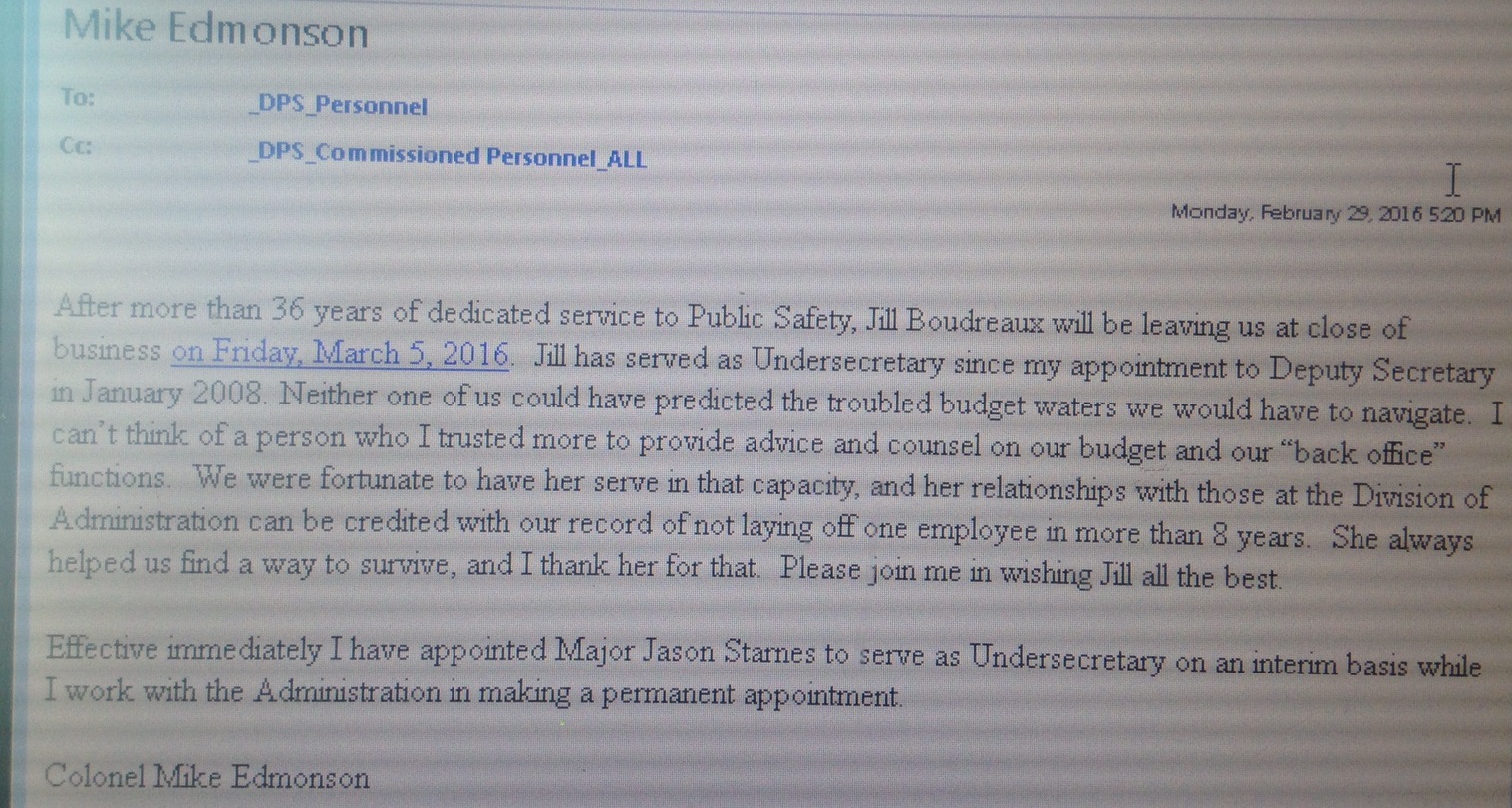
Starnes has since denied he is staying at the LSP Training Academy and more significantly, he has said he is not acting in the capacity of Undersecretary of Management and Finance despite this February memorandum from Edmonson announcing his appointment:

EDMONSON NAMED

(CLICK ON IMAGE TO ENLARGE)

Starnes’ name has since been quietly removed from the DPS Management and Finance Web page and replaced by that of Edmonson who is listed as Deputy Secretary and Custodian of Records. http://mfn.dps.louisiana.gov/

The Office of Management and Finance page contains a link to the undersecretary but when readers click on the link, a “Message from Undersecretary” heading pops up. Beneath that are only the words “Coming Soon.”

That has to be one of the more obvious moves by Edmonson to obscure a major departmental administrative blunder on his part.

The effort to promote someone in his inner circle illegally, Taken with his clumsy but almost successful effort to steer a bill amendment through the Legislature in the waning hours of the 2014 session that would have given him a retirement pay hike of some $30,000 and the documented cases of inconsistent and inadequate investigations and punishment (or outright ignoring) of wrongdoing within his agency, should give pause to the Senate and Governmental Affairs Committee which is scheduled to vote on his confirmation today (Monday, June 6).


Read Full Post »

It was only last Nov. 20 that a joint meeting of the House Committee on Appropriations and the Senate Committee on Finance was told that the Office of Group Benefits (OGB) was in improved financial condition.

By April 21 of this year, however, serious discussion had begun about a premium increase for state employees and retirees even as state workers have been told they will not get merit pay raises for the sixth straight year.

OGB Executive Director testified before the joint committee last November that the agency’s fund balance, nearly depleted by the reckless fiscal policies of Bobby Jindal, had recovered to $122 million at the end of the 2015 fiscal year (June 30, 2015) and was projected to be $146 million by the end of the current fiscal year. http://house.louisiana.gov/H_Video/VideoArchivePlayer.aspx?v=house/2015/Nov/1120_15_AP_SenFinance

Neither amount, of course, is anywhere close to the $500 million fund balance accrued by former OGB Executive Director Tommy Teague before he was teagued in April 2011. (for those who may have forgotten, the term coined by a reader for those who dared disagree with Jindal who were quickly fired or demoted).

It is, however, a significant increase from the low balance that came perilously close to double digits in 2014.

Jim Fannin (R-Jonesboro), at the time a member of the House and chairman of the House Appropriations Committee though he had already been elected to the Senate, asked West what the OGB “burn rate” (the amount paid out monthly in benefits in excess of premiums) was.

“It was $16.3 million,” West replied. “It’s now $7 million. Changes that were made have had a positive impact on the fund balance.”

She said OGB has held no public hearings “because there are no planned benefit changes for 2016.”

But wait. Her testimony does not quite jibe with the April presentation of OGB consulting actuary Arthur J. Gallagher & Co. in that OGB ESTIMATING CONFERENCE

At that estimating conference, Gallagher said a 7 percent rate increase would increase the fund balance to $156.9 million by the end of fiscal year 2017 (June 30, 2017), which it said was “within the target range” of $130 million to $240 million.

Gallagher recommended that the new rate increase go into effect in January 2017 “for ease of communication and administration due to annual enrollment timing.”

Gov. John Bel Edwards, then a state representative, openly opposed the 2014 OGB rate increase plan proposed by West and then Commissioner of Administration Kristy Nichols.

https://louisianavoice.com/2014/08/25/louisianavoice-learns-of-jindal-plan-to-force-state-retirees-out-of-ogb-by-raising-members-premiums-cutting-benefits/

Edwards even went so far as to request an attorney general’s opinion on the method by which Nichols and West were attempting to implement the new premium increase and when the Jindal administration learned in advance that the AG’s opinion would be detrimental to its premium increase plan, Nichols quickly shifted gears in saying that the state would go through the required rule-making process spelled out in the Administrative Procedure Act (APA).

That move only served to further invoke Edwards’ ire because, he said, the changes had already been implemented without the required public hearing. https://louisianavoice.com/2014/09/23/smackdown-attorney-general-opinion-on-ogb-proposals-hands-jindal-administration-another-stinging-legal-setback/

Now Edwards finds himself in the ticklish position of having to either uphold his original position of opposing a rate increase, which originally brought him to the attention of state employees as their White Knight, or backing his OGB Executive Director.

As our late friend C.B. Forgotston was so fond of saying: You can’t make this stuff up.

Read Full Post »

It seems that certain state officials are finding a new means of discouraging Louisiana citizens from seeking information about the way the public’s business is being conducted. This new tactic is nothing less than a form of official harassment that is both chilling and dangerous.

Transparency and accountability in government are currently hot news topics. Last week (May 26), a local Baton Rouge group, Leaders with Vision, held a lunch meeting and discussion with the theme, “Are Louisiana Sunshine Laws adequate in today’s 21st Century World?” Participants included Sen. Dan Claitor; Rep. Dee Richard; Former Baton Rouge Advocate Executive Editor and transparency advocate Carl Redman and LouisianaVoice Editor Tom Aswell.

Both the state and the federal government recognize the need for transparency in the democratic process. Louisiana passed the Louisiana Public Records Act, also known as Louisiana’s Sunshine Law, in 1940 – more than 25 years before President Lyndon Johnson signed the federal Freedom of Information Act (FOIA) in 1966. Anyone can request public records and the purpose of the request does not need to be stated. In fact, the custodian of the record is not allowed to ask the purpose. The major exemptions are pending criminal litigation; juvenile status offenders; sexual offense victims; security procedures; trade secrets; and some public employee information.

Unfortunately, not everyone in government agrees with the concept of transparency and accountability. We have public officials suing constituents in an obvious effort to prevent them from accessing public records. Two recent examples follow.

On May 27, A LouisianaVoice REPORT revealed that several judges in the 4th Judicial Circuit Court filed a lawsuit against The Ouachita Citizen and Publisher Sam Hanna, Jr to prevent the publication from seeking public records to which they were legally entitled. In this case, judges are suing a publication to prevent them from accessing public records concerning the court operation and their presumably dirty laundry.

Now we find that closer to home, John White has likewise filed a LAWSUIT against Mike Deshotels and Dr. James Finney over public record requests that they made to the Louisiana Department of Education (LDOE) – most likely because they have hit a nerve.

On May 31, 2016, Dr. James Finney detailed the history of the suits in a letter to the Governor, John White, the Louisiana Board of Elementary and Secondary Education (BESE) members, and various state staff how the lawsuit came about:

As you may recall, I sent you an email March 12 (attached below) describing the status of several pending record requests that I had placed with John White and the Department of Education.  I also mentioned the existence of a lawsuit (Finney vs White, 6395333, attached).  That lawsuit, which was filed May 22, 2015, was set for trial in late April.

However, on April 11, Mr. White’s attorney requested and was granted a continuance, presumably to become better prepared for trial and to resolve a scheduling conflict with the Department’s sole witness.  Rather than prepare for trial, however, it seems that Mr. White instead instructed his attorney to file two lawsuits against me which appear to be groundless, unnecessary, and against the public interest. Meanwhile, Mr. White and his staff have made no effort to address the 35 pending requests which are subject of my lawsuit.

The first new lawsuit (White vs Finney, 647827, attached) addresses five requests I made in fall 2015, five that I made in February of this year, and one that I made in March. In the lawsuit, Mr. White apparently is asking the judge to create special conditions on Louisiana’s public records law. It seems that, for whatever reason, Mr. White is bending over backward to make sure the public has no idea what statistical distributions LEAP, iLEAP, or EOC test scores follow.  Are they symmetric?  Skewed?  Bimodal? Uniform?  Nor does he, it seems, wish the public to have any means of verifying that School or District Performance Scores have been fairly and accurately calculated.

The second new lawsuit (White vs Deshotels et al, 647953, attached) attempts to reverse favorable judgments Mr. Deshotels received in two prior lawsuits, and apply that reversal (which seems unlikely given that the 19th JDC is not an appellate court) to a subsequent request by Mr. Deshotels and also to one of my requests.  He seeks to use Mr. Deshotels and I as pawns, and cost us additional time and money, to establish a data-suppression policy that was already soundly rejected at court.

I have repeatedly requested meetings with Mr. White and/or his staff to work out arrangements that allow the public to have access to important public records without compromising student privacy nor causing the Department undue burden. I have consistently been rebuffed. And now we’re tangled in litigation in three different divisions of the local district court.

Most of my requests to date, and all that are subject to litigation thus far, could be collected into the following six categories. I trust you would consider these all to be important and of potential public interest:

  • calculation details regarding Value-Added Modeling as performed by the Department
  • voucher programs’ exact enrollments and costs, and demographics of voucher students
  • test-score distributions and technical reports
  • details of School and District Performance Score calculations adequate to verify accuracy and credibility
  • charter schools’ enrollments, charters and leases, and other information
  • exact enrollment numbers with no more suppression than is absolutely required to protect the anonymity of an individual student

I urge you as a body to ask Mr. White to defend his position regarding data secrecy, and his preference for litigation over useful dialogue. Is the department in service to the public, or to test-creators, charter networks and private schools? Have the school grades and Value-Added measures been calculated fairly?  How will we ever know? Is Southern politeness more important than democracy? Is it appropriate to sue citizens rather than responding properly to public record requests?  Please ponder those questions carefully, and provide the appropriate guidance to the Superintendent who is employed at your pleasure.

Thank you.

Dr. James Finney

As one might expect, the suits against Deshotels and Finney are funded by you, the taxpayer, as the LDOE has brought the suit using LDOE funds. Deshotels and Finney are on their own when it comes to legal fees related to these suits. Just to be clear:  You are covering the costs for John White to sue private citizens to prevent them from exercising their constitutional rights.

Of course, Deshotels and Dr. Finney intend to pursue the suit in the courts, rather than ask for a dismissal, to press forward on their requests to this public information that is critical to determining the impact of various policies on our children’s education and the efficacy of the charter experiment in Louisiana. (Remember the last time the government experimented in the south? It happened at Tuskegee.)

As Mercedes Schneider recently noted in her blog deutsch29, “Suing private citizens over public record requests is a new low for an already sorry excuse of a state superintendent. However, it seems that with White, no low is too low.” https://deutsch29.wordpress.com/2016/05/31/la-superintendent-john-white-sues-citizens-who-made-public-records-requests/

The use of virtually unlimited financial and legal resources (at taxpayer expense, no less) to beat down citizens with limited funds to fight back poses an unprecedented and dangerous threat to the very checks and balances upon which our government is founded.

When will Governor Edwards tire of this excuse for a superintendent and encourage the BESE board to bring John White’s tenure up for a vote? Let’s get the BESE members on record as to whether they stand for Louisiana’s children or for the out-of-state interests that bought their seats. Let’s decide, once and for all, if BESE stands for accountability or for secrecy.

For Edwards, the Legislature, and BESE to sit back and do nothing about this infringement upon the public’s right to know should be seen as an endorsement of clandestine activity worthy only of our distrust and fear.

Read Full Post »

If you didn’t believe the Senate and Governmental Affairs Committee handled Louisiana State Police (LSP) Superintendent Mike Edmonson with kid gloves a week ago (Wednesday, May 18) you need only contrast that performance with the manner in which committee members ripped into Department of Juvenile Justice Director Mary Livers two weeks earlier (Wednesday, May 4).

In all the years of political posturing witnessed in more than 40 years of covering elected officials, we have never seen anything as disgraceful and disrespectful—or as hypocritical—as the grandstanding of committee Chairperson Karen Carter Peterson (D-New Orleans).

Nor did members Jean-Paul Morrell (D-New Orleans), Wesley Bishop (D-New Orleans), and Jim Fannin (R-Jonesboro) even make so much as an attempt at civility or professional courtesy in dealing with Livers, a veteran of 40 years in the field of corrections. Fannin, in fact, stopped just short of an outright accusation of malfeasance and misappropriation of funds in his condescending North Louisiana drawl.

Members spent the entire 80 minutes not looking at her overall performance but instead, grilling Livers about conditions at the Bridge City Juvenile Detention Center. They seem particularly fixated on her seeming inability to prevent employee turnover at the facility—even to the point of Bishop’s application of a puzzling mathematical formula to explain the significance of 30 staff vacancies at Bridge City.

Oh, but when it came to addressing the documented personnel and administrative problems in the state’s law enforcement agency (verified by LSP’s own internal documents, by the way), members took on a collective hear no evil, see no evil, speak no evil persona. Instead of a vetting by the committee, the hearing turned into a coronation with the only missing stage prop being a halo. https://louisianavoice.com/2016/05/18/16942/

To watch the unabashed lovefest during the Edmonson hearing, go to the 1:11 mark at this link: http://senate.la.gov/video/videoarchive.asp?v=senate/2016/05/051816S~G_0

Yes, the Bridge City facility does have problems. Any correctional facility does and Bridge City may well be far worse than the others and Morrell may have been correct when he said he was concerned that recent events there “was not isolated.”

It was in April that several teenagers housed there broke through locked doors and gave staff a run for their money for several hours and members were justifiably concerned over the reports of violence and “mayhem” (Peterson’s word for conditions there). http://www.nola.com/crime/index.ssf/2016/04/bridge_city_youth_center_attac.html

But as Livers attempted to explain, she was repeatedly interrupted by Peterson who seemed to think the hearing was all about her and who made sure everyone understood she is a lawyer. Among the problems at Juvenile Justice, Livers said, is a 40 percent budget cut endured by the agency.

“There is a lack of staff there,” Livers said. “We have more than 30 vacancies and the staff we have are required to work multiple shifts to make up for the shortage and there is no money in our budget for overtime pay.” (Did we mention a budget cut of 40 percent?)

“The youth there have lots of problems or they wouldn’t be in a facility like Bridge City,” she said. “The problems are historic. When you have more than 100 kids in a facility, you have problems. Today Bridge City is at 136 youth. That’s too many kids in one place, not enough space. It’s a recipe for problems. We have a difficult time keeping people.”

As Livers was saying this, Peterson can be seen on the inset video as she shared a laugh with another committee member. http://senate.la.gov/video/videoarchive.asp?v=senate/2016/05/050416S~G_0

As evidence of Peterson’s apparent inattention to the testimony, Livers said 38 minutes into the video, “I was there (at Bridge City) yesterday.” Then, just 22 minutes later, at the one-hour mark, she asked Livers “When was the last time you were down there.”

Livers said the 30 vacancies were direct line officers. “That’s a major part of the vacancy issue. There are challenges filling social work positions. Our salaries are competitive to hire but not to keep. I’m down there every two or three weeks when we’re having these kinds of issues…”

“You’re always having these kinds of issues,” Peterson interrupted. “You say you have a passion for this. Overall, I’m not suggesting you’re not doing a good job but in this instance, it’s not adequate. Why? Even with the resources you have, if there are current vacancies and you lead the department and the vacancies are the reason that institution can’t function, that needs to be prioritized. Whatever needs to happen to get that filled, that’s your job. Every day it’s not filled, those children are at risk.”

Funny that same mindset wasn’t present two weeks later when Edmonson said in that same chair. You’d think that when a trooper is allowed for months on end to work a couple of hours and then go home to sleep for the remainder of his 12-hour shift, the driving public might be “at risk.”

When a trooper is having sex with a young female while on duty—once on the back seat of his patrol car—you’d think a committee member might wonder if the public might be “at risk” because the trooper wasn’t doing his job.

It might be reasonable to assume the integrity and reputation of the Louisiana State Police might be “at risk” when a State Police lieutenant escorts an underage girl onto the gaming floor of a Vicksburg, Mississippi, casino, tries to use his position to talk his way out of a citation (again, from LSP documents obtained by LouisianaVoice through a public records request), is fined $600 by the Mississippi Gaming Commission, and is subsequently promoted to troop commander.

Some member of the committee missed a great opportunity to pontificate about whether a state police lieutenant found to be using prescription narcotics while on duty might be placing himself “at risk.” That same member might wonder why that trooper was also subsequently promoted to troop commander.

But….nary a word from a single member—except when they took turns gushing over what a great public servant Edmonson is.

But Peterson, Bishop, and Fannin tripped all over each other in challenging Livers and her performance. And when Livers attempted to explain the hiring process, she was abruptly cut off by Peterson. Not a shred of common courtesy was displayed by either of the three. Funny how that works.

Peterson asked why there was such a high turnover—a question Livers had already addressed in describing the working conditions at Bridge City. But she gamely tried again. “There is a variety of reasons,” she said. “Most say the job was not what they thought it would be. They don’t like being called into service and working all kinds of hours because of vacancies.”

“That goes back to you,” Peterson snapped. “It’s not enough to take responsibility. You’ve been there a long time. You say you take responsibility but nothing gets done.”

“With all due respect,” Livers said, “I don’t think nothing is being done. I think a lot is being done. Is it acceptable? No, but we’ve thrown everything we have at it to make the sure the kids are safe.”

“There are 136 kids at Bridge City,” Peterson said. “Are they safe?”

“Based on the staffing we have, yes,” Livers said.

When Bishop finally got to speak, his jumbled math quickly became a bone of contention.

“I’ve tried to equate 30 vacancies for 136 kids,” he said. “Let’s say there are just 120 kids. With 30 vacancies, that’s a ratio of four to one.”

Huh? As best we could make out, he seemed to believe there were only 30 staff members before they all quit—or something like that.

“There are more than 200 staff members who are there,” Livers said, trying to bring him around—possibly to Common Core math.

“Aren’t absences even more of a reason to fill vacancies?” he asked. “Why don’t you fill the vacancies? Why would you not hire people?”

“Why would anybody not strive to fill all the positions that you have?” Livers answered.

“That’s the question most of us are asking,” said Bishop, apparently also not paying attention when Livers earlier explained why there was such high turnover at Bridge City. (What does it take to get these people to shut their mouths and listen to testimony being given?)

“We are striving to do that, Senator,” she said, coming down heavy on the word. “And we’re striving to keep those people. It’s not from a lack of desire, attention, or focus; it is a complexity of issues that culminate into a very difficult task.”

“You’re still saying it’s safe?” Peterson asked.

“Chairwoman, we’re doing everything we can…”

But again, Peterson was hell bent on interrupting. “I’m asking if you believe the facility under your jurisdiction is safe.”

“I do.”

Then it was Fannin’s turn. The former Chairman of the House Appropriations Committee before he was forced to run for the Senate after being term-limited on the other side of the Capitol rotunda asked how long the 30 vacancies had existed and what the average vacancy duration was.

He then launched into a veiled accusation of fiscal mismanagement by Livers. “I don’t recall the Department of Juvenile Justice having any excess revenues. What do you do with the funds allocated for those 30 salaries?”

Reminding Fannin of that 40 percent budget cut, Livers tried to explain that her agency had ended its fiscal years having to borrow money from the Treasury to stay afloat. “Whatever money there is goes towards operations,” she said. “We’ve ended the year short of funds for three years in a row.”

“You’re not really answering my question. You didn’t know how long the vacancies was (sic) and now you’re not wanting to answer what you use the money for.”

“We have been underfunded for the past three years, so when we have operational costs, whatever savings there may be from vacancies are shifted into operations through working with the Division of Administration,” she said. “We are one of the agencies that have suffered the most cuts.”

“But you have 30 vacancies,” Bishop said. “A deliberate decision was made to use money for vacancies for other purposes.”

“We are not deliberately not hiring people, Senator,” she said. “That seems to be the impression you’re getting.”

Peterson closed out the joint exercise in narcissism by scolding Livers one last time. “You were there yesterday and you were there three weeks ago and that was inadequate,” she said. “I don’t know who runs that facility but I would highly recommend that you get there and roll up your sleeves and you fix it (funny, no one told Edmonson to “fix” anything). And you hire these 30 people ASAP.

“And we may ask you to come back and finish this confirmation hearing before the end of the session.”

No you will not.

Your committee’s boorish treatment of Ms. Livers, in stark contrast to the butt-kissing you did with Edmonson, convinced her she’s had enough of your crap. To be perfectly blunt, she doesn’t need to be subjected to such a blatant double standard.

Accordingly, she has taken her retirement and gotten out of Dodge.

Yes, there are problems at Bridge City. No one can deny that. There are problems at every corrections facility. And committee members are within their rights to ask hard questions—but they do not have the right to ignore one problem with only syrupy words of high praise for the public face of law enforcement in Louisiana while crucifying another department head just for the sake of political posturing.

So, Sen. Peterson, why don’t you get there and roll up your sleeves and fix it? And you hire those 30 people ASAP.

Read Full Post »
Rumor has it a newly-elected legislator from North Louisiana was told by a lobbyist friend there was so much at the Capitol that “You could just pick it up off the floor.”

Arriving for his inauguration back in January, he walked up the 50 steps and into the Capitol rotunda. He was no sooner in the door when he spotted a $100 bill lying on the floor. He looked at it a moment and then grunted and walked past the bill, saying, “Hmpf, I’ll pick you up tomorrow. I’m not working on my first day in Baton Rouge.” (With apologies to the late comic Brother Dave Gardner.)

That said, what’s the price of a reliable legislator these days?

Obviously, the going rate depends on a lot of factors. If, for instance, 97 oil and gas companies want a lawsuit against them for destroying Louisiana’s coastal marshlands, the price is pretty high as evidenced by the millions of dollars poured into political campaigns and lobbying efforts.

The oil companies, with virtually unlimited financial resources, spent like a drunken sailor by spreading the money around among legislators and political action committees.

On other issues, the answer might be not so much.

Take, for example, the confirmation of Mike Edmonson as Superintendent of State Police. That price apparently is a little north of $76,000.

The Louisiana Sheriffs’ Association obviously does not have the bottomless expense account enjoyed by the oil companies but it still manages to spread its money around pretty generously through its own political action committee, the Louisiana Sheriffs’ and Deputies’ PAC.

But for the purposes of this one issue—the confirmation hearings last Wednesday on Edmonson’s reappointment by Gov. John Bel Edwards, we will concentrate on only a few recipients—members of the Senate and Governmental Affairs Committee, the President of the Senate and a handful of key legislative caucuses.

Last week, we watched the pathetically transparent attempt by members of the Senate and Governmental Affairs Committee to avoid all questions about Edmonson’s record of allowing payroll fraud and other transgressions by those under his command. https://louisianavoice.com/2016/05/18/16942/

Somewhat puzzled by the collective amnesia of the committee (sarcasm) and its equally apparent determination not to thoroughly vet certain nominees while grilling others (realism), we thought we’d peel back the layers and take a peek at campaign contributions to members of the committee.

What we discovered proved interesting, to say the least.

Take committee Chairperson Karen Carter Peterson (D-New Orleans), who also serves as Chairperson of the Louisiana Democratic Party:

  • Karen Carter Peterson: $3,100 in director contributions from the Sheriffs’ PAC;
  • The Women’s Caucus: $3,500;
  • The Louisiana Democratic Campaign Committee: $13,000;
  • The Louisiana Legislative Black Caucus: $25,500.

Democrats and Republicans alike benefited from the sheriffs’ PAC:

  • Wesley Bishop (D-New Orleans), vice chairperson of the committee: $1,000;
  • Jean-Paul Morrell (D-New Orleans): $4,250;
  • Greg Tarver (D-Shreveport): $1,600
  • Louisiana Republican Legislative Delegation: $8,800;
  • Jack Donahue (R-Mandeville): $2,000;
  • Jim Fannin (R-Jonesboro): $3,700;
  • Neil Riser (R-Columbia): $500;
  • Mike Walsworth (R-West Monroe): $4,700

And just in case you might think the sheriffs’ influence was concentrated on just the committee members, the PAC also contributed $4,800 to Senate President John Alario (R-Westwego). You think he may have whispered in the ears of committee members to go light on Edmonson?

Granted, we’re not talking about a lot of money here—especially considering some of the aforementioned contributions date back to 2003. But it’s a steady flow of contributions to legislators who are restricted by the amount from any one contributor during a single election cycle ($2,500) is never ignored by the recipient. While the amounts of their contributions are lower, so, too, are their expenses because their districts are not statewide. It’s also enough to discourage legislators from taking the chance of pissing off the Sheriffs’ Association.

And while $76,000 contributed since 2003 may not seem like a lot, when you take into consideration the Sheriffs’ PAC contributed more than $794,000 on all candidates since that time—the vast majority of those legislators—it’s much easier to see how much more influence is purchased when the money is spread across the political landscape.

And to be sure, the Sheriffs’ and Deputies’ PAC doesn’t overlook those other legislators. The list is long and nearly every member of the legislator has received at least one contribution from the PAC. Here is the complete list of SHERIFFS ASSOCIATION CONTRIBUTIONS since 2003.

What’s the price of your legislator?

Read Full Post »

« Newer Posts - Older Posts »


