Feeds:
Posts
Comments

Archive for the ‘Layoffs’ Category

In our lowlights review for the first six months of 2014, we were reminded by State Rep. Jerome “Dee” Richard (I-Thibodaux) that we had omitted a major low point in Louisiana politics.

Accordingly, we will preface our second half with the June veto by Gov. Bobby Jindal of HB 142 by Richard and Sens. Francis Thompson (D-Delhi) and Mack “Bodi” White (R-Central) which was pass unanimously by both the House (84-0) and Senate (37-0).

Called by Richard as the only “piece of legislation that would’ve done anything in the form of reform,” HB142 called for a reduction in consulting contracts. Richard said the bill also “would’ve provided transparency in the way the state hands out contracts” and would have provided savings that would have been dedicated to higher education.

“It just made too much sense to Bobby,” Richard said.

Jindal, on the other hand, said the bill would “hinder the state’s efforts to continue to provide its citizens with timely, high-quality services.”

Such high-quality services as paying $94,000 to a firm to assistant students to learn to play during recess; paying consulting fees to Hop 2 It Music Co. or to the Smile and Happiness Foundation.

Jindal also said the bill would “cause significant delays and introduce uncertainty to executing a contract” and would “discourage businesses from seeking opportunities to provide services to the people of Louisiana.”

Which now brings us to the second half of political news that could only occur in Louisiana.

JULY

Troy Hebert back in the news:

Three former ATC supervisors, all black, have filed a federal lawsuit in the Baton Rouge’s Middle District claiming a multitude of actions they say Hebert took in a deliberate attempt to force the three to resign or take early retirement and in fact, conducted a purge of virtually all black employees of ATC.

Baton Rouge attorney J. Arthur Smith, III filed the lawsuit on behalf of Charles Gilmore of Baton Rouge, Daimian T. McDowell of Bossier Parish, and Larry J. Hingle of Jefferson Parish.

The lawsuit said that all three plaintiffs have received the requisite “right to sue” notice from the U.S. Department of Justice pursuant to Equal Employment Opportunity Commission (EEOC) complaints.

So, where are all those savings we were promised?

To probably no one’s surprise except a clueless Gov. Bobby Jindal, the takeover of the Louisiana Office of Group Benefits (OGB) by Blue Cross Blue Shield of Louisiana a scant 18 months ago has failed to produce the $20 million per year in savings to the state.

Quite the contrary, in fact. The OGB fund balance, which was a robust $500 million when BCBS took over as administrators of the Preferred Provider Organization (PPO) in January of 2013, now stands at slightly less than half that amount and could plummet as low as an anemic $5 million a year from now, according to figures provided by the Legislative Fiscal Office.

There is no tactful way to say it. This Jindal’s baby; he’s married to it. He was hell bent on privatizing OGB and putting 144 employees on the street for the sake of some hair-brained scheme that managed to go south before he could leave town for whatever future he has planned for himself that almost surely does not, thank goodness, include Louisiana.

So ill-advised and so uninformed was Jindal that he rushed into his privatization plan and now has found it necessary to have the consulting firm Alvarez and Marcel, as part of their $5 million contract to find state savings, to poke around OGB to try and pull the governor’s hand out of the fiscal fire. We can only speculate as to why that was necessary; Jindal, after all, had assured us up front that the privatization would save $20 million a year but now cannot make good on that promise.

We can save, but we have to let you go…

The Jindal administration announced plans to jettison 24 more positions at the Office of Group Benefits (OGB) as a cost cutting measure for the cash-strapped agency but is retaining the top two positions and an administrator hired only a month ago.

Affected by layoffs are eight Benefits Analyst positions, three Group Benefits Supervisory spots, one Group Benefits Administrator, seven Administrative Coordinators, an Administrative Assist, two Administrative Supervisors, one IT Application Programmer/Analyst and one Training Development Specialist.

All this takes place at a time whe OGB’s reserve fund has dwindled from $500 million at the time of the agency’s privatization in January 2013 to about half that amount today. Even more significant, the reserve fund is expected to dip as low as $5 million by 2016, just about the time Jindal leaves town for good.

Completing the trifecta of good news, we also have learned that health benefits for some 200,000 state employees, retirees and dependents will be slashed this year even as premiums increase.

Neil Riser helps Edmonson revoke the irrevocable:

One of the single biggest state political stories of the year was the surreptitious attempt of State Sen. Neil Riser to slip an amendment into an otherwise nondescript bill ostensibly addressing procedures in handling claims against police officers that would have given State Police Superintendent Mike Edmonson an illegal $55,000 per year retirement boost.

Events quickly began to spin out of control after Riser first denied, then admitted his part in the ruse and as retired state police opposed the move and public opinion mounted against the move, Edmonson, after first claiming he was entitled to the raise, finally relented and said he would not accept the increase.

Meanwhile, Jindal, who signed the bill, was eerily quiet on the issue despite speculation he was behind the attempt to slip the increase into the bill.

State Sen. Dan Claitor, just to make sure Edmonson didn’t go back on his word, filed suit to block the raise and a Baton Rouge judge agreed that the bill was unconstitutional.

The bill, which quickly became known as the Edmonson Amendment, along with the Office of Group Benefits fiasco, constituted the most embarrassing moments for a governor who wants desperately to run for president.

AUGUST

Selective—and hypocritical—moral judgments

Gov. Bobby Jindal weighed in early on the kissing congressman scandal up in Monroe. When rookie U.S. Rep. Vance McAllister was revealed on video exchanging amorous smooches with a female aide, Jindal was all over him like white on rice, calling for his immediate resignation.

Jindal’s judgmental tone was dictated more by the philosophical differences between the two (McAllister wanted the state to expand Medicaid, Jindal most assuredly did not) than any real issues based on morals as Jindal’s silence on the philandering of U.S. Sen. David Vitter who did a tad more than exchange affectionate kisses.

Edmonson Amendment spawns other state police stories:

LouisianaVoice, in its continuing investigation of the Department of Public Safety (DPS), learned that a number of DPS employees enjoy convenient political connections.

  • Dionne Alario, Senate President John Alario’s daughter-in-law, is a DPS Administrative Program Manager;
  • Alario’s son, John W. Alario, serves as a $95,000 per year director of the DPS Liquefied Petroleum Gas Commission.
  • DPS Undersecretary Jill Boudreaux retired on April 28 from her $92,000 per year salary but the day before, she double encumbered herself into the position and reported to work on April 30 in the higher position of Undersecretary. Commissioner of Administration Angéle Davis ordered her to repay the 300 hours of annual leave (about $46,000) for which she had been paid on her “retirement,” but Davis resigned shortly afterward and the matter was never pursued.
  • DPS issued a pair of contracts, hired the contractor as a state employee, paid her $437,000 to improve the Division of Motor Vehicles and ponied up $13,000 in airfare for trips to and from her home in South Carolina. The contractor, Kathleen Sill, heads up a company called CTQ but the company’s web page lists Sill as its only employee.
  • Boudreaux’s son-in-law Matthew Guthrie was simultaneously employed in an offshore job and was on the payroll for seven months of the State Police Oil Spill Commission.
  • Danielle Rainwater, daughter of former Commissioner of Administration Paul Rainwater was employed as a “specialist” for State Police.
  • Tammy Starnes was hired from another agency at a salary of $92,900 as an Audit Manager. Not only was her salary $11,700 more than state trooper Jason Starnes, but she is in charge of monitoring the agency’s financial transactions, including those of her husband.

Thanks, retirees; here’s your bill for medical coverage:

LouisianaVoice was first to break the news that the Jindal administration was planning to force retirees out of the Office of Group Benefits by raising premiums astronomically and slashing benefits.

The news sparked waves of protests from employees and retirees alike, prompted legislative hearings at which Commissioner of Administration Kristy Nichols looked more than foolish in their attempts to defend the ill-conceived plan.

The entire fiasco was the result of the Jindal administrations foolish decision to cut premiums, which allowed the state to be on the hook for lower contributions as well. The money the state saved on matching premiums went to help patch those recurring holes in the state budget. Meanwhile, because of the lower premiums, the $500 million OGB reserve fund shrank to about half that amount as OGB spent $15 million per month more than it received in premiums.

All this occurred just three years after then-Commissioner of Administration Paul Rainwater, in a letter on the eve of the privatization of OGB, promised the continuation of quality service, rates that would be “unaffected” with any increases to be “reflective of medical market rates.” More importantly, he emphatically promised that benefits “will NOT change.”

HHS_2013_SNPS_35_Day

OCTOBER

What premium decrease?

Contrary to the testimony of Commissioner of Administration Kristy Nichols that Buck Consultants recommended that the Office of Group Benefits reduce premiums for members, emails from Buck Consults said exactly the opposite. State Rep. John Bel Edwards (D-Amite) had asked Nichols during legislative committee hearings who recommended the decrease and she replied that the recommendation came from Buck. All witnesses before legislative committees are under oath when they testify.

Surplus, deficit, tomato, to-mah-to:

Nichols “discovered” a previously unknown “surplus” of $320 million in mystery money that set off a running dispute between her office and State Treasurer John Kennedy—an argument that eventually made its way before the Joint Legislative Committee on the Budget.

With a tip of our hat to cartoonist Bud Grace, we are able to show you how that surplus was discovered:
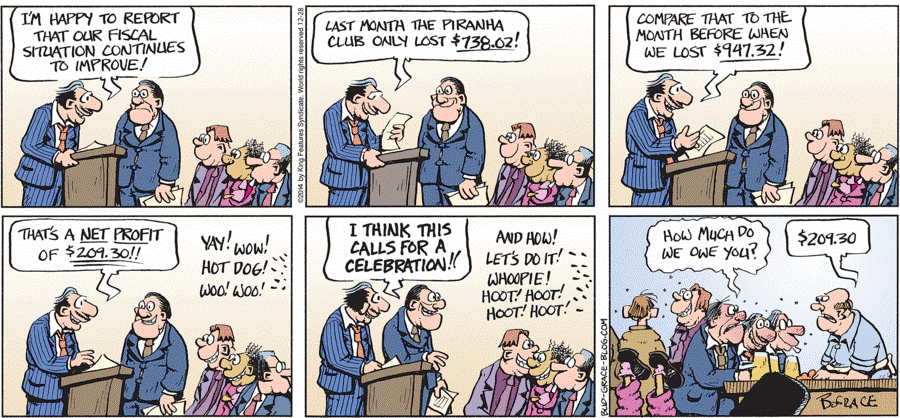
JINDAL SURPLUS SECRET

(CLICK ON IMAGE TO ENLARGE)

Murphy Painter vindicated, Jindal humiliated:

Jindal’s attempted prosecution persecution of fired Director of the Office of Alcohol and Tobacco Control Murphy Painter blew up in the governor’s face when Painter was first acquitted of criminal charges, costing the state nearly half a million dollars in reimbursement of Painter’s legal fees, but Painter subsequently won a defamation suit against his accuser.

Secret survey no longer a secret but “no one” more popular than Jindal:

A survey to measure state employee satisfaction in the Division of Administration (DOA) should be an eye opener for Commissioner of Administration Kristy Kreme Nichols and agency heads within DOA.

Meanwhile, LouisianaVoice has learned that Gov. Bobby Jindal (R-Iowa, R-New Hampshire, R-Anywhere but Louisiana) received some exciting news this week when a new poll revealed that no one was more popular among Republican contenders for the GOP presidential nomination.

The excitement was short-lived, however, when the actual meaning of the numbers was revealed.

It turns out that in a CNN poll of New Hampshire voters, Jindal tied with Rick Santorum with 3 percent, while “No one” polled 4 percent, prompting Comedy Central’s Stephen Colbert to joke that Jindal should adopt the slogan “Jindal 2016: No one is more popular.”

To shred or not to shred:

The controversy surrounding the sweeping changes being proposed for the Office of Group Benefits just got a little dicier with new information obtained by LouisianaVoice about the departure of Division of Administration executive counsel Liz Murrill and the possibly illegal destruction of public records from the Office of Group Benefits (OGB) and the involvement of at least two other state agencies.

While it was not immediately clear which OGB records were involved, information obtained by LouisianaVoice indicate that Murrill refused to sign off on written authorization to destroy documents from OGB.

We first reported her departure on Oct. 14 and then on Oct. 22, we followed up with a report that Murrill had confided to associates that she could no longer legally carry out some of the duties assigned to her as the DOA attorney.

But now we learn that the issue has spilled over into two other agencies besides OGB and DOA because of a state statute dealing with the retention of public documents for eventual delivery to State Archives, a division of Secretary of State Tom Schedler’s office.

Reports indicate that Schedler became furious when he learned of the destruction or planned destruction of the records because records should, according to R.S. 44:36, be retained for three years and then delivered to the state archivist and director of the division of Archives, records management and history.

NOVEMBER

Secret grand jury testimony of Greenstein made public:

The Louisiana Attorney General’s office, in an unprecedented move, released the 100-plus pages of testimony of Bruce Greenstein, former Secretary of the Department of Health and Hospitals but the testimony did little in revealing any smoking gun related to the state’s $180 million contract with CNSI. About the only thing to come out of his testimony was the indication of an incredible bad memory in matters related to his dealings with his former bosses at CNSI and a razor-sharp recall of other, more insignificant events.

Approval? We don’t need no stinkin’ approval:

The very first state agency privatized by Gov. Bobby Jindal was the Office of Risk Management (ORM) and after the state paid F.A. Richard and Associates (FARA) $68 million to take over ORM operations and then amended the contract to $75 million after only a few months, the agency was subsequently transferred three times to other firms. The only hitch was a specific clause in the original contract with FARA that no such transference was allowable without “prior written approval” from the Division of Administration. The problem? When LouisianaVoice made an FOIA request for that written approval, we were told no such document existed.

Edwards’ Last Hurrah:

Former Gov. Edwin Edwards, one of the most successful, colorful and charismatic politicians in Louisiana history, lost—decisively. Republican Graves Garrett rode the Republican tide to easily hand Edwards his first political defeat, dating back to his days on the Crowley City Council. Some may remember when Buddy Roemer led the field in 1987, forcing Edwards into a runoff. Technically, though, Edwards did not lose that election because he chose not to participate in the runoff, thus allowing Roemer to become governor. But he would return in 1991 to win his unprecedented fourth term.

DECEMBER

Friends of Bobby Jindal seeking donations:

A new web page popped up seeking donations for the Friends of Bobby Jindal, raising speculations of an attempt at a higher office (president?) since Jindal can’t run for governor again.

The new web page cited a speech by Jindal at a foreign policy forum at which he called for increased military spending.

Gimme the keys to the cars:

The Public Service Commission (PSC) became the second state agency (the State Treasurer’s office was the first) to openly defy Jindal when the administration demanded that the PSC relinquish possession of 13 vehicles as part of the administration’s cost-cutting measures.

We have already examined State Rep. Jerome “Dee” Richard’s attempt to cut consulting contracts which was passed unanimously by both the House and Senate but vetoed by Jindal.

But there was another veto that should be mentioned in context with Jindal’s penny wise but pound (dollar) foolish fire sale approach to state finances.

Earlier this year, State Sen. Jack Donahue (R-Mandeville) managed to get overwhelming passage of a bill that called for more oversight of the tax break programs by the state’s income-forecasting panel.

But Jindal, who never met a tax break he didn’t like, promptly vetoed the bill, saying it could effectively force a tax increase on businesses by limiting spending for the incentive programs.

Only he could twist the definition of removal of a tax break for business into a tax increase even while ignoring the fact that removal of those tax breaks could—and would—mean long-term relief for Louisiana citizens who are the ones shouldering the load. And for him to willingly ignore that fact borders on malfeasance.

Another (yawn) poor survey showing:

24/7 Wall Street, a financial news and opinion company, released a report which ranked Louisiana as the 11th worst-run state in America.

Louisiana, in ranking 40th in the nation, managed to fare better than New Jersey, which ranked 43rd, or eighth worst, something Jindal might use against Gov. Christ Christie if it comes down to a race between those two for the GOP nomination.

Louisiana had “one of the lowest median household incomes in the nation,” at just $44,164, the report said “and 10.7 percent of all households reported an income of less than $10,000, a higher rate than in any state except for Mississippi. Largely due to these low incomes, the poverty rate in Louisiana was nearly 20 percent (19.8 percent) and 17.2 percent of households used food stamps last year, both among the highest rates in the nation. The state’s GDP grew by 1.3 percent last year, less than the U.S. overall.

May we pray?

Meanwhile, Jindal prompted more controversy by having his favorite publisher and LSU Board of Supervisors member Rolfe McCollister run interference in securing the LSU Maravich Center for a political prayer event in January of 2015. The event will be sponsored by the controversial American Family Association and will not (wink, wink) be a political event, Jindal said.

And that, readers, is where we will leave you in 2014.

For 2015, we have an election campaign for governor to look forward to.

Just when you thought it couldn’t get any worse.

Read Full Post »

One of Gov. Bobby Jindal’s favorite activities (second only to trips to Iowa and New Hampshire) appears to be his now-routine exercise of mid-year budget cuts and hiring freezes.

But like any deft politician, he leaves himself wiggle room.

Lots of wiggle room.

On Jan. 15, 2014, Jindal, in reaction to the state’s worsening fiscal condition, issued an executive order for a “limited hiring freeze” that extended to some 40 state agencies. That order stipulated that no agency use employee transfers, promotions, reallocations or the creation of new positions in such a manner as to exceed a ceiling imposed by the commissioner of administration. JANUARY HIRING FREEZE

As state finances continued to deteriorate, Jindal followed up with a statewide expenditure freeze on April 14. While that order imposed statewide cuts, it listed enough exemptions and exceptions as to render it practically meaningless—except for higher education and healthcare expenditures not covered by federal funding. As has always been the case, those were not spared. APRIL EXPENDITURE FREEZE

The order continued a trend that has come to define the Jindal administration: extensive mid-year cuts.

Then, on Nov. 7, Jindal issued his first executive order of the 2014-2015 fiscal year that began on July 1 for another statewide expenditure freeze. Again, the main areas cut were higher education and health care, though as with the April order, other agencies felt at least some of the effects. Theoretically at least, the only exceptions were essential services and federally funded programs. NOVEMBER EXPENDITURE FREEZE

Now, Jindal is at it again. On Dec. 18, he issued yet another executive order, the fourth of the calendar year and the second this fiscal year. This one called for expenditure reductions totaling $153 million and authorizing Commissioner of Administration Kristy Nichols to impose an additional $17.4 million in cuts for total cuts of $170.4 million.

DECEMBER EXPENDITURE REDUCTION

Among the latest cuts ordered by Jindal included:

  • Higher Education: $4.9 million;
  • Department of Education: $6.77 million;
  • Corrections: $336,780;
  • Division of Administration: $3.5 million;
  • Veterans Affairs: $240,000;
  • Office of Juvenile Justice: $1.98 million;
  • Office of the Department of Health and Hospitals (DHH): $131.8 million (includes $127.44 million in cuts to medical vendors, $2.64 million to medical vendor administration, and $308,213 in cuts to the Office of Citizens with Developmental Disabilities);
  • Office of Children and Family Services: $964,980;
  • Department of Natural Resources: $1.29 million;
  • Department of Economic Development: $1.4 million.

One of the more interesting sidebars to this entire scenario is that with the latest executive order, DOA gave some agencies only eight working days in which to provide a myriad of information, including lists of all contractors and amounts paid on the contracts.

DOA has consistently taken weeks and sometimes months in which to comply with similar requests by LouisianaVoice, a point which will be raised in any future litigation by LouisianaVoice. We will, in all probability, cite that long-standing legal precedent Goose v. Gander in our legal arguments.

We mentioned at the beginning of this post that Jindal has left himself a lot of room to maneuver around his own dictates and we had little problem in finding good examples.

In early November, only hours before that Nov. 7 hiring freeze for example, the Office of Group Benefits (OGB) brought two six-figure appointees over from Blue Cross and Blue Shield of Louisiana to assist OGB Chief Executive Officer Susan West in handling an agency that appeared to be spinning out of her control.

West makes $170,000 a year as CEO but the governor’s office somehow saw fit to pay Thomas Groves $220,000 a year as Assistant Commissioner and Elise Cazes $106,512 as Group Benefits Administrator.

And now we learn that OGB is still hiring long after that hiring freeze took effect last month.

The Office of Civil Service will close applications on Friday (Dec. 26) for the position of Group Benefits Director (what that entails). The salary range for that position is between $50,900 and $107,000, according to the Civil Service announcement.

That’s a pretty big spread and our bet is the new hire won’t be starting at the bottom of that scale.

It seems curious to us that OGB managed to survive—and even thrive, building a $500 million reserve fund balance—without all that added weight before the decision to fire former CEO Tommy Teague in April of 2011, lay off more than 100 personnel, to privatize the agency and in the process, manage to lose half of that $500 million reserve fund.

Not satisfied with increasing the number of administrative positions at OGB, the administration is currently advertising for a Chief Legal Officer for OGB, according to listings provided by Civil Service.

And then there is the case of Chance McNeely who, since last march has served as a $65,000-a-year policy analyst for the Governor’s office but more recently was appointed as Assistant Secretary for Environmental Compliance at the Department of Environmental Quality at an as yet undisclosed salary.

Three things stand out about the McNeely appointment. First, with Jindal’s term of office winding down to just over a year left, McNeely need a nice cozy spot to land in a classified (read: protected) position.

Second, the creation of that position would seem to violate Jindal’s own directive of last April that “no agency use employee transfers, promotions, reallocations or the creation of new positions in such a manner as to exceed a ceiling” imposed by the administration. Jindal and Nichols would argue that that caveat applied to the previous fiscal year, not 2014-2015 and technically, they would be correct. But the state’s financial condition is even worse than last year, so one might reasonably assume that prohibition should have been carried forward into the new fiscal year. But when it adheres to the wishes of Jindal, the rules apparently do not apply. After all, it was in a Division of Administration staff meeting a couple of years ago that the directive was given to staffers to not let the law stand in the way of the administration’s wishes.

And third, since when does Jindal care about the environment anyway? Remember that Jindal himself described climate change advocates as “science deniers.”

Curious indeed for a governor obsessed with reducing the size of government.

But, as those cheesy TV commercials say, there’s more. We also have the Department of Education.

Since January of 2014, DOE has chalked up 300 new hires—190 full time and 110 part time—at a combined salary of more than $9.6 million, or an average yearly salary of $50,857, including part timers.

The Recovery School District (RSD), which has experienced a string of critical state audits, had 93 of those 190 new full time hires at a combined salary of $4.1 million.

DOE hired 50 part time employees at $500 per week or more (a combined salary of $2 million per year) and 16 of those part timers, all employed by RSD, were hired at $1,000 per week or more. One of those, guidance counselor Nancye Ann Verlander, was hired at a part time salary of $3,000 per week ($156,000 per year), according to records provided by Civil Service.

Two others, Kathryn Elichman and Kenneth Elichman, were hired as part time administrators at $1,600 and $1,150 per week ($83,200 and $59,800 per year, respectively), records show, and a part time school nurse receives $72,800 per year.

Meanwhile, Jindal travels the country visiting fairs and community groups in Iowa and New Hampshire and grabbing network TV face time at every opportunity to proclaim how he has delivered a balanced state budget, reduced the size of government, lowered taxes, and turned Louisiana into a utopia for its four million citizens.

Those citizens, however, somehow continue to see Louisiana turn up near the bottom of surveys of all things good and at the top of all things bad.

Such is the surrealistic world of budget cuts and hiring freezes in the administration of Gov. Bobby Jindal.


Read Full Post »

If ever there was an appropriate analogy to the old expression rearranging the deck chairs on the Titanic, Gov. Bobby Jindal’s methods of dealing with successive years of budgetary shortfalls (read: deficits) would have to be it.

The Louisiana Public Service Commission (PSC) now has openly defied him (each member, even down to former Jindal cabinet appointee Scott Angelle) on his order for the commission to render unto Caesar Jindal 13 PSC vehicles to be included with about 700 other vehicles to be auctioned early next year in an effort to raise some $1.4 million ($2,000 per vehicle).

That is significant because unless we missed something somewhere along the way, that is the very first time any state agency, the legislature included, has stood up to this little bantam rooster. Tommy Teague did and was fired but the agency he headed, the Office of Group Benefits, went quietly to the slaughter like so many sheep.

Legislators, fearing capital outlay cuts in their districts or demotion from plum committee assignments, have likewise been strangely quiet as a group with only the occasional individual protests.

That move of selling off vehicles is more like the analogy of robbing your kid’s piggy bank to meet the mortgage payment than any real solution to a much larger problem and raises the logical question: what will the administration do next to scrape together a few dollars?

And the news only gets worse for Jindal’s fading presidential aspirations (hopes that themselves are a joke because something that doesn’t exist already can’t very well fade.

Even more ominous than ripping vehicles from state agencies, is the looming certainty of more mid-year cuts and employee layoffs in the wake of growing budgetary ills. Those fortunate enough to avert the layoffs will see no merit increases for FY-16 and contract reductions are expected to continue—except for certain favored contractors favored by our transparent governor. No agency head in his right mind would cut funds for a contractor with a close Jindal connections (read: campaign contributions).

In the meantime, we will also be curious to see if any of those six-figure Jindal appointees are among those being laid off. You can most likely check that box “No.”

Jindal, of course (along with most legislators) has been blaming the state’s worsening fiscal condition on the precipitous drop in crude oil prices.

Not so, says long-time state government observer and chief curmudgeon and former legislative assistant C.B. Forgotston.

Here’s the way he explains it:

            If one merely looks the “spot” prices regularly reported in the media it seems like much bigger issue. It’s nothing like the “oil bust” of the 1980s. At that time a majority of the state revenues were from oil severance taxes. That is no longer the case.

            Additionally, the state’s severance tax revenues are based on the contract price, not the “spot” price that is regularly reported in the media. For example, some of the companies currently drilling in the Tuscaloosa Marine Shale have pre-sold their potential finds at $96 per barrel. That is the price on which the taxes will be paid. The consensus in the oil industry is the current downturn in oil prices is temporary. It may last 6 months or it may last a year; it is not a forever thing.

            Also reducing the impact on state revenues, as pointed out by Legislative Fiscal Office economist Greg Albrecht, low oil prices means savings for consumers. Their spending shifts to other items on which sales taxes are collected. For businesses, especially small businesses, it means more profit which means higher income taxes.

The major problem in the current budget and creating the $1.4B shortfall projected for next year’s budget is not a reduction in revenues, but overspending. Overall revenues have grown every year that Jindal has been governor. However, he and the legislators have consistently spent not only one-time revenues on recurring expenses, but imagined revenues under the guise of “efficiencies” which cannot be measured.

            Blaming oil prices is merely a scapegoat for passing fiscally-irresponsible budgets for the last 7 years.  Don’t let those responsible avoid the blame. It’s time to hold Jindal and the legislators’ feet to the fire by telling them to set better priorities based on real, as opposed to imagined, revenues and amorphous efficiencies.

They’ve got one more time to get it right in the 2015 Regular Session. If they don’t the first order of business for the new governor and new legislators in early 2016 will be to hold a special session to raise taxes and reduce services to balance the final Jindal budget.

And lest anyone might be foolish enough to write Forgotston off because he retired and no longer involved in day to day state matters, that would be a serious mistake. But even discounting Forgotston, we have Greg Albrecht, chief economist for the Legislative Fiscal Office, weighing in on the subject. And he is very much involved in the day to day operations of the state.

Albrecht takes a different tact in explaining how we got where we are. http://theadvocate.com/news/11102302-123/economist-greg-albrecht-louisiana-tax

Albrecht says that priorities for spending state revenue on such pesky items as education, infrastructure and social services are set only after we first dole out billions of dollars in tax credits, rebates and exemptions that place a terrific drain on state financial resources.

Here’s one that he didn’t mention but which we feel is worth pointing out: if the NFL awards a Super Bowl to New Orleans, Saints owner Tom Benson gets a cool million dollars from the state. That has already happened once since that condition was included in a generous incentive package negotiated to keep the Saints in New Orleans.

Another practice that has since terminated but which cost the state millions: when a visiting NFL team such as Atlanta, Tampa Bay, etc., played in New Orleans, every traveling member of that team—players, coaches, support personnel, etc.—was required to pay state income tax on 1/16th of his income. That individual, after all, received 1/16th of his salary in Louisiana. As soon as the Louisiana Department of Revenue received a check for those taxes, the state cut a check for an identical amount to Benson.

Albrecht said many of the tax breaks are “open-ended spending” and unappropriated. “It’s on autopilot” and the spending “is the priority” of state government because all other spending is secondary.

He said attempts to curtail the programs have run into resistance in the form of screams of protest from business interests who would be impacted. They consistently deflect talk of costs to the state by parroting the old line about the economic benefits of the programs designed to attract certain businesses or to assist certain segments of the citizenry.

But when Enterprise Zone exemptions are used to build Wal-Mart stores in affluent communities like St. Tammany Parish (where two have been built using the program), one must wonder at the benefits derived from a program designed to uplift pockets of high unemployment.

Companies pay about $500 million to local governments in property taxes on inventory that is considered property and the state simply reimburses those companies dollar for dollar. “We’re on the hook for whatever the local assessor puts down,” Albrecht said. http://www.thenewsstar.com/story/news/local/louisiana/2014/12/15/state-gives-away-billion-tax-breaks/20460681/

He said legislators have asked that he examine the various tax breaks for possible cutbacks and while Rep. Joel Robideaux (R-Lafayette), chairman of the House Ways and Means Committee which deals with taxes, feels legislation will be filed to alter some of the tax credits, he is realistic in the knowledge that any attempt to amend or eliminate the breaks could be vetoed by this corporate welfare-happy governor.

“The veto pen will determine what passes or not,” Robideaux said. “The question is, ‘Can we craft legislation that will avoid the veto pen?’”

Earlier this year, Sen. Jack Donahue (R-Mandeville) managed to get overwhelming passage of a bill that called for more oversight of the tax break programs by the state’s income-forecasting panel.

But Jindal, who never met a tax break he didn’t like, promptly vetoed the bill, saying it could effectively force a tax increase on businesses by limiting spending for the incentive programs.

You gotta give Jindal credit for creativity, though. Only he could twist the definition of removal of a tax break for business into a tax increase even while ignoring the fact that removal of those tax breaks could—and would—mean long-term relief for Louisiana citizens who are the ones shouldering the load. And for him to willingly ignore that fact borders on malfeasance.

Read Full Post »

Some things never change when it comes to doing business with the State of Louisiana.

Several business owners have, over the past couple of years, told LouisianaVoice they would never bid on a state contract because, they said, the bid process and contracts are rigged, or at least weighted, heavily in favor of pre-selected vendors.

Now, three separate sources have come forward to offer specifics that support that claim as it regards a request for proposals (RFP) for renewal of an existing $75 million contract.

One of our very first stories under the LouisianaVoice banner was the manner in which Gov. Bobby Jindal went about privatizing his very first state agency, the Office of Risk Management (ORM), throwing nearly 100 employees out of work in the process.

Now we learn the story of F.A. Richard & Associates (FARA), the Mandeville company the state initially paid $68 million to take over as third party administrator (TPA) of ORM has taken yet another interesting twist.

Well, make that two interesting twists—including a third violation of the original contract between the Division of Administration (DOA) and FARA and now it seems there may be a strong case made for bid manipulation on the part of the state.

The reason we said the state initially paid $68 million is because eight months after that 2011 takeover, FARA was back asking—and getting—an amendment to its contract which boosted the contract amount by exactly 10 percent, or $6.8 million, bringing the total cost to just a tad under $75 million. An obscure state regulation allowed a one-time amendment to contracts for up to (drum roll, please)…10 percent.

Then, less than a month after the contract was amended by that $6.8 million, FARA sold its state contract to Avizent, an Ohio company, which kept the contract for about four months before it sold out to York Risk Services Group of Parsippany, New Jersey.

Last month, it was announced that Onex Corp., a Toronto-based private equity firm, had finalized a deal to acquire York for $1.325 billion.

In each case, the name FARA was retained “for branding purposes,” according to one former FARA employee, but there was no getting around the fact that the state’s contract was—and is—being shifted from one company to another until the latest deal that placed in the possession of a foreign corporation.

The original contract with FARA stipulates that the contract may not be sold, transferred or re-assigned without “prior written authority” from DOA.

LouisianaVoice, of course, made the appropriate public records request for that “prior written authority” right after it was sold the first time—to Avizent. After the usual delays in responding, DOA finally sent us an email which said no such document existed.

So, now we a contract the very specific terms of which have openly violated not once, not twice, but three times and the state has remained silent on this point.

Jindal, in case you need a reminder, is the same Louisiana governor who only last Friday criticized President Obama of “flaunting the law” in his executive action granting amnesty to illegal immigrants.

But as bad as the contract shuffling might be, ongoing efforts to rig the bidding process for a renewal of the five-year contract in FARA’s favor would appear to be far more serious.

Three separate sources—one employed by DOA and the other two former employees of first ORM and, after ORM was privatized, FARA, said that FARA had been requested to assist in drafting a new RFP in such a way as to guarantee that FARA would retain the contract.

Both former FARA employees, interviewed separately, said a staff meeting of FARA employees was held in Lafayette last April and again in May. On both occasions, they said, FARA management assured them that the company had been asked to assist ORM in drafting the RFP and that FARA was certain to win renewal of the contract, which expires next July 1.

“We were all told to update our resumés so they could be used in beefing up FARA’s proposal,” said one of the former employees.

If true, that would constitute bid rigging in almost any law book and should prompt an immediate investigation. This would be an ideal opportunity for someone to awaken East Baton Rouge District Attorney Hillar Moore to see if he is up to performing his duties.

Wasn’t that, after all, the basis for the investigation of Bruce Greenstein and the $189 million contract to his former employer, CNSI? That was the investigation that led to his nine-count indictment for perjury.

Having said that, if there are any other business owners who have had unpleasant experiences in bidding on state contracts, or who feel they have been shut out of the process through favoritism we would love to hear from you. Our email address is: louisianavoice@yahoo.com or louisianavoice@cox.net

Read Full Post »

If further evidence is needed that Kristy Kreme Nichols and Susan West are trying to shovel water with a pitchfork in their efforts to put a good face on the looming changes in the Office of Group Benefits (OGB), LouisianaVoice has learned of more developments that aren’t very pretty and which are sure to only intensify the confusion and indecision accompanying the pending open enrollment period that begins on Oct. 1 and runs through Oct. 31.

And now you can add another name to the mix—that of newly hired (at $106,512 per year) Group Benefits Administrator Elise Cazes, formerly an executive with Blue Cross/Blue Shield of Louisiana, which serves at the OGB third party administrator for OGB’s preferred provider organization (PPO).

Nichols, meanwhile, keeps churning out all those happy face news releases—some even written by Gov. Bobby Jindal’s communications officer Mike Reed but published in the Baton Rouge Advocate under her byline—in an attempt to assuage the concerns of some 230,000 state employees, retirees and dependents now covered by OGB.

But now, in addition to the administration’s losing credibility with its rosy assurances in Louisiana, OGB customer service efforts appear to be coming unraveled in California—and perhaps even Florida—at a cost of $1 million to Louisiana taxpayers.

A week ago, we told you about the state’s $1 million contract with Ansafone of Santa Ana, California, and Ocala, Florida (okay, we first said it was Answerphone of Albany, New York and that the contract was for $2 million, but our IT (I’m Telling) source in Nichols’ office was incorrect on those points).

At any rate, the state hired Ansafone to hire 100 persons in California and another 100 in Florida to man phone banks to field questions from OGB members. Not only was it absurd (not to mention heartless) to fire two dozen OGB employees recently because there was “not enough work” for them, but to then pay an out-of-state firm to hire phone bank employees in California and Florida—employees completely unfamiliar with OGB’s proposed coverage plans—was nothing less than insulting, not to mention shortsighted and yes, stupid.

To illustrate our point, we received word today (Thursday) out of California of what can best be described as a monumental disaster in the making. The preparations being made in Santa Ana have all the clearheaded thinking of a sack of rats in a burning meth lab, to paraphrase a line from Two and a-Half Men.

It seems that the job fair for prospective employees to man the phones more closely resembled a cattle call, a term normally used to describe open auditions for movie and television parts. That’s where actors and actresses (in this case prospective telephone service representatives) show up en masse for auditions (job interviews).

Except in this case there were no interviews of any of the 80 or so applicants who showed up. Instead, they were shown a video presentation that passed for orientation at the end of which they were all congratulated on their new jobs. No interviews, no screening, no background checks. Hired.

There followed six days of “training,” that consisted of the reading of handouts distributed to the new employees. “They read to us verbatim from a two-inch-thick document,” said one of the hires who asked that his name not be revealed. “Half of those there kept falling asleep.”

He said the OGB representative, Elise Cazes, asked for feedback from the new employees, some of whom failed to return for the second day of “training.”

“It was not until our first day on the phones that they told us the information they had tried drilling into us was wrong,” he said, adding that they were told to instead use “the knowledge base on the computer.”

He said the problem with that was the knowledge base, which contains a dozen or so links “only comes up when there is a call coming through,” making it impossible to access the data in advance.

“If I take a call, I like to be able to answer questions without having to put him on hold while I search for the proper link to access so the caller does not think I don’t know what the hell I’m doing,” he said.

“I expressed my concerns about this and I asked for printouts of the correct information. I thought they were serious when they said they wanted feedback. I was wrong. Wednesday was my day off and I was called at home and told the client no longer wanted me on the project.”

The “client,” he said, was OGB and the directive came from Cazes.

At least you have to give her credit: she certainly learned quickly that dissention is not tolerated by Jindal and his hand puppets.

Our source said the people Ansafone and OGB have answering insurance plan questions “are grossly unprepared for the questions that plan members have or are going to have with open enrollment begins. The slapped everything together,” he said.

“My last day there (Tuesday) they were still purchasing computers and setting them up. They ran out of room and had to set up in a warehouse with no air conditioning,” he said. “They were running fiber optic cable and wires everywhere.

“I feel bad for these people who are going to be calling. They’re (OGB and Ansafone) are doing everything on the fly. The system is middle school at best. There are going to be dropped calls, incorrect answers and a multitude of other problems,” he said.

He said members who do not select a plan or who do so incorrectly will be automatically defaulted to the Pelican HRA 1000 plan which is the least desirable of the four plans OGB will offer next year.

As you read this, keep in mind that Ansafone’s web page somewhat prophetically contains its “five Star Recipe for Customer Service Failure.” http://www.ansafone.com/five-star-recipe-for-customer-service-failure/

Oops. Looks like that page has been taken down since we called attention to it last Friday. Perhaps Ansafone took one look at the OGB open enrollment plan and saw customer service failure in the cards. And a million bucks can cause you to compromise on otherwise strongly held principles.

Nevertheless, the recipe is was so rich in irony that we can’t resist giving you the three main ingredients again:

  • A “tablespoon of no communication.”
  • A “dash of not caring.”
  • “4 ounces of empty promises.”

OGB members may wish to start a check list to keep score on the accuracy of that recipe just for the fun of it.

The legislature is scheduled to review the OGB Health benefits in the Joint Legislative Committee on the Budget on Friday (Sept. 19) and in the House Appropriations Committee next Thursday (Sept. 25).

Additionally, OGB has scheduled a series of meetings throughout the state during October to answer questions about the open enrollment.

https://www.groupbenefits.org/portal/pls/portal30/ogbweb.get_latest_news_file?p_doc_name=4D7A497A4F4445794D793551524559334D6A4531

The information OGB has supplied for annual enrollment leaves many questions unanswered.

One reader has compiled a list of questions that need to be answered before making an informed choice. The questions that should be posed to OGB during these hearings are as follows..

  • The flexible benefits guide for 2015 is not on the website.  Are the IRS maximums of $2500 still applicable?
  • The benefit comparisons do not include any mention of laboratory and radiology services. Are these subject to the deductible? Also, what are the co-pay and/or co-insurance amounts for each plan?
  • Annual mammograms are currently covered with no charge for OGB members. Will this continue? What about pathology for well women pap-smears?
  • Are the co-insurance amounts computed on the contract rate for in-network providers? What about the co-insurance computation for out of network providers—is this on the contract rate or provider charges?
  • Are the listed deductibles for in-network providers a separate amount from the listed deductible for out of network providers? Example, is the total deductible for in-network and out-of-network providers for Pelican HRA 1000 $2000 + $4000 for $6000 deductible? Is this the same answer for all plans?
  • For Out-of-Pocket Maximums (OOPM), once the OOPM is reached, are all services/benefits covered at 100%? Are the OOPMs for in-network providers a separate amount form the listed OOPM for out-of-network providers? Example, is the total OOPMs for in-network and out-of-network providers for Pelican HRA 1000 $5,000 + $10,000 for $15,000 OOPMs? Is this the same answer for all plans?

The problem is the only ones who might have an interest in the OGB open enrollment and the options offered are state employees.

And state employees who ask questions are subject to being teagued.

Ah, but there is a silver lining.

All the meetings, including the legislative committee meetings, are scheduled during the work day which makes it difficult, if not impossible, for many state employees and teachers to attend.

So it appears your jobs are safe for now even if your medical coverage is not.

Whew! That was close!


Read Full Post »

« Newer Posts - Older Posts »

