Feeds:
Posts
Comments

Archive for the ‘Lawsuits’ Category

What began as an 18-month $350 million contract with a San Diego firm with ties to former U.S. House Speaker Newt Gingrich has morphed into a 15-month $500 million agreement with the Office of Group Benefits OGB to administer the state’s prescription drug program for more than 220,000 state employees, retirees and dependents.

But details have emerged that raise questions about a possible conflict of interests involving a consulting firm retained by a teachers benefits program in Alabama and OGB in Louisiana which ultimately recommended awarding contracts to the same company by both states.

OGB’s contract with MedImpact was originally for $350 million and was to run from Jan. 1, 2014 through June 30 of this year but has been amended to $500 million and the terms shortened to March 31, which equates to an increase of about 74 percent.

Gingrich launched the Center for Health Transformation as part of an ambitious consulting and communications conglomerate to let consumers, not health maintenance organizations (HMOs), choose their doctors, medical treatments and hospitals. http://hl-isy.com/Products-and-Services/Pharmacy-Benefit-Evaluator/PBE-Abstracts/2012/MedImpact

But Gingrich failed to reveal that his idea would be financially beneficial to drug manufacturers, health insurers and other health care professionals who paid up to $200,000 annually to participate in the center’s operations.

MedImpact was one of those companies.

Gingrich’s taking money from organizations and then using the weight of his name to advance their interests was described as “a massive financial conflict of interest” by Sid Wolfe, director of health research for the watchdog group Public Citizen. http://www.washingtonpost.com/wp-dyn/content/article/2007/06/10/AR2007061000484.html

Even former Congressman Billy Tauzin of Louisiana has entered the picture as co-chair of Medicine Access and Compliance Coalition (MACC), an assortment of health care providers who advocate lower drug prices through the federal 340B Program. http://www.huffingtonpost.com/2013/08/13/billy-tauzin-drugs_n_3719468.html

Section 340B of the Public Health Service Act requires pharmaceutical manufacturers participating in the Medicaid drug rebate program to provide outpatient drugs at discounted prices to taxpayer-supported health care facilities that provide care for uninsured and low-income people. http://www.aha.org/content/13/fs-340b.pdf

Despite the magnitude of the MedImpact contract, it is the company’s connections to Buck Consultants, hired by the state to select the winner from among four proposals for that contract, which appears more than a little questionable.

OGB’s Notice of Intent to Contract for the Pharmacy Benefits Management (PBM) service, obtained from the Division of Administration (DOA) nearly four months after requested by LouisianaVoice—and then only after we filed a lawsuit against DOA—says, “Representatives of Buck Consultants, OGB’s actuarial consulting firm, provided assistance to the (selection) committee throughout the review and evaluation process.”

Buck Consultants, readers may remember, figured prominently in the controversy over DOA’s mishandling of OGB and the dissipation of more than half of OGB’s $500 million reserve fund.

Commissioner of Administration Kristy Nichols told a legislative committee that Buck Consultants had recommended that the state lower premiums for members of OGB, a move that led directly to the evaporation of the reserve fund. Communications between Buck and DOA obtained by LouisianaVoice, however, refuted Nichols’ claim.

Four firms submitted proposals to administer the prescription drug program for OGB. They were CVS Caremark, Express Scripts, Catamaran and MedImpact. CVS was disqualified because of sanctions imposed on the company in January of 2013 by the Center for Medicare and Medicaid Services (CMS).

Catamaran was the previous contractor but the company and the state have been involved in extended litigation which is expected to continue at least through June 30 of this year.

“As indicated in the Buck report, the proposal submitted by MedImpact has been determined to be the most advantageous to the state…,” said the Notice of Intent to Contract. “Accordingly, the committee recommends that the contract …be awarded to MedImpact.”

The connections between MedImpact and Buck, a global human resource benefit consulting firm that is part of the Xerox conglomerate, however raise conflict of interests issue—a relationship that LouisianaVoice traced back to the awarding of a contract to MedImpact in 2010 to administer the pharmaceutical benefits program for Alabama public school teachers, retirees and dependents through the state’s retirement system.

The Alabama Public Education Employees’ Health Insurance Plan (PEEHIP) board members, lacking pharmacy specialty training, retained Buck Consultants in late 2009 and early 2010 to handle the entire process, including writing the request for proposals (RFP), receiving and scoring the RFPs and making a recommendation for a contract.

Buck handled the entire process and gave the board the choice of contracting with MedImpact which was named by Buck primary contact person Michael Jacobs as having the best of several proposals submitted. The entire recommendation to the board took up a single paragraph in the board minutes.

The employee for the Retirement System of Alabama (RSA) who negotiated and signed the contract between the state and MedImpact later admitted in deposition that he had been involved in a relationship with a female representative of MedImpact.

But it was the relationship between Buck, Jacobs and MedImpact that warrants a closer look.

Even as he was contracted by RSA to issue, receive and evaluate the RFPs, it turns out that Buck, unbeknownst to Alabama officials, was simultaneously under a $50,000 contract to MedImpact. BUCK DEAL WITH MEDIMPACT

Jacobs, in a Dec. 23, 2009, letter to MedImpact Vice President of Business Development Bryan Boda, noted that the term of the contract was from Dec. 24, 2009, through Feb. 28, 2010, but upon written notice, “will be extended for an additional term, as mutually agreed to by both parties.”

Attached to that letter was a description of the scope of services to be provided by Buck which, among other things called for Buck to:

  • Provide MedImpact with marketplace information without disclosing anything to identify MedImpact’s proposal;
  • Collect competitor information, utilizing the internal proprietary Buck database of vendor information and drawing upon Buck’s “extensive data base” on PBM industry practices as well as outside public sources;
  • Develop a competitive employer marketplace analysis;
  • Present its final report during a final meeting with MedImpact at its (MedImpact’s) corporate headquarters.

It should pointed out that attorneys for three Alabama pharmacies excluded from participation in the prescription drug program for the teachers found it necessary to obtain the letter of agreement between Buck and MedImpact from Buck after MedImpact refused to provide the information.

The discovery of the contract between Buck and MedImpact during the time Alabama was in the process of selecting a prescription drug administrator for PEEHIP immediately raises the question of whether a similar arrangement existed between the two during the time Louisiana was selecting an administrator for OGB’s prescription drug benefits program.

An email to Buck Consultants posing that question was not answered.

MedImpact also refused to divulge what it was paying for prescription drugs, revealing only what it was charging Alabama. In one case, attorneys for the three pharmaceutical companies did obtain a document showing that MedImpact paid about $26 for an amoxicillin prescription but charged the state $96.

That, of course, also raises the question of how the billing is done by MedImpact for OGB. Does MedImpact pass along a 300 percent mark-up to OGB at a time when the state is, for all practical purposes, broke? MedImpact calls itself a transparent company but like our “transparent” governor, it has not been forthcoming thus far with details about what it pays for prescription drugs or about its contract with Buck Consultants.

And at the other end of the spectrum, it appears that not nearly enough hard questions have been asked by officials—either in Alabama or Louisiana.

After all, how can it be considered an acceptable practice for Buck Consultants to contract with a state to issue an RFP, evaluate the proposals and make a recommendation to award the state contract to a firm already contracted with Buck Consultants for Buck to collect competitor information?

Read Full Post »

Even as the governor’s office was imposing travel and spending freezes as the state continued to struggle with an overwhelming budget deficit last fall, the Office of Group Benefits (OGB) was spending nearly $9,600 to send two of its top executives on five separate trips to California and Florida to train new phone bank employees to handle inquiries about pending changes to health coverage for state employees, retirees and dependents.

The expenditures also occurred in the wake of Gov. Bobby’s depletion of the OGB reserve fund from $500 million before privatization of the agency to less than half of that by last September.

A Division of Administration (DOA) employee with close ties to Commissioner of Administration Kristy Nichols and Deputy Commissioner Ruth Johnson revealed to LouisianaVoice last year that DOA had contracted with Ansafone which has offices to set up the phone bank to take calls from OGB members.

When we were first told of the contract, we understood the company to be Answerphone, Inc., which is in Albany, N.Y. We later learned, however, that the company was actually Ansafone with offices in Santa Ana, California and Ocala, Florida.

The dates of travel for Elise Williams Cazes and Charles Guerra to destinations in California and Florida were from Sept. 9 through Nov. 13 with Cazes running up travel, lodging, meal and car rental expenses of $5,553.74 in three trips and Guerra accounting for the remaining $4,044.33 in his two trips, records show.

Guerra is the Chief Operating Officer for OGB while Cazes, previously employed by Blue Cross/Blue Shield of Louisiana (BCBS), was appointed Group Benefits Administrator last June.

The requirements for her position as the Medical/Pharmacy administrator responsible for benefit plan management and vendor performance were written especially to her qualifications, according to our same DOA source.

LouisianaVoice made a public records request on Oct. 4 for a record of Guerra’s expenses but received a response from DOA on Oct. 13 which said, “The Division of Administration has no records which are responsive to your request.”

But when DOA finally did comply with our request on Jan. 23—and only after we filed a lawsuit against the state on Jan. 16—records indicated that OGB CEO Susan West approved meal expenses of $457 for Guerra for the dates of Sept. 30 through Oct. 5. West signed off on that approval on Oct. 10, three days prior to DOA’s denial of the existence of expense records, meaning DOA had at least partial records in response to our request.

Moreover, records show that the state was billed $732.39 for Guerra’s hotel reservations for that trip on Sept. 23, a full 11 days before our request for the records was submitted and nearly three weeks prior to DOA’s denial of the records.

Likewise, Enterprise Car Rental invoiced the state another $225.82 on Oct. 5 for lease of a vehicle during Guerra’s visit to Santa Ana.

Finally, records reveal that Shorts Travel Management, which books all travel for state employees, billed the state $675.39 on Sept. 23 for Guerra’s Sept. 30 flight to California and his return to Baton Rouge on Oct. 5.

So, bottom line, the state was billed $2,090.60 for travel, car rental, lodging and meals for the first of Guerra’s two trips to California—all well before denial our public records on the basis of DOA’s claim that no such records existed.

For Guerra’s second trip to California, from Nov. 10 through Nov. 13, DOA paid $949.84 for his flight, $290.12 for his meals, $176.77 for his car rental, and $537 for his hotel. The remaining $175 was for parking, airline baggage fees and booking fees for both trips.

Cazes ran up her $5,553.74 in charges for two trips to California and one to Gainesville, Florida, as well as several trips for meetings in various localities in Louisiana in her personal vehicle.

She cost the state $787 for meals for the three out-of-state trips, along with $506.74 in parking and in-state travel in her vehicle, $2,452.34 for airline tickets, $532.80 in car rental fees, $1,197.86 for hotels and $77 in ticket booking fees.

In addition to the $9,598.07 in travel, lodging and related expenses for the two, the state also entered into a $1 million contract with Ansafone to hire 200 persons in California and Florida to field calls about sweeping changes being proposed for OGB at the time.

The “training” that Cazes and Guerra conducted on their trips consisted of a few days of reading handouts distributed to new employees hired to man the phone banks. At the end of training and the first day actually on the job the employees were informed that what they had been told in the training sessions was wrong and the Ansafone web page containing its “Five Star Recipe for Customer Service Failure” was subsequently taken down.

Read Full Post »

The Baton Rouge Advocate last December ran an excellent eight-part series on Giving Away Louisiana in which the paper examined inventory tax rebates, movie tax credits, Enterprise Zone tax credits, solar energy subsidies, fracking incentives and the state’s 10-year property tax exemptions, all of which combine to gut the state treasury of billions of dollars in tax revenue.

We took a little different approach.

Sometimes all one has to do to illustrate the folly of Louisiana’s corporate tax exemptions and tax credits is do the math.

The theory in Baton Rouge is that such tax breaks create jobs which in turn produce taxes for the state coffers through consumer spending and state income taxes, thus making the exemptions and credits a win-win for everyone concerned.

Take the five-year tax credit awarded in 2013 to Lakeview Regional Medical Center in St. Tammany Parish for an upgrade to its hospital facilities, for example. In exchange for the creation of five new jobs with a new five-year payroll of $1 million, Lakeview was awarded $330,000 in Enterprise Zone tax credits. (A tax credit is a dollar for dollar reduction of a tax liability meaning a $1 tax credit reduces one’s taxes by a full dollar.)

Broken down, that comes to $200,000 per year in new payroll, or an average of $40,000 per new employee per year against a tax credit of $66,000 per year.

At Louisiana’s 4 percent tax rate for that income bracket for a family of three, that means the state will rake in $4,000 per year total for all five employees ($800 each). http://www.tax-brackets.org/louisianataxtable

For a single employee, the state income tax revenue increases to $5,650 for all five employees ($1,130 each), still a far cry from the $66,000 per year in tax credits awarded to the hospital.

Obviously, the new employees will spend money locally which will generate local and state sales tax revenues, but it will take a lot of income and sales taxes from five employees to make up for the loss of $66,000 per year over that five-year period.

Louisiana, meanwhile continues to offer inducements to business and industry that defy logic—projects like the $152,000 Enterprise Zone five-year tax credit for Wal-Mart. Enterprise Zone credits are awarded ostensibly for businesses to locate in areas of high unemployment.

This Wal-Mart, however, was built in St. Tammany Parish, one of the most affluent areas of the state. And Wal-Mart pays low wages, has been cutting back on offering medical benefits for its employees and last March, the EEOC filed a an age and disability discrimination lawsuit against Wal-Mart stores in Texas.

In this case, the total five-year payroll for the 65 new jobs created by the new Wal-Mart was $2.78 million, or about $8,550 per year per employee. The federal poverty level for a single person is $11,670 per year and $19,790 for a family of three. That means the typical Wal-Mart employee in Louisiana is eligible for food stamps and Medicare/Medicaid–at state expense. The 2014 That salary for a family of three produces a state income tax of $21 ($41 for a married person with no children or $61 for a single employee claiming only him/herself).

The total taxes owed, depending on marital status and number of dependents, would range from $1,365 to $3,965 for all 65 employees, or between $6,825 and $19,825 for the five years of the Enterprise Zone tax credit—a far cry from the $152,000 tax credit awarded Wal-Mart.

In 2013 alone, Entergy, the electric-utility holding company with total assets of $43.4 billion and which provides electricity throughout south Louisiana and parts of Arkansas, Mississippi and Texas, received 21 separate 10-year property tax exemptions totaling $115 million while creating….not a single new job.

Entergy CEO J. Wayne Leonard received $27.3 million in compensation in 2009 and that same year, Entergy directors awarded him an additional $15,871 to pay part of his 2008 federal income taxes. The question here might be: how many Entergy employees did the directors help with their federal income taxes?

All this from a company that, after independent audits of charges, had to refund nearly $3.4 million to the New Orleans Sewer and Water Board in 1992 ($1 million), the City of New Orleans in 1993 and 1994 ($2.2 million), the New Orleans Superdome Mall ($70,000) and LSU ($90,000).

While state income taxes are not the only barometer in calculating the impact of corporate tax breaks (state and local sales taxes paid by those employed as a result of the incentives, for example, would add to the equation), but just taking state income taxes for a typical family of three or four, this what LouisianaVoice found:

  • The state gave 10-year Quality Job payroll rebates of an estimated $40.85 million in 2013 against projects creating 1,357 new jobs with a combined new 10-year payroll of $680.85 million. That comes out to an average salary of $49,700 per year. For an employee married, filing jointly and with 3 exemptions (including him/herself) that comes to an average state income tax of $1,008 per year—or a 10-year total of $13.7 million total for all 1,357 employees. So, the state collects somewhere between $13.7 million and $20.6 million (depending on marital status and dependents) against payroll rebates of $40.85 million over 10 years—a net loss to the state of about $20 million.
  • The state gave five-year Enterprise Zone tax credits totaling $19.6 million during 2013 for projects producing 4,857 new jobs with a combined five-year, new job payroll of $658.3 million, an annual average salary of only $26,900—an average state income tax liability of $400 per employee which, over a five-year period, produces about $9.7 million to $10 million in state income taxes—against tax credits of $19.6 million, or a net loss of $9.6 million to $9.9 million to the state over the five year life of the tax credit.
  • But the real kicker is the 10-year property tax exemption of $790 million in 2013. For that, 3,696 new jobs were created with a new 10-year payroll of $1.84 billion, or about $184 million per year, which comes out to $49,780 per new employee per year. That salary would produce an average state income tax liability of about $1,200 per year per new employee, or about $44.4 million over 10 years, a loss to the state of more than $750 million over 10 years. By these calculations, it would take something like 17.5 years of state income taxes from these 3,696 employees to make up for the $790 million in lost property taxes.

These three programs combined for a net loss to the state of about $80 million per year just in state income and property taxes. And that doesn’t even include the movie and TV credits or tax abatements, the inventory tax rebates, and the other incentives. So, since Jindal has been in office, the state has given away well over $5 billion dollars in Enterprise Zone, Quality Jobs, and 10-year property tax exemption programs without coming anywhere near recovering that amount in individual taxes paid by employees of those corporations who nevertheless are called upon to shoulder a disproportionate share of the cost of government not borne by their employers.

Read Full Post »

To call Gov. Bobby Jindal disingenuous would be to belabor the obvious. The evidence is there in plain view for everyone to see: his painfully patronizing platitudes, designed to appeal to his ever-shrinking core base, induce involuntary winces of embarrassment not only from his critics, of which there are many, but from objective observers as well.

But now it turns out that Jindal is trying his best to out-imitate Attorney General Buddy Caldwell as he heads into his final year as governor.

Caldwell, as some still may not know, was probably best known for his Elvis impersonation before being elected as the state’s highest legal counsel.

Jindal, not to be outdone, has set about impersonating everyone in sight, beginning on that fateful night in 2009 with his pitiful attempt at a Reagan-esque response to President Obama’s State of the Union address. Woefully inept as a polished speaker, that performance was universally panned and his status as a rising star in the Republican Party appeared to have been prematurely snuffed out.

But Jindal is nothing if not resilient. Seemingly oblivious to critics, he has spent the ensuing six years doggedly trying to re-claim his status among the Michelle Malkins and Rush Limbaughs as the nation’s savior.

To do that required his forcing the media to give him ink in the daily newspapers and face time before the unblinking eye of network cameras. The BP Deepwater Horizon oil spill did just that and he took full advantage. He grabbed every opportunity to express his concern on the nightly news. Of course, when the national media ignored that growing sinkhole that threatened only a few homes in Assumption Parish, so did Jindal. The fact that local media gave the hole that was swallowing entire trees ample coverage was insignificant since that could not enhance his national image, so one quick trip long after the sinkhole first developed had to suffice for someone so bent on burnishing his presidential image. In a way, it was reflective of the way George W. Bush had to be goaded into doing a flyover of the carnage inflicted by Hurricane Katrina and to rush through the photo opt with “heckuva job, Brownie.”

And then there was Jindal near the end of his first term and already running for re-election as he traversed the state handing out those cherished veterans’ pins in appreciation of those who had served the country in the armed forces.

A great gesture, right? Also reminiscent of President George Bush the First in his 1990 run-up to his 1992 re-election campaign when he was handing out those “Thousand Points of Light” awards to such people as Sam Walton and about 5,000 others.

But the most blatantly transparent rip-off of another’s idea by this governor, who can never be accused of originality, came with his Jan. 24 Prayerpalooza at the Maravich Assembly Center on the LSU campus.

That event, which crammed all of 3,000 attendees into the 18,000-seat P-Mac, was a direct clone of former Texas Gov. Rick Perry’s event, The Response, held four years ago in Houston’s Reliant Stadium. Perry, you may recall, announced his candidacy for the GOP nomination only days after that rally.

Jindal might be wise not to base his decision to seek the nomination on his rally, which drew only about 10 percent of the 30,000 who attended the Houston rally despite (or perhaps because of) the participation of Cindy Jacobs.

Understandably, Jindal and his supporters have played down her part in this year’s event, even going so far as to take down the video that featured her endorsement of the Baton Rouge rally while all the other promotional videos were retained.

Jacobs apparently is a bit much even for Jindal. All she has ever done is suggest that her child’s stomach ache once prevented the assassination of President Reagan; that she could foresee terrorist attacks and prevent coups; that birds died and fell from the sky because of the repeal of Don’t Ask, Don’t Tell, and that she had the power to raise the dead.

Undaunted, his weekly Team Jindal email blast described Jindal as “speaking to a crowd of thousands” at the prayer fest. While we do concede that the 3,000 in attendance did, in fact, constitute “thousands,” by purposely failing to mention the actual head count, Team Jindal was implying that the crowd numbered in the tens of thousands. Laughable as that may be, it is nevertheless a disturbing trait of this administration to parse words so as to convey the message that all is well in the land of Jindal.

And then there is the subtle, under-the-radar form of imitation that may have escaped observers’ attention: Jindal’s channeling of the later Gov. Earl K. Long.

Earl, many will recall, once said, “Someday the people of Louisiana are gonna get good government and they ain’t gonna like it.”

Prophetic words from a man who also once said, when asked by a legislator whether ideals had any role in politics, “Hell yes, I think you should use ideals or any other g—d— thing you can get your hands on.”

Louisiana history buffs (and those of us old enough to remember the events vividly) are aware that ol’ Earl’s train left the tracks during 1959, his final year in office. He was in and out of mental institutions and had an affair with stripper Blaze Starr that grabbed national headlines. He even cut a deal with former Gov. James A. Noe of Monroe to have Noe run for governor and Earl for lieutenant governor on Noe’s ticket. (Yes, candidates ran on tickets, from governor all the way down to comptroller of voting machines, back then.) The deal was for Noe to get elected, take office, and resign, allowing Earl to become governor. Up until the first term of former Gov. John McKeithen, a Louisiana governor could not serve consecutive terms, thus necessitating the flim-flammery. Noe and Long even had LSU All-American Billy Cannon campaigning with them under the banner of “The Noe Team is the Go Team.” The problem with that slogan, which no one apparently caught, was that Cannon, played under the system of former head coach Paul Dietzel in which LSU actually had three separate teams—the Go Team (which played offense only), the Chinese Bandits (exclusively defense) and the White Team (both offense and defense). Cannon played on the White Team.

That was the same election in which arch segregationist Willie Rainach, a state representative from Homer in Claiborne Parish, ran third behind New Orleans Mayor deLesseps  “Chep” Morrison and former Gov. Jimmie Davis. The Noe-Long team finished out of the money with Noe failing even to carry his own precinct in Monroe and Davis went on to defeat Morrison in the runoff election.

So now, we have the gubernatorial train barreling headlong toward a similar mental derailment. Jindal, caught up in the throes of delusions of grandeur (some would say delusions of mediocrity) that leave him convinced he is presidential timber, apparently feels his repeated budget fiascos are of little consequence. He has abandoned any vestiges of leadership except where it might appeal to his support base, which probably explains his actions with Common Core.

For it before he was against it (another imitation: remember John Kerry’s position switch on the Iraq war), Jindal issued an executive order declaring that parents should be able to opt their children out of taking the Common Core standardized tests this year.

Besides putting Jindal at odds with the Board of Elementary and Secondary Education, the order calls into question the status of a couple of state contracts with a testing firm totaling $117 million.

Data Recognition Corp. (DRC) has contracts of $68.8 million and $48.2 million, both of which expire on June 30 of this year, that call for DRC to develop test forms, printing and distributing and collecting materials, scoring and reporting test results. It is unclear how much, if any of those contracts, are for Common Core testing, but if that is included in the contracts and the executive order is implemented, litigation is almost certain to follow. (And we know how well Jindal, represented by attorney Jimmy Faircloth, has fared in courtroom appearances.)

A pattern of irrational behavior on Jindal’s part is beginning to emerge as he flails away at attempts to grab onto some issue which will resonate with voters—even at the cost of abandoning the post to which he was elected by the people of Louisiana.

And we don’t even have to elaborate on his silly gesture of producing his birth certificate during the hoopla over President Obama’s citizenship. It was not only silly, it was pitifully superficial and sophomoric considering no one had even questioned his birthplace.

Jindal received the Thomas Jefferson Freedom Award from the American Legislative Exchange Council (ALEC) at its 2011 national convention in New Orleans. But as he systematically tears down the programs designed to help the less fortunate among us, he ignores the philosophy of the man for whom that award was named. It was Jefferson who said, “The care of human life and happiness, and not their destruction, is the first and only object of good government.” That sentiment was echoed more than a century later by President Harry Truman: “The whole purpose of government is to see that the little fellow who has no special interest gets a fair deal.”

There is no question that Jindal is an intelligent man. But intelligence alone cannot overcome the avalanche of problems besetting our state and that appears to be the one lesson which has thus far escaped him.

Perhaps A.E. Wiggin, the character from the novel Ender’s Game, said it best: “Intelligence appears to be the thing that enables a man to get along without education. Education appears to be the thing that enables a man to get along without the use of his intelligence.”

Read Full Post »

In our lowlights review for the first six months of 2014, we were reminded by State Rep. Jerome “Dee” Richard (I-Thibodaux) that we had omitted a major low point in Louisiana politics.

Accordingly, we will preface our second half with the June veto by Gov. Bobby Jindal of HB 142 by Richard and Sens. Francis Thompson (D-Delhi) and Mack “Bodi” White (R-Central) which was pass unanimously by both the House (84-0) and Senate (37-0).

Called by Richard as the only “piece of legislation that would’ve done anything in the form of reform,” HB142 called for a reduction in consulting contracts. Richard said the bill also “would’ve provided transparency in the way the state hands out contracts” and would have provided savings that would have been dedicated to higher education.

“It just made too much sense to Bobby,” Richard said.

Jindal, on the other hand, said the bill would “hinder the state’s efforts to continue to provide its citizens with timely, high-quality services.”

Such high-quality services as paying $94,000 to a firm to assistant students to learn to play during recess; paying consulting fees to Hop 2 It Music Co. or to the Smile and Happiness Foundation.

Jindal also said the bill would “cause significant delays and introduce uncertainty to executing a contract” and would “discourage businesses from seeking opportunities to provide services to the people of Louisiana.”

Which now brings us to the second half of political news that could only occur in Louisiana.

JULY

Troy Hebert back in the news:

Three former ATC supervisors, all black, have filed a federal lawsuit in the Baton Rouge’s Middle District claiming a multitude of actions they say Hebert took in a deliberate attempt to force the three to resign or take early retirement and in fact, conducted a purge of virtually all black employees of ATC.

Baton Rouge attorney J. Arthur Smith, III filed the lawsuit on behalf of Charles Gilmore of Baton Rouge, Daimian T. McDowell of Bossier Parish, and Larry J. Hingle of Jefferson Parish.

The lawsuit said that all three plaintiffs have received the requisite “right to sue” notice from the U.S. Department of Justice pursuant to Equal Employment Opportunity Commission (EEOC) complaints.

So, where are all those savings we were promised?

To probably no one’s surprise except a clueless Gov. Bobby Jindal, the takeover of the Louisiana Office of Group Benefits (OGB) by Blue Cross Blue Shield of Louisiana a scant 18 months ago has failed to produce the $20 million per year in savings to the state.

Quite the contrary, in fact. The OGB fund balance, which was a robust $500 million when BCBS took over as administrators of the Preferred Provider Organization (PPO) in January of 2013, now stands at slightly less than half that amount and could plummet as low as an anemic $5 million a year from now, according to figures provided by the Legislative Fiscal Office.

There is no tactful way to say it. This Jindal’s baby; he’s married to it. He was hell bent on privatizing OGB and putting 144 employees on the street for the sake of some hair-brained scheme that managed to go south before he could leave town for whatever future he has planned for himself that almost surely does not, thank goodness, include Louisiana.

So ill-advised and so uninformed was Jindal that he rushed into his privatization plan and now has found it necessary to have the consulting firm Alvarez and Marcel, as part of their $5 million contract to find state savings, to poke around OGB to try and pull the governor’s hand out of the fiscal fire. We can only speculate as to why that was necessary; Jindal, after all, had assured us up front that the privatization would save $20 million a year but now cannot make good on that promise.

We can save, but we have to let you go…

The Jindal administration announced plans to jettison 24 more positions at the Office of Group Benefits (OGB) as a cost cutting measure for the cash-strapped agency but is retaining the top two positions and an administrator hired only a month ago.

Affected by layoffs are eight Benefits Analyst positions, three Group Benefits Supervisory spots, one Group Benefits Administrator, seven Administrative Coordinators, an Administrative Assist, two Administrative Supervisors, one IT Application Programmer/Analyst and one Training Development Specialist.

All this takes place at a time whe OGB’s reserve fund has dwindled from $500 million at the time of the agency’s privatization in January 2013 to about half that amount today. Even more significant, the reserve fund is expected to dip as low as $5 million by 2016, just about the time Jindal leaves town for good.

Completing the trifecta of good news, we also have learned that health benefits for some 200,000 state employees, retirees and dependents will be slashed this year even as premiums increase.

Neil Riser helps Edmonson revoke the irrevocable:

One of the single biggest state political stories of the year was the surreptitious attempt of State Sen. Neil Riser to slip an amendment into an otherwise nondescript bill ostensibly addressing procedures in handling claims against police officers that would have given State Police Superintendent Mike Edmonson an illegal $55,000 per year retirement boost.

Events quickly began to spin out of control after Riser first denied, then admitted his part in the ruse and as retired state police opposed the move and public opinion mounted against the move, Edmonson, after first claiming he was entitled to the raise, finally relented and said he would not accept the increase.

Meanwhile, Jindal, who signed the bill, was eerily quiet on the issue despite speculation he was behind the attempt to slip the increase into the bill.

State Sen. Dan Claitor, just to make sure Edmonson didn’t go back on his word, filed suit to block the raise and a Baton Rouge judge agreed that the bill was unconstitutional.

The bill, which quickly became known as the Edmonson Amendment, along with the Office of Group Benefits fiasco, constituted the most embarrassing moments for a governor who wants desperately to run for president.

AUGUST

Selective—and hypocritical—moral judgments

Gov. Bobby Jindal weighed in early on the kissing congressman scandal up in Monroe. When rookie U.S. Rep. Vance McAllister was revealed on video exchanging amorous smooches with a female aide, Jindal was all over him like white on rice, calling for his immediate resignation.

Jindal’s judgmental tone was dictated more by the philosophical differences between the two (McAllister wanted the state to expand Medicaid, Jindal most assuredly did not) than any real issues based on morals as Jindal’s silence on the philandering of U.S. Sen. David Vitter who did a tad more than exchange affectionate kisses.

Edmonson Amendment spawns other state police stories:

LouisianaVoice, in its continuing investigation of the Department of Public Safety (DPS), learned that a number of DPS employees enjoy convenient political connections.

  • Dionne Alario, Senate President John Alario’s daughter-in-law, is a DPS Administrative Program Manager;
  • Alario’s son, John W. Alario, serves as a $95,000 per year director of the DPS Liquefied Petroleum Gas Commission.
  • DPS Undersecretary Jill Boudreaux retired on April 28 from her $92,000 per year salary but the day before, she double encumbered herself into the position and reported to work on April 30 in the higher position of Undersecretary. Commissioner of Administration Angéle Davis ordered her to repay the 300 hours of annual leave (about $46,000) for which she had been paid on her “retirement,” but Davis resigned shortly afterward and the matter was never pursued.
  • DPS issued a pair of contracts, hired the contractor as a state employee, paid her $437,000 to improve the Division of Motor Vehicles and ponied up $13,000 in airfare for trips to and from her home in South Carolina. The contractor, Kathleen Sill, heads up a company called CTQ but the company’s web page lists Sill as its only employee.
  • Boudreaux’s son-in-law Matthew Guthrie was simultaneously employed in an offshore job and was on the payroll for seven months of the State Police Oil Spill Commission.
  • Danielle Rainwater, daughter of former Commissioner of Administration Paul Rainwater was employed as a “specialist” for State Police.
  • Tammy Starnes was hired from another agency at a salary of $92,900 as an Audit Manager. Not only was her salary $11,700 more than state trooper Jason Starnes, but she is in charge of monitoring the agency’s financial transactions, including those of her husband.

Thanks, retirees; here’s your bill for medical coverage:

LouisianaVoice was first to break the news that the Jindal administration was planning to force retirees out of the Office of Group Benefits by raising premiums astronomically and slashing benefits.

The news sparked waves of protests from employees and retirees alike, prompted legislative hearings at which Commissioner of Administration Kristy Nichols looked more than foolish in their attempts to defend the ill-conceived plan.

The entire fiasco was the result of the Jindal administrations foolish decision to cut premiums, which allowed the state to be on the hook for lower contributions as well. The money the state saved on matching premiums went to help patch those recurring holes in the state budget. Meanwhile, because of the lower premiums, the $500 million OGB reserve fund shrank to about half that amount as OGB spent $15 million per month more than it received in premiums.

All this occurred just three years after then-Commissioner of Administration Paul Rainwater, in a letter on the eve of the privatization of OGB, promised the continuation of quality service, rates that would be “unaffected” with any increases to be “reflective of medical market rates.” More importantly, he emphatically promised that benefits “will NOT change.”

HHS_2013_SNPS_35_Day

OCTOBER

What premium decrease?

Contrary to the testimony of Commissioner of Administration Kristy Nichols that Buck Consultants recommended that the Office of Group Benefits reduce premiums for members, emails from Buck Consults said exactly the opposite. State Rep. John Bel Edwards (D-Amite) had asked Nichols during legislative committee hearings who recommended the decrease and she replied that the recommendation came from Buck. All witnesses before legislative committees are under oath when they testify.

Surplus, deficit, tomato, to-mah-to:

Nichols “discovered” a previously unknown “surplus” of $320 million in mystery money that set off a running dispute between her office and State Treasurer John Kennedy—an argument that eventually made its way before the Joint Legislative Committee on the Budget.

With a tip of our hat to cartoonist Bud Grace, we are able to show you how that surplus was discovered:
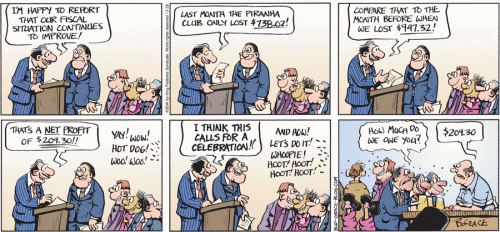
JINDAL SURPLUS SECRET

(CLICK ON IMAGE TO ENLARGE)

Murphy Painter vindicated, Jindal humiliated:

Jindal’s attempted prosecution persecution of fired Director of the Office of Alcohol and Tobacco Control Murphy Painter blew up in the governor’s face when Painter was first acquitted of criminal charges, costing the state nearly half a million dollars in reimbursement of Painter’s legal fees, but Painter subsequently won a defamation suit against his accuser.

Secret survey no longer a secret but “no one” more popular than Jindal:

A survey to measure state employee satisfaction in the Division of Administration (DOA) should be an eye opener for Commissioner of Administration Kristy Kreme Nichols and agency heads within DOA.

Meanwhile, LouisianaVoice has learned that Gov. Bobby Jindal (R-Iowa, R-New Hampshire, R-Anywhere but Louisiana) received some exciting news this week when a new poll revealed that no one was more popular among Republican contenders for the GOP presidential nomination.

The excitement was short-lived, however, when the actual meaning of the numbers was revealed.

It turns out that in a CNN poll of New Hampshire voters, Jindal tied with Rick Santorum with 3 percent, while “No one” polled 4 percent, prompting Comedy Central’s Stephen Colbert to joke that Jindal should adopt the slogan “Jindal 2016: No one is more popular.”

To shred or not to shred:

The controversy surrounding the sweeping changes being proposed for the Office of Group Benefits just got a little dicier with new information obtained by LouisianaVoice about the departure of Division of Administration executive counsel Liz Murrill and the possibly illegal destruction of public records from the Office of Group Benefits (OGB) and the involvement of at least two other state agencies.

While it was not immediately clear which OGB records were involved, information obtained by LouisianaVoice indicate that Murrill refused to sign off on written authorization to destroy documents from OGB.

We first reported her departure on Oct. 14 and then on Oct. 22, we followed up with a report that Murrill had confided to associates that she could no longer legally carry out some of the duties assigned to her as the DOA attorney.

But now we learn that the issue has spilled over into two other agencies besides OGB and DOA because of a state statute dealing with the retention of public documents for eventual delivery to State Archives, a division of Secretary of State Tom Schedler’s office.

Reports indicate that Schedler became furious when he learned of the destruction or planned destruction of the records because records should, according to R.S. 44:36, be retained for three years and then delivered to the state archivist and director of the division of Archives, records management and history.

NOVEMBER

Secret grand jury testimony of Greenstein made public:

The Louisiana Attorney General’s office, in an unprecedented move, released the 100-plus pages of testimony of Bruce Greenstein, former Secretary of the Department of Health and Hospitals but the testimony did little in revealing any smoking gun related to the state’s $180 million contract with CNSI. About the only thing to come out of his testimony was the indication of an incredible bad memory in matters related to his dealings with his former bosses at CNSI and a razor-sharp recall of other, more insignificant events.

Approval? We don’t need no stinkin’ approval:

The very first state agency privatized by Gov. Bobby Jindal was the Office of Risk Management (ORM) and after the state paid F.A. Richard and Associates (FARA) $68 million to take over ORM operations and then amended the contract to $75 million after only a few months, the agency was subsequently transferred three times to other firms. The only hitch was a specific clause in the original contract with FARA that no such transference was allowable without “prior written approval” from the Division of Administration. The problem? When LouisianaVoice made an FOIA request for that written approval, we were told no such document existed.

Edwards’ Last Hurrah:

Former Gov. Edwin Edwards, one of the most successful, colorful and charismatic politicians in Louisiana history, lost—decisively. Republican Graves Garrett rode the Republican tide to easily hand Edwards his first political defeat, dating back to his days on the Crowley City Council. Some may remember when Buddy Roemer led the field in 1987, forcing Edwards into a runoff. Technically, though, Edwards did not lose that election because he chose not to participate in the runoff, thus allowing Roemer to become governor. But he would return in 1991 to win his unprecedented fourth term.

DECEMBER

Friends of Bobby Jindal seeking donations:

A new web page popped up seeking donations for the Friends of Bobby Jindal, raising speculations of an attempt at a higher office (president?) since Jindal can’t run for governor again.

The new web page cited a speech by Jindal at a foreign policy forum at which he called for increased military spending.

Gimme the keys to the cars:

The Public Service Commission (PSC) became the second state agency (the State Treasurer’s office was the first) to openly defy Jindal when the administration demanded that the PSC relinquish possession of 13 vehicles as part of the administration’s cost-cutting measures.

We have already examined State Rep. Jerome “Dee” Richard’s attempt to cut consulting contracts which was passed unanimously by both the House and Senate but vetoed by Jindal.

But there was another veto that should be mentioned in context with Jindal’s penny wise but pound (dollar) foolish fire sale approach to state finances.

Earlier this year, State Sen. Jack Donahue (R-Mandeville) managed to get overwhelming passage of a bill that called for more oversight of the tax break programs by the state’s income-forecasting panel.

But Jindal, who never met a tax break he didn’t like, promptly vetoed the bill, saying it could effectively force a tax increase on businesses by limiting spending for the incentive programs.

Only he could twist the definition of removal of a tax break for business into a tax increase even while ignoring the fact that removal of those tax breaks could—and would—mean long-term relief for Louisiana citizens who are the ones shouldering the load. And for him to willingly ignore that fact borders on malfeasance.

Another (yawn) poor survey showing:

24/7 Wall Street, a financial news and opinion company, released a report which ranked Louisiana as the 11th worst-run state in America.

Louisiana, in ranking 40th in the nation, managed to fare better than New Jersey, which ranked 43rd, or eighth worst, something Jindal might use against Gov. Christ Christie if it comes down to a race between those two for the GOP nomination.

Louisiana had “one of the lowest median household incomes in the nation,” at just $44,164, the report said “and 10.7 percent of all households reported an income of less than $10,000, a higher rate than in any state except for Mississippi. Largely due to these low incomes, the poverty rate in Louisiana was nearly 20 percent (19.8 percent) and 17.2 percent of households used food stamps last year, both among the highest rates in the nation. The state’s GDP grew by 1.3 percent last year, less than the U.S. overall.

May we pray?

Meanwhile, Jindal prompted more controversy by having his favorite publisher and LSU Board of Supervisors member Rolfe McCollister run interference in securing the LSU Maravich Center for a political prayer event in January of 2015. The event will be sponsored by the controversial American Family Association and will not (wink, wink) be a political event, Jindal said.

And that, readers, is where we will leave you in 2014.

For 2015, we have an election campaign for governor to look forward to.

Just when you thought it couldn’t get any worse.

Read Full Post »
« Newer Posts - Older Posts »


