Feeds:
Posts
Comments

Archive for the ‘Lawsuits’ Category

MAGNIFYING GLASS

By Ken Booth

Guest Columnist 

Under the provisions of Louisiana 44:1 et seq. (The Public Records Law), should any local or state government official raise questions as to whether requested records are public, the agency’s custodian of public documents is required to notify in writing the person making the request of the custodian’s determination and the reasons, including the legal basis. Said notice shall be made within three days of the request exclusive of Saturdays, Sundays, and legal holidays (emphasis added).

The law is pretty plain. It doesn’t say “may be made,” “might be made” or “should be made” within three days. The word used was shall.

MIKE EDMONSON PHOTO

But with the introduction of the new administration, elected and appointed officials in Louisiana seem to have decided they are exempt from provisions of the state law…one of them, the head of the State Police, of all people, even having “manufactured…own loophole for denying public records requests,” as reported by Louisiana Voice. https://louisianavoice.com/2016/06/01/lsp-stakes-out-claim-that-investigations-records-are-exempt-from-public-records-law-if-no-disciplinary-action-is-taken/

Are they perhaps taking their cues from federal officials?  Within the past week, for instance, the State Department told a federal court that processing a demand for documents relating to Hillary Clinton and her aides would take as long as 75 years and would stretch “generations.”

Besides Obama, of course, Nixon, both Bushes and Bill Clinton have regularly invoked executive privilege as a means of protecting documents from public scrutiny.

What brings this to mind are a series of demands for public records recently involving three areas of significant public interest but which have either gone unacknowledged or denied or even fought with lawsuits against the public seeking the records.  That’s a mean stretch even by Louisiana’s political and corruption standards.

When the weekly Ouachita Citizen sought to follow-up on a state audit that pointed to possible payroll fraud involving a law clerk for the 4th Judicial District Court, the court’s judges balked and denied the paper’s request for disciplinary action taken against court clerk Allyson Campbell over her alleged falsification of time sheets and other public documents.

When the newspaper filed a complaint with the District Attorney, the court filed a lawsuit against the newspaper which from a financial standpoint would effectively throttle further attempts to litigate the issue.

The paper has multiple public requests in at the office of state Attorney-General Jeff Landry which have for weeks gone unanswered.

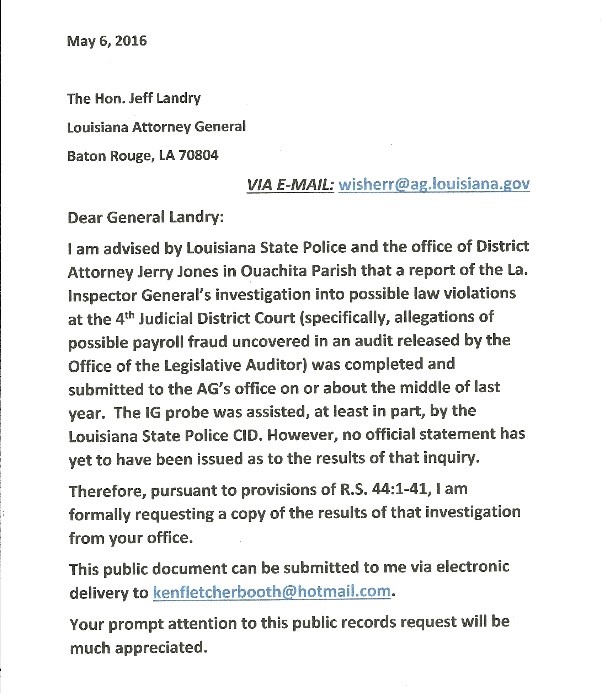
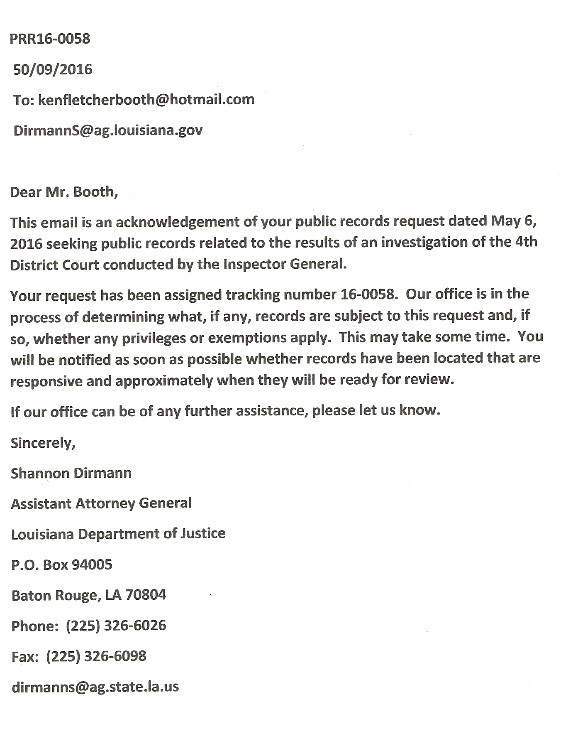
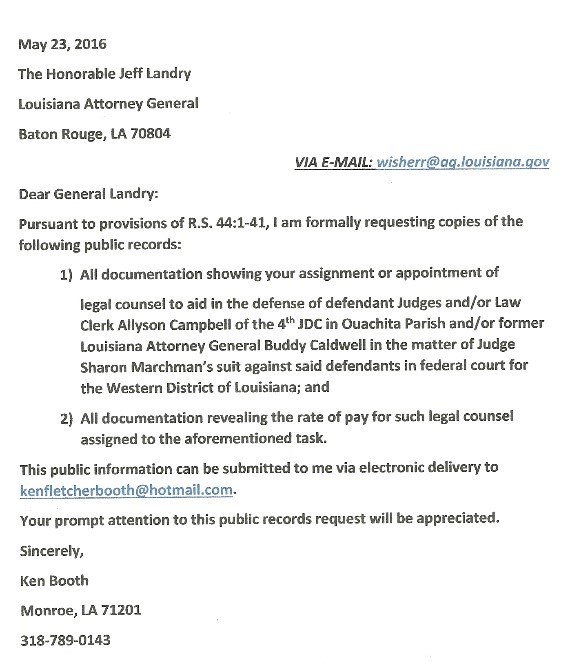
Similarly, a couple of my own requests (shown here) to the new “transparency-minded” and “aggressive” Republican Attorney-General remain without result except for one letter which said it “may take some time.”

In a June 7th E-mail to Landry’s office, I wrote: “I would very much appreciate either the documents requested sixteen days ago or an opinion from that office on why they cannot be produced. Please know this is a public records request that will not go away silently.”

Landry’s press secretary Ruth Wisher has made sure that reporters know that her boss doesn’t always return her texts. Well, that certainly makes everything hunky-dory.

BOOTH REQUEST

AG RESPONSE TO BOOTH

BOOTH FOLLOW UP REQUEST
           Known records requests to the AG’s office also demand access to a state police report on its investigation into the allegations of possible payroll fraud and destruction or concealment of court documents. A report on the findings from a companion investigation by the Inspector General’s office was released back on April 15th. The state police report is known to be in the hands of the Attorney General.

All of this is at odds with the very public Landry who has been throwing his weight around the capitol lately pushing for control of his agency’s own finances, making national headlines while trying unsuccessfully to crack down on illegal aliens, and squaring off (at least publicly) with the Gov. John Bel Edwards as if he hopes to succeed him some day.

But Landry and the 4th Judicial District Court in Ouachita Parish are not the only ones playing keep-away with public records.

LouisianaVoice has been repeatedly stymied by the Louisiana State Police with respect to sought after records.

In fact, as a recent LouisianaVoice post notes, Edmonson has manufactured his own loophole for denying public records requests after tiring, he suggests, of the public learning of “far too many instances of misconduct at LSP followed by a mindset of circling the wagons.”

Several high-profile cases of alleged improper State Trooper conduct have been determined to have been free of wrong doing and are therefore exempt  from public records laws if no diciplinary action is taken. That’s staking out a rather questionable claim by the Supertindent.

Curiously, however, his agency did release records showing payroll fraud had occurred at Troop D headquartered in Lake Charles when the lieutenant there was accused of having instructed the men under his command to pad their time sheets to reflect work that had not been performed.

Ironically, that’s the same charge investigated by the same LSP against the law clerk in Ouachita Parish, the report of which has been hidden from public scrutiny even amid growing speculation nothing will come of the charges against her or the Judges who approved her bogus time sheets. It should be noted that the Troop D lieutenant was found to have engaged in “no wrong doing” and access to any investigation findings with respect to him has been denied. However, a trooper he supervised and who figured in the padded time sheets was fired.

The Superintendent of the Louisiana State Police is appointed by the Governor with consent of the State Senate. Edmonson had—and continues to have—the support of Gov. Edwards.

Edwards is also credited with preserving through his influence, at least indirectly, the job of another Jindal administration hold-over department head, Education Superintendent John White. While White actually is appointed by the Board of Elementary and Secondary Education over which the governor has little control since most board members are elected, his stated support of White certainly didn’t hurt.

JOHN WHITE PHOTO

White, a 2012 BESE appointee, has been under considerable public fire over his steadfast defense of the Common Core program.

White has filed a lawsuit against two individuals seeking public records in five different requests from the Department of Education, presumably to block their access to dirty laundry in that agency as might be said of the lawsuit by the Judges in Monroe against The Ouachita Citizen.

Even considering Louisiana’s notorius reputation for politial scandals, suing private citizens or even the news media by government agencies has plunged the state’s standards to a new low.

As has been pointed out elsewhere the use of unlimited financial and legal resources—all paid for by the taxpayers—to block citizens with limited financial means is a dangerous threat to the very notion of checks and balances that are supposed to protect the public from abuse.

For those elected Louisiana officials to sit back and do nothing to put a stop to this unprecedented assault on the public’s right-to-know is pretty much tantamount to an endorsement of such actions.

And if the civilian public looks the other way when this kind of mess is exposed and doesn’t demand that it stop then expect the level of distrust to grow.


Read Full Post »

By James C. Finney, Ph.D.

Guest Columnist

(Editor’s Note: James Finney is one of two Louisiana citizens (Mike Deshotels is the other) who was named as a defendant in a lawsuit by State Education Superintendent John White in an effort to thwart efforts by the pair to obtain public records from the Department of Education. White has defended his action by pointing out he is not seeking monetary damages from Finney or Deshotel. He failed to mention, however, that it will cost them money from their personal funds to defend the lawsuit while White has the financial resources of the State of Louisiana at his disposal.)


Much has been written about the Student Scholarships for Educational Excellence Program, otherwise known as the Louisiana Scholarship Program, or the voucher program. To summarize: The Department of Education allows vouchers for almost any private school that wants them (or so it seems) and then performs minimal oversight.

The students are tested, but the Department works hard to make sure taxpayers don’t get to see any useful data. The program is based on a premise that it helps poor kids access private schools. But “poor” is 2.5 times the poverty level which, for a family of four, means an annual income of $59,625 is low enough to put a kid in a private school at taxpayer expense. And, of course, the state refuses to release any data about how many children are at which ends of that range of income. And the point is, allegedly, to allow kids to escape failing public schools.

Never mind that the students may have never attended a public school. Ever.

But this post isn’t about that voucher program. It’s about the sneaky alternative that funds private schools by way of tax rebates. The Tuition Donation Rebate Program allows donors to fund private school tuition and recoup most of that donation as a tax rebate.

As might be expected, there are middlemen taking their cut of the money. At the beginning of the program, there was only one such organization—Arete Scholars Louisiana. The registered agent, Gene Mills, he of the Family Forum, has apparently neglected the paperwork required to keep charter 41200779N active with the Louisiana Secretary of State.

Mills, founder of Louisiana Family Forum, was the centerpiece of an extraordinary post by Jason France on his Crazy Crawfish blog in October 2012. https://thecrazycrawfish.com/tag/louisiana-family-fourm/

Founded in 1998, Louisiana Family Forum included as its “Independent Political Consultant” and “Grassroots Coordinator,” former State Sen. Dan Richey. http://www.lafamilyforum.org/about/

As an example of the family values for which Family Forum supposedly stands, Richey, while serving as a state senator from Ferriday in the 1980s, gave his allotted Tulane scholarship to a Caddo Parish legislator’s daughter in exchange for that legislator’s awarding of his scholarship to Richey’s brother as a means of circumventing the informal prohibition against giving the scholarships to immediate family members.

Superintendent John White’s Department of Education, with the approval of the Board of Elementary and Secondary Education (BESE), thought it was critical that there be multiple organizations available to help people support private education rather than pay taxes. So they gave grants of up to $499,750 to ACE Scholarships Louisiana (charter 41590796K) and up to$500,000 for New Schools for Baton Rouge Excellence Scholarship Fund (charter41726088K) so that these limited-liability corporations could each set up their business of accepting donations, funneling them to private schools, and providing the documentation required for the donors to get tax rebates from the Louisiana Department of Revenue.

According to the Louisiana Nonpublic School Choice 2015 Annual Report, which was submitted to BESE but not accepted, the tuition donation rebate program started in 2013-14 with Arete.

Arete’s 2013-14 Arete’s 2014 Annual Report indicates that the organization disbursed 14 scholarships, worth a total of $60,975.02, and all funded by the Atlanta Falcons.

No, that’s not a typo: Those Atlanta Falcons. That amount was confirmed by the Louisiana Department of Revenue: One unnamed taxpayer was issued a rebate in the amount of $60,975.02 in tax year 2014.

According to the state’s 2015 annual report cited above, there were two Student Tuition Organizations active in 2014-15: Arete and ACE. Arete’s 2015 Annual Report confirms the number of scholarships reported by the state, 50, at 24 schools, with a total value of $180,381, while ACE Scholarships Louisiana LLC’s 2015 Annual Report reports 13 scholarships, three schools, and a total of $40,780.67.

The donors of note on Arete’s annual report include the Atlanta Falcons, Chik-fil-A, James Garvey and several other individuals. ACE’s donors were David George and Edward Rispone. According to the Louisiana Department of Revenue, the total of rebates awarded in 2015 was $101,659.85, and they ranged in size from $950 to $47,105.

The numbers exploded in 2015-16, though, especially for ACE.  The state’s voucher report indicates that Arete awarded (as of March 2016) 205 scholarships at 50 schools, ACE awarded 558 scholarships at 77 schools, and New Schools awarded 13 scholarships at four schools. The names of the schools, donors and dollar amounts likely won’t be available for several months, however.

The targets for total scholarship awards (remember those half-million dollar contracts a few paragraphs above) were 1,000 for this year and 1,250 for 2016-17 (ACE) and 75 and 125, respectively for New Schools. So apparently New Schools aimed low and shot lower. Perhaps that’s a good thing, in that taxpayers will see less revenue diverted away from the state’s coffers. On the other hand, this spreadsheet indicates that, as of the end of 2015, New Schools had already collected $300,000 on its contract, and ACE had already collected $249,874.98.

It’s interesting what a person can learn from availing themselves of their rights under Louisiana’s public records law (Title 44).

Read Full Post »

It seems that certain state officials are finding a new means of discouraging Louisiana citizens from seeking information about the way the public’s business is being conducted. This new tactic is nothing less than a form of official harassment that is both chilling and dangerous.

Transparency and accountability in government are currently hot news topics. Last week (May 26), a local Baton Rouge group, Leaders with Vision, held a lunch meeting and discussion with the theme, “Are Louisiana Sunshine Laws adequate in today’s 21st Century World?” Participants included Sen. Dan Claitor; Rep. Dee Richard; Former Baton Rouge Advocate Executive Editor and transparency advocate Carl Redman and LouisianaVoice Editor Tom Aswell.

Both the state and the federal government recognize the need for transparency in the democratic process. Louisiana passed the Louisiana Public Records Act, also known as Louisiana’s Sunshine Law, in 1940 – more than 25 years before President Lyndon Johnson signed the federal Freedom of Information Act (FOIA) in 1966. Anyone can request public records and the purpose of the request does not need to be stated. In fact, the custodian of the record is not allowed to ask the purpose. The major exemptions are pending criminal litigation; juvenile status offenders; sexual offense victims; security procedures; trade secrets; and some public employee information.

Unfortunately, not everyone in government agrees with the concept of transparency and accountability. We have public officials suing constituents in an obvious effort to prevent them from accessing public records. Two recent examples follow.

On May 27, A LouisianaVoice REPORT revealed that several judges in the 4th Judicial Circuit Court filed a lawsuit against The Ouachita Citizen and Publisher Sam Hanna, Jr to prevent the publication from seeking public records to which they were legally entitled. In this case, judges are suing a publication to prevent them from accessing public records concerning the court operation and their presumably dirty laundry.

Now we find that closer to home, John White has likewise filed a LAWSUIT against Mike Deshotels and Dr. James Finney over public record requests that they made to the Louisiana Department of Education (LDOE) – most likely because they have hit a nerve.

On May 31, 2016, Dr. James Finney detailed the history of the suits in a letter to the Governor, John White, the Louisiana Board of Elementary and Secondary Education (BESE) members, and various state staff how the lawsuit came about:

As you may recall, I sent you an email March 12 (attached below) describing the status of several pending record requests that I had placed with John White and the Department of Education.  I also mentioned the existence of a lawsuit (Finney vs White, 6395333, attached).  That lawsuit, which was filed May 22, 2015, was set for trial in late April.

However, on April 11, Mr. White’s attorney requested and was granted a continuance, presumably to become better prepared for trial and to resolve a scheduling conflict with the Department’s sole witness.  Rather than prepare for trial, however, it seems that Mr. White instead instructed his attorney to file two lawsuits against me which appear to be groundless, unnecessary, and against the public interest. Meanwhile, Mr. White and his staff have made no effort to address the 35 pending requests which are subject of my lawsuit.

The first new lawsuit (White vs Finney, 647827, attached) addresses five requests I made in fall 2015, five that I made in February of this year, and one that I made in March. In the lawsuit, Mr. White apparently is asking the judge to create special conditions on Louisiana’s public records law. It seems that, for whatever reason, Mr. White is bending over backward to make sure the public has no idea what statistical distributions LEAP, iLEAP, or EOC test scores follow.  Are they symmetric?  Skewed?  Bimodal? Uniform?  Nor does he, it seems, wish the public to have any means of verifying that School or District Performance Scores have been fairly and accurately calculated.

The second new lawsuit (White vs Deshotels et al, 647953, attached) attempts to reverse favorable judgments Mr. Deshotels received in two prior lawsuits, and apply that reversal (which seems unlikely given that the 19th JDC is not an appellate court) to a subsequent request by Mr. Deshotels and also to one of my requests.  He seeks to use Mr. Deshotels and I as pawns, and cost us additional time and money, to establish a data-suppression policy that was already soundly rejected at court.

I have repeatedly requested meetings with Mr. White and/or his staff to work out arrangements that allow the public to have access to important public records without compromising student privacy nor causing the Department undue burden. I have consistently been rebuffed. And now we’re tangled in litigation in three different divisions of the local district court.

Most of my requests to date, and all that are subject to litigation thus far, could be collected into the following six categories. I trust you would consider these all to be important and of potential public interest:

  • calculation details regarding Value-Added Modeling as performed by the Department
  • voucher programs’ exact enrollments and costs, and demographics of voucher students
  • test-score distributions and technical reports
  • details of School and District Performance Score calculations adequate to verify accuracy and credibility
  • charter schools’ enrollments, charters and leases, and other information
  • exact enrollment numbers with no more suppression than is absolutely required to protect the anonymity of an individual student

I urge you as a body to ask Mr. White to defend his position regarding data secrecy, and his preference for litigation over useful dialogue. Is the department in service to the public, or to test-creators, charter networks and private schools? Have the school grades and Value-Added measures been calculated fairly?  How will we ever know? Is Southern politeness more important than democracy? Is it appropriate to sue citizens rather than responding properly to public record requests?  Please ponder those questions carefully, and provide the appropriate guidance to the Superintendent who is employed at your pleasure.

Thank you.

Dr. James Finney

As one might expect, the suits against Deshotels and Finney are funded by you, the taxpayer, as the LDOE has brought the suit using LDOE funds. Deshotels and Finney are on their own when it comes to legal fees related to these suits. Just to be clear:  You are covering the costs for John White to sue private citizens to prevent them from exercising their constitutional rights.

Of course, Deshotels and Dr. Finney intend to pursue the suit in the courts, rather than ask for a dismissal, to press forward on their requests to this public information that is critical to determining the impact of various policies on our children’s education and the efficacy of the charter experiment in Louisiana. (Remember the last time the government experimented in the south? It happened at Tuskegee.)

As Mercedes Schneider recently noted in her blog deutsch29, “Suing private citizens over public record requests is a new low for an already sorry excuse of a state superintendent. However, it seems that with White, no low is too low.” https://deutsch29.wordpress.com/2016/05/31/la-superintendent-john-white-sues-citizens-who-made-public-records-requests/

The use of virtually unlimited financial and legal resources (at taxpayer expense, no less) to beat down citizens with limited funds to fight back poses an unprecedented and dangerous threat to the very checks and balances upon which our government is founded.

When will Governor Edwards tire of this excuse for a superintendent and encourage the BESE board to bring John White’s tenure up for a vote? Let’s get the BESE members on record as to whether they stand for Louisiana’s children or for the out-of-state interests that bought their seats. Let’s decide, once and for all, if BESE stands for accountability or for secrecy.

For Edwards, the Legislature, and BESE to sit back and do nothing about this infringement upon the public’s right to know should be seen as an endorsement of clandestine activity worthy only of our distrust and fear.

Read Full Post »

Editor’s note: Just when you think good, old-fashioned investigative reporting has gone the way of LINOTYPE MACHINES and hot lead typesetting, the Baton Rouge Advocate conducts a thorough probe of operations at the Louisiana State Penitentiary that has resulted in a wave of resignations if no indictments.

And then there is a twice-weekly publication up in West Monroe called The Ouachita Citizen headed by Publisher Sam Hanna, Jr. His paper’s ongoing investigation into the Fourth Judicial District Court is making a lot of people very uncomfortable and with good reason. So uncomfortable, in fact, that several judges in the 4th JDC actually filed a lawsuit against Hanna and The Citizen to prevent the publication from seeking public records to which they were legally entitled. Such action by the judges is unprecedented and appears frighteningly Nixonesque in its brazen attempt to thwart legitimate efforts to inform the citizens of Ouachita Parish. It’s the kind of action that should send chills down the spine of the electorate. Hanna has vowed to refuse to pay court costs assessed in that litigation. He has lost advertising revenue as a result of his coverage of the court.

Following is a lengthy story by Citizen reporters Zach Parker and Johnny Gunter published yesterday (Thursday, May 26) by the paper. One major point raised is the apparent conflict of interest in the Attorney General’s office conducting an investigation of the 4th JDC while at the same time defending four of the judges in a lawsuit brought against them by a fifth judge.

By Zach Parker and Johnny Gunter

The Citizen

Inquiries by The Ouachita Citizen into Fourth Judicial District Attorney Jerry Jones’ involvement in an investigation of Fourth Judicial District Court show the district attorney offered a false account of his communications with investigators, filed misleading court documents and did not refer this newspaper’s criminal complaint to authorities involved in the investigation.

Those activities formed part of Jones’ efforts to downplay the investigation into possible wrongdoing at the court as well as his involvement in the probe.

The investigation concerned allegations that law clerk Allyson Campbell committed payroll fraud and destroyed or concealed court records. Those accusations also are the focus of separate lawsuits, one filed in district court by Monroe businessman Stanley R. Palowsky III and the other in federal court by Fourth Judicial District Court Judge Sharon Marchman.

Jerry Jones restricts probe’s scope

In July 2015, Jerry Jones called on the Office of State Inspector General and Louisiana State Police to investigate public corruption. At that time, he was tight-lipped about the scope of the investigation, at first refusing to comment though he later clarified the investigation concerned Fourth Judicial District Court.

As revealed in comments to The Ouachita Citizen as well as to other media outlets, Jerry Jones restricted the scope of the investigation to an audit of the court’s finances released March 2, 2015 by the Louisiana Legislative Auditor’s Office. That audit said some court employees may have earned pay for hours not worked. As first reported by The Ouachita Citizen and later confirmed in open court, Campbell was the subject of auditors’ comments.

However, there were other allegations concerning Campbell that Jerry Jones sidestepped during interviews, repeatedly claiming the probe concerned the audit only. During interviews, he downplayed any outcome of an investigation into payroll fraud since Campbell was a salaried employee, not hourly, in spite of the allegations concerning falsified time sheets approved by court judges.

In March 2015, Ouachita Citizen reporter Johnny Gunter submitted a criminal complaint to Jones’ office, asking the district attorney to investigate not only allegations that Campbell had committed payroll fraud but also accusations by Palowsky and Monroe attorney Cody Rials that Campbell had destroyed or concealed documents they had filed with the court in their separate legal matters.

Little more than a week before the Inspector General and State Police launched their joint investigation, The Ouachita Citizen learned Jones had not begun an investigation, requested any documents or information from court officials in response to the newspaper’s criminal complaint.

Through The Ouachita Citizen‘s inquiries and reports, more details emerged concerning the scope of the court investigation. In a June 30, 2015 interview, retired Judge Ben Jones, who is the court’s administrator, informed The Ouachita Citizen that he had discussed the newspaper’s criminal complaint with Jerry Jones.

“He (Jerry Jones) indicated to us (the court) that he would respond to your criminal complaint and take appropriate action at such time that he thought appropriate,” Ben Jones said. “We are prepared, should he act on that criminal complaint, we are prepared to cooperate, and that’s what we’ll do. But at this point, he has not asked us for any information, any documents, or initiated any investigation.”

During that interview, Ben Jones repeatedly said Jerry Jones would conduct an investigation into the matters raised by The Ouachita Citizen‘s criminal complaint “with integrity” and would show court officials no special privileges.

Ben Jones was one of five district court judges named defendants along with Campbell in Palowsky’s lawsuit. In his lawsuit, Palowsky accused Ben Jones and judges Carl Sharp, Wilson Rambo, Fred Amman and Stephens Winters of covering up Campbell’s activities, a claim reiterated in Marchman’s lawsuit in U.S. District Court.

In the district attorney’s interviews with the press, Jerry Jones said the investigation into the court did not involve any judges.

Jerry Jones gives false account of communications with investigators

The Ouachita Citizen learned Jerry Jones concealed his communications with investigators as well as offered the newspaper conflicting accounts of a report on the investigation’s findings.

When asked in an April 25 interview whether he had engaged in any communications with the Inspector General or the State Police concerning the investigation, he said, “No. None at all.”

The District Attorney further distanced himself from the investigation at that time and said, “I haven’t had any communication with them other than having my assistant ask (Inspector General) Stephen Street about the status of the report,” referring to whether a report had been prepared on any findings in the court investigation.

He made that statement to the newspaper in spite of the fact that his office had received a letter from Street 10 days before, a letter which represented a report on the investigation’s findings. Street’s April 15 letter claimed there was no “sufficient cause” to file criminal charges against Campbell on the accusations of payroll fraud or document destruction was first reported by The Ouachita Citizen. According to that letter, Street was concluding his office’s investigation into the matter.

“Because the available facts do not provide sufficient cause for the arrest of Ms. Campbell for any criminal offense, we are closing our file and taking no further action on this matter,” Street wrote. “Ms. Campbell was interviewed and denied destroying or hiding any court records or pleadings. She stated that her work schedule was approved by her supervisor and that she worked the hours for which she was paid. Judge Carl Sharp supported her claim that all court documents were always available to him. He also confirmed that Ms. Campbell was a salaried employee whose hours were sometimes irregular.”

In a May 11 interview, The Ouachita Citizen asked Jerry Jones why he had misinformed the newspaper by saying he’d had no communications with investigators though he’d received the April 15 letter from Street. In response to that query, he again denied he had engaged in any communications with investigators.

The Ouachita Citizen then asked Jerry Jones about his written correspondence with Street: He declined to comment, saying he couldn’t answer that question and had referred his office’s investigation to the Attorney General’s office.

The Ouachita Citizen then informed him that the newspaper had obtained a copy of the April 15 letter revealing correspondence between Street and Jerry Jones on the investigation, at which point the district attorney paused and then said, “Okay, I made a mistake. You’re not getting another word out of me.”

Throughout the investigation Jerry Jones sought to distance himself from the court probe though the Inspector General’s letter as well as The Ouachita Citizen‘s inquiries to State Police all referred to the district attorney’s involvement. According to the newspaper’s inquiries, he was calling the shots in the investigation though he said he wasn’t investigating and didn’t have the manpower in his office to conduct such an investigation.

“We keep it separate,” he said in the April 25 interview. “I’m not investigating.”

Following The Ouachita Citizen‘s May 11 interview, Jerry Jones informed the newspaper that State Police had completed a written report that contradicted the findings revealed in Street’s April 15 letter. He said he would ensure the newspaper was provided with a copy of the State Police report he claimed existed.

The Ouachita Citizen submitted an inquiry and a public records request to State Police about the purported report, asking to obtain a copy. However, State Police authorities informed the newspaper that Jerry Jones had told them the investigation should be considered open, a status that would bar the release of documents pertaining to the investigation, including the unseen State Police report.

According to a May 11 statement from State Police spokesman Maj. Doug Cain, State Police investigators were awaiting clearance from Jones to release the investigative report.

Later that day, State Police informed The Ouachita Citizen that record would not be released, per instructions from Jerry Jones.

“The district attorney for the 4th JDC is awaiting additional information and the matter is considered still open at this time,” wrote Michele M. Giroir, State Police attorney supervisor in a May 11 email. “Therefore, pursuant to R.S. 44:3(A)(1), the records are exempt from disclosure at this time.”

Records dispute DA’s claim he transferred case to AG

Since early last year, Jerry Jones has repeatedly told The Ouachita Citizen he was not investigating but had referred that responsibility to the Attorney General’s office.

“You people keep saying I’m investigating, but I’m not,” he said. “I sent that to the AG’s office.”

At that time, Buddy Caldwell was Attorney General and had appointed a taxpayer-paid defense for Campbell in spite of questions raised by The Ouachita Citizen about the legality of that appointment. Caldwell’s involvement in the defense of Campbell later was cited as grounds for naming him a defendant in Marchman’s lawsuit.

In support of his claim he had transferred the responsibility of investigating to the Attorney General, Jerry Jones produced last year a motion to recuse he had filed at the Ouachita Parish Clerk of Court’s office in the court record for Stanley R. Palowsky III v. W. Brandon Cork and others, the lawsuit in which the allegations against Campbell first surfaced.

His Dec. 5, 2014, Motion to Recuse said, “Now into this Honorable Court comes Jerry L. Jones, Fourth Judicial District Attorney, who, with respect, represents: The District Attorney recuses himself and his office in the above captioned case and moves that same be sent to the Attorney General’s Office.”

However, Jerry Jones’ motion to recuse has laid untouched in the court record and was never sent to the Attorney General’s office, according to Ouachita Parish Clerk of Court Louise Bond.

Earlier this week, The Ouachita Citizen asked to review the court record for Palowsky v. Cork, which is secured in Bond’s office since, she said, it’s a “high profile case” and she did not want any parties claiming their documents had gone missing from it, referring to accusations from Palowsky that Campbell had either destroyed or concealed documents he filed in that same case.

After a review of the record by Bond and The Ouachita Citizen, there was no indication that Jerry Jones’ motion to recuse had ever been sent to the Attorney General’s office.

“I don’t see anything that shows we sent anything, but there’s nothing on there that shows where it should be sent,” she said.

Bond confirmed with her deputy clerks that the DA’s document had not been sent there. It hadn’t been sent because Jerry Jones’ document didn’t indicate who or where the motion should be sent, though it asked the Clerk of Court’s office to handle the matter.

“I checked and nothing was sent,” Bond said. “But there’s nothing on here showing us who at the Attorney General’s office should receive it or where even to send it.”

Bond told The Ouachita Citizen that the deputy clerk, B.J. Graham, who accepted Jerry Jones’ filing no longer worked at the Clerk of Court’s office. Graham had quit, according to Bond.

According to Bond, normally a mover in a legal matter will either indicate they have sent copies of the filing to other parties in the matter. If the filing does not bear the name, address or contact information of the person it should be sent to, like the DA’s filing, then the mover will attach a cover sheet with instructions, Bond said.

“Most of the time they say please serve to so-and-so, or it shows that they’ve already sent copies, but there are no instructions, either on a cover sheet or on the motion itself,” Bond said.

Jones’ motion to recuse was later signed as a judicial order by Judge Carl Sharp: “It is ordered that the Fourth Judicial District Attorney’s Office is recused from the above captioned case and same be sent to the Attorney General’s Office.”

Sharp is a defendant in both Palowsky’s and Marchman’s lawsuits. He is accused of covering up Campbell’s activities. Sharp also is one of the judges for whom Campbell clerks. Additionally, Sharp defended Campbell against the payroll fraud allegations during an interview with Inspector General investigators, according to Street’s letter.

Jerry Jones’ motion to recuse and Sharp’s order are available for viewing at www.ouachitacitizen.com

The Ouachita Citizen contacted the Attorney General’s office on numerous occasions, through telephone and email, to ask whether they had received any correspondence from Jerry Jones, including his recusal. Attorney General spokesperson Ruth Wisher suddenly ceased all communications with The Ouachita Citizen last week in spite of earlier pledging to answer the newspaper’s questions by Thursday, May 19. Attorney General Jeff Landry and Assistant Attorney General Shannon Dirmann also did not respond to communications from The Ouachita Citizen.

Two days after the Attorney General office’s last communication with The Ouachita Citizen concerning its questions, Landry’s office filed a pleading in Marchman’s federal lawsuit on behalf of Caldwell, the former Attorney General and defendant in the judge’s lawsuit.

Absence of investigation a key point in public records dispute

The Ouachita Citizen recently learned Jones did not refer the newspaper’s criminal complaint to some authorities investigating the court. Inspector General Stephen Street said state law protecting Inspector General records meant he could not reveal whether Jerry Jones had sent his office the newspaper’s criminal complaint or not.

“Due to OIG (Office of Inspector General) statutory confidentiality, I am unable to confirm or deny the receipt of the complaint to which you refer,” Street wrote in an email.

However, State Police did not receive the newspaper’s criminal complaint, according to Cain, the State Police spokesman.

“We are unaware of any complaint from The Ouachita Citizen through the DA’s office,” Cain said.

The Attorney General’s office did not respond to questions from The Ouachita Citizen about whether Jerry Jones had sent them this newspaper’s criminal complaint.

The Ouachita Citizen‘s criminal complaint was prompted by the district court’s refusal to produce public records from Campbell’s personnel file that could shed light on the allegations of payroll fraud and document destruction. The day after The Ouachita Citizen submitted its criminal complaint, the court sued the newspaper, asking for an ad hoc judge to determine whether Campbell’s right to privacy outweighed the public’s right to know.

In spite of The Ouachita Citizen submitting its criminal complaint with Jones in March 2015, there was no investigation called to target the court until after an ad hoc judge had ruled against this newspaper, declaring Campbell’s personnel file off-limits to public records requests.

During a court hearing before the ad hoc judge, The Ouachita Citizen argued the public should be granted access to Campbell’s personnel file since its public records requests – stemming from the allegations of payroll fraud – concerned public tax dollars (referred below as the “public fisc”). In response, the court argued there was no need for judicial intervention to make Campbell’s personnel file available to the public since the district attorney could exert his office’s authority to investigate if there were any reasonable grounds present in the newspaper’s criminal complaint.

Delivering the court’s argument was Monroe attorney Jon Guice, who also represented the five district court judges in Palowsky’s lawsuit and is a defendant in Marchman’s lawsuit.

“The response to his argument about the protection of the public fisc is it is handled by the law and you need not intervene in that,” Guice continued during the May 19, 2015 hearing on the public records requests. “His client (The Ouachita Citizen) is well aware that the legislative auditor sent a copy of its findings to the district attorney.

“They have also asked the district attorney to avail himself of that report and to do his duties to investigate, and if there is an issue there for him to address it. So, this court need not feel as though it has a duty of protection of the public fisc when there is an expressed officer, i.e., the district attorney who the legislative auditor has provided its findings and whom the paper has asked to honor his obligation. So if there is something there then that’s the way that is to be handled.”

After the ad hoc judge ruled against The Ouachita Citizen, details in Palowsky’s and Marchman’s lawsuits have suggested Guice, Ben Jones, the court administrator, and other court officials manipulated the documents present in Campbell’s personnel file before the ad hoc judge reviewed it to determine whether it was subject to The Ouachita Citizen‘s public records requests.

Jerry Jones later told The Ouachita Citizen he had agreed with Ben Jones to postpone acting on The Ouachita Citizen‘s criminal complaint until after the ad hoc judge had ruled in the court’s case against the newspaper.

When Ben Jones was asked about that arrangement during a June 30, 2015 interview, he said, “I am not prepared to say I had any agreement with Jerry Jones to wait until after the final judgment but he has elected, obviously, to delay any action until, I mean, to my knowledge, no action has been taken so far.”

“I have no idea when any action might be taken, but I take him at his word that he will respond to the complaint, and he has indicated that he would honor his obligation to respond to the complaint,” Ben Jones continued. “That’s all I can tell you about that. I have talked to him, but I’m not at liberty to say everything about that conversation.

“But I will say this to you. I know Jerry Jones and I am convinced that any investigation that he initiates will be one done with integrity. I absolutely believe that to be the case. He will go wherever the findings take him. That’s how he is, and that’s a good thing. It is our expectation that he will show us no special privileges or special deference. I expect him to respond to the request that he investigate with integrity, and I don’t fear that at all.”


Read Full Post »

By Ken Booth and Zach Parker

More than 28 months ago, then-Deputy Administrator of Louisiana’s 4th Judicial District Court Julie Cunningham raised flags about senior law clerk Allyson Campbell’s sometimes prolonged absences from work while still being paid based upon time sheets proclaiming her presence.

Those time sheets were submitted to and approved variously by judges Wilson Rambo, Fred Amman, or Wendell Manning among others for whom she may have been clerking at the time.

But an inspection of Campbell’s time sheets and e-mails revealed that on seven different days Campbell was paid for hours not worked. On one of those days, she had sent an email from her I-Phone from New York where she reported having been “bumped to 9 AM Tuesday.”

The Ouachita Citizen reports video surveillance footage for that Tuesday, Feb. 4, 2014, shows Campbell was never at the courthouse. But the New York number was crossed out and the seven hours were carried from a row for “total hours worked” to a row for “annual leave used.” Judge Wendell Manning signed off on that time sheet as well as sheets on two other days when Campbell had reported working seven hours.

Cunningham’s report outlined at least 12 days in which there were questions about Campbell’s work attendance.

At the time, court officials researched the issue and determined it was “illegal for a public employee to be paid for time not worked,” according to Judge Sharon Marchman in a lawsuit later filed against her fellow judges in federal court.

But a week after the Cunningham report was discussed at “several meetings” Marchman said the court changed its work attendance policy requiring “all law clerks” to sign in and out each time they enter and leave the courthouse.

Judge Marchman’s federal suit contends, “notably, shortly after the new rule’s implementation, Campbell refused to comply and falsified her sign-in-sheet.”

A subsequent routine state audit issued early last year cited possible payroll fraud in the matter.

In the meantime, Campbell’s time card issues and alleged destroyed or hidden court pleadings in a civil action handled by the law clerk came to light in a civil lawsuit filed by an attorney who claimed her actions had thwarted efforts on behalf of his client. Specific records cited were later discovered being used as an end table and under a couch in Campbell’s office; others were believed shredded and carried to a dumpster located between the courthouse and its annex.

The Ouachita Citizen filed a public records request with the court seeking any and all documents purporting to show what if any disciplinary action may have been taken against Campbell in connection with these allegations. The court refused to turn over the documents claiming they were private, personal, and could cause among other things, “embarrassment” to the individual and/or “loss of friends.”

The Court refused to turn over any such documents claiming it would violate the privacy of Campbell. The newspaper responded with a criminal complaint to the District attorney claiming a violation of La. R.S. 44: 1-41, the Public Records Act.

The court refused to turn over the documents claiming they were private, personal, and could cause among other things, “embarrassment” to the individual and/or “loss of friends.” Then, perhaps hoping to put a lid on all this, the Court sued The Citizen, making it a costly proposition to continue its pursuit of the issue.

Let that sink in. The court filed suit against a newspaper for making a routine public records request.

If there were true justice in the 4th JDC, the suit would have been randomly assigned to Judge Marchman. But what do you think were the chances of that happening?

Citizen Publisher Sam Hanna, Jr., told LouisianaVoice that his publication had been assessed court costs in the lawsuit but he has no intention of paying them. “They can come arrest me if they want, but I’m not paying court costs on this matter,” he said.

Putting things in perspective, it’s more than a little ironic that judges who are charged with forcing other public agencies to comply with public records requests can exempt themselves from those very same laws, thereby setting a dangerous legal precedent that can only breed deep distrust of all public officials, particularly the judiciary itself.

And we haven’t even touched on the blatant message of arrogance and smugness such a lawsuit conveys.

The Citizen may never have received an answer but Marchman’s federal lawsuit against the judges last month may have provided it.

Her petition reads:

            “On April 24,2014, the judges had a meeting and agreed en banc to remove Campbell from the position of ‘senior law clerk, to terminate her stipend, and to suspend her for one month without pay. Campbell was then given a warning and a reprimand regarding not only her attendance, but also her behavior during meetings with the human resources department.”

According to Marchman’s suit, it was during Campbell’s suspension in May of 2014 that 52 files which required Campbell’s attention were found underneath a couch in her office. At issue were Post Conviction Relief applications given to Campbell to address by Judge Carl Sharp. The oldest of these discovered documents was dated November 2, 2011, three years before.

Louisiana’s Inspector General Stephen says an investigation by his department along with detectives from the state police found nothing wrong with the work hours of a law clerk for the 4th Judicial District Court.

A state audit had pointed to possible payroll fraud when an inspection of time sheets revealed the chief law clerk had turned in time sheets for work on days she was not even at the courthouse. Those time sheets were approved by her supervising judges.

The allegedly falsified Campbell time sheets, said to have been borne out by courthouse security camera video showing she was a no-show there on the questioned ‘work days,’ and a subsequent allegation of cover-up by four Ouachita Parish District Court Judges, prompted a fifth District Judge, Sharon Marchman, to file a federal court lawsuit against all of them for retaliating against her for “trying to expose Campbell’s history of payroll fraud and document destruction” while acting under color of law.

Whether Marchman was aware is not known, but state Inspector General Stephen Street had by then already decided interviews his office had conducted at the courthouse led him to conclude “the available facts do not provide sufficient cause for the arrest of Ms. Campbell for any criminal office, [and] we are closing our file and taking no further action in this matter.”

In his letter to Ouachita-Morehouse Parish District Attorney Jerry Jones on April 15th, Street outlined how “several 4th Judicial District Judges, as well as other local attorneys, the current and former court administrator, employees of the Clerk of Court, (Louise Bond),” and other court employees and assistants as well as Campbell herself. Campbell, he wrote, had denied destroying or hiding or destroying any court records or pleadings.”

Street mentioned only that interviews had been conducted with the principals to the complaint and all had assured that nothing improper had taken place with respect to Campbell’s being paid based upon the time cards that tended to contradict that.

It is not clear from Street’s letter whether his investigator ever saw any documentary evidence supporting the original allegation of payroll fraud.

District Attorney Jones at the outset referred the allegations of wrong-doing to the state police who wound up working in concert with the OIG’s north Louisiana investigator, Heath Humble.

Since then, the DA has consistently referred all questions regarding the status of the case to the office of the Louisiana Attorney General, Jeff Landry.

Accordingly, a public records request for documentation or any statement regarding the status of the investigation long since closed by the local and state investigators was answered by Shannon Dirmann, an Assistant Attorney General who wrote on May 9th: “Our office is in the process of determining what, if any, records are subject to this request, and, if so, whether any privileges or exemptions apply. This may take some time. You will be notified whether records have been located and are responsive.” In other words, ‘we’ll get back to you.’

Interesting indeed, since Joseph Lotwick, the General Counsel for the Attorney General’s office had answered a similar records request on May 10—one day later—from LouisianaVoice with “I have enclosed a copy of the Inspector General’s April 15, 2016 letter to District Attorney Jerry Jones as it is a public record.”

“I trust that this response is sufficient.”

When a copy of an attorney’s lawsuit against Campbell was requested, it was learned it had been sealed.

In response to our own public records request the court administrator Judge Ben Jones, himself one of the defendants named by Marchman’s suit, produced a document showing Campbell has been awarded steady pay increases in spite of questions regarding her actions.

In the Ouachita court case there is documentation which appears to demonstrate false claims of work not performed, the hiding of at least 52 post-conviction release pleadings, and/or official court documents allegedly shredded or otherwise destroyed.

District Attorney Jones said he may have the official findings of the Louisiana State Police investigation this week.

That could prove embarrassing for either virtually the entire bench of judges at the 4th JDC should detectives actually detect payroll fraud has been committed—or for the LSP itself should that report find no wrongdoing took place.

That’s because it would fly directly in the face of LSP’s own actions taken against Lt. Paul Brady of Troop D in Beauregard Parish who his own agency determined had “padded time sheets” submitted by troopers under his supervision.

He was officially suspended for violation of the code of conduct and ethics, albeit only a near-meaningless 24-hour suspension. https://louisianavoice.com/2016/05/10/rank-and-file-lsp-display-more-integrity-than-supervisors-how-long-will-gov-edwards-tolerate-edmonson-liability/

LouisianaVoice cited at least five state troopers on May 10th who said Brady instructed them to pad their time sheets to reflect 12 hours even though they worked shorter shifts or were not even on duty.

One trooper told Internal Affairs that Brady tried coaching him on what to say if someone asked about the time. The Trooper reportedly informed Brady that he was not going to lie.”

The Brady suspension letter stated, “You signed the … timesheets knowing that they had worked less hours. You signed the … described biweekly timesheets knowing that the hours related to firearms transition were not accurate.”

Moreover, Chris Guillory, the Commander at Troop D who was Brady’s supervisor and who was transferred out of Troop D is said to have been aware of Brady’s padding of time sheets but took no action.

One would hope those 4th District Court Judges who approved their law clerk’s time sheets for work on days on which she was not present are paying attention. The events at Troop D amounted payroll fraud which in other (apparently selective) cases have resulted in criminal charges.

But Campbell has friends, or rather, relatives in high places which most likely makes the judges hesitant to come down on her. A sister is a prominent personal injury attorney in Monroe and their father is a powerful banker who is married to the daughter of politically active attorney Billy Boles.

So why else would we imply that criminal charges for payroll fraud are selective? Simply this:

https://louisianavoice.com/2016/03/13/dcfs-funding-slashed-necessitating-driveway-visits-but-overworked-caseworker-is-arrested-for-falsifying-records/

As they used to say in those “This-is-your-brain; This-is-your-brain-on-drugs” TV ads:

Any Questions?


Read Full Post »

« Newer Posts - Older Posts »