Feeds:
Posts
Comments

Archive for the ‘Lawsuits’ Category

Only in Louisiana.

A lawsuit filed in 23rd Judicial District Court in Ascension Parish challenging the legality of the proposed approval of $450 million in industrial tax exemptions raises two immediate questions:

  • What are Projects Magnolia, Zinnia, Bagel and Sunflower/Sunflower Seed?
  • Why is the Ascension Parish Council being so secretive about the true identities?
  • Why did the Ascension Parish Council’s Finance Committee not follow the law in considering the proposed tax exemptions?
  • Most important of all, what is the Ascension Parish Council trying to hide?

These are all questions to which plaintiffs Dr. Henrynne Louden, George Armstrong and Lana Williams are seeking answers in their petition filed last Friday.

On Sept. 12, the council’s Finance Committee, which in truth is comprised of all 11 council members, met and added to its agenda for the full council meeting of Sept. 21 Item 7, calling for the consideration of “resolutions to award industrial tax exemption at levels recommended by the Ascension Economic Development board for the following projects:

  • Project Magnolia;
  • Project Zinnia;
  • Project Bagel;
  • Project Sunflower/Sunflower Seed.

Altogether, the four projects would cost Ascension Parish $55.6 million—for a grand total of 32 new jobs, or $1.7 million per job.

To see the lawsuit in its entirety, click HERE.

Ascension_code_names.PNG

“The identity of the projects on the agenda for the meeting of the council held on September 21, 2017, are fictitious,” the lawsuit says, adding that neither the plaintiffs “nor any other member of the public could determine, from a review of the consent agenda:

  • The identity of the company (or companies) seeking the benefit of an industrial tax exemption;
  • The amount of the exemption sought for each project;
  • The cost of granting each of the exemptions;
  • Whether any of the projects comply with requirements of the Louisiana State Constitution, or
  • Whether any of the projects comply with requirements of Executive Order Number JBE 2016-73.

“There are two things at issue in this suit,” said a spokesperson for an organization calling itself Together Louisiana: “Whether public subsidies can be approved by a public body without disclosing the identity of the entity receiving the subsidies, and whether reasonably specific public notices must be provided regarding approval of such subsidies.”

Article 7, Section 21(F) of the Louisiana State Constitution of 1974 spells out the requirements for approval of the ad valorem tax exemptions for new manufacturing facilities.

“After being elected,” the lawsuit says, Gov. John Bel Edwards determined that the Board of Commerce and Industry “…had approved industrial tax exemptions contracts ultimately resulting in an average of $1.4 billion in foregone ad valorem tax revenue each year for the next five years for parishes, municipalities, school districts and other political subdivisions of the state that directly provide law enforcement, water and sewage, infrastructure, and educational opportunities to Louisiana citizens.”

On Oct. 21, 2016, Gov. Edwards issued Executive Order Number JBE 2016-73 entitled “Amended and Restated Conditions for Participation in the Industrial Tax Exemption.”

The executive order requires that the governor and Board of Commerce and Industry be provided with a resolution adopted by, among others, “the relevant governing parish council, signifying, “whether it is in favor of the project,” the lawsuit says.

The executive order further says that contracts for industrial tax exemptions which do not include a resolution by the relevant local governing authority “will not be approved by the governor.”

The agenda for the Sept. 12 Finance Committee meeting, the plaintiffs say in their petition, “failed to indicate that (it) would be considering whether or not to approve a resolution signifying that the council was in favor of one or more industrial tax exemption.” Despite failing to include the item on its agenda, the Finance Committee did, in fact, recommend approval by the council of such a resolution, placing the committee, the lawsuit says, in violation of the state’s open meeting laws.

“Not only are meetings of the public bodies to be open,” the lawsuit says, (but) “citizens have the right to know—in advance—the subject matter upon which governing bodies will deliberate and vote.”

The state’s open meeting laws require posting written notices of the agenda of all meetings “no later than 24 hours, exclusive of Saturdays, Sundays, and legal holidays, before the meeting” and “shall include the agenda, date, time, and place of the meeting.”

The committee’s violation of the open meeting laws, the plaintiff say, deprived the public of the right to:

  • Know what was being considered by the Finance Committee;
  • Directly participate in the deliberations of the Finance Committee;
  • Protect themselves from secret decisions made without any opportunity for public input.

The lawsuit is asking the court to declare actions of both the Finance Committee and the full council void as provided by law.

The plaintiffs and their attorneys, Brian Blackwell and Charles Patin of Baton Rouge are, in all probability, correct in their interpretation of the state’s open meeting laws (Article XIL, Section 3 of the 1974 Louisiana State Constitution and Louisiana Revised Statute 42:19).

But this is Louisiana and it has been the experience of LouisianaVoice and other members of the media that the law is whatever some judge says it is. Judges apparently have wide discretion in concocting their own interpretations of the law to accommodate whomever the judges wish to accommodate—usually campaign donors.

The three plaintiffs in this case have the full moral support of LouisianaVoice but the reality is there is usually negligible correlation between law and justice once you walk through those courtroom doors.
Read Full Post »

Call it the hangover effect, but the saga of Louisiana State Police (LSP), particularly Troop D in Lake Charles, just won’t go away.

A state district judge, basing his decision in large part on a series of LouisianaVoice stories, has ordered LSP to produce personnel records “within 10 days” of two Troop D State Troopers for a plaintiff in a lawsuit brought against State Police.

Emily Landers filed suit against LSP through the Louisiana Department of Public Safety and Corrections, Entergy Gulf States Louisiana and PPG Industries in connection with a Dec. 1, 2010, auto accident on I-10 in Calcasieu Parish.

Landers was driving on I-10 when her vehicle was struck by an electrical line that had fallen across both sides of the interstate. LSP already had several troopers onsite, she says in her petition, but they were sitting on the shoulder of the road with lights activated.

The troopers identified as potential witnesses included Jimmy Rogers, Derrick Cormier, Zack Matt and Paul Brady and Landers said that the credibility of each was at issue.

A second person also involved in a separate accident, John Heurtevant, said that Trooper Rogers’s testimony as to the location of his and Trooper Cormier’s units were situated and what the state knew at the time of the accident.

Landers requested the LSP policy and procedure manual, personnel files, including reprimands and internal investigations of Rogers, Cormier, Matt and Brady, and any information in the state’s possession regarding any road closure because of the electrical line.

LSP objected to the release of personnel files, claiming that the files did not relate to any matters involving the litigation. Landers’s attorney, Thomas Townsley, however, said in a Sept. 11 motion to compel that the credibility of the officers “is very relevant, and go to some of the core issues in this case.”

MOTION TO COMPEL

Townsley said that while the state would be relying on Rogers’s testimony to support its position that the state handled the emergency properly “despite the fact that most evidence discredits his testimony.”

Townsley said he had obtained information from LouisianaVoice “that demonstrates (sic) that Trooper Rogers has severe credibility, character, and integrity issues.”

https://louisianavoice.com/2015/08/17/state-police-headquarters-sat-on-complaint-against-troop-d-trooper-for-harassment-captain-for-turning-a-blind-eye-to-it/

Townsley also cited a second LouisianaVoice story which discussed State Police investigations of Capt. Chris Guillory, Brady and Rogers.

“Although the LouisianaVoice was denied access to Rogers’s records because the Louisiana State Police did not complete its investigation due to his resignation, sources report Rogers resigned after it was discovered he was committing payroll fraud on parish-funded overtime details known as Local Agency Compensated Enforcement (LACE).

“Rogers was reported issuing citation on his regular shift, but claiming them on different dates in order to accrue overtime,” Townsley said.

https://louisianavoice.com/2015/09/05/state-police-launch-internal-affairs-investigation-of-troop-d-commander-after-public-records-requests-by-louisianavoice/

Townsley said he was also aware “of Trooper Jimmy Rogers filing a incident report with false information on it. Consequently, this information is very relevant regarding the character, honesty, and integrity of major witness/employee of the state who was allegedly negligent in this accident that led to the plaintiff’s accident and injuries.”

Judge Ronald Ware of the 14th Judicial District agreed.

In a two-page ruling dated Sept. 26, Judge Ware first denied the state’s motion for summary judgment (dismissal) and then granted Landers’s motion to compel.

JUDGMENT

Ware ordered that the troopers’ personnel files “which are to include, but not limited to, reprimands and internal investigation…to the court for an in camera (confidential) inspection within 10 days of the hearing. Upon the court’s review, a decision will be given on what should be redacted and what should be given to the plaintiff’s counsel.”


Read Full Post »

Former Director of the Office of Alcohol and Tobacco Control Murphy Painter was acquitted of all the dubious charges brought against him by the Jindal administration after Painter refused to bend the rules for granting alcohol permits to a vendor for Tom Benson’s Champions’ Square in New Orleans. (See our original story HERE.)

But now, three years after his hard-fought battle to clear his name, events are only now coming to light that illustrate just how far the Jindal administration was willing to go in violating Painter’s Fourth Amendment rights against unlawful search and seizure in order to build what it thought would be a slam dunk criminal case against him.

Instead, the state ended up having to pay Painter’s legal fees of $474,000.

Documents obtained by LouisianaVoice also show that investigators lied—or at least distorted the truth beyond recognition—about Painter and that the state tampered with and/or destroyed crucial evidence, much of it advantageous to Painter’s case.

Benson, after all, was a huge contributor to Jindal campaigns and the state’s agreeing to lease office space from Benson Towers at highly inflated rates apparently was not enough for the owner of the Saints; that liquor permit needed to be approved, rules notwithstanding, and when Painter insisted on playing by the book, he was called before the governor and summarily fired and federal charges of sexual harassment were doggedly pursued by an administration eager to put him away for good.

But he fooled them. He was acquitted, and he filed a civil lawsuit against his accuser, which he won at the trial court level but lost on appeal (See story HERE). He currently has another civil lawsuit pending against the Office of Inspector General (OIG).

Now the state is dragging that litigation out in the hopes that with his limited finances and the state’s ability to draw on taxpayer funds indefinitely, he can be waited out until he no longer has the financial resources to seek the justice due him.

Briefs, motions, requests of production of documents, interrogatories, continuances—all designed to extend the fight and to keep the lawyers’ meters running and the court costs mounting—are the tactics of a defendant fearful of an adverse ruling. If that were not the case, it would be to the state’s advantage to try the case ASAP.

And never mind that every brief, every motion, every interrogatory, every request for production, and every continuance means the state’s defense attorneys are getting richer and richer—all at the expense of taxpayers who are the ones paying the state’s legal bills.

But all that aside, LouisianaVoice has come into possession of documents that clearly show the state was in violation of Painter’s constitutional rights and that an investigator for OIG simply colored the truth in the reports of the OIG “investigation” of complaints against him.

That investigator, who now works for the East Baton Rouge Parish coroner’s office, was inexplicably dismissed from Painter’s civil lawsuit against the state by the First Circuit Court of Appeal. Painter has taken writs on that decision to the Louisiana Supreme Court as that civil litigation rocks on in its sixth year of existence. I’ll get back to him momentarily.

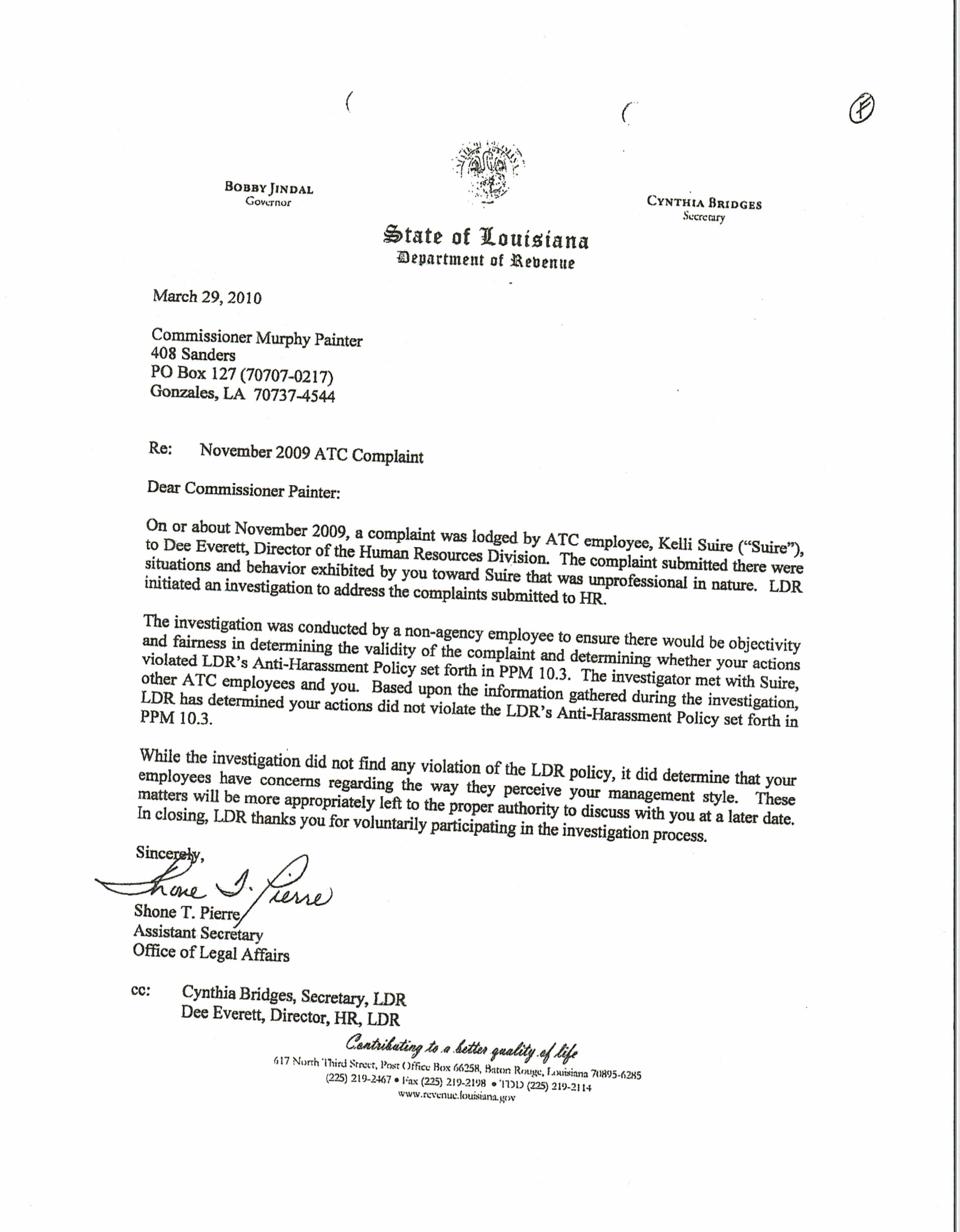
The events leading up to Painter’s firing and subsequent federal indictment began innocently enough with a March 29, 2010, letter to Painter from then-Department of Revenue Secretary Cynthia Bridges. She was writing pursuant to a complaint lodged by ATC employee Kelli Suire who would later the catalyst in Painter’s firing. Bridges, however found no violations by Painter regarding the complaint of “unprofessional” behavior toward Suire, but said concerns about his management style would be left “to the proper authority to discuss with you at a later date.”

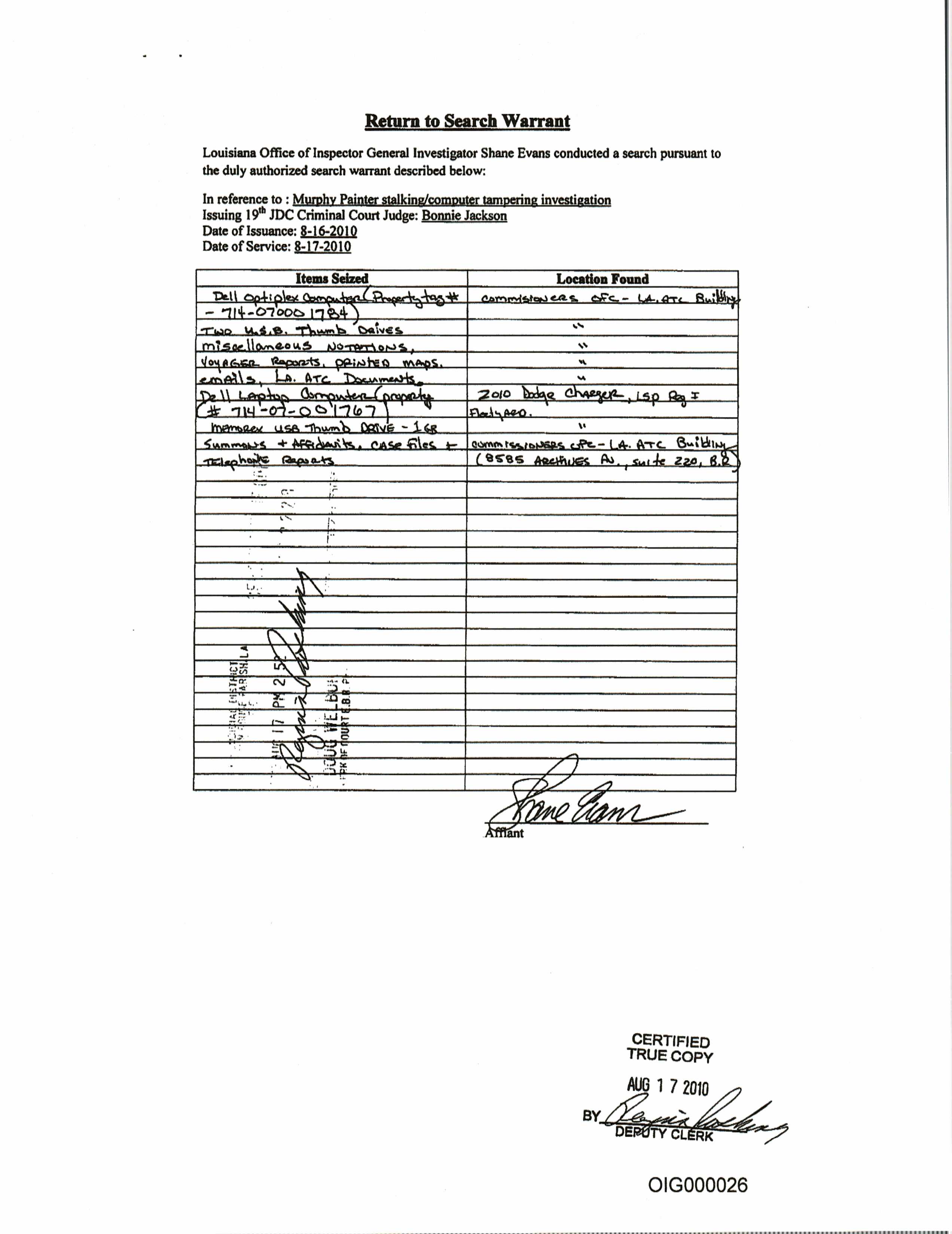
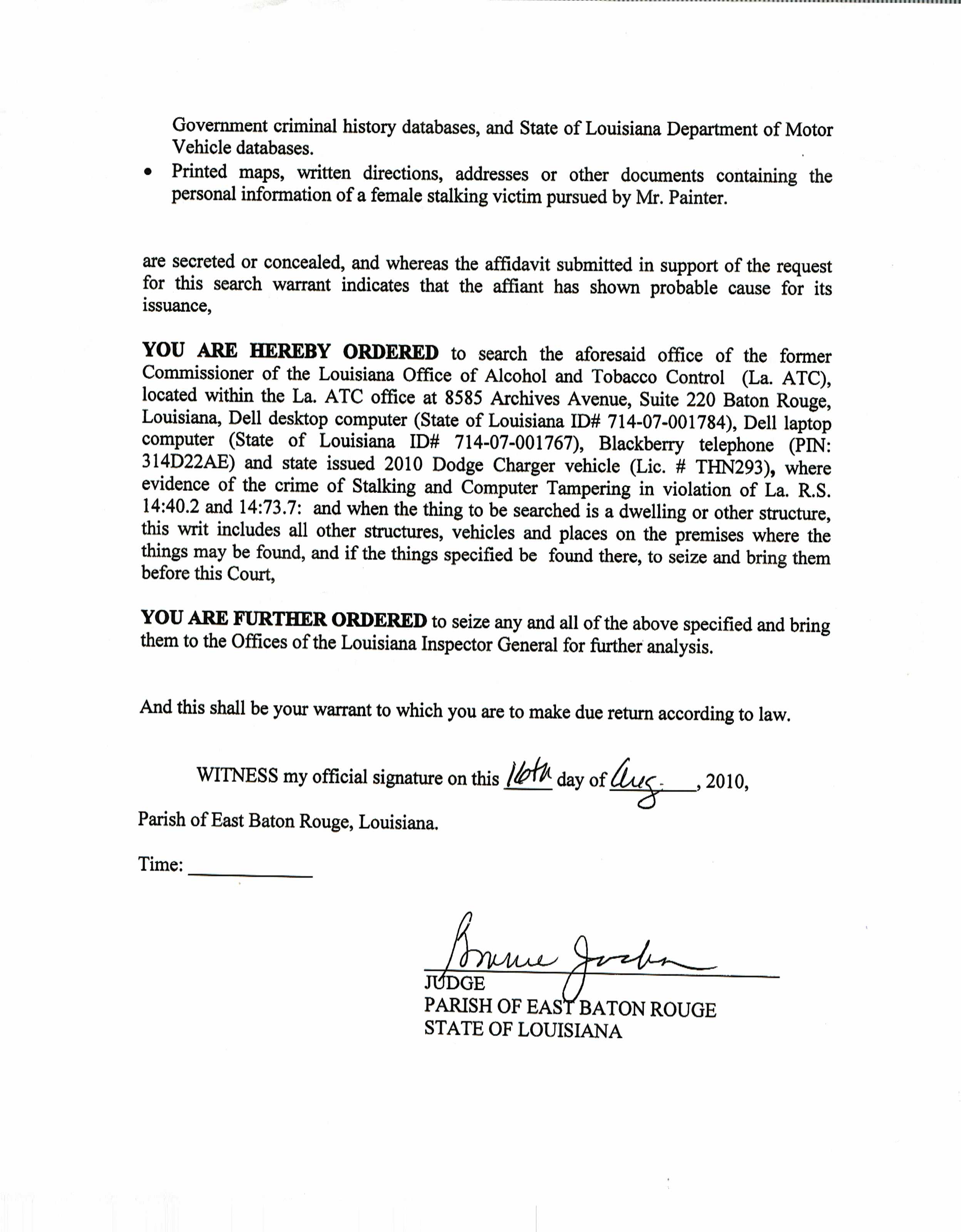
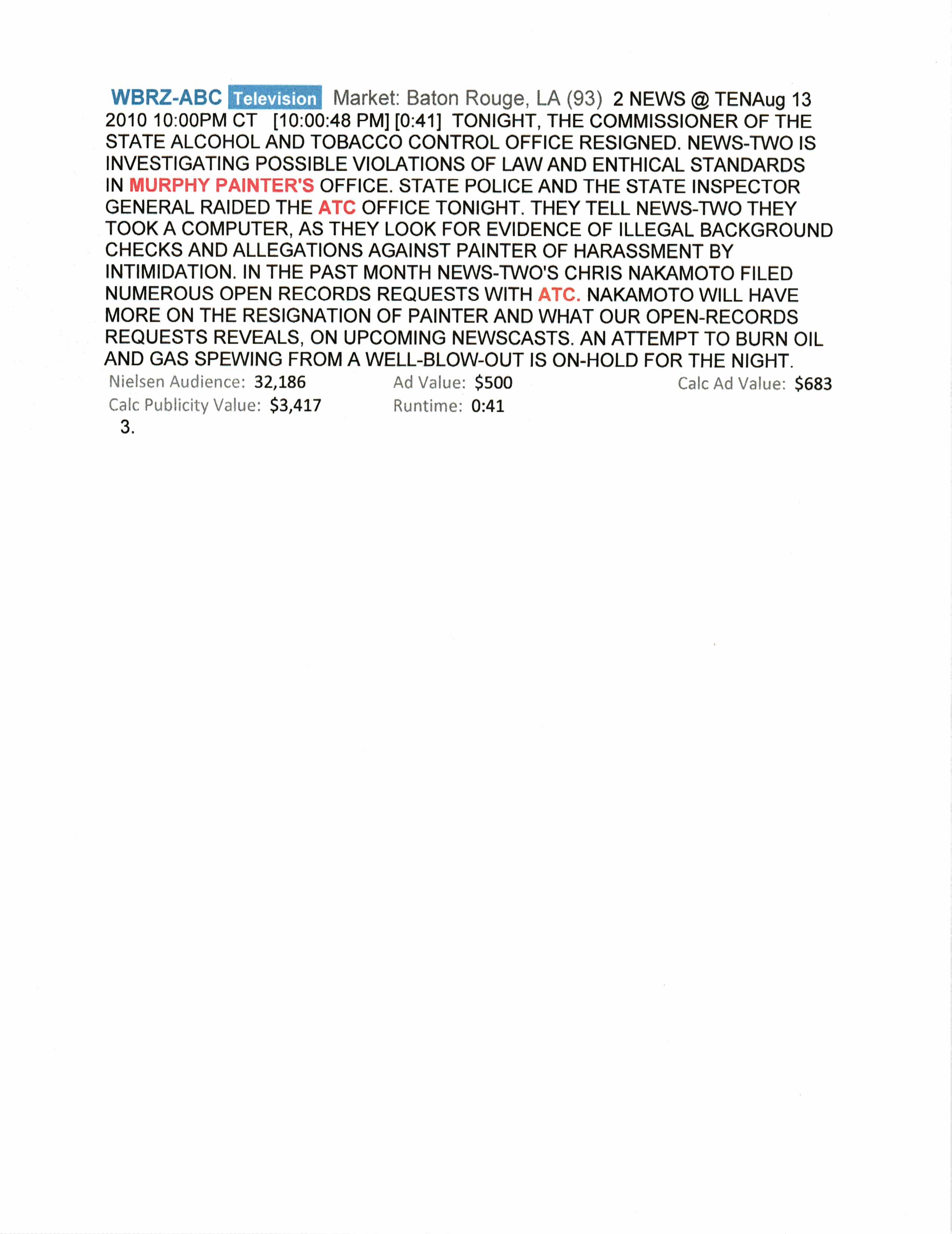
Then on Aug. 13, 2010, more than four months following Bridges’s letter, Baton Rouge television station WBRZ reported that Painter “resigned” and the OIG’s office simultaneously raided ATC offices, seizing Painter’s state desktop and laptop computers, three thumb drives, notes, affidavits, reports, maps, ATC documents, telephone reports, and a 2010 Dodge Charger assigned to Painter.


There was only one problem with the timing.

Bonnie Jackson, 19th Judicial District Judge, did not sign the search warrant authorizing the raid and search of Painter’s office until Monday, Aug. 16.

That would appear to have made the previous Friday’s raid—pulled off three days before a judge had signed the search warrant—illegal and a clear violation of the Fourth Amendment which says, “The right of the people to be secure in their persons, houses, papers, and effects, against unreasonable searches and seizures, shall not be violated, and no warrants shall issue, but upon probable cause, supported by oath or affirmation, and particularly describing the place to be searched, and the persons or things to be seized.” (Emphasis added.)

The second violation, the destruction of evidence was not learned until three years later when Painter’s computer was finally returned and he found that some 4,000 files had been deleted. Much of that, of course, would have been routine state business related to ATC operations but there was other information contained in the files, Painter says, that could have helped exonerate him from the charges that were lodged against him by the Jindal administration. It is not only illegal to destroy evidence, but also to destroy state documents—even if they do not constitute evidence.

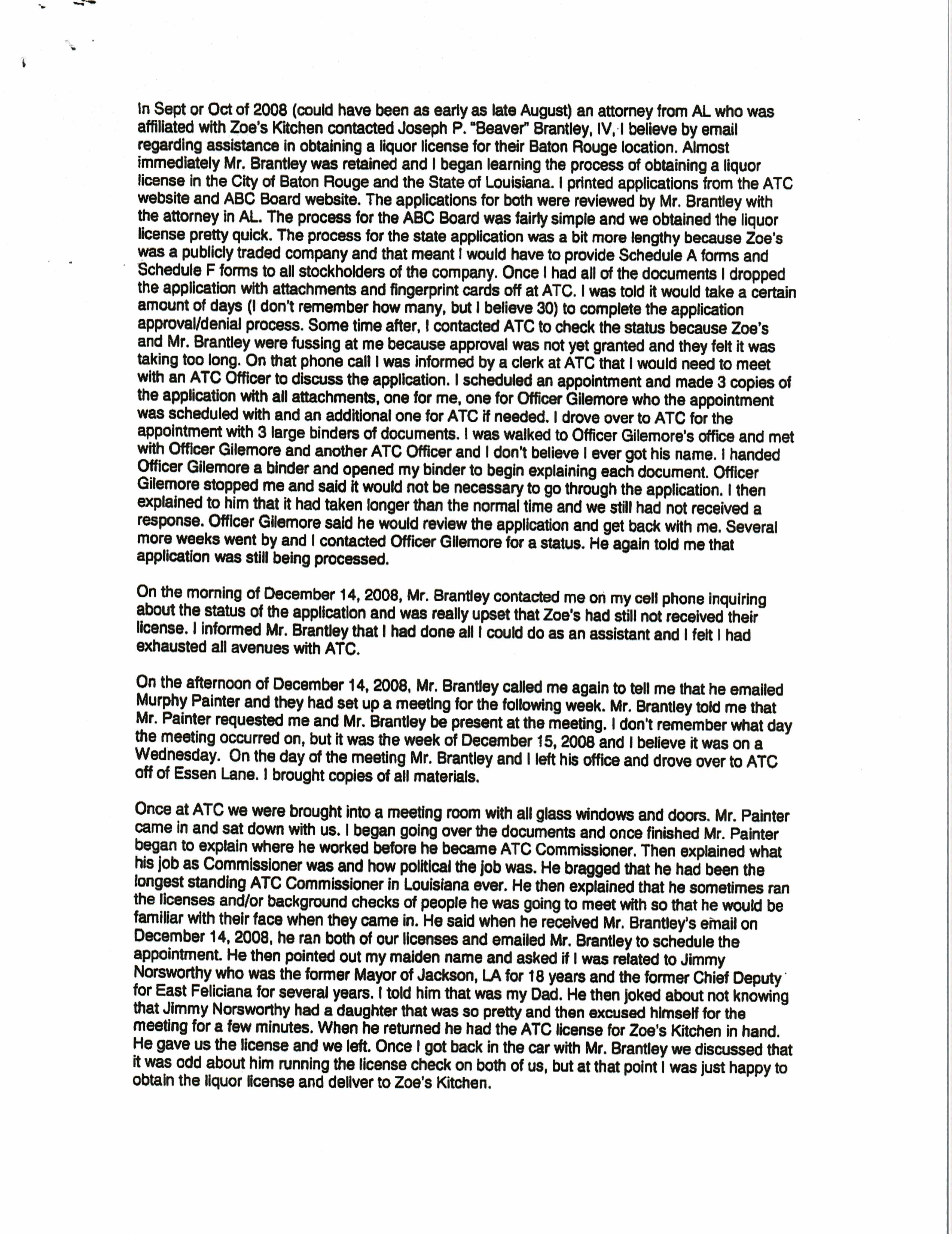
The third violation, this one by OIG, involved the apparent misrepresentation of testimony given in interviews by an attorney and his assistant who had experienced difficulty in obtaining a liquor license on the part of his client, a business with multiple out-of-state owners, a situation which made the licensure procedure more involved.

The attorney, Joseph Brantley, and Painter had exchanged emails whereupon Painter invited Brantley to come to the ATC offices so that the problem could be worked out. “Why don’t you come by here around 3:00 p.m. or 4:00 if that works for you tomorrow and we will go over ours versus yours,” Painter said in his email at 12:26 p.m. on Sunday, Dec. 14, 2008. Brantley responded three minutes later, asking, “Is it OK if I bring the lady that has been doing the primary work (on the file)?”

OIG investigator Shane Evans, who now works for the East Baton Rouge Parish coroner’s office as its chief investigator, then laid the groundwork for the sexual harassment charges to be brought against Murphy when he wrote in a report of his interview with Brantley on Oct. 13, 2010:

“Mr. Brantley advised that Toby Edwards was a former assistant (paralegal) of his, that she is an attractive woman, and that after the meeting in late 2008, Mr. Painter granted the permit immediately.”

In his report of his interview with Edwards, also on Oct. 13, 2010, Evans wrote:

“During the meeting with Mr. Painter, he told Ms. Edwards that he had run her driver’s license and looked at her photograph. He said that was the only reason that he had granted them the meeting. (That is blatantly false: Copies of the Dec. 14, 2008, email exchange between Painter and Brantley obtained by LouisianaVoice clearly show that Painter invited Brantley to a meeting before he ever knew of Edwards’s existence.) She took his statement as the only reason he decided to meet with them is because he thought she was attractive. Ms. Edwards said his statement and demeanor made her very uncomfortable. She said she was very glad Mr. Brantley was present.

“She also said that she found it unusual that the permit had been repeatedly turned down but once she met with Mr. Painter face-to-face, her client immediately received the permit.”

Another report by OIG, the result of a second interview with Edwards on Nov. 5, 2012, described both Brantley and Edwards as “uncomfortable” during the meeting with Painter.

A second interview of Brantley on Nov. 7, 2012 produced yet a fourth OIG report that said, in part, that Edwards wore a “professional,” semi-low-cut shirt. “Mr. Brantley noticed that Mr. Painter noticed and glanced at Ms. Edwards’s chest during the meeting.

“…According to Mr. Brantley, Mr. Painter ‘clearly looked at’ Ms. Edwards’s chest,” the report says. Mr. Brantley even told Ms. Edwards that Mr. Painter was attracted to women, maybe more ‘than the average guy.’ Although Ms. Edwards would have attended the meeting anyway, Mr. Brantley took her to the meeting ‘for effect.’ He thinks that the meeting was more successful than it would have been otherwise if Ms. Edwards had not attended.

Pretty damning stuff, right?

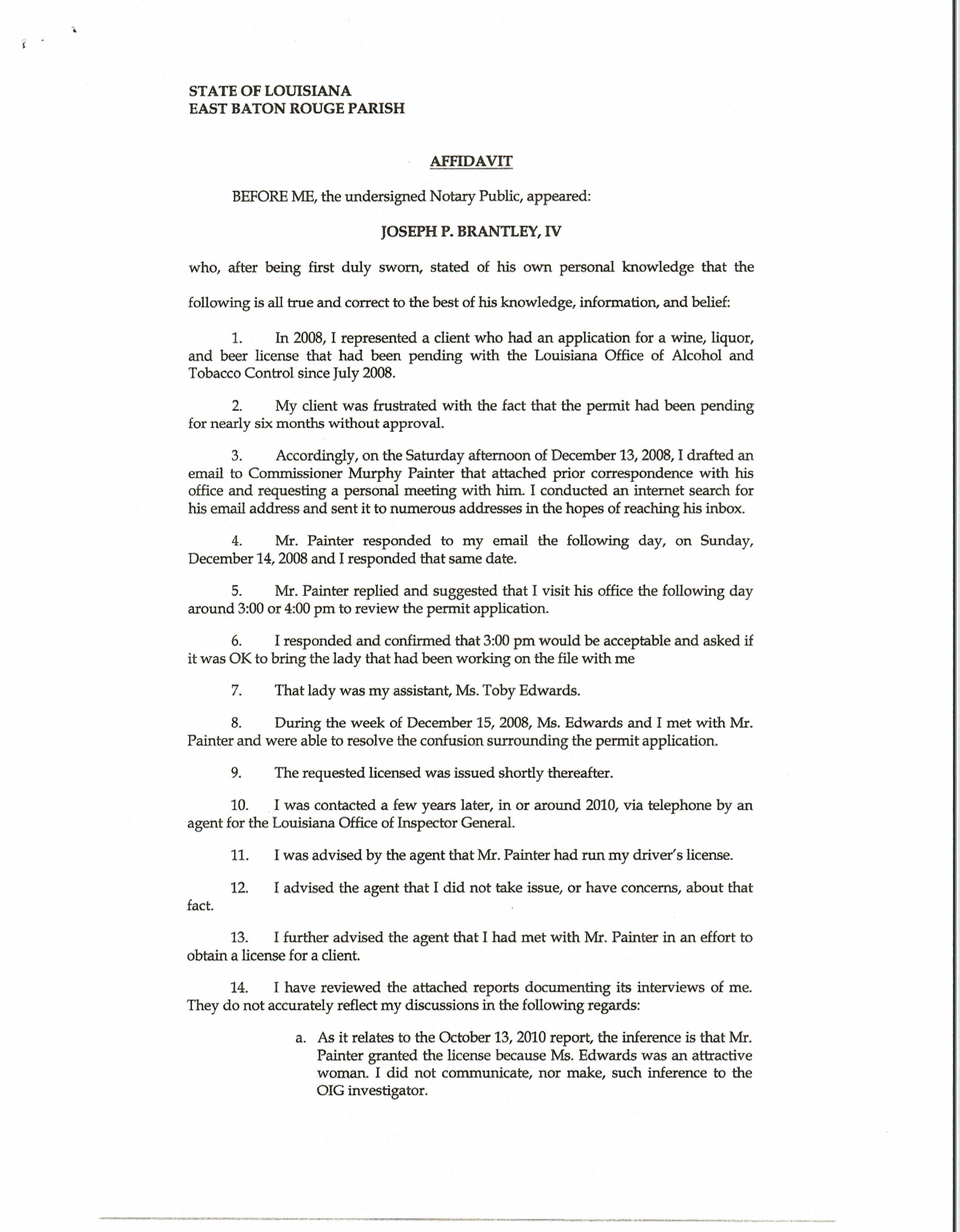
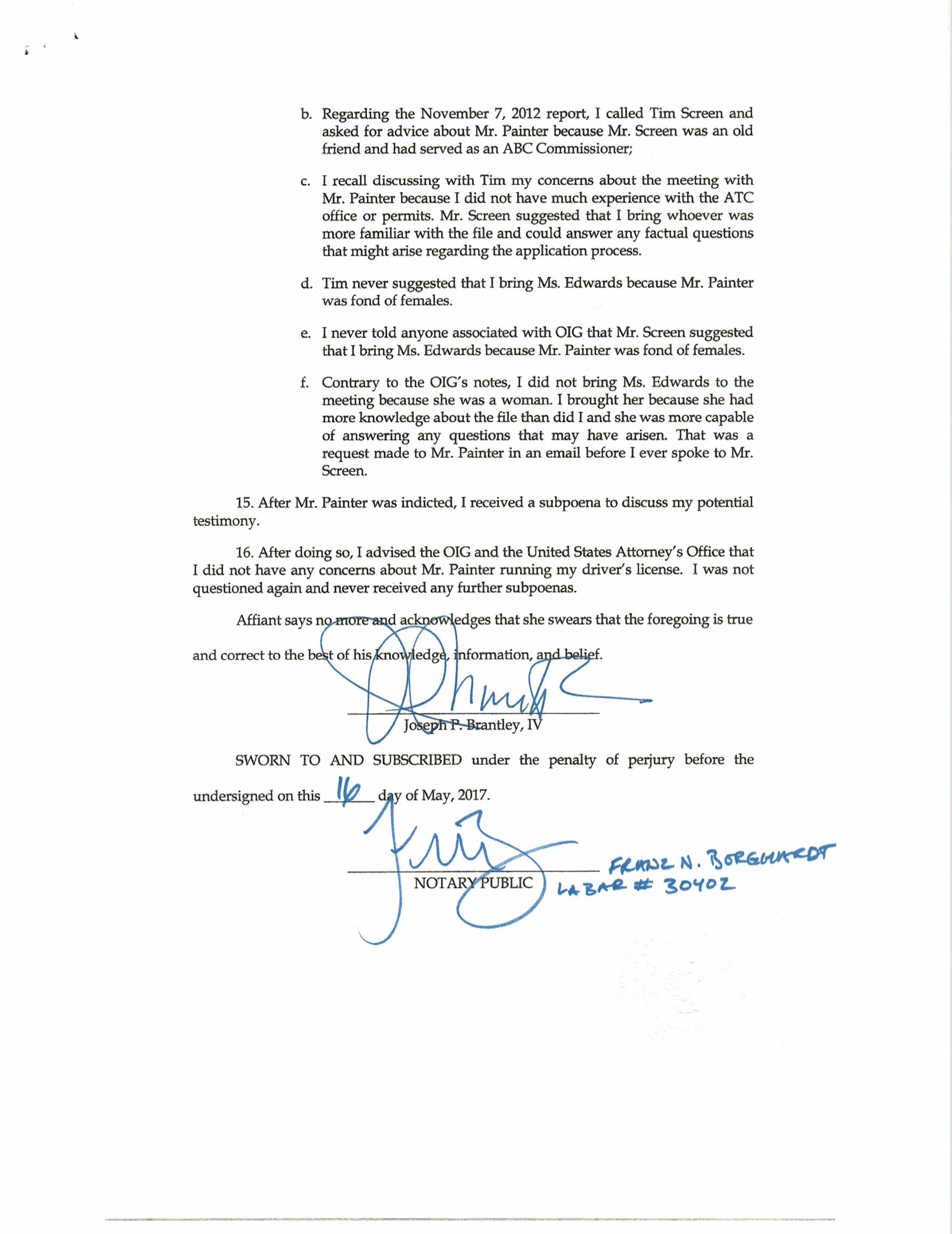
Well, it would be except for affidavits signed and sworn to by Brantley and Edwards (now Pierce), which provide quite a contrasting version of events.

Brantley, after reviewing the OIG reports, flatly denied ever telling Evans or any other OIG investigator that Edwards took part in the meeting with Painter because Painter was fond of females.

“I brought her because she had more knowledge about the file than did I and she was more capable of answering any questions that may have arisen.”

Edwards pointedly noted that the meeting took place in a room “with all glass windows and doors.” She said she also learned at the meeting that Painter was a long-time acquaintance of her father, a former deputy sheriff in East Feliciana Parish and joked to her that he didn’t know her dad “had a daughter that was so pretty.” She said he then excused himself for a few minutes and later returned with a license for Brantley’s client.

Here are both of those affidavits:


So, with a little tweaking of the facts, a man’s career was ruined, his occupation stripped from him and his finances gutted—all because he insisted that a major campaign contributor submit the proper forms before obtaining a liquor license for his Sunday parties outside the New Orleans Superdome.

This is Louisiana at its worst, folks, and it’s a clear example of how the political establishment can crush you if you don’t have the right contacts and sufficient financial resources to match those of the state’s taxpayers.

Read Full Post »

Karma, you gotta love it.

A lawsuit brought by a Houma couple against Terrebonne Parish Sheriff Jerry Larpenter has been settled for an undisclosed amount, according to a story posted online by the Houma DAILY COURIER.

The couple, Houma police officer Wayne Anderson and wife Jennifer, filed the lawsuit in U.S. District Court in New Orleans after Larpenter obtained what was quickly determined an unconstitutional search warrant in order to carry out an equally unconstitutional raid on the couple’s home and to cart off computers and cellphones while investigating ExposeDAT, an anti-corruption website that was critical of Larpenter.

Also named as defendants in the Anderson’s lawsuit were Parish President Gordon Dove, the Terrebonne Parish government, the Terrebonne Levee District and levee board member and local businessman Tony Alford. Alford and the levee district were subsequently dismissed by the Andersons and U.S. District Judge Lance Africk dismissed Dove and the parish as defendants after the parties reached a $50,000 settlement, the newspaper said.

The order signed by Africk dismissed the lawsuit without prejudice, which means the suit can be re-instituted should Larpenter not honor the settlement terms.

Wayne Anderson, whose blog was critical of Larpenter and which prompted the illegal raid, told New Orleans WWL-TV, “I think the sheriff’s finally learned that he can’t bully people and violate people’s constitutional rights. In our case, he stepped on the wrong people’s constitutional rights because we knew our rights. Hopefully, he thinks twice the next time he gets his feelings hurt.”

The paper said that Larpenter filed a request in May to dismiss the lawsuit on the grounds of qualified immunity.

That has to go down as one of the more ironic twists in the entire episode: Larpenter, ignoring the Constitutional guarantee of free speech of citizens as laid out in the First Amendment, took offense at criticism contained in a web blog and raided a person’s home on no more substantial probable cause than that and yet thinking he was protected by qualified immunity.

Judge Africk correctly denied that motion on July 19 and Larpenter, seeing the handwriting on the wall, chose to settle rather than go to trial and most likely subject himself to another judicial lecture on the Constitution.

Terrebonne, this is your sheriff.

Read Full Post »

The 17-year-old girl who was raped twice in a Union Parish jail cell in April 2016 has filed suit in Third Judicial District Court, according to a copy of the lawsuit obtained by LouisianaVoice.

The Third JDC comprises the parishes of Lincoln and Union.

Meanwhile, nearly 17 months after the rapes occurred, Louisiana Attorney General Jeff Landry’s office still has not completed its investigation.

The girl, who was thought to be high on meth, was being held in an isolation cell when Demarcus Shavez Peyton, 28, of Homer, who was awaiting sentencing after being convicted of aggravated rape in a separate case, was allowed to leave his cell and assault the girl twice in her cell.

Named as defendants in her lawsuit are the Union Parish Detention Center, the Union Parish Police Jury (which operates the detention center), the Union Parish Detention Center Commission (made up of Union Parish Sheriff Dusty Gates, District Attorney John Belton and Union Parish municipal chiefs of police).

The lawsuit says another prisoner, Darandall Eugene Boyette was also allowed into her cell with the intent to sexually assault her but “departed before committing any criminal act.”

Because the district attorney is a member of the commission that governs the detention center, Belton rightfully recused his office from any investigation and instead, requested the attorney general’s office to conduct the investigation.

And while Attorney General Landry on Tuesday issued one of his regular press releases in which he “applauded President Donald Trump’s decision to phase out of the Obama-era Deferred Action for Childhood Arrivals (DACA) program,” he still has not wrapped up what should be a routine investigation of a rape that occurred in the limited confines of a jail cell, a case where he knows the identities of the victim, the rapist, and witnesses.

Apparently, Landry is far too busy issuing press releases to worry about the victimization of a 17-year-old girl—or the obvious liability to which the defendants are exposed.

Among the claims asserted by the victim through her Monroe attorney, Jeffrey D. Guerriero, are:

  • Failure to provide a reasonably safe and secure facility for the custody of women, especially minor women;
  • Failure to protect female inmates from male sexual assault;
  • Failure to provide adequate training to employees and personnel;
  • Failure to property monitor, observe and keep proper surveillance of prison inmates;
  • Failure to properly monitor and supervise employees;
  • Failure to provide, implement and enforce proper policy and procedure for the reporting of, handling, investigation and treatment care rendered to female inmates who have been victims of sexual assault while incarcerated;
  • Failure to provide proper services to inmates who have been victims of sexual assault while incarcerated;
  • Failure to properly secure inmate cell doors;
  • Allowing convicted rapist inmates to move within the facility unmonitored and without supervision;
  • Inadequate or negligent supervision of inmates within the facility;
  • Failure to provide adequate staff to supervise and monitor inmates;
  • Failure to provide adequately trained staff and employees to maintain a safe environment for female inmates, particularly minor female inmates.

Meanwhile, Attorney General Jeff Landry on Thursday (Sept. 7) issued a press release saying, “All welfare fraud needs to be found and ended.”

But he can’t seem to complete a simple rape investigation after nearly 17 months.

Read Full Post »

« Newer Posts - Older Posts »